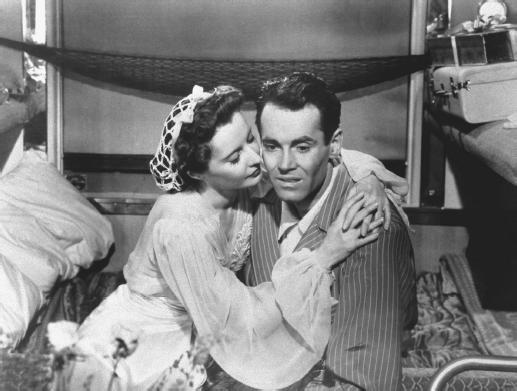
Showing posts with label Henry Fonda. Show all posts

Saturday, June 1, 2024

Meteor (1979)

Saturday is traditionally "Take Out the Trash Day"...

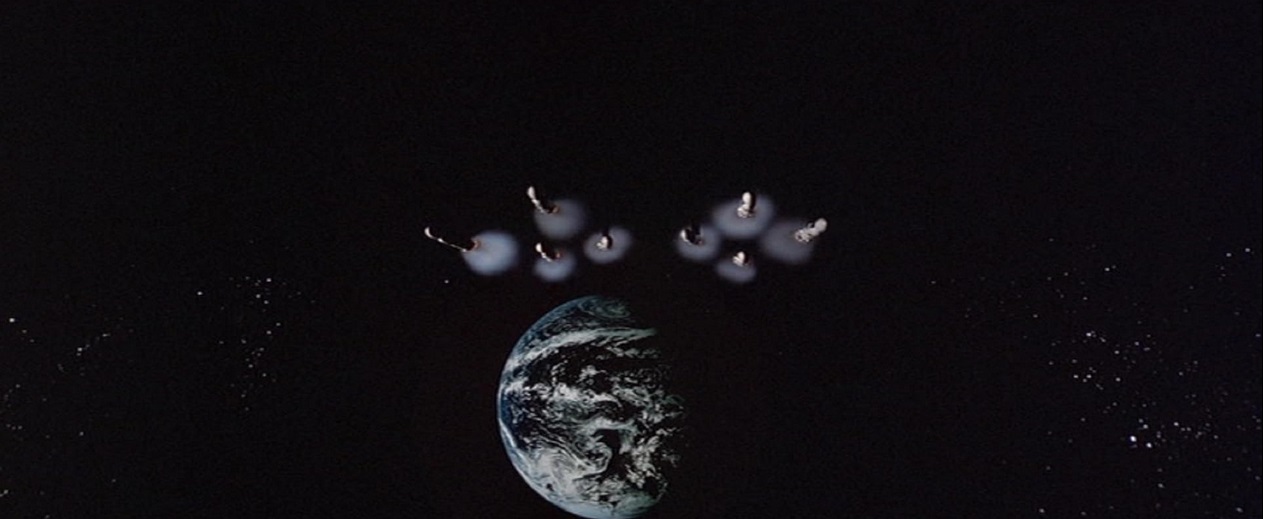
Meteor (Ronald Neame, 1979) A co-production between Shaw Bothers Studios, Warner Brothers, Nippon Herald Films and American International Pictures, featuring a script by Edmund H. North (who wrote The Day the Earth Stood Still and co-wrote Patton) and Stanley Mann (who wrote a couple of Sean Connery's early films) and featuring a cast that probably ate up most of the movie-budget—ConneryNatalie WoodBrian KeithKarl MaldenHenry Fonda, Martin Landau, and Trevor Howard all under the direction of Ronald Neame, who directed The Poseidon Adventure. The story was the most high-profile of topics—an asteroid (called "Orpheus") is headed for Earth and American and Russian scientists must cooperate and use their own orbiting nuclear defense systems to destroy it before it hits Earth and creates a global catastrophe.

What could possibly go wrong?
 
Budgeting. That's what could go wrong.
 
Although a lot of the writing in Meteor is overwrought, the cast does alright with it, and Neame's direction isn't particularly flashy, but manages to keep things moving briskly.
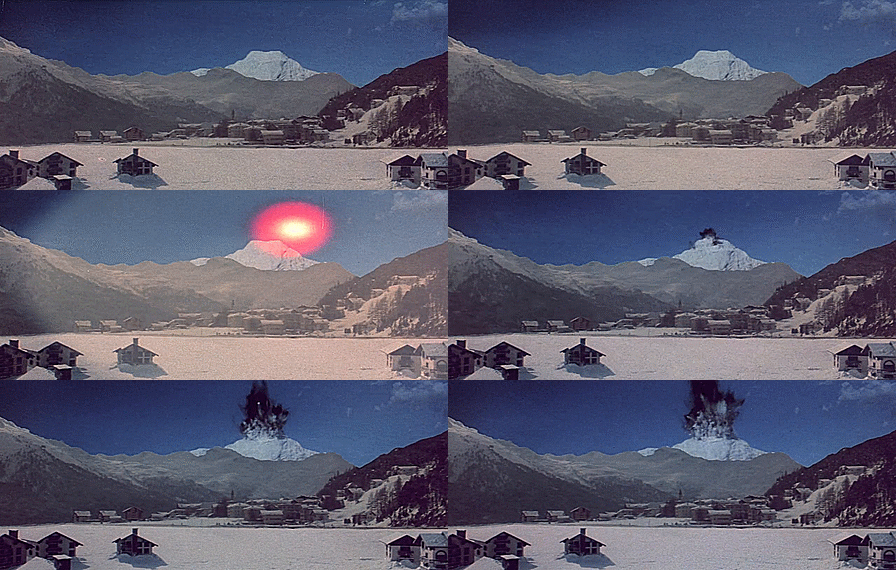
But, by the time all of that was done, the movie's coffers had little room left for post-production and special effects. It didn't help that by the time attention was being paid to the post-production, the group assigned to do the effects of the large threatening asteroid and the missiles designed to destroy it was summarily fired for the work for being below expectations.*
Now, there's a lot of grousing these days that "special effects don't make good movies." Goodness knows there have been a lot of movies where the special effects were sub-par, even in the 1970's (Logan's Run, for instance), even after the water-shed moment of the Star Wars premiere. And one has merely to look at the output of AIP's
post-Star Wars coat-tails films to see that their effects work was "made-in-the-garage" quality.
So, one is left with a Frankenstein-monster of a movie: An able cast with a somewhat shaky script (with some truly cringe-inducing dialogue), spliced with sub-par special effects sequences that—despite the many limitations—seem to go on forever, with no real editing scheme to create tension, but plopped into the film to fill the time with the shakiest of continuities.
There's no finesse to it at all—how could there be when the film was being pieced together so close to the premiere? One can only console oneself with a sequence where the all-star cast gets drenched in mud while trying to escape their command headquarters through the New York City subway system. The images call to mind so many derogatory descriptions for the movie. "Disaster" being the kindest one.
Hollywood wasn't quite done with the concept yet: 1998 saw the release of not one, but two "asteroid-threatening-the-Earth" movies: Armaggedon and Deep Impact

Apparently, there's a lot of "rockery" in neighborhood-space. And nothing new under the sun.

* Actually, two groups of special effects studios were let go, sucking up a lot of the "post" budget and pushing the time-line for the eventual team—they had a mere two months to complete the work before the premiere!

There was another major up-ending of expectations in the post-production: John Williams was given the job of writing the score for Meteor, but the production delays and the revolving door of special effects artists prevented any sort of semblance of "picture lock" for him to compose music for it before he had to go off and work on Steven Spielberg's 1941. Laurence Rosenthal was then hired to compose the score, which ended up being rather good—amazing, given his time-constraints.

Thursday, March 28, 2024

The History of John Ford: My Darling Clementine

When Orson Welles was asked what movies he studied before embarking on directing Citizen Kane he replied, "I studied the Old Masters, by which I mean John Ford, John Ford, and John Ford." 

Running parallel with our series about Akira Kurosawa ("Walking Kurosawa's Road"), we're running a series of pieces about the closest thing America has to Kurosawa in artistry—director John Ford. Ford rarely made films set in the present day, but (usually) made them about the past...and about America's past, specifically (when he wasn't fulfilling a passion for his Irish roots). 

In "The History of John Ford" we'll be gazing fondly at the work of this American Master, who started in the Silent Era, learning his craft, refining his director's eye, and continuing to work deep into the 1960's (and his 70's) to produce the greatest body of work of any American "picture-maker," America's storied film-maker, the irascible, painterly, domineering, sentimental puzzle that was John Ford, John Ford, and John Ford.
 
My Darling Clementine (John FordLloyd Bacon, 1946) Stuart Lake's 1931 biography of Wyatt Earp, "Wyatt Earp: Frontier Marshal," had already inspired two previous Earp moviesone in 1934 and one in 1939, both titled Frontier Marshaland in 1946, he published another book "My Darling Clementine." John Ford took an interest in the latter and bought the film rights, using it to make the last film he owed on his contract with 20th Century Fox.

Ford had revolutionized the Western genre with his 1939 film of Stagecoach and My Darling Clementine was his return to making horse operas since that film. Ford also wanted to make the film as he had conversed with the real Wyatt Earp during his silent-movie days, and he wanted to make an accurate depiction of the frontier town of Tombstone and of the climactic Gunfight at the O.K. Corral, a 30 second skirmish in the city's streets that author Lake had mythologized in "Frontier Marshal".
There are those who say this is Ford's best Western, though, as great as it is, I find it slightly problematic. Great, but there are little details that paw at the dirt. For the first point, it is wildly inaccurate about events during Earp's tenure in the law while he was in Tombstone. He was never sheriff as the film depicts—that was his brother Virgil (played in the film by 
Tim Holt)—the Earps weren't cowboys but gamblers and pimps...and opportunists. Old Man Clanton (played by Walter Brennan at his most repellent) who, in the film, is the instigator of the bad blood between the Earps and the Clanton and whose killing of Virgil leads to the famous "gunfight"—which also *cough* took place in 1881, not 1882—died before any of this took place. Doc Holliday was a dentist, not a surgeon, and there was never any "Clementine." One isn't even sure of the details of that gunfight, even though Ford says he staged it as Earp described it to him when the two found themselves on the same silent film-shoot. But, who lived and who died in real life is nothing like presented in the film.
Earp was well-known for "polishing his badge" in interviews—and Blake Edwards, in his 1988 film Sunset has Earp say "that's just how it happened...except for a lie or two." Certainly, Lake's biographies are rife with inaccuracies, due to writerly creativity, Earp's sketchy relationship to Truth and the efforts of Earp's widow, Josephine, to white-wash history in her husband's favor.

But, then we're also talking about John Ford, who, in two years, would make Fort Apache where John Wayne's Cavalry Captain Kirby York would lie to the press about the actions of his fallen superior Lt. Col. Owen Thursday (Fonda again) "for the sake of the Corps" and who would articulate the sentiment in 1962's The Man Who Shot Liberty Valance when a member of the press says "This is the West, sir. When the legend becomes fact, print the legend." Ford mythologized the West in his movies, even if, in later films, he would puncture those myths for a more nuanced perspective on "Manifest Destiny."
There's a story of Ford being confronted by a historian of the Old West about all those fictions in Clementine and Ford replied "Well...did you like the picture?" to which the guy said he did very much. To which Ford hammered back "What more do you want?"
 
Good argument, that. Really.
But, the other issue I have is that director's credit. What we have now as My Darling Clementine isn't exactly the film Ford made. 20th Century studio head Darryl Zanuck thought it was okay, but wanted to make changes to it—and employed studio employee Lloyd Bacon to shoot other scenes, while Zanuck trimmed some 17 minutes out of the film. Those non-Ford scenes include 
Henry Fonda's Wyatt Earp talking over the grave-site of his brother James (Don Garner), killed in an ambush by the Clantons. The other big change? The ending, where Earp bids farewell to Clementine. In Ford's version they shake hands. But, preview audiences felt...unfulfilled. So, Zanuck had Bacon shoot a new close-up of a farewell kiss. Afterwards, when Zanuck offered Ford another contract to do more movies at Fox, the director turned it down to make films, without Zanuck's interference, through his own studio, Argosy Pictures. 
So, what do we have in My Darling Clementine, that odd mixture of fiction and legend? History as we'd like it to be. Simplistic delineations between good and evil out on the edge of civilization. And where young Wyatt Earp has revenge on his mind—that part's certainly historically accurate—for the harm done to his family, it's a case of Good versus Bad (certainly less complicated than the testimonies given at the Earp's real-life trial after the incident) with Good triumphing and even getting the girl. Maybe it was Zanuck's treatment of it talking, but Ford dismissed it as "essentially a film for children."
Ford was toiling in the fields of Myth, not History. He was telling a far bigger story than the one leading to the rumble at the O.K. Corral; Ford was examining the story of the dawning of a frontier civilization. When the town of Tombstone is first introduced by old man Clanton he describes it as "wide-open". That's an understatement; it's not even a town, just a single row of "growing concerns"—a hotel, a boarding house, a saloon, a brothel, a store, "that" corral...and a barbershop. There isn't even a defining thing as a street—the doors of buildings face open landscape, interrupted by transitory covered wagons. It's rough and in its genesis.
It's certainly no place to raise a family, the only examples of which are the Earps and the Clantons, polar opposites—one defining anarchy and the other abiding by the rules, such as they are. The Earps come to Tombstone for a respite from the trail, leaving young brother James to look after their herd, only having that moment of relief lead to the young man's death, presumably ambushed by the Clantons. The Earps settle in town—after Wyatt resolutely handles a disturbance—ultimately to settle scores.
Their positions as law-men will be a challenge to the Clantons, but also to Tombstone's most prominent citizen, "Doc" Holliday (
Victor Mature), once a surgeon, now a drinker, gambler, and gun-fighter. He has come to—appropriately—Tombstone to die, running from his past life to the drier desert, hoping it will help his tuberculosis. He has come to town a dead man walking, and he's lost hope...in his health, himself, and in everything. His existential crisis is first irritated by the presence of the Earps—he can't exactly throw his callousness around anymore—but it comes to a respectful kindredship. He begins—against a thousand reasons not to—to hope.
Part of this transformation is due to his friendship with Wyatt, who is centered, contained, confident, and unflappable. Henry Fonda's interpretation of Wyatt is not given to overzealousness or going off half-cocked. He's steady...even in a crisis...in stark contrast to the Clantons who know no bounds or ethics. The man who no longer believes in anything, starts to find purpose. And the rough-hewn Earp begins to gradually become more dapper, in no small part due to the presence in town of Holliday's former flame and assistant, Clementine Carter (
Cathy Downs), who has come there to try to bring Holliday back to his old life.
The balance of Tombstone shifts from merely trying to persevere against adversity to appearing to thrive, to build, and—once the Clantons are taken care of—why, they even presume to hire a schoolteacher. How's that for putting down roots and hoping for the future? 
You boil down those "legends of Wyatt Earp" (forget all those troublesome details)—and you get the story of the building of community, which is far less exciting than the turf-battles and gun-fights of less-considered examples of the Western, but the more protracted, difficult story of mending fences.

That's the story of My Darling Clementine. Not "the taming of the West" but the taming of our worst instincts.

Wednesday, March 15, 2023

Directed By John Ford

One of the delightful things about Steven Spielberg's film The Fabelmans is the late inclusion of maverick director David Lynch portraying maverick director John Ford in the recreation of the young Spielberg's meeting with him. Lynch "got" it exactly right—the irascibility, the bluntness, the crotchedly pugnaciousnes,...and the simplicity of the lesson being taught. He tells Spielberg something he knows, but not everything he knows. Just a tid-bit, that has served Spielberg well ever since (his film War Horse is a shining example of the lesson that Ford taught him that day). 

That's just a preamble for this expanded documentary that Peter Bogdanovich revised years after his death—the original was made in 1971 while Ford was still alive. One of these days (how often I say that!) I'll get back on track with the "History of John Ford" series I was doing. It's not complete yet, but the many John Ford entries I've run across while compiling an Index for this site tells me there's still a lot of work to do. 
 
For one thing, I can't believe I've never brought this over from my old movie blog. But, here it is:
 
Directed by John Ford (Peter Bogdanovich, 1971, 2006) Bogdanovich's essential primer is a "viewer's digest" of some big things that that made John Ford such a powerful director not only in individual films, but also across a career of experience. Generous clips from throughout his life's work illustrate points, punctuated by talking head clips from the '71 version including Ford himself (who is not very helpful, to say the least—by saying the least*—and is deliberately dismissive of doing the whole "critical analysis" thing, much like a comedian hates to explain a joke, or a magician a trick), as well as actors he worked with like John Wayne, Henry Fonda, and James Stewart
 
The 2006 update folds in Harry Carey, Jr., Maureen O'Hara, and analysis from Clint Eastwood, Martin Scorsese, Walter Hill, and Steven Spielberg, as well as Bogdanovich (you couldn't keep him out of one of his own documentaries, even if it's about another subject).
The update has everything from the original re-jiggered to add more points, but there's more of a "legacy" feel to the thing, now, as the casts of regulars Ford depended on have dwindled—Ford was still alive during the first version—and so the next generation who grew up and learned their craft sitting in the theater watching Ford's images talk about "what John Ford means to me." Also, as the man is gone now, there's a bit more psychological analysis and more delving into the man's irascible personality, already on full display in his interview.
But there is one troubling aspect to this "new" version, something that stuck in my craw when I saw it (and no doubt would result in Ford caning Bogdanovich if he got wind of it). There is a brief (very brief) examination of Mary of Scotland, Ford's only film directing Katherine Hepburn, and the subject of much speculation over what their relationship was. A sound clip is played of Hepburn's visit to Ford days before his death. The tape was allowed to run continuously, and their parting words to each other are played, words that they had no way of knowing were being recorded, and words that might not have been said if known they'd been overheard (Ford specifically asks her "Are they gone?"). It's nothing scandalous or huge. Ford merely says "I love you," and Hepburn says "it's mutual." But it feels like a violation of the departed by the parties that recorded it and who have re-presented it. And far too much is made of it (Really?  It was the inspiration for the names of O'Hara's and Wayne's characters in The Quiet Man?) in a gossipy, speculative fashion.
These were, after all, words from two people who must have known they'd never see each other again, and it's nice and it's lovely. But it's beneath the film, beneath Bogdanovich, and undercuts whatever scholarly impact the film might otherwise enjoy to make anything more of than the sweet parting gesture it is. The worst part is...there's no one to rebut, no one to protest, no one to defend...or even better yet, to correct the speculation. Even Ford's maxim of "When the legend becomes fact, print the legend" doesn't cover this
.
That aside (and it's my quibble, really), it's an invaluable first toe-dip into the films of Ford, and enriches the experience and appreciation of every film of his seen afterwards. One thing Bogdanovich did right (besides getting Turner Classic Movies to bank-roll it, so more people would see it, as the various clips from many studio sources would be very expensive) is he kept the original's essential narration by Orson Welles, Ford fan and student. The voices and faces and memories out of the past have as much weight and bearing as the films do, reverberating throughout history and time, feeling immortal and universal.
*


Friday, March 18, 2022

The Male Animal

The Male Animal (Elliott Nugent, 1942) The draw for this one wasn't the director or the stars (although I'm a big fan of Henry Fonda and Jack Carson). 
 
It's the author, James Thurber. Probably a name past it's sell-date in many people's minds, but his legacy in the zeitgeist has burrs that stick. The phrase "My World and Welcome To it"—which was the title of a book he authored and a TV series inspired by him—is attached to Thurber. He was also the author of "The Secret Life of Walter Mitty" and it was adapted for the movies, first (in 1947) starring Danny Kaye and (just a few years ago) one directed and starring Ben Stiller

The man was, obviously, a writer, and quite well-known in his time. He was also a cartoonist—appearing in The New Yorker—a playwright, and (as the phrase goes) "a celebrated wit." He was a good enough writer that he probably never used the phrase "a celebrated wit" in regards to himself or anyone else. Thurber wrote the original play with this film's director, Elliott Nugent, and it was adapted for the screen by Stephen Morehouse Avery and the celebrated Casablanca team of twin-brothers Julius J. and Philip G. Epstein.
It takes place in modern times at Midwestern University, where football is the driving force for the college-town rather than higher education. And the weekend of Homecoming with its anticipated game against Minnesota and the return of All-American Joe Ferguson (Carson) for the first time in six years, the streets are filled with flivvers and bobby-soxers and impromptu rallies through the streets. Everyone is in a fervor and rah-rah-ing on a testosterone high (and little thinking to anything else).
So, it's a bad time for there to be any little contretemps on campus, with the boosters and city officials schmoozing around and their blood pressure already on the boil. Even if something is a little subtle in its nuance, it will turn into a cut-and-dried cage-match in arguable hues of black-and-white. It wouldn't seem to be a bad time for English professor Tommy Turner (Fonda) to announce his planned readings for the Monday after the game with the theme of "English prose by non-English speakers). Dull stuff...not unlike Turner, himself. Except Turner has a sister-in-law (
Joan Leslie). Sister-in-law has a boyfriend (Herbert Anderson), who's the editor of the campus newspaper and in Turner's class. Said boyfriend writes an editorial in said newspaper praising the professor for including anarchist Bartolomeo Vanzetti in that list of non-English speakers.
What's the American word for "contretemps?" Taken in context, it must be when you object to something without having read it, or seen it, but you'd "heard something about it." Sure glad something like that wouldn't happen today (he said sarcastically).
By the way, the passage that is being objected to is this:
If it had not been for these things, I might have lived out my life talking at street corners to scorning men. I might have died, unmarked, unknown, a failure. Now we are not a failure. Never in our full life can we hope to do such work for tolerance, for justice, for man's understanding of man, as now we do by accident. Our words - our lives - our pains - nothing! The taking of our lives - lives of a good shoemaker and a poor fish peddler - all! That last moment belongs to us - that agony is our triumph.

Thursday, September 23, 2021

The Fugitive (1947)

 The Fugitive (John Ford, 1947) Not the 1993 Harrison Ford movie based on the classic TV series (for that, go here) This John Ford-directed film is based on Graham Greene's "The Power and the Glory," adapted by Dudley Nichols (although when Ford got to Mexico to film, he basically threw out the script, and let his images do most of the talking) and starring Ford cast-stalwarts as Henry Fonda, Ward Bond, John Qualen, Jack Pennick, and Pedro Armendariz, and with a crew made of indigenous film-craftsmen. It took Ford out of his comfort zone, but also inspired him—finding what he had with cameraman Gabriel Figueroa—to make a film of shadows in a sun-blasted environment, more in line with the kind of film Ford was making when he was trying to make a statement.

One of the pervasive criticism's of Ford's body of work is its occasional moments of sentimentality, and for a tone inconsistency that interrupted drama for comedy (or "hi-jinks"). The Fugitive is one of those instances where Ford's tone is relentlessly consistent and low comedy is completely shorn from the narrative, and everything is played in deadly earnest. And, because their is no consistency in the world, especially the world of criticism, this one is often criticized for its consistent tone of religious fervor. You can't please everybody, no matter how hard you pray.
You know when someone is making an "art film" when they get a little hazy on the details, not wanting to nail down time and place, but planting it in some metaphorical zone that won't get anyone's back up, and The Fugitive begins with this narration:
"The following photoplay is timeless. The story is a true story. It's also a very old story that was first told in the Bible. It is timeless and topical, and is still being played in many parts of the world. This picture was entirely made in our neighboring Republic, Mexico, at the kind invitation of the Mexican government and of the Mexican motion picture industry. It's locale is fictional. It is merely a small state a thousand miles north or south of the Equator - who knows."
The film follows an unnamed Catholic priest (Fonda), who is trying to avoid arrest and execution in a Mexican State run by a tyrannical despot who has told his police to eradicate all religious practices in the state. Being the last priest left alive and dressed in peasant clothes and without the trappings of a priest, he is on the run, but is consistently called upon to practice his faith among the people surreptitiously. Discovered hiding in an abandoned church by a village woman (Dolores Del Rio), he makes a promise to baptize her illegitimate child and all the children who have not been baptized.
The Lieutenant of Police for the State (Armendariz)—who just so happens to be the father of that illegitimate child—lets it be known that he will take a hostage from every village to execute until the last remaining priest turns himself in. At the same time, a bank robber (Bond) has arrived in town but is able to avoid capture, due to attention being diverted to the priest. The two men run parallel paths to avoid being captured, but their fates become joined as the search intensifies.
The film differs quite a bit from Greene's book—the priest was originally the father of the child, but that wouldn't have passed the Hays Office—and Ford, once he got to Mexico, diverged so much from Nichols' script that the two—who had been a team for 30 years—decided to never work together again. To be fair to Nichols, there are a couple places where Fonda's priest could have easily been captured by the Lieutenant, but for the fact that he doesn't recognize him as the man in the wanted posters plastered around town. It seems a little far-fetched, considering that Fonda tends to stand out from the other peasants.
However one views the script or what Ford did with it, one aspect of The Fugitive makes it essential viewing—the miracles of cinematography that Ford pulled off with Figueroa. Evocative of Ford's work in The Grapes of Wrath, The Informer, and The Long Voyage Home, the images contain some of the blackest blacks in cinema history contrasting with the bleached exteriors of the Mexican landscapes. Ford's painterly eye was never so evident as here* as he photographically shows a Dark Age being pierced by enlightenment.

* And here's another couple images...

Wednesday, August 11, 2021

The Lady Eve

The Lady Eve
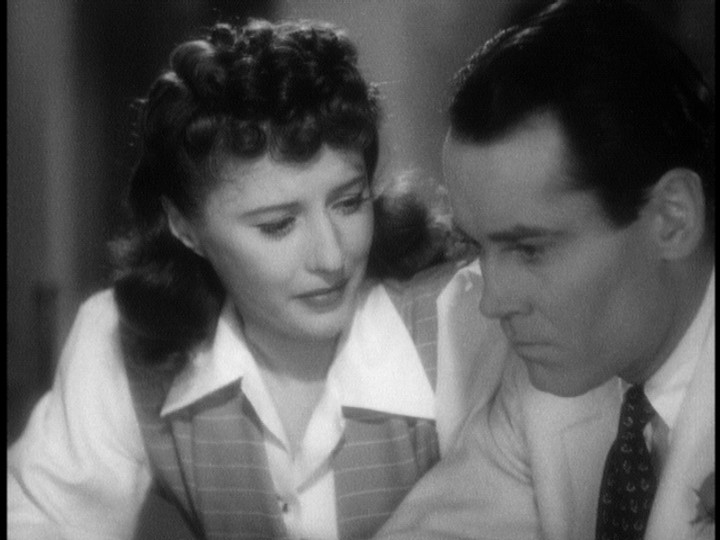
(Preston Sturges, 1941) Ale heir Charles "Hopsey" Pike (Henry Fonda) has been up the Amazon for a year as an ophiologist (emphasis on the "oaf."). The trip must have been made without a paddle because he can't tell two snakey grifters (Charles Coburn, Barbara Stanwyck playing a father-daughter con artist team—the family that preys together...) are trying to collect him...and his dough...on the cruise back to the States. She's already beaned him with an apple as he was boarding ship—it's not exactly Cupid's Arrow, but it'll do, in theory. After he gets hit, well, he's not a lot wiser.
 
Sturges' third film (and first big hit) is a distillation of every screwball romance that had come down the pike previously. As with the best screwball comedies, the woman has all the power and nobody could play power better or with more cruel humor than the ungainly Barbara Stanwyck, here as fast as quicksilver and, frankly, a bit tough to keep up with—you want to watch it twice just to see all of her nuances you missed. Her opponent...object of affliction...affection...is a combination of every man-handled man-type that you can have in these comedies. "Hopsey" Pike is well-off, a specialist in his field but a tenderfoot out of it—he can spot snakes in the jungle but not in the grass—somewhat sheltered and clumsy, and saves money on casting Ralph Bellamy by playing his own stuffed shirt. And being on a boat ensures that the ground is never too sure under his feet, the better for the sweeping off of. And the best guy to "take" in a "confidence" game is somebody who doesn't have any.
 
Confidence, that is. 
Henry Fonda
didn't play many rubes, as there was always something steely under his baby-blues; you couldn't hide his intelligence and Sturges doesn't try, making Hopsey book-smart, but virginally inexperienced and shy. One would say clumsy, given the right circumstances, which is where Stanwyck's Eugenia comes in, with her foot in the aisle to trip him up, literally. Pretty soon, that becomes Sturges' short-hand for letting you know that "Hopsey" is falling for Eugenia, a 40's comedy substitute for attraction being physically evident
But the best un-laid plans... Pretty soon, Eugenia is falling for Hopsey, as evidenced by her getting hot and bothered by his chosen field of study. "Slimey snake!" she yells as she wakes up from a nightmare.
Preston Sturges was always one for tweaking the censors, and with The Lady Eve, he's more than suggesting by associations of culture and psychology what's going on here in a knowing way—the biblical way of knowing, complete with snakes and apples and falls from innocence.
Things get complicated as
Eugenia must thwart her father's plans for fleecing the golden boy—she does actually care about him, but when Pike finds out what the two are up to, he breaks off with her, leaving her in a huff. If she was honest with him, he'd probably have done the same thing, so with that moral quandary and his making her feel cheap and all, she plots her revenge, with one of the best lines of spite to come out of Hollywood: "I need him like an axe needs a turkey!" Appropriate vindication mixed with a vindictiveness chaser ensues.
Well worth the time and effort to seek out,
The Lady Eve is a shining example of how sophisticated and down-and-dirty Hollywood comedy could get. And Stanwyck, one of the wiliest of actors, positively glows on-screen. In 1994, The Lady Eve became part of The National Film Registry as being "culturally, historically or aesthetically significant."
 
They don't mention that it's funny as the devil, too.

Friday, June 11, 2021

Anytime Movies #3: Once Upon a Time in the West

While I catch up on the reviews still in "Draft" phase here, I'll re-run a feature I ran when I first started this blog seven years ago,* when it was suggested I do a "Top Ten" List.

I don't like those: they're rather arbitrary; they pit films against each other, and there's always one or two that should be on the list that aren't because something better shoved it down the trash-bin.

So, I came up with this: "Anytime" Movies.


Anytime Movies are the movies I can watch anytime, anywhere. If I see a second of it, I can identify it. If it shows up on television, my attention is focused on it until the conclusion. Sometimes it’s the direction, sometimes it’s the writing, sometimes it’s the acting, sometimes it’s just the idea behind it, but these are the movies I can watch again and again (and again!) and never tire of them. There are ten (kinda). They're not in any particular order, but the #1 movie IS the #1 movie.


Landscapes.

That’s what’s featured in
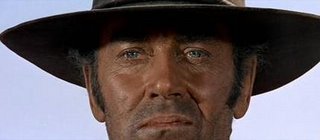
Sergio Leone’s Once Upon a Time in the West. Whether it’s the vast, aboriginal spaces of Monument Valley—an affectionate genuflection to the films of John Ford—or the intricately chiseled planes of the faces of Charles Bronson and Henry Fonda—you spend a lot of time looking at both in Once….—as well as deep close-ups of the faces of Jason Robards and Claudia Cardinale. There is one shot where Bronson ever so slowly relaxes a smile out of existence. Bronson does it so subtly you don’t know what’s happening until it’s happened. It’s one of the things I look forward to in the Dance of Death of Once Upon a Time in the West. Here are some others:


1. “Looks Like We’re Shy One Horse…” The first twelve minutes. A dilapidated train station in the middle of nowhere. Three long-coated bad-men wait for a train. They while away the time, each in their own unique fashion. Driven mostly by sound and filmed in extreme close-ups, the sequence, accompanied by the homely squeak of a windmill—one of the out-sized sound effects typical of Leone’s westerns—and the jokey placement of the credits, rolls on and on until a confrontation ends explosively. It’s an opening of great economy and intricate film-making. Few words are spoken throughout. I’ve shown students this sequence to show just how much presence and atmosphere simple sound effects can bring to a scene. It’s just the opening gambit in a plot by two men who are playing against each other. It will take the entire movie to explain why.


2. “You Don’t Know How To Play” The gist of Once Upon a Time in the West is a chess game with lives and futures as the playing pieces. As scripted by Sergio Leone and his co-scenarists--the soon to be master of Italian horror films Dario Argento and the young Bernardo Bertolucci--the movie is a series of moves and counter-moves by the antagonists, each one trying to tame the frontier in their own way, and taking their own sweet time about it. Each has to make the pieces fall their way. For the first-time viewer it can be maddening following the strategems of the four participants in the story, but by the end the motivations and loyalties—or lack of them—become clear.
3. “People Scare Easier When They’re Dyin’” The villain of the piece is the meanest, rottenest most conniving scumbag to ever walk a dusty street and spit on it. “Frank” is a sadist who smiles when he kills and for the first time in his life he has a patron with a vision—one big enough for Frank to start to see how there might be such a thing as a future, and that one man can own it. He just can’t understand why people are getting in his way.
4. “Instead of Talking, He Plays. And When He Better Play, He Talks.” The composer and the director did it backwards. Ennio Morricone wrote the music for the film first and Leone built his sequences around the music, playing it on-set to establish mood. There are two spectacular pay-offs--one in the previously mentioned Monument Valley sequence. But the other is at a train station where Claudia Cardinale, has just arrived from New Orleans to find no one to meet her. After a long wait (which is actually mercifully short for a Leone western) she decides to hire passage. Sounds disappear as she is seen through a station window talking to an official, and then the camera HEAVES up and over the roof, and in a burst of music reveals a burgeoning western town full of life and activity. It’s as if all of America is presented in that one astounding crane shot. My wife audibly gasped when she saw the shot in some movie clip program on TV, so stunning is the effect. And more than a little of the power of that shot is due to Morricone’s music and the angelic voice of Edda Dell’Orso, wordlessly cooing an ode to the country and to the protagonist around whom the movie and the future hinges.
5. “Ma’am, It Seems To Me You Ain’t Caught The Idea” For the first time in a Leone western, a woman is the hero, but like her predecessor—"The Man with No Name"—she is flawed and has some learning to do, and it’s up to Leone’s trio of men – another man with no name (going under the aliases of dead men), a wolf-like vagabond-thief, and the villain, Frank—to push, prod, blackmail, challenge and coerce her into a new role. It’s a role each man knows they’ll have no part of, and that, for a time, she is reluctant to fulfill. In the last shot of the film, she is seen bringing water to the railroad work-crew who will be bringing people and prosperity to what will be her town. It may seem a servile role, but as we pull away and follow the disappearing tracks to the frontier, leaving her to her future, she begins to bark orders, to direct and take charge. Her station will become a cornerstone of the push west. “This movie drips with testosterone,” a colleague once told me after a screening. Yes, but Leone includes a healthy shot of estrogen as, for the first time, he is dealing with a story that not only leaves the past behind, but also looks forward to the future.
After his spectacular success with the "Dollars" trilogy starring Clint Eastwood, Leone was given a lot of money, quite a bit of it from Paramount Pictures, to not make his next planned film (based on the novel, "The Hoods" which would eventually become his last film Once Upon a Time in America) but make his next production a western. When he delivered this slow-moving epic on a small scale writ large, the full length film (2 hours, 46 minutes) became a hit in Europe, but Paramount cut what it considered "extraneous" material—a full 25 minutes of it—for its American release.* The film was a bomb in the States. It was released, after all, in 1968, the year of Bullitt, Rosemary's Baby, and 2001: a Space Odyssey. Cinema, and its audience, was changing. The next year Easy Rider would be a huge hit. Once Upon a Time in the West might have seemed a little archaic to the youth audience. Eastwood, a popular star outside of the Leone films by then, wasn't in it. Bronson—popular in Europe, but a supporting actor in America—was. Fonda, Cardinale, and Robards, perfectly cast though they are, did not bring in droves of film-goers.
But, despite its reputation from the box-office performance upon its release in America, the film has developed a cult following here—more than that, it is acknowledged as a masterpiece of film-making, one of the great films of the 20th Century, maybe a little behind-the-times for the box-office, but certainly ahead of its time for the influence it has had on subsequent film-makers.

For me, it is simply beautiful, dusty and hard-scrabble though it is. Some of the images, some of the sequences, run through my head daily, and Morricone's music "ear-worms" into my head once a week. It is still, despite the acolyte-directors who "one-off" the style and sometimes the film, wholly original, while acknowledging its debt to films of the past, presenting them in its own unique way. You'll never see a wide-screen film filled so interestingly as Once Upon a Time in the West. Filled and brimming. Rustic and operatic, Once Upon a Time in the West is a fairy-tale of Myth and History—film history—while making its own.
Claudia Cardinale: The West wrapped around her little finger.

Anytime Movies:
Once Upon a Time in the West
-Only Angels Have Wings
The Searchers

* And, on Sunday, we'll put up a "Don't Make a Scene" feature from each week's film.

** There had been a precedent: United Artists cut 16 minutes from the nearly 3 hour The Good, The Bad, and the Ugly. And Paramount made a worse decision when it eventually released Leone's Once Upon a Time in America: restructuring the director's intricate flashback structure into a chronological narrative, which robbed the movie of its melancholy tone, and removed any mystery the film contained. Curiously, the longer film is fascinating throughout, but Paramount's re-edit seemed interminable. It just shows the differences between a genuine film-maker and studio hacks.