Written at the time of the film's release...
And...at the time Avatar had come out and marching towards becoming the "#1 Box Office Champion of All Time." I was underwhelmed by it—there's a link to my review buried down there if you even care. On the other hand, nobody was going to see this film, which, as you can tell if you read it, I found a shame. One can advocate, but people are going to see what they want—it's their money, after all—and it's all a part of the free market (or as some would label it, "cancel culture"—the Supreme Court seems to think what you do with your money is free speech, even if you're paying for it). But, just as I quixotically advocated for The Imaginarium of Dr. Parnassus, I would also urge people to see the wonderful Everything Everywhere All at Once, which, in a multi-plex of less imaginative offerings has far more bright ideas and film-making brio than the rest of the offerings in said multi-plex combined.
"Ladies and Gentlemen, This World is Full of Wonderment for Those with Eyes to See it."
One must consider the momentum of publicity when one talks about James Cameron's Avatar. The tsunami of NewsCorps force-fed publicity and societal group-think has done its job on the populace and the majority are of one mind. At this point, I've heard too many smart people saying that nobody will ever make movies the same way again, that it's ground-breaking, and (okay) the story isn't much, but the visuals are so spectacular it compensates for the stunning more-of-the-sameness of the blah-blah-blah.
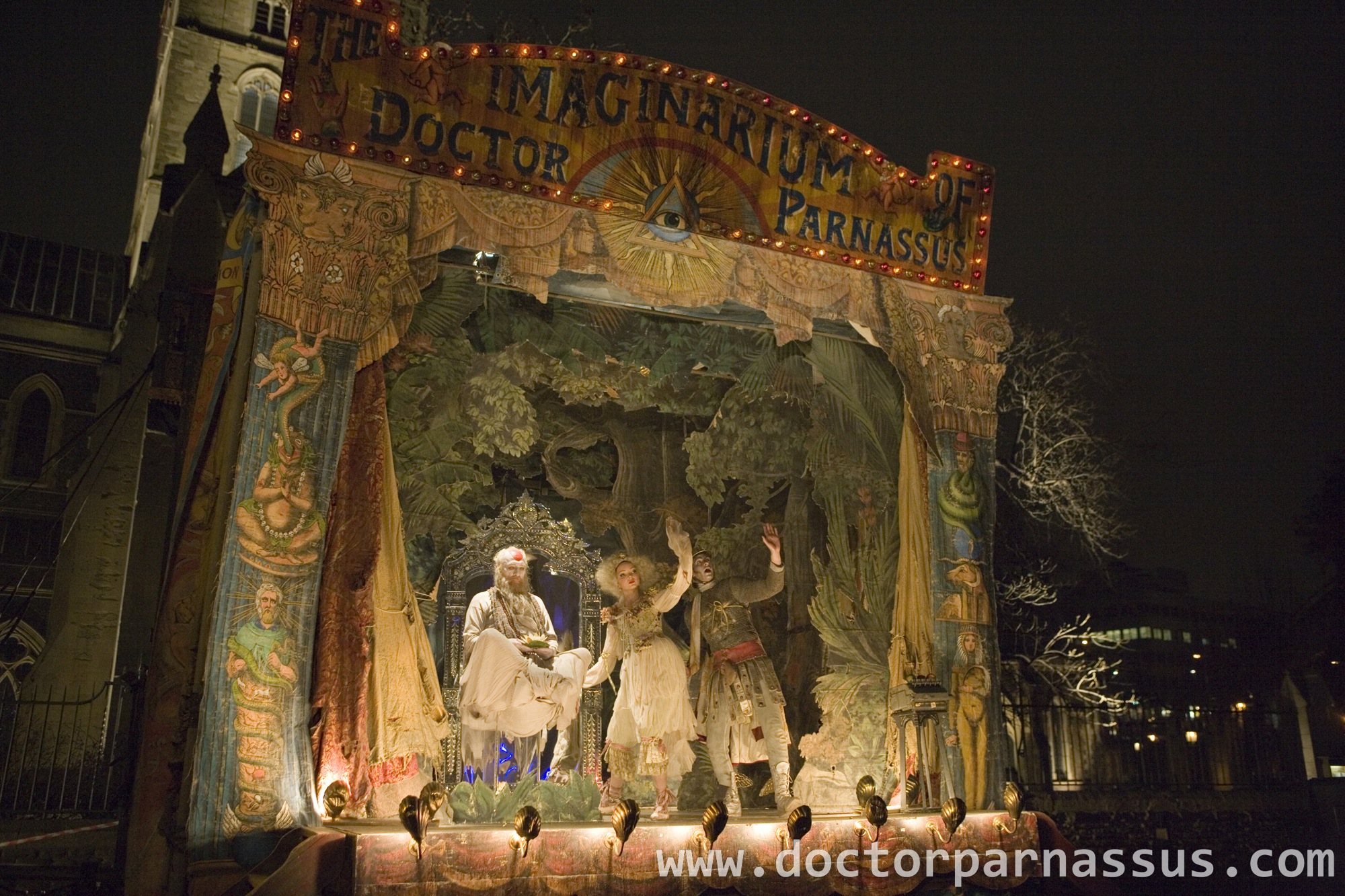
But...nobody's lining up to see Imaginarium. And that's a shame. For, if you want a fantasy film brimming with ideas, some of them quite provocative, it is this one, directed by that most snake-bit of directors, Terry Gilliam.
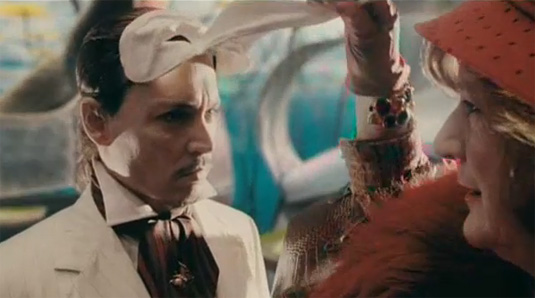
 It has been abundantly documented ad nauseum the tragic story of this film: how star Heath Ledger died in the middle of filming, and how a corps of Ledger-Gilliam supporters—Johnny Depp, Jude Law, and Colin Farrell—stepped up to play the visages of Ledger in the "Imaginarium" sequences (actually it seems perfectly natural the way Gilliam does it), but what isn't reported is that Gilliam was hit by a bus and broke his back during the filming.* Despite these alarming developments that would halt anyone other than a crazy "Monty Python" alum, the film is rich in detail, bursting with context, and doesn't have that "scrimping" footage-stretching feel that so many films-in-trouble give off.
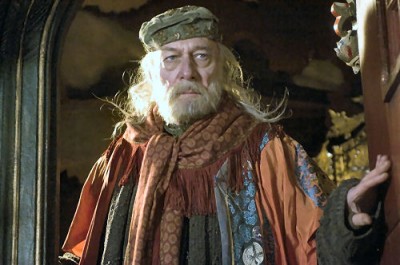
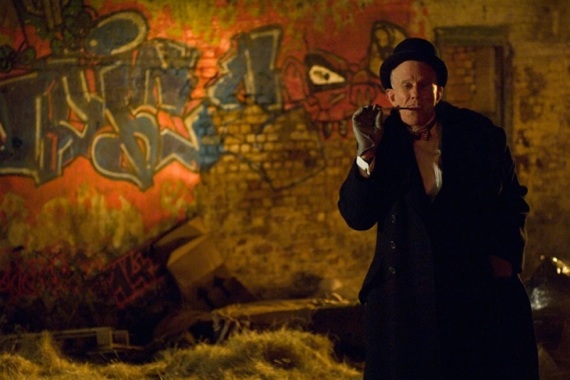
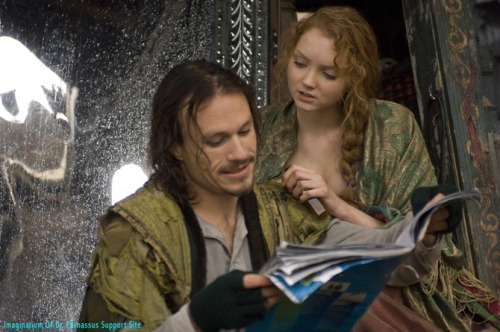
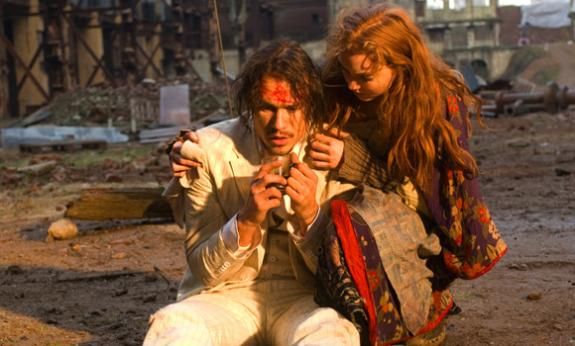
 It's basically a fairy-story set in our world (or a delirium dream, not sure) where Dr. Parnassus (Christopher Plummer) is an immortal, who, with his rag-tag theater troupe—assistant Percey (Verne Troyer), barker Anton (Andrew Garfield) and daughter Valentina (model Lily Cole, whose alarming face is that of an alabaster porcelain doll)—travels in an out-sized Bergman-crossed-with-Joad horse-drawn wagon/convertible stage, enticing marks to enter his "Imaginarium," a mirror that sucks the hapless into Parnassus' bizarre mind-scapes, where they either live...or die. Parnassus, you see, has made a deal with the Devil. Inhabiting the old man's mind, as he does most of ours, is Mr. Nick (Tom Waits...of course), who has his own lures to the impure of heart. Enter one of Nick's speak-easy's or one-night-stand motels that stick out like sore toad-stools in the landscape and BOOM! the Devil takes your soul. And the bottom line of the Devil's deal is a certain number of souls before Valentina's sweet 16th birthday ("The age of consent" she trills) or her day of freedom becomes her day of imprisonment, as the Devil claims her for her own. A situation as Grimm...and familiar...as can be.
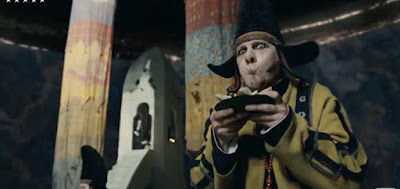 But Gilliam's Devil is in the details. The little band are aided in their quest by an amnesiac named Tony (Heath Ledger) whom they save and who, in turn, tries to save them, but whose past comes back to haunt and threaten them. Ledger is at his quick-silver best here, his accent wavering through several dialects, his eyes darting (all qualities picked up by his capable alter-ego's), for Tony is a chameleon, a huckster, the trickster of Myth—which Gilliam uses to savage satiric effect—and is a devil of his own, capable of destroying what he seeks to save. The battle between Good and Evil, Duty and Temptation turns complicated, and Parnassus must bargain again, at great sacrifice, to save that which he loves most, whether it's wished for or no.
 The Devil's in the details for the look of the film, too. The "real-world" that the "Imaginarium" wagon trundles through is our world, but it's a world of extremes: back-alley garbage-lands with trash-fires that litter the scene (where the rag-tag group seems to fit most) and vast temples of commerce-malls, where Tony, with a marketer's zeal attempts to bring new customers. Each of these victims have their own "Imaginarium" realms: a wealthy dowager emerges into a vision of giant fashion-shoes, another a 2-D pop-up book forest. At one point, a falling "Imaginarium" customer takes an incredible fall, and Gilliam cuts to an improbable "Python" joke—a giant thumb-tack—sitting in the middle of nothingness (Gilliam mercifully, for the moment, has the hapless mark miss the point). And even outside the mirror, there are wonders of movie-making brio. In a scene where Percey walks away from Parnassus with his usual bluster, Gilliam shoots the diminutive Troyer at a heroic looking-up angle—the camera had to be scraping the street.Now, a confession. It may sound like I'm gushing about Gilliam here, but I've always had a problem with his films: I fall asleep through them. It's not that I'm bored, but there's something about the richness of detail, the constant flow of new things to look at, and the murky lighting that induces narcolepsy in me. Before seeing a Gilliam film, I try to load up on coffee and sugar to get through it. I have no idea why this occurs (maybe it's Rapid Eye Movement caused from the orbs darting about the screen), but it is inevitable—it occurred here through the Jude Law sequences—but I managed to keep my eyes open throughout the whole thing this time.
 If the film is flawed, it is that it tries to do too much. Even with a simple story, derived from old fairy-tale tropes, Gilliam again attempts to fit 10 pounds of story into a 5 pound film. Complications begin to pile up, revelations are delayed, little troubling details are revealed—there's a convenient pitch-pipe here—and everything becomes resolved in an ambiguous and hasty manner. Like most Gilliam films, a second viewing may make murky matters clearer.
 Plus, the overall story has a premise open to interpretation...is it a "God versus Devil" story, or merely a fairy tale? The Christian Science Monitor's Peter Rainer thinks it may even be autobiographical with Parnassus a mask for Gilliam, "a mad dreamer forever riven between his imagination and the necessity to sell it."** And like his "Python" fraternity, there's a streak of dark running through this, as with all Gilliam films (remember how Kevin's parents are killed at the end of Time Bandits?), that may be off-putting for some viewers. Fans of Gilliam's films should expect it, but those who prefer their fantasy milkier may not like the taste of the dark stuff. Avatar is far less subtle, more a punch "on the nose," and although dark, gives the impression of a happy-ish ending.
 So, it is doubly appropriate that Imaginarium brings me back to Avatar. For what is Gilliam's film but a re-working of the caution "You can fool some of the people all the time, and all the people some of the time," and that includes the Devil, but the Devil gets his own.What's Gilliam's next movie? Well, he's determined to go back and film his Don Quixote movie, come hell or high water.*** It is only appropriate for this most quixotic of film-makers, forever charging against the impossible odds at realizing the incredible visions wind-milling in his head.
* Here, the endlessly inventive Gilliam made lemonade—convincing the bus company to provide transport rather than face a law-suit, thus saving lots of production money. And, if all of this wasn't enough, producer William Vince died right after filming. The film is dedicated to Ledger and Vince, and credited as "A Film by Heath Ledger & Friends."
** Nice observation, that. But Rainer also thinks Ledger looks "dispirited" in the film--well, yeah, the character's just gone through a painful transition, but Ledger's performance of it is never less than audacious and energetic. I'm guilty of it, too, but critics shouldn't try to read actor's minds--they're chameleons, after all, when they're doing it right, and we should speculate cautiously when ascribing motivations to surface appearances on film.

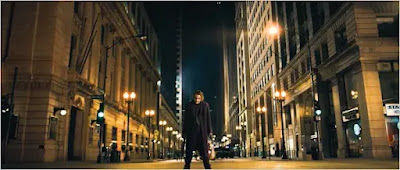 Ledger's not the only show in town in The Dark Knight. Aaron Eckhart makes a complicated "White Knight" of DA Harvey Dent (it's really his story), Christian Bale's Bruce Wayne and booming Batman are deeper than the portrayal of Batman Begins--more soulful, less Bush-brash--and Michael Caine and Morgan Freeman do able support for roles slightly more down-played than the last film's. This time, Gary Oldman's Lt. Gordon has more to do, and the longer he's on-screen, the better you like him, and Maggie Gyllenhall gives the character of Rachel Dawes more of a spine (with a contrarily slinky walk) than Katie Holmes was able to provide.


 By the end, some of the cast has been culled, and a long entrapment scene has gone on far too long, with still another set-piece just around the corner. At some point, every one of the good guys takes a hit, usually for noble purposes, but each keeps plugging away, trying to prevent having to put tooth-paste back in the tube, as consequence upon consequence piles up. And in the end, The Batman must re-adjust his modus operandi, taking on a new guise in his battle, one that he can only accomplish alone. At the same time, he handicaps himself to ensure he can't cross the line with too much power. He's left running in front of a metaphorical fast-moving train, knowing that at any moment he's going to have to turn and stop it.
 "Dark Knight?" This thing is black as pitch.

 And that's a genuine accomplishment.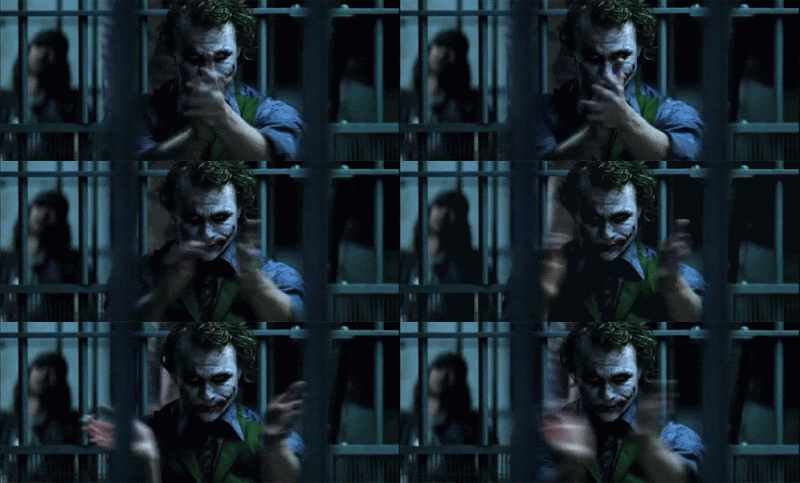


.jpg)
.jpg)