Showing posts with label Children's Film. Show all posts

Friday, July 15, 2022

The Phantom Tollbooth (1970)

The Phantom Tollbooth
(
Chuck Jones, Abe Levitow, Dave Monahan, 1970) When Warner Brothers' "Termite Terrace" was closed in 1962, animator Chuck Jones moved over to M-G-M where he started a new series of "Tom and Jerry" cartoons, won an Oscar for his short The Dot and the Line: a Romance in Lower Mathematics, and worked on such projects as The Bear That Wasn't, "How the Grinch Stole Christmas!", "The Pogo Special Birthday Special" and "Horton Hears a Who!"
 
But before M-G-M closed its animation division in 1970, Jones produced this adaptation of Norman Juster's 1961 children's classic (with illustrations by Jules Feiffer) that sold more than three million copies—Juster had also written "The Dot and the Line". Jones worked on the film in 1968, completing it by the end of the year. But, this was the time when M-G-M was in a slow-motion battle against corporate raiders and were taken over by Kirk Kerkorian and his appointed studio head James T. Aubrey. The result was a priority on real estate, the creation of the line of M-G-M Grand casino's, and a stranglehold on making movies. The Phantom Tollbooth was grudgingly released in 1970. 
The Phantom Tollbooth tells the story of Milo (
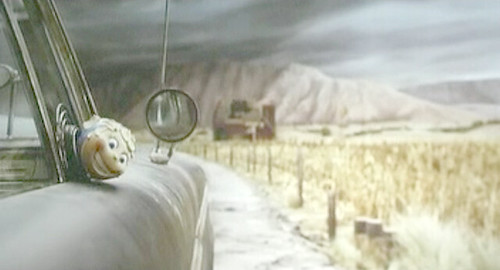
Butch Patrick), bored San Francisco youngster, who is at that point in life where, if video-games existed, he'd be sitting in his room all day exercising his thumbs and wasting his life (or game-lives) in pursuit of short-term goals that get you nothing but transitory ego-boosts and dopamine hits. But, Milo gets a present—a big candy-striped box—that, when it's unwrapped contains a toll-booth, red car and a map to the Kingdom of Wisdom in the Lands Beyond.
As imagined by Jones' favorite background artist Maurice Noble, the Kingdom of Wisdom is an especially colorful animated world with its own rules, imaginary characters, and logic-sense. For Milo, it's a test for what sort of person he's going to become, and like The Wizard of Oz, it's a scavenger hunt of exploration, picking up helpers in order to achieve the ultimate goal. But unlike Dorothy, Milo isn't trying to find home. He's trying to find himself. In that way, it's more like Rebel Without a Cause.
First clue: he's stopped by a character named Officer Short Shrift (voiced by the ubiquitous 
Mel Blanc, who's actually ubiquitous in this one movie!) who gives him a ticket that says "I Am" and that's it. Getting a citation without any more clarification than that seems a rather pointless infraction. But, it just points to the fact that Milo doesn't know what he is, yet, except for a blank slate. It is the goal to sign that ticket, and, having done so, having a clue to what you are. A character named The Whether Man (Daws Butler), who can't make up his mind, is no help at all, creating more questions than answers.
But, there are bumps in the animated road. Early on, Milo is trapped in The Doldrums, beset by Lethargians, who are only to happy to leave him in a slothful slump of a swamp, from which he is rescued by Tock (
Larry Thor), a "watch"-dog, who has a ticking clock for a stomach, and who is there to make Milo realize he's burning daylight and get him unstuck—dogs are good for that (imagine if it was a cat! Or a computer!). Once unsullied, Tock and Milo find the primary conundrum—a war that has occurred between the cities of Dictionopolis (concerned with all things letters) and Digitopolis (where numbers rule).
At one time, the cities were ruled by King Wisdom and his daughters, but since his death, the two cities have fallen into discord under their respective rulers, King Azaz, the Unabridged (voiced by
Hans Conried), the man of great letters of Dictionopolis, and the Mathemagician (voiced by Hans Conreid), no. 1 of Digitopolis. As a result the princesses, Rhyme (voiced by Patti Gilbert) and Reason (voiced by June Foray) have been banished to the Castle-in-the-Air, guarded over by creatures from the Mountain of Ignorance.
The band, which now include The Humbug (voiced by
Les Tremayne) and The Spelling Bee (voiced by Shepard Menken), try to return Rhyme and Reason to the Kingdom of Wisdom and along the way meet such creatures as the Demon of Insincerity, the Senses Taker, the Terrible Trivium, Faintly Macabre the Not-So-Wicked Which, and two noisy folks called the Awful Dynn and Kakofonous A. Dischord, who try to stop the freeing powers of Chroma the Great. One wonders why there isn't anybody named the Overarching Metaphor?
Being a punster myself, I tend to like things like this, which bring about colorful characters that delight a child and then around about when puberty wears off and a thought pops into your head, you realize that there might have actually been a lesson in there pin-balling inside your subconscious...just waiting to set off a light-bulb. And, being Jones' first feature, the animation, though threadbare (given the budget), stays consistently imaginative throughout and is helped immeasurably by Maurice Noble's imaginative, trippy backgrounds.
The songs, however, are a bit "meh!" and make you want to hit the fast-forward button, or at least, hit the head until they blow over. They're hold-overs from the treacly "Summer of Love" era, where the orchestrations are brassy, thumped with heavy tambourines, and in need of The Partridge Family. But, they don't last long. And every once in awhile something comes along where you admire the intricacy of the thing and the beauty of the art. Author Juster was not a fan, so one wonders if one can't hit two birds with one stone and just read the book, as it's been around for at least 50 years, and has aged very well, and never fallen out of fashion, or catered to trends, and, with the benefit of imagination, has an unlimited budget.

Friday, October 16, 2020

Lemony Snicket's A Series of Unfortunate Events

Lemony Snicket's A Series of Unfortunate Events (Brad Silberling, 2004) O-kayyy. So far, for Hallowe'en on this site we've featured apocalyptic religious cults, invisible men, sadistic versions of "Big Brother" and lots and lots of creepy things. I'd like to say the best is yet to come, but, no. Things are going to get worse. Much, much worse...to the point, where I have a true sense of dread about what's coming up—not just in the posting, but in the very writing of it. Dear, dear me. Oh, it's going to be awful...simply awful. Really, people should have better things to do than to make movies like the ones I'll be considering in the next couple of weeks. 

But (sigh) it is Hallowe'en Season. And one must simply get this stuff out of our systems, so that we can vote with clear consciences, and think of our fellow citizens and how they are coping with a pandemic, and social distancing, and wearing masks, and interviews from the census by bright ardent people who are only doing the right thing, as well as the intricacies of working at home while also supervising the on-line education of our precious dutiful children.
But in the warm comfort of the domicile, many flights of stairs from the garret in which this is written, the Hallowe'en movie of choice is this (to be heretofore crunched to Unfortunate Events to avoid a cramp). It might be the best movie Barry Sonnenfeld never made. It has his insensibility, his florid camera moves,* snappy editing, austere framing and live-action cartoonish gambits (lots of shots of peoples' faces gaping into the camera).

But, it didn't have enough budget and so
Brad Silberling took over the project.

Silberling is a chameleonic director; he tends to take on the characteristics of whatever project falls into his lap—handy for his long tenure as a television director of such idiosyncratic shows as "
NYPD Blue," but making him hard to pin down as a feature director. How do you explain the disparity between Unfortunate Events and his unfortunate City of Angels? Before you attempt that, let me trump it by adding the even more unfortunate Will Ferrell vehicle, Land of the Lost.

So, it's perhaps fortunate for Silberling that so much of "Unfortunate Events" depends on others. The Lemony Snicket-styled writing—a bit like "Miss Manners" without her morning pick-me-up—of dark, despairing fore-shadowing** inspires a switch-back Rankin-Bass-styled opening that comes crashing to a halt. ("This would be an excellent time to walk out of the theater, living room, or airplane where this film is being shown." says the Lemony Narrator, as read by Jude Law)
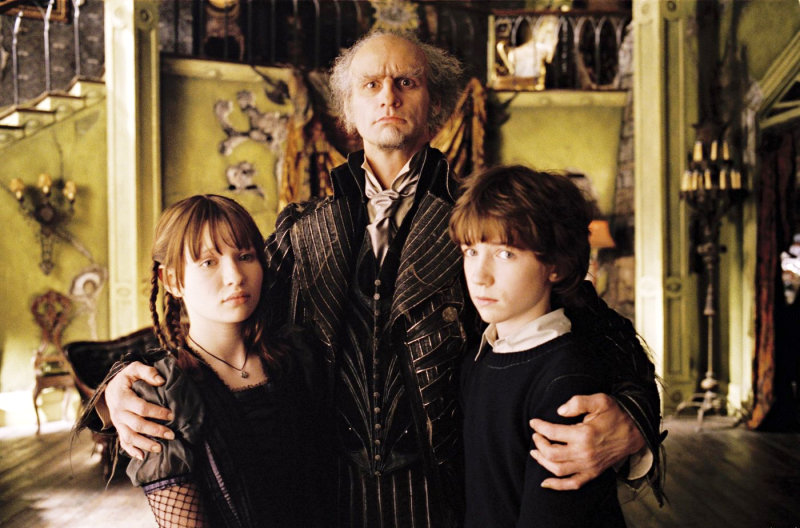
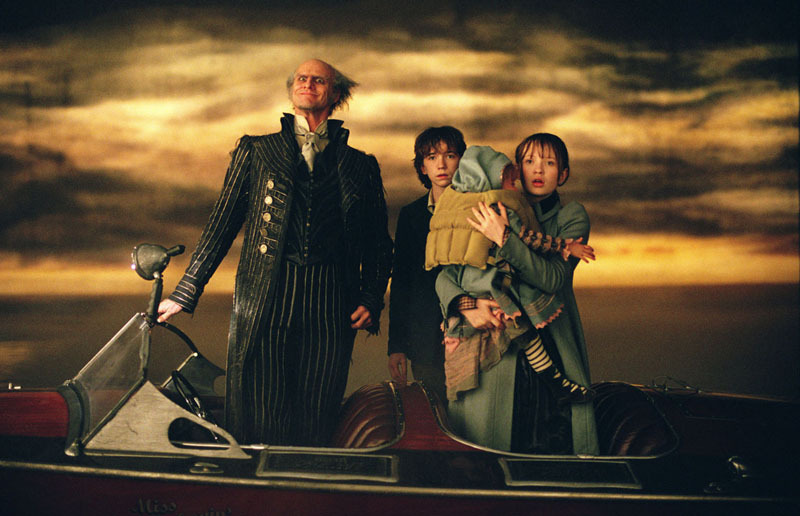
"Fade to Black" is the more appropriate phrase. Fade to monochromatic gothic steam-punk macabre, (which permeates the film, like a lighter version of "The Addams Family") as the film takes up the sad misfortunes of the Beaudelaire orphans: Violet, a voracious inventor (Emily Browning); Klaus, a voracious reader (Liam Aiken); and Sunny, a voracious biter (Kara Hoffman and Shelby Hoffman). When their parents are killed in a mysterious fire, the Estate (executed by a piggish Timothy Spall), the kids are shipped off to the cunning clutches of Count Olaf (Jim Carrey), a despicable actor who only cares for the Beaudelaire fortune. Treated as servants by the fiend, he decides to kill them off when it's determined that he'll only get the money when they're adults. And so he leaves them, locked in a car on a rail-road track with the 11:15 barreling down on them.
What to do, what to do?

Based on the first three "Unfortunate Events" books ("
The Bad Beginning," "The Reptile Room," and "The Wide Window,"***), the film is as episodic as could be with the child-endangering machinations of the Count the single unsavory thread running through it. 

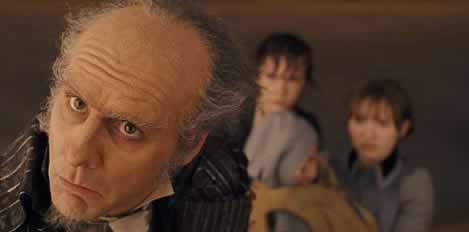
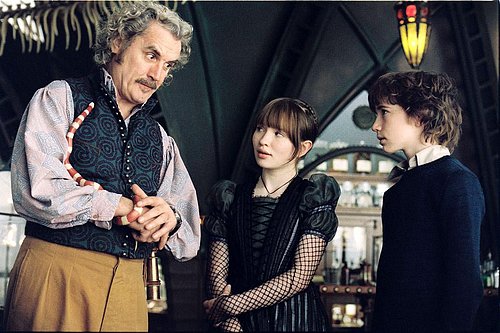
Upon Carrey's every entrance, Silberling takes the wise course of just hanging back, giving Carrey a wide shot (with distorting anamorphic lens) and keeping any other actor out of giggling range. So much of his performance is ad-libbed, you could make the case that it's Carrey who's driving the bus; things calm down considerably when Billy Connolly and Meryl Streep take possession of the children (and the movie), but gears up again when Carrey dervishes his way into the scene (Connolly stays out of his way, but Streep engages him, going eye-to-eye).
It's a good thing, too. "Unfortunate Events" could have turned excessively mordant to the point of leeching all the fun out of it, production-designed into stasis if Carrey wasn't there to break windows (and characters) in the proceedings. In that spirit, the cast is rounded out by such anarchic spirits as Catherine O'Hara, Jennifer Coolidge, Cedric the Entertainer, Dustin Hoffman, Jane Lynch, and Craig Ferguson that flit around the corners to keep things from getting too predictable, and deservedly more than a little off-kilter.

* He started out as the Coen Brothers' cinematographer.

** It's fun when doled out in tea-spoons of dread and low dudgeon, but if you want to hear it overdone, listen to the director and author Daniel Handler's commentary track on the DVD. Handler (as "Lemony Snicket") acts like your staid Aunt Petunia, who goes all-fluttery and horrified at the movie, which is funny for ten minutes, then overstays its welcome...by two hours.
 

*** Dear reader, do be careful when going to these links, for it appears this Lemony Snicket character wants your e-mail address. The cad. I would be cautious. Very, very cautious.

Wednesday, August 21, 2019

Good Boys

F-Bombs (Out of the Mouths of Babes)
or
"Two Weeks in the 6th Grade and I'm a Social Piranha!"

The "R" rating is prominent in the promotions for Good Boys because, God forbid, kids the ages of the stars of it should go see this movie (at the premieres, do they escort them out? I mean, they ACTED the damn thing). But, then, I'm not sure what good it would do to actually let 11-12 year old's see this movie, other than to show them what adults think of them.

Because the movie isn't FOR the age-group it depicts, like a YAF novel. It's for adults to give them a nostalgic laff about the naivete and confusion of that time period between childhood and wanting to be an adult—you realize you can't do certain things adults can do, you're constantly told "you wouldn't understand," you see adulthood as a freedom you covet without realizing the responsibilities that come with it (that give you no freedom at all). It's the last flush of childhood that you can actually enjoy before the mantle of licenses, financial responsibilities and permanent records take away your childhood and make you nostalgic for the way things were.


Which is why they make movies like Good Boys for adults.

There's a grand tradition of this in the movies—"Our Gang," one of my faves The Sandlot ("You're killing me, Smalls"), where kids are trying to act like adults in an adult world, where the adults are almost absent (the comic strip "Peanuts" is like this where there are no adults and the kids talk—as cartoonist Al Capp used to carp—"like psychiatrists" or, as in the animated versions, adults squawk like muted trumpets). If it was a drama, it would be To Kill a Mockingbird—kids not understanding the frailties and failings of adults. But, in a comedy, it's kids trying to negotiate through the adult world without understanding it, and Good Boys takes it to the extreme.
The story follows the issues of "The Beanbag Boys" (called that because...they all have beanbag chairs)—Max (Jacob Trembley, the brilliant young actor from Room), Lucas (Keith L. Williams, who's hilarious) and Thor (Brady Noon, who gives the most mannered performance, but has the most conflicted role)—friends since kindergarten, who are entering sixth grade, which for them is a highly transitional time. Their little clique runs the risk of fraying due to peer pressure, family crises, and the inevitable consequences of growing up and away from each other, but seem determined to stay bonded through thick and thin.
Thor is the most theatrical, but also the one most susceptible to peer pressure—despite his talents, he doesn't try out for the sixth grade school play because he'd be thought of "not cool." Max is starting to notice girls, particularly Brixlee (Millie Davis), who he can't look in the eye while also trying to be apathetic, at the same time the sight of her makes him weak in the knees. Lucas, is the tallest of the three, but is being cut down to size due to the impending divorce of his parents. These are the crises of children, because their stasis is being shattered and change is being forced on them without any regard to how they feel about it. They are completely messed up, but try to hide it behind a veneer of "cool" lest they humiliate themselves.
The events of the movie revolve around Max and his Brixlee fixation. The popular boys are giving them a hard time--Thor is being harassed  for his interest in theater arts, conflicting with Max, who wants to be popular because he thinks it will give him a better chance with Brixlee (an invitation to a "kissing party" That Brixlee is going to becomes his obsession). Big problem, though;  he's never kissed anybody. What if his kissing...well...sucks. To get an education--a horrifying encounter with porn doesn't work because "they never kiss, not their mouths"--Max takes control of his father's drone against his orders ("I use it for work!") to spy on two "old" girls, Hannah (Molly Gordon) and Lily (Midori Francis) in Hannah's nearby backyard. Hannah has a college boyfriend, so the boys "one-up" the traditional spying through the fence to go to aerial reconnaissance. They watch Hannah and Benji--the boyfriend--have a fight right after he delivers some "Molly" to Hannah for a concert that night. Just when the girls go in for a consoling clinch, Max loses control of the droid, allowing the girls to capture it...and hold it hostage.

This is not good. It becomes a hostage situation that goes seriously wrong with a confrontation where Max may have to 'fess up to his Dad and be grounded for the kissing party. But, Thor manages to steal one of the girls' gotcha bags containing the ecstasy (don't worry, the boys don't get access to it--they can't figure out child-proof caps). But, it begins a cat-and-mouse game between the Beanbag Boys and the "old girls" as each has something the other wants. There are the inevitable complications that divert this "Coming of Age" movie into an "Incredible Mess" movie (the kind where relatively simple goals become increasingly out-of-reach by increasing road-blocks, tangents and diverting sub-goals that keep the ultimate goal tantalizingly harder to achieve.
"Honey...yeah...we're not having kids."
The Beanbag Boys turn out to be surprisingly adept at navigating these smaller complications to achieve their ends, even as they risk fraying the fabric that binds them together.
They're not bad kids--in fact, their naivete and embedded anti-drug indoctrination makes them quite charming, despite the beer-sipping (four sips is a crowd-impressing record) and the F-bombs that explode out of their mouths.
They're just trying to make sense of a bizarre adult world that, more often than not, turns them into screaming meemies (and cry-babies--they are constantly crossing the line from sixth grade sophisticates to the behavior of kids in single digits). I'm not sure what kids would make of this if they were allowed to ss it (for one thing, a lot of the jokes will fly right over their heads). But, then, they're not the target audience. Older teens and adults are, and in that context, the movie is a nostalgic comedy as opposed to being about the loss of whatever innocence they still retain.

It's an odd movie. But very funny.


Tuesday, March 14, 2017

A Monster Calls

When the Bough Breaks
or 
That's Ent-ertainment!

Seeing a lot of depressing films can really put the zap on your head. Makes you not want to write about them. Makes you not want to see anything for awhile. But you have to resist that urge.

Because you might miss something brilliant.


Something like A Monster Calls.

A Monster Calls didn't do any "business," really. It had that icky "The BFG" feeling, the kind that keeps away audiences, even family audiences, because it seems it might be too frightening or nightmarish to families who don't think twice about taking their kids to The Avengers or some lumpen play-doh-pixel animation that won't inspire sleepless nights—for kids or their parents (Hey, Hollywood, Mom and Dad gotta sleep!) That stuff is safe, like sugar-water; it keeps them bouncing on the seat-springs for 90 minutes and when the rush is over and done with, then it's safe to put 'em in bed, with their revenge-fantasies and sermon-stories cavorting like empty calories in their heads.  And in the morning, they burst like bubbles, because there's nothing challenging there. At least, nothing like real life.

Who needs that, after all? For that, you can stay home.
Conor O'Malley (Lewis McDougall) is having a nightmare—the one "with the darkness the wind and the screaming." In it, he is in a blasted landscape, a graveyard that has opened up, more grave than yard now, and he is desperately clinging to something hanging over the edge. A look into the pit and he sees his mother (Felicity Jones...of Rogue One) desperately grasping his arm, trying to keep from falling into the abyss. But, he can't prevent it; he's just 12, somewhere as the narration tells us "too young to be an adult; too old to be a kid."
Conor wakes up from his night-mare and goes to his day-one. He makes breakfast—cold cereal—gets dressed, takes one look in at his mother and trudges to school where he sits in the back of the class, dead-eyed, rather be drawing, and notices the askance glare of the bigger bully who will beat him between classes. He's getting it from all sides: his father is absent, living in the U.S. with his new family, but who talks about visits when all Conor wants to do is escape; his grandmother (Sigourney Weaver) is coming to visit and she's a brittle, stern woman who has issues of her own, Conor's struggles not being among them, with talk of living with her in her antiseptic memory-steeped brownstone; because Conor's Mum has cancer and the treatments are making her sick and weak...and not making her better—it's time for a more aggressive treatment in hospice.
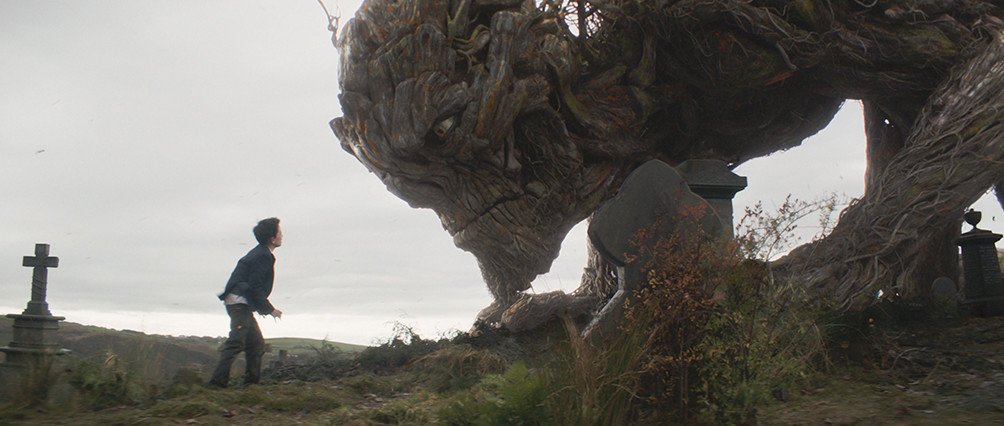
Conor retreats but he can't go far. Sleep brings the nightmares and his drawings are disturbing things that one night manifests to life in the form of a an animated yew tree (voiced by Liam Neeson)—the one that sits in the graveyard of the local church—that uproots with a burning fire inside it and invades his room at precisely 12:07 am with an ominous warning; he will tell him three true tales and once those stories are complete, Conor must reciprocate with one of his own—and if the story is not true, the monster will eat him.
Pretty simple story, with Grimm elements of the macabre, but A Monster Calls is anything but simple. When the stories begin, the film warps and woofs and spatters into bizarrely wondrous illustrations that morph into surrealism and suggestivism to tell their fairy-tale stories of kingdoms and wizards and differing points of view, but each of them have an edge that defy fairy-tale logic and mannerisms, don't hew to myth but to behavior and the complexities of psyche, paths that confuse and confound Conor, shaking him down to his his own core-beliefs of childhood, uprooting his own naivete and the expected behavior of youngster-hood.
Dad comes to visit, but he can't stay long, and before you know it, he's just a memory, leaving the situation of his ex-wife and son behind to return to life in the U.S. Mum moves to the hospital, and Conor to his grandmother's, where he is a stranger and a bit of a burden, an outsider but not a center of concern. The only one who seems to notice him and pay attention to him is the Monster, who tells Conor that, rather than the Monster coming to him, maybe it is Conor who summoned his presence to him.
A Monster Calls is an anti-fairy-tale, which does not comfort; it is a kid's movie not for kid's and that they won't understand—maybe be fascinated with the graphics and the out-sized emotions, but it ultimately will run against the grain of a child's expectations of easy solutions and happily-ever-after. But, it is also a film that is so much made up of the anxieties of a child's world that is much too large for them to be comfortable in, even if they grow five times their size. The embedded stories are not safe and, though they toy with issues of good and evil like a fable, the palette gets all mixed-up and smeared with the light and the dark. The images (created by the FX-house glassworks Barcelona) are beautifully painted nightmares (they also did the Tree-Monster FX although a bit more photo-realistically) that shift along with the attitudes inhabiting its characters.
Kids don't know id's, even while they are acting out on them all the time. They wear their hearts on their sleeves, even if they don't know exactly why they are feeling what they are feeling. Children don't know the secrets of adults (most times because one of those secrets is that they're being protected from them by their parents)...that time is short, life is hard, and that eventually yesterday's outnumber tomorrow's. Kids don't need to know that time is the ultimate bully and it will beat you up and it won't wait for recess to do it.
Life is hard. That's the reality of it, but a child is sheltered from the more harsh realities of life. A child barely knows life that they should know anything about death. Nor that, at the moment of their birth they're carrying an hourglass and time is running out for the first second. Children shouldn't know that stuff. They're fed stories that conclude "...and they lived happily ever after," when there are actually no guarantees on the "happily" and a definite negative on "they lived...ever after." The curse of original sin (from the biblical stories) may not be from the tree of knowledge, but born of the knowledge of death. Death thus becomes childhood's end even as it is for another. Life is cruel that way.
No, not cruel; Life is merely indifferent. And as I've said about indifference here before, it is the opposite of love.

As I said, maybe not for children—they can't comprehend the future. But, for adults, with memories of the past, it is amazing. And if those memories involve loss, there will be tears...over the painful dichotomies of life...and death...and how both can be embraced. A Monster Calls is that special.

Right down to its anti-fairy tale roots.


Friday, July 1, 2016

The BFG

Be Careful What You Wish For
or
Dreams That Go Bad

In 1982, a couple of big things happened in the world of kid's entertainment: Steven Spielberg directed E.T.: The Extra-Terrestrial, a re-imagining of an earlier screenplay idea in which evil aliens harass the residents of an American town—he became dissatisfied with it and reversed it with the help of screen-writer Melissa Mathison (who had written the equally magical The Black Stallion) to fashion it into the biggest movie hit of the year, and, for awhile, of all time; In London, Jonathan Cape published Roald Dahl's "The BFG," an expansion of a concept the author had dabbled with in his 1975 book "Danny, the Champion of the World," about a giant who makes frequent visits from "giant territory" to deliver dreams to sleeping Londoners. Both stories featured outcasts and their eventual relationships with their more-normal counterparts among the human community. It seems fated that the two would meld into a project that combined those two powerhouses of children's fantasy.


Producers Frank Marshall and Kathleen Kennedy, Spielberg's usual production partners, had been trying to make a live-action version since 1991 (an animated version was produced by ITV in 1989), but for one reason or another, never materialized, going through different screenwriters and directors until Melissa Mathison got the job from Dreamworks in 2011 (Spielberg's old production arm, Amblin, is credited as production studio so as to not imply a collaboration between distributor Disney and animation rival Dreamworks—"The Mouse" can get testy about such things). Spielberg came on board in 2014, filming began in March of 2015 and, incredibly, the thing got finished in time for a release by July 2016, including elaborate special effects by WETA that encompasses wholly 90% of the picture. Spielberg's upper ecehelon of collaborators all worked on it—cinematographer Janusz Kaminski, editor Michael Kahn, production designer Rick Carter, costume designer Joanna Johnston, and composer John Williams.
Melissa Mathison died, after battling cancer in November 2015, and the film is very early on in the credits dedicated "For Our Melissa"—not unlike Dahl's book being dedicated to his daughter Olivia, who died of measles encephalitis in 1962. A slight air of melancholy hangs over the project, which is fine as it frequently leavens Spielberg's penchant for the sugary, something that has been largely absent from his Senior work as a director.
And The BFG is remarkable—stunning in all sorts of applaudable ways. The effects work is stellar, making up the vast majority of the mise en scene of the movie with a fluidity and attention to detail that draws one in with fascination. This is spectacular world-building, similar to the care and beauty that went into Disney' 2016 version of The Jungle Book from earlier this Summer. And the motion-capture performances of Mark Rylance (who was the very sly stand-out for his underplayed work in Spielberg's Bridge of Spies), Jemaine Clement and the other giant actors is truly amazing, completely stepping over "The Uncanny Valley" as nimbly as if there truly were giants of great stride. Spielberg also retains his reputation as a deft director of children, getting a terrific performance from newcomer Ruby Barnhill as the heroine of the story, Sophie
Also, in this era of "no limits" cinema (thanks to the digital imaging revolution) it is refreshing that Spielberg takes care in the pacing, not throwing the movie into "editing over-drive" as seems to be the norm for "blockbuster-filmmaking" among the Spielberg acolytes. It is nice to see a movie not being made "by stop-watch" and trying to make Guinness by squeezing as many shots into a sequence as possible.
All noteworthy. But, I must confess for all the splendor there is to be seen, the overall effect left me uncharmed. This takes a certain amount of self-examination and confession. I am not the target audience, which is younger by decades. Saying that, I can still be moved by a film aimed at the youngsters and entertained—Pixar makes a regular habit of achieving that. And I'm a big fan of Spielberg as a filmmaker; I think he is the best of the current directors out there, eking out over Martin Scorsese by frames.
I was dissatisfied with the film, however, despite it hitting all its marks, and bringing the wonders and chills of childhood to the fore. Way past my sell-date, I can't imagine the reaction the film will have over young audiences. But, a great children's film should also appeal to adults, as well. And I found that the film dragged (despite my delight that it wasn't a roller-coaster). Bits of business and Spielberg's scrupulous sense of place by making sure the audience knows where it is at all times bogs the movie down no matter how fluid the camera work and intricacy of the choreography. I found myself drifting off, losing focus and the sense of caring about what was going on. Perhaps it was the circumstances under which the film was made. Maybe the filmmakers couldn't bear to part with a single word or sequence that had been worked out by "Our Melissa." Gifted she is, but in the editing room, a filmmaker must be equal parts story-teller and butcher. Maybe the affection for the screen-writer overwhelmed the cruelty of the knife that is required to make a tight, concise film that isn't in love with itself, so determined is its aim to win over the audience.
I always consider a Spielberg film "an event," so I went to an evening-before-opening screening of the film—saw it in 3-D—and sat down in the theater. Easy to find a seat, as I was the only one in the theater. True, 10 pm is past the bed-time of the targeted demographic, but I was still surprised at there being only an audience of one—the film is competing against the new "Tarzan" movie and the latest "Purge" film, both probably more suited for late night audiences. Still, I was shocked at the lack of humanity.
Hard to know what to make of this. Perhaps Spielberg has, indeed, become the director who makes great scenes but can't make a complete movie (as one internet snark put it—I really MUST stop reading comments sections). I don't think so. Bridge of Spies and Lincoln were both terrific films. I think this was a case of too much affection for the material to the point of protection, and maybe some hubris that a Spielberg children's film was a certain home-run. Nothing is certain in the market-place. This one may be big, it may be friendly, but its quite a few feet below giant stage.
Disney with Dahl at the time they were making their "Gremlins" short for the Armed Forces.