Showing posts sorted by relevance for query John Huston. Sort by date Show all posts

Friday, December 16, 2016

Now I've Seen Everything Dept.: John Huston, Part 1

The Laughing, Inveterate Gambler

"The Monster is stimulating," Humphrey Bogart said of his director on the set of The Maltese Falcon. "Offbeat kind of mind. Off center. He's brilliant and unpredictable. Never dull." "The Monster" was his affectionate nick-name for John Huston.

John Marcellus Huston was born August 5, 1906 into a "show-biz" family. His father was the well-regarded actor Walter Huston (although, at the time of John's birth, his father had not yet achieved any real fame for his work, and when his son was born took a job as a civil engineer). His mother, Rhea, was a sports editor up to the time of his birth, but gave that up to raise John.

The Huston's divorced when John was six, and while the two went off a pursued their original careers, young John was sent to a series of boarding schools. Young John was a sickly child, but once he moved to Los Angeles with his mother to attend high school, he became an amateur boxer, giving it up after breaking his nose. Los Angeles also made him aware of the new medium of films, and he was fascinated with it, and made it one of his interests, along with acting, literature, abstract painting...and writing.

He had his first successes, while living in Mexico, writing for The American Mercury, at the time edited by the legendary H.L.Mencken. He moved back to Los Angeles to work with Samuel Goldwyn Studios and Universal Pictures as a dialogue writer and script doctor, a period which he called "a series of misadventures and disappointments," characterized by hard-drinking and reckless gambling. A traffic accident, in which a pedestrian was killed, traumatized Huston and he left the country for five years drifting between London and Paris, studying painting and making a meager living as an artist.

Huston returned to Hollywood in 1937, determined to make it as a writer-director in Hollywood, working for Warner Brothers, where his screenwriting work, attracted attention around the industry. His work on such films as Jezebel, The Amazing Dr. Clitterhouse, Juarez, Dr. Ehrlich's Magic Bullet, and Sergeant York. After his second Oscar-nomination for writing York, Huston made a deal with Warners that if his next script made money for them, he would be allowed to direct his own scripts. His next writing was High Sierra, which became a huge hit for Warner Brothers and brought notice to its star mostly known for playing "heavies," Humphrey Bogart. His first film for Warner Brothers would become not only a hit, but a classic film that has never dulled in its luster or power.

Huston inspires as much as he is inspired. Huston's free-wheeling productions in the 50's were the focus of four books—Lillian Ross' "Picture" (a non-fiction book on the making of The Red Badge of Courage), and Peter Viertel's "Black Hunter, White Heart" (a roman a clef about The African Queen), Katherine Hepburn's non-fiction account of the Queen filming "The Making of the African Queen (or How I went to Africa with Bogart, Bacall and Huston and almost lost my mind)" as well as Ray Bradbury's collection of his stories about writing Moby Dick for Huston—"Green Shadows, White Whale."


The Maltese Falcon (1941) Warner Bros. had already filmed "The Maltese Falcon" twice before and made some money from the property, so it was a good bet to give a remake to their current screenwriting phenom' as his first directing job. They couldn't lose much, what with a limited budget, a B-grade cast of "nobodies," and an investment in future directing talent. Well, sometimes you bet small and hit the jackpot, as the forties version of The Maltese Falcon became the definitive one and elevated its cast to star status. Huston stuck to Dashiell Hammett's gritty roots straddling the needs of the Hollywood mystery film and what would become (post-war) "film-noir." He also lucked into the casting of Humphrey Bogart as detective Sam Spade (George Raft turned it down), and decided that maybe Bogart shouldn't smile so larkily through the whole thing (as Ramon Navarro had), keeping Spade more in the realm of Bogart's previous Huston-penned role in High Sierra as a sympathetic hoodlum—cynical, but with reason. Mary Astor's drama-queen performance as Brigid O'Shaunessy is a fine deflect for the story, and Huston excelled at casting character parts with Peter Lorre, Sidney Greenstreet, Elisha Cook and Ward Bond in key roles. Just to show that "the stuff that dreams are made of" can come from humble origins.  

It was named to the National Film Registry in 1989, the first year of its inception.


In This Our Life (1942) Remember the song "Sisters" from White Christmas, the one with the lyric "Lord help the Mister that comes between me and my sister, and Lord help the sister that comes between me and my man?" Huston's second directorial assignment for Warner's (when he was called away after the Pearl Harbor attack, Raoul Walsh—who directed Huston's script of High Sierra—completed the film) is this soapy adaptation (by Howard Koch) of the Pulitzer Prize-winning novel by Ellen Glasgow, which was strong enough for Bette Davis to be attracted to the project. She didn't like the script, though, and thought she was too old for the part of the younger sister of the Timberlake family (she is, but co-star Olivia deHavilland probably couldn't pull off the other role, where Davis could in spades). 

DeHavilland and Davis play Roy and Stanley Timberlake (yep, girls with male names), the older sensible and settled, the other, young and vainglorious—if not downright evil. The movie flirts with adult themes—the younger sister runs off with the elder's husband of deHaviland's Roy (Dennis Morgan), causes a scandal among the town and family who have to pick themselves up from the incident and bear up. Despite that husband's subsequent suicide, Stanley Timberlake never learns her lesson and continues to take the selfish path, destroying lives like stepping on ants, which Davis performs with dervish-like zeal. 


Extraordinarily melodramatic, but with enough of a social conscience—in the course of the story, a servant's son is caught up in her machinations and it is admitted that a black man's word will never be held equal to a white woman's, no matter the evidence—to make it notable.


Winning Your Wings (1942) The only film Huston made with James Stewart, albeit Lieutenant James Stewart, one year in the Army Air Corps. A recruitment film for the war effort, Huston directed Stewart and a cast of would-be recruits, answering questions about how the Corps can serve them, while they're serving it. Stewart is folksy, and "aw-shucks" in the on-camera portion, and was probably told to "punch up" the narration in spots, because he goes into his high, slightly panicky tones in parts.  Winning Your Wings was nominated for Best Documentary that year at the Oscars.


Across the Pacific (1942) A Warner's programmer, ostensibly to re-team Bogart and Astor, that fed on American anger over the recent Pearl Harbor attack (interestingly, the first version of the film involved subverting a planned attack on Pearl, then quickly shifted to Panama after the actual attack). It's an odd movie for Huston to make (but then so is the previous one) and the caricaturish nature of the Japanese depicted is outlandishly cartoonish and offensive. But, America was at war, and Warners found a new avenue for making money by stoking the war-fever. 

Huston was called into the military during filming and the film was completed by Vincent Sherman, not to the film's detriment, as it's a minor effort with the basest of intentions.

Report from the Aleutians/The Battle of San Pietro/Let There Be Light (1943-1946) Of all the directors who made documentaries during the Second World War, Huston is perhaps only second to John Ford in the best chronicling of the war effort. Huston was on the front lines and some of his footage is damned scary, but his propaganda efforts were not glossed-over tales of the glory of battle, and dared, rather, to show Americans audiences the danger and terrible conditions their family members were forced to endure fighting overseas (as much as the military censors would allow, anyway).  

Huston crossed into the military no-man's-land, however, with the final film of the trio, Let There Be Light, about the psychotherapy being used to treat post-traumatic stress (or "battle neurosis" as it was called then), as it pushed the boundaries so much it was deemed too controversial* and was banned from viewing until the 1980's.


It was, however, voted into the National Film Registry in 2010.  


The Treasure of the Sierra Madre (1948) Huston's Oscar-winner about greed and American psychosis south of the border was his first film after the second World War. Based on the novel by "the mysterious" B. Traven, the film follows three American ex-pats ("down on their luck") who collaborate to find gold in the Sierra Madre mountains. The hard work pays off, all too well it seems, for along the way, they must fight Mexican bandits, greedy interlopers, and their own internal squabbles over "gold-fever," and ingrained paranoia. Huston won an Oscar for writing and directing and his father Walter won for his portrayal of the old prospector Howard, who is the conscience and philosopher of the film. Curiously though, the awards escaped Humphrey Bogart who gives the best performance of his career as Fred C. Dobbs, the ferociously weak and venal member of the gold-diggers (Tim Holt is the third member who could turn good or bad, depending on circumstance and his own moral compass). Men under duress, whether by Nature or their own making, can turn against themselves and their best interests. There's a gambler's story for you. Complex, yet with the basest of intentions and the simplest of plots, it is atmospheric, incessantly intriguing and daringly powerful. 

And it's one of those Huston films that end in fateful laughter. One is tempted—very tempted—to call this Huston's best film in a career full of great ones that are both highly regarded by critics and the public. 


This one was voted into the National Film Registry in 1990.


On Our Merry Way (1948) Not sure what he did on it, but Huston (along with George Stevens) was reportedly involved in the direction of a segment of this anthology film, but no one knows how (The film is listed as being directed by King Vidor and Leslie Fenton).  Indeed, it might have been a story cut from the film that starred Charles Laughton as a preacher tasked by a young boy to visit his dying father—deemed too serious for a comedy, it was cut before wide distribution in theaters.
The first pairing of best buddies Henry Fonda and James Stewart
was in one of the surviving segments of On Our Merry Way,


Key Largo (1948) Bogart plays a war vet who comes to the Largo hotel to explain to the managers, the Temples (Lionel Barrymore and Lauren Bacall) the circumstances of his friend's death—Barrymore's son and Bacall's husband—in Italy during World War II. He helps them prepare the hotel for an upcoming hurricane, but ends up protecting them from another storm in the form of the Johnny Ricco gang, whose leader (Edward G. Robinson) is trying to sneak back to America after an extended Havana exile to avoid prosecution. 

For fans of Bogart, if that plot seems familiar, it's because the story is very reminiscent of "The Petrified Forest," the play that made Bogart a well-considered actor on Broadway. This time, though, he's not playing the "heavy," (as he did then) but is playing the affected hero, changed here to reflect the post-war environment, returned from the war with a heavy burden— survivor's guilt—and finding himself the one man, however reluctantly, to stand up against the Ricco gang. It is a chance for redemption of a sorts, and the best way of letting go of the past—by finding a future. 


Great cast, willing to delve into the psychological cruelty layered into the story, that makes it rise above the pre-war gangster films, with their more simplistic view of good and evil.

Claire Trevor won her second Oscar playing Ricco's humiliated moll.


We Were Strangers (aka: Rough Sketch) (1949) In 1933, the Cuban congress under President Machado cowardly votes to outlaw assembly to four people at a time in an effort to suppress protest and insurrection. At the same time, political dissidents are being targeted for assassination by Havana police officer Armando Ariete (Pedro Armendariz), including Monolo Valdez, whose sister China (Jennifer Jones) witnesses his gunning down in the street. A bank employee, she decides to join forces with a revolutionary cadre (Gilbert Roland, David Bond, Jose Perez, Wally Cassell, Ramon Navarro, and John Garfield), who plan to kill the president and his cabinet at the funeral of a government official. As her house is across from the "rich" cemetery, the group decides to tunnel underground to set the explosives to take the down the regime.

Garfield plays the "Bogart" role, Tony Fenner, but plays him as if he were playing a noir detective. Jones is miscast, but does her best with her role, but the guy you can't take your eyes off is Gilbert Roland...and Pedro Armendariz. Armendariz plays his corrupt-to-the-core policia all circumspect and restrained—you almost don't recognize him—then he plays a drunk-scene that is so impressive, you forget how good he could be.


Supposedly, Huston and script-writer Peter Viertel spent time working on the script with Ernest Hemingway at his Havana hideaway, but Papa's suggestion that all the revolutionaries die wasn't taken to heart. There is plenty of blood-shed, though, during a night-time machine-gun shoot-out where the only illumination is from the fire coming from the gun-barrels.


Of all the movies made by John Huston, this one is hardest to access (and that includes Let There Be Light, which the Army suppressed for 40 years). The reason? It (as well as the Frank Sinatra movie Suddenly) figured in testimony before the Warren Commission about the assassination of President Kennedy. It seems assassin Lee Harvey Oswald was a fan.

Jennifer Jones rocks a machine-gun against the Cuban secret police.


The Asphalt Jungle (1950) Gritty film-noir caper movie about a team of down-on-their-heels grifters carrying off an elaborate jewel heist planned by a criminal genius (Sam Jaffee) and funded by a corrupt lawyer (Louis Calhern).  It's one of the seminal heist-noir films, extraordinarily influential (Stanley Kubrick used it as a model for his early noirs, and there are echoes of it in in 1955's Rififi), with a terrific cast headed by Sterling Hayden and Jean Hagen (it also has a small but notable role by Marilyn Monroe). What must have impressed Huston is its haunting "best laid plans" moral about the vagaries of collaboration when motivated by personal greed and ambitions in a combustible mixture with Fate, no matter what rung of the social ladder you may be clinging to. In that way, the Reidenschneider gang, pulling off their elaborate jewel robbery, are in the same family as the criminals seeking The Maltese Falcon, or the drifters panning for The Treasure of the Sierra Madre. Skirting the Hays Code requirements by its unglamorous and often violent outcomes, there isn't an upright copper or detective in sight until the end, leaving one to suspect that the culprits' own moral decay decided their futures from the beginning.

It was named as part of the National Film Registry in 2008.


The Red Badge of Courage (1951) M-G-M's released version of it is incredibly paired down from Huston's intentions (as chronicled in Lillian Ross' book about the filming, "Picture"), but it is still a powerful "small" telling of the Civil War story, with bleak battleground landscapes the like Matthew Brady would have captured if only he had a movie camera. Huston adapted the Stephen Crane novel himself and cast WWII's most decorated soldier Audie Murphy as The Youth who must overcome his fear of dying if he's ever going to be effective in the war.  Huston also cast the baby-faced Bill Mauldin, vet-creator of the "Willie and Joe" cartoons, as The Loud Soldier, making the film feel much more realistic in the depiction of raw kids fighting the war.  The movie was a pet project of Huston's, but the studio producing it (M-G-M) didn't like his non-star stunt casting and the lack of romantic interests in a story about youths at war, so while the director was distracted prepping The African Queen, executives ordered the film cut to a length of just over an hour (from its intended two hour length) for theatrical release and kept it as the second feature on double bills.

The full-length version is considered "lost." 

WWII vets Bill Mauldin and Audie Murphy in The Red Badge of Courage


The African Queen (1952)  Bogart and Hepburn (Katherine) are thrown together by tragedy as two quarreling river-rats who take the rickety scow The African Queen down the African river for a rendezvous with World War I Prussians.

No wonder Huston couldn't wait to get to this one—an exotic location, Africa, with buddies Bogart and Bacall and the feisty Hepburn—and if there were logistical problems (and how could there not be in Africa?) the director could always go off and indulge in some exotic hunting.**
The scrpt, by James Agee and Peter Viertel (who would go on to write a roman a clef about the filming, "White Hunter, Black Heart") is a fine mixture of preparation and happenstance, allowing things to change as serendipity came into view. And given the hectic production, it's no wonder that there is an awful lot of studio work done in front of projectors to pick up pieces and avoid complications. But, you'd never notice it looking at the film and the rigorousness of the performances. Bogart and Hepburn are at the top of their respective games sparking off each other—and it's just them and The Queen for 80% of the film. This is the film that won Bogart his Oscar for an uncharacteristic, but enthusiastic performance as the gin-soaked Canadian ship-pilot Charlie Allnutt—as independent as the river is long—until he is giving passage to missionary Rose Sayer after the death of her brother and the annihilation of their ministry. It's a small boat, a long river, and the two are going to be in each other's business the entire trip, God help them both.

Until recently, The African Queen has been in the most egregious conditions of any motion picture still being printed, but the recent restoration for Blu-Ray has worked some miracles at long last and the film appears in much better condition than it has in decades.


Again, National Film Registry. 1994.

"Oooh, Miss..."

Moulin Rouge (1952) Not the Baz Luhrmann musical spectacular (this has no exclamation point in it), but John Hustons' masterful film of the life of Henri de Toulouse-Lautrec. A painter himself, Huston was determined to bring Lautrec's life to the screen and, in collaboration with his cinematographer Oswald Morris) was determined to recreate the colors and images in Lautrec's paintings and photographed it in three-strip Technicolor in order to grade and saturate the colors to achieve that end.

The effect is masterful and quixotic, as is the film.  Lautrec (Jose Ferrer, who had to do some painful gymnastics to play the diminutive painter) is an aristocrat, but sees himself as an outcast for his diminutive height—4 ft. 8—which the film attributes to his falling down stairs as a child, and although, in real life, he did fracture both his legs at an early age, the real reason his legs did not heal properly was a genetic one—his mother and father were first cousins.


They split in order to not bear any more children, and Lautrec frequents the Moulin Rouge dance hall as he sees himself a misfit and is attracted to the baudy clientele and dancers. Trained in painting, he is soon asked to create a poster for the venue, to which Lautrec devotes himself, painting and overseeing the printing to make it "just so." The poster proves controversial and popular, but Lautrec's lonely existence drives him to depression and alcoholism. 


Cameos by Zsa-Zsa Gabor (who can't lip-synch), and Christopher Lee—as Georges Seraut (who wonders "what has made Henri so unhappy,"), and a dashing Peter Cushing

Growing up, my family's kitchen was festooned with a bright festive wall-paper patterned after Toulouse-Lautrec's poster art of dancing girls and frivolities (but not his sketches of prostitutes), so it was fascinating to see Huston go to pains to recreate the scenes that the artist was beholding to make those splashy images.


Beat the Devil (1953)  "Only phonies like it," said Bogart of this film, made by his own Santana Productions (that he lost money on it might have colored his opinion). It's an odd one, though. Anyone familiar with Bogart and Huston (this was their last collaboration) will recognize a kinship with The Maltese Falcon (but others as well) as a group of mutually distrusting grifters (Bogart, Gina Lollabrigida, Robert Morley, Peter Lorre, Marco Tulli, Ivor Bernard) prove there's no honor among thieves as they await a tramp steamer to Africa where they're trying to acquire mineral rights to uranium (not exactly a jewel-encrusted statue, but as one of them says "it's a brave new world"). They meet the Chelms (Edward Underdown and Jennifer Jones), two Brits who are also making their way to Africa to see about coffee interests, but whose stories also seem to change. Loyalties divide and conquer in a screenplay (that was said to be re-written every day) by Huston and Truman Capote. It's a twisting, humorous caper in which no one can be trusted—not even the film-makers—a lark of a movie with nasty undertones, that ends as so many Huston films with the sound of laughter. One suspects that everyone had a good working vacation.


Moby Dick (1956) Call Richard Basehart Ishmael in this extraordinarily ambitious film of Herman Melville's "wicked book" of the whaling vessel Pequod and its captain's monomaniacal search for the whale that disfigured him. Huston tapped Ray Bradbury*** to write the script, and the fantasy author managed to pair down the classic's bulk and detail and strip it to its bare essentials and imagery. Huston had wanted to make a film of this for years with the intention of casting his father in the role of Captain Ahab. Walter Huston died in 1950, and with the insistence of Warner Bros for a "name actor," Gregory Peck was cast in a departure from most of his leading man roles. 

Peck is quite good, flinty and growly in the role—sort of Abe Lincoln's evil twin—but came away after a grueling production period (in which for a while he was lost at sea on the big floating whale model) harboring the opinion that Huston himself really should have played Ahab.**** 

Maybe. It's still a visually impressive accomplishment (photographed by Oswald Morris again, leeching out the more vibrant color spectrum) with some manic direction during the whale-hunting scenes that border on hysteria, that it still manages to shoe-horn some of the darker themes of the book amidst the basic adventure story of man shaking his fist at God for the vagaries of his life.


Heaven Knows, Mr. Allison (1957) After the arduous filming of Moby Dick, this island-bound variation of The African Queen must have seemed like a vacation to Huston. The laid-back Robert Mitchum, the fun and professional Deborah Kerr (albeit playing a nun), hiding from Japanese troops on a sunny, palm-festooned Pacific island has just the right amount of exoticism, but with fewer leeches. Marine Corporal Allison is washed ashore on a Pacific island that has just been evacuated pending a Japanese landing. He finds the island abandoned, save for Sister Angela, who has stayed behind with an elderly priest who has subsequently died. When a Japanese meteorological team comes ashore, they hide in a cave playing a game of cat and mouse with the Japanese troops, watching naval battles light up the sky just over the horizon and awaiting the day when they can be rescued. Mitchum's in top-form playing a New Jersey rough-neck, full of slang, contrasted with Kerr's reserved Irish nun, both belonging to a corps of sorts, him the Marines, she the Catholic church. The story flirts briefly with a love story, but abandons it for one of mutual respect and duty. A neat return to themes and a more personal scale for the director. 


The Barbarian and the Geisha (1958) It's evidence that the Hollywood Blacklist was starting to lose its stranglehold when anti-Communist John Wayne decided to make a movie with leftists John Huston and Sam Jaffee. Huston spent most of the 1950's globe-trotting away from the U.S. and Wayne was intrigued with the story of Townsend Harris, America's first Consul General to the Empire of Japan, who opened up relations between America and the empire after Commodore Perry established trade between the two countries. The movie gets the trade parts right, but not the relationships as it tries to make a big deal between Harris and the geisha Okichi, something that apparently is the stuff of myth—Okichi was a house-maid and Harris fired her after three days (not much plot for a movie there).

But, the odd pairing of Huston and Wayne has its cinematic benefits—Huston makes full use of Wayne's large presence as very much a bull in a china shop, big and ungainly, but not without its charms—you couldn't find a better contrast between the West and the East, as Wayne must pick his way through, ducking his head from the low doorways, not talking much, but with actions serving as a better bridge than words.


Say what you want about Wayne's acting, but he's terrific in the role and there's a wonderful line of dialog—"Well, Henry, we were sent out here to establish diplomatic relations with Japan. So far, we have let in a cholera ship, started an epidemic, burned down half the town, and been taken into custody. Wonderful record. Let's drink to it."—that a lesser actor might have chewed to ironic effect and Wayne plays straight with just a hint of rueful brio. Huston must have loved that.


The Roots of Heaven (1959) Seven years after traveling to Africa to make The African Queen, and pursuing a personal yen to kill an elephant, Huston returned to Africa—this time Camaroon, Chad, and the Belgian Congo to make this penitent film about an idealist (Trevor Howard), determined to single-handedly stop the hunting and poaching of elephants by any means necessary. Starting by petitioning the government, then the local games-men, who both turn a blind eye to the elephants' plight in favor of short-term economic gains, he turns to more aggressive tactics—burning down ivory trade-posts and shooting buckshot into the prominent back-sides of offenders, even the most prominent, that of TV commentator Cy Sedgwick (Orson Welles in a brief comic performance), which draws the attention and ire of a beleaguered bureaucracy. Despite Errol Flynn being top-billed (William Holden was originally to play Howard's part) and producer Darryl F. Zanuck's hopes for what it would do for Juliette Greco's career, this is Howard's movie all the way, and he's the best thing in it, besides Oswald Morris' lush location photography. Interesting theme, years ahead of its time, about ecology, sustainability, the human imperative, and the power of a grassroots movement.


The Unforgiven (1960) Based on a novel by Alan LeMay (who wrote "The Searchers"), The Unforgiven plays like a twisted reverse version of John Ford's film version of that tale, but whereas the Ford film, filmed five years previously, seems optimistic in the softening of racial hatred in even the worst of mankind, Huston's film is considerably mixed in its messages. The Zachary family, led by Lillian Gish, are part of a cattle ranching concern in Texas. The kids, Ben (Burt Lancaster), Cash (Audie Murphy), Andy (Doug McClure) and adopted daughter Rachel (Hepburn...Audrey) try to keep things together after the death of their father at the hands of Kiowa fighters. The white populace is in a murderous frenzy over their frequent attacks, but the Kiowas may have their reasons. According to the raving Abe Kelsey (a great, creepy performance by Joseph Wiseman), Rachel may have been an infant stolen from the Kiowas during a reprisal raid, and raised as white in the Zachary family. The Zachary kids deny it, but the rumor and subsequent death of the son of partner Zeb Rawlins (Charles Bickford) over Rachel, turns the community against them. 

The language is coarse (referring to Kiowas as "red-hide niggers") but the subsequent attack on the Zachary household is carried out like any Western shoot-out, despite the motivations involved. Huston was deeply dissatisfied with the film, its intended message of racial tolerance negated by the actions of the Zachary's at the end of the film in order to have a traditional Western outcome (the "injuns" die, the whites live and "justifiably" so) insisted on by the producers. Some good performances (by Gish, Murphy and Wiseman), but one could see why the liberal Huston, who was making effective statements about racism 'way back around the time of In This Our Life, would look back on this one and curl his lip.


* The reason given was that it invaded the privacy of the 76 subjects of the film, but a cynical view would consider the devastating effect its portrayal of what at the time was termed "battle fatigue" would have on Army recruitment, rather than on the subjects.

** 

*** Ray Bradbury wrote a fictional account of his working with Huston on Moby Dick called "Green Shadows, White Whale." One of the parts of it was the story "Banshee," which was subsequently adapted for the syndicated "Ray Bradbury Theater." The material is a little slight, but Peter O'Toole (who was Huston's Angels in The Bible) played director "John Hampton," (Charles Martin Smith played the Bradbury character)...
...And let us not forget that Clint Eastwood did a credible Huston imitation—the sort of acting Eastwood just never did—when playing the Huston-like character in White Hunter, Black Heart.
**** Peck would play the part of Father Marple in the 1998 television movie of "Moby Dick" produced by Francis Coppola and directed by Franc Roddam.  The Marple role is played in "the Huston version" by his pal Orson Welles for an entire reel of film.

Friday, May 5, 2017

Now I've Seen Everything Dept.: John Huston, Part 2

Part 1 of our look at John Huston's films can be found here.

"The Eccentric's Eccentric"*

The first 20 years of John Marcellus Huston's directorial career were a careful dance between practicing studio politics with the moguls of old Hollywood and pursuing his muse as an artist. But, once the "studio system" had died, Huston had to find other ways to pursue his art. Forming partnerships with actor-producers, independent's, filming more for the likes of United Artists than a Warner or a Zanuck, he took on the working ethic of his pal Orson Welles, working where he could, subsidizing some projects with acting gigs (beginning, seriously, in 1963 with The Cardinal, for which he was Oscar-nominated for Best Actor in a Supporting Role), taking on "jobs" until he could bankroll one of his pet projects, some of which had been thought about for decades.

Huston became more of a vagabond artist, a jack for all trades, rather than a hired man, and the role suited him, as it had when he was a penniless youth selling paintings to get by in Paris. And he was a chameleon, a director of no discernible identifying style, but an ethic of intelligent irony that straddled the short-lived fashions and fads of Hollywood. His ingratiating wit and wickedness never fell out of fashion, creating a legacy of work that rarely strayed from the evergreen. His films don't "date" or age, but seem as fresh as when they were first made. It's why so much of his work is part of the National Film Archives. John Huston, maverick, gambler, iconoclast, endures.


John Huston, the man, died of pneumonia August 28th, 1987. He was 81.


The Misfits (1961) Now, here's Hollywood Magic for you—one of America's great playwrights, Arthur Miller, adapts one of his short stories for his wife, the legendary Marilyn Monroe. You cast some of the best actors working—Eli Wallach, Thelma Ritter, Montgomery Clift, and for the lead, the King of Hollywood, Clark Gable. Neither Gable nor Monroe ever got the "cred" for the power they evoked on the screen—they were dismissed as mere "stars," not actors, but trying to "direct" that wattage—usually turned into disaster. Huston knew better. He left them alone and let them work...when they showed up. Filming was catch-as-catch-can, as the Miller-Monroe marriage was disintegrating, leading to frequent absences on the set.

Miller's screenplay tells of dancer Roslyn Taber (Monroe) divorcing her husband (Kevin McCarthy in one scene) in Reno, Nevada, and at a loss of how to continue with her life. At a bar with her friend Isabelle (Ritter), they meet aging cowboy Gay Langland (Gable) and Guido (Wallach), who take to Roslyn like...well, like bar-flies to gin, and insert themselves into her post-divorce convalescence. The party moves to Guido's half-completed house in the hills, left unfinished after his wife's death in childbirth. He's pushy and intense, while Gay is laid-back and folksy, and soon Roslyn is living with Gay in Guido's house, and happy. But, dark clouds invade and it usually has to do with Gay's obstinacy about living free and not "being told what to do." He's a cowboy without a ranch and the best that he can do is round up wild horses to be sent to the dog-food factory. He's a tumbleweed. And his idea of freedom is different from hers. With the help of a punch-drunk rodeo rider Pence (Clift), a round-up on the Nevada salt-flats is planned, but Roslyn breaks down, seeing the wild horses, roped and tied for slaughter.


If there's a problem with The Misfits, it's the script. Miller is a little circumspect in his themes, and the only one who comes right out and says anything is Roslyn, and she's seen as merely a trophy...or the missing something in each of the males' lives. There's a constant male-female yin-yang, as both sexes stumble through transitions, but if there's a statement about which sex does a worse job of it, it's hard to spot. Nice metaphor of the horse-roping with Gay's own mule-headedness to see that the cowboy ways have veered from westward to south. As hard as the actors try, there's a lack of yearning that would be necessary to pull it off. Clift comes off best, and Monroe sparks off him, more than she does Gable. Sadly, it would be the last film for The King, who had a heart attack two days after completing re-shoots, and Monroe, who battled addictions and her own demons until she overdosed two years later.


Freud (also known as The Secret Passion)(1962) Huston's closing narration invokes The Oracle of Delphi's phrase carved into the temple entrance γνῶθι σεαυτὸν (gnōthi seautón = "know thyself") in his telling of Sigmund Freud's work with hysterics and their dreams. Huston had wanted to make the film since 1940 but its subject matter made it a tough sell to studios.  But, as cinema evolved and the studios began to lose their grip on the industry, Huston saw the opportunity and contracted with Jean-Paul Sartre to write the script. Sartre's original 95 page treatment expanded the more he worked on it, ultimately producing a script for a film eight hours long. The two parted company, and Sartre requested his name be removed from the film. Charles Kaufman and producer Wolfgang Rheinhardt are credited with the final screenplay, although it is mostly Huston's hand in the writing.

Huston's film traces the young psychoanalyst (played by Montgomery Clift, working again for Huston after his amazing performance in The Misfits) from his early days dealing with mysterious symptoms and being rebuffed by the medical establishment in Vienna, his explorations of the unconscious through hypnosis and how they affected him personally, through to the presentation of his radical theories on infantile sexuality which made him a pariah even among his closest associates. The film also stars Susannah York and David McCallum as two of Freud's most troubling troubled patients.


Jerry Goldsmith (perhaps recommended for the job by Goldsmith's mentor-friend Alex North, who did the score for The Misfits, or, has been suggested, for his queasy TV-scores for "The Twilight Zone" and "Thriller") produced experimental atonal music for the film, that still feels so contemporary that Ridley Scott lifted whole segments to use in his sci-fi-horror movie Alien, replacing music that was being written for it...by Jerry Goldsmith.  


The List of Adrian Messenger (1963) After the two heavy dramas, Huston retreated to his new home in Ireland, and made his next film there, which was a relative lark—a gimmicky mystery with a master of disguise as its chief suspect and central conceit. The story of a serial killer (Kirk Douglas) systematically offing the members of one family so that he might claim its inheritance is a bit of a trifle, a bit like Kind Hearts and Coronets without the humor or satire, but it boasts a cast who are taking the whole thing very seriously, anchored by a strong performance by George C. Scott as a veddy British investigator named Antony Gethryn, and with such stalwart character actors as Herbert Marshall, Clive Brook, Gladys Cooper, Jacques Roux and Marcel Dalio, with Dana Wynter as the mother of the last remaining Messenger (who is played by Huston's son Tony). 

As if to show the film was no serious drama (and more probably to attract audience attention to a film without much American star appeal other than Douglas), Huston peppered the film with cameo "guest stars" with elaborate make-ups (designed by John Chambers) to hide their identities ("they" being Tony Curtis, Burt Lancaster, Robert Mitchum, and Frank Sinatra), who reveal themselves in a coda at the end. The score is Jerry Goldsmith's second for Huston, producing a creepy soundtrack that might fit well in a particularly lurid Agatha Christie mystery.


The Night of the Iguana (1964) Huston continues his string of literary explorations with this adaptation of a short play by Tennessee Williams, filmed in Puerto Vallarta, which became a tourist destination after the filming (a statue of Huston was installed to acknowledge the debt). 

The cast included Richard Burton (who brought his new mistress, Elizabeth Taylor, for the filming), Ava Gardner, Deborah Kerr, Sue Lyon, and Grayson Hall (who was nominated for a Best Supporting Actress Oscar) and a phalanx of press to record the fireworks. Any worries that the set might have been as chaotic as The Misfits (or Cleopatra) were dispelled when Huston bought his cast their own personal derringers.** 

He needn't have worried. Despite expected troubles in the remote location, the film came in on time and on budget.

The Rev. T. L. Shannon (Burton) is a defrocked minister, who finds himself at this point in his life at the bottom of a whiskey barrel, working for a second-rate tour company called Blake's Tours, escorting a hot, tired bus-load of "old...er, the, the...good" Baptist women ("a crate of wet hens" he calls them) through the unholy hot environs of the religious vestiges of Puerto Vallarta. The roads are bumpy but the relationships are bumpier: the tour's brittle organizer Ms. Fellowes (Hall) is suspicious of Shannon—her jail-bait niece, Charlotte (Lyon) is paying way too much attention to him for her peace of mind (if she has any). Fearing for the loss of his job, Shannon sabotages the tour bus to end up at his one refuge in the area, the Mismaloya hotel run by his friend Fred Faulk. But Fred has recently died, leaving his widow Maxine (Gardner) to run the place by herself. Shannon hopes that by keeping the tour at the isolated hotel, he can keep Ms. Fellowes from calling his boss and firing him from the lousy job he has failed into.


Also finding themselves at the hotel (despite it being closed for the fiery month of August) is Hanna Jelkes (Kerr) a painter and caretaker for her poet grandfather, whom she calls "Nonno" (Cyril Delevanti). They have run out of money on their journeys while the old man struggles to complete one last poem. Shannon implores Maxine to let them stay, while he tries to keep control of a situation he has already lost and is making worse by hitting the bottle, suffering a complete breakdown in the process.


It seems like a "nothing" play, but with Williams' words and a pitch-perfect cast (except for Burton, who's a bit florid in his part—Huston wanted the far less magisterial James Garner for the role, which would have been fascinating), it is alternately raucous and moving, a vivid portrait of middle-aged angst and of time's ability to throw in a cage-match the indifference of the world and our own demons.


The Bible: In the Beginning (1966) Huston makes a religious movie, but in his own image. Not only is he the Narrator, but he also plays Noah, and (in what some might call type-casting) The Voice of God. Huston's film covers all the begats, from Adam and Eve (Michael Parks and Ulla Bergryd) to Abraham and Sarah (George C. Scott and Ava Gardner), from the Creation to Abraham's sacrifice of Isaac to prove his loyalty to God. That's a lot (no pun intended) to cover (22 chapters of Genesis), including Babel, Lot (Gabrielle Ferzetti), and Cain (Richard Harris) and Abel (Franco Nero, his film debut), and several examples of God's Wrath (ushered in by the presence of three angels—all played by Peter O'Toole), including the destruction of Sodom and Gomorrah.

Filmed in 70mm, it is a huge film (and there was talk of the film's producer, Dino DeLaurentiis, making a film of the New Testament later on), a bit sprawling and filmed by Huston in a style veering between naturalistic and surreal.


Casino Royale (1967) The 1960's were weird, man!  Huston went from his epic for Dino DeLaurentiis to being one of a team of directors spoofing the "James Bond" phenomenon in this, producer Charles K. Feldman's sprawling, ludicrous party of a movie. The Bond series with Sean Connery was making bank, and when producers smell money, it's like sharks sensing blood in the water. The one property that Danjaq (Albert Broccoli and Harry Saltzman) didn't own of the Bond books at the time was Fleming's first Bond novel (it had earlier been sold to TV by Bond creator Ian Fleming) and Feldman determined that since he couldn't get Connery or the cooperation of EON Productions, he would out-produce the series in his own inimitable, if chaotic, style, filling the movie with stars (who didn't get along on-set), four directors, and a script that was cobbled together from several different sources (including Woody Allen, who co-starred). Ostensibly starring Peter Sellers (although he was fired/quit/dismissed after his casino scenes with Orson Welles) and a host of others, Huston directed (for four weeks) those scenes which featured David Niven as "the real" James Bond, coming out of retirement to seduce the widow of an organized crime villain (played by Deborah Kerr). Those scenes are the least campy (and involve actual location shooting which implies some actual coordination on the production's part) and are almost decipherable. The highlight of the film is merely its bouncy eclectic score by Burt Bacharach, as the film itself is a rather dim mess, and a time-waster. 

The parties during the filming must have been good, though.

Sellers and Welles in one of the few scenes they filmed simultaneously on the same stage (with Ursula Andress)


Reflections in a Golden Eye (1967) Huston's adaptation of the Carson McCullers novel, this was supposed to re-team Montgomery Clift and Elizabeth Taylor (they were best friends and had starred together in A Place in the SunRaintree County, and Suddenly, Last Summer), but insurance companies balked at the in-ill-health Clift. Taylor put up her salary as insurance, but Clift died before filming began. Clift would have been perfect, and to keep the project alive, Taylor wanted Marlon Brando to replace him, and it is a superb choice. Playing an in-the-closet military instructor, Brando turns in one of his best performances of that decade—brittle, fey, but when he is humiliated by the last thing in the world he thinks he's in command of, the scene is one of the actor's best displays of raw emotional fireworks in his career. Taylor, after years of playing victims, turns into a holy terror (in anticipation of Who's Afraid of Virginia Woolf?) and there are great turns by Brian Keith and Julie Harris (it also the debut of Robert Forster). Huston originally planned to release the film in a goldenish hue with only one splash of color per frame, but the look confused audiences already leery of the subject matter, and so it was subsequently released in a full color version, rather squashing the point of the film's depiction of focus. It was the last time Huston would experiment with a film's color palette, but was able to eventually to restore the original idea with the release of the film to video.


Sinful Davey (aka The Sinful Adventures of Davey Haggart, 1969) Huston returned to Ireland to film this historical comedy based on the autobiography of David Haggart, a pickpocket and thief who penned it while waiting to be hanged for his crimes in 1821. It was the 1960's, after all, and the tale of a rebellious youth was certainly in fashion (one such tale, Tom Jones, had even won the Best Picture Oscar in 1963). John Hurt plays the titular lead, determined to make a name for himself, living up to the reputation of his suspected father, the highwayman Willie Haggart. The younger Haggart makes his chaotic way through life stealing "pokes," robbing graves, even posing as a member of the gentry, all the better to steal the ladies' jewels at a formal dance held by The Duke of Argyll (Robert Morley), his benefactor. Pamela Franklin plays his childhood sweetheart, determined to make an honest man of him. 

That last had a great deal to do with the falling-out between Huston and his producer, Walter Mirisch, who objected to Huston casting his daughter Anjelica in the lead, insisting that Huston find someone else. That might have been enough to sour the deal, but Mirisch also recut the film (and replaced the intended John Barry score with a lighter one by composer Ken Thorne) after some lackluster previews, leading Huston to list Sinful Davey as one of his few film-making regrets. It is a better film than Huston lets on, mostly larky, and with an eye towards being deliberately provocative. Hurt shines in the role, making the most of a part where he is always the life of the party.


A Walk with Love and Death (1969) Student Heron of Fois (Assi Dayan, son of Israeli Defense Minister Moshe Dayan) gets a real education that the words he's learned in books are basically bosh as he takes a pilgrimage to the sea during the Hundred Years War. The peasants he meets along the way are generous, but the soldiers are generally wanton, leaving corpses floating in the rivers and cattle carcasses in the field. After a night in a castle, he meets the daughter of the proprietor—Claudia (Anjelica Huston, daughter of the director and her film debut), who is enchanted with Heron's goal to reach the sea and gives him her scarf, so that he can dedicate the journey to her as her knight. He gets as close to his goal as he can when he hears that Claudia's town has been raided and the castle burnt to the ground. He makes his way back and finds her hiding in a church, her father slain, and the priests surprisingly unsympathetic. They continue Heron's quest for the Sea and learn lessons about the value of quixotic love, loyalty to a cause, the duplicity of both rich and commoner, the need for revenge, family loyalty, the glory of killing, and the holy nature of earthly Churches. The cherished values of their times reveal themselves to have no value whatsoever, just means for destruction and excuses for war.

Huston takes a page from Zeffirelli and Bergman in this tale of young lovers clinging together against a sardonic mistrustful world. Just as Zeffirelli cast young actors rather than established stars for his Romeo and Juliet, Huston does the same here, and despite their lack of experience it is rare when the movie sinks to high-school dramatics. The production is spare, employing a lot of location shooting and a scruffy environment ala Bergman. Huston was losing the Hollywood veneer he had grown accustomed to and was doing maverick film-making more in line with his pal, Orson Welles—just with more stable financing. It's hard to find A Walk with Love and Death, but it's far better than its reputation implies.


The Kremlin Letter (1970) Intricately plotted spy film about a military officer, Charles Rone (Patrick O'Neal) who is discharged without his knowledge (to the consternation of his superior played by Huston) to be used as a Soviet spy by a team of "old hands" in the spy game—dubbed "The Highwaymen"—who are trying to acquire a MacGuffin involving U.S./Russian intrigues. The combination of old guard (Dean Jagger, Richard Boone, Nigel Green, George Sanders) and new recruits (O'Neal and Barbara Parkins) infiltrate Soviet society while trying to make in-roads on a letter promising Russian aid to the U.S. to slow Chinese nuclear advancement, and, tangentially, the disappearance and suicide of one of The Highwaymen, Robert Stuydevant, who went rogue after WWII, when the spy networks became more corporatized. They are all under the watchful eye of KGB operative Kosnov (Max von Sydow), a particularly brutal operative with one weakness, a rather kinky and cruel wife (Bibi Andersson). Where most spy films of the era are joking around, this one is in deadly earnest with a few indulgences (George Sanders in drag, anyone?) and very little room for non-ideologies, like sentiment. Like a chess match, there are only a couple of kings maneuvering around, the rest are merely pawns, ultimately disposable. O'Neal is the star of the piece, but his lack of charisma is overwhelmed by the likes of von Sydow, Orson Welles, Sanders and Green, with a particularly fine performance by Boone, who has rarely been more effective in a film. Definitely one of Huston's most underrated movies.


Fat City (1972) Fat City is a tale of two boxers—Tully (Stacy Keach) and Ernie (Jeff Bridges) one on the way up and one on the way down, but the only difference between the two, career-wise, is in the timing. Ernie is in the early rounds of the bout, all puppyish energy and vigor. Keach's Tully is in the later stages of the fight, battered, bruised, and tired, having known defeat and the occasional victory, always just out of reach of the length of a right jab. When we first encounter them, Ernie has yet to have his first professional fight. Tully is a couple years out of the ring, barely subsisting. He's scarred over, but that hardening of tissue, mostly keeps the sense-memory of past victories ringing in his head. Both mean are trying to get into the ring, one with no way of knowing what will come when he's in it, and the other all too aware of the toll it will take...but, anything is better than his current situation.  As it's said in The Shawshank Redemption, you either gotta get busy living or get busy dying.  In this case, living is fighting.  And for the older pugilist, there's still some fighting to be done, rounds to go before he sleeps.

Huston has had many great male performances under his direction, from such as Bogart, Gable, Clift, Brando, Connery, Finney, but I don't think I've ever seen a better performance in one of Huston's films than Stacy Keach in this.*** In whatever you've seen him in, nothing prepares you for the internalized pain that Keach conveys in every aspect of his performance. And there's one moment that will stay with me for the rest of my life. During the fight-centerpiece of the film, when Tully makes his comeback, he's knocked to the canvas, but never counted out. He spends an interminable nine seconds on his knees and elbows, head hanging—and there's a moment, a long moment, when you wonder if he's going to get up—if he even wants to get up. Then, he rolls up into a rickety stance to complete the last few seconds of the round. The fighters retreat to their corners and Keach sprawls on his stool, as the cut-men treat a bleeding gash over his left eye.

Huston stays on Keach's face, and there is no expression on it—none. So, you go to his eyes, which are dead, betraying no light and no spark. There may be nothing going on in his mind except the most primal reptile instincts to survive; his head is a black hole, nothing leaves, and there may be nothing to leave. He's a shell, hollow and broken.  That look will show up again in the film, as a final note, lacking in grace, the soundtrack empty, giving a brief glimpse of death, a living one, yes, but a death that still haunts.


The Life and Times of Judge Roy Bean (1972) John Milius wrote this one and might have been a better choice to direct it, actually. The movie suffers from tone problems. It's supposed to be rough-and-tumbleweed, with extreme odd-ball characters, but efforts are made (probably due to Paul Newman's participation) to turn it into Butch Cassidy and the Sundance Kid—the most egregious example being the insertion of a cutesy song ("Marmalade, Molasses, and Honey" sung by Andy Williams) into the mix. After riding into the lawless town of Vinegaroon, bandit Roy Bean is set upon by townies and given a "Texas sleigh ride" into the desert. He is found by Maria Elena (Victoria Principal), saved, and given a gun to wreak his vengeance. Bean sets himself up as judge, jury and executioner—"The Law West of the Pecos"—and holds court in the very saloon he was attacked in. He re-names the town "Langtry" (after his beloved Lilly Langtry—played by Ava Gardner). The film is narrated by several participants (even a dead one), but mostly by Tector Crites (Ned Beatty) who becomes the bartender of the re-named "Jersey Lily." Episodic and uneven (Huston shows up at one point playing "Grizzly" Adams), the film culminates in an apocalyptic burning of the town, once it is taken over by lawyer Frank Glass (Roddy McDowell), turned into an oil-town, and Bean is run out. "Highly fictionalized" is too generous a term for this one (although Milius was never too concerned with "getting the facts right")—Bean only ever sentenced two men to hang (and one of those escaped) as the Judge was more interested in pocketing fines—and he would always end his wedding ceremonies with "and may God have mercy on your souls."


The MacKintosh Man (1973) War is not logical, and spy-craft even less so, but there's an absurd madness to it that parallels the Vietnam-era quote stated "we had to destroy the village in order to save it."

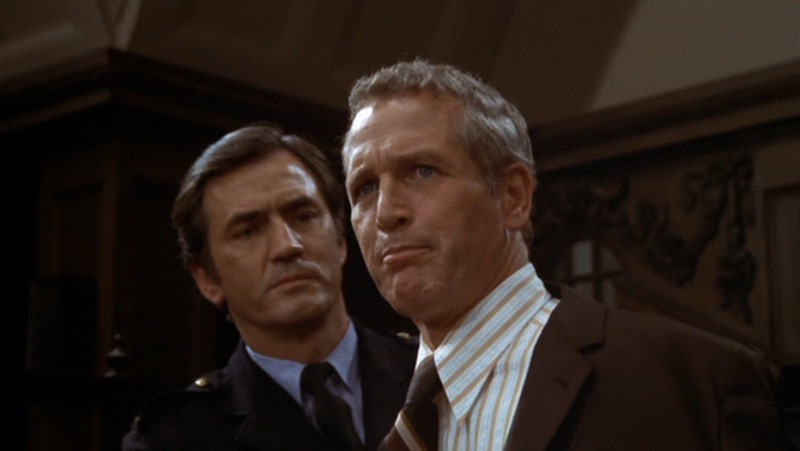
That logic (or lack of it) is much in display in Huston's film of The MacKintosh Man (written by Walter Hill),**** a spy thriller the director made in Britain and Malta with Paul Newman. In it, a British Intelligence agent, Rearden (Newman) is framed and sent to prison, in order to infiltrate a criminal organization. But, unknown to him, the deceit goes much deeper, as his superior, Mackintosh (Harry Andrews), is using the mission to ferret out a leak in information in the British government. Once Rearden is sprung from prison by the conspirators, overseen by an enigmatic figure named "Mr. Brown" (Michael Hordren), Rearden and another prisoner, Blake (Ian Bannen), are spirited away to an unknown location, drugged and held until the police activity surrounding the prison break cools down. The escape causes a row in Parliament, led by a law-and-order lord, Sir George Wheeler (James Mason), who rails against the bumbling way in which the prisons and the law are handling it, until he is persuaded to cool down the rhetoric by Mackintosh, himself.

Things get complicated when Mackintosh is run down in the street, and the operation taken over by his deputy, Mrs. Smith (Dominique Sanda), who is now charged with a double mission—finding the leak and who sanctioned the murder of Mackintosh.

Huston barely takes any of this seriously, even if Newman plays it straight, and Sanda—well, it's hard to tell if she plays it at all, her character being so enigmatic as to be undecipherable. But, it's all staged well (and photographed by the legendary Oswald Morris), especially a car chase through winding Irish country roads that look dangerous as Hell, and Huston ends on a typically ambiguous note. But, he's made much better films about duplicity and duty (as has Hill, for that matter), and this one feels like a minor effort before tackling much more ambitious projects. 


The Man Who Would Be King (1975) Huston's adaptation (with long-time collaborator/assistant Gladys Hill*****) of a favorite Rudyard Kipling story spent a long time in search of the right pair of actors to play the roles. First, it was planned with Gable and Bogart, but "Man plans, God laughs" (just like in a Huston film) and death interfered with the casting. Then, Huston suggested to Paul Newman he should play it with Robert Redford. But, Newman had the good grace and the good judgment to suggest Sean Connery and Michael Caine, two actor-chums who'd wanted to work together for years. That brilliant suggestion was just too perfect to resist—for Huston or Connery and Caine—and it led to one of the director's most well-rounded and entertaining adventure stories in years. As two rapacious former infantrymen and current soldiers-of-fortune, Connery and Caine play Daniel Dravot and Peachy Carnahan, free-mason brothers who have a very interesting take on plundering that sounds very close to nation-building (or traditional colonizing): they'll teach the tribes of Kafiristan to make war on each other while they take the ancient riches from the city as payment. 

That plan, after an arduous journey that tests their resolve and their mettle, works only too well and only too easily, so that their success can only be threatened by their own greed and hubris. It will lead one to his dreams far beyond his meager imagining, and the other to realize that Fate can break even the most stubborn of bonds, only to, ultimately, rebuild them again after a painful accounting. Everyone is brilliant in this and have the best of material to work with. Perhaps it was Fate, that enemy of so many best laid plans and Huston films, that forced the movie to wait for its perfect casting. The Man Who Would Be King is a classic of Huston's that ranks with The Maltese Falcon and The Treasure of the Sierra Madre (which it closely resembles in theme), as not only the best of Huston's work, but the best of cinema itself.


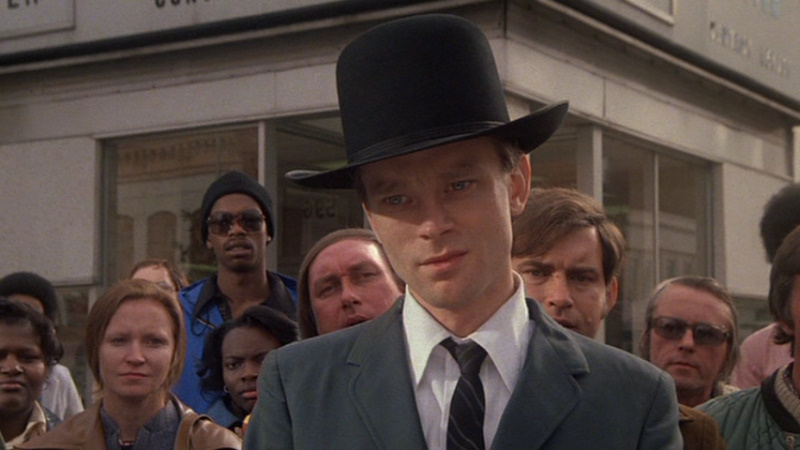
Wise Blood (1979)  Flannery O'Connor's excoriating look at religion (in general) and Christianity (in particular) is one bitter chalice of wine—satirical, venomous, and with a savage wit that doesn't seem so comic as you see it playing out. And the man who directed The BibleJohn Huston, takes O'Connor's fire-brand of a novel, and without being too showy, manages to dim the outrageousness and make it a little more real, and a little more relatable. Brad Dourif (a sadly underused actor) heads the cast as Hazel Motes, just off the bus from the Army. He returns home to find the home of his preacher-father (played by Huston) abandoned. You never steer too far away from the family tree, and when Hazel buys himself a new black suit, more than one person says it makes him look like a preacher, which raises Hazel's ire. He intends to live his post-service life as unpreacherly as possible, despite appearances. Huston keeps a lid on the blackness and bleakness, with an almost matter-of-fact presentation of all this, even being discrete at times. That's not to say the film isn't off-center, it is. Obviously it is set in America, but one is hard-pressed to determine when. Filmed in Macon, Georgia, it seems like it could be post-WWII with the attitudes and costumes, but the locals and vehicles are from the period of the filming—1979. It gives you the sense of backwardness and a slight disorientation, like none of it is real. Combine that with Huston's clear-eyed direction and you begin to not know what to believe. Apt.


Phobia (1980) What to make of this one? Phobia looks to have a TV-movie budget—so did Wise Blood, but with better source material, as opposed to this one, being the work of horror-film writers. After championing psychology in both fiction and non-fiction films, Phobia has as its protagonist a shrink (Paul Michael Glaser), treating his patents' fears through radical immersive media techniques, who, to his horror, discovers that his patients are dying—by the very things that terrify them. Very convenient. The police (in the form of police detective John Colicos) are baffled, especially when the accidents are a little too "on the nose" and begin showing signs of being set up. In the words of Ed Wood, Jr., "it looks like murder! And somebody's responsible!"

I was left wondering who was responsible for this film. There are faint glimmers that somebody was thinking during this, but not with any wit or panache. If anything, it looks like Huston was going out of his way to not put any style at all into the film—an anti-thriller...and trying to make the footage last long enough to make a feature-length film. Everything looks cut-rate, the photography is unexceptional, the sound muddy and "roomy," but without evoking atmosphere. Perhaps, like the procedure in the film, it was an experiment gone wrong, and one hopes that at least everyone got paid. It is, hands down, the worst film of Huston's career.


Victory (aka Escape to Victory)(1981) Based on a war-legend of Ukrainians playing football against Germans during WWII and a subsequent Hungarian film (Two Half-Times in Hell), this one tells the story of British POW's planning an escape from Nazi imprisonment during a propaganda match. It is best known for its starring of Pele and some 18 other footballers for the key game scenes. And then, there are Michael Caine and Sylvester Stallone. As the film feels a bit like a soccer-match crossed with The Great Escape, one could say that Stallone plays Hilts (the Steve McQueen role) as he is the one recruited to set the plan in motion with the help of the French Resistance by making his own solo escape and letting himself be recaptured to give details to the would-be escapees.

The film went through some re-writes (some at Stallone's behest)—originally the outcome offered by the German Commandant (played by Max von Sydow) is that if the Germans are allowed to win, the POW's would be freed, but if the POW's won, they'd be executed—but, it was changed to be a bit more straight-forward, winner-take-all conclusion, the POW's had to win the match AND escape, and if that wasn't enough, they choose to delay their escape, so they might ALSO win the match. That might be a goal too far for credibility's sake. Still, it's an interesting film for football fans.


Annie (1982) Producer Ray Stark had a hot property on his hands—the Broadway hit that had buoyed up the 70's and helped save New York Theater. Who to direct, though? Stark favored movie veterans for big extravaganzas—like Jack L Warner hiring George Cukor to direct My Fair Lady, he'd hired William Wyler to direct Funny Girl. Who was around to direct Annie that may give it the glamour it needed. John Huston? He'd never directed a musical before. But, Huston was probably one of the few directors alive who remembered The Great Depression, and might give it a bit more authenticity than a younger man would have given it. Also, Huston was about to embark on some of the darkest (but cherished) projects of his long career. Given that, why not Huston? His fatalism might keep the movie from becoming too over-the-top saccharine, and the film's own optimism is something of a tonic at this stage of Huston's career. 

The property is a mess—the songs are not great, although "Tomorrow" is an effective ear-worm—and once you boil down the comic-strip to its essentials, it's very campy. There's not much Huston can do with that—Carol Sobieski is credited with the script, what there is of it between the incessant songs—but he did some home-work watching M-G-M musicals and it is in the dance sequences, freed from stage limitations, where Annie genuinely shines as a movie. And it's quite a lovely thing that Huston stops the movie dead for a few minutes, to show us highlights from Cukor's Camille. Most amusing is the performance of Albert Finney, cast as "Daddy" Warbucks (Huston was first interested in Sean Connery playing it), who does a full-tilt dead-on John Huston impersonation in the role. And there's something else distinctive about Annie...


It is the only film in Huston's entire work that has an unambiguously happy ending.

WHAT could she be singing?


Under the Volcano (1984) One day in the death of Geoffrey Firmin, former British Consul to Mexico. One of those "unfilmable" novels that had eluded other directors, and that Huston had been eyeing for decades. Originally intended for Richard Burton, Huston again lucked into the perfect performance with Albert Finney—his "Daddy" Warbucks in Annie—taking the lead role. 

It is November 1, 1938, the "Day of the Dead" in Cuernavaca, Mexico and Firmin has just quit his job as Consul. He celebrates it and the Mexican festival the same way he does every day, by drinking himself into a coma. The activity is complicated by two unusual events: the return of his wife Yvonne (Jacqueline Bisset), who has returned, after leaving him the year previously, to try and reconcile their marriage; and the visit by his half-brother Hugh (Anthony Andrews), returning from reporting on the Spanish Civil War to touch base with his out-of-touch sibling in the hopes of helping him get back on the wagon, or, at least, to some semblance of functionality. But, Firmin is too far gone in his alcoholic delirium to even conceive of such sober conclusions. He does not make it easy, and is so far gone that his life may be irretrievable.

It is an amazing performance by Finney, who keeps the tragedy of Firmin the focal point by ignoring it, never making Firmin a fool but a genuine train-wreck on two shaking legs, suggesting the charm and intelligence of the man that once was, before being drowned in an ocean of booze. Like train-wrecks it's fascinating to watch, even as you know you should avert your eyes.


Prizzi's Honor (1985) Richard Condon's 1982 novel (the first of four "Prizzi" novels) is about love between two mob "hit-people", Charley Partanna (Jack Nicholson, who worshipped Huston and jumped at the chance to be in one of his movies), working for the Brooklyn Prizzi family, and Irene Walker (Kathleen Turner), a freelance contractor. With so much in common, why not fall in love? It is an anti-Godfather comedy of manners, where that film's myth of "family loyalty" is turned on its ear. It is, after all, "just business."

Charley meets Irene at a family wedding and asks his former lover Maerose Prizzi (Anjelica Huston), the Don's granddaughter, who it is. A little insensitive on Charley's part as he and Maerose used to be a couple. Seems Irene's a hit-person, who sometimes does "wet-work" for the Prizzi family. Charley is smitten, but is unaware that Irene is married. Fate plays a hand in the romance when Charley is assigned to kill Irene's husband for robbing a Nevada casino under Prizzi control. Irene agrees to pay back the Prizzi's what money she can access, but Maerose, jealous of Irene's hold on Charley, discovers that Irene is probably holding back some of the stolen money, a move that restores her honor inside the family, after her break-up with Charley. Amidst all the turmoil, Charley and Irene marry, but, as with so many marriages, work gets in the way of the relationship.

For Prizzi's Honor, Huston was again nominated for Best Director for a film (it was his fifth nomination for Director, though he'd been nominated many times for Writing)—and at 87, he was the oldest director to be so honored, and his daughter Anjelica actually won the Best Performance by an Actress in a Supporting Role Oscar, completing a multi-generational hat-trick for the Huston clan. Her grandfather, Walter, had won Best Performance by an Actor in a Supporting Role for The Treasure of the Sierra Madre, also directed by his son, her father. It is sweetly ironic that so much "family business" is tied to a film about a family business. But, it is also a neat little closing of the circle in Huston's career, that he should maintain such longevity and prowess to direct both his father and daughter to Oscar wins. He would have one more film in him, another long-wished-for project of his, and his daughter, Anjelica, would top-line it in another impressive performance.


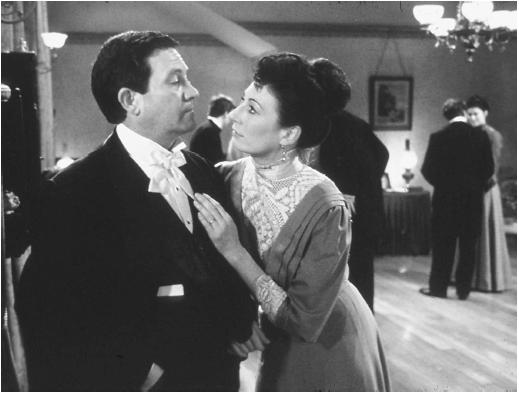
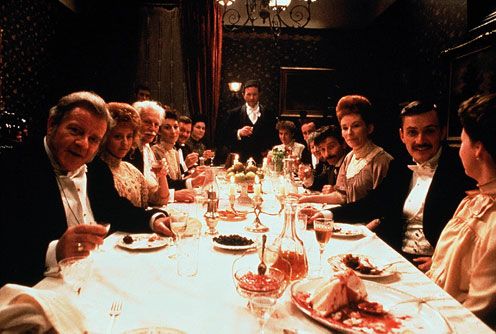
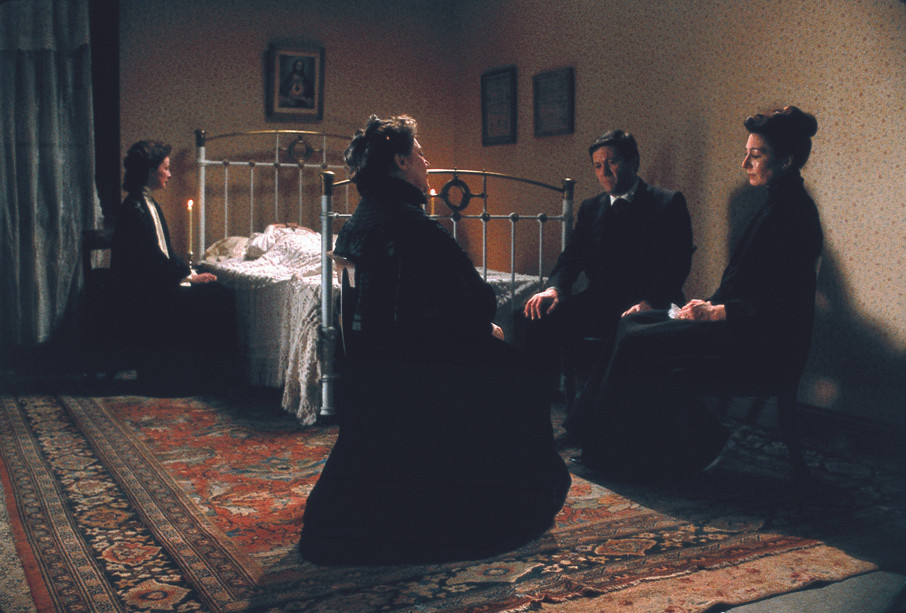
The Dead (1987) An annual Epiphany dinner held by the Morkan sisters (Helena Carroll, Cathleen Delany) creates an epiphany for their nephew, Gabriel (Donal McCann) and his wife Gretta (Anjelica Huston) in the legendary director's last film, a film every bit as strong as his first (The Maltese Falconway back in 1941) and in many ways far, far more subtle.

You look back on the accomplishments of Huston's storied career—the classics like FalconThe Treasure of the Sierra Madre, The African QueenThe Man Who Would Be King, the grandiose films of the '50's, his WWII documentaries, and "unfilmable" projects like Moby DickThe Bible: In the Beginning...Reflections in a Golden EyeWise Blood and Under the Volcano, and the occasional misstep like Beat the DevilCasino RoyaleThe Life and Times of Judge Roy BeanPhobia, or The MacKintosh Man******— it is apt that he "go out" on this simple, elegant adaptation of one of his favorite authors' (James Joyce) short stories, working with his kids (Tony wrote the screenplay, Anjelica stars and in many ways is the "center" of the film), set in the land he loved—Ireland—where he lived and filmed for so many years. An insatiable gambler on- and off-set, this one he was "all in" and left the table a winner.

Tough project, too. Most of it set in one rooma large part around a dinner table, with fine singing (and in one case, not—but the guests are graceful in their praise—and the director moves away from the elderly actress singing, having trouble with lip-syncing the dubbed song, and charitably meanders to another room, dwelling on the cherished collections of that character's rich life, instead). Huston was in frail health, directing from a wheelchair using a monitor in another room to keep the sound of his by-now always required air compressor from ruining the soundtrack while filming.

Graceful is the word for The Dead, and despite the title, it only periodically succumbs to Irish melancholy. It centers around a celebration, after all, a once-a-year special occasion in which, who knows, it may be the last time some of the group might be thereBest to keep the spirits up, the praise high, and the liquor slightly rationed. And there aren't any small parts here, if the lines are unevenly distributed, there are bits of business, reaction shots, ensemble acting and quite a bit of dancing to keep things busy.

I just wish (selfishly) the host had stuck around to throw another party.

John Huston statue in Puerto Vallarta
The inscription is from Huston's eulogy for Humphrey Bogart:
"We have no reason to feel any sorrow for him, only for ourselves
for having lost him. He is irreplaceable. There will never be another like him.'


* So he was dubbed by no less than Paul Newman.

**

*** Everybody is good in this, but one should also note Susan Tyrrell's feisty, free-wheeling performance of a drunk bar-fly that is on par with Keach's and  feels so real you want to throw up your hands and give up.

**** This was around the era where Huston was no longer adapting classics, but beginning to take advantage of the scripts of the new college-class of film-makers, including Hill and (for his previous film) John Milius.

*****
Huston's long-time assistant and muse Gladys Hill...with Connery and Caine.

****** Just imagine if his last film was Annie—which, in itself, was a weird untypical chancy project for him to take on!