When Orson Welles was asked what movies he studied before embarking on directing Citizen Kane he replied, "I studied the Old Masters, by which I mean John Ford, John Ford, and John Ford." Running parallel with our series about Akira Kurosawa ("Walking Kurosawa's Road"), we're running a series of pieces about the closest thing America has to Kurosawa in artistry—director John Ford. Ford rarely made films set in the present day, but (usually) made them about the past...and about America's past, specifically (when he wasn't fulfilling a passion for his Irish roots). In "The History of John Ford" we'll be gazing fondly at the work of this American Master, who started in the Silent Era, learning his craft, refining his director's eye, and continuing to work deep into the 1960's (and his 70's) to produce the greatest body of work of any American "picture-maker," America's storied film-maker, the irascible, painterly, domineering, sentimental puzzle that was John Ford, John Ford, and John Ford. The Iron Horse(John Ford, 1924) "Accurate and faithful in every particular of fact and atmosphere is this pictorial history of the building of the first transcontinental railroad" says the opening title card of The Iron Horse, John Ford's epic 2 1/2 hour silent epic about the building of the first transcontinental railroad. Well, that might be a stretch, but it certainly "becomes" truth, so "cut...print" this legend that manages to cram a large swath of American history into its story of cowboys, Indians, cattle-drives, the Pony Express, murder, ethnic conflicts, ethnics, situational ethics, love lost and found, men (lost and found), the transitory nature of railroad towns, a nice little bar-room brawl, and the consideration of what passed as frontier justice, as well as appearances by Buffalo Bill Cody, Wild Bill HickokandAbraham Lincoln. That's a lot of track to put down and Ford and his writers Charles Kenyon andJohn Russell manage to link it all with the stories of a disparate group of people all linked together to try to unite the country after its fractious Civil War. They just have to keep from killing each other first.
It starts with a man and a dream. David Brandom (James Gordon) is commiserating with two of his friends in Springfield, Illinois, contractor Thomas Marsh (Will Walling) and Abraham Lincoln (Charles Edward Bull) as he prepares a journey West with his son to survey a better path across the U.S. for a future rail transportation system than the Indian trail that is the expected route. Three months later, Brandom finds a pass that will cut the trip a good two hundred miles, but before he can alert anyone to the fact, he is attacked and killed by a raiding party of Cherokees, and killed by a white renegade who only has two fingers on his right hand. Davey Jr., hiding from the attack is left alive and is found by trappers.
Cut to June, 1862 and now-President Abraham Lincoln signs a bill to build two railways, the Union Pacific and Central Pacific, simultaneously to meet mid-way and construction, forming a continuous route from East to West, despite protests from the military not to divert funds from the Civil War. To watch the signing is contractor Marsh as well as his daughter Miriam (Madge Bellamy)—who had been sweet on young Davey in their youth, but is now engaged to her father's engineer, Jesson (Cyril Chadwick).
The project gets underway, but soon runs into difficulty, both internally and externally. Cheyenne warrior attacks plague the construction (led by frequent Ford actor Chief John Big Tree), disrupting payrolls and killing workers, requiring law enforcement to be constantly on-site. Those attacks could be at the instigation of a land-owner, Deroux (Fred Kohler), who wants the train to be built on his holdings—and he's aided by the fact that Jesson is taking bribes to maintain Deroux's interests over Marsh's'. It puts the project in a financial bind, forcing Marsh to start looking for a shorter, more efficient route that over Jesson and Deroux's objections.
In the nick of time reappears young Davey (George O'Brien) who encounters the train while delivering mail via the Pony Express. Davey re-unites with Marsh, who tells him of the troubles he's having, and Davey tells him of the pass he and his father discovered on their doomed surveying expedition all those many years ago. Marsh tasks Davey to re-trace the steps of the trip as the discovery may save the project from ruin.
But, Davey can't go alone. Jesson insists on going to verify the viability of the route. This is bad news for Davey, who's suspicious of the engineer, not only because he distrusts him on first sight, but also as he's engaged to Miriam, his boyhood love. He has good reason to distrust Jesson, as the crooked engineer has been tasked by Deroux to kill Davey and scuttle any plans to scuttle the route that would not benefit him.
Sure enough, once they find the fabled pass, while Davey starts to descend the side of the bluff to check conditions of the passage, Jesson cuts his rope, sending the young man tumbling into the valley. Without so much as a backward glance, Jesson goes back to Marsh to report the route is unsafe, Davey having been killed in a typical rock-fall.
Of course, he hasn't. That wouldn't be right. And how Davey gets back to the train is just one of the many sub-plots and incidences in Ford's massive epic—it would have been called a 15-reeler in its day (10 minutes a reel). And those reels are jammed with happenstance. Despite the plight of Davey, there's so much going on because...well, building a locomotive track across virginal country is a complicated thing...because of the remoteness and the man-hours needed and the supplies needed to feed and house those producers of man-hours, and that's fine if everybody agrees it's a good idea. If they don't, that's drama. And The Iron Horse carries a lot of drama.
So, yeah, there's all that stuff in the film I listed in the first paragraph of the post-proper. Davey's is just one story, but his story is contained in the entire movie, even pre-dating the building of the railroad. There's a call-back to the earlier murder of Davey's father, the perpetrator being one of the dramatis personæ in the latter-day proceedings. To anyone who's experienced the bubble-universe of movies, it won't be any surprise who the scoundrel is (actions beget character), despite that individual's ability to cross cultures.
As insular as the story is, it does take advantage of the scope inherent in such a massive project as the transcontinental railroad, an attempt by settlers to unite both shores of the continent and create a line between such far-flung expanses and peoples. Ford's histories of the U.S. are all about world-building, the particulars of the individuals finding common ground, despite their differences, and making a better world for themselves through the efforts of the dedicated and despite the desires of the self-interested. Community is all in Ford's films, even in such early efforts as this silent epic that stretched the boundaries of subject matter, location filming, and the art of film-making.
It's an epic tale of an epic task, a milestone in building a future and cementing the "United" in the "United" States.
Ford's The Iron Horse was voted into The National Film Registry in 2011. How could it not? So far, 11 of Ford's films have been voted in, more than any other director (aside Howard Hawks' 11). I'm sure there will be more to come in the future. The Iron Horse will enter the U.S. public domain in 2020. It can be seen on YouTube and Daily Motion—for free—now.
It takes a lot of time to do the "Don't Make a Scene" feature that I put up every Sunday (all those screen-caps!), so while I'm preparing a bunch more, I'm going to take a break and re-post the ones that have gotten the most "hits," counting down from the 10th highest to the first. When I started compiling them, I was totally baffled by the results (enough that I'm considering posting a couple of my favorites that resonate a lot with me, once we're done with this). I would never have thought that these would be the most looked at, but here they are, as part of "Don't Make a Scene (Redux)."
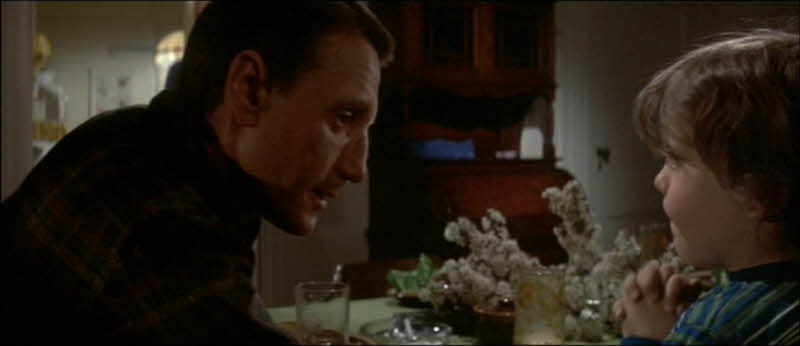
The Story: For me, the artistry of Steven Spielberg is not in the big things, but the little ones. Yes, Jaws is a great picture for the brio with which it was made, crafting an action thriller in the one place where things get cinematically slowed down—the water—with an antagonist that is barely seen, because it was technologically tough to pull off in salt water (translation: the damned shark rarely worked). Spielberg had to conjure suspense out of nothing but ideas, and he was learned enough in cinematic tricks to pull it off. That's what everybody remembers. But, when I think of Jaws, I remember how he managed to get a sense of community and decent performances out of the locals, and how he managed to make things matter before we go shark-hunting. In a movie where the people could get lost in the movie-making mechanism, ground up like in the teeth of a shark, Spielberg and his writers emphasized character and made us care. I always remember this scene from Jaws, when I think of how good a film-maker Spielberg is. It's just an economical thirty seconds, hardly a bump in the road, in the film's momentum. But it shows the depths of grief Brody is going through, and why he would personally take on the task of joining the Orca expedition to take on The Great White Shark. The Set-Up: Amity Police Chief Brody (Roy Scheider) has had a rough few days. He's getting pressure from all sides. A great white shark has decided to make a high tourist season beach its personal buffet, killing several of its townspeople. The citizenry is, naturally, alarmed. The mayor wants the news stifled, and local experts are starting to nose around. Plus, there are several shark-vigilante groups stupid enough to try to hunt it down. A tiger shark has just been caught, but the interest has died down when the mother of one of the victims has confronted and slapped the Chief in public. That night, at the dinner table, things are subdued. Action.
INT. BRODY HOUSE - NIGHT - DINING ROOM
Brody and Ellen, Sean and Michael, have all finished dinner.
Brody's plate is untouched, a virgin meatloaf. His glass, on the other hand, is well used, with the remnants of a stiff scotch and ice.
He is staring across the table at the youngest, Sean, who makes a face at him.
He makes a face back.
They play this game together for a few minutes.
BRODY C'mere
BRODY:give Daddy us a kiss.
SEAN Why?
BRODY Because he I needs it.
Sean gives Daddy the kiss. Brody shoos him and Michael off
to bed.
Ellen, who is feeling progressively more left out
with each passing moment, gets up abruptly and clears a few
dishes. Brody is not letting her into his world for the
moment, and it shows.
 The Iron Horse (John Ford, 1924) "Accurate and faithful in every particular of fact and atmosphere is this pictorial history of the building of the first transcontinental railroad" says the opening title card of The Iron Horse, John Ford's epic 2 1/2 hour silent epic about the building of the first transcontinental railroad. Well, that might be a stretch, but it certainly "becomes" truth, so "cut...print" this legend that manages to cram a large swath of American history into its story of cowboys, Indians, cattle-drives, the Pony Express, murder, ethnic conflicts, ethnics, situational ethics, love lost and found, men (lost and found), the transitory nature of railroad towns, a nice little bar-room brawl, and the consideration of what passed as frontier justice, as well as appearances by Buffalo Bill Cody, Wild Bill Hickok and Abraham Lincoln. That's a lot of track to put down and Ford and his writers Charles Kenyon and John Russell manage to link it all with the stories of a disparate group of people all linked together to try to unite the country after its fractious Civil War.