Super-Saturation
or A Small "s" Sequel The first Guardians of the Galaxy movie looked like such a lame concept in the trailers (and post-credits set-up of some Marvel film or other—I've lost track*) that it was a pleasant surprise for it to be not only fresh and funny, but an oddly genre-disdainful addition to the Marvel Universe, a story of space-orphans who form a Dirty Half-Dozen and quite against their intentions become a family, a dysfunctional family, to be sure, but a family nonetheless. Indeed, more power to them as they discover they're better as a group than as individuals, no matter how good they think they are, individually. Given the success of the first film, there had to be the inevitable sequel, called (unimaginatively) Guardians of the Galaxy, Volume 2. Same cast with a few additions, same writer-director (James Gunn, whoseSuperwas a damning condemnation of heroic vigilantism, comic culture and the ones who are both perpetrators and victims of it) and one would hope, given his past, that any continuation would have the same affectionately anarchic spirit and mess with the formula.
The self-styled Guardians are on a job protecting a group called "The Sovereigns" (as in the coinage, I'd guess, because they are gilded from head to foot like some Goldfinger fetish-fantasy) whose "something-or-other" batteries are being threatened by a "who-the-hell-cares" squid-ish attacker from outer space that's going to drain them or eat them or replace them with cheap convenience-store-branded batteries and that just ain't right. It feels like a disposable "Men in Black" sequence where they just needed a strong open and this is as good as any to show that the group is still together and functioning as a viable team.
Now, as everyone synchronizes watches and gets ready for the attack, Rocket the Raccoon (he has a lot of good disparaging nicknames in the movie) is busy...setting up a sound system? What the...? It's because one of the delights of the first film was its use of old obscure pop as a soundtrack and the sound system is to play a track...possibly as mood music for the team, distraction for the opponent, or for soundtrack sales for Marvel Studios (my guess would be the latter). Whatever. The Main Titles run along while the Guardians are battling a big-mouthed squid, while in the foreground Baby Groot is boogieing to ELO's "Mr. Blue Sky" to the delight of the audience, while the carnage goes on around him.
Cute. But derivative, one might even say pandering. And a bit of a time-waster, even if the Titles are unwinding in the background. It's a call-back to the previous film's mid-credit sequence where "potted" Groot is grooving to the Jackson's "I Want You Back"—and freezes whenever Drax (David Bautista) notices him. This sort of "memory lane" of audience highlights is lazy writing and dilutes the good will of the original as well as its uniqueness. I keep wondering if someday a movie sequel will ever be a direct copy of its predecessor and I realize that it's been done—Back to the Future II, for most of its length follows a parallel path to its Part 1. It's a weakness of series films that they hearken back to their origins, and there's nothing anyone can say except "I've got a bad feeling about this." It is lazy writing, but at the behest of producers who know it's less risky to do more of the same than tinker with what made the coffers fill the last time. This is concerning for someone who enjoyed the original Guardians' insouciance in messing with the uber-tone of most movies based on comics, trying desperately to be taken seriously that they take on the mantle of big-m "Myth." It's indicative of less risk-taking (which made its predecessor so enjoyable). A Guardians of the Galaxy entry that took itself seriously would be as dull as Thor...or Iron Man III. Enough on that, there's a whole rest of the movie that improves things.
Ayesha...or "Her"...or "Kismet"...anyway, she's different from the Marvel comics version...i f she weren't she'd be the Sylvester Stallone character's mother. A-Yeesh.
But, the sequence does get the movie started and introduces us to the Sovereigns, whose Queen Ayesha (Elizabeth Debicki...in an Oscar-worthy performance because, frankly, she LOOKS like an Oscar) pays the Guardians their reward, the sister of Gamora (Zoe Saldana), Nebula (Karen Gillan), the bitter daughter of Thanos (it would be Josh Brolin if he appeared) who disappeared after commandeering a ravager ship in the last movie. Fortunately, it starts to lighten up once the G.o.t.G's move away from Main Title Land. With Nebula in tow, they have to leave in a hurry when it's discovered that Rocket has stolen some of the batteries they've been paid to protect. The Sovereigns send out an impressive number of drone-ships to stop them, but a couple of light-jumps and the battered ship, which is dragging a tethered Drax held by a straining Gamora with her hair on fire (now that's a bit more like it!), crash-lands on a far-away rock.
"Some day, son, this can be all yours..."
They've been followed. The folks in the craft are Ego (Kurt Russell) and his protege Mantis (Pom Klementieff), who make the astounding revelation that Ego is the actual biological father of Peter Quill (Chris Pratt)—his real one, not his human step-father. Quill, Drax and Gamora go to Ego's planet (well...yeah, no, I'm not going to say it...spoiler) while Rocket and Groot keep an eye on Nebula while repairing their ship. The Sovereigns aren't done yet. After Yondu (Michael Rooker) has a falling out with another Ravager, Stakar Ogord (Sylvester Stallone...mm-hmm...we're starting to recycle past super-hero stars***) over child-trafficking (he's the one who plucked Peter Quill from Earth, after all, but...keeps him...because he had tiny, stealing hands), he's approached by the Sovereigns to track down the Guardians wherever in the Universe they might be.
Ego's planet...or maybe...his ego's bigger than you think.
So, there's a lot of conflict and cross-conflict: the Guardians against the Sovereigns AND the Ravagers; factions of the Ravagers against other factions of the Ravagers; Nebula against Gamora; Quill against his team-mates who are suspicious about Ego; Quill with his own suspicions about Ego (despite his finding out the answer to one of his Big Questions). With conflicts come alliances and sometimes in the most unexpected places. Old grudges dissipate with new understandings and different perspectives and the Guardians evolve into a new team, a combination of old and new members.
"We are a pair, aren't we?"
But, the biggest conflict isn't Ravager or Sovereign vs Guardian, it's Nature vs Nurture. It seems odd but wholly appropriate that by the end of Guardians, Vol. 2, there is a perverse contradiction of "there's no place like home." DNA is less important than the strings that tie us together; sure, you may find your biological father or mother, but sometimes, in their absence, you may outgrow them or even replace them with what you need. It is not as complex as Oedipus, especially in the comic-book world filled with orphans who find themselves empowered without biology having anything to do with it. Our courts (in the real, non-fictional world) favor DNA over everything when they have to solemnize the future of a child. Guardians 2 comes down hard on the side of step-parents, mentors, and...well, guardians, who will take in a waif when there's a case of need, even if the arguments against are as a big as a planet.
....ow
It's different and that's good. For all the call-backs and deja-vu moments, it doesn't run in place until it comes up with a good idea for a third movie (which a lot of sequels do). It takes a major hanging plot-point, resolves it, and moves on. That actually builds more good will in a franchise than all the repetitions of key moments can buy.
The Ego begins inflating across the Galaxy (when its Guardians are distracted)
** And, as if to belie that opening asterisked statement, I am wrong in this point—there IS a prelude of sorts, set in "EARTH. MISSOURI. 1980" with a CGI'd Kurt Russell (this "de-aging" stuff DOES NOT work on conventionally handsome or beautiful actors, but seemed to work well on the recreation of the skull-like countenance of Peter Cushing in Rogue One.)
"The (10th) Greatest Marvel Film Since Avengers: Endgame!"
or
"The Ballad of Rocket Raccoon"
I notice an up-tick in the number of people who looked at my review of Guardians of the Galaxy Vol. 2. I've long since stopped trying to figure out the patterns of what people are looking at, but I suppose it had something to do withe the release of Guardians of the Galaxy Volume 3—the movie that James Gunn was working on when he got hired as the High Evolutionary of the DC Movie Universe.
But, there was no incentive to see it. I haven't watched the last couple of Marvel movies, as they've been sputtering as far as quality, depending on call-backs, cameos, or with no clear sense of where things are going—other than contracts need to be fulfilled, promises made must be delivered on, and a general running-in-place while Kevin Feige tries to come up with a follow-up to the colossal success that was the first batch of Marvel movies. It seemed like, at those times, they were taking chances, swinging for the fences, and hitting home-tuns. Now, it seems they're just counting the receipts, waiting for the Next Big Thing to happen.
Trouble is the fan-base is lying in wait. Disappointments among the "TrueFans" may collapse the enterprise like a stack of back-issues no one's bothered to box.
Still, folks DID look at the review. I made a point to see it.
How is it? A pretty good send-off, actually, while being something different. It's an origin story of sorts—of how Rocket the Raccoon (voiced again by Bradley Cooper) came to be a wise-cracking, take-no-prisoners, but still fuzzy-funny animal came to be, mostly told in flash-back, after he is left near-death after an attack on Guardians of the Galaxy HQ (Planet Knowhere) by Adam Warlock (Will Poulter). The super-powered Warlock is on a mission to steal the mercurial mammal for his mother, Queen Ayesha (Elizabeth Debicki) of the Sovereigns at the behest of The High Evolutionary (Chukwudi Iwuji), a sort of gene-split Dr. Mengele/Dr. Moreau of Space, who's on a mission to create the perfect utopia based on his manipulating evolutionary traits.
Yeah, that trick NEVER works, but His Highness (Evolutionarily) wants Rocket—or as he designates him, Test Subject "89P13"—back, as the little varmint was the only test subject of his that displayed original thought, and may be the key to achieving his perfect utopia. Too bad that the way to get him back puts him in a coma.
The Guardians band together to try to save Rocket's life, but discover that he has an implanted kill-switch on his heart that will explode him if they trying any extraordinary efforts to save him. But, Peter "The Star-Lord" Quill (Chris Pratt), still nursing a broken heart after losing his lost love Gamora (Zoe Saldana) during the events of "The Blip"—then getting back an earlier version of her that can't stand him—determines that he's going to find the code to disable the kill-switch and save his little bandit-buddy, even if he has to travel the Galaxy, kill a bunch of multi-legged creatures and even *gulp* face his ex-girl-friend to do it.
And so, they do, over 2½ hours (which feels it, probably due to some rocky transitions that director Gunn has trouble with), meeting new friends and old friends of Gunn's in new roles (Nathan Fillion, anyone?), squeezing inSylvester Stallone(the guy cannot handle tech-talk),Liz Debicki, and even an appearance by Howard the Duck (voiced bySeth Green, nice), and actually providing "I'm worth-being-here" arcs to Mantis (Pom Klementief) and Kraglin (Sean Gunn). Plus, we get another example of why Karen Gillan may be the most unsung-acting hero in the MCU and a "giving it 100%" performance by Pratt. Throw in a talking space-dog (voiced byMaria Bakalova—"He just called me 'a BAD DOG!'") and you have a vast cornucopia of cutesiness mixed in with Gunn's "ick" factor. Call it "Anthropro-Marvel"—the place where the studio can really get silly (even by comic-book standards).*
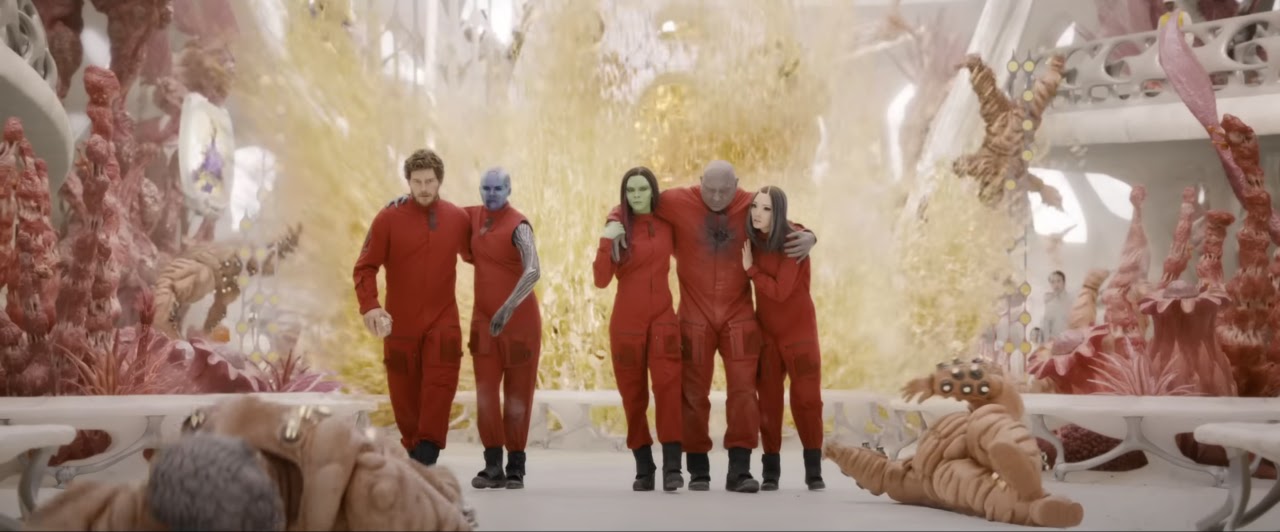
Take, for example, the look of the High Evolutionary's Orgosphere—an organic planet made out of meat—which is pure 20th Century Fox sci-fi tacky, ala Fantastic Voyage or Barbarella. It has the look of spareness, but the detail of something well-considered, rather than what the budget could spare. And one just knows, going along that one is missing a gazillion references stuffed into the thing with minor characters and such, but, frankly, there's enough for the non-Marvel Zombie to appreciate.
At the same time, there's a nice little message about universality and worth, where one's lab-rat could just be worth saving if only they were noticed. It's an extension of the original GotG movie, where everyone was, basically, a cast-off, but were worth more than the sum of their parts put together. Here, no one's a loser, except for the one's who never would have suspected they were in the first place. And, once again, it shows that although Gunn will always make films that feel tough-as-nails-cynical, they still have a core of sentimentality to them that puts them a notch above the usual super-hero fare.
It's a good movie for the series to go out on (if, indeed, it ends).
* Although judging by the Marvels trailer, they're not going to stop there.
We started "Blogging By Cinema-Light" on January 26, 2014 to fulfill a need. Not to give the world another movie review blog (there are far too many of those), but to focus my attention on the writing and the movies and less on the day to day busy work of maintaining the various little goo-gah's and widgets of the previous web-site—"Let's Not Talk About Movies." That site was doing well (approaching 1 million hits when I abandoned it). But the name...that started seeming a little precious and counter-productive. So, for 2014, I re-thought, re-imagined, and did a thorough scrub of the concept (eliminating a ratings system that, while practical, still seemed to box films into niches that unfairly summed them up and became too much the focus), accentuated the visual, and allowed me a better chance to focus and work on an ever-growing back-log of reviews for older films (a goal that still manages to elude me).
The blog has steadily grown without benefit of affiliations although I have expanded the distribution through Google+, Twitter, Facebook and the usual Networked Blogs, and slowly but surely, the numbers have been picking up as word has gotten out semi-organically (while LNTAM continues to be a warehouse store that people keep coming back to, even if the shelf-life of those articles have approached gaminess and might be breaking down, functionally—they get moved over to BBCL and fixed and updated, if possible).
And what have people been clicking on since we started?
"I have taken over your blog... and your readership" (And, yes, I'm pandering)
Scarlett Johansson, evidently. The article that has gotten the most hits since we started was my snarky review of Lucy, the sixth is my luke-warm but appreciative look at Under the Skin (But, curiously, not Don John or Captain America: Winter Soldier). Maybe it's the gif graphics of her eyes blinking that are attracting people (Morse code?). Hard to say, but the folks coming here have some sort of Scarlett Fever. We shall see if something else attracts people more in the coming months (There's the new Avengers movie and one from the Coen brothers (Hail, Caesar!)...but they both feature...Scarlett Johansson. Damn!). The rest of the top five are a single review of The Godfather, Part III (I LIKE to think because people are fascinated with my take on the religious aspects of it, but probably not), two entries of the semi-regular "Now I've Seen Everything Department" overviews—for James Cameron (because who doesn't like James Cameron movies?—me, evidently) and the "Planet of the Apes" dynasty, as well as Shutter Island(no idea why that's so popular, but I suspect folks just want someone to explain it to them...not gonna happen, sorry). Another curious entry in the top ten is my review of The Maury Island Incident, which I explain away because it was a locally-made film and the review was probably visited by every member of the cast and crew (and re-distributed through other web-sites).
Two that I have missed: A Most Violent Year (because I haven't gotten around to it) and Still Alice (because the studio is waiting until Oscar buzz makes audiences want to see a drama about Alzheimer's).
I'm out of the sound business...permanently now. But, I still listen closely to movies and very much admire films that are mixed well and where the sound is integral and part of the visceral experience of a film (and do something creative, which is rare). I can't say I was impressed by much this year, everything I saw sounded competent for verisimilitude, but nothing made me sit up and take notice, except for one thing: I was quite annoyed that some movies were horribly mixed...Interstellar being the prime example. I love film music, too. But, in the same movie, I found Hans Zimmer's thumping score for it a detriment to the entire experience—at one point, even drowning out and supplanting dialogue. It might not be important dialogue, but nevertheless, it should be heard. Music supports, and can even drive a narrative. But it should never smother it. Here are my favorite scores of this year: The Imitation Game and The Grand Budapest Hotel by the versatile Alexandre Desplat, and The Theory of Everything by Johann Johannsson.
I also collect soundtracks, which with the digital revolution and the parsing of the multi-tracks of sound and music have created a boom of releases over the past 20 years, including the official releases of scores I thought would never see the light of day—one of those being a personal favorite that I've wanted for nearly 30 years—Jerry Goldsmith's score to the John Huston mystery trifle, The List of Adrian Messenger.
Freeze-Frames:*** The Imitation Game—Held shot on young Alan Turing (Alex Lawther) as he finds out about his school friend, Christopher Morcomb Birdman—an extended conversation (well, they all are in this movie) between Riggan Thomas (Michael Keaton) and Mike Shiner (Edward Norton) where Keaton stumbles over his lines...but it feels so natural and real I wonder why more actors (excepting James Stewart) don't do that. The Guardians of the Galaxy—the perfection of the selection of the songs for the "Awesome Mix Tape"
Whiplash—J.K. Simmons (just saying...and cowering). Jersey Boys—Clint Eastwood indulges in a CGI tour up The Brill Building accompanied by many songs filtering out the windows in their infancy. A Most Violent Year—"power" performances by Oscar Isaac and Jessica Chastain in every sense of the term. The Grand Budapest Hotel—the never-ending civility of M. Gustav (Ralph Fiennes) despite "the barbaric slaughterhouse that was once known as humanity."
Best line of 2014: The Theory of Everything—"Thank you, Mother. I think that may be the most English thing anyone's ever said to me" The Drop—Bob Saginowsky (Tom Hardy) reacts to the idea of keeping a dog: "That's a huge responsibility." Second best line. Big Eyes—A Hitchcock echo from Tim Burton: After leaving her first husband, Margaret Ulbrich (Amy Adams) drives to San Francisco with her daughter; she passes a line of foothills that will be passed by Marion Crane (on her way to The Bates Motel) one year later in screen time, but 54 years ago in ours. Under the Skin—The Female (Scarlett Johansson) lures her victim into a non-descript house and walks teasingly into blackness, as her victims strip...and sink.
The Homesman—Reluctant shepherd George Briggs (Tommy Lee Jones) goes looking for another lost sheep and finds a bitter reflection of his earlier circumstances: "I kept my word and here you broke yours..." Selma—Martin Luther (David Oyelowo) and Coretta Scott King (Carmen Ejogo) sit in a darkened room listening to a tape sent to them by the FBI of a blackmailing sex tryst. Director-writer Ava Duvernay writes it so that Coretta recognizes it's not him, but Ejogo plays it so the question still hangs. Boyhood—The big "eerie" of how different young Mason (and Ellar Coltrane) looks as he ages.
The Amazing Spider-man 2—Peter Parker (the sadly fired Adam Garfield) tries to explain the soot all over him to Aunt May (Sally Field): "I was cleaning the chimney!" "We HAVE no chimney!" "Wha-a-a-a-a-a...??" and while we're in super-hero territory: Captain America: Winter Soldier—Cap (Chris Evans) keeps a checklist of things he needs to check out in the here-and-now since his WWII deep-freeze.
and: X-Men: Days of Future Past—Quicksilver (Evan Peters) super-speeds around a room being disarming while grooving to Jim Croce's "Time in a Bottle" on his Walkman. It would be the best presentation of that super-power already, but the song just aces it.
Oh, okay, two more... Big Hero 6—another leap in CGI animation with the amazing facial work in this film and the "look" of San Fransokyo.
Birdman—Riggan Thomas' "Birdman" voice sounds less like his "Batman" voice and more like Christian Bale's. Now, THAT is funny... Leaving super-hero-ville with one last line—from Guardians of the Galaxy: "I'm going to die surrounded by idiots!" Interstellar—Astronaut Cooper (Matthew McConaughey) reacts to 40 years of messages from home, realizing that, for his choice, he can never get those lives back. Never, ever go near a black hole.
The Theory of Everything—"How long?" Stephen Hawking (Eddie Redmayne) asks his wife (Felicity Jones) apropos of nothing and everything. "Two years" is her sorrowful reply. Gone Girl—"We're so cute I could just punch us in the face." Agreed. Still do. The Imitation Game—the eyes of Keira Knightley: an actress most well-known for how well she can go off the rails, in The Imitation Game, she has to play a very normal, very proper, very restrained, very British woman, and all the acting comes from her eyes, most notably in the horror expressed at the effects the chemical castration drugs on her friend Alan Turing (Benedict Cumberbatch).
Director Damien Chazelle does the Oliver Stone "double daddy" dance to the extreme in Whiplash. Birdman—Is Riggan's on-stage shooting a jokey metaphor for actors trying to reach too far? Really? The Most Wanted Man—Philip Seymour Hoffman's F-bomb screaming freak-out at the end of a very, very measured performance.
Big Hero 6—"On a scale of 1 to 10, how would you rate your pain?" Baymax is hilarious. Godzilla—the best thing about it, really: the bizarre HALO jump into the city besieged by two prehistoric monsters to the tuneless voices of Ligeti's "Lux Aeterna."
Fury—This nearly final exchange between Norman Ellison (Logan Lerman) and "Wardaddy" Collier (Brad Pitt): "I'm going to surrender." "Please don't..."
The Fault In Our Stars: "Perhaps 'okay' will be our 'always.'"
Dawn of the Planet of the Apes—the opening sequence of apes on horseback hunting reindeer. The one time I actually DID laugh in Inherent Vice—"Doc" Sportello reacts to Hope Harlingen's (Jena Malone) "crack-baby" picture.
Edge of Tomorrow (or is it "Live. Die. Repeat?")—the semi-guilty pleasure of watching Tom Cruise being killed over and over entertainingly. Jersey Boys—We get an idea of what a "Clint Eastwood Musical" really is, at the end, when the entire casts bops down the street to "December, 1963 (Oh, What a Night) with performer's brio and panache...and on the last note, Eastwood hangs on the performers in their final stances for a very long period of time, smiles plastered on their faces, arms raised in the air. A series of frozen tableaux...for nostalgia? This thing haunts me.
The Homesman—the varying degrees of crazy on the prairie.
The Grand Budapest Hotel—the intricate nested doll construction (with aspect ratios) devised by Wes Anderson.
The Imitation Game—Turing's bombe...stops.
Captain America: Winter Soldier: Robert Redford gloriously underplays his villainy: "Oh, Renata, I wish you would have knocked..."
Foxcatcher—Wow! Steve Carell comes out of nowhere in the face-slapping scene: "You ungrateful ape!"
The Drop—another brilliant Dennis Lehane turnaround you never see coming, but should have. The Imitation Game—Joan Clarke (Keire Knightley), under pressure from her parents, refuses the job offer at Blechley Park to Alan Turing, who won't take "no" for an answer: "That would be...indecorous" Turing, the genius, bursts in frustration, "I don't even know what that means!!" No, of course he doesn't. The Theory of Everything—Stephen Hawking sitting in his bathtub, staring at the hand that is betraying him by no longer functioning because of ALS.
Life Itself—Despite a non-existent jaw, Roger Ebert's spirit comes through in the form of a smile above ever-twinkling eyes. American Sniper—Chris Kyle (Bradley Cooper) looks at TV footage of an embassy bombing and sums up and presages: "Look what they've done to us..." The Skeleton Twins—Maggie Dean (Kristen Wiig) is pissed off, but that just won't do for brother Milo (Bill Hader), who presents her with a little inspirational Starship.
And, from Into the Woods—Agony:
And finally, lest we forget:
*** After, and in the spirit of, Kathleen Murphy and Richard Jameson's yearly recap of "Moments Out of Time" .
A Long Time Ago In a Galaxy Far, Far Away The genesis of the Star Wars series can be seen in George Lucas' first feature THX-1138; that film begins with a promo for the movie serial "Buck Rogers in the 20th Century" "Right after (American) Graffiti I was getting this fan mail from kids that said the film changed their life, and something inside me said, do a children's film. And everybody said, 'Do a children's film? What are you talking about? You're crazy'. I was a real fan of Flash Gordon and that kind of stuff, a very strong advocate of the exploration of outer space and I said, this is something, this is a natural. One, it will give kids a fantasy life and two, maybe it will make someone a young Einstein and people will say, 'Why?' What we really need to do is to colonize the next galaxy, get away from the hard facts of 2001 and get on the romantic side of it. Nobody is going to colonize Mars because of the technology, they are going to go because they think maybe they will be able... well, it is romantic, it is the romantic aspect of it that needs to be looked at for a second, which nobody had ever looked at before. I mean, everybody had looked at the hardware end of it."*
After trying to buy the rights to "Buck Rogers" (and finding it prohibitively expensive) Lucas began cobbling together his own story out of disparate bits and pieces—scifi, westerns, war stories (and the current Viet-Nam struggle), movie serials, sword and sorcery stories, Arthurian legend, Kurosawa movies, Baum's Oz series, all manner of things in his cultural zeitgeist to create his romantic sci-fi story. It went through a lot of changes...from the hero being female...the primitive wookies leading the fight against The Death Star...the hero's name being Luke Starkiller...his hermit warrior being crazy and surviving the entire movie...all manner of changes. He then began assembling a team of imagineers, like artist Ralph McQuarrie, model-maker Greg Jein, the team of underemployed effects artists under the helm of John Dykstra, sound effects creator Ben Burtt. Despite the success of American Graffiti, Lucas' odd little space movie "The Journal of the Whills" was rejected by Graffiti's distributor Universal Pictures, but picked up by Alan Ladd Jr. at 20th Century Fox, who took a chance on Lucas based on his previous film's success and secured a budget of $10 million. Lucas, in his contract, retained all sequel rights. And merchandising.
The Original Trilogy
"They were in the wrong place at the wrong time. Of course, they became heroes."
Princess Leia Organa from "The Journal of the Whills" (From the "Star Wars" novel by George Lucas (ghosted by Alan Dean Foster)
Episode IV: A New Hope(George Lucas, 1977) "It is a period of civil war. Rebel spaceships, striking from a hidden base, have won their first victory against the evil Galactic Empire. During the battle, Rebel spies managed to steal secret plans to the Empire’s ultimate weapon, the DEATH STAR, an armored space station with enough power to destroy an entire planet. Pursued by the Empire’s sinister agents, Princess Leia races home aboard her starship, custodian of the stolen plans that can save her people and restore freedom to the galaxy…."** "A boy...a girl...and a Universe" said the first trailer for Star Wars. Orphan Luke Skywalker (Mark Hamill) lives on Tatooine—"if there's a bright center to the Universe, this is the planet that it's farthest from" he says disparagingly. He's just an apprentice moisture farmer on his desert planet home, but he dreams of joining the Space Academy to become a pilot—like his father he never knew.
Fate...and politics...run in his favor; the Galactic Empire has built a super-weapon and the resistance movement have found the plans for it and its vital flaw that may be the key to destroying it. In desperation, the rebels, led by the planet Alderaan's Princess Leia Organa (Carrie Fisher) have flown to that same "nothing" planet that has been the make-shift Elba of General Kenobi (Alec Guinness), a former resistance hero who could make use of the plans. By happenstance, the plans and the boy reach Kenobi ("that crazy old hermit") at the same time, and the Empire—in their search efforts—remove any reason for the boy to remain on the planet and continue with Kenobi on his mission to deliver the Death Star plans to the rebels...and to keep the boy, the primary reason he's been on that worthless rock for 20 years, in his tutelage, to right the wrongs of his past.
With a scruffy (if hunted) space-freighter smuggler named Han Solo (Harrison Ford) and his even scruffier co-pilot Chewbacca (Peter Mayhew) providing transport, the group make their way to the rebel base on Dantooine, which, when they arrive, they find to be nothing but blasted rubble, and, a bit distant from the field, the Empire's planet-killer, the Death Star. Luke is determined to rescue the Princess and Kenobi to disrupt the planet-killer's defenses, but any arguing about it becomes moot, when their ship is captured by a tractor beam.
Before their adventure is over, the Princess will be rescued, General Kenobi will be dead, and young Luke will save the Resistance by destroying the Death Star, with the help of Solo having his back as well as by the mystical urgings of a spirit-guiding Kenobi.
The second part of a Star Wars trilogy was a fore-gone conclusion after the runaway success of the first one, but its success allowed Lucas to do a few things he had hoped to originally do, but was discouraged due to a budget dictated by the "dodgy" box-office potential of the first film. First, he resurrected the "serial" aspect of the stories by renaming the first film "Episode IV: A New Hope" and its second film "Episode V: The Empire Strikes Back." There was much potential after the first film (Vader was still around, the Empire still in charge, Luke was a new, if untrained, hero with "The Force"), but no story. The first draft, from a Lucas idea-sketch was written by longtime sci-fi writer and screenwriter (mostly for Howard Hawks) Leigh Brackett, which was deemed promising but not quite in the direction Lucas wanted to go. For that, Lucas hired his Spielberg-recommended writer for their Indiana Jones collaboration, Lawrence Kasdan.
Episode V: The Empire Strikes Back(Irvin Kershner, 1980) "It is a dark time for the Rebellion. Although the Death Star has been destroyed, Imperial troops have driven the Rebel forces from their hidden base and pursued them across the galaxy. Evading the dreaded Imperial Starfleet, a group of freedom fighters led by Luke Skywalker has established a new secret base on the remote ice world of Hoth. The evil lord Darth Vader, obsessed with finding young Skywalker, has dispatched thousands of remote probes into the far reaches of space…."
On the ice-planet of Hoth, the Rebels have set up a temporary base, but it is soon discovered by Imperial scout-droids. The Rebels' location revealed, The Empire launches a Vader-supervised attack, not long after Luke, injured from an attack by an indigenous creature, has seen the spirit of Obi-Wan Kenobi, who has advised that he continue his Jedi training with his own Master, Yoda, on the planet Dagobah.
The Rebels escape the attack of the Empire—barely—and our heroes split up; Luke, with R2-D2, goes to meet his new Master and the Millennium Falcon with Han, the Princess, Chewie and C-3P0 do their best to escape the Imperial Forces without a functioning hyper-drive. While Luke trains, they make their way for sanctuary at the gas-planet of Bespin—thanks to Solo's old friendship with its manager, Lando Calrissian (Billy Dee Williams).
But, Lando has already made a deal with Vader and the Empire for Luke using his friends as bait: Han is frozen in carbonite and taken by bounty-hunter Boba Fett to be handed over to Jabba the Hutt on Tatooine. Luke breaks his training prematurely to rush to Bespin to save them, but is confronted by Vader, who wields new powers against Luke, disarms him (by cutting off his sword hand) and then tells him a horrifying truth—that Darth Vader is actually Luke's father, Anakin Skywalker.
Rather than be seduced by Vader's words, Luke risks death, but communicates his plight with an escaping Leia, who rescues him to plan their next move against the Empire...and to rescue Han Solo.
Cagily, The Empire Strikes Back was designed to end with that serial staple—a cliff-hanger, with several little mysteries that needed to be resolved: 1) Is Han Solo alive and can he be rescued from Jabba the Hutt?, 2) If he survives, how will the Luke-Leia-Han romance triangle be resolved?, 3) Yoda mysteriously mentions that Luke isn't the Rebel's last hope—"there is another" (not "another, there is?"), 4) Is Darth Vader really Luke's father in direct conflict with Obi-Wan Kenobi's explanation?; 5) Will Luke be able to complete his training?; 6) How can the Empire be defeated with such formidable foes as Darth Vader and his Master, The Emperor? The last film of the trilogy had a lot of heavy force-lifting to do....
EpisodeVI: The Return of the Jedi (Richard Marquand, 1983) "Luke Skywalker has returned to his home planet of Tatooine in an attempt to rescue his friend Han Solo from the clutches of the vile gangster Jabba the Hutt. Little does Luke know that the GALACTIC EMPIRE has secretly begun construction on a new armored space station even more powerful than the first dreaded Death Star. When completed, this ultimate weapon will spell certain doom for the small band of rebels struggling to restore freedom to the galaxy..." Originally called "The Revenge of the Jedi" (until it was pointed out to Lucas that Jedi, unless you look at their actions closely, do not seek revenge), Episode VI had two things to do—get Han Solo out of "carbon-freeze" (IF Harrison Ford agreed to come back to appear in it) and resolve the issues accumulated from the first two. Oh! And bring peace and justice to the Galaxy. That, too. But, Lucas didn't have a story. Instead, he recycled an early draft of A New Hope in which Wookies were trained to battle the Death Star, in part inspired by the Vietnam War where a montagnard army (the North Vietnamese) is able to keep a far more technically advanced enemy (the United States) at bay. For VI, Wookies were re-purposed as Ewoks, another Death Star was commissioned—focusing on completing its fire-power FIRST and its infrastructure second (The Empire had visually impressive but logistically questionable weapons) and positioned it near a habitable moon in the gravity well of the planet Endor (a gas giant), with the evident intent to lure the rebels and Skywalker to their doom.
The film is easily divided into two sections: the first, being the rescue of Solo, who has become a carbonite trophy in Jabba's Palace on Tatooine, and the planning and execution of the all-or-nothing raid on the new Death Star, which will put the rebels in harm's way ("It's a TRAP!") and put Luke in a personal confrontation with his father and his Master, the Emperor Palpatine (Ian McDiarmid). The dynamic of the principals have changed: Luke has become a Jedi Knight and eases into the leadership role, while Han ("A Jedi KNIGHT! Jeez, I'm out of it for a little while and everybody gets delusions of grandeur!") takes on a useful supporting role while still thinking he's in charge; but it is Leia who has never been more in command, which should come as no surprise with the revelation that she's actually Luke's twin sister—the "another" that Yoda talked about in The Empire Strikes Back (you'd think Obi-Wan would know about that). The Ewoks turn out to be real teddy-bears (marketable teddy-bears) and their help proves to be invaluable—and highly unlikely—in the disarming of the Death Star's shield-generator. But, just as unlikely is the downfall of the galactic-wide Empire by the events of Endor. The bad guys lose, the good guys win, and everybody is happy—even the spirit of Darth Vader/Anakin Skywalker, who turns out to be a good guy, after all, despite the career of murder and terrorism he's overseen for the past couple of decades. And the story of Luke Skywalker ends with the deep suspicion that it was Darth Vader's story, all along... The next "Star Wars" films would cement that suspicion.
The Prequels
After the release of Star Wars (before it became Episode IV: A New Hope), Rolling Stone Magazine did an interview with George Lucas for its August 25, 1977 issue, the germ of what became known as "The Prequels" was revealed:"It's about Ben and Luke's father and Vader when they are young Jedi knights. But Vader kills Luke's father, then Ben and Vader have a confrontation, just like they have in Star Wars, and Ben almost kills Vader. As a matter of fact, he falls into a volcanic pit and gets fried and is one destroyed being. That's why he has to wear the suit with a mask, because it's a breathing mask. It's like a walking iron lung. That's the idea. It was a whole part of the plot that essentially got cut out. It may be in one of the sequels."
George Lucas spent fifteen years in R&D before going back to the Star Wars Universe he created. In that time, practical effects began to be supplanted by Computer Generated Images (Lucas was one of the original investors in Pixar, before selling it to Steve Jobs, and advancing CGI through his Industrial Light and Magic shingle), and editing could now be computer-based, as well, allowing Lucas to swap scenes, players, backgrounds, even dialog, to his whims. He now had total creative freedom to do with the films as he wished without the constraints of budget, studio influence, or technological limitations. There was just one thing he didn't count on—"his fans," who had been stoked with books and other merchandising licensed by Lucasfilm to maintain their interest in the absence of any films.
Episode I: The Phantom Menace (George Lucas, 1999)
"Turmoil has engulfed the Galactic Republic. The taxation of trade routes to outlying star systems is in dispute.
Hoping to resolve the matter with a blockade of deadly battleships, the greedy Trade Federation has stopped all shipping to the small planet of Naboo.
While the congress of the Republic endlessly debates this alarming chain of events, the Supreme Chancellor has secretly dispatched two Jedi Knights, the guardians of peace and justice in the galaxy, to settle the conflict...." The Galactic Republic is in a bit of a disarray due to the actions of the Trade Federation, who have aggressively expanded the embargo of the planet Naboo—led by the young Queen Padmé Amidala (Natalie Portman)—to mount an invasion force. And so her ally, Senator Palpatine (Ian McDiarmid, once again) sends two Jedi Knights, Master Qui-Gon Jinn (Liam Neeson) and his apprentice Obi-Wan Kenobi (Ewan McGregor) to negotiate with the Federation. But, they are immediately attacked, as the Federation is taking orders from an unknown entity, a Dark Lord of the Sith, Darth Sidious, who wants to destabilize the Republic for his own ends. The Jedi retreat to Naboo to rescue the Queen's party and make their way to the capitol of Coruscant, but an attack forces them to travel to Tatooine to re-group. The Dark Lord sends his apprentice, Darth Maul (Ray Park) to dispatch the Knights and complete the Dark Lord's plan.
But, Qui-Gon becomes intrigued with a young slave-boy, Anakin Skywalker (Jake Lloyd), a technical prodigy and instinctual pilot, who is strong with the Force, and who the zealotous Jinn believes could be "The Chosen One," who can bring balance to the Force. Despite the misgivings of the Jedi Council, he is tasked with training the young Skywalker as a Jedi padawan. Given the stakes of the dispute, and with her life in danger, Palpatine persuades Amidala that she can cast the swing vote on a vote of no confidence for Chancellor Valorum (Terence Stamp). With a newly formed alliance with the Gungans of Naboo, Amidala and the Jedi return to her planet to head off the Federation invasion. Although they succeed, Qui-Gon is killed, and in his memory, Obi-Wan vows to train Anakin to become a Jedi, a move that the newly elected Chancellor Palpatine takes a great interest in.
But, the Jedi Council has mis-givings over the appearance of Darth Maul—if such a dark apprentice can exist, where is his master?
As Roger Ebert said in his review of The Phantom Menace, "If it were the first 'Star Wars' movie, 'The Phantom Menace' would be hailed as a visionary breakthrough. But this is the fourth movie of the famous series, and we think we know the territory"...It had been 18 years since Return of the Jedi, and this was a brand new cast in a somewhat familiar setting. Lucas set about to expand his scope, and with the ability to create CGI creatures and landscapes, he let his imagination—and his anthropology background—run free. But, a lot of fans didn't like it. There was an outcry of too many characters hewing to Earth stereotypes and one character in particular, a Private SNAFU Gungan named Jar Jar Binks (Ahmed Best) became the touchstone of everything that was considered "wrong" about the Prequels. Fans decried Lucas' attempt to demystify the Force by basing it on "midi-chlorians," and his casting doubt on the efficacy of the Jedi Knights—which, in the original series had never been seen, and were the stuff of Legend and limited fan imagination. But, in Lucas' vision, the holy order of the Jedi seemed far less competent and cohesive, seeming more like shock-troops than knights of a round table (but, then, hadn't we heard about them from Obi-Wan Kenobi, not the most reliable of story-tellers "from a certain point of view"?). Fans lost sight that the "Star Wars" films were based on old movie serials and were more aimed at youngsters than the slavishly devoted. In subsequent years, older Star Wars fans have been surprised that their kids actually like the Prequels better than the originals. Lucas was surprised at the vitriol over The Phantom Menace, so he scaled back the diversity of the first film a bit, by and large eliminated the reviled comic relief of Jar Jar and promised a "harder, kick-ass" "Star Wars" and cast up-and-coming heartthrob Hayden Christensen (who had made favorable impressions in The Virgin Suicides and Life as a House) as the teen Anakin, who has a "thing" for older women.
Episode II: Attack of the Clones (George Lucas, 2002)
"There is unrest in the Galactic Senate. Several thousand solar systems have declared their intentions to leave the Republic. This separatist movement, under the leadership of the mysterious Count Dooku, has made it difficult for the limited number of Jedi Knights to maintain peace and order in the galaxy. Senator Amidala, the former Queen of Naboo, is returning to the Galactic Senate to vote on the critical issue of creating an ARMY OF THE REPUBLIC to assist the overwhelmed Jedi...."
It is ten years after the events of The Phantom Menace. When Senator Padmé Amidala arrives at Coruscant to vote on the creation of an Imperial Army to strike down the separatists led by Count Dooku (Christopher Lee), her ship is destroyed by a bomb, killing her surrogate Korde. She is put under the protection of Obi-Wan Kenobi and his apprentice Anakin Skywalker (Hayden Christiansen). But, another attack on the Senator's life warrants investigation of who might be behind the threat. So, while Anakin takes the Senator to her home planet of Naboo for safe-keeping, Obi-Wan investigates who might be leading the assassination attempts. The trail leads to the planet Kamino and Kenobi discovers two things: Kamino is engineering a clone army for the Republic, all based on the genetic template of a bounty hunter Jango Fett (Temuera Morrison); and it is Fett, who is behind the assassination attempts on Senator Amidala (How convenient. I wonder if the two have something in common?). Obi-Wan follows Jango to the planet Geonosis to further investigate.
Anakin and Padmé fall in love, but Anakin is beset by powerful nightmares that those he loves will die, and so the two travel to his home planet of Tatooine, only to find that his mother—true to form...or Force—has been killed by Tusken raiders, whom Anakin then slaughters in a rage. Meanwhile, Obi-Wan's trip to Geonosis has led him to an imminent threat to the Republic—Separatists led by Count Dooku are developing a battle-droid army against the Republic financed by the Trade Federation. Obi-Wan transmits a warning to Anakin, who relays it to the Chancellor Palpatine. This allows the Chancellor to declare emergency powers to use the clone army in defense of the Republic, while Anakin and Padme go off to rescue their friend Obi-Wan. But, Obi-Wan has been captured, as are Anakin and Padmé, and they are sentenced to death in a Romanesque battle over seen by Dooku and the Traders.
When all seems lost, help arrives in the form of the Jedi Knights, led by Mace Windu (Samuel L. Jackson) and the newly minted clone army, who are able to save the day, but Dooku escapes, pursued by the Jedi. In the resulting battle, Obi-Wan is incapacitated and Anakin has his right arm severed, and Dooku escapes to Coruscant, where in a meeting with Darth Sidious, he delivers the plans for a super-weapon to control the galaxy. In secret, Anakin and Padmé marry on Naboo in defiance of Jedi stricture.
Lucas had delayed writing Attack of the Clones after the reception of The Phantom Menace, spending more time on design work than the script and leaving the final draft to Jonathan Hales. Reaction to Attack of the Clones was more favorable and Lucas was emboldened to start the script of the final part of the Trilogy...to be titled Revenge of the Sith while Attack was still in production.
Episode III: Revenge of the Sith (George Lucas, 2005)
"War! The Republic is crumbling under attacks by the ruthless Sith Lord, Count Dooku. There are heroes on both sides. Evil is everywhere. In a stunning move, the fiendish droid leader, General Grievous, has swept into the Republic capital and kidnapped Chancellor Palpatine, leader of the Galactic Senate. As the Separatist Droid Army attempts to flee the besieged capital with their valuable hostage, two Jedi Knights lead a desperate mission to rescue the captive Chancellor...."
During The Clone Wars, Chancellor Palpatine is taken prisoner by Separatist leaders Count Dooku and the mostly mechanical General Greivous as a battle rages over the Galaxy hub of Coruscant, and it is charged to Obi-Wan and Anakin to rescue him. This they do, but not before Palpatine orders Anakin to kill Dooku in cold blood, which he does with only a moment's hesitation...and great satisfaction.
Anakin re-unites with his secret bride, Padmé, who announces that she's pregnant. Anakin is overjoyed, but his nightmares return, this time of Padmé dying in childbirth. The two Jedi's are tasked with separate missions again: Obi-Wan is sent to dispose of General Greivous (wheezed by Matthew Wood) who has escaped to the sink-hole-pitted planet of Utapau, former hideout of the Separatists; Palpatine asks that Anakin be admitted to the Jedi Council, which they refuse, but task him to be the bodyguard of the Chancellor, the better to report back to them any activity that might be considered suspicious—just as Palpatine wants Anakin to report on Jedi activities (given that he was Padmé's bodyguard in the last movie it doesn't bode well).
The Chancellor tells Anakin of how the Force is far more powerful than even the Jedi can imagine—of how utilizing the Dark Side can prevent death...and even create life. Given Anakin's fears, this is tempting news. So, it is no risk for the Chancellor, after being informed of Greivous' death and refusing to abdicate power, that he reveals to the conflicted Jedi that he is actually the Sith Lord Darth Sidious, who has been been pulling the strings of both the Separatists and the Republic.
Anakin warns the Jedi Council, who decide to take action against Palpatine, but when a contingent of Jedi led by Mace Windu enters his chambers the Chancellor attacks them, killing the other Jedi, leaving Windu to gain the upper-hand by deflecting Palpatine's force-lightning back onto him. Anakin enters the room, and seeing the situation, fearing Palpatine's death would rob him of a chance to save Padmé, makes the choice to dis-arm (literally) Windu, allowing Palpatine to kill him. The Chancellor makes Anakin his Sith apprentice, dubbing him Darth Vader and orders him to the Jedi temple to kill all the children being trained in the Force, then to the planet Mustafar to assassinate the Separatist leaders, their use no longer necessary.
Palpatine then orders his clone troops to kill their Jedi generals throughout the galaxy, the only ones able to escape the slaughter are Yoda and Obi-Wan, who, now fugitives, realize too late the Chancellor's scheme to use the excuse of a "Jedi plot" to turn the Republic into a Galactic Empire, with himself as absolute ruler. Obi-Wan smuggles himself aboard Padmé's transport as she leaves for Mustafar, while Yoda and Senator Bail Organa (Jimmy Smits) head for the Senate headquarters to confront the now-Emperor Palpatine.
Yoda cannot defeat Palpatine, but Organa rescues the Dagobahn Master before he can be killed. Padmé reaches Mustafar, pleading with Anakin to not follow the Emperor's plot, but Vader will not listen, accusing her of betraying him, which he becomes certain of when Obi-Wan emerges from her ship. He force-chokes Padmé, and he and Kenobi fight a light-saber battle to the near-death, Skywalker becoming hideously deformed as a result. Obi-Wan leaves with Padmé to try to save her and the twins, but she dies in childbirth "losing the will to live" (not too much a stretch if you believe in "The Force"). Anakin, however, survives after being found by Palpatine and put into a walking mechanical iron lung ("Darth Vader, rise..."). The Organa's take the girl-child, Leia, to raise on Alderaan. Obi-Wan takes the boy to Tatooine to Owen and Beru Lars as a double sunset sinks on the horizon.
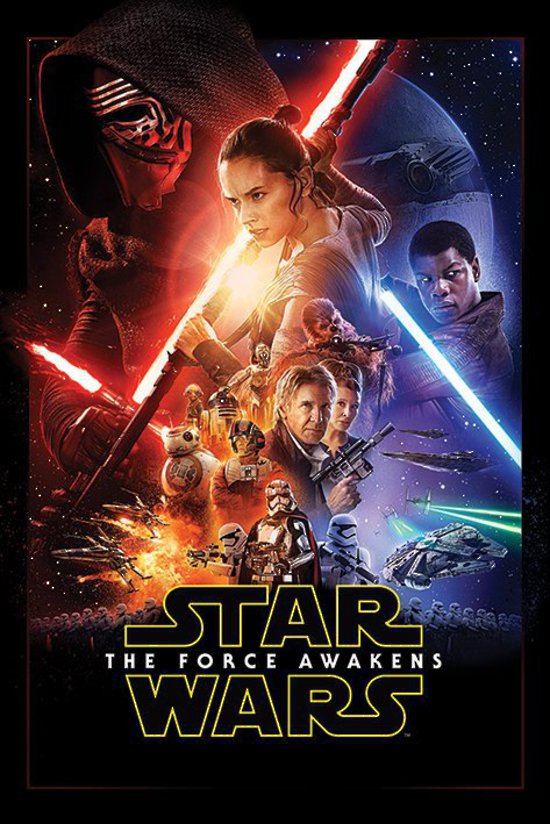
The Sequels After fan reactions to the Prequel trilogy, Lucas abandoned the nine story arc of the Skywalker family—he despised being beat up by self-professed fans who didn't like his ideas. He had ideas, of course...ideas of what would happen next (along the lines of events being cyclical and the Resistance losing their way). But, the hard work and years of commitment produced a great deal of animus and, suddenly, the money and success didn't matter for all the volatility. Lucas had been through one divorce (from his editor-wife Marcia), so he chose to divorce Star Wars...and its fans. He sold the franchise and his Lucasfilm shingle to Disney for 4.06 billion dollars, half in cash and half in Disney stock. Some alimony. And Lucas could move on, devote himself to education and his long talked-about "art-movies" that nobody would ever see...or criticize. Put in charge of the films was long-time Spielberg producer Kathleen Kennedy, who would supervise the creative and financial aspects of Lucasfilm product for the Disney Corporation. For the revival of the Lucasless sequels, Kennedy chose among the many directors influenced by Star Wars and picked J.J. Abrams (who had successfully re-booted a new "Star Trek" film series for Paramount) to direct and co-write, with Lawrence Kasdan (inactive director and co-scripter of Original Trilogy films), a new 3-film arc with new characters and the old team of Luke Skywalker, Han Solo, and Princess Leia—along with Chewbacca, R2-D2, C-3PO. First, they created a threat to the Galaxy—The First Order, risen from the ashes of the Sith's Empire, led by Supreme Leader Snoke (Andy Serkis), who has created *sigh* yet another Death Star—out of a planet this time—called the Starkiller, commanded by the salivating General Hux (Domhnall Gleason), with troop-forces commanded by Kylo Ren, the force-sensitive son of Han and Leia and grandson of Sith Lord Darth Vader. Their attack on the New Republic is two-pronged—use the Starkiller to keep unruly systems in line and destroy the last of the Jedi, Luke Skywalker, Kylo's former teacher, who has conveniently disappeared.
"Luke Skywalker has vanished. In his absence, the sinister FIRST ORDER has risen from the ashes of the Empire and will not rest until Skywalker, the last Jedi, has been destroyed.
With the support of the REPUBLIC, General Leia Organa leads a brave RESISTANCE. She is desperate to find her brother Luke and gain his help in restoring peace and justice to the galaxy.
Leia has sent her most daring pilot on a secret mission to Jakku, where an old ally has discovered a clue to Luke’s whereabouts . . .."
General Leia has set out to find her brother, dispatching Poe Dameron (Oscar Isaac) to find a map fragment that might disclose his location. But, when he is captured on the desert planet Jakku by the First Order, he hides what he's found in his droid BB-8 (wait, this sounds familiar...) and it is found by an orphan scavenger named Rey (Daisy Ridley), who is helped by an ex-stormtrooper "Finn" (John Boyega)—who has escaped the First Order and rescued Dameron—and, of all people to run into in a seemingly infinite galaxy, Han Solo (Ford again) and his co-pilot Chewbacca. When Rey learns that it is THE Han Solo, the once doubting space-freighter pilot makes a deeply felt admission "It's all true...the Force...the Jedi...all of it."
What BB-8 has is a mere fragment of a map and Han tells the story of how Luke once tried to re-establish the Jedi Order, only for it to end in disaster when his apprentice turned Sith and slaughtered the other trainees. That apprentice is the son of Han Solo and General Leia Organa, who now calls himself Kylo Ren (Adam Driver), chief assassin for the First Order. Seems everybody's going in the same direction.
On the planet Takodana, the party consults Maz Kanata (Lupita N'yongo) about getting BB-8 to the Resistance, but Rey is drawn by powerful forces to find the original Skywalker light-saber, which Kanata gives to her. However, the planet is attacked by Ren's forces, who captures Rey and is only staved off by Resistance forces led by Dameron, with General Organa close behind. At a briefing about the First Order's Starkiller base, Resistance forces plan an attack, starting with blowing up the planetoid's defenses—per usual—then with an assault by fighter-pilots. But Organa has one other task for Solo—find their son and bring him back.
Infiltrating the base, with Finn's insider knowledge, Solo and Chewbacca find Rey—who has used her Force powers to escape her holding cell. The four then plant explosives to start the attack scenario. Confronting his son, Han is killed, Chewbacca injured Ren, and Finn and Rey each confront him while the Starkiller begins to disintegrate from the attack. Finn in injured, but Rey is able to defeat him, doing more damage, and using the Millenium Falcon make their way back to the Rebel base on D'Qar, where BB-8's map fragment is combined with a miraculously re-activated R2-D2, and Finn and Chewbacca travel to Ach-To to confront the hermited Skywalker, who does not appear to be too pleased to be found.
Reaction to The Force Awakens was strong; many critics called it the best Star Wars film since the first one. That was nearly a sure-thing, as it was part of the plan; The Force Awakens kept the story-beats of A New Hope while also setting up many unanswered questions to whet appetites and churn up fan speculation (to the series' detriment, probably). Mysteries like Rey's origin and why she is a natural Force-sensitive, Snoke's place in the mythos, and where the Skywalker family-light-saber came from (didn't it drop into Bespin?) were left deliberately ambiguous and became plot-holes that fans were only too happy to speculatively fill in with their own version of certainty lest they be caught off-guard by surprises farther down the line—like Darth Vader being Luke's Father in Empire. Wasn't that part of the fun of it?
"The FIRST ORDER reigns. Having decimated the peaceful Republic, Supreme Leader Snoke now deploys his merciless legions to seize military control of the galaxy.
Only General Leia Organa’s band of RESISTANCE fighters stand against the rising tyranny, certain that Jedi Master Luke Skywalker will return and restore a spark of hope to the fight.
But the Resistance has been exposed. As the First Order speeds toward the rebel base, the brave heroes mount a desperate escape...."
The Resistance forces of General Organa are trying to make an escape from their planet base, but are blockaded by First Order forces. Poe Dameron leads a suicide mission to destroy...or at least, distract, the Order ships...to give the once-rebels a chance to escape. The main contingent manages to get to light-speed, but not without heavy casualties on both sides. They are distressed to learn that the Order has tracked their jump through Hyperspace.
Meanwhile, Rey has found Luke Skywalker on the planet Ach-To, but finds he is reluctant to take her on as a student of the Force, or to stand up against the First Order, as his former student Kylo Ren is one of the Order's commanders. She doggedly pesters him while he grapples with his past failures and uncertain future, but recognizes in her the same raw Force sensitivity that caused his fears about Ren. This does not make his own resistance to becoming involved any the lesser. On the other side of the Galaxy, the Resistance is in disarray, with a lack of fuel being their main problem, forcing a side-mission to the gaming planet Canto Bight to find a hacker to disable the Order's tracking device, so that they can best use their light-speed without further detection. Leia becomes injured during a First Order attack, and the Resistance is put in charge of General Holdo (Laura Dern) and this brings her into conflict with Poe, who stages a mutiny.
Rey leaves Luke as her time refining her Force powers has led her to communicate with Kylo Ren. She allows herself to be taken prisoner by Ren, and when brought before Snoke, Ren kills the Supreme Leader and tries to convince Rey to join him in ruling the Galaxy. She refuses, but instead, helps the Resistance in making a last stand at the planet of Crait. Luke shows up there, too, and provides a powerful distraction to the First Order, and Ren in particular, to allow his sister and the rebels to escape. But, Luke was never at Crait. His image was a force-projection, and the exertion comes at a cost—he becomes one with the Force...and disappears.
Meanwhile, on Canto Bight, it appears that there are more individuals with the Force than might be suspected. More democratic that way...and wasn't that the goal all along?
Director Rain Johnson also grew up on Star Wars and his love of the films is evident in his script and direction. But fan-reaction was even more vitriolic to The Last Jedi than with The Force Awakens (it was even helped by Soviet interference in social media to further sew discord among Americans...talk about an Evil Empire!). Evidently, being a fan isn't enough...to the "fans." Actress Kelly Marie Tran left all social media after being harassed perpetually online for her character, who was reviled as being too much evidence of "Social Justice" and "Inclusion" and all the "PC" things that Star Wars is against. Uh...Wait a minute, wasn't Leia a General? And Mon Mothma? Aren't women part of the Resistance, too? Didn't Star Wars have a lot of alien races, beginning with the Cantina scene? Is there a different Star Wars that people are watching and remembering? Fans didn't want their Star Wars to be too political (hey, kids, it always was...you just grew up, that's all) But, the harshest criticism came with the use of Luke Skywalker—this wasn't the heroic Luke of the first—or...uh, second—trilogy that everyone thinks they remember. This was a Luke who doubts and whines and...oh, wait a minute, that IS the Luke I remember. The vitriol turned ugly...and frankly, a bit non-sensical to anyone with a bit of history behind them. Personally, I blame The Force and its Dark Side. Too tempting, it is. Too easy. Resist, one must. Oh, and Russian-bots. I blame them, too.
The Last Jedi shook up the Star Wars Universe. For the third Star wars film, designated director Colin Trevorrow was let go "for creative differences." J.J. Abrams (who was quite fond of The Last Jedi script) was re-hired to complete the Trilogy.
Episode IX: The Rise of Skywalker(J.J.Abrams, 2019) The dead speak! The galaxy has heard a mysterious broadcast, a threat of REVENGE in the sinister voice of the late EMPEROR PALPATINE. GENERAL LEIA ORGANA dispatches secret agents to gather intelligence, while REY, the last hope of the Jedi, trains for battle against the diabolical FIRST ORDER. Meanwhile, Supreme Leader KYLO REN rages in search of the phantom Emperor, determined to destroy any threat to his power....
Kylo Ren's response to the "mysterious broadcast" is to find the Emperor and kill him thus solidifying his tenuous hold as leader of The First Order, something opposed by General Hux. Traveling to Mustafar (where Darth Vader used to hang out), he steals a "Wayfinder" that will lead him to the fabled home-planet of the Sith, Exagol.
For their part, Poe, Finn and Chewbacca take the Millenium Falcon to meet with an informant who confirms what Kylo finds out from the source—the Emperor Palpatine is indeed, alive, and has assembled a huge fleet of star destroyers, each one capable of destroying a planet, to be unleashed upon the galaxy in a scant 16 hours. What they don't know is that Kylo Ren has made a deal with Palpatine—kill Rey and the Emperor will give him control of the Sith on top of being leader of the First Order.
Where is Rey? On the planet Ajan-Kloss (a jungle planet, another one-ecosystem planet), perfecting her Jedi-training under the supervision of General Leia, a process not beyond the interference of Kylo Ren, with whom she is still psychically linked. That link doesn't tell him where she is, however. Or that when "the boys" get back with the Falcon that she joins them in a search for a second "Wayfinder"—noted in the Jedi texts by Luke Skywalker who had once gone on a failed quest to find it.
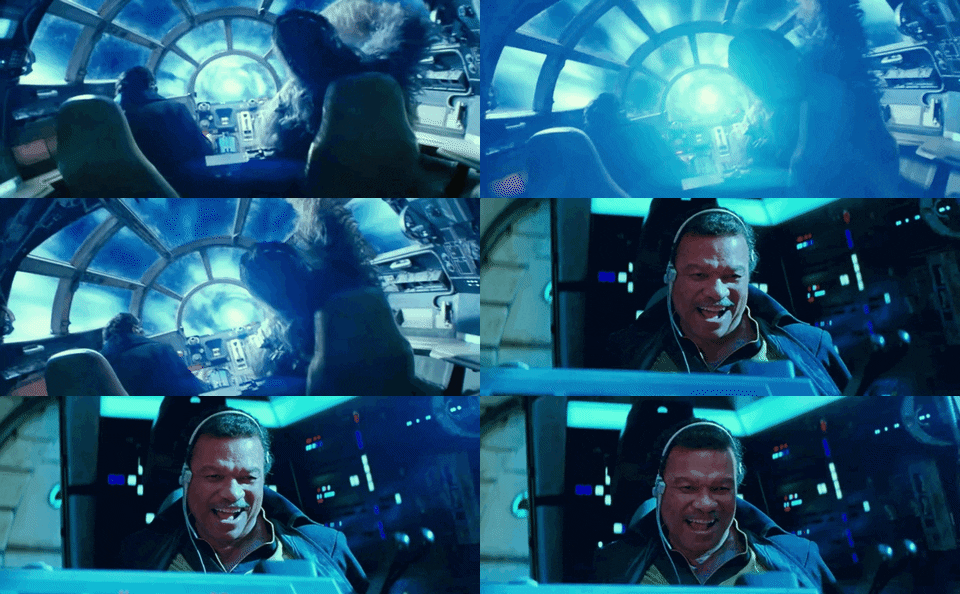
The journey takes them to the planet Pasaana, where they come across Lando Calrissian (Billy Dee Williams is still cool at 82), then to another planet in search of a way to decode a Sith dagger they find (where they run into an old flame of Poe's because he evidently needs one), then to a moon of Endor to the husk of the imploded Death Star. There Rey must confront her demons and defeat a pursuing Kylo Ren if she is to find the Emperor and stop his Sith-storm upon the galaxy.
This all sounds perfectly reasonable in the overview. It's the details that drive you crazy. Sure, there has to be a "McGuffin" of the "Wayfinders" (and it's convenient that there are two of them!) to make it more of a quest story than a battle royale (which it turns out to be, anyway). But, The Rise of Skywalker suffers from a lot of those conveniences—there are a couple of new wrinkles in Jedi-powers that come in way too handily—and an awful lot of time given to fan-service. Didn't like The Last Jedi? A lot of it is ignored (along with its characters). You a Kylo-Rey "shipper?" The movie bends personalities backwards to provide it. Miss Luke, Leia and Han? They're ba-ack, despite deaths real and imagined with re-purposed footage and contrived explanations that would boggle the mind of Obi-Wan ("...many of the truths we cling to depend greatly on our own point of view") Kenobi.
Why, Chewie even gets a medal (it was Carl Sagan back in 1977 who griped about Star War's "wookie chauvinism"). And we find out Rey's parentage; she's a Palpatine, her parents hiding her from her evil grandfather in the same way Luke and Leia were hidden from Darth Vader. The echoes are obvious. Then, after fighting Ol' Granddad, force-immolating the entire Sith population, and being killed in the fight—only to be saved by a self-sacrificing Kylo Ren—Rey is last seen in the glow of the rising Tatooine suns, having taken the name of "Skywalker." All neatly wrapped up, even if some of it feels like an elaborate Jedi Mind-Trick. One is left wondering if there is "Balance" in the Force. Not really. And how soon before the dark predilections of the galaxy produce another threat—as our world demonstrates, all you need is a crack-pot leader and you're hip-deep in Sith again.
The Rise of Skywalker checks off its short-sighted "Big Story" boxes but leaves a lot of hanging chads and dangling plot-threads—we never find out why Maz Kanata is important, the character of Rose Tico is totally under-served and that terrible threat of an armada just goes *pfft* in a hail of force-lightning. Much ado...
I did like one part: when Rey's battle is at its most hopeless, she is egged on by the voices of Qui-Gon Jinn, Mace Windu, Yoda, Annakin Skywalker, Obi-Wan Kenobi and Luke (and some other Jedi I couldn't identify). That is special, and is the one inkling that there was a legacy of nine movies to fulfill and not just the immediate problems to be solved in this trilogy. With so much fan-service displayed throughout The Rise of Skywalker, it is the one with the most...Force.
The Stand Alones
It was ILM's John Knoll who came up with the idea for the first of Disney's stand alone films, Rogue One—do a story about the "Rebel spies [who] managed to steal secret plans for the Empire's ultimate weapon THE DEATH STAR" (as it was described in the first (or fourth, "depending on your point of view") "to infinity and beyond" opening crawl. But, it would be the first "Star Wars" film without that crawl and with an almost entirely new cast of characters as the focus.
Rogue One(Gareth Edwards, Tony Gilroy, 2016) One morning on the planet Lah'mu, Galen Erso (Mads Mikkelson) receives a visit from The Empire's weapons developer Orson Krinnic (Ben Mendehlson), who presses him back into service to complete the Empire's super-weapon, The Death Star. Erso does not go quietly and in the capture, his wife is killed and his daughter Jyn escapes by hiding and is rescued by Clone Wars veteran Saw Gerrera (Forrest Whittaker). Fifteen years later, an imperial skiff pilot Bodhi Rook (Riz Ahmed) escapes with a message from Erso intended for his daughter. Rook takes it to Gerrera, who is leading a guerilla army on the planet Jedha. Meanwhile the Rebels recruit their intel officer Cassian Andor (Diego Luna) to seek out the now-grown Jyn Erso (Felicity Jones) and free her from an Imperial work-camp to see if she can reach her father to learn more about the super-weapon. Lucky that the two happen simultaneously.
And lucky that everybody goes to Jedha, where the Empire is mining the powerful khyber crystals to power their Death Star. Jyn, Cassian and droid K-2SO (voiced by Alan Tudyk) are joined in Gerrera's headquarters on the planet by two guerilla warriors: the sightless Force warrior-monkChirrut Îmwe, Guardian of the Whills (Donnie Yen) and fellow Guardian and mercenary fighter Baze Malbus (Wen Jiang). Jyn is given the smuggled transmission from her father in which he reveals that he has engineered a tactical weakness into The Death Star, the schematics of which can be found in the Imperial database of the planet Scarif, telling her "Save the Rebellion and save the dream."
First, though, they have to save themselves. The group leave Jedha for two reasons: 1) The Death Star has taken position in the vicinity of Jedha to launch its first attack on its capitol city and 2) to travel to the planet Eadu to try and rescue Galen from the Imperial research facility where the Death Star was engineered. Little do they know that Krennic has been sent to Eadu by Grand Moff Tarkin (Guy Henry), who has taken command of the Death Star to find out who allowed Rook's escape, endangering the project. Krennic exposes Galen's actions and is deciding his fate when a rebel squadron destroys the facility, killing Galen. Krennic is ordered to Mustafar to face Darth Vader (wheezed once again by James Earl Jones) for the security breaches
Jyn's team travels to Yavin4, the secret Rebel base, where their lack of credible evidence (uh, been to Jedha lately?) makes the Rebel leaders reluctant for a battle on Scarif, but a faction of the Rebels, including Jyn, Cassian and the team from Jedha, decides to make the treacherous journey where, after a costly battle in which almost everyone is killed, they are able to deliver the Death Star schematics into the hands of one Princess Leia Organa, who escapes the clutches of the Empire for parts unknown—unless you've seen Episode 4.
The Force was strong with Rogue One, generating the third highest box-office of the Star Wars films (adjusted for inflation it's the seventh), which was amazing in that, except for cameos by Vader, and a CGI'd Tarkin and Leia (and some Rebel Leaders like Smits' Bail Organa and Mon Mothma), Rogue One had new characters and new concepts that slightly expanded the Star Wars Universe, while inching up to the familiar territory in the old timeline. But, with one important difference: it had nothing to do with "The Skywalker Family Saga," which, rivaled the Fate of the Galaxy for what Star Wars fans cared about most. With that in mind, the next Stand-Alone decided it would focus on a "fan-favorite" character.
It is a lawless time. Crime Syndicates compete for resources - food, medicine, and hyperfuel. On the shipbuilding planet of Corellia, the foul Lady Proxima forces runaways into a life of crime in exchange for shelter and protection. On these mean streets, a young man fights for survival, but yearns to fly among the stars...
Han Solo's Adventures as a Young Man: Corellian runaways Han (Alden Ehrenreich) and Qi'ra (Emilia Clarke) try to escape the criminal syndicate run by Lady Proxima, but only Han manages to escape, enlisting in Imperial flight school, and being kicked out. Forced into being an infantryman for the Empire, he notices that a criminal gang run by Tobias Beckett (Woody Harrelson) has infiltrated the battle, posing as high-ranking officials, when their intention is get as much weaponry and fuel to pull off a heist on Vandor-1. Han threatens to expose them unless they take him with them, but Beckett turns Han in and he is locked away with a particularly fearsome creature—a Wookie.
Han meets Chewbacca, gets roped in with Beckett's gang, gets involved in a train-heist (albeit elevated and carrying "hyper-fuel") and is sent on the fabled "Kessel Run" to deliver the goods with the aid of a rapscallion named Lando Calrissian (Donald Glover) and his smuggling cruiser, the Millenium Falcon. Meanwhile, there's a larger conspiracy going on that involves the Empire and Han's squeeze, Qi'ra, and the movie ends with Han and Chewie falconing their way to Tatooine to "slug" it out with a certain gangster.
Solo serves its function as a panacea for fans, who wanted more "by-the-numbers" Star Wars movies, but this one had endless call-backs (or forwards) with everything except how he got that Harrison Ford chin scar (as they did with Indiana Jones and the Last Crusade), but the result is a film that feels over-familiar and ultimately a bit dull. The chaotic production saw original directors Phil Lord and Christopher Miller let go two-thirds of the way through filming—taking the average of different reports that had them replaced half-way and 3/4—over "creative differences" (it seems they were making it more of a romp over co-screen-writer Lawrence Kasdan's wishes) and replaced by Ron Howard, who had filmed Lucas' Willow, and seemed to prefer to make his Star Wars film from a palette of various shades or murk and colored gels.
Box office returns were slack, which caused concern for Disney and the Lucas-less Lucasfilm, who put "holds" on planned stand-alone Star Wars films. Perhaps, they had gone to the moisture-vaporating well too many times, threatening to turn the franchise as arid as Tatooine. By the time of this writing, plans beyond Episode IX are up in the air, leaving the future of Star Wars unknowable, despite being set "a long time ago."
Perhaps its signature phrase should have, as its punctuation, a question mark.
* Rolling Stone, August 25, 1977 ** The original "infinity-crawl" was much, much longer, and when Lucas showed it to his USC film-buddies, this was merely one of the stinging criticisms of Brian De Palma. It was De Palma who re-wrote and minimized the crawl to its current length.




.png)