Sunday, October 28, 2018

Peeping Tom

Peeping Tom (Michael Powell, 1960) Mark Lewis (Carl Boehm, actually Karlheinz Böhm) is never without his camera—a camera of some kind, still or film. A shy young man, he works as a "focus-puller", hoping to become a film-maker. In his other job, he takes pin-up shots of models to be sold "under the counter" in plain brown envelopes. Photography is his passion, his aspiration, his raison d'etre. But, it is also a means to end.

For his hobby is terrorizing and killing women.


Mark is one of those people who, during a newscast of a lurid incident, it is always remarked "he seemed like such a nice young man—kept to himself." The intensity is never mentioned, though, or the creepiness. But, just  the fact that Mark ALWAYS has a camera with him should raise an alert.

It certainly should tip off Dora (Brenda Bruce), a prostitute Mark follows one night. Or maybe it shouldn't. He hides his movie camera under his coat (hmm..I sense a metaphor-based film thesis in the works) and we see what happens from the point of view of the view-finder, as he encounters on the street, follows her to her flat, and then murders her, filming it, then skulking off to his house, where he develops the film and watches it, transfixed...or turned on...or what? It's difficult to say exactly what is going on with this monster, but since we're watching the film...we're accessories. 
Peeping Tom (as the title suggests) is about voyeurism at it's cruel dark little heart. Mark "likes to watch." Not participate, really, but watch. To record and see it over and over again. He's a vicious killer, a sociopath, but as long as the camera is between him and his victims, there's a filter there, responsibility-once-removed, and all for the sake of "art," his footage is to be part of a documentary he is making—or at least recording—paralleling his experiences as a child as his father (played by director Powell) runs psychological experiments on him, while a documenting camera records the events. It is suggested (filmicly) that Mark is merely doing what he knows and is familiar with in his growing up. But, if so, where did he learn to kill?

And—like Mark—we watch, complicit in his actions. It adds another dimension to the experience of the movie. Perhaps it's a feeling of generated guilt that we're watching what he's watching—compounded by Mark's compulsion and utter lack of guilt—which gives us the universal experience of feeling out of control in the passive experience of watching a movie. You feel helpless when your instincts are challenged. This is a familiar feeling to anyone who's ever watched Hitchcock's voyeuristic classic, Rear Window.
And (it seems) you can't discuss Peeping Tom without also mentioning Hitchcock, whose film, Psycho, was released just two months after Powell's film.* Michael Powell had worked closely with Hitchcock during the director's "British"period, working as a still photographer on his shoots and the two were somewhat close throughout their careers. That they should simultaneously direct the most lurid films of their careers has more to do with the loosening of restraints in subject matter for film at the time than anything else. For Powell, whose career—as part of "The Archers" in collaboration with Emeric Pressburger—was a prestigious one, the subject matter of Peeping Tom was a departure from, say, The Red Shoes** or A Matter of Life and Death, although, it isn't too far afield from the hysteria of, say, Black Narcissus. But, the nuanced approach, the vital color palette, should be familiar to anyone familiar with the films produced by "The Archers."
Even as the movie makes us implicit voyeurs, we are also innocent bystanders, shocked by the new and the unexpected, looking for some sense of normalcy amidst all the creepiness. Peeping Tom provides this downstairs from Mark's austere flat—far more elaborate is his film room—where he rents out the ground floor of his family home to Helen (Anna Massey—who would be a victim in Hitchcock's Frenzy ten years later) and her blind mother (Maxine Audley) whom she cares for. Helen is empathetic towards the damaged, so she is drawn to mark for his shyness, his past—he shows her his father's home movies of his psychological experiments—and because she knows that he spies on her.
He might be drawn to her, too—or it's just because she shows him attention, which he's not accustomed to. Ego is a facet for both killers and film-makers, and perhaps she satisfies that need. Or she's just another victim for his secret hobby.
There's an added element to the murders that are noteworthy. Peeping Tom is full of reflections and refractions both in the film and the viewer's reaction to it. But, Mark's murder weapon is his own camera—one of the tripod's legs contains a sword with which he slays his victims—it serves double duty as both weapon and recorder. But the camera also holds a mirror to the victim, so they can see their own death, which own enhances the terror that Mark wants to record.
Peeping Tom is the complex daddy of the slasher films of the 1970's—which scaled the concept down to just a voyeuristic POV, unknowable killers and shock-cuts—but, even with the artistic sensibilities of Powell in play, it's still a creep-fest, that compels one to take a shower afterwards—that is, if Psycho isn't also on the double-bill.


* Peeping Tom received a critical thrashing in the press when it was released. Perhaps this is why Hitchcock did not have press previews of Psycho when it was released, instead emphasizing a "not-to-be-revealed" mystery in the film in its marketing to the public.

** The inclusion of the star of The Red Shoes, Moira Shearer, led to some controversy , as well.

Friday, October 26, 2018

Olde Review: Sisters (1973)

This was part of a series of reviews of the ASUW Film series back in the '70's. Except for some punctuation, I haven't changed anything from the way it was presented, giving the snarky, clueless kid I was back in the '70's a break. Any stray thoughts and updates I've included with the inevitable asterisked post-scripts.

This is a companion piece to the Olde Review of Purple Noon.

This Saturday's films in 130 Kane at 7:30 pm are thrillers: one sophisticated; the other unsophisticated, but God, it's neat, and they are Rene Clement's Purple Noon and Brian DePalma's Sisters

Sisters (Brian De Palma, 1973) 1976 was a banner year for Brian DePalma. Two of his films, Obsession and Carrie were released (within five months of each other) and were critically acclaimed. Not only that, they made a lot of bucks. And so, Brian DePalma has achieved financial success. More power to him. I've been a DePalma fan since way back, and from Sisters to Phantom of the Paradise to Obsession and Carrie, my respect and admiration for his film-making skills has only grown. Last quarter, DePalma's Phantom of the Paradise was shown. And from reports of the attendance too many of you blew the chance to see it. Don't miss the chance to see Sisters—his first feature film.* I'm not even going to hint at the plot because one of its joys is that the plot turns and twists into a maze of incidents in which the protagonists are lead. **
Sisters, like Obsession, borrows very liberally from the films of Alfred Hitchcock in themes and incidents. In fact, DePalma even borrows Hitchcock's long-time musical accomplice, Bernard Herrmann,*** for the energetic film score. The ironies, the quirky characters, the quality of the grotesque in humor and incidents make Sisters thoroughly entertaining, as is Hitchcock's films, but DePalma leads them on to his own bizarre sense of humor and film-making. 
(Sisters) is very much DePalma's film, no matter how many ideas he may have borrowed. And just as Hitchcock holds a fascination with special effects, so, too, does DePalma who has as much love for the devices of split-screen and the like (which he uses brilliantly) as he does in making blood spurt from a murder victim (something he does like no other director—a fact which has led one newspaper reviewer to give it the special category of "DePalmaesque Violence"). 
This violence, though it has a horrible humor, may upset the more sensitive in the audience. But DePalma gives you all the hints and time in the world to cover your eyes. So I hope you don't miss the brilliance of the film for the violence. At such a low budget, it is such a great movie.

Broadcast February 12, 1977
It is a good movie—but it's not a great one, as the Nervous Nellie I was in college wrote. DePalma would surpass it, and eventually lose the Hitchcock fetish he had going for a long while, and be more of his own cine-man for good or ill. But Sisters has a demented sense of humor that is just as sick as a ruptured (or deliberately severed) artery that even Hitchcock would try to staunch. 
Combined with Herrmann's mad bell-clanging, theremin-stabbing score***—which seems to convey the soul of madness—it is one of the loopiest horror movies to shuffle spasmodically down the mausoleum corridor, with its mad scientist (William Finley), its homicidal maniac (Margot Kidder), as well as a mother-harassed girl detective (Jennifer Salt) with a dogged assistant (the wonderful Charles Durning). 
DePalma calmed down quite a bit in his style, and his social conscience (which he displayed in some of the features I neglected to mention he made before Sisters*) has come back, when he's not making fetishistic erotic thrillers with a "hook." Sisters was the initial stab at the movie-market outside of art films, the lowest common denominator to make a name for its film-maker in the mainstream—the same route that so many film-makers, both auspicious and inauspicious, have taken to "break in." Sisters is among the most ingeniously devilish of those freshman horrors and one film-maker's affectionate tribute to another.


* I was wrong here. He had made small budgeted independent films before this. Those being Murder à la Mod, Greetings, The Wedding Party, Dionysus, Hi, Mom!, and Get to Know Your Rabbit.

** Well, I'm pretty much spoiling it in my later comments.


***

Thursday, October 25, 2018

Olde Review: Young Frankenstein

This was part of a series of reviews of the ASUW Film series back in the '70's. Except for some punctuation, I haven't changed anything from the way it was presented, giving the kid I was back in the '70's a break. Any stray thoughts and updates I've included with the inevitable asterisked post-scripts.


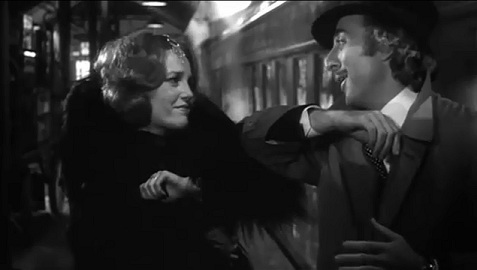
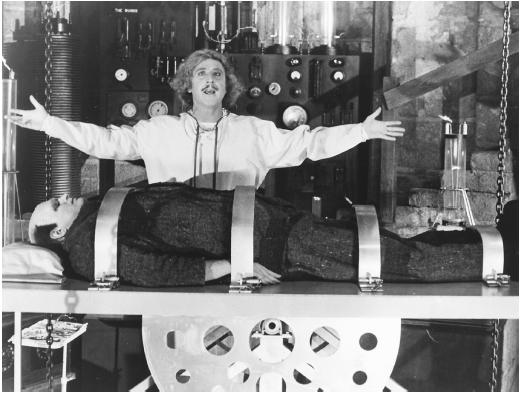
Young Frankenstein (Mel Brooks, 1985) In my review of last quarter's bill of comedies,* I stated that Mel Brooks is just about the only remaining graceful comedy filmmaker**--his films have a flow along with the jokes. After a couple of false starts,*** Brooks achieved his cinematic sense with Young Frankenstein, and achieved it, as most film-makers do today, by following the example of a predecessor in film-making--in this case. the director of the original Frankenstein films, James Whale. His coming of age didn't occur only because of the help of Gene Wilder's script (Wilder's own Sherlock Holmes' Smarter Brother was an abysmal failure), but through the realization by Brooks that the best movie spoofs are those that poke fun at and embrace their cinematic progenitors. And so, in tandem with the humor, good and bad, we are treated to the charms of two-dimensional castles, rain-washed cobblestones, studio-built forests and the glories of black and white photography. And you have to have a special love to go to the trouble to obtain the lab equipment from the original Frankenstein. 
Brooks' love of the original gentles this film. His love makes him understand the charms of the original Frankensteins. Young Frankenstein turns serious when Gene Wilder screams out during the experiment because Brooks understands that he is challenging God's right to be the sole source of life. 
It turns serious when Wilder confronts his creation, and is able to conquer his fear to become the loving father-creator to his very lonely, dependent creation, a moment coupled with the young scientist's first ecstatic re-affirmation of his family name. Brook's understanding goes so far as to present its own version of the weird sexuality that was in the old "Frankenstein" films. Brooks also has the melancholy understanding of the monster's plight--the plight of all those different enough to be rejected by society. However, there is one thing different about Young Frankenstein, as opposed to the originals--this one has a happy ending for all concerned--for Brooks' Young Frankenstein is a sentimental, gentle film--a rare thing these days--a quality that only adds to my enjoyment and appreciation of the films of Mel Brooks.
Broadcast on KCMU-FM on January 6th, 1977

As far as that goes, and it didn't go far. Brooks made a wonderful, financially-risky movie called Silent Movie, (and it was silent, except for one word, spoken by mime Marcel Marceau), then came High Anxiety, a somewhat haggard Hitchcock parody, then The History of the World, Part 1Spaceballs, Life Stinks, and on. And sadly on. Brooks is now a Broadway entrepreneur with his wildly successful Broadway production of "The Producers," and his fine staging of a musical version of "Young Frankenstein." And his company, Brooksfilms, is still in business--except for his own films, Brooks rarely played it safe.


*Those being The Running, Jumping, Standing Still Film, Love and Death and Monty Python and the Holy Grail--I just found those reviews, we'll get to them eventually.

** I hope I changed my mind on this. Blake Edwards was still active at the time, as was Woody Allen.


*** Presumably, The Producers, (clumsy, but funny as Hell) The Twelve Chairs, (better, but not terribly funny), and Blazing Saddles, (which was rude, crude, hilarious, and one of the worst looking movies I've ever seen).


Wednesday, October 24, 2018

I Married a Witch

I Married a Witch (René Clair, 1942) A Preston Sturges production (that he quit over differences with the director), partially written by Dalton Trumbo (who quit over his differences with Preston Sturges—maybe he should have waited until Sturges and Clair started to have meetings), I Married a Witch is one troubled flick, and, sadly, it shows. Where it should be charming (and dare I say "magical"?), it's merely cloying. And all of the behind-the-camera wrangling wasn't the only thing causing havoc on the picture, as there was quite a bit of cursing and hexing among the actors in front of the camera, too. Joel McCrea (who would have been a better match here) passed on the starring role after his difficulties with Veronica Lake on Sullivan's Travels ("Life's too short..." was his comment) and Frederic March—a better actor and no slouch at comedy (see Nothing Sacred) was inserted.  But, his efforts comes off forced and flat, and Lake's antics off-screen soured any chemistry when the two were photographed together. 
And yet, Lake is great.  She didn't take any of this too seriouslyit's a fantasy, after all—and she's that perfect combination of alluring and goofy.* Her character, a witch named Jennifer burned at the stake during the witch-trials by one of the ancestors of March's character, places a curse on the male family-line to always marry the wrong woman. By the time, lightning strikes a gnarled tree which frees the spirits (in smoke form), the latest of the Wooley clan is a scion running for political position and is on the hallowed eve of marrying the starchy daughter (Susan Hayward) of his chief supporter, a newspaper publisher (Robert Warwick). Everything seems well-orchestrated and on-schedule, prim and proper and corrupt. What's needed is a little black magic.
And where there's smoke, there's fire. Wooley and Jennifer "meet cute"...in a burning building—whatever the merits of the film, you can't say it's "formula"—and Jennifer's witch starts popping up everywhere, most notably in Wooley's pajamas in his bed, which makes things...complicated. Now, that "formula," which we mentioned earlier, comes to the fore, when the witch decides to seal the deal with a love potion to ensure Wooley's love for her. Guess who drinks it?  You don't need magic powers to guess.
Where the film picks up (and actually does catch fire) is in the drawn-out wedding sequence, where Jennifer's manipulations (along with her father's, played in corporeal form by Cecil Kellaway) manage to derail the most staged of political-social weddings and does so four times.** The wedding singer sings "I Love You Truly," the wedding march begins, and then (boom) something happens and everything gets pushed back to the starting point—"I Love You Truly." Having to pick up the pieces and re-stage something so elaborate that many times is comedy gold, and Clair and the writers (including Robert Benchley who has a prominent role) keep ramping up the stakes when returning to the ritual, leading to a fine capper involving the ceremony's stodgy wedding singer.
But, then, things turn "charming" again, undercutting the satire and the basic push-pull of organization and chaos. But, for a brief time, anarchy reigns supreme, turning the greased gears of prominence and political glad-handing into a thudding, shuddering mess, seeing a processional and wanting to pull the rug out from under it. No wonder Sturges wanted to do it. And Trumbo? He knew a lot about witch-trials (but not as much as he would). Benchley is nicely droll throughout, light on the irony, heavy on the farce. There's a constant battle between the wisenheimer and the twee and the result is rather milquetoast.  What should have bubbled like a cauldron comes across as rather tepid.
But that wedding section. It's crashingly good. 
"that perfect combination of alluring and goofy"
  
* What is it with blondes and comedy?  As much as Hollywood tries to shoe-horn gorgeous blonde-types into drama, some of the most alluring women are at their best doing comedy—Carole Lombard, Grace Kelly, Kim Basinger, Cybill Shepherd, Charlize Theron (all serenely beautiful) were at their best (in my opinion) when they were sly and antic, as if there was something in their DNA (or peroxide) that compelled them to find the "funny" in a situation, especially their own, and blow it up. One of those little mysteries that occupy my brain in stray moments.

** The bride is played by pre-stardom/America's sweetheart Susan Hayward, who's character is such a straight-laced sour-puss that she has to be reminded by her newspaper-editor of a father to smile at her own wedding, which she manages to do only the first three times. It's among the collection of running gags in the extended sequence that builds to a satisfyingly disruptive conclusion.

Tuesday, October 23, 2018

Scanners

It's October..."so maybe I should pay attention to horror films." How cliché.

I have some planned and in the hopper, but I noticed "The Large Association of Movie Blogs" is showcasing director David Cronenberg, so I'm also going to be throwing in a bunch of Cronenberg reviews from the past and the retrospective present. After all, you can't have a Cronenberg movie without a little bit of horror...somewhere.

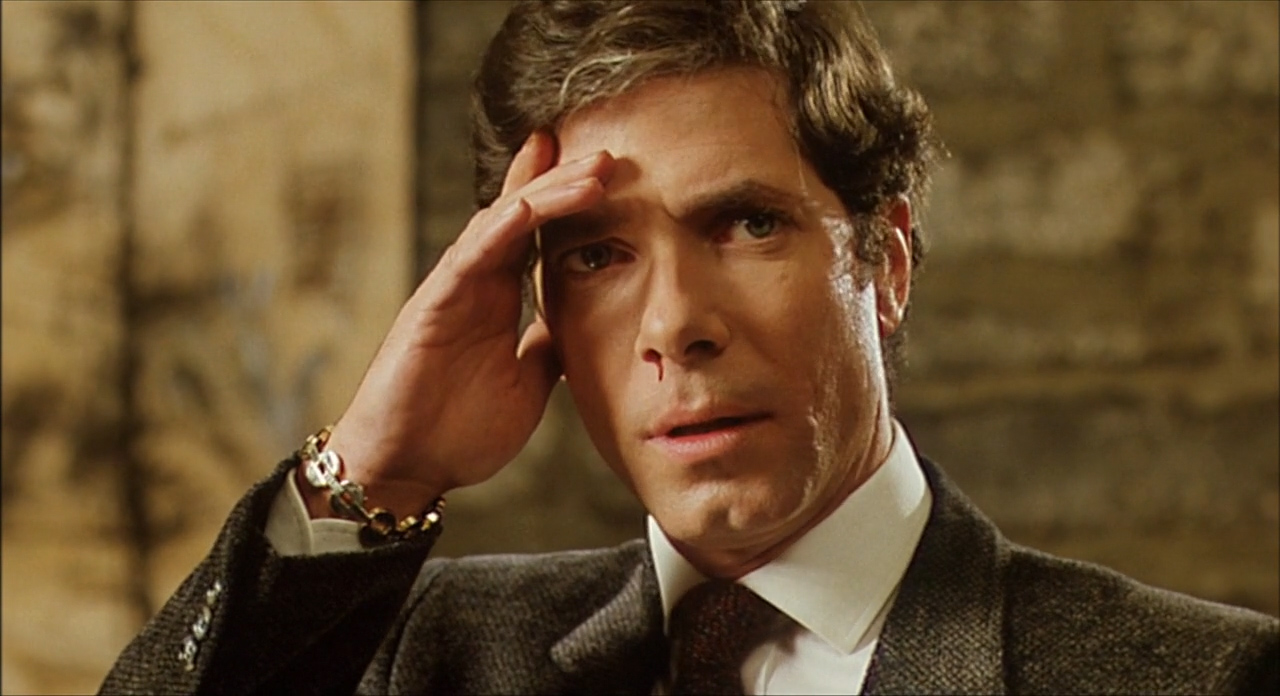
Scanners (David Cronenberg, 1981) You can weaponize anything. But, I wonder if David Cronenberg knew when he was writing and directing Scanners that the United States military was (seriously) investigating the use of psychic abilities for intelligence and warfare at Forts Mead and Bragg. The programs, dubbed "The Stargate Project" were documented by Jon Ronson in the book "The Men Who Stare at Goats," which was made into a film in 2009. No one that I've read has made the connection, and evidently Cronenberg's initial concept was far afield from what was finally put on-screen; so the film could be used as a tax write-off, it was rushed into production forcing last-minute scripting while filming. And, it isn't the military that is doing the experimentation, it's a corporate interest specializing in private security—a sort of pre-Blackwater in the world of the Military-Industrial Complex. Meet the new boss. Same as the old boss. And trust Cronenberg to be ahead of the curve in terms of paranoia and conspiracies.
There is an "issue" at ConSec: at a conference in which they were announcing the use of "scanners"—agents with psychic and telekinetic abilities, a demonstration was called for and a volunteer from the audience came to the stage. Rather than providing a number from 1 to 100 for the scanner to predict, the volunteer, a scanner named Revok (Michael Ironside) psychically assaulted the Consec agent causing his head to explode, resulting, as the ConSec chairman says "in six corpses and substantial loss in credibility for our organization." And all without a bone-saw. ConSec security chief Braeden Keller (Lawrence Dane) suggests, for the good of the company, that the "scanner" program be halted, but he is overruled by Dr. Paul Ruth (Patrick MacGoohan), who has identified Revok from CCTV footage; Revok has acquired defector scanners from ConSec and has started his own band of rival scanning rogues. 

But Dr. Ruth has a plan: he has picked up a drifter named Cameron Vale (Stephen Lack) who has been arrested for stealing food and giving a woman who gives him the stink-eye a seizure. Ruth wants to work with Vale to oppose Revok and possibly infiltrate his network. Vale has been unhinged by his abilities, but Ruth injects him with a drug he's developed called "ephemerol" (heh) that negates Vale's powers and keeps him sedate.
Vale has been homeless because his scanning abilities has made him anti-social, not knowing where they came from, but once Vale explains his gifts and shows him others with his abilities, he is able to recruit Vale for his efforts. He also helps him to channel his abilities, and is astonished by the power that Vale demonstrates when he drastically increases the heart-beat of a yoga master who has trained himself to keep it low. Ruth sets Vale a task—to find other scanners and his link to them might be through sculptor Benjamin Pierce, himself a scanner.
"I'm thinking of a number between 1 and 100..." "Uuhh...No. 6?"
But, Revok has hired assassins to follow Lark to Pierce, and while Pierce is very angrily reluctant to help Lark, they are interrupted by Revok's killers who shoot Pierce—Lark uses his abilities to kill the shooters and reads from Pierce's dying mind a name: "Kim Obrist."*
Obrist (Jennifer O'Neill) is a scanner herself—there seem to be a lot of these folks (where do they come from?) and she has her own band of unaffiliated scanners. Vale attends a meeting of her group and—wouldn't you know it (especially if you have ESP!)—more of Revok's killers show up and take out Obrist's group, but Obrist is able to use her mind to kill the assassins, making them burst into flame. Lark compels the one surviving assassin to lead him to Revok and he is given a vial with the name "Biocarbon Amalgamate." Lark takes it upon himself to keep Obrist safe, but tracks down the BioCarbon facility, where he discovers it is run by Revok and they are controlling shipments of ephemerol through a ConSec program called "RIPE" and Vale contacts Ruth of what he's found out. On Ruth's instructions, Lark brings Obrist to Consec, where she is injected with ephemerol and taken by Keller to be interrogated.
So, as things gets increasingly more complicated, they also get more contained and insular, and this is where Scanners has its big drawbacks. I'm sure that the concentration of scanners in one city has more to do with budgetary considerations than any sort of story logic, but, be that as it may, it doesn't explain why it takes so darned long for Vale (or Ruth) to realize that there is probably a traitor in their midst as Revok's infiltration of the ConSec systems are so complete. You would think that folks with such enhanced brains and abilities might figure any of this out before it turns into such a murderous problem, but Cronenberg, given the constraints of time and budget is more concerned with stunning visuals than story logic.
Those "stunning visuals" (most created by make-up legend Dick Smith—he of The Godfather, Taxi Driver, Little Big Man, and The Exorcist) create the sense that anything is possible with the abilities of the Scanners—except for figuring anything out and having to rely on sleuthing like a normal person. The abilities are convenient when the script calls for them to be, but pretty useless in the main. And that's a major flaw. It's enough to make a critic's head explode.
The performances are all over the map: Lack is okay, but largely unsympathetic in an opaque kind of way—he was probably hired because he looks like he could be a derelict but also clean up real nice. O'Neill is one of those actresses that relies more on looks than personality, and she is mostly required to look earnest, like she is covering up a deep, dark secret (SPOILER ALERT: she isn't). MacGoohan, as usual, in inscrutable, an actor who's always had the ability to portray smarter even if the character doesn't call for it, merely by an ironic half-smile. On the other end of the spectrum is  Ironside. He's the master of excess, for whom subtlety seems to be a waste of time—one would say he'd be better suited for silent pictures, but even there he'd be over-the-top. His Revok is both malevolent and insane, so much so that one wonders if he could be capable of being in charge of anything if he didn't have the ability of mind control. 
Scanners is rather dumb, despite its considerable displays of brain-power. And it is giddily gruesome—as Cronenberg gleefully can be. I mean, a guy's head explodes within the first 15 minutes—and it gets worse from there. I've called Cronenberg the Enemy to the Squeamish and it is never more evident than it is in Scanners. One should hold onto one's head...or, at least, their lunch.


* Kim Obrist is listed as an assistant to producer Claude Heroux in the credits.

Sunday, October 21, 2018

Don't Make a Scene: The Shining

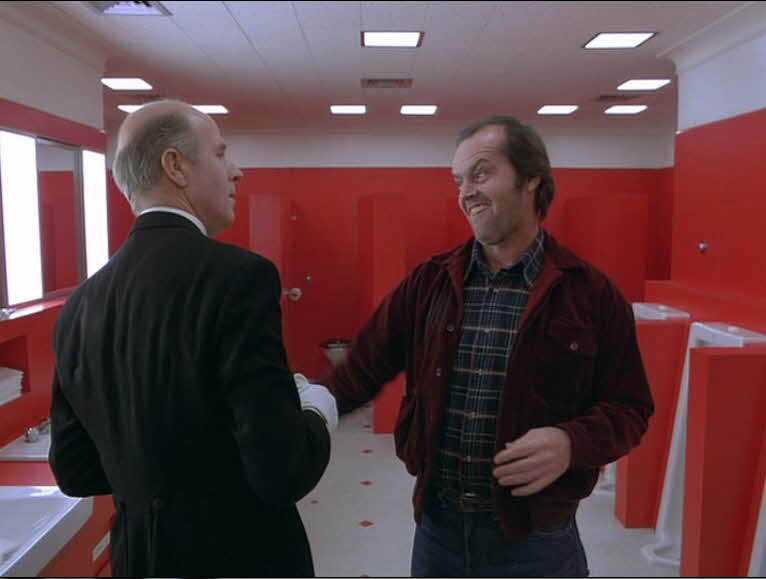
The Set-Up: For another Halloween horror "Don't Make a Scene," we have a typical Kubrick negotiation, this time in a men's room with one Hell of a paint-job.

The film is Stanley Kubrick's controversial adaptation of Stephen King's "The Shining." After the lukewarm reception given by both audiences and critics to Barry Lyndon, Kubrick felt required to make a potential box-office hit.  Finding King's book pre-publishing, he decided to make his first genre horror film from King's thick book about domestic strife, isolating cabin fever, psychic phenomena and malicious ghosts.  Kubrick took King's ghost melodrama and pared it down to essentials. Then, he adapted it freely (with the help of novelist Diane Johnson), making changes that, frankly, angered King's devoted fans, as well as the author.*

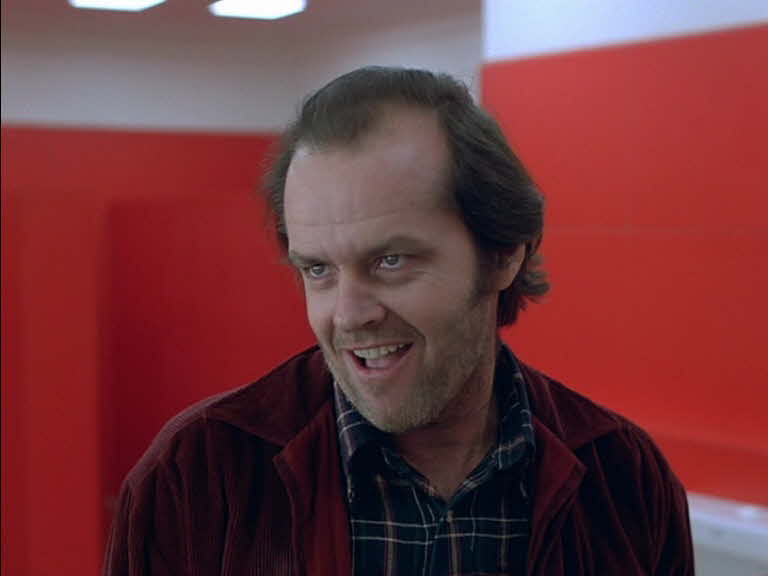
Kubrick cast Jack Nicholson as the tragic care-taker of the Overlook, both for his star power and because he'd wanted to work with the actor before (on his much-researched but studio-rejected post-2001 project, Napoleon), as Nicholson conveyed an innate intelligence that would prove unnerving in his descent to madness (the susceptibility of intelligent people to fatal flaws of character, or nature, is a common Kubrick theme). Nicholson took it even further—also something that has proven controversial—making his Jack Torrance highly reminiscent of the spit-flying subjects of horror comics (such as those published by EC Comics), with just a touch of the comic manicness of a Looney Tunes character (of the type watched by Jack's son, Danny).

That manic quality is in full display in this scene, despite the stillness and measured pacing of the editing. Conflicting emotions play across Torrance's face as the roles shift from fawning waiter and "important" guest to chastising superior and submissive craven—check out Nicholson's body language in the medium close-ups in the "Gentlemen's," as his spine seems to twist out of shape from scene to scene, while the mask of his face squirms from bravado to paranoia to wretched supplication to wolfish viciousness in the face of Grady's psychological warfare using class-ism, racism and sexism. Kubrick was never so much inclined to direct for realism from his actors, as he was for "something interesting," and, no doubt as he did with George C. Scott in Dr. Strangelove, he shot differing versions with varying degrees of intensity and used the "extreme" examples.

Finally, one cannot look at this scene and not think it had some influence on the work of David Lynch—who at the time was working on The Elephant Mancertainly in his work on "Twin Peaks," but also in his filmwork starting with Blue Velvet.  The odd creepiness in the stillness of this scene with its deep malevolent undertones—which screen-caps cannot capture but is readily apparent in the provided video—share the same unnerving quality as Lynch's post-Dune work.

As with most of Kubrick's work, The Shining did not prove to be the huge box-office success that Kubrick anticipated, but has gone on to be acknowledged for what its tag-line crows: "A Masterpiece of Modern Horror."

The Story: Former teacher (and reformed alcoholic) Jack Torrance (Jack Nicholson), his wife Wendy (Shelley Duvall) and son Danny (Danny Lloyd) are spending the Winter taking care of the shut-down Overlook Hotel.  Alone, isolated, they inhabit a tiny living space upstairs.  And Nature abhors a vacuum, and the Supernatural even more so.  Both Danny, who has a psychic ability—"shining"—and Jack are seeing visions of past murders and residents at the Overlook, including—for Jack—an encounter with the perpetrator of a grisly axe murder at the Overlook, Delbert Grady (Philip Stone).

Action!

CUT TO: M.L.S. JACK moves away from bar.
He dances forward to center of room - CAMERA TRACKS after him.
WOMAN enters cam.R.f.g. and walks away. WAITER (GRADY), carrying tray of drinks, walks forward from b.g.
He bumps into WOMAN.
GRADY Oh!
GRADY staggers forward, colliding with JACK and spilling
drinks down front of JACK's jacket.
GRADY Oh dear, oh dear. I'm so sorry, sir. Oh!
He puts down tray and takes advocaat glass from JACK.
GRADY Oh dear oh dear... I've made an awful mess of your jacket, sir.
GRADY puts glass on tray.
JACK Oh eh that's all right. I've got plenty of jackets.
GRADY mops JACK's jacket with his serviette.
GRADY I'm afraid it's advocaat sir. It tends to stain.
JACK Advocaat is it?
GRADY Yes sir. Look um... I think the best thing is to come along to the gentlemen's room, sir, and eh...
GRADY bends down and picks up his tray.
GRADY we'll get some water to it, sir.
JACK & GRADY start to walk away to the Gentlemen's. CAMERA TRACKS after them.
JACK Looks as though you might have got a spot of it on yourself there, Jeevesy old boy.
JACK pats GRADY on his back.
GRADY That doesn't matter, sir. You're the important one.
JACK Awfully nice of you to say. Of course I intend to change my jacket this evening before the fish and goose soiree.
JACK & GRADY enter Gentlemen's Toilet.
GRADY Very wise, sir. Very wise.
JACK exits cam.R behind door.
JACK (OFF) Here, I'll just, eh...

CUT TO: INT. MEN'S TOILET - M.L.S.
Men's toilet. JACK moves in from cam.L.b.g. He holds door open.
JACK hold this for you there, Jeevesy.
GRADY enters cam.L.
GRADY Thank you, sir. Thank you.
GRADY walks forward and puts his tray down on basins cam.R. JACK walks forward.
GRADY Now let's see if we can improve this with a little water, sir.
GRADY soaks his serviette under tap. JACK puts glass down
cam.L and turns to GRADY cam.R.
JACK Right, I'll just set my bourbon and advocaat down right there.
JACK laughs. GRADY starts to sponge JACK with serviette.
GRADY Won't keep you a moment, sir.
JACK Fine.
GRADY sponges JACK.
JACK What do they call you around here, Jeevesy?
GRADY Grady, sir. Delbert Grady.
CUT TO: M.S. JACK over GRADY. GRADY sponging JACK's jacket.
JACK Grady?
GRADY Yes, sir.
JACK Delbert Grady.
GRADY That's right, sir.
GRADY sponges JACK's trousers.
JACK Eh, Mr. Grady...
JACK clears his throat.
JACK (CONT'D) haven't I seen you somewhere before?
GRADY Why no, sir. I don't believe so.
GRADY turns cam.L to basins to rinse serviette under tap.
He turns back to JACK and sponges his jacket.
GRADY Ah ha, it's coming off now, sir.
JACK Eh... Mr. Grady... weren't you once the caretaker here?
GRADY Why no, sir. I don't believe so.
GRADY sponges JACK's trousers.
JACK You, er, a married man, are you, Mr. Grady?
GRADY sponges JACK's jacket sleeve.
GRADY Yes, sir. I have a wife and eh two daughters, sir.
JACK And, er... where are they now?
GRADY Oh, they're somewhere around. I'm not quite sure at the moment, sir.
JACK takes serviette away from GRADY and wipes his hand with
it.
JACK Mr. Grady, you were the caretaker here.
JACK I recognize you. I saw your picture in the newspapers. You eh... chopped your wife and daughters up into little bits, and eh... and you blew your brains out.
JACK throws serviette into basin cam.L.
CUT TO: M.L.S. GRADY over JACK.
GRADY That's strange, sir. I don't have any recollection of that at all.
JACK Mr. Grady, you were the caretaker here.
CUT TO: M.S. JACK over GRADY.
GRADY I'm sorry to differ with you, sir, but you are the caretaker. You have always been the caretaker.
GRADY I should know, sir. I've always been here.

CUT TO:
M.C.S. JACK laughs.
CUT TO: M.C.S. GRADY
GRADY Did you know, Mr. Torrance, that your son... is attempting to bring an outside party into this situation? Did you know that?
CUT TO:
M.C.S. JACK. He shakes his head.
JACK No.
CUT TO: M.C.S. GRADY
GRADY He is, Mr. Torrance.
CUT TO:
M.C.S. JACK
JACK Who?
CUT TO: M.C.S. GRADY
GRADY A nigger.
CUT TO:
M.C.S. JACK
JACK A nigger!
CUT TO: M.C.S. GRADY
GRADY A nigger cook.
CUT TO: INT. MEN'S LAVATORY - M.C.S.
JACK How?
CUT TO: M.C.S. GRADY
GRADY Your son has a very great talent. I don't think you are aware how great it is, but he is attempting to use that very talent against your will.
CUT TO: M.C.S. JACK
JACK Well, he is a very willful boy.
JACK smiles.
CUT TO: M.C.S. GRADY.
GRADY Indeed, he is, Mr. Torrance. A very willful boy. A rather naughty boy, if I may be so bold, sir.
CUT TO: M.C.S. JACK.
He looks about.
JACK It's his mother.
JACK looks about.
JACK She, eh... interferes.
CUT TO: M.C.S. GRADY.
GRADY Perhaps they need a good talking to, if you don't mind my saying so. Perhaps a bit more.
CUT TO: M.C.S. JACK.
GRADY (OFF) My girls, sir, they didn't care for the Overlook at first. One of them actually stole a packet of matches
CUT TO: M.C.S. GRADY
GRADY (CONT'D) and tried to burn it down. But I corrected them, sir. And when my wife tried to prevent me from doing my duty I corrected her.
CUT TO:
M.C.S. JACK smiles.
CUT TO:
M.C.S. GRADY.

The Shining

Words by Stanley Kubrick and Diane Johnson

Pictures by John Alcott and Stanley Kubrick

The Shining is available on DVD from Warner Home Video.


* The list of changes is lengthy and spoilerific—even if one has read the book—so we won't go into those here.  King subsequently wrote and produced a TV mini-series of the book with director (and Spielberg protege) Mick Garris starring Steven Weber as Jack and Rebecca De Mornay as Wendy.  The result was certainly closer to the book, but was sentimental and cloying and wildly melodramatic.