Saturday is traditionally "Take Out the Trash" Day. Written at the time of the film's release.
"That 'Strangers on a Train' Shit" or "It's Like a Douchebag Museum...!"
Office politics can get mean. Office politics can make you crazy. Office politics can get very, very messy (now, we have a movie that has all three!) However, I don't know many offices (outside the Post Office) where the politics can make you homicidal. Not even Congress.
But that's the situation inHorrible Bosses,which given the tough economic times, the high unemployment rates, and the relative lack of power suffered by your disappearing middle class, almost seems plausible. Documentarian/director Seth Gordon (The King of Kong: A Fistful of Quarters) has made a film that follows three rather hapless worker-buddies (who seem competent at their jobs, the events of the movie notwithstanding), as their job situations drive them to considering murdering their higher-ups. All three are unmarried (although Charlie Day's dental technician is engaged), so we're talking some arrested development here, especially considering Jason Bateman is one of the three and SNL's Jason Sudeikis is the third).
Bateman's Nick is up for a promotion, so he's been tolerating some abusive grooming tactics by his boss Dave Harken (Kevin Spacey, recycling his role in Swimming with Sharks), but doesn't get it when Harken takes the position himself.
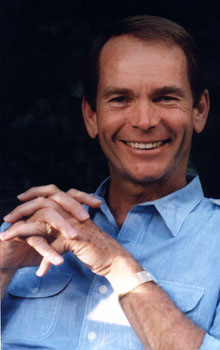
Sudeikis' Kurt is also expecting advancement as an account manager at the chemical factory run by Donald Sutherland, when Sutherland's character dies, and the company is taken over by his "Dipshit Cokehead Son", played by Colin Farrell (in a nicely over-the-top skeezeball performance, which seems to have been cut a bit—he's not in it much.
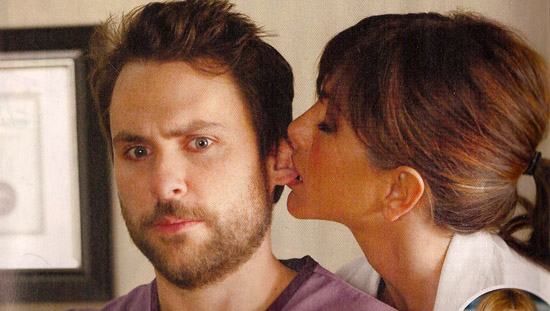
And Day's Dale is a tech for an extremely aggressive cougar of a dentist (Jennifer Aniston, bless her) who is determined to seduce him (for some reason), and is incapable of anything more complicated than single entendres.
They decide that, rather than "Best Practices," going to "H.R.," or finding another situation, they'll merely cut through the red tape and go straight to the yellow—they're going to kill their bosses. So much for negotiating skills and being a "people person." This is what commiserating in a bar can lead to. The next bar leads them to Dean Jones (Jamie Foxx—playing it straight and dead-pan), an ex-con who goes by a common vulgarism, because "Dean Jones" reminds too many people of The Love Bug. No wonder they want this guy to plan the executions. Jones' suggestion is that each of the guys does the murder of someone else's boss (and dutifully, Alfred Hitchcock's Strangers on a Train is mentioned, as is Throw Momma From the Train, which is the red-headed step-child of the Hitchcock film...which reminds me that today is recycling day).
This cannot go well, and despite some laugh-out-loud moments, it does not, succumbing to "easy answers," and a "Deus ex machina." God's gotta be watching these guys, because they're so incompetent, they can't do anything right*...which leads us back to the recycling bin. Rummaging through, it is not too hard to see that this is The Hangover which itself is a new version of a Three Stooges movie, especially in the psychology of the three leads. Bateman plays Moe the strong one, Day is Larry the weak whiner, and Sudeikis is so meat-headed he can only be Curly. And while no eye-poking or face-slapping occurs, you just know that the insults and slow burns between the three are the passive-aggressive equivalent. And a lot less fun.
There are good moments—Aniston and Farrell are clearly having fun playing broad—and one of my favorite actor-characters shows up at the end (a little too briefly), but all in all, the face I wanted to slap was my own.
* This shoots down the premise of the movie: if these guys are so ham-fisted doing...everything...maybe they don't deserve the promotions they think they've been cheated out of.
In this one, Laurence Harvey plays a double agent—Alexander Eberlin—working for the British Secret Service. He's upper-class, arrogant, and a snob, but quite good at his job, and when we first see him he is in the business of burying a colleague—killed by the Soviets, apparently, the third agent to meet such a fate recently. The Service is in a tizzy With three men down, they assign Eberlin the job of tracking down the suspected soviet agent behind the killings, whom they identify as Krasnevin. They want the agent tracked down and killed before any more harm can come top one of their own. Seems easy enough.
The only complication—which the British do not know—is that Eberlin himself is Krasnevin. He has been working for the Soviets for years, infiltrating the British Service for years. The man identified in the briefing as Krasnevin is actually his Soviet contact "Pavel" (Per Oscarsson). Somehow, he must convince the British that he can do the job, while at the same time, get back to his masters in the USSR, before he is found out.
One can see why the story would attract director Anthony Mann, who directed a slew of fine films (mostly in the film-noir and western genres) about conflicted men pushed to their self-imposed limits by individuals just that much worse than they are. For Eberlin, it's his fellow agent Gatiss (Tom Courtenay), who is determined to find the traitor in their midst and has a sociopathic zeal to do whatever it takes to bring him to ground. Gatiss, ironically, is the perfect spy, while Eberlin is not. And they're pitched in a mano a mano battle, while Eberlin fights his on a larger scale between nations and their bureaucracies.
The film itself is not so interesting, save for that one aspect. It has the curious distinction of being one of those spy films with no one to root for, everyone in a pitched battle of wits with merely the size of the arena being the distinction. No, the curious thing is that it feels like two distinctly different films, owing to the fact that it's Mann's last film—he died after finishing principal photography in Britain and while filming in West Germany, where star Laurence Harvey (who had directed The Ceremony in 1963) was picked to complete the film in mid-filming to protect the project's investment. And their styles are decidedly different.
This (I'm fairly certain) is an Anthony Mann shot.
Where Mann has a composer's eye for interesting angles and communicating relationships with where he puts his camera relative to its subject, Harvey's style is less classically-trained (especially with wide-angle compositions) and more geared to current catch-as-catch-can fashion. Mann, also, traditionally, tried to fill the frame with as much detail as possible, those specifics forming patterns to direct the eye to what he thought was important, whereas Harvey seems satisfied just to "get the shot" artfully or not.
This looks like something Harvey shot.
Mann's way has a scope to it, a dimensionality, whereas Harvey's compositions are flat and uninteresting, almost static and off-kilter (something Mann was more than capable of, but to a narrative purpose). It makes it a distracting watch, not because it's a good movie, but because one ends up playing "who shot this?" as a way of passing the time, until, finally, one just runs out of good material to admire and admits that "Harvey did this" for the remainder of the movie.
"Harvey" again
Hardly a way to generate suspense. But a way to get through it, at least. Plus, one has early roles for Mia Farrow, Peter Cook (playing straight but in a disorientingly comic way) as well as Lionel Stander, who's always fun to watch.
Mann directing? The shadows make me think so.
So. A potentially good film, tragically not living up to it. The film didn't do well at the box-office as the 1960's "spy-craze" was waning, and about to go undercover as comedies. And although Mann is officially credited as being the director on it, I have a hard time thinking of A Dandy in Aspic as his last film.
The Last King of Scotland(Kevin Macdonald, 2006) Talk about lucky guys--at last year's Oscars, Peter Morgan was nominated for his screenplay for The Queen, and the two leading actors of his screenplays won both Best Performance Awards: Helen Mirren for The Queen, and Forrest Whitaker for this film. They both had great material to work with. Morgan's talents for breathing life and personality into history (catch his HBO film, "Longford," while you're at it) puts to shame the recent spate of "highlights-biographies" (Ali, Nixon, Man on the Moon, Chaplin, Ray) that are like filmed Cliff Notes. And Whittaker is amazing in the film ("How'd they get him?" K. asked when he was first on screen. No, it's not the real guy, it's Forrest Whittaker), projecting the half-baked soul of Idi Amin Dada. It's a Supporting-sized role, but so large does Whittaker's portrayal loom over the movie that he dwarfs everyone else, even James McAvoy's starring performance as cocky Scotts physician Nicholas Garrigan, who goes looking for some selfish adventures and winds up being The Devil's Internist in Uganda.
And what starts as lucky breaks for a kid out of medical school turns into a nightmare of bad choices as the wildly paranoid Amin sinks deeper into madness, torturing first his enemies, and then those in his circle of confidence. In a country run by a lunatic, its a short trip from adviser to being strung up from a meat-hook (lest you think, Last King... is as genteel as The Queen, think again, the violence is bloody, and the torture is dwelled upon).
The director isKevin Macdonald, a former documentarian, and he seems to have a problem with pace. Last King feels drawn out, and in need of additional editing (as did his previous film, the interminableTouching the Void, which managed to make an incredible story something of a drag). But the sense of place and time feels genuine--you might not believe afterwards that the story is actually fictitious.
I realize I
am not the man to do a critical analysis of Les Misérables, the filmed version of the long-running staged presentation of the concept album produced by Claud Michel Schönberg, Alain Boublil and Jean Marc Natel, (from the novel by Victor Hugo)
for many reasons: 1) I'm not terribly fond of musicals, finding the form
unnatural and artificial—the inclination to burst into song having the
requirement of being necessitated by the surge of emotion, which, if you do it
too much, is a bit unsufferable—but, if the words and music are clever, born
out of character and need, my prejudices can be batted away in the sweep of
sheer admiration; 2) I’ve never seen “Les Miz” on stage, so this is my first
exposure to the material, which I found musically strong, with nice linking
strains between songs, but the lyrics, for the majority of it, trite and of the
“Moon-June” variety, and the propensity to insert (with a guillotine) moments of
light-heartedness in the midst of the most dramatic moments; 3) I have never
liked the direction of Tom Hooper (who directed the mini-series “John Adams”
with a heavy emphasis on unnecessary dutch angles, tortured compositions, and camera
movement “baggage” for its own sake, and then directed The King’s Speech with a somewhat less gaudy eye, but a penchant
for “gilding the lily” of competent performances with camera and lens
tricks.
So, Les Misérables is almost a “perfect storm” of things I don’t like
in movies, making me feel a bit uncomfortable about even attempting to discuss
it without the need to eviscerate it like an after-meal chicken.Oh, there are things I thought were
marvelous—the grittiness of it, the general down-troddeness of the whole thing,
the brio of the effort in dragging it, naturalistically, to the screen, when
everything cries out to leave it on the stage where it seems the presentation
would be at its optimum.
So,
kids, let’s get started. I’ll leave out the show itself, which has more than silenced its original critical drubbing by becoming the wildly popular “people’s choice” at the box office, entirely appropriate given its liberté/fraternité themes. Vive “Les Miz” and all that.But the stage presentation was already an odd ying-yang of performers belting out their inner emotions to the cheap seats, confessing their shame at the top of their lungs. To then bring it back down to intimacy, forcing powerful song material to be played out with naturalistic emotions—crying, snuffling, doubt—then compounds the confusion by compromising the musical material from its original intentions.
Then, director Hooper further piles on the emotional dissonance by shooting everything in very tight close-up, so we have intimate emotions couched in thundering expressiveness delivered at a timid range right in our faces. Hooper did no service to his actors here, threatening to expose every mis-step of their performances (which, by the way, was sung and recorded on set in real time) so close that the audience can’t miss it.
How’d
they do? Admirably well, considering. Anne Hathaway will surely win an Oscar for the “I Dreamed a Dream” sequence alone, finding the right balance of giving the song its due, while also expressing the grief, humiliation and moments of rage in her character.*
Towards the end of the film, Eddie Redmaynepulls
off a similar gift with “Empty Chairs at Empty Tables” and, surprisingly, Amanda Seyfriedmakes the most of her moments with a high, feathery voice that
doesn’t betray fragility.Hugh JackmanandRussell Croweare other matters. Both great performers with musical pasts (the former on Broadway, the latter with his vanity band), both are very capable, but the material, production and presentation get the better of both of them, exposing Jackman’s reedy voice (somewhere between Anthony Newley and David Bowie) and Crowe’s pop sensibility to pitch to the note he’s seeking.
The unlikeliest successes are Sacha Baron Cohen and Helena Bonham Carter, as the unscrupulous Thénadier couple, because their song is a knockabout one with lots of stage business letting them loose from the trap of Hooper’s tight framing, and because Cohen is allowed to throw in a couple of ad-libs (in beat, mind you) between lyrics, allowing a little bit of fresh air into the proceedings.
For me,
it was a train-wreck that seemed to go on forever, with only a couple of bright
spots to give me hope. But, given the production’s history, I’m sure the people will rise above it all, despite the tyranny of the direction on display.
* One of the best lines at the
Golden Globes was Amy Poehler’s about Hathaway’s performance: “I have not seen someone so totally alone and abandoned
like that since you were on stage with James Franco at the Oscars."And, yes, she did win the Best Supporting Actress Oscar.
**The creators of the stage version must have realized this, too, as they
keep turning up and their capering has a tendency to undercut the heavy drama. Entertaining, yes, but at the expense of the rest of the play.
I wouldn't say I was the best manager in the business. But I was in the top one." — Brian Clough
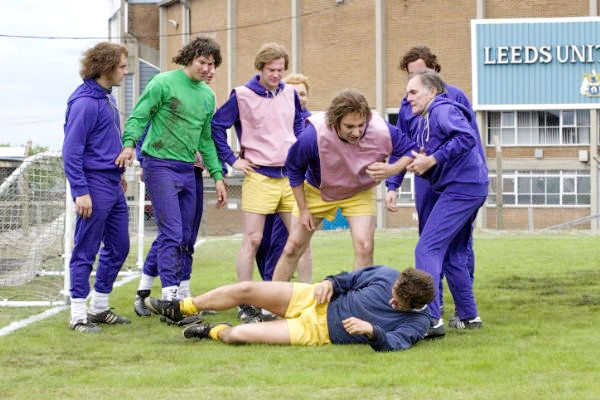
There are apparently two major industries in Britain that have created rabid fans: football and Peter Morgan-Michael Sheen movies. Football we know all about. What we colonists call "soccer" is an obsession carried in the hearts and minds and livers throughout the entire rest of the world (as a matter of fact, you could probably make a connection between loving this injury-inducing sport and embracing universal health-care!).
The feats Clough accomplished were done with aplomb, ego, a big mouth and a vindictive drive to show up the other teams in the leagues, especially Leeds. But, that drive also gave him a tunnel vision when it came time to manage Leeds, which was done with a "new broom" approach, angering the players, the club's board and the fans who saw the team fall to its worst season in ten years after only six games. Consequently, he got the sack. As fast as his success was acquired, he fell ten times faster.
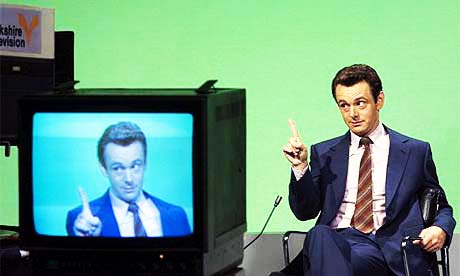
Morgan as screenwriter lets the mighty fall gently, depending on the grace that is shown, and whether the eyes are open during the trip. Idi Amin and Nixon, locked in their delusions, get no sympathy. Queen Elizabeth and Tony Blair are allowed insight as they're falling. Clough gets that insight after he hits rock-bottom, and Morgan's frequent collaborator Sheen registers every triumph in flashing teeth and every hurt in darkening bags under his eyes. Sheen, as a performer who's made a living playing performers, knows the degrees to which the face can display a false-front and genuine pain.
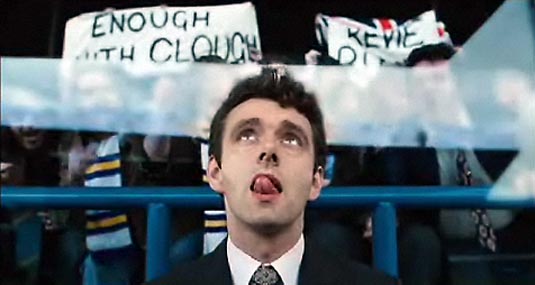
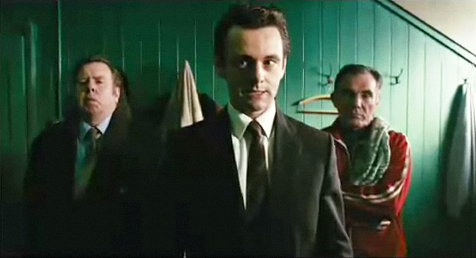
During an introductory press interview before taking over for Rievey, it's a cocky Clough who, with no prior knowledge, already thinks he has the team licked, with secret winks, flashing tongue and a smarmy way of laughing at his own jokes. After a dressing down from the Leeds captain, he'll maintain the same confident smirk on his face, but his eyes will dull with fear as soon as the player turns his back. If Sheen felt any disappointment in not playing the "Nixon" part of Frost/Nixon, he's compensated here for playing a personality of similar insecurities, but with an antic theatricality that the former President was never capable of. It's Sheen's show, but he's given ample opposition and support from Timothy Spall, Jim Broadbent, and Colm Meaney, who plays Coach Rievie with an irascible sense of entitlement.
Director Tom Hooper keeps things low-key in a BBC vid kind of way (thankfully dropping the peculiar framing that marked "John Adams"), but it isn't too long before one notices that, more and more, he's placing his Clough in ever tightening offices, hotel rooms, and locker-room corridors—an outsider trapped in his own prison of obsession and focus. One sequence is brilliantly twisted in its scope, or lack of it: as a much-needed match goes on outside, Clough stews and twitches inside his dennish office behind the stands, listening to the crowd reactions, not daring to emerge into the light to watch. Perversely, whenever a Derby goal is scored, the crowd leaps to its feet blocking out the only outside light to his office, casting him in darkness. You know that whatever Clough wins, he's lost.
* Although it would have been logical as one of the plot-points involved a London bombing, Sheen (and the character of Blair) subsequently did not appear in Hereafter.
The Story: A simple picnic in one of the most picturesque places on Earth in To Catch a Thief.
With two of the screen's most popular stars of the 1950's, under the director who was fast becoming as much a household name as Cecil B. DeMille, Alfred Hitchcock.
Forget the witty repartee provided by John Michael Hayes (although it's tough to do, with a suggestive thought appearing every few lines or so and even a crack at British-born Grant playing Americans all the time—the man worked with Hitch on Rear Window, The Man Who Knew Too Much, and The Trouble with Harry), the key to the scene is Hitchcock's minimalist editing of the scene—he just lets the actors ACT!—and a camera that, once it's settled, stays in the same spot for several minutes—the edit coming right before the climactic kiss in order for the audience to be more involved in it...and, I'm sure, Hitchcock, too.
The script segment is from Hayes' last draft and it's fairly descriptive of the action (although there are bits of business the actors throw in like Kelly's Francie's self-absorbed procurement of the salt without offering Grant's Robie any) and the dialog is pretty much spot-on how it would appear on-screen. But, with little differences. Both Kelly and Grant had worked with Hitchcock before, so they knew his methods and they knew how much he would tolerate deviating from the script (Answer: Not Much!).
But, Grant learned a few tricks from working with Howard Hawks—specifically on His Girl Friday. There was a concerted effort on that film to make the dialog speed along and feel like real conversation, rather than written dialog. So, Grant and co-stars would at little unimportant phrases at the beginnings and ends of lines, so that actors could interrupt and step over each other without anyone missing the crux of what was being said. Grant became a master of it, and his dialog always feels natural because he's adding things the way he would talk. Kelly proves quite adept at the same thing, and the scene has a logical flow and a feeling of two people really talking without knowing what the other will be saying (despite everybody reading the same script). Those additions are noted in green.
One should also mention that Kelly's character is a little weird, even beyond the parameters of the "muted sexiness' required of "the Hitchcock blond." She is genuinely intrigued, even—dare I say?—excited at "Conrad Burns" from Oregon being the cat-burglar John Robie. It rev's her engine, although she's perfectly capable of exceeding the speed limit on her own. I know that we've done two Hitchcock scenes in a row, but this attribute makes me want to do a third one—next week—that runs along the same attribute.
The Set-Up: John Robie (Cary Grant) is a former cat-burglar and jewel thief, retired now to the South of France. When a new string of robberies begin occurring on the French Riviera, the police suspect him (naturalment!). He wants to return to his peaceful retirement without having to look over his shoulder all the time, so he decides he'll catch the thief, himself, to prove his innocence. From a local insurance man (John Williams), Robie gets the names of the most bauble-bearing and most susceptible-to-rob people living in the area. At the top of the list are Jessie Stevens (Jessie Royce Landis) and her daughter Frances (Grace Kelly) from America, and Robie makes his introductions over dinner posing as Conrad Burns, lumber tycoon from Oregon. Jessie likes this "Mr. Burns" but "Francie" has a definitely cool demeanor. Until, she plants a big good-night kiss on him. She then makes a habit of turning up everywhere he is, while his attitude is something of a "mutual disregard." She's just revealed that she knows he's John Robie "The Cat" and has helped lead the police on a merry chase. Time for lunch, double entendres on the menu.
Action.
457. EXT. LA TURBIE–(DAY)–MEDIUM SHOT
Francie stretches her arms up and out into the air. Then she takes a comb out of her purse,
and begins arranging her hair. She talks as she does this.
FRANCIE: My, it’s a lovely day. (Takes a deep breath) Did you ever
see any place in the world more beautiful than this?
FRANCIE: Look
at the colors of the sea off there, and the sky, and those
pink and green buildings on the hill.
FRANCIE: Think of all the roofs
down there you could climb over.
ROBIE: Who did you call me?
FRANCIE: Robie. John Robie. One of the world’s cleverest jewel
thieves—known as The Cat. I’ve read all about you, in the
Paris paper.
ROBIE: You might have read about somebody called The Cat,
but—
FRANCIE: (Interrupts) I thought you were hungry.
ROBIE: I am.
She takes out the key, and hands it to him with a smile.
FRANCIE: The picnic basket’s in the trunk.
Robie opens the door, and starts to walk around the car.
THE CAMERA PANS with him.
He starts to open the trunk.
458. EXT. LA TURBIE–(DAY)–SEMI-CLOSEUP
Francie combing her hair in the rear view mirror, and at the same time, watching Robie.
FRANCIE: I hope you try to...
FRANCIE: ...bluff me, Mr. Robie. Then I can have
the fun of telling you how clever I was.
459 EXT. LA TURBIE–(DAY)–CLOSEUP
Through the rear view mirror, we see Robie opening the trunk in back. He pauses in doing
so, as he replies:
ROBIE: Since I am not Mr. Robie, but W. Burns, Miss
Stevens—there would hardly be any point in bluffing you.
ROBIE:Nevertheless, tell me how clever you were.
Robie takes out the picnic basket, and closes the trunk.
460. EXT. LA TURBIE–(DAY)–SEMI-CLOSEUP
Francie turns, with delight, and leans over the back of the seat to face him.
FRANCIE: Well, the first thing I noticed about you, was—
Her eyes follow Robie as he is moving from the trunk to the front seat of the car. His
VOICE is HEARD off:
ROBIE: (Interrupting) Don’t sound so pleased with yourself.
FRANCIE: I never caught a jewel thief before. It’s stimulating.
It’s
like, like—
The CAMERA FULLS BACK as Robie comes into the picture and puts the basket on the
front seat.
ROBIE: Like sitting in a hot tub?
She laughs.
There is something about her manner that seems flushed and exaggerated.
FRANCIE: Here, let me serve.
Robie seats himself on the floor of the car, with his feet on the ground. His back is to her.
She opens the picnic basket. Takes out two bottles of beer and an opener, which she hands
him.
FRANCIE: The first time I saw you was on the beach in Cannes. You
swam ashore from a motor boat driven by...
FRANCIE: ...that little
French girl.
ROBIE:You got an opener?
FRANCIE:Hm.
ROBIE:Thank you....
FRANCIE: (Looks up to him) Do you want a leg or a
breast?
ROBIE: You make the choice.
Robie makes no reactions to her revelations. He forces himself to be outwardly calm and
nonchalant. Francie reaches into the basket, and hands him a chicken leg. She takes a piece
of breast meat for herself. He has opened the beer bottles by now, hands one to her.
Each of them takes a bite of the chicken. She reaches in the basket for some salt, and salts
his chicken, and then hers.
FRANCIE: That was two days before you showed up at the hotel as
Mr. Conrad Burns,
ROBIE:(uh-huh)
FRANCIE: ...just over from America.
FRANCIE: Did you
swim?
ROBIE:Somehow, Miss Stevens. you’ve lost me. Well, naturally!
FRANCIE: Now don’t be disappointing, and act like Mr. Burns.
ROBIE: I can only be myself.
FRANCIE: Then be yourself, John.
ROBIE: I prefer Conrad.
FRANCIE: You can’t be serious.
FRANCIE: And it’s about time you called me
Francie.
She eats some more of the chicken, then takes a swig of beer.
FRANCIE: I have to look out for Mother. They’ve tried to steal her
jewelry before. When I read about the—uh,
FRANCIE: you—in the
papers—just a small item but I picked it up—
FRANCIE: I was sure
that mother would catch your eye.
ROBIE:Mm-hm. She did. Because I liked her. So far, Miss Stevens—
FRANCIE:Mmm. Francie
ROBIE: (So far)You
haven’t said anything that even remotely sounds clever.
FRANCIE: (Nods) Well, Stick around. The next thing I noticed was something remarkable.
ROBIE:Yeah?
FRANCIE: All evening long, you only looked at my
mother—never at me.
ROBIE: I kissed you, didn’t I?
FRANCIE: I kissed you.
ROBIE:At least I ...certainly wasn’t looking at your mother then.
FRANCIE: You were thinking about her. Otherwise you’d never have
let me say goodnight so easily.
ROBIE: I’m a gentleman.
FRANCIE: A rough lumberman from the big Northwest?
ROBIE:I’llI must remember to shout “timber” occasionally.
FRANCIE: Now here comes some of the clever part— (She smiles
defiantly)
FRANCIE: You’re not quite convincing, John.
FRANCIE: You’re like an American character in an English movie.
FRANCIE: You don’t
talk quite the way an American tourist ought to talk.
ROBIE:Don't you know that All the guidebooks say don’t act like a tourist.
FRANCIE: It’s just that you never mention business, or baseball, or
television, or politics, or taxes, or wage freezes, or senate
probes.
ROBIE: Everything I left home to forget.
FRANCIE: You’re just not American enough to carry it off.
FRANCIE: How long
has it been?
ROBIE: Since Boston won the pennant? How long has what been?
FRANCIE: Since you were in America last?
ROBIE:Three days ago. Just after Kukla, Fran and Ollie. I dunno. About four or five days.
FRANCIE: And Oregon?
ROBIE:A week ago. The day they found a Communist in the
Russian Embassy.About three or four days before that.
FRANCIE: Name me three deciduous trees indigenous to the North-west.
ROBIE: Now listen...
ROBIE: You’re a nice girl with too much imagination. If you go
around talking like this about me, end up in a French jail
for something I didn’t do.
FRANCIE: (Smiles triumphantly) Are you going to rob Mother first,
or somebody else?
ROBIE: Under the circumstances, somebody else.
FRANCIE:Mm. That’s nice. Mother likes you.
ROBIE:Well...
FRANCIE: —I think Lady Kenton
should be our next job.
He puts down the beer and chicken.
ROBIE: Now look—
FRANCIE: Isn’t she on your list? She ought to be. The Kenton jewels
are famous.
FRANCIE: I know every inch of her villa.
ROBIE: I can already hear your next line.
FRANCIE: The cat has a new kitten.
FRANCIE: When do we start?
He turns, reaches up and takes her wrist.
ROBIE: Don’t talk like that.
FRANCIE: (Pleasantly) You’re leaving fingerprints on my arm.
ROBIE: I’m not John Robie, The Cat.
FRANCIE: (Speaking rapidly) Why are the police following you?
Show me that “real estate” list. That villa you went to
isn’t for rent, and you know it.
FRANCIE: The Sanfords have owned
it for years—and I’m going to a party there in a week—
FRANCIE:You have a very strong grip. The kind a burglar needs.
He relaxes his hand a little, but still holds her. He smiles at her.
He pulls her down to him,
and kisses her.
After they part:
ROBIE: That’s why you came out here, isn’t it?
FRANCIE: We’ll have cocktails at eight—dinner at eight-thirty. All in
my suite. We’ll talk about it there.
ROBIE: Can’t come. I’m going to the Casino and watch the fire-works display.
FRANCIE: You get a better view from my place.
ROBIE: Already got another date.
FRANCIE: Everywhere you go, I’11 have you paged as “John Robie,
The Cat”.
He doesn’t say anything to this.
FRANCIE: Eight o’clock. And Be on time.
ROBIE:I don’t have a good watch. Haven't got a decent watch.