Friday, August 23, 2019

The Great Buster: A Celebration

All the World's a Landing Pad

I could have kicked myself (with an appropriately spiraling prat-fall with legs propellering) when I missed the limited theatrical run of The Great Buster: A Celebration, the new documentary stitched together by Peter Bogdanovich. The life-work of Joseph Frank "Buster" Keaton has long been my movie-equivalent of comfort food. Precise, extraordinary and slightly melancholy (with only a dash of sentiment), his are the rare silent movies that do not "date" and seem extraordinary even by today's sophisticated standards.  That's due, in large part, because so many of today's films borrow the presentation and seek the comic timing that Keaton imbued in his films.* The testimony of many of those interviewed in the film attest to that.

Fortunately, TCM presented it as part of their day-long tribute to Keaton for a day in their annual "Summer Under the Stars" fest. Narrated by Bogdanovich himself, it contains a lot of what's come before in films about Keaton—the best of which is still Kevin Brownlow's Buster Keaton: A Hard Act to Follow (1987)—but also a lot of little-seen material that had to be dug for. And it has an interesting way to tell Keaton's story, one that is, indeed, a celebration, rather than the usual peak-valley-re-discovery arc presentation that follows the path his career took.
The story of Keaton (ironically for a comedian) is a sad one: after enjoying success with his own productions, Keaton—at the suggestion of his father-in-law—signed a deal with M-G-M, the lousiest studio to do a comedy at the time as the Marx Brothers and Laurel and Hardy found out for themselves, and found himself a square peg in M-G-M's restrictive round hole.
But, Bogdanovich switches it out a bit to ensure that his Keaton overview ends on a high note. In the first part of film he goes over Keaton's entire career—from his days as a precocious vaudeville performer in his parents' act (starting at the age of three!) where he first got the taste for performing for an audience, through his entry into film as a writer and performer for comedian Roscoe "Fatty" Arbuckle at the height of his career. Then (when Arbuckle was charged with manslaughter after the death of actress Virginia Rappe) stepped from his supporting roles to starring in comedy two-reelers, building on Arbuckle's mentorship—while he was working for Arbuckle, Keaton took one of the film cameras, took it apart and put it back together again—making his own short films, and then features.
Keaton's films were always popular, but his masterpiece, The General, was expensive and not a success, so he took his father-in-law's advice and signed with M-G-M to his detriment and everlasting regret. Then came his dry-spell, doing the occasional writing, even directing scenes, and punching up the films of other performers (like Red Skelton) losing two marriages and sinking into alcoholism and depression, even briefly being institutionalized after a nervous breakdown. Then, in the 1950's, his activity increased, showing up in Billy Wilder's Sunset Boulevard and Charlie Chaplin's Limelight,* appearing in shorts, television, and commercials, and guesting in movies in the 1960's.
Bogdanovich ends the section with Keaton's loving reception at the 1965 Venice Film Festival, which showed all of his features—Bogdnovich then does a "greatest hits" review, ending the film with the best of Keaton's lifetime of work.

It's a sublime choice—leaving a viewer wanting more from the master of the comedic landing without the pain of his fall.


*


* My experience watching Limelight was that Keaton was given short-shrift by Chaplin in their scenes together. But, in The Great Buster, comedian Richard Lewis, who was friends with Keaton's widow, said that Chaplin treated Keaton "like a king." And Norman Lloyd, who appeared in Limelight says that Chaplin had Keaton direct his death scene, so that he could concentrate on his performance. Now, that's a lot of trust, generosity, and respect reflected in that. 

Wednesday, August 21, 2019

Good Boys

F-Bombs (Out of the Mouths of Babes)
or
"Two Weeks in the 6th Grade and I'm a Social Piranha!"

The "R" rating is prominent in the promotions for Good Boys because, God forbid, kids the ages of the stars of it should go see this movie (at the premieres, do they escort them out? I mean, they ACTED the damn thing). But, then, I'm not sure what good it would do to actually let 11-12 year old's see this movie, other than to show them what adults think of them.

Because the movie isn't FOR the age-group it depicts, like a YAF novel. It's for adults to give them a nostalgic laff about the naivete and confusion of that time period between childhood and wanting to be an adult—you realize you can't do certain things adults can do, you're constantly told "you wouldn't understand," you see adulthood as a freedom you covet without realizing the responsibilities that come with it (that give you no freedom at all). It's the last flush of childhood that you can actually enjoy before the mantle of licenses, financial responsibilities and permanent records take away your childhood and make you nostalgic for the way things were.


Which is why they make movies like Good Boys for adults.

There's a grand tradition of this in the movies—"Our Gang," one of my faves The Sandlot ("You're killing me, Smalls"), where kids are trying to act like adults in an adult world, where the adults are almost absent (the comic strip "Peanuts" is like this where there are no adults and the kids talk—as cartoonist Al Capp used to carp—"like psychiatrists" or, as in the animated versions, adults squawk like muted trumpets). If it was a drama, it would be To Kill a Mockingbird—kids not understanding the frailties and failings of adults. But, in a comedy, it's kids trying to negotiate through the adult world without understanding it, and Good Boys takes it to the extreme.
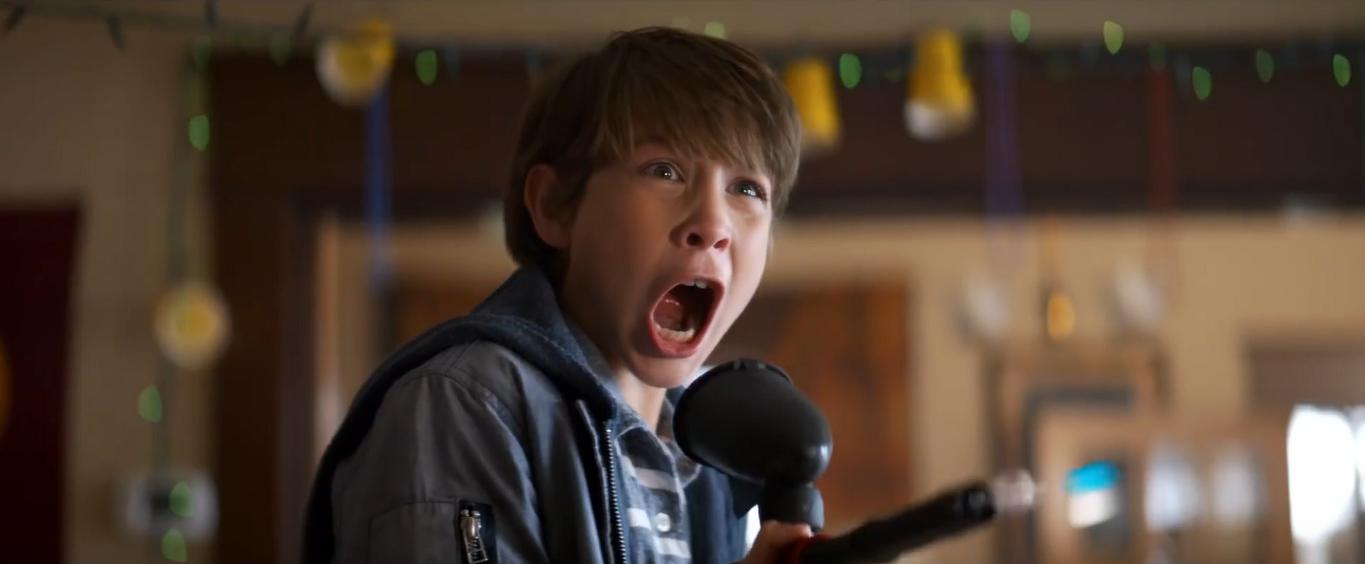
The story follows the issues of "The Beanbag Boys" (called that because...they all have beanbag chairs)—Max (Jacob Trembley, the brilliant young actor from Room), Lucas (Keith L. Williams, who's hilarious) and Thor (Brady Noon, who gives the most mannered performance, but has the most conflicted role)—friends since kindergarten, who are entering sixth grade, which for them is a highly transitional time. Their little clique runs the risk of fraying due to peer pressure, family crises, and the inevitable consequences of growing up and away from each other, but seem determined to stay bonded through thick and thin.
Thor is the most theatrical, but also the one most susceptible to peer pressure—despite his talents, he doesn't try out for the sixth grade school play because he'd be thought of "not cool." Max is starting to notice girls, particularly Brixlee (Millie Davis), who he can't look in the eye while also trying to be apathetic, at the same time the sight of her makes him weak in the knees. Lucas, is the tallest of the three, but is being cut down to size due to the impending divorce of his parents. These are the crises of children, because their stasis is being shattered and change is being forced on them without any regard to how they feel about it. They are completely messed up, but try to hide it behind a veneer of "cool" lest they humiliate themselves.
The events of the movie revolve around Max and his Brixlee fixation. The popular boys are giving them a hard time--Thor is being harassed  for his interest in theater arts, conflicting with Max, who wants to be popular because he thinks it will give him a better chance with Brixlee (an invitation to a "kissing party" That Brixlee is going to becomes his obsession). Big problem, though;  he's never kissed anybody. What if his kissing...well...sucks. To get an education--a horrifying encounter with porn doesn't work because "they never kiss, not their mouths"--Max takes control of his father's drone against his orders ("I use it for work!") to spy on two "old" girls, Hannah (Molly Gordon) and Lily (Midori Francis) in Hannah's nearby backyard. Hannah has a college boyfriend, so the boys "one-up" the traditional spying through the fence to go to aerial reconnaissance. They watch Hannah and Benji--the boyfriend--have a fight right after he delivers some "Molly" to Hannah for a concert that night. Just when the girls go in for a consoling clinch, Max loses control of the droid, allowing the girls to capture it...and hold it hostage.

This is not good. It becomes a hostage situation that goes seriously wrong with a confrontation where Max may have to 'fess up to his Dad and be grounded for the kissing party. But, Thor manages to steal one of the girls' gotcha bags containing the ecstasy (don't worry, the boys don't get access to it--they can't figure out child-proof caps). But, it begins a cat-and-mouse game between the Beanbag Boys and the "old girls" as each has something the other wants. There are the inevitable complications that divert this "Coming of Age" movie into an "Incredible Mess" movie (the kind where relatively simple goals become increasingly out-of-reach by increasing road-blocks, tangents and diverting sub-goals that keep the ultimate goal tantalizingly harder to achieve.
"Honey...yeah...we're not having kids."
The Beanbag Boys turn out to be surprisingly adept at navigating these smaller complications to achieve their ends, even as they risk fraying the fabric that binds them together.
They're not bad kids--in fact, their naivete and embedded anti-drug indoctrination makes them quite charming, despite the beer-sipping (four sips is a crowd-impressing record) and the F-bombs that explode out of their mouths.
They're just trying to make sense of a bizarre adult world that, more often than not, turns them into screaming meemies (and cry-babies--they are constantly crossing the line from sixth grade sophisticates to the behavior of kids in single digits). I'm not sure what kids would make of this if they were allowed to ss it (for one thing, a lot of the jokes will fly right over their heads). But, then, they're not the target audience. Older teens and adults are, and in that context, the movie is a nostalgic comedy as opposed to being about the loss of whatever innocence they still retain.

It's an odd movie. But very funny.


Tuesday, August 20, 2019

Olde Review: Forbidden Games (1952)

This was part of a series of reviews of the ASUW Film series back in the '70's. Except for some punctuation, I haven't changed anything from the way it was presented, giving the snarky, clueless kid I was back in the '70's a break. Any stray thoughts and updates I've included with the inevitable asterisked post-scripts.


This Saturday's ASUW films in 130 Kane at 7:30pm are the last of the Fall series, and they are Rene Clement's Forbidden Games and Kon Ichikawa's Fires on the Plains. They look at the effects of war on children and men.

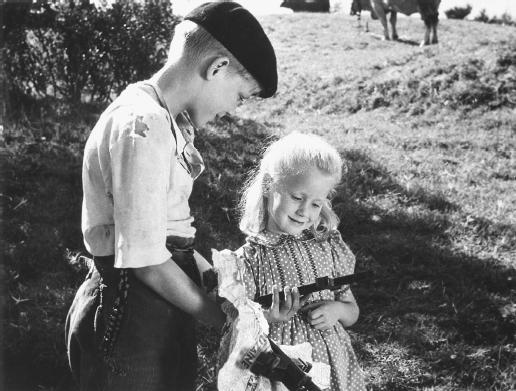
Forbidden Games aka Jeux Interdits (René Clément, 1952) is a story of children in the midst of World War II. And for an anti-war film, there is very little war to be seen—at the beginning, a few strafing planes that rip through a line of fleeing Parisiennes, that leaves the young female protagonist an orphan. But the bloodshed is kept to a minimum, for the war is important only in a roundabout way; it's the two children in this story, and the family that surrounds them that are important. Forbidden Games is a film that is rich in allegory, but also rich in humor, and rich in a sort of melancholy attitude to the tarnished innocence of the children and the petty arguments of their elders. It's a film that, because of its nature, will lose something of its message, if you don't come across it yourself. So, suffice it to say that you will be left thinking about it, and thanking for it, for quite some time.


Broadcast on KCMU-FM on December 6th and 7th, 1976

Well, that's about as generic a review as one can write...and still have seen the film. That the saddest thing in the film is the kids' shortened childhood, and their melancholy embracing of the responsibilities of adulthood and attitude to death makes it that rare war film that deals exclusively with collateral damage and the effects of the anonymous warfare ripping apart the lives of others. The little girl, Brigitte Fossey, who was five when this was filmed, went on to have a long career in films--you probably saw her in Cinema Paradiso.

Sunday, August 18, 2019

Don't Make a Scene (Redux) The Dark Knight Rises

It takes a lot of time to do the "Don't Make a Scene" feature that I put up every Sunday (all those screen-caps!), so while I'm preparing a bunch more, I'm going to take a break and re-post the ones that have gotten the most "hits," counting down from the 10th highest to the first. When I started compiling them, I was totally baffled by the results (enough that I'm considering posting a couple of my favorites that resonate a lot with me, once we're done with this). I would never have thought that these would be the most looked at, but here they are, as part of "Don't Make a Scene (Redux)."

Dances with Catwomen (2012)


The Story: Last week, Keaton and Pfeiffer from 1992.  This week, twenty years later with Bale and Hathaway in 2012.  A lot has changed in 20 years from Batman Returns to The Dark Knight Rises. But so much stays the same.

First, the dance itself, although Christopher Nolan shoots it with more sustained "takes" and fewer cuts than Tim Burton did. Second, we're at another costume ball, although the emphasis is less on costumes than formal wear with masks. Third, Bruce Wayne (who wears a mask professionally, although it's debatable which role he plays is the mask) shows up for the soiree...as himself...mask-less (although, again, that's debatable). Fourth, some one comments on it: in Burton's, Max Shreck calls the costume "trust-fund goody-goody;" With Nolan, Wayne identifies it as "Bruce Wayne: Eccentric Billionaire." Fifth, Selina Kyle and Wayne exchange a kiss, but this one is not so romantic as challenging. Sixth, Selina comments on Wayne's privates in both films, it's an odd comic moment in the first film, but it's oddly unnecessary, especially in the latter film where the comment is generated completely out of context from the previous remark.

Two completely different scenes, though, even though the characters are both masked, both divided, and in transition. In Burton, they're romantic, potential partners; in Nolan, they're wary combatants, although non-threatening for now...even Selina's "storm" warning has a beneficial aspect to it. The dance is suggestive of the alliance/antagonism relationship Bruce and Selina have always "enjoyed" in the comics, two people caught in the middle of themselves and each other, capable of tipping to either side, given circumstances.

Seeing it in the theater, it was eerie to see it unfolding, with memories of the first dance.

The Set-Up: Years after the death of "White Knight" D.A. Harvey Dent, "The Batman" accused of his death has gone into hiding, and so has his alter-ego Bruce Wayne (Christian Bale), whose only achievement has been to develop a cold fusion reactor that he quickly scrapped, losing half of his family's fortune. A robbery at stately (and recently rebuilt) Wayne Manor by a mysterious cat-burglar (Anne Hathaway) has brought Wayne out of hiding to a charity function thrown by Miranda Tate (Marion Cotillard), where he spies the thief—Selina Kyle—who stole only his mother's pearls...and his fingerprints.

Action.

Wayne watches Miranda glide away. Then turns to Selina.
WAYNE Mind if I cut in?
Rich Twit turns, annoyed - 
Wayne hands him his cane. 
Takes Selina by the waist. She glares at him.
WAYNE You don’t seem very happy to see me.
SELINA You were supposed to be a shut-in.
WAYNE Felt like some fresh air.
SELINA Why didn’t you call the police?
WAYNE I have a powerful friend who deals with this kind of thing.
WAYNE (Admires her cat ears.) Brazen costume for a cat burglar.
SELINA Yeah? Who are you pretending to be?
WAYNE Bruce Wayne, eccentric billionaire. Who’s your date?
SELINA His wife’s in Ibiza. She left her diamonds behind, though. Worried they’d get stolen.
WAYNE It’s pronounced ’Ibeetha’. You wouldn’t want these folks realizing you’re a crook not a social climber.
SELINA (flash of anger) You think I care what anyone in this room thinks about me?
WAYNE I doubt you care what anyone in this room thinks about you.
SELINA Don’t condescend, Mr. Wayne. You don’t know a thing about me.
WAYNE Well, Selina Kyle, I know you came here from your walk-up in Old Town - modest place for a master jewel thief. Which means either you’re saving for your retirement - or you’re in deep with the wrong people.
SELINA You don’t get to judge me because you were born in the master bedroom of Wayne Manor.
WAYNE Actually, I was born in the Regency Room.
SELINA I started off doing what I had to. Once you’ve done what you had to they’ll never let you do what you want to.
WAYNE Start fresh.
SELINA There’s no fresh start in today’s world. Any twelve-year-old with a cell phone could find out what you did. Everything we do is collated and quantified. Everything sticks. We are the sum of our mistakes.
WAYNE Or our achievements.
SELINA The mistakes stick better. Trust me.
WAYNE You think that justifies stealing?
SELINA I take what I need to from those who have more than enough. I don’t stand on the shoulders of people with less.
WAYNE Robin Hood?
SELINA I’d do more to help someone than most of the people in this room. Than you.
WAYNE Maybe you’re assuming too much.
SSELINA Or maybe you’re being unrealistic about what’s really in your pants other than your wallet.
WAYNE Ouch.
SELINA You think all this can last?
Wayne glances around at the sumptuous party.
SELINA There’s a storm coming, Mr. Wayne. You and your friends better batten down the hatches, because when it hits... 
SELINA ...you’re all gonna wonder how you ever thought you could live so large... 
SELINA ...and leave so little to the rest of us.
WAYNE Sounds like you’re looking forward to it.
SELINA I’m adaptable.
WAYNE These pearls do look better on you then they did in my safe...

Wayne rolls her into his shoulder - reaches up to the back of her neck, unclasps the necklace.
WAYNE ...But I still can’t let you keep them.
The pearls slide off her neck into his other hand. Selina looks at him. Angry. 
Then kisses him, hard, 
...and disappears into the crowd. 
Wayne’s cane reappears.
RICH TWIT(annoyed) You scared her off.
WAYNE Not likely.

EXT. MUSEUM - MOMENTS LATER

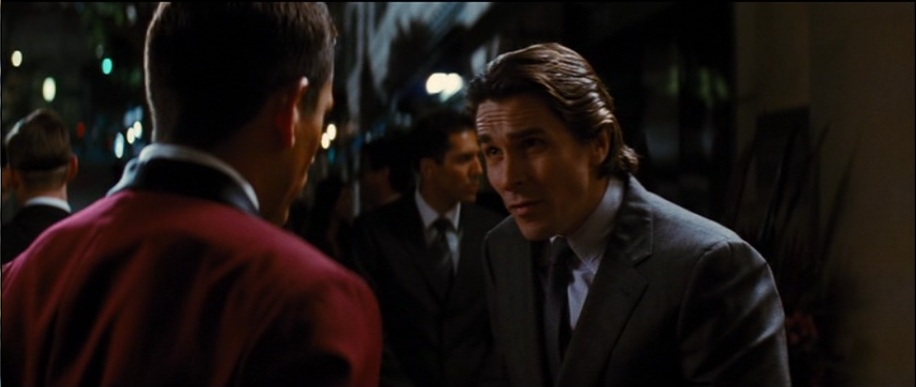
Wayne approaches the Valet. Pats down his pockets.
WAYNE I must have lost my ticket -
VALET Your wife said you were taking a cab home, sir.
WAYNE My wife?

INT./EXT. LAMBORGHINI RACING DOWN STREETS - CONTINUOUS
Selina permits herself a little smile as she guns the engine.


The Dark Knight Rises

Words by Jonathan Nolan, David S. Goyer and Christopher Nolan

Pictures by Wally Pfister and Christopher Nolan

The Dark Knight Rises is available on DVD from Warner Home Entertainment