Friday, April 24, 2015

Countdown to Avengers: Age of Ultron—The Avengers

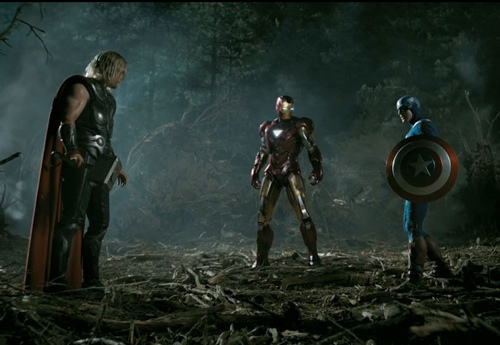
The latest "Avengers" movie comes out on May first. For this month of Fridays before the premiere, we'll be re-running reviews of the movies that formed the stepping stones for this latest one. This time, we'll look at the first film went "all-in," collecting all the established Marvel heroes, whether starring in their own films or playing supporting roles, in what was hinted at in the post-credit teasers as "The Avenger Initiative." 

For this one, which was the lynch-pin of the franchise and HAD to become a success, the now-established Marvel Studios called upon a fan-favorite writer-director whose previous attempts to make a super-hero movie had been scuttled by another studio, but he was well-known attracting an audience and making a budget stretch to the point of bursting. The result was successful far beyond anyone's expectations, with the only down-sides being post-Avengers movies seemed to be a little run-of-the-mill and accusations of the "Whedonization" of the Marvel Universe.  


Whatever.  It worked like gang-busters.


"We've Got a Hulk..."
or
Playing Your "A" Game

This one is The Big Pay-Off.

Back in the day (around about Iron Man) when they started doing teasers at the end of Marvel movies for the idea of an "Avengers" event, one hoped that they could pull it off. Captain America needed to work (and it did). Iron Man II integrated other characters successfully.  They even managed to make Thor somewhat interesting. And even though two "Hulk" movies under-performed at the box-office, there was still potential there. Given the scenario of the "Ultimate Avengers" storyline (a revamp in the Marvel line that started everything over from Origin Story Square One with a decidedly more adult, realistic attitude...and a Nick Fury that looked like Samuel L. Jackson) a case could be made for a good old fashioned Marvel Jam story of the "When Titans Clash!" school.

The problem is all those heroes. It could turn into a mighty cluster, if there isn't a compelling story that slots heroes into appropriate scenarios, a problem with some of the "X-Men" films. And one also hopes that there's a compelling reason for these guys to be here, that there is some character function going on, even though they have plenty of screen-time in their own series to work on those.

Will The Avengers "assemble" into a well-functioning superhero romp, and make Joss Whedon (who excels at ensembles) an A-list director that fans have been hoping for?
"Yes" to the former and "Maybe" to the latter, although pulling off this one is not an easy feat—so many particular and persnickety stars, so many owned and exploitable characters that corporations (and opposing film studios) want to manage, and so many potential minefields that it would take a superhero (with levitating powers) to rise above and negotiate them.  But Marvel's The Avengers (what they're calling this one to avoid any confusion) manages to be fast-paced, quick-witted, and, although slightly derivative (mostly of Jack Kirby's "Fourth World" series, with hints of The Andromeda Strain in sub-text, and, let's face it, most mythology and comic book tropes), and is, as one character analogizes, "a bag full of cats," fulfills its basic tenet: to be consistently entertaining, with crises every few minutes, wonders to behold (some of the sets are simply amazing), interesting pair-ups in terms of fights (Marvel heroes are always fighting each otherthey're very turf-oriented, which is bad because they're all in New York) and dialogue. 
And it does two essential things: keep each individual hero definable in tone and action, and make those fights "followable"—this isn't a hodge-podge of pictures of punches, muzzle-flares and explosions, there is breathing room between sequences and shots, so an audience is allowed to register action and result, something missing from a lot of action movies, where there is either bad direction or a style-disconnect between various "units" filming. It feels "of a piece," despite the subject of the film being about extraordinary outcasts aligning uneasily.*
In a pithy line of dialogue between "Iron Man" Tony Stark (Robert Downey, Jr. riffing brilliantly) and villain Loki (Tom Hiddlestone, registering far more than he did in the Thor movie)—everybody gets their Loki scene, The Hulk's being the best—the entire movie is summed up in an adamantium-encased nut-shell: "Yeah, takes us a while to get any traction, I'll give you that one but, let's do a head count here. Your brother, the demi-god; a super soldier, a living legend who kind of lives up to the legend; a man with breath-taking anger management issues; a couple of master assassins, and you, big fella, you've managed to piss off every single one of them."  

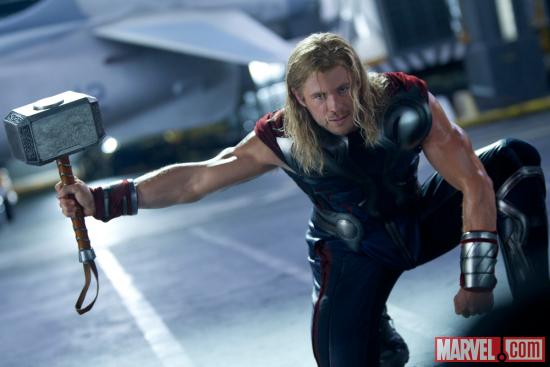
Motivation enough to form a coalition of the willing.  And the disparate styles of the players is well-evidenced-six degrees of declaration: Chris Evans is all un-ironic directness (even though he is perfectly capable of matching Downey snark-for-snark); Chris Hemsworth is all stentorian brio done with Shakespearean force (he's so much more effective here than in his own movie); Jeremy Renner is as taut as his crossbow wire, Scarlett Johnasson's blank-stared Black Widow is well-suited for her position as a lethal scam-artist, Samuel L. Jackson manages to make even original lines sound like oft-quoted cliches; and Downey, quick and mercurial, dances around the dialogue, adding his own steps. Each actor has their own way of working with Whedon's words, and Downey's pace has everyone playing their "A" game.
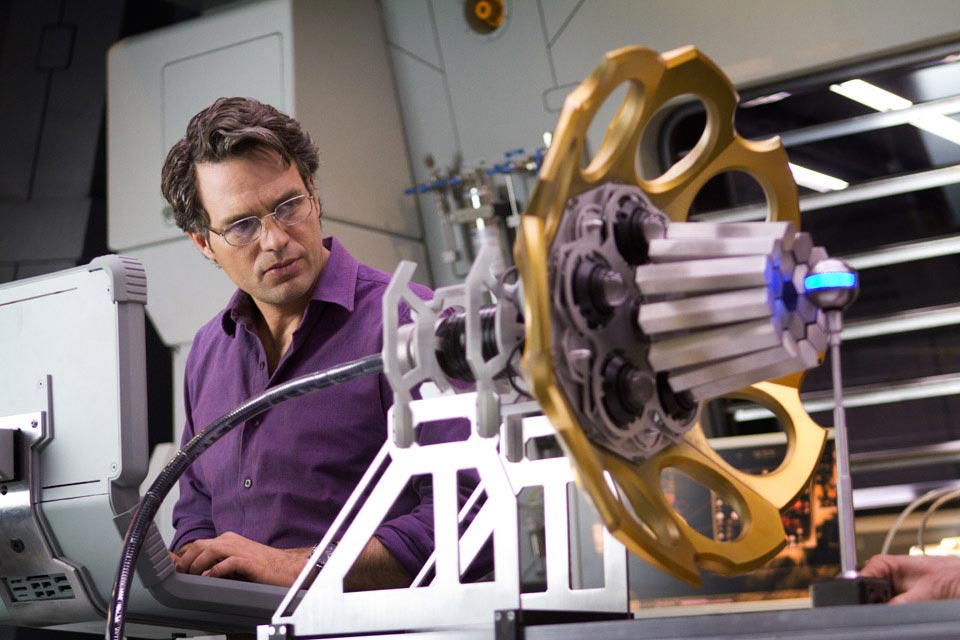
But the best here is Mark Ruffalo, playing Dr. Bruce Banner and (the first time an actor is allowed to, via motion-capture) his altered super-ego, The Hulk. Two movies and two different actors (Eric Bana and Edward Norton, no slouches) tried to do something with the limited premise and came up short. However, here, with less screen-time, Ruffalo manages to make Banner as interesting as his comically destructive "Other Guy," his physicist not guarded or fearful or weak (as has been the norm), but ironically bitter, resignedly haunted, the most mysterious of Marvel's "Mystery-Men."  "You really have got a lid on it, haven't you?" says Stark at one point, referring to the Doctor's self-control and the monstrous result of any lack of it. "What's your secret? Mellow jazz? Bongo drums? Huge bag of weed?"  Maybe The Hulk is such a one-smash pony that he's at his best as a supporting character, rather than the star of a movie series. One could argue that about all the characters here with the exception of Downey's Iron Man, who is, due to the actor's efforts, a one-man circus.
But, here it's all in the group, nobody's around long enough to drag it down, and it's the interactions that count. The plot is MacGuffin-oriented in the Marvel-style of "I-don't-know-what-it-is-but-it-sure-is-big:" the doohickey from Captain America and the whatsit from Thor are involved so that a race of advanced aliens can take over l'il old us. Not sure of the motivation, but who cares? Marvel's The Avengers is big, bold, brassy and breezy, and has the feel and crazy zeal of those Japanese monster movies that combined a lot of characters and smashed them together.

I don't know what it is, but it sure is fun.**
All the potential Avengers, assembled by George (every little detail) Perez

* Whedon shows the eventual alliance solidifying in two nicely planned shots, one—used in all the commercials—orbiting the heroes as they "circle the wagons," and a meticulously planned CGI sequence in mid-battle that is the super-hero equivalent of "going around the horn."

** There are TWO codas this time: one after the initial credits (before they get into the detail stuff) and another one that was filmed right after the Hollywood premiere that's odd...but fun.

Thursday, April 23, 2015

The History of John Ford: The Man Who Shot Liberty Valance

When Orson Welles was asked what movies he studied before embarking on directing Citizen Kane he replied, "I studied the Old Masters, by which I mean John Ford, John Ford, and John Ford." 

Running parallel with our series about Akira Kurosawa ("Walking Kurosawa's Road"), we're running a series of pieces about the closest thing America has to Kurosawa in artistry—director John Ford. Ford rarely made films set in the present day, but (usually) made them about the past...and about America's past, specifically (when he wasn't fulfilling a passion for his Irish roots). In "The History of John Ford" we'll be gazing fondly at the work of this American Master, who started in the Silent Era, learning his craft, refining his director's eye, and continuing to work deep into the 1960's (and his 70's) to produce the greatest body of work of any American "picture-maker," America's storied film-maker, the irascible, painterly, domineering, sentimental puzzle that was John Ford, John Ford, and John Ford.


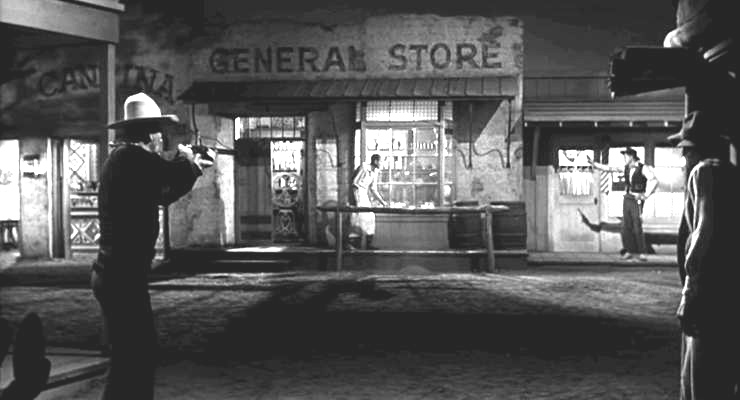
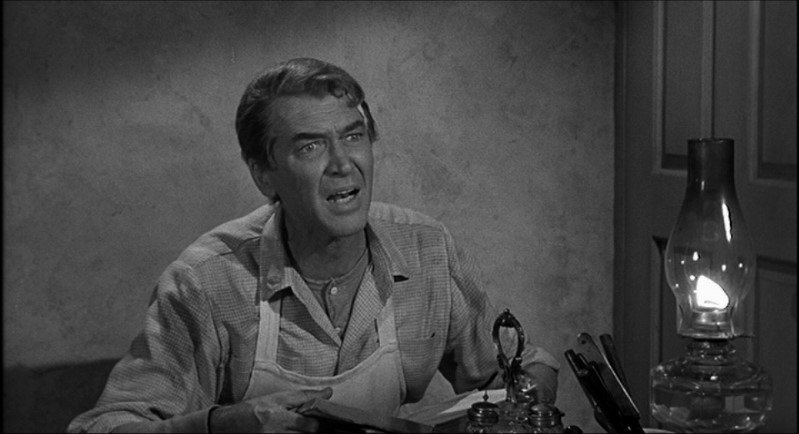
The Man Who Shot Liberty Valance (John Ford, 1962) Even the mention of the title invokes a cynical irony for those who have seen it. This crowning glory in the long accomplished (dare one say legendary) career of director John Ford, 68 at the time of its filming, is a bitter pill of a film and a meditation on the inexorable march of time and the brutal boots of history.

It is about "becoming"—not just in the strictest sense of transitioning (although the town of Shinbone, in which it is set, is in the midst of leaving its old West roots behind to take its place as part of the Union of States), but also in the less used sense: of reflecting favorably on the subject to its advantage.

It is also about, as so many of
John Ford's films over the years, the taming of a wilderness, and the creation of a society. And the unbecoming truth that to create the veneer of civility, sacrifices must be made, just as sure as Sunday dinner.

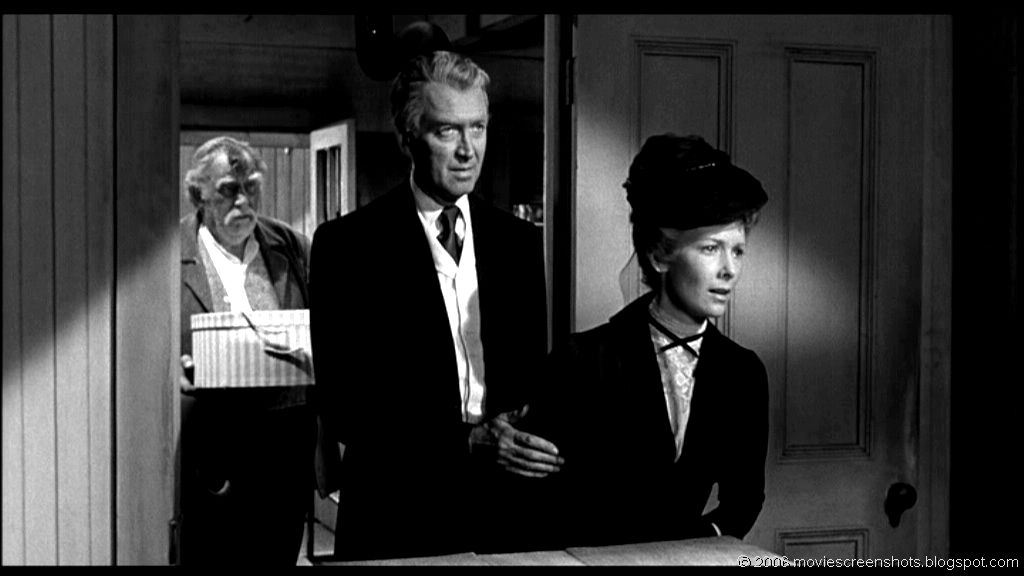
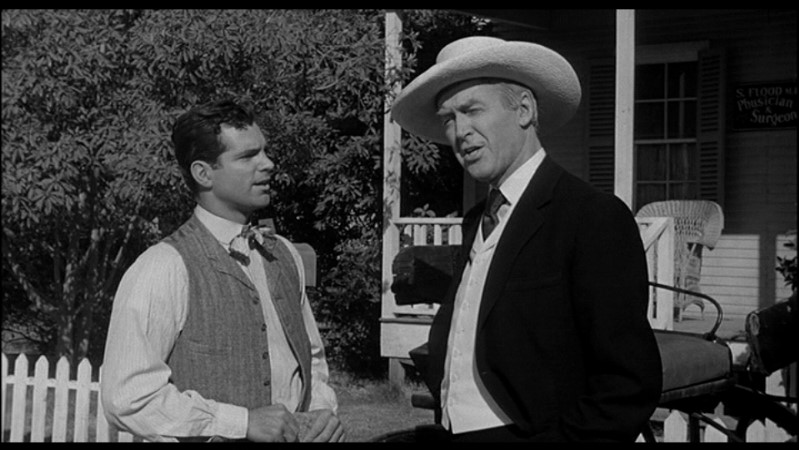
Senator Rance Stoddard and his wife Hallie (James Stewart, Vera Miles) return to the town of Shinbone to much hoopla. It is their home-town, of course, but as the Senator now spends all his time in Washington he doesn't get back there much. So the press start nosing around to get the where-fore's of why "The Man Who Shot Liberty Valance" (and rode that acclaim into politics), is there now. The occasion is a funeral for a man nobody knows (or has little regard for), but he's very important to the Stoddards—he is, after all, the man who brought them together. And as Hallie places a cactus on Stoddard's plain pine coffin, Stoddard relates the tale, one that blows away the Senator's folksy bluster with a scouring truth.

The Senator talks of his first coming to Shinbone as a greenhorn lawyer* and his run-in's with
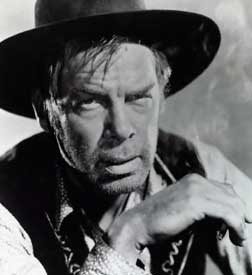
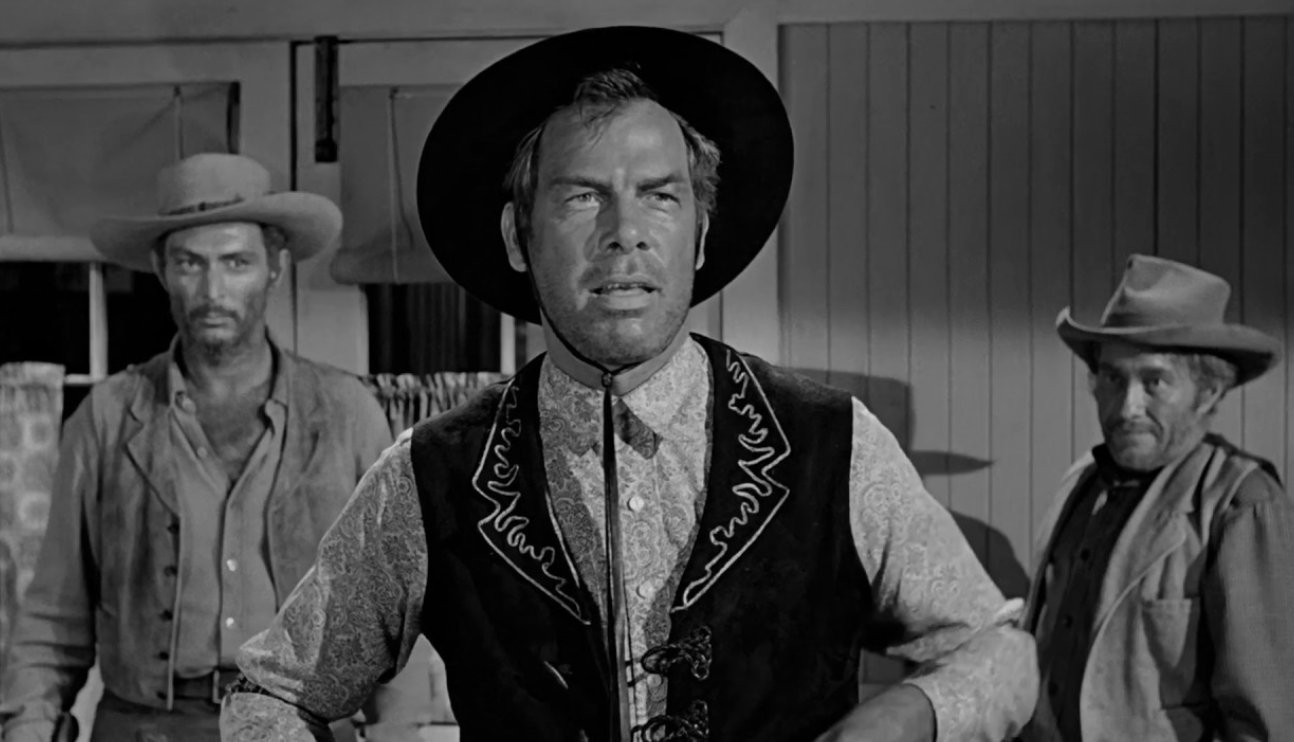
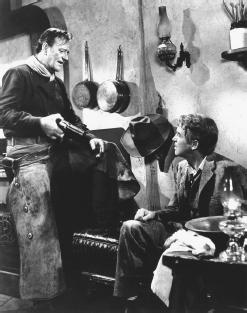
local bandit Liberty Valance (Lee Marvin, gloriously over-the-top), a malevolent thief and enforcer for the cattle industry who has the small town of Shinbone afraid to come out of their houses. Beaten and bleeding, Stoddard is brought to recover under the roof of the Ericson's (Jeanette Nolan, John Qualen, Miles) by Tom Doniphon
(John Wayne), who's sweet on Hallie and is building a house for the two of them outside the city limits. Doniphon is contemptuous of Stoddard's belief in law and order (calling him "Pilgrim," only one of two films where Wayne used that oft-parodied term), believing that the only way to stand up to anarchists like Valance is a loaded pistol.
I say "anarchists" pointedly, because The Man Who Shot Liberty Valance (Get it? "Liberty" Valance?) is as much about politics as it is a story about a love triangle in the Old West. You have the anarchistic, irresponsible Valance on one side and you have the "book-larned," law-and-order, taming-the-West-by-education-and-civics Stoddard on the other. In between, you have Doniphon, who's all for government (far as it goes) but in his time, you tame the West with bullets and hard work. But that time is passing. Doniphon is late to realize that that taming means the passing of the bad guys who will disrupt, but also good guys with a sense of entitlement. Ford chooses sides, and it's for civilization—because anything else is stagnation and waste. For all the talk of "Freedom" and "Rights," those are granted only under the auspices of control and Law. Because Valance represents not only unbridled freedom, but also the seeds of despotism. As a rancher, Doniphon knows those seeds will take over unless something stronger, hardier is planted in its stead.
Even if it means the death of his way of life.

Sacrifices must be made.

By the time the tale of Stoddard and his benefactor/mentor and rival is told, a bloom has, impossibly, appeared on the cactus, because like Stewart's lack of youth in the flash-backs and the old-age make-up for the young actors in the present, Ford is also playing with time, even going to his own past, using a piece of music from 1939's Young Mr. Lincoln (that put a melody to Lincoln's loss of his first love Ann Rutledge) for the scene of Hallie regarding Doniphon's burnt-out homestead. And so, the telling of the tale of a lifetime is enough time to ensure new life in movie terms.
In The Man Who Shot Liberty Valance, Ford goes so far as to state outright something he'd been alluding to throughout his career as a film-maker, story-teller and chronicler of the United States. Given a choice between printing the unvarnished truth or a myth for the common good, the newspaperman says, "This is the West, sir. When the legend becomes truth, print the legend."

There was never a better-stated justification of film-making.

It's a definitive statement of Ford's career directing movies. But Liberty Valance is also a bridge from Ford's early Westerns to the "modern" "oaters" of the 60's as Valance's wormy toadies are portrayed by Lee Van Cleef (of Sergio Leone's "Dollar" trilogy) and Strother Martin (part of Sam Peckinpah's stock company). Those film-makers were inspired by Ford, and in their own revisionist methods of "printing the truth," made their own legends.

And so the film is its own truth, summarizing one director's past as a pioneer and presaging the future of the Western film, on the edge of its demise, both "becoming" even in the depth of their cynicism.


* One of the criticisms of the film is that both Stewart and Wayne are playing young men when the two were both in their 50's. Wayne can get away with it (as he always plays old...and other reasons), but Stewart doesn't come across as a man in his 20's. I have something to say about that towards the end of the review.

Tuesday, April 21, 2015

Gravity (and the Heaviness on Earth)

Push-Me, Pull-You
or 
"I'm Tellin' Ya, It's a Hell of a Story"

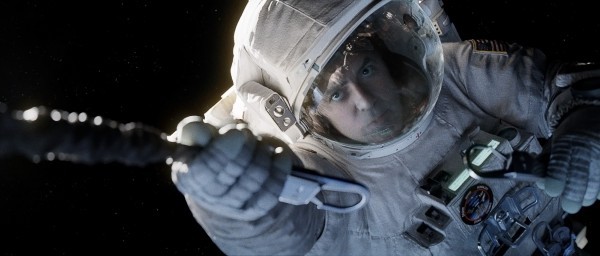
Gravity may just appear to you the shortest movie you've seen in awhile.  It lasts all of ninety minutes, but it rips by, despite long, leisurely takes where nothing much is happening (The opening shot alone is 17 minutes long without a traditional edit). In that, it gets the yin-yang of space travel just so—floating at a relative leisurely pace while simultaneously moving at 16,000 mph, or as one test pilot describes the job—hours of boredom punctuated by moments of sheer terror.

Gravity pushes that out a bit, with many moments of sheer terror, but without some trumped up space monster hiding in lunar rocks (Apollo 18) or below the ice (Europa Station). No, it doesn't need anything fancy. It goes for the basics—a limitless indifferent Universe.

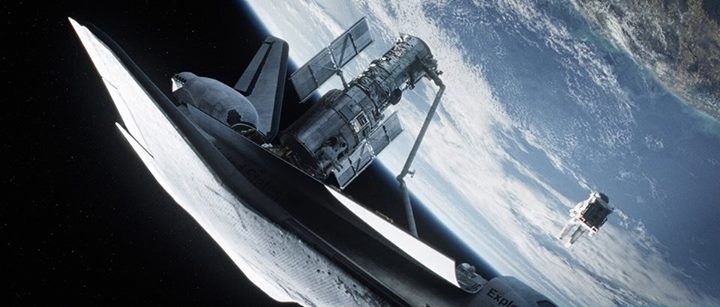
Up in space, aboard a futuristic space shuttle, terror comes by every 90 minutes or so, as a catastrophic collision between old Russian communication satellites causes a debris field hurtling by tearing holes through what ever fragile life-sustaining contraption we can put up there. Director Alfonso Cuarón (and his co-scenarist son Jonás) put the stakes right up front. "Life in Space is Impossible."

They, then, spend the next 90 minutes destroying whatever faith in technology and science you might have. It's an evangelist's dream come true.
That debris field starts out with a few little pieces, but like a cosmic game of "Asteroids" every collision creates more junk, sprays of it, and that just makes everything worse. Space is our garbage field—Cuarón underpins the point by showing us all the junk—pens, screws, cuff-links ("cuff-links??")—floating in zero-g inside the space stations and capsules we put up there in some sort of mad attempt to make normal life in space. It's a cosmic joke that after years of polluting the Earth, our garbage is making space uninhabitable (as if it ever was), too.

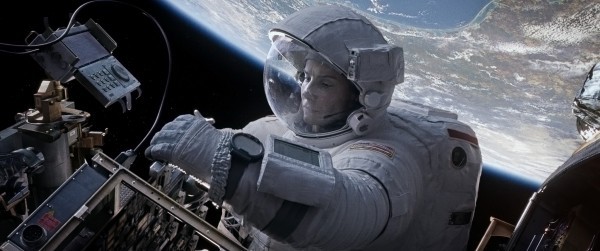
But, that's a lot of deep thought for after the film is over (as are some anomalies and plot conveniences).* In the watching, Gravity is a fun-ride on so many levels, a visual romp and roller-coaster—the dialogue being mostly tangential and matter-of-fact—as the crew of the shuttle Explorer must deal with the fact that every 90 minutes their equipment is going to take a debilitating series of hits that might burst their protective bubbles just to survive. The film is in mostly long, swooping stretches (the edits, interestingly, in dialogue situations), floating from one aspect to another, sometimes even violating the space of the astronaut's helmet, moving through the screen to get their perspective. The novel aspect of this one is that the zero-gravity that science fictions films have recently taken pains to re-create or avoid has no restrictions in this scenario, there are no walls to bump into; if you go, you go until something stops you, slows you down, or retards your progress, and everything you do, pushes you in the opposite direction. You can swim, but you'd better have an exit strategy for stopping, and spinning in place to turn around isn't going to help, because you're going to keep spinning. And the series of catastrophes, hardships, and just plain pains-in-the-ass keep piling up one after the other, you would think it was Harold Lloyd up there.
Speaking of which, Gravity, besides the scrupulous pixelization of space, also boasts a dynamite sound experience.  In space, no one can hear dynamite, of course, but also no one can hear your thrusters whoosh-by, either, really. And Gravity is scrupulous about making sure you don't hear sounds in airless space, unless you absolutely have to. Sounds are restricted to radio chatter (and interference) but also, only those sounds that would transmit through an astronaut's space-suit. So, there are scenes where they're using power-tools? Only you don't hear the metallic grind of power-tools, you hear the vibration of the power-tools motors spinning. But that's it. Satellites get punctured, solar panels are torn off in bursts of shrapnel, but the most you hear is a muffled fwump if something impacts an astronaut, or vice versa. And the theater I saw it in makes use of a Dolby system called ATMOS that pin-points where to put each particular sound as it careens through the theater. It truly is an immersing experience in the theater.

For this space kid, despite some hokum here and there, it's the most fun I've had at the movies this year,** and someone is going to have to do something really exceptional to have better sound than this one.

* Three things, quibbles, anomalies, that are SPOILERS: 1) Sandra Bullock's hair is not plastered down on her head, but it's short, and would float around more than we see here (not a big deal, really, just a tech glitch, so the movie could get made); 2) At one point, we spend 10 minutes showing precisely how the whole friction-less world of Newton's laws of motion acts in zero-g, and then creates a cliffhanger situation that completely erases it, unnecessarily; and 3) Every 90 minutes that debris field shows up—IF everybody's in the same orbit, but one is STANDING STILL (which can't happen if you're actually orbiting) or they're going in opposite directions (at which point it would be every 45 minutes and very violently because they're colliding head-on).  As far as the plot conveniences, those are fairly obvious.

** There are some nice little in-jokes along the way.  My favorite: the unseen voice of Mission Control is Ed Harris, who played Flight Director Eugene Krantz in Apollo 13.  I could imagining him having conniption fits down on Earth: "Failure is NOT an option!" "Not on MY watch!"

There is already a sequel of sorts to the Alfonso Cuarón film Gravity, written and directed by co-scenarist Jonas Cuarón.  If you have seen the film, it will make perfect sense and add another touch of (dare I say it?) "gravitas" to the feature.

If you have not seen Gravity, then consider this a major SPOILER ALERT. Don't watch.

Sunday, April 19, 2015

Don't Make a Scene: The Last Picture Show

The Set-Up: What is this thing called love? As fragile as a whisp...a remembrance of a perfume or after-shave. As powerful as the way the sun shines bright and ignites the light of shadowed memory.

Which brings us to The Last Picture Show.

Ben Johnson didn't want the part. The old veteran of John Ford westerns from horse-wrangler to stunt-rider to lead-actor had been doing mostly character-parts and was alright doing that. He was particularly memorable as one of Sam Peckinpah's The Wild Bunch, but this one he didn't want to do. There was too much bad language, nudity and whoring around in the screenplay for his taste (The Wild Bunch didn't?). "Oh, come on, Ben," said film historian-turned-director Peter Bogdanovich. "If you play this part, you'll win an Academy Award!"

Bogdanovich gambled. Sam "the Lion" was a pivotal part of Larry McMurtry's "The Last Picture Show," but not a big part. And not just anybody could play it. It had to be an old war-horse, a veteran cow-poke who had dust in his lungs, dirt in the lines of his face, and a lot of years under his belt. And integrity. It couldn't be just anybody. And Bogdanovich, who idolized John Ford and revered his pictures, couldn't think of anyone more right than Ford's star for Wagon Master, and also Ford's seemingly ageless Sgt. Tyree of the Cavalry Trilogy to play the role. Johnson was film-history to Bogdanovich, and so he was history. He had to be Sam "The Lion."

So, when it came to this monologue, Bogdanovich wanted it to be special. He wanted it to be in one continuous shot (and it would have been if not for a blown cue--there's an edit and a second, less crisply focused take continues the scene). But, miracles can't be stopped. When Johnson starts his reminiscence on the first take, the sun pokes through the overcast and lights on Johnson's back and shoulders bathing it in a glow. It's a quiet, spooky moment, and don't kid yourself: Bogdanovich saw the light changing and wanted to catch whatever it did—he gambled—as his heroes Ford and Hawks had on previous pictures. That it should happen at that precise moment, lighting Sam's reverie, is something that can't be explained...like love.

Or omens.

And Ben Johnson won the 1971 Best Supporting Actor Oscar for this role.

The Story: There's one man the boys (and ladies) look up to in Anarene, Texas. That's Sam "the Lion" (Ben Johnson). He owns a block of store-fronts in the downtown (or what passes for downtown). The picture show, the hardware store, the diner. There he holds court over the old folks, who hang around without much to do, and the high-schoolers (who hang around without much to do). The kids with money and their parents—they go out of town. Not the arid dustbowl of the old downtown.

Sam has had a falling-out with the local boys over some foolishness they played with Billy (the late Sam Bottoms), the kid who's a bit simple, but that's over and done with. Put away. And Sam and Sonny (Timothy Bottoms, Sam's older brother) and Billy go out to the fishing tank (long since fished out) to spend the day and talk like men.

Action!


(Sam the Lion pulls out rolling papers and a tobacco pouch, and looks at Sonny and Billy skipping stones)
Sam: I thought you boys wanted to fish? C'mon, keep an eye on them corks, Billy!
Sonny: I don't think there's anything in this tank 'cept turtles.
Sam: That's what I like 'bout it, tell ya the truth. Wanna try one?
Sonny: Sure!
(Sam finishes making his cigarette)
Sam: Never liked to clean fish, or eat 'em, either. Spend half your time pickin' out bone.
Sam: Yeah, I just come out here to get a little scenery. Too pretty a day to spend in town.
Sam: You wouldn't believe how this country's changed.
Sam: First time I seen it, there wasn't a mesquite tree on it...or prickly pear neither. I used to own this land, you know. First time I watered a horse at this tank was...more than forty years ago. I reckon the reason why I always drag you out here is probably I'm just as sentimental as the next fella when it comes to old times.
Sam: Old times. I brought a young lady swimmin' out here once, more than 20 years ago.
Sam: It was after my wife had lost her mind and my boys was dead.
Sam: Me and this young lady was pretty wild, I guess. In pretty deep. We used to come out here on horseback and go swimmin' without no bathin' suits. One day, she wanted to swim the horses across this tank. Kind of a crazy thing to do, but we done it anyway. She bet me a silver dollar she could beat me across. She did. This old horse I was ridin' didn't want to take the water. But she was always lookin' for somethin' to do like that...
Sam:...Somethin' wild. I'll bet she's still got that silver dollar.
Sonny: Whatever happened to her?
Sam: Oh, she growed up. She was just a girl then, really...
Sam: Here, let me help you with that.
Sonny: Why didn't you ever marry her after your wife died?
Sam: She was already married.
Sam: Her and her husband was young and miserable with one another like so many young married folks are. I thought they'd change with some age, but it didn't turn out that way.
Sonny: Bein' married always so miserable?
Sam: No, not really. About 80% of the time, I guess. We oughta go to a real fishin' tank next year. Naw, too late to think about things like that too much.
Sam: If she was here, I'd probably be just as crazy now as I was then in about five minutes. Ain't that ridiculous?
Sam: Naw, it ain't really. 'Cause bein' crazy 'bout a woman like her's always the right thing to do.
Sam: Bein' a decrepit old bag of bones,that's what's ridiculous...
Sam: ...gettin' old.


The Last Picture Show

Words by Larry McMurtry and Peter Bogdanovich

Pictures by Robert Surtees and Peter Bogdanovich

The Last Picture Show is available on DVD through Sony Home Video and the Criterion Collection.