Saturday, October 25, 2014

Olde Review: The Haunting (1963)

This was part of a series of reviews of the ASUW Film series back in the '70's. Except for some punctuation, I haven't changed anything from the way it was presented, giving the kid I was back in the '70's a break. Any stray thoughts and updates I've included with the inevitable asterisked post-scripts.

The Haunting* (Robert Wise, 1963) Robert Wise, who directed The Haunting is a supreme craftsman of film. he was formerly a film editor, one of the men who pasted Citizen Kane together, in fact, and thus knows how to compose his shots to make interesting stretches of film. He knows how to manipulate an audience, how to shock, how to fool. He can direct your attention to what he wants you to see. He is also quite adept at using special effects, thus he can pull off such projects as The Day the Earth Stood Still, West Side Story, The Andromeda Strainand The Haunting. However, when it came to characterization, Wise usually falls flat on his face,** as was evident in West Side StoryThe Sound of Music, and Two People. So, what you have in Robert Wise is the perfect disaster-movie director, and he fulfilled that label when he directed The Hindenburg last year. I can guarantee that your spine will be pleasantly chilled by The Haunting.
Unlike Rosemary's Baby, The Haunting does take place in odd, creepy surroundings--The Olde Hill House--and you have such things as a creaky metal circular stairway, convenient for a suicide, whispering corridors. Take a brooding mansion, some brutal situations, and some brutish ghosts and one quakingly susceptible person and you have the formula for this type of gothic. Whether its successful or not depends on whether the director can stir them up to make them a) original, which is unlikely, or b) scary, which you can do in a myriad number of ways, cinematically. Although The Haunting is not really the former, it is certainly the latter, so you might want to take a spare hand along Saturday night to clutch.
Maybe not. You see, there's a situation where....well, I'm not going to give it away. Find out for yourself, and...sleep well Saturday night.

Broadcast on KCMU-FM on October 22 and 23rd, 1976.

My criticism of Wise's ability with actors is unfair and untrue. He tended to cast talented actors when he could, and The Haunting is full of them--Richard Johnson, Claire Bloom, and Julie Harris, along with Russ Tamblyn (from West Side Story) and Lois Maxwell. The Haunting still holds up as a chilling film, and it's because of the way Wise (and scenarist Nelson Gidding) set the movie up with a prologue outlining the sad history of the elegant but dreerily off-kilter chiaroscuro of "Hill House," lovingly photographed with an eye towards the odd angle and moving attention to the side of the frame. The one section I still recall vividly is the long camera lift going up the circular stairs preceding a suicide victim's climb, then their feet dropping into frame, and Wise then double-timing back down those stairs. It just creeps you out and prepares you for further shocks in other rooms.
Wise shoots in widescreen black-and-white, all the better to photograph shadows in, and cranks up the sound design of the creaks, moans, whispers and poundings reverberating down the corridors. Wise wracks nerves expertly, and manipulates the audience, pushing the cliched tropes of The Old Dark House as far as they can go, while also suggesting horrors, rather than throwing them in your face (as is the current para-norm).  The planning and execution make one ill at ease, as if the way the film is shot suggests that the very milieu of the movie is haunted and not normal. Plus, Wise (originally an editor) is the master of the shock-cut, both the set-up and the splice. Wise could do anything, in any genre, and was one of the great craftsmen of the American cinema.

* Not to be confused with the inadequate 1999 remake produced by Steven Spielberg and directed by Jan de Bont. Those two thought you could create the same creepiness in vivid color and with digital effects....pffft...Kids!

** Oh, I don't know.  West Side Story boasts a lot of fine performances--it's Richard Beymer's Tony that's the exception. And while Christopher Plummer is at his most...restrained in The Sound of Music, everyone else is fine. The quartet of researchers in The Andromeda Strain are more full developed than Michael Crichton's original characters, and one can't forget Paul Newman's work as Rocky Graziano in Somebody Up There Likes MeSteve McQueen, Richard Attenborough, Richard Crenna, and Mako in The Sand PebblesSusan Hayward in I Want To Live, and William Shatner in Star Trek: The Motion Picture
... Whoops, killed that argument!

Thursday, October 23, 2014

The Silence of the Lambs

The Silence of the Lambs  (Jonathan Demme, 1994) "I will NOT go see a movie like THAT!"

My client was adamant. I knew what he meant. I was repulsed by the idea, myself. After all, it was based on a novel by
Thomas Harris, the most ghoulish and cruelest of thriller writers. I'd read "Black Sunday" and it had an image I wish I could sand-paper out of my mind. I'd read "Red Dragon" (and seen it's Michael Mann movie adaptation, Manhunter), but I hadn't read "The Silence of the Lambs." After "Red Dragon" I swore off his novels. Harris went places I just didn't want to go...ever...not even in a pulp entertainment.

But the "buzz" about
The Silence of the Lambs was so good, I had to go. My wife didn't want to see it ("UH-uh"). But a female colleague heard I was going (and her husband was "in no way" going to see it), so we agreed to meet up at the theater—almost like a dare—and satisfy our morbid personalities.

See, I'd seen Manhunter (starring pre-"CSI" William Petersen and Joan Allen), and the most intriguing thing about it was the introduction of a character named Dr. Hannibal Lecter* (played in Manhunter by Brian Cox). Lecter was an über-villain, like Dr. Mabuse. An insane genius psychiatrist, far more twisted than his clients, and he seemed unstoppable and uncontainable. Indeed, he was portrayed as a criminal so dangerous, he was kept in an impenetrable transparent cage of perspex. Cox played him agitated, and as a cannibal, he perpetually chewed gum, as if to satisfy a craving (or to keep his jaw strong).
 
A study in contrasts: Brian Cox (above) and Anthony Hopkins (right) as their respective Lecters.
 
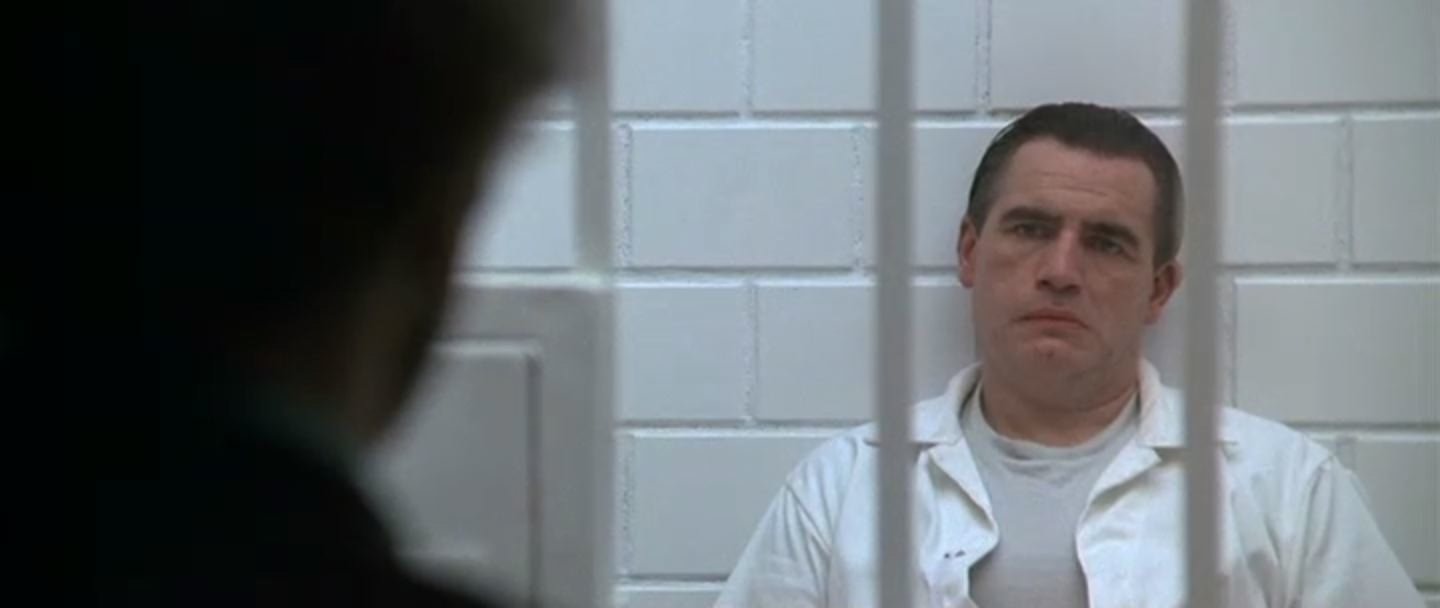
Anthony Hopkins famously played him in The Silence of the Lambs as an unblinking, supremely confident being of stillness. When we first see him (after an extended build-up talking about how dangerous he is), the camera slides him into view—and he's already waiting for us. That's a bravura move (done in silence, purely visually, pure cinema) in collaboration between Hopkins and director Jonathan Demme (who has never been so "to-the-bone" instinctual in his set-ups). Our first sight of Hopkins is a shock; he's not doing anything. Nor does he have to. In a dungeon-cage with a transparent front (not bars, as they're too penetrable, but more like a zoo for observation), he still is in control of the situation and knows it, and his "laser-like intellect" has already begun profiling his prey, FBI Agent Clarice Starling (a bird's name, indicative of small, tremulous life), played by a subtly vibrating Jodie Foster (who's brilliant).
This is a horror movie. And the best horror movies don't just scare us. They touch a nerve, grab on tight and slither up into our brains and take root, never leaving us. They know what scares us, right down to the DNA in our collective alligator brains, and individually to our unbidden (but specially created) nightmares. And like Jaws, The Silence of the Lambs serves up one of the special horrors to our conqueror species: fear of being eaten...consumed. It's not just the dying and the reduction to meat, but it's taking away ourselves, our "souls," our specialness and uniqueness (like Gene Hackman's Sheriff in Unforgiven blurting down the echoing cave of a gun-barrel: "I was building a HOUSE!"). "Deserves got nothing to do with it."

And that's a horror.  A true horror. A viscerally twisting fear of humankind, that we don't matter, everything that we are, that we do, can't hold off Death. Any Death. Every "snuff" makes us just dust in the wind. And everything we are amounts to nothing. "Tell her to paint an inch thick.  To this favour, she must come."

"Make her laugh at that."

Sure, it's a horror movie. But becoming carrion is one thing. This is about skin-suits. Bad enough to be turned into a meal, yes. But apparel? 

Yeee-EEE-eee!

So, that's the reason so many people might NOT want to go see The Silence of the Lambs. What is there, of such value, to see it? To face your fears and walk into the darkened theater to face these horrors?
There is a subtle sub-text in the film and a not-so-subtle-visual one. One of the travails of Agent Starling is to go through her rigorous FBI training, the obstacles, the paths, includes making her way through a traditional world (and institution) of men. She is often under-estimated (except by, of all people, Lecter, who is intrigued and challenged by her: "People will say we're in love" is his witty reversal on it) and must point out to the officious males she's dealing with (and it is dealing) that they are treating her in a subordinate manner ("You know, we get a lot of detectives here, but I must say I can't ever remember one as attractive."), even though she calls everyone—her superior Jack Crawford (Scott Glenn), Lecter, even the serial killer she's seeking (the terrific Ted Levine, whose brave work in this film should never be unacknowledged in any review) "sir." 
Foster's Starling is a victim, too, although she won't succumb to victimization. She fights it. And she fights the battle for the women whose lives have been lost through the pathological extension of that subjugation, and, with her work, might be saved. Reduction of the human being is the tough theme that runs through The Silence of the Lambs, and it is perpetrated by serial killers and officials alike, anyone who assumes more authority than they are due. Or more superiority than they deserve. We all covet that to some degree. Look in the mirror.

What looks back?
"The eyes are the window to the Soul" they say (although it's difficult to trace who originally said it). And director Demme makes sure we see them, both eyes and souls. Frequently, even in conversations, he will photograph the actors looking straight on, their eyes on a direct axis with the center of the camera lens (and thus, the audience). A lot of directors do that (Spike Lee and Woody Allen, for instances), but more often than not, those uses are to have the characters speak directly to the audience, breaking the fourth wall between player and played. Not Demme (and this is what makes Silence unique). Whole conversations happen, with the actors looking out at us, as if we are the ones having the conversation—we connect with them, those flickering phantoms on the screen, making them more than casual phantoms, the ones we merely observe as if they were any passer-by on the street. We look into those windows, see the Souls (even those of the Soulless) and immediately those beings have value and worth, not just victims of our gaze, but true intimates, more than the mere shells that envelop their spirits.

And this is what separates The Silence of the Lambs from the many serial-killer/slasher movies that stalk through the genre—separates it a full 180° from the other films, in fact. So many of those use the POV subjective shot of the killer observing and hunting its prey (and Demme uses it, too, in the nerve-jangling final confrontation between Starling and "Buffalo" Bill). So many used it, in fact, that it became a cliché of the type, putting us in the uncomfortable position of seeing the world through the victimizer's vision, rather than the victim's—the hunter's, rather than the hunted's—accompanied by the rasping inhuman breath of the coveting, rather than the pleadings of the coveted. The Silence of the Lambs breathes new life into the form, elevating the victim, the genre...and us. It gives value to the human being, and in so doing, raises itself up, as well.
---------------------------------------------------

"So," the client began tentatively. "I went to go see Silence of the Lambs... 

"And?" I offered. "Wha'd ya think?"

He blurted. "Ya know, that was a REALLY GOOD movie."

Yes, it is. Still is. Repulsive, still, certainly. But a great movie.


And it still has the distinction of being the only horror movie to win the Best Picture Oscar, and, even rarer, to win the Big Five categories (Best Picture, Director, Actor, Actress, Screenplay), all deservedly so.


* In Mann's film, he's Hannibal Lecktor, a more oral-associated mad scientist name.

Wednesday, October 22, 2014

Gone Girl

Keeping Up Appearances in the Tender Trap (Sir Reality in the State of Nancy Grace)
or
"We're So Cute I Could Just Punch Us in the Face"

One can see where people are enthusiastic about Gone Girl, Gillian Flynn's story of a missing person investigation.  It's so full of good ideas and banal dialogue and frightening concepts one doesn't know whether to hate it or love it.

It has gotten a comfortable fit for a director of the movie version from that master of discomfiture, David Fincher, who always manages to make movies that get under your skin and irritate, no matter the genre. Even a romance like The Curious Case of Benjamin Button has its seriously icky side the way Fincher envisions it.


And Gone Girl is hardly a romance, although the subject of marriage is prevalent throughout, but not in the form of Holy Matrimony. Everything about the marriage of Nick and Amy Dunne is unholy. As attorney Tanner Bolt (Tyler Perry in probably his best performance outside of Madea) says "You two are the most fucked up people I've ever met, and I deal with fucked up people for a living."


Even the first words of Nick's narration creep you out: "When I think of my wife, I think of her head...and what's inside it. I think about cracking her skull, unspooling her brains and sifting through it, trying to pin down her thoughts. What are you thinking?  What are you feeling?  What have we done to each other?  What will we do?"

"What have we done to each other?  What will we do?"
It's July 5th, the day after Independence Day (or "Co-dependence Day" as I call it) and Nick Dunne (Ben Affleck) puts out the garbage, surveys his street and drives to the local bar he owns (well, not really) with his sister Margo (Carrie Coon) to talk about what he's going to get his wife Amy for their anniversary, and generally do some grousing about how lousy their marriage (five years in) is. He bitches and moans over a bourbon first thing in the morning, then drives home.

His front door is open and the cat's out. He goes into the living room and a glass table is shattered and a hassock overturned. Nothing's stolen.  


But his wife Amy is gone.

"Ready, aim...."
The police come at Nick's calling and do a forensics scan. The police investigator (Kim Dickens, who's terrific) does a cursory scan of the place, finds it suspicious and puts post-it notes on discreet blood-spatters in the house. A more thorough scrubbing of the place shows that there's been a lot of blood lost that has been cleaned up, indicating that there has been fouler play than what is immediately apparent. Nick falls under suspicion, although he is genuinely baffled by the circumstances.
"Smile for the cameras" might not be the best thing to do...
Amy's parents from New York (David Clennon and Lisa Banes) go into over-drive. Amy was the inspiration for a series of well-selling children's books—"Amazing Amy"—and their public media campaign to find Amy Dunne has plenty of opportunity for cross-promotional purposes and escalates the search to national attention. Nick's callow behavior before the cameras invites public speculation and suspicion and pretty soon, he's being pilloried in the press, especially when lookeeloo's and buttinski neighbors start sticking cameras and microphones and themselves into the proceedings. It doesn't help that Nick has been having an affair with one of his students (Emily Ratajkowski) and his public appearances pleading for the return of Amy do not sit well with her. Her revelations are (as they say in the press) "a bombshell" for which strategies need to be planned
Supermodel Ratajkowski "dressed like a Mennonite"
And Amy is still missing. The speculation fuels even more suspicions with the police. And evidence begins to mount up for motive and means that speak of Nick's secret life and their troubled marriage. "You ever hear the expression the simplest answer is often the correct one?" asks unsympathetic investigator Jim Gilpin (Patrick Fugit). "Actually," says detective Rhonda Boney "I have never found that to be true."
Arthur Conan Doyle had Sherlock Holmes say in "The Sign of Four" "...when you have eliminated the impossible, whatever remains, however improbable, must be the truth." In the age of the 24 hour news-cycle, truth does not matter as much as filling up dead air-time. Those outlets spew as much improbability as they can in their race to get the story first. So, CNN filled their valuable airwaves about missing Malaysia Airlines Flight 370 with speculation about black holes and other conspiracy theories, The New York police commissioner held a press conference saying that the Aurora, Colorado movie shooter was costumed like "The Joker" (he wasn't, and what does a NYPD commissioner know about Aurora, Colorado?). Bloviating talk-show hosts opine viciously about the actions of the parents of any missing child. The regularity with which purported news organizations "get it wrong" in the first few hours of an event are legion, so much so that the NPR press-critique show "On the Media" has come up with something called "The Breaking News Consumer Handbook" that offers tips for practical cynicism.

This is the reality that Gone Girl is based in, where victims of crimes can be perceived as perpetrators (and there's plenty of precedence, as in "experts" like the ghoulish Nancy Grace (snarkily satired here as portrayed by Missi Pyle) can be allowed to batter the desperate (and even drive them to suicide) in the name of media-justice. Fincher has directed movies showing the downside of media circuses, how they're becoming more bread and circuses) and, as in The Social Network, throws cold water on the "fun" trends of public distraction that are shown to be quite personal public destructions.  Oh, what a tangled world-wide web we weave.

That sinking feeling...
But there's something else going on in Gone... The media circus shenanigans are all too familiar to anyone who "watches" news channels (and it feels a bit like a documentary at times). But, the "other" theme running concurrently in the movie can only be spoken of in general terms, lest the thickened plot be given away. It's there, disquieting, maddening and just a little ballsy and brilliant, but sure to piss people off and pull loyalties every which way (I like that).

Because running concurrently with the plot of Nick being confronted with his past, there is a parallel telling of events from Amy's perspective—her diary...in fact. It's Amy's view of things that makes things uncomfortable for awhile—for the discriminating movie-goer, not in terms of the plot—only because it starts so gushily hearts and flowers that, like Amy says at one point "We're so cute I could just punch us in the face." The dialogue is so floaty and so "daytime television" that the movie is in real danger of losing any interest several minutes into it. Stick with it, though. That sentiment turns mighty fast, as that diary becomes evidence. It is damning.

You see, writer Flynn messes with stereotypes. That's all I can say. She pulls in one direction that breaks the mold and then pushes in another that feels hackneyed and "old" and, frankly, is a bit over-the-top—then utterly perverts it to make something truly horrifying in its implications and...appearances. At the same time that she's boldly staking new ground, she's also re-enforcing sexist attitudes and tropes to an alarming degree in a dance that's two steps forward, four steps back. She does this to the women portrayed, but lest one begins to feel the need to pick sides, she's just as tough on the men, too. One watches Gone Girl with an admiration of how unsympathetic it all is—watching it, I kept thinking (as a friend once phrased) "I got no dog in this fight." Everybody is nasty, but that's okay as long as things look good for the cameras...and how you spin it, so the court of public opinion looks more like a court of law—but without the rules of jurisprudence (or even simple prudence). 

Rosamund Pike is going to get her share of laurels for her multi-faceted portrayal of the amazing Amy, but Affleck has rarely been better as the callow and callous Nick, so comfortable in his skin that he bears the stink of entitlement. You never end up rooting for him, but you never have any sympathy for him, either, for all the travails he goes through...amid the risks and burdens of the couple's secret lives and secret deaths. 


I wandered out of the theater wondering: "If Men are from Mars and Women are from Venus, what happens when a man comes up against Dejah Thoris?" Hell hath no fury, indeed...
Amy Dunne exults in a sugar-storm

Tuesday, October 21, 2014

The Spirit of the Beehive

The Spirit of the Beehive (aka "El Espiritu De La Colmena") (Victor Erice, 1973) Victor Erice is the Terrence Malick of Spain (though to be correct it should be the other way around). His films are precise and planned so carefully that he has made just three films since 1972's The Spirit of the Beehive, his most famous work and the one that seems to have seeped into the public world-wide consciousness the most.

Spirit tells the story of two Castillian children, Ana (Ana Tennant) and Isabel (Isabel Telleria); Father (Fernando Fernan Gomez) is a bee-keeper, Mother (Teresa Gimpera) is a repressed housewife. That "repressed" thing is going around: The Spanish Civil war has just ended (it is 1940) and the outlying areas are barely recovering from the turmoil of the conflict and are just starting on the long march to Franco's fascist regime.  Hind-sight is 20/20 and Erice's film was made towards the end of the Francoist government.
One day, a travelling projectionist comes to town.  The children go to see a matinee of James Whale's Frankenstein, (it's 1940 and the movie has been out since 1933 but there was this little thing about a war going on) which deeply affects the youngest, Ana. She wonders why, in a pivotal scene, the monster kills a young child (in the film it's never seen) and if the monster is real. She's told by her older sister that the monster is a spirit who will come at her call—"Hello, I am Ana." And Ana begins an obsessive quest for the monster that she believes exists and walks among the countryside.
It's relatable. I was obsessed with Frankenstein's monster when I was young and in my single digits. There was nothing "deep" about it. I was not concerned with its origins as the brainchild of Percy Shelley's wife, or of the Monster's representation of the unnatural brought to life. I knew nothing of it's overarching theme of man's desire to be God and re-animate life from death, and more than nothing about it's sequel's of man's desire to be Woman and create life as a collaboration. No, what I knew was he was tall and green, had a flat head and bolts in his neck (which were pretty cool). And his suit didn't fit. And his shoes were massive. And he was a monster, impure and simple—no bats, no bandages, no dual identity to complicate things. What you saw was what you got and the monster's visage (and director Whale's way of shooting him) had a dynamic I liked.

Grrrrrrrr.  Monster gooood!
In a natural world this vast, something un-natural must fascinate.
And I certainly didn't think that Frankenstein's monster could be used as a symbolic stand-in for a repressive regime that would instill look-over-your-shoulder dread in its citizenry in the same way a lightning-blasted corpse-quilt come to life would the umlaut-stricken in a bürger-hamlet.

Or instill it in any child anywhere in the world.

After all, Ana and Isabel's childhood world/playground is a vast canvas of Nature, where an unnatural thing (like the Monster) would be completely out of place and at odds with the rhythm and hum of the way things are, much like a war would, or an industrial revolution, or an imposed order.
Ana sees this monster, this inarticulate creature, who yearns to learn—much as she does—but fears it for the way it could destroy her (like the little girl with the flowers in the movie). The Monster is magical in a way that the world is not. It's her boogey-man in the closet that she hopes she can control like everything else in her world. And when she is told by her Sister that the monster's spirit walks still and probably lives in that barn "over there," Ana must investigate.
This sets in motion a series of events that juxtaposes life and freedom, identity and society, death and repression. Erice made this in the last echoes of the Franco regime and the citizens of the post-war world walk around in a form of zombie-state, their expressions impossible to read. That the Frankenstein monster is also seen in this context as a symbol of life and freedom shows what a palpable symbol it remains, and how malleable.

Sunday, October 19, 2014

Don't Make a Scene: Frankenstein (1931)

The Set-Up: It's October, of course, and that's Hallowe'en month. So things, from this point on, will get a little dark and (maybe) stormy. It will mostly be a little creepy until November 1st with the occasional new movie diversion—although what I've been seeing lately can certainly fit into the "dark" quality. Today's "scene" serves as an introduction.

And a warning for the faint of heart.

This one's from James Whale's adaptation of Frankenstein—not the first one, certainly—there were silent versions—but the most famous one, the "Karloff" version. Now, I'll bet everyone's seen it. But, do you remember the introduction? 

Introductions are fun in movies. They take the movie-screen and turn it back in technological times to a stage—a dimension once removed, but a stage nonetheless—where the theater curtains are pulled back to reveal...more curtains. And immediately the "fourth wall" between players and audience is shattered. No telling what could happen next.

Such intro's can be the heighth of pompous showmanship—check out Cecil B. DeMille's for The Ten Commandments, which was nicely lampooned by Frank Tashlin (former Looney Tunes director) in The Girl Can't Help It*—but, here, it's a little bit of a joke, a needling tease to get the audience's nerves a bit on edge before the movie began. Nice trick. No, really, folks, we can't tell you about all the... well... that would be telling. But, be on your guard. We're just saying...

Woo-OO-ooo.  "Very scary, kids..."

The Story:  It's before the beginning.  No story yet.  But...you know where the exits are.

Action!
EDWARD VAN SLOAN: How do you do?
VAN SLOAN: Mr. Carl Laemmle feels it would be a little unkind to present this picture without just a word of friendly warning.
VAN SLOAN: We are about to unfold the story of Frankenstein. A man of science who sought to create a man after of his own image...without reckoning upon God.
VAN SLOAN: It is one of the stangest tales ever told. It deals with the two great mysteries of Creation: Life and Death.
VAN SLOAN: I think it will thrill you.
VAN SLOAN: It may shock you.
VAN SLOAN: It might even horrify you.
VAN SLOAN: So, if any of you feel that you don't care to subject your nerves to such strain, now is your chance to...uh...
VAN SLOAN: ...well, we've warned you.

Frankenstein (1931)

Words by Garrett Fort Francis Edward Faragoh and Robert Florey

Pictures by Arthur Edeson Paul Ivano and James Whale

Frankenstein is available on Universal Home Video.

* I'm only suspecting this.  DeMille's religious opus came out October 5th, 1956, just two weeks after the rock n' roll movie, The Girl Can't Help It, began production, and released in December of that year...Whew, that's fast movie-making.

Sunday, October 12, 2014

Don't Make a Scene: Up

The Story:  Diamonds are a girl's best friend. A boy's best friend is his Mother. So where does that leave the humble cur, which was collectively Man's best friend but has been displaced in both categories?

Up.  Still quite up, in fact.

I was already sold on Up before this scene. Those who have seen it, and with whom I've discussed it always bring up the dialogue-less set-up story to Frederickson's balloon adventure, a scene of such mute sensitivity and sublime dexterity in the animated form, that just the recall of it can cause the misting of the eyes in the most cynical of viewers.* Up manages the requisite miracle of all animated features, which is to enchant the kids and engage the adults—the line "No, that won't work" created a 30 second cascading wave of laughter among the "grumps" in the audience, which was met by a quizzical expression on the up-turned faces of their accompanying charges. 

But, this scene was the cherry on top for me. 

See, I have (well, "had") a dog. A very expressive dog who, though he attempts it on far too many occasions, keeps trying to talk to me. And, I know, that if possessed of such a wondrous device as a talking collar, this is what he would sound like...and this is what he would usually be saying...right down to the snap distraction ("SQUIRREL!!") that would occasionally pre-occupy him.

Now, it is one thing to break down this scene—the introduction  to "Dug" from the movie Up shot-by-shot. But, it cannot come close to the artistry displayed by the Pixar creators—thank goodness a portion of it is on-line for you to see the subtleties: the reflexive hind-leg scratch when Russell pats his lower back; the tail that starts talking before Dug does; the reflective mirroring of expressions to his companions'; the quick-silver reactions to new phenomenon.  These are all accurate anthropomorphic distillations of basic dog body-language. That they are paired with the goofy voice (provided by co-director Bob Peterson) and simple construction sentences provided by the red-blinking "voice-collar" is easily too much of a good thing. But, bring it on.

The speed and movement of this scene I couldn't translate, and too many movements, both subtle and not, fell by the way-side.** But clicking on any of the stills to blow them reveals a wealth of detail; *** the intricate colors of the flora, the goo-gadgetry attached to Russell's back-pack, the intricate pore-patterning on Dug's nose. The deeper down you go with Up, the more is revealed, far more than a one-time viewing could ever encompass. 

Any movie that does that is a gift from its shining wrapping paper on the outside to the invisible sentiment behind it.

Pixar is any movie-goer's Best Friend.

The Set-Up: "You can't take it with you," they say. "Bah!" says life-long balloon peddler Carl Frederickson (Edward Asner). About to be "seniored" out of the precious home he shared with his long-time companion, Ellie, he rigs every last balloon he has to the house for one last adventure: a trip to Paradise Falls that he and his late wife never seemed to have the money or time to accomplish. He has inadvertently brought along Russell (Jordan Nagai), a neighborhood boy-scout trying to earn his last merit badge for "Assisting the Elderly." Now, they've made it to South America, and with the goal of settling the house down near Paradise Falls, the two tramp along a high escarpment, the house in tow.  They've picked another in a series of distractions—a rare, flightless bird—which Russell has named Kevin, and wants to keep, much to Carl's frustration. The balloon's are losing helium, and he wants to make it to the Falls before the House makes its last land-fall. Time is of the essence, but there are always more distractions in a new territory. 

Action!

Mr. Frederickson: I see you back there!
Mr. Frederickson: Go on, get away! Shoo! Go annoy someone else for awhile!
Dug: Hey, are you okay over there?
Russell: Huh?
Mr. Frederickson: Uhh...
Mr. Frederickson: Hello?
Mr. Frederickson: Oh!
Mr. Frederickson: Hello, sir! Thank goodness! It's nice to know...
Mr. Frederickson: ...someone else is up here!
Dug: I can smell you!
Mr. Frederickson: What?! You can...smell...us?
Dug: I can smell you...
Mr. Frederickson: Hey...
Russell:(chuckles) You were talking to a rock!  Hey! That one...
Russell: ...looks like a turtle!
Russell: Look at that one! That one looks like a dog!
Russell: Errr---augh. It IS a dog!
Mr. Frederickson: What?
Russell: Uhhhh...
Russell: We're not allowed to have dogs in my apartment!
Russell: Hey! I LIKE dogs.
Mr. Frederickson (calling to the voice in the distance): WE HAVE YOUR DOG!!
Russell: Woh!
Mr. Frederickson: I wonder who he belongs to?
Russell: Sit, boy!
Russell: Hey, look! He's trained! Shake!
Russell: Uh-huh? Speak!
Dug: Hi there!
Mr. Frederickson and Russell react in shock
Mr. Frederickson: Did that dog just say "Hi there?"
Dug: Oh, yes!
Mr. Frederickson: RRah!!
Dug: My name is Dug. I have just met you...
Dug: And I love you!
Mr. Frederickson: Uhhh...wa...wha..
Dug: My Master made me this collar. He is a good and smart Master, and he made me this collar, so that I may talk...
Dug: SQUIRREL!!!
Dug: My Master is good and smart!
Mr. Frederickson: It's not possible.
Dug: Oh, it is...
Dug: ...because my Master is smart!
Russell: Ooooh! Cool! What do these do, boy?
Dug: Hey! Would you...(dial click)quero contigo...(dial click) Ah use that collar...(dial click)konishiwa hanishwa...(dial click)to talk. I would be happy if you stopped.
Mr. Frederickson: Russell!
Mr. Frederickson: Don't touch that. It could be...radioactive or something!
Dug: I am a great tracker. My pack sent me on a special mission! All by myself!
Dug: Have you seen a bird?
Dug: I want to find one!  And I'm on the scent.
Dug: I'm a great tracker! Did I mention that?
Kevin runs at Dug and carries him away with a Whump!
Kevin: SQUAWK!
Dug: Hey, that is the bird.
Dug: I have never seen one...
Dug: up close...but...
Dug: ...this is the bird!
Dug: May I take your bird back to camp as my prisoner?
Mr. Frederickson: Yes! Yes! Take it! And on the way, learn how to bark like a REAL dog!
Dug: I can bark. Woof! Woof!
Dug: And here's howling: Arooooooo!
Kevin: SQUAWK!
Russell: Can we keep him, please, please, pleeeeeeeeease!
Mr. Frederickson: No!
Russell: But it's a TALKING DOG!
Mr. Frederickson: It's just a weird trick or something!
Mr. Frederickson: Let's get to the falls!
Dug: Please be my prisoner!
Dug: Oh, please! Oh please, be my prisoner!

Up

Words by Bob Peterson and Pete Docter

Pictures by Pete Docter, Bob Peterson (and too many people to count)

Up is available on DVD and Blu-Ray from Walt Disney Pictures Home Entertainment.

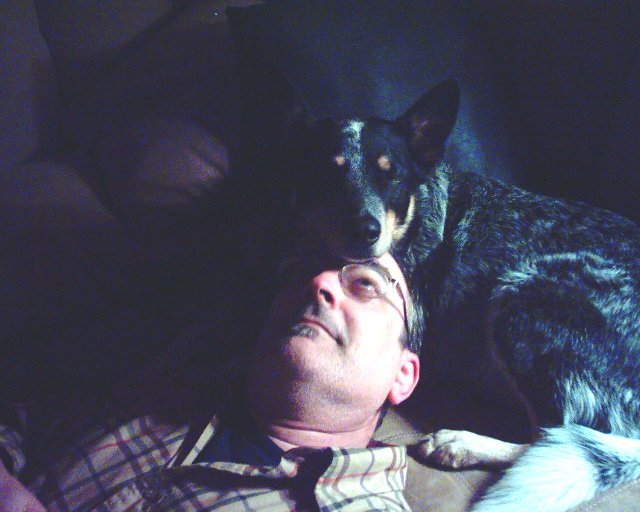
For Smokey
(2001-2014)
One week gone; never forgotten


* I would say that Up is my favorite Pixar film—I've never not enjoyed and admired one, and the story-crafters at that studio only seem to get better with time—but, that place is still held by Ratatouille, which, to me, made a quantum leap in computer-generated story-telling.

** Keeping this one manageable is why I didn't publish it on time last week.  Apologies are due, but this one was worth the wait.

*** The wealth of which, and the examination of such, also delayed publication.