Wednesday, February 24, 2021

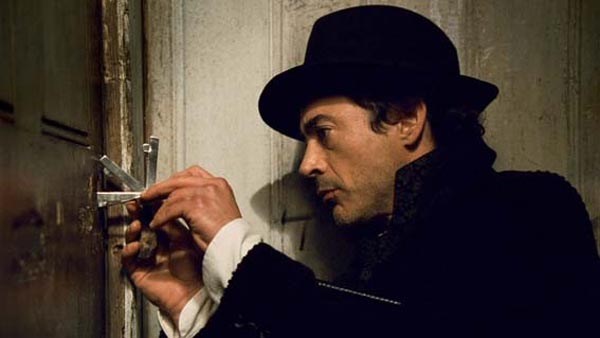
Sherlock Holmes (2009)

Written at the time of the film's release...before the "Benedict Cumberbatch" version of a modern-day "Sherlock" (in case you were looking for clues about why I wasn't mentioning it).

"The Lord, The Woman, the Ginger Midget and the Parisian Giant" 

or 
"The Peripatetic Plot of the Madonna's Husband"

I had been looking forward to the new Sherlock Holmes with anticipation and dread. I'm a fan, though hardly a "Baker Street Irregular," and Robert Downey Jr. is always worth watching—even when he's not, able to suck nuance out of even claustrophobic camera set-ups and able to project a fiendish intelligence out of every role. Fans of the Great Victorian Detective, I've liked several incarnations—particularly Jeremy Brett's encyclopedic and eccentric interpretation, and suffered through the attempts to get another Holmes series started. Brett left a long shadow—one that not even a good choice like Rupert Everett could dispel.* And clues in the trailer led one to deduce that they would try and make Holmes more of an action figure than Conan Doyle might have intended—more like a Bourne-again Holmes than the amateur pugilist of the books. 
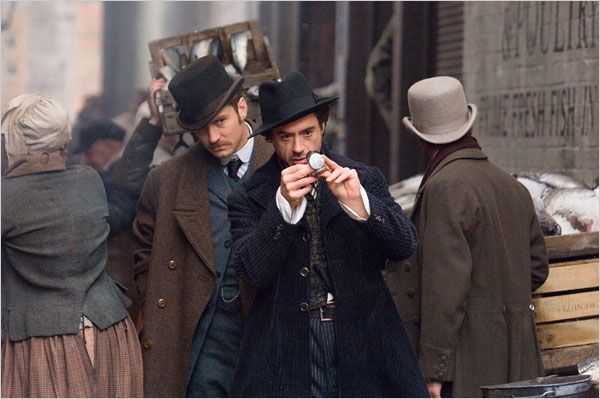
There are elements of that here, but done cunningly by writers Michael Robert Johnson, Anthony Peckham, and Simon Kinberg; Holmes, ever the synthesizer of information-bits diagnoses his battles first using his observations of his opponents, then carries them off with judicious speed, making note of their potential recovery time, both physical and psychological. Neat touch that, as is a nice summing up of Holmes' misanthropic characteristics—sitting at a restaurant table awaiting Watson (Jude Law,** as good as Law has ever been) and his intended, Mary Morstan (Kelly Reilly),*** Holmes observes every argument, every petty theft, every peculiarity of his fellow diners—without his mind disciplined in pursuit, the vagaries of the world must drive him mad. Both Robert Stephens and Brett maintained that the difficulty in playing Holmes is that there is no center to him—a brain with no heart. Bur even an unbridled intellect must react to the world, and in Downey, jnr. there is quicksilver in those reactions
The game that is afoot is one that will challenge Holmes to his core in a battle of facts and logic against magic and the dark forces.**** When we first see Holmes and Watson in action, they disrupt a ritual sacrifice by the fiendish Lord Blackwell (Mark Strong), who is already responsible for three murders before the fourth is disrupted. Sentenced to hang, Blackwell informs Holmes he will rise from the dead to usher in a new destiny for England. Holmes is skeptical, but intrigued, especially after Blackwell is hanged, declared dead (by Watson), then escapes his coffin. At a time in History, when engineering marvels such as London Bridge are being accomplished, it seems more imperative than ever for Holmes to dispel the superstitious
Disrupting his concentration is a visit by the one woman who has out-foxed Holmes, Irene Adler (Rachel McAdams, far too contemporary an actress for the part—one expects her to huff and say "whatever..." at any moment), in the story "A Scandal in Bohemia." Adler is an adventuress, to be sure, but she is almost a secret agent here, more in line with the fictional series of stories that been built up around her by Carole Nelson Douglas
There is far less drawing-room discussion and far more darting about and cane-dashing than in previous incarnations. The humor is amped up considerably, and the effects of injury down-played, but for all that it's a good representation of Holmes, adrenalized and puffed up as it is. Guy Ritchie shows that he has evolved from mumbling street-thug films to something with more than empty panache. His breathlessly paced opening half of the film stumbles somewhat with an extended fight with a Parisian giant, but manages to regain its footing with some genuinely well-done sequences that manages to clue the audience in to eke out its suspense. There has been some criticism of late that Ritchie doesn't have the depth or focus to pull off a big-budget film, although he's been angling for them for years. "Sherlock Holmes" is his defiant reply. 
And not only are Law and Ritchie showing their best games here—composer Hans Zimmer, long an adherent of the generically grinding over-the-top symphonic score (he supervised all three "Pirates of the Caribbean" scores, which, frankly, are hard to tell apart), his work for "Sherlock Holmes" is folk-song based, with clever rhythms and instrumentation—kudos to orchestrator Kevin Kaska—that keeps the period alive amidst the clutter of the art direction.

* Although I'd like to see Ralph Fiennes, or better, Daniel Day-Lewis, try. 

** Law appeared in the Granada version of Doyle's "The Adventure of Shoscombe Old Place."
*** Although why Watson feels the need for Holmes to meet her in the first place is rather odd. She did, after all, hire him in "The Sign of Four."
**** Conan Doyle's stories focused on matters that challenged the societal structures of Victorian England and elaborate plots of thievery, and rarely dealt with the occult, although some of the modern stories—like Young Sherlock Holmes (1985), which also featured an occult presence, as it was produced by Steven Spielberg, not long after Indiana Jones and the Temple of Doom, have featured Holmes against more supernatural threats. There was always that element to Doyle—such as the monstrous "Hound of the Baskervilles"—but they were usually explained away in bursts of Holmesian fact-checking.
Shamelessly going for search-engine hits...

Tuesday, February 23, 2021

Ma Rainey's Black Bottom

A-One, A-Two, A-You Know What To Do...
or
When the Levee Breaks (When My Daddy Stay Out Late/He Don't Care a Thing for Me)

August Wilson died in October 2005, and is best known for his "Pittsburgh Cycle" of ten plays and there has been a concerted effort to bring the ten to the screen. Hallmark made "The Piano Lesson" in 1995, But the rest...? Part of that is that Wilson insisted that his black plays be directed by black directors ("the job requires someone who shares the specifics of the culture of black Americans") making the job more difficult. Well, bullshit. Let's just say it. Nobody wants to invest the money in a black play with black actors by a black director (unless, of course, it has the word "Hood" in the title) because they don't think they'll get their money back to which I say "Wakanda Forever!" So the effort is being made to toss out the seeds on the wind and see what takes root—Denzel Washington directed Fences in 2016 with outstanding performances by him and Viola Davis—she won the Best Supporting Actress Oscar, but I was surprised she wasn't nominated for Best Actress, as she stole the show. She does that.

And there would be that same danger with the second film to be done (of the second play in the cycle), Ma Rainey's Black Bottom, if director George C. Wolfe hadn't cast his film so perfectly, and then run away with it to make an honest-to-god film as opposed to a filmed play. Ma Rainey surges and glides and pivots and laterals, lifted aloft by the music and by Wilson's language cadences. And the acting is never short of fascinating. One hesitates to put the word "perfect" to anything but to my eye and ear, this one is perfect.
It is 1927, and Ma Rainey (Davis, almost unrecognizable—except the eyes always shine through) has interrupted her tour down South to do recordings for her manager Irvin (Jeremy Shamos) and studio executive Sturdyvant (Jonny Coyne) to meet the need for "Race Records" for those blacks who've moved to the North during the "Black Migration." In her entourage is her nephew Sylvester (Dusan Brown) and one of her dancers Dussie Mae (Taylor Paige), who will accompany her to the session. 
She'll get there in her own time, but first to arrive are the band: Cutler (Colman Domingo)-trombone, Toledo (Glynn Turman)-piano, Slow Drag (Michael Potts)-bass, and Levee (Chadwick Boseman)—trumpet. Levee is the youngest member of the troupe, and is all unbridled energy—he just bought a pair of fancy new shoes from his poker winnings the night before and his excitement for the session is for getting to do his own arrangement of the "Black Bottom" piece and sell his arrangements to Sturdyvant with an eye towards recording them and starting his own group.
The banter between band-mates escalates and falls, as the older band-mates scoff at Levee's braggadocio over his thinking that he might have some sort of control over what Ma will or won't perform for the session. It sounds good when Ma isn't there and its just the band he's angling with, but sounding good and producing are two different things. Power plays are at the heart of Ma Rainey's Black Bottom—who has it and who pretends to have it—and one can bluff all they want to, but there's a difference between a poker-hand and life, and the rules don't necessarily apply to both.
The dynamics change when Ma arrives at the studio; you play it her way or you don't play. In a studio, time is money. But that's money down the drain if you don't get product to exploit. So, things shift and drift, with the ultimate aim of a good recording from everybody—"Who this 'we?'" What you talkin' about 'we?' Come talking this 'we" stuff. Who's 'we?'"—with no solo's allowed. And Ma will push her power—punching up and down—as far as she can go because it's her voice, her material, her band, and her name on the release forms. Nobody makes any money until that happens. You want power? Watch how a diva plays it.
This would be a great solo showcase, just for the presence of Viola Davis ("No look goes uninvested," says director Wolfe) as Ma, and the participation of the late Chadwick Boseman in his last role—that's what all the publicity is about (and they are great, don't get me wrong, I've never seen either of them do anything but light up the screen)—but, everybody in it is great. Davis and Boseman are perfectly capable of blowing people away on-screen, but they are matched by Domingo, Turman, and Potts as the band-members; they are given their monologues and solo's and each are given their moments to shine, while dialoguing without any hint that what they're saying hasn't been lived and is coming straight from their minds to their lips. This is a near-perfect ensemble piece and it is thrilling watching what they do with it.
And director George C. Wolfe does a brilliant job of giving them the proscenium to perform. Even while you're hanging on every word, there are moments when his shot choices are nothing short of breath-taking, anticipating the arcs of the play and giving you something amazing to look at and contemplate, whether the action is happening in the frame, or just waiting for it to happen. Wolfe is a grand ring-master setting things up and paying them off, with three—and other minor ones—dynamics of power that come crashing together and either makes great music or explodes.
It is thrilling to watch this kind of work and one hopes against hope that Netflix makes this more available—beyond its platform—so that more people can see it and appreciate the way a stage-bound work can be opened up from within just by making inspired choices. 

This is the second of the planned "Pittsburgh Cycle" adaptations; one wishes that Wolfe will direct the remaining eight, as well. That will do justice to Wilson's legacy.
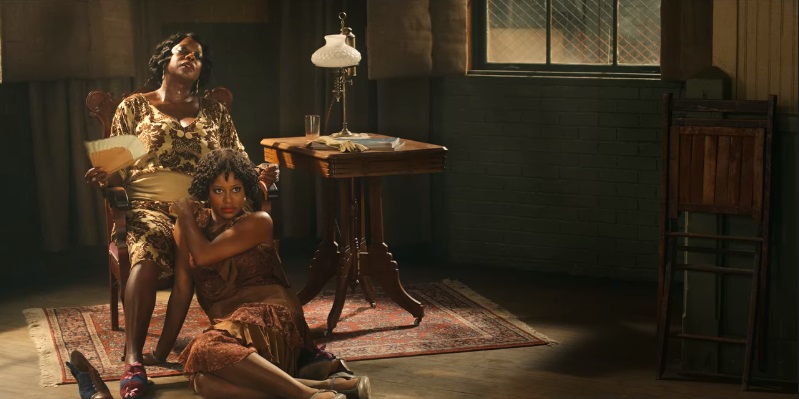
Some of George Wolfe's compositions:

Sunday, February 21, 2021

Don't Make a Scene: Silverado

The Story: We meet the four riders of Silverado in individually desperate straits: Emmett is given a wake-up call by armed gun-men; Paden is left for dead in the desert after a robbery; Jake, well, we haven't met him yet by this scene, but let's just say he's not in the best of situations.

Then, there's Mal. Like Emmett and Paden, he's been on a journey and the town of Turley is his best stop after not having "a shot of whiskey or slept in a bed in 10 days." He's real tired. But, not so tired that he can't take care of himself when the going gets rough, as, unfortunately, things get in the West of the post-Civil War era when your skin-color tends to something besides sun-burnt. And "that ain't right," a sentiment of Mal's that he uses all too frequently, as much as Paden's frequent assessment of the "luck" of a situation.

Paden has no control over luck, but Mal will have none of letting a situation that "ain't right," go uncorrected. So, he'll take action when required. All four of the riders will. They make a good team.

But, that may cause some disturbance in the town's fabric; Mal's efforts attracts the attention of the town's Sheriff, Langston—John Cleese with the altogether appropriate entrance line for any constabulary in a Monty Python sketch: "What's all this, then?" The shock of the line and the resulting "coke-spitting" laugh it issues—especially after a tense action fracas—is almost a relief. That Cleese, known to audiences for his comedy, plays the rest of the scene in earnest creates a certain frisson for the rest of the scene, tight-roping (using a patented "silly walk") between seriousness and levity.

It's another great scene—of so many—in Silverado.

The Set-Up: After surviving an ambush in an abandoned shack, Emmett (Scott Glenn) picks up a stray—he finds Paden (Kevin Kline), lying the desert in his underwear, the victim of a robbery; the bad guys stole his guns, his boots, his clothes, his hat and his horse. Eventually, travelling with Emmett, he gets it all back—good luck. Now, they're in the town of Turley, looking for Emmett's little brother Jake (Kevin Costner) before the brothers visit their sister in Silverado. So far, no luck. In a saloon the next day over breakfast, they observe a fellow traveler, Mal (Danny Glover), who will prove valuable in achieving their goal.

Action.


INT. SALOON/HOTEL - DAY
The newcomer is a lithe, strong, black man -- MAL. He has no other weapon besides the rifle. 
Mal looks around the room and walks wearily to the registration desk, although there is no one behind it.
He RINGS a bell for service.

At the sound of the bell several of the patrons look up and spot Mal for the first time. 
The three Tough Men are instantly displeased at the sight of the black man. Paden, returning to his meal, notes their attitude and glances over at Mal.

Mal leaves his saddlebags at the registration desk, but takes the rifle as he walks across to the bar. The nervous Waitress is working there. The sight of Mal only adds to her agitation.

WAITRESS
(cold) What do you want?

MAL (friendly, tired) I haven't had a drink of whiskey or slept in a bed for ten days. 
MAL
Give me a bottle. 

The Waitress hesitates, uncertain. She places a shot glass and a bottle on the bar beyond an elaborate, brass, nude statuette whose upraised arms hold dishes full of hard-boiled eggs. 
Mal has leaned his rifle against the bar and must now move a few steps to stand before the whiskey.
The three Tough Men exchange looks as Mal uncorks the bottle and slowly, lovingly fills his shot glass. He puts the bottle down and regards the glass for a long moment of pleasant anticipation. Mal's hand has started for the glass when the saloon's PROPRIETOR appears from a back room.
PROPRIETOR (sharply) Hey! What are you doing, buck?
Mal draws his hand back and straightens slightly. A different kind of weariness comes into his face.

MAL
Having a drink.

PROPRIETOR
No, you're not. Get out of here.

The Proprietor shoots the Waitress a withering look; she shrugs helplessly and hurries away.
At the tables two of the three Tough Men quietly rise and separate, moving toward the two ends of the bar. Emmett and Paden watch.

MAL
(flat) I haven't had a drink of whiskey or slept in a bed for ten days.

PROPRIETOR
You ain't getting them here.

MAL
(gravely) I'm real sorry to hear that.

At this, the First Man steps forward quickly, snatches Mal's rifle, and slides it down the bar. Mal looks across the distance at his only weapon.

PADEN
(quietly, to Emmett) Doesn't look quite fair.

EMMETT
(watching carefully) Which way do you mean?

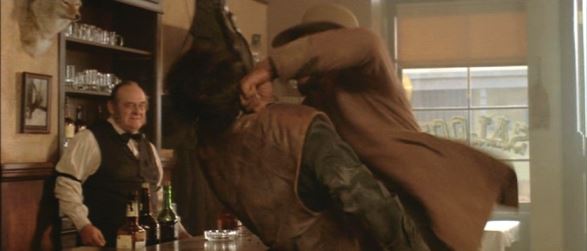
The Second Man lurches up to the bar and pins Mal's arms behind him. The First Man moves quickly, cocking back his arm for a punch square in Mal's face. 
As the blow is unleashed, Mal bends forward with terrific speed and force, pulling the Second Man onto his back.
The Second Man's face is suddenly where Mal's was an instant ago, and the First Man's punch lands hard on it. 
Mal slams the Second Man's back against the edge of the bar; he falls to the floor.
Mal blocks a blow from the First Man and steps in with a flurry of body blows.

Back at the Tough Men's table, the Third Man pushes back his chair as if to rise. Emmett has just picked up a chicken leg; now he waves it ever so slightly at the Third Man: "Stay out of it". The Man looks at Emmett and Paden, then settles back into his seat.
Mal sends the First Man crashing down through a table with a final blow.
He turns in time to see the Second Man, back on his feet, grab Mal's whiskey bottle and break it against the bar.
Mal looks for a frustrated moment at the splashing whiskey -- what a waste.
The Second Man lunges with the sharp glass.
Mal lifts the heavy statuette easily with one hand and uses its upraised arms to catch the Man's wrist and twist the bottle painfully from his grasp.
Mal's other hand hits the Man once in the throat, and he is down.
The Proprietor rises from behind the bar, a sawed-off shotgun in his hand.
Mal spins, swinging the statuette brutally against the Proprietor's arm.
The shotgun clatters to the floor as the Proprietor recoils in pain, crashing into a shelf of glasses. The fight is over.

Suddenly, standing in the doorway holding a leveled gun is an enormously tall figure -- SHERIFF LANGSTON. Dressed rather elegantly in suit and bowler, he dwarfs the man at his side, DEPUTY KERN. He surveys the scene as the three injured men stir back to life. When he speaks, it is, surprisingly, with a British accent --

LANGSTON
What's all this then?

PROPRIETOR
This nigger's breaking up my place, 
PROPRIETOR
...Sheriff Langston.

LANGSTON
I don't like that word much, Carter.

PROPRIETOR
We don't serve them here and you know it. 
PROPRIETOR
I asked him to leave and he went crazy on us. 
PROPRIETOR
He owes me money for this damage.

LANGSTON Is that a fact?
EMMETT
'Fraid not, Sheriff. These other fellas started the ruckus.

Langston's attention focuses on Emmett and Paden.
LANGSTON There are three strangers in this room, traveler, and these gents you are accusing aren't them.
LANGSTON
(to Mal, indicating Emmett and Paden) Are these your friends?

MAL
(shakes his head "no") I wanted a drink and a bed. I guess I came to the wrong place.

LANGSTON
(taking in the mess) Came to the wrong town.
LANGSTON I don't tolerate this kind of thing. It's hard on the peace, and it's hard on the furniture. 
LANGSTON
Now, knowing a bit about Carter here, I'm going to let you go without paying for the damages. But go you will, and I mean now.

MAL
Is there a place in town that takes... my kind?

LANGSTON You misunderstand. I want you out of town. 
LANGSTON
In fact, I want you all the way out of my jurisdiction.

MAL
(seething) That ain't right.

LANGSTON
I decide what's right in this jurisdiction. Now move.

Mal glares at Langston and, finally, moves. 
He takes his rifle from the bar, then walks over, picks up his saddlebags, and slings them over his shoulder.
He is almost to the door when he stops, 
turns, and walks slowly back to the bar.
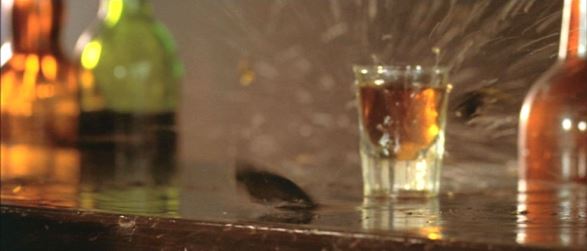
The shot glass full of whiskey has miraculously survived the fracas.
Mal brings it to his lips and swallows with satisfaction.
He turns and goes out the front door. Langston motions to Deputy Kern to follow and witness Mal's departure.
Langston turns and looks at Emmett and Paden as he slowly uncocks his revolver and holsters it.

PROPRIETOR Who's going to pay for all this, Sheriff?
LANGSTON
Don't press your luck, Carter.

Langston moves to Emmett and Paden's table and pulls up a chair.
He lifts the last biscuit from a basket. He takes a fastidious bite.

LANGSTON
Now let's talk about you chaps.

PADEN
We'd rather stay.

LANGSTON We'll see about that. 
LANGSTON
I'm Sheriff John Langston. As you may have guessed, I am not from these parts.

PADEN
You're kidding.

LANGSTON
(ignoring that) But the good citizens of Turley have taken me in their embrace, and for one simple reason. I maintain the peace. So when strangers come to town, I always ask them their business.
LANGSTON Have you come for the hanging?

EMMETT
("no") I'm just meeting a guy here and moving on. So far I haven't been able to find him.

LANGSTON In my town, when you're looking for someone, you ask me.
EMMETT
All right. I'm looking for a young fella, full of juice. About my size, wears a fancy two-gun rig.


Langston takes a long time reacting to this information.
Now he slides his chair back a foot, giving his gun hand a little more room.

LANGSTON
I know where that gentleman is.


Silverado

Words by Mark Kasdan and Lawrence Kasdan

Pictures by John Bailey and Lawrence Kasdan

Silverado is available on DVD and Blu-Ray by Sony Home Video.