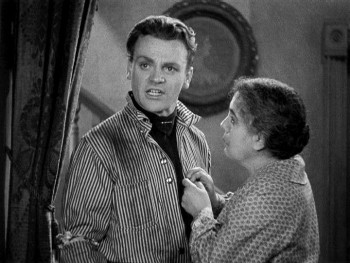
The Public Enemy(William Wellman, 1931) "Learn your lines, find your mark, look 'em in the eye and tell 'em the truth." That was James Cagney's recipe for good acting, succinct, humble, with plenty of lee-way to find your own path, and completely shy of the mark when it came to talking about how he did it. This gangster film was Cagney's first starring role—in fact, up until two weeks before filming, Edward Woods (who plays Tom Powers' best friend) was going to play the lead. But, there was something about the little guy with the bantam rooster's brio that made director William Wellman turn the tables on the roles. It's the story of a rotten kidfrom a good family with all the contrary instincts to look out for a number one—himself—who has no moral compunctions about anybody else, that leads him down a precariously slippery slope at a time in history when society was providing an excellent opportunity for taking advantages of loop-holes in the law and morality. Pretty soon, "Tommy" is a booze-runner during Prohibition, and anybody getting in his way, even some he'd pledged loyalty to earlier, would find their way on the wrong end of his fist orthe business end of his gun (and curiously, Cagney's Powers employs both the same way, with a forward thrust of the arm, as if fist and firearm were interchangeable).
It's a pretty standard morality—or immorality—tale. But, you watch Cagney do it his way and you never forget it. He's extremely charismatic, and like James Dean, does so in a way that separates him from everybody else. Where the rest of the cast—in one of the early talkies—is ramrod-stiff and talking with fine e-lo-cu-tion, Cagney is loose in everything, wrapping himself around furniture, spitting out his slang dialogue, and if there's a little dead-air, he throws in a little wise-crack in word or gesture for good measure. He's encouraged by Wellman, who takes a lot of chances in this pre-Code drama ("Did he just say what I think he said?" "Is that gesture in the credits what I think it means?"), and who sets up the tenor of the times in one masterful shot from a street corner's vantage-point, moving from a distillery to a corner-bar, following a pole of beer-buckets that crosses the path of a Salvation Army band. Wellman liked to play it rough—they used real bullets in a shot where masonry is picked off close to Cagney's head, and when Cagney is hit by the actor playing his sanctimonious brother, Cagney goes down like a ton of bricks—because Wellman told the other actor to clobber him, breaking a tooth in the process. And there's the famous grapefruit-in-the-face shot (making Mae Clarke something of a legend extending far beyond her career), that Wellman came up with—because he always imagined doing that to his own wife, who habitually ate half a grapefruit in the morning.
But, it's Cagney that's the Big Show. Watch the scene where he stands in the rain, luxuriantly eyeing his next targets, the guys who gunned down his buddy in the street. With murder on his mind, a smirk comes over his face, that turns into a fierce grin, then disappears into a grimace as he moves forward and walks right into the camera, like a ball of fire that can never be put out. Cagney's so good, he's scary.
Cagney's Tom Powers with murder on his mind—that not even a downpour can douse.
A Matter of Life and Death (aka Stairway to Heaven)(The Archers, 1946) A cryptic reference to "The Archers" (and their ability to seamlessly combine reality and fantasy) crept into my review of Scott Pilgrim vs. The World, and necessitated the completion of a couple reviews I've had in draft stage the last few months, waiting for the creative spark that would ignite them into a full-blown post. A Matter of Life and Death, coming as it did with the stench of the Second World War still enveloping the planet, is a meditation on, and an impassioned plea for, the value of a single human life at a time when the world had seen so much slaughter. Like it's American counterpart, Frank Capra's It's a Wonderful Life, both films begin in the Heavens for a brief prelude contemplating cosmic predetermination. One man is literally, and spiritually, put to trial for his life, on Earth (as it is in Heaven) when he doesn't die in circumstances that should have killed him. The story proper begins with the protagonist's life in the air. A lone RAF pilot, poet Peter Carter (David Niven) is the last man crouching on a doomed bomber hurtling to destruction. The rest of the crew has bailed out, and Carter, without a parachute, has determined to go down with the plane, hoping to bail out at the last second to avoid death.
He spends his last fleeting moments in tenuous radio communication with June (Kim Hunter), an American radio operator, who listens, horrified, as Carter banters through his stiff upper lip, and a parallel falling occurs, as the two are linked in life, death and love for those precious few minutes. Nothing can come of it, of course. He's a dead man, for sure.
So, the two are both shocked (though delighted) that Carter survives the fall and is washed up on the beach. It's some sort of miracle.
"Every time the factory whistle blows, an angel gets it's wings..."
Heavens Above...
The Earth Below
Actually, no. It is more of a clerical error, as the being-counters in Heaven (we presume, and it's never stated outright) await Carter's arrival with the rest of his crew (none of them made it). A representative (Marius Goring) is dispatched from Powell and Pressburger's amusing depiction of Kingdom Come (as a sort of empyrean General Motors, an Industrial Age Promised Land), to send Carter packing for Paradise...except...he doesn't want to go. And won't, unless, he's forced to. Of course, that he's seeing time-stopping visions of Heavenly Hosts indicates "chronic adhesive arachnoiditis" suffered from an earlier brain injury, and a battle for Carter's life is fought on two fronts, both dependent on the work of one man: Doctor Frank Reeves (Roger Livesey), who diagnoses the ailment and, before he can perform surgery, is killed, where he can conveniently argue Carter's case for life in a celestial court-room—the highest court of all.
The Highest Court of All
Carter's out-of-body experience on the operating table—a comic highlight
But, it is more than that—it always is with the films of Powell and Pressburger. At the end of the European War, there was bitterness on both sides of "the pond:" Americans were grieving their losses and blaming England for "having to be bailed out;" Britons were bitter of the first American Invasion of the war—their own country, and of the havoc "the Yanks" caused creating their launch-point.*The Case for Peter Carter becomes, in a deeper and richer sense, a debate centering on "Whither England," and whether the "special arrangement" between The Kingdom and The Colonies should be continued, unquestioned. This odd and whimsical fantasy**becomes a propaganda piece for the very existence of Britain itself, God (or Whoever) Save the King.
The production values are top-notch and imaginative, including an ecumenical escalator that bridges the two worlds...and two photographic processes. Reversing The Wizard of Oz schema, it is the worlds under the rainbow that glow with rich eye-dazzling Technicolor, while "the next world" is shown in black and pearly-white.
* A fine film, too often overlooked, about this war on the home-front is John Schlesinger's unusually restrained (for him) Yanks. ** This is one of those films that modern critics would sniff "is inconsistent in tone." Hey, life is inconsistent, pal!
The Set-Up: The Kubrick Trap. There are those who see it as a maze, but it is usually more lethal than that. People don't just lose their way...they're constantly being threatened with losing themselves...or their lives. The machinations that threaten to grind the souls in Kubrick's movies take many forms: they may be societal or social—political systems, class systems—military, technological, even supernatural. They may even be hard-wired into the folds and curves of the protagonists' grey-matter (talk about your mazes!). And the people who populate in the chess-master Kubrick's films are merely pawns to those designs.
But even pawns can occasionally take a King.
Rarely.
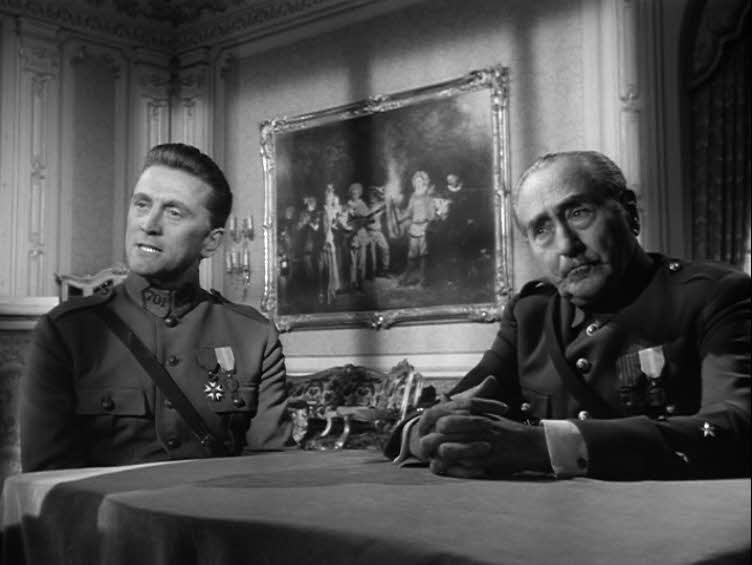
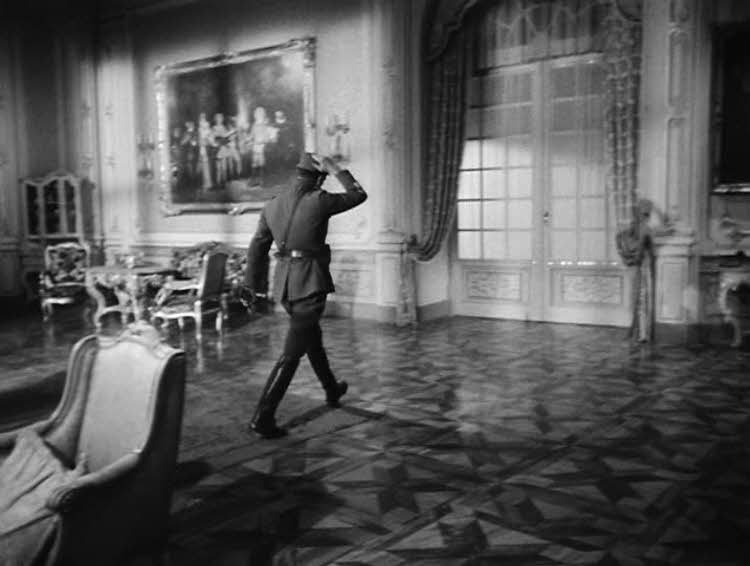
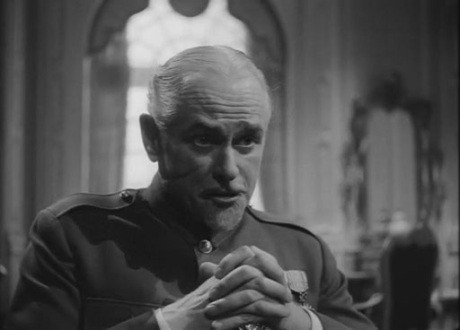
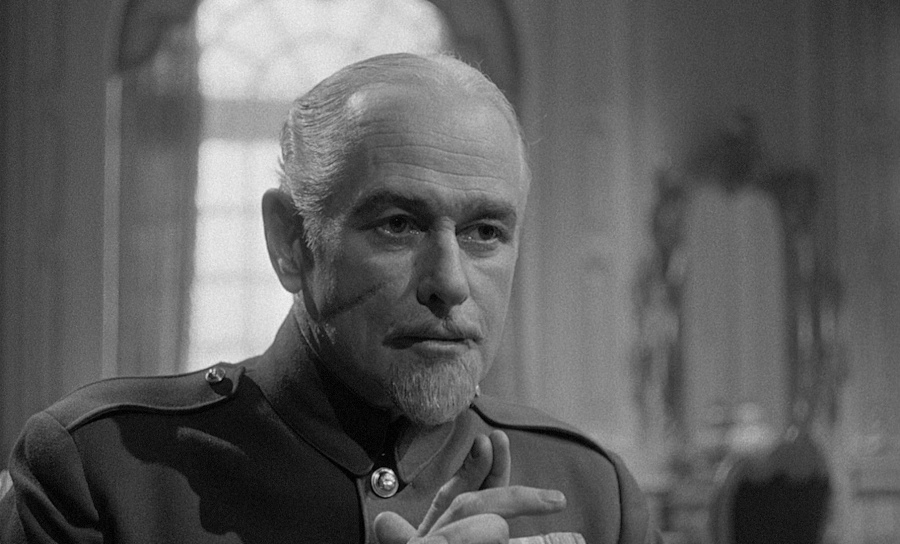
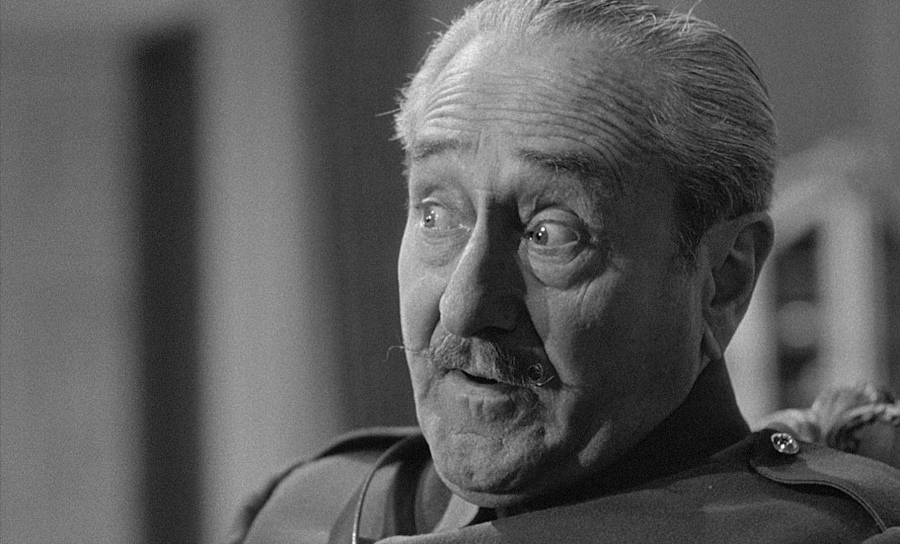
Because I don't talk about Stanley Kubrick enough,* I'll be eventually putting up some scenes from Kubrick films that show those traps being set. This one is one of the best, from an early film in Kubrick's career—Paths of Glory—a controversial** small-budget film set during World War I, for which Kubrick had the luck to get a star the caliber of Kirk Douglas to star.***Paths of Glory tells the story of one attack that goes wrong, slipshod in planning and impossible in execution. The general whose idea it was to launch it in the first place is outraged and humiliated that the troops could not pull it off. And so he decides to set an example by court-martialing and executing members of the troop. He cynically decides that he will bury the evidence, blaming the men for the failure, and blustering his demands for satisfaction. He has the power and he will use it. In the chateau headquarters of the generals, the war is a game of advancement, and General Mireaux will not fall on his sword for anyone.
This meeting, directly after the attack, is a triangulation between strata of power—Mireaux will dress down his subordinate, Dax—in command of the troop—in front of the older, craftier General Broulard, who serves as referee, negotiator and Master of Ceremonies. Broulard is a political animal in the military game, assuaging egos, keeping his eye on both The Big Picture and his ambitious subordinates. Far from the front, he specializes in watching his back. He is the master manipulator by not choosing sides—other than his own. Mireaux, however, is a martinet—vain, egotistical and callous, seeing the war as a personal stepping stone for advancement and his greater glory. Dax, on the other hand, is literally in the trenches, making due with the situation as it is handed to him. Orders are orders, but orders come from men and men are flawed.
But you can't say that. Not to the men who control your life...and see lives as disposable...and a means to an end. So, Dax is in the uncomfortable position of being caught between the men who depend on him and the men who don't care. He is fighting two fronts: the simpler fight at the trenches with a common enemy with its deadly consequences, and the more complicated political fight above, with the men who control all Fates.
The fight for the Ant Hill done (a spectacular sequence, shot with only two simultaneously running cameras), Kubrick concentrates next on the fallout, away from the close-quarter muddied trenches and the chaos of the battlefield, in the immaculately airy rooms of the Neoclassic French headquarters that don't look like they've ever seen the destruction of war. Kubrick stages it literally for its triangulation (as he will stage the subsequent court-martial as a chess-match). The set-ups reflect the politics and advantages of the argument and the participants' relative position in it. Isolating medium shots of individuals. Close-ups for emphasis. Bonding two-shots (if one can call it bonding). The editing more closely follows reactions than words (as usual, with the Sunday "Scene" we put the dialog only contained in the individual shots, and here the dialogue is pointedly broken up, emphasizing the visual rather than the dialog), eyes darting from one man to the other searching for political advantage, seeking the important "two against one." Even when Mireaux is at his most emotional ("For cowardice!"), Kubrick is focusing on the reactions of Dax and Boulard, the former surprised and outraged while the latter looks away, betraying a slight embarrassment at the out-burst and Mireaux's lack of civility. Kubrick saves his most looming close-up for Broulard, who must finally rein in Mireaux's self-pitying melodrama ("I was talking of [executing] a hundred men. Now we're down to 12.") for the sake of a compromise that neither of the other two parties is comfortable with.
And the dialogue is blunt, direct and brutal...but not without insinuating nuance. A product of Kubrick, Calder Willingham and early Kubrick collaborator Jim Thompson—he of the brutal pulp fiction novels, including The Killer Inside Me—it reflects Thompson's ability to see the worst in people and have them express it without their having any sense of self-examination or discretion—the ultimate in ego, bordering on pathology. The frankness of the dialogue—despite the political under-pinning that restrict it—has a tension all its own; add Kubrick's insistence on focusing on the reactions to it and you have a very full, very tense scene of one-ups-manship. Production will be starting soon on Lunatic at Large, a "lost" Kubrick project,**** written by Thompson in the late 50's. The Story: The French attack on The Ant Hill, an insignificant scrap of land save for advantage and the vain-glorious ambitions of General Mirieuax (George Macready) has not gone well. Led by Colonel Dax (Kirk Douglas), the infantry were cut down almost immediately—some of the men not even able to leave the trenches. Incensed, Mirieuax even attempted to have French guns fire on the troops to provoke them. The aftermath of the battle is a debriefing and dressing down of the Colonel by Mirieux in the luxurious headquarters of General Broulard (Adolphe Menjou), both mens' superior and a particularly political military man. Action!
MIREAUX: I ordered an attack. Your troops refused to attack.
DAX: Our troops did attack, sir, but they could make no headway.
MIREAUX: Because they didn't try, Colonel. I saw it myself. Half of your men never left the trenches.
DAX: A third of my men were pinned down because the fire was so intense.
MIREAUX: Don't quibble over fractions, Colonel.
MIREAUX: The fact remains that a good part of...
MIREAUX: ...your men never left their own trenches. Colonel Dax, I'm going to have ten men from each company in your regiment tried under penalty of...
MIREAUX: ...death for cowardice. DAX: Penalty of death? - MIREAUX: For cowardice!
MIREAUX: They've skim milk in their veins instead of blood.
DAX: It's the reddest milk I've ever seen. My trenches are soaked with it! MIREAUX: That's just about enough out of you. DAX: Well, I'm not going to mince words and stand by when-- MIREAUX: Colonel Dax...
MIREAUX: ...If you continue in this manner, I shall be forced to place you under arrest. BROULARD: I believe the colonel has a point, even though he makes it rather bluntly. This is not a trial...
BROULARD: ...but it does bear certain aspects of one, and Colonel Dax technically is cast...
BROULARD: ...in the role of the defense. In view of the gravity of the charges, a court of law would grant him all possible latitude in...
BROULARD: ...presenting his case. MIREAUX: Latitude is one thing, insubordination another.
BROULARD: I am merely offering an opinion, General. Please do not feel constrained to accept it.
MIREAUX: I'm perfectly willing to accept it, General Broulard.
DAX: I'm sorry, sir. I certainly didn't intend to be insubordinate.
DAX: My only aim is to remind you of the heroism these men have shown on every...
DAX: ...occasion in the past. MIREAUX: We're not talking about the past. We're talking about the present.
DAX: But don't you see, sir? They're not cowards, so if some didn't leave the trenches, it must have been because it was impossible.
MIREAUX: They were ordered to attack. It was their duty to obey that order.
MIREAUX: We can't leave...
MIREAUX: ...it up to the men to decide whether an order is possible or not.
MIREAUX: If it was impossible, the only proof of that would be their dead bodies lying in the bottom of the trenches.
MIREAUX: They're scum, Colonel. The whole...
MIREAUX: ...rotten regiment is a pack of sneaking, whining, tail-dragging curs.
DAX: Do you really believe that, sir?
MIREAUX: Yes, I do. That's exactly what I believe. And...
MIREAUX: ...what's more, it's an incontestable fact.
DAX: Then why not shoot the entire regiment?
[Broulard scoffs at the notion] DAX: I'm perfectly serious. BROULARD: Well, now, Colonel, you're missing the point entirely. We don't want to slaughter the French army. All we want to do is to set an example.
DAX: Oh, well, if it's an example...
DAX: ...you want, then take me.
BROULARD: Take you?
DAX: Yes, sir. If it's an example you want...
DAX: ...one man will do as well as a hundred. The logical choice is the officer...
DAX: ...most responsible for the attack.
BROULARD: Come now, Colonel. I think you're overwrought.
BROULARD: This is not a question of officers.
BROULARD: Paul, we don't want to overdo this thing.
BROULARD: Suppose we just make it a dozen.
MIREAUX: I was talking of a hundred men. Now we're down to 12.
BROULARD: Paul, let's not haggle over this thing anymore.
BROULARD: Let's get it settled once and for all...
BROULARD: ...so we can all live with it.
MIREAUX: Well, perhaps I was a bit too anxious to see proper justice meted out. I've spent my entire life in the army. I've always tried to be true...
MIREAUX: ...to my principles. That's the only mistake I can ever be...
MIREAUX: ...accused of. I'll settle for this: Have the company commanders select one man from each company in the first wave. Three...
MIREAUX: ...in all. BROULARD: Well, that's very reasonable of you, Paul.
BROULARD: The court martial will meet at the chateau at 3:00 this afternoon. MIREAUX: Will that be...
MIREAUX: ...convenient for you, General? - BROULARD: Oh, I won't be there, Paul.
MIREAUX: You won't be there?
BROULARD: No. I think it best that you handle this matter on your own.
MIREAUX: Probably so.
DAX: General Mireau,
DAX:...if it's at all possible...I'd like to be appointed counsel...
DAX: ...for the accused. MIREAUX: I'll take the matter under consideration. BROULARD: Oh, we can permit that here, Paul.
* This is sarcasm. If anything, I talk about Kubrick and his films too much, and actually I try to avoid it, spacing them out to avoid some sort of overload.
** Because of its harsh depiction of the French military, it was banned in France—and if it was shown at Cannes, no doubt Kubrick would have been made "persona non grata," as Lars von Trier was in 2011.
*** Subsequently, Douglas, when producing Spartacus, replaced director Anthony Mann (no slouch in the directing department) with his young "find," Kubrick. The experience created a fine film, but soured Kubrick from ever again making a "Hollywood" picture again. From then on, it would be his projects with his rules.
**** Literally, it seems. Kubrick was going to film it after collaborating with Marlon Brando on the pre-production of One Eyed Jacksbut Spartacus became his next project. Then, amidst his notes and papers and books on just about everything, the script was misplaced—something that Kubrick, it is reported, always regretted. I wrote the above piece in 2011. In 2010, it was reported that "Lunatic at Large" was being pursued for production with actors Sam Rockwell and Scarlett Johannson slated to star. As of 2023, nothing has come of it. Yet.