Saturday, July 26, 2014

Queen of Outer Space

Queen of Outer Space (Edward Bernds, 1958) Up until a recent viewing, the only time I'd heard of this film was an overheard mention in grade school when someone imitated Zsa Zsa Gabor's line reading of "I HATE her! I HATE that Queen!"

It's actually shocking to see who's associated with this camp classic with the result of the work: the story is by classic screenwriter Ben Hecht who once wrote of the movies: "Of their many sins, I offer as the worst their effect on the intellectual side of the nation. It is chiefly from that viewpoint I write of them -- as an eruption of trash that has lamed the American mind and retarded Americans from becoming a cultured people." That he came up with this only proves that he had no problems writing such trash...when there was some money in it. The script is by one of the more fertile minds in science fiction and television drama, Charles Beaumont, who wrote some of the better...and more unnerving...episodes of "The Twilight Zone." But you'd never know it here as the best writing Hecht and Beaumont did for the picture was endorsing their pay-checks. Hecht supplied an outline. Beaumont, unimpressed, did what he could with the screenplay, but the final script was done by Bernds and Elwood Ullman, who worked together on shorts starring The Bowery Boys and The Three Stooges.

Ship interior by Radio Shack™

It shows, and one longs for some Stoogian bitch-slapping going on. What there is, is a crew of three astronauts (Eric Fleming—from "Rawhide"—comic character actor Dave Willock, and Patrick Waltz) are assigned to escort a scientist (Paul Birch) on a routine hop to Earth's space station. En route (after an interminable launch sequence) they come across dangerous animated rays that, after about thirty misses, hits the station and destroys it. The crew try to outrun the rays, but end up crashing on Venus, where, before long, they're attacked by women with mini-skirts and long legs, who capture them and take them to the elaborate palace (judging by the exterior matte painting, anyway) of the planet's Queen, Yllana (Laurie Mitchell).

Worst bridesmaids' dresses ever!
It's at this point that one becomes uncomfortable. Not just due to the sexism which runs rampant throughout (more on that later), but also because it all looks so familiar. The crewmen running around in uniform-y leotards, the women in primary colors with high skirts, the set-bound planet with the gradation-less colored sky and polystyrene rocks and foliage just large enough to suggest a horizon, the matte paintings that have nothing to do with the set exteriors, the interiors that are as blank and sterile as a Ramada Inn hallway, the planetary negotiations that seem to center around the boudoir—Good Lord, Jim, it's "Star Trek: The Original Series!" 
What's on your hip, Earth-man? Is it some sort of weapon?

Remember that episode "Mudd's Women" with the space-hookers? The look of it is there, as well as the condescending attitude. But The Queen of Outer Space takes it into orbit. A low orbit ("Twenty six million miles from Earth and the little dolls are just the same!"). The evil Queen has banished all men from Venus, and, for some reason, now wants to destroy Earth with a "Beta Disintegrator," (good for destroying our Beta's, evidently), a threat the Earth-men obviously take very seriously with technically-charged lines like "How could a bunch of women invent a gizmo like that?"(Probably by not using the words "gizmo" or "framas"). She wants to execute the spacemen as spies and the advance guard of an invasion force (some invasion force—they crashed!), but the secret head of the resistance, Taleeah (Gabor, an actress of such limited range the only resistance you could believe she'd put up would be over her wardrobe*) plots to rescue them, while "the advance guard" have their own strategy—have the Captain seduce the Queen.  

Twenty six million miles from Earth and the little pricks are just the same.

"...as blank and sterile as a Ramada Inn..."
I'm something of a kill-joy when it comes to "camp." I don't enjoy it unless it is intentional, not accidental (ie. the TV-"Batman" is intentional, Reefer Madness is accidental). I remember sitting down to enjoy a rollicking evening of smirking over my first viewing of Plan 9 from Outer Space, acknowledged to be Ed Wood's Mess-terpiece, and coming away without the sense of fun one was "supposed" to have, but, instead, feeling disgust at the incompetence of the whole thing. We were not amused.
Actually, Ed Wood would have been impressed by this...

I have the same contempt for The Queen of Outer Space, but with the added degree that it's the same contempt as its makers have for women, in general. In this thing, women are an unknowable hive-mind in two varieties, "drone" and "bitch," while all the men have distinct personalities, even if it is merely 

fifty shades of "doofus." One wants to have a sense of wonder when viewing science-fiction, but it shouldn't be "I wonder how this ever got made?" The film-making is at "Stooge" level here, but with no sense of their timing or of film-making artistry of any kind, not even on a basic level. Watching it is painful, and it's frequently ludicrous, if unintentionally.

It's a waste of film. And a waste of space.

I HATE her!  I HATE this Queen!


* As it is, she probably did, as she's a study in contrast, dressed to the 9's while the rest of the cast is dressed to the 2's.  

Thursday, July 24, 2014

Now I've Seen Every "Thing" Dept.

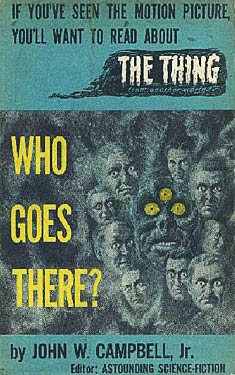
"Who Goes There?" by Don Stuart (a pseudonym for sci-fi pioneer John W. Campbell) is one of the acknowledged "great" stories in speculative fiction.

Part science-fiction, part horror and part psychological thriller, it tells of an isolated Antarctic research facility that discovers a flying saucer long buried in the ice.  Investigation leads to finding the saucer's sole inhabitant not too far away and taking the
BEM-sicle back to the Ice Station for analysis.

Of course, it escapes and this particular ET has a special talent—it can "pretend" to be anyone it has killed and "absorbed." Hiding in plain sight, the "Thing" starts picking off the scientists one by one, while the humans among them start to worry which of their (dwindling) number could be the wolf in sheep's clothing.

Paranoia strikes deep, but "The Thing" strikes deeper, able to replicate the men down to their blood-cells, which provides them with a nifty test to see who's genuine and who's a "Thing"-a-ma-job—take a blood-sample and dip a hot wire into it, and the alien-cells react and start to metamorphose, while the human hemoglobin merely sizzles.

Eventually, the alien is trapped by the scientists, while it is constructing an anti-grav ship to escape, forcing it outside into the cold, where it is torched by the scientists. Humanity triumphs that the alien has been thwarted from fleeing or spreading itself to another outpost. All's right with the world, especially considering that no other visit has occurred since the first ship crashed twenty million years before. No other invasion is expected anytime soon. The end.

From its origins in the August 1938 issue of "Astounding Stories," the tight, compact story was first adapted for the screen by Charles Lederer (with assists from Ben Hecht) and the film's producer, one of the great directors of American film, who put such a personal stamp on it that, to this day, there is debate about just how much work on it the listed director of record actually did.  And that man's influence has taken over the DNA of his film's clones, so powerful is his influence and legacy.
The researchers take a measurement of the saucer.
Hawksian team-work in The Thing (from Another World)
  

😀😀😀😀😀😀😀😀😀😀😀😀😀😀😀😀😀😀😀😀😀😀👽😀😀😀😀😀😀😀😀😀😀😀😀😀😀😀😀😀😀😀😀😀

The Thing (From Another World) (Christian Nyby, 1951).  Yes, it says "Christian Nyby" in the credits, but the film is such a prime example of Executive Producer Howard Hawks' style that folks just assume he had a hand in directing it as well.  He almost certainly re-wrote the script, as it crackles with wit, banter, and includes the requisite "Hawks woman" who's tough enough to play with "the boys."  In fact, the dialogue and human interplay are better than the film deserves and is more entertaining than the "monster movie" that is at its frozen core. 

Hawks puts it in the arctic, then tossed out Campbell's psychological element—his military/scientific crew are Hawksian professionals and suspicions about each other would drive a wedge into that mix (it's enough that one scientist want to emphasize research over self-preservation to cause some heated exchanges*), fraying the team-spirit necessary to get through the crisis and the simple goal of staying alive. Nope. It's simple. The "Thing" is bad. "It" wants to kill us. We kill "it" before "it" kills us. Research? That's what autopsies are for!
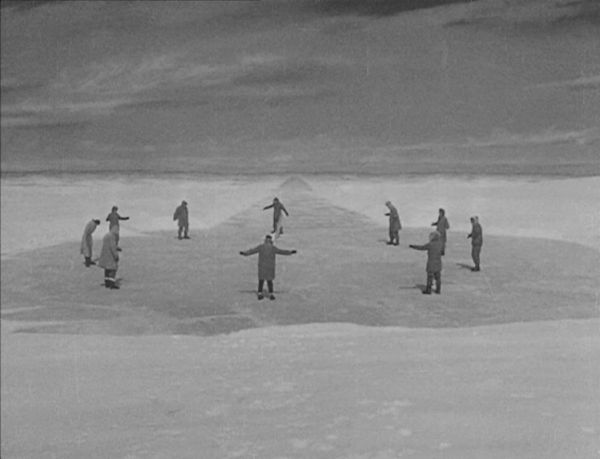
So, The Thing (From Another World) is much more of a monster movie than the study of paranoia the story is. Teamwork towards a common goal is emphasized—you can say that a lot of Hawks' films are analogies to the disparate gypsy-camp of film-makers working together to create a single film—and it boils down to survival. Besides the interplay of the characters, the film also boasts some iconic scenes: the Air Force officers and scientists spreading out on the ice to determine the size of the saucer;
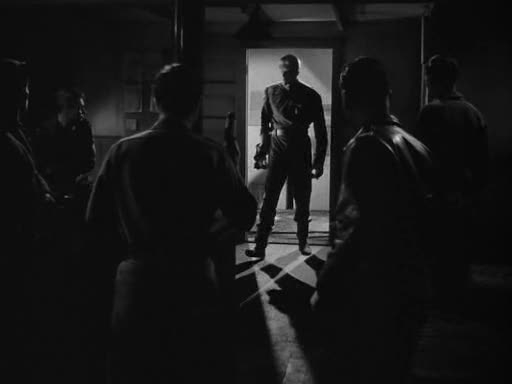
the sight of "the creature" (explained in simple unscientific jargon by one of the researchers as "an intellectual carrot") silhouetted in light as it kinetically bursts open the door of the room hiding the crew; the truly eerie scene of growing blood-sucking creature-clones like they were lethal daisies.


The Thing (From Another World) is a tough, no-nonsense monster movie with sides clearly drawn: us against them. But the only hint of the original tale's paranoia comes from the film's final line: "Watch the skies!"
Braised carrots are on the menu at the arctic station tonight.
James Arness (in a role he hated) gets fried in The Thing (From Another World)

😀😀😀😀😀😀😀😀😀😀😀😀😀😀😀😀😀😀👽😀👽😀👽😀👽😀👽😀👽😀👽😀😀😀😀😀😀😀😀😀😀😀😀😀

The Thing (John Carpenter, 1982) Director Carpenter has long been a disciple of Howard Hawks (his Assault on Precinct 13 is an urban remake of Rio Bravo, and Halloween is merely The Thing in costume), so it was only natural that he would take on the sole horror movie in Hawks' CV.

Bill Lancaster's script hews a little closer to Campbell's story, re-introducing the character conflicts and the assimilating alien (and eliminating Hawks' lone female character, making the station very much a "boys' club," comprised of Carpenter's "go-to" top-liner Kurt Russell—as chopper pilot McReady—and a "who's who" of veteran '80's character actors, Wilford Brimley, T.K. Carter, David Clennon, Richard Dysart, Charles Hallahan, Donald Moffat, Keith David, and Richard Masur).

In the Hawks version it was "us against them;" with Carpenter, it's back to "we have met the enemy, and he could be one of us."

Kurt Russell as MacReady in Carpenter's version
The tone is decidedly different, too. Carpenter's film is dark and brooding and creepy, punctuated by sequences of crazily unnerving violence concocted by make-up wizard Rob Bottin's creative realizations of the creature's ability to turn any part of a human's anatomy into a potential source of weapon or defense. It's icky and gooey and strangely goofy to see heads sprouting spider legs and skittering through the facility, or to see the detached head of one of the researchers pull itself along by whipping its tongue around a table leg and pulling itself out of harm's way.
Rob Bottin's creature creations for The Thing (1982) emphasize
a strange versatility when utilizing its human hosts.
Ultimately, though, for all the anarchic lunacy of the monster sequences, the movie boils down to a claustrophobic, paranoid fight between the men amongst themselves in their search for who is the monster among them, and Carpenter ends the film on a decidedly down note as the survivors of the carnage eye each other, each suspecting the other of being a creature, while they await certain death from the freezing elements, their previously secure station decimated by the events of the previous hours, providing no safety, no sanctuary or any warmth. There are no winners in the decidedly small intergalactic battle zone. 
And, though we're left with no ending and only a stalemate, we can be assured there will be no survivors, either. Any victory is hollow, and one is left pondering if any "thing" human came out of it.

😲😲😲😲😲😲😲☹️☹️☹️☹️😬😬😬👽👽👽👽👽👽👽👽👽👽👽👽👽👽👽👽👽👽😬😬😬☹️☹️☹️☹️😲😲😲😲😲😲


The Thing (Matthijs van Heijningen Jr., 2011) A direct prequel to Carpenter's film,** but basically the same plot. Spaceship found. Creature in the ice. Thaws out. Starts absorbing people.

What's interesting is that van Heijningen also pays tribute to Hawks, by turning the sex-tables on the story, making paleontologist Kate Lloyd (
Mary Elizabeth Winstead from Scott Pilgrim, who looks unnervingly like Zooey Deschanel and can rock a mean flame-thrower) the "guy-in-charge" after the official authority structure breaks down. Just as Hawks up-ended The Front Page by casting Rosalind Russell in one of the men's roles for His Girl Friday, van Heijningen provides an interesting dynamic by putting a woman in control of a station full of panicking men.
One doesn't have to have seen the Carpenter version to appreciate what is going on in the film, but if one has there are touchstones that one can appreciate (and check off if one is a "completist" or continuity-obsessive) along the way—especially at the end once the credits have started rolling—there's the merged double-creature that is briefly seen in the earlier film, the axe in the door, the suicide, the fleeing dog pursued by snipers. But, the giddy, manic quality of the creature-creations has been muted for straight-out horror effects—van Heijningen even has a cheap-shot "Boo" effect early on that still makes one jump—but Carpenter's (and Campbell's) blood-test sequence is neatly sabotaged for a simpler, more organic, and slightly creepier, test that anticipates a potential attack every time someone opens their mouth.
It does its job well, but one is left feeling it really wasn't necessary to make this entry, as it its only function seems to be to ride the coat-tails of its predecessor and fill in some blanks of an already competent version that left some audience-members behind (in the same way that
2010 did for 2001).

Kate Lloyd (Mary Elizabeth Winstead) rocks a flame-thrower.


* And we all know how disastrous heated exchanges can be at an ice-station!

** The film literally ends where Carpenter's begins, with a Norwegian helicopter  and gunman chasing a dog over the Antarctic wastes.

Wednesday, July 23, 2014

Robinson Crusoe on Mars

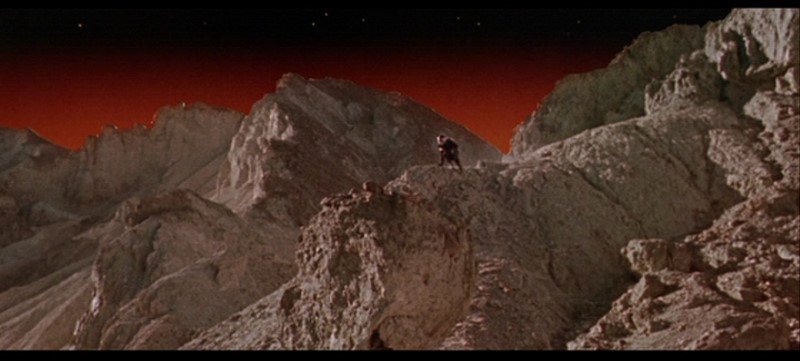
Robinson Crusoe on Mars (Byron Haskin, 1964) "This Film is Scientifically Accurate!" screamed the poster. "It is only one step ahead of present reality!" If "present reality" means ignorance about conditions on Mars, then one has to agree.  One might go so far as the opposite side of the orbit as to say Robinson Crusoe on Mars is more fantasy than science fiction.

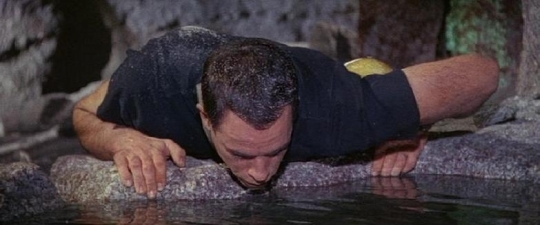
But, I still love it, with the same affection I had for it when I first saw it on some TV movie matinee show in the late 60's.*  Taking Daniel Defoe's classic story and putting it in the space realm wasn't much of a stretch, but what the filmmakers did with it made it an ingenious adventure film, full of obstacles that the lone survivor of a mission to Mars must overcome in order to last more than the 60 hours his air supply will allow in the too-thin Martian atmosphere.  With his mother-ship (out of fuel due to maneuvers to avoid "an unidentified mass") circling enticingly out of reach in orbit, Commander Kit Draper (Paul Mantee) must eke out an existence with anything the Martian surface can provide, even though it has all the appearance of a dead rock with volcanic activity. With the aid of a "mascot" monkey named Mona,** Draper is able to find sources for air, water and food, enough that the isolation on Mars starts wreaking havoc on his psyche. Be careful what you wish for, because soon he's being buzzed by creepily moving, thrumming spacecraft (looking suspiciously like the floating Martian craft from The War of the Worlds). ***
The director was special effects wizard/cinematographer Byron Haskin, who was a fine adventure director, helming that 1950's era The War of the Worlds, Disney's classic version of Treasure Island, From the Earth to the Moon, and many of the better episodes of "The Outer Limits." The man had a way of grounding the most fantastic of concepts to something that felt real, but his alien ideas always seemed sleek and properly "out-of-this world." And he knew how to keep things moving, with new surprises around every papier mache escarpment.
Particular praise must go to actor Paul Mantee—who looks like he could have been one of the Mercury 7 astronauts, short, wiry, and with rugged features that made him no candidate for matinee idolatry—as for the majority of time RCOM is a one-man show. This sort of science-fiction story could easily be played for camp (and for that, see Mantee's unfortunate co-pilot, Adam West), but Mantee's low-key performance—an extended monologue with recorded soliloquies—never strays into that territory, even when an escaped slave from those pesky spacecraft shows up to serve the purpose of "the man Friday." Mantee would go on to make a career in television, and pop up in episodes of many dramas (and the occasional comedy), sometimes playing more than one character over the course of their runs—and had a recurring role on "Cagney and Lacey." A jouneyman actor with features that could be of a villain or a tough guy, he's one of those character actors you could depend on to "blend," and even excel when the need arose. Like shouldering an entire science fiction film and keeping it from spinning out of orbit. Mantee (and "Friday" actor Victor Lundin) did a commentary track for the Criterion release.  I'll have to give that one a listen.
* I estimate it to be 1966-1967.  The reason I watched it is that Adam West (then TV's "Batman") had a small role in it, barely a cameo, really.  Despite the actor's lack of presence, I was captivated by the film.

** It is, basically, a "kids'" film, as the makers regularly do "insert" shots of Mona to reassure us that the monkey is doing just fine. 

*** Thanks to some very intricate gap-editing tricks.

Tuesday, July 22, 2014

Fantastic Voyage

Fantastic Voyage (Richard Fleischer, 1966) There has been a lot of talk recently of re-making 1966's Fantastic Voyage, a fairly interesting (if preposterous) science fiction movie of the 20th Century Fox strain, that did its damnedest to dumb down physiology and biology and make it a race against time with what were cool 60's scientific touchstones like lasers, computer typography, and Raquel Welch in a tight wet-suit (more than she apparently wore in one of the posters for the movie—oh, those mad marketing boys). 

The film is set (naturally) in the middle of the Cold War where Russian and American scientists are battling each other to develop a sustainable miniaturization process, presumably because they know small cars are in coming in the future. Seems they can only keep things shrunk for a limited amount of time and both sides want the secret! And, as there always is, there's ONE MAN in the world who HAS THE SECRET and BOTH SIDES WANT IT!* 

<Aside> Am I just perverse or whenever one of these kinds of plots comes along, and both sides fight to get Dr. MacGuffin, wouldn't it be fun if it turns out that the guy's a charlatan...or just simply wrong?** Maybe he just wanted to visit Chicago (in which case, the joke's on him)...or maybe the Russians just really wanted to get rid of him—"Here, this guy's single-handedly destroying our economy, let's give him to the Americans!!" Actually, I think some of that was in The Living Daylights</Aside>
Anyway, Dr. Benes has the secret, is defecting to the Americans and a botched Russian assassination attempt leaves him with a blood clot in his brain, and so, rather than giving him a shot of heparin (which would cost $70 in our time), our Best and Brightest Budget-Busters decide to inject a miniaturized submarine, The Proteus (designed by the Italian engineer Arturio Schlerosis), crewed by a team of experts to laser the blood clot, and book out of there before they de-miniaturize and give the guy a migraine the size of the military disbursement.
Welch, Kennedy, Pleasance, and Boyd (with William Redfield piloting above)
You read that and go "oh, that sounds so easy" but as with any operation, complications arise, even more than in your average Cialis commercial, and the crew must fight time, tides, detours (The Proteus didn't have Tom Tom), lack of oxygen, VERY LOUD NOISES, and a saboteur among them who's wrecked the laser-thingy. Who could it be? Let's see, it might be Dr. Arthur Kennedy (except he was creepy in the 50's, scholarly in the 60's) or pilot William Redfield (who would be creepy in the 70's), "Rocky" couldn't play evil even if you gave her a dueling scar and a moustache to twirl, leaving only Donald Pleasence, who if agent Steve Boyd knew anything about pop culture, was portraying every other bad guy and crackpot in movies during the 60's...when Steven Boyd wasn't.
The crew has a few hang-ups removing PINK insulation whilst in an artery.
Or is that plaque?
They all get shrunk down to one micron, and are then injected into Benes' blood stream via hypodermic, and try and make their way up to the brain and its offending clot. Arthur O'Connell and Edmond O'Brien monitor the problems of the crew in their control rooms with the obtuse monitors of blinking lights that go spitzin'/sparkin' if something goes wrong. Sailin' along the old blood-stream (which, gosh, who knew it resembles being in a lava-lamp?), the crew wax philosophic and squabble and brainstorm, and Fleischer and his actors all play this with straight faces, no matter how cheesy the sets—the ones involving full-sets look like a particularly tacky wall-paper pattern rather than a cell-wall, while the miniature traveling shots fare considerably better. And there are red blood cells and nasty white ones, and in a perverse science-fiction "Perils of Pauline" moment, Raquel Welch is attacked by...either anti-bodies or cellulite, I forget which.
Cruising a funky blood-stream in Fantastic Voyage.
It's crazy stuff, and I remember reading the Isaac Asimov novel tie-in, and admiring how he worked herculean magic to make all the stuff plausible in a practical sense—for example, he wanted to make sure that every last bit of the Proteus gets out of Benes in order to prevent his head blowing up (in the movie they leave the laser rifle, the ship, all sorts of stuff), conjecturing a time differential between the shrinkees and the shrinkers, and making the issue of getting more oxygen from the lungs a LOT more complicated than the movie ever thought to do (the Proteus crew CANNOT breathe normal air, it has to be miniaturized along with them, as explained by Asimov). It's goofy, but it was different from your typical space movie (while maintaining the tropes of sci-fi films). I still remember it somewhat fondly, while also not taking it at all seriously.

A Fantastic Voyage poster promoting
its subject of biology

*Excuse me, I went into copy-writing mode there.

** Actually, a variation of this "downer" ending was filmed—the Proteus crew did so much damage bumping into the defecting doctor's inner workings that he survives the process...but has forgotten his secret. Insert a Nelson Muntz "HAH-ha!" here.

Sunday, July 20, 2014

Don't Make a Scene: The Godfather

The Story: Even as it's unspooling before your eyes the first time, you know this is a great scene. There are actually two such scenes between the Don and Michael talking over Family matters:* the first one—which was edited out of the theatrical version—is concerned with plot-points and specifics—the Don's vagueness being more pronounced, Michael's bringing up "Sicily and Sonny," the re-iteration that Michael would take the "hit" for the upcoming actions against the Five Families rather than having the Don go back on his pledge "on the souls of my Grandchildren," and ending with the Don saying "there's plenty of time to talk about that now."

This scene couldn't be more different. It's subtler, richer and puts in perspective the entire tragedy of Michael Corleone...and Don Vito. It spells out the main theme of The Godfather story—of its destroying what "might have been." It repeats specific plot-points the audience might miss from having been mentioned in passing some screen-time earlier and that would raise questions later. 

This scene also wasn't written by Mario Puzo and Francis Ford Coppola. The author is Robert Towne, one of the more gifted script-writers and "doctors" (and directors) Hollywood has known. That Towne was able to take so many threads—"strings," if you will—of this sprawling scenario and distill them into this rich, overarching short scene is something of a miracle of screen-writing craft. Towne gives us this transitional moment between father and son—ultimately, their last moments**—and neatly buttons up plot-points while advancing the story-line, provides information that the audience will need, gives us a deeper insight to the special bond between father and son and how their roles are reversing, and makes it so full of trivial conversational details that it feels real...and, in contrast to that "other" scene, ends it with the devastating reversal of that other unseen conversation with "This wasn't enough time, Michael."

Towne's brevity while allowing so much import belies that statement.

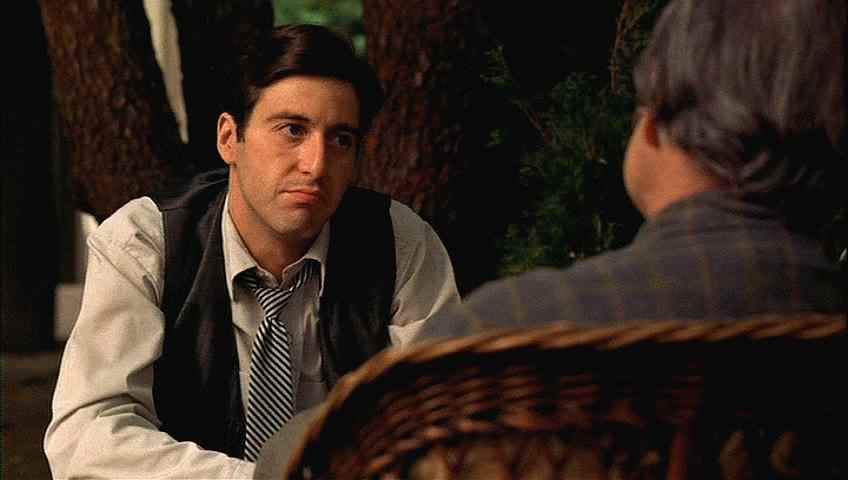
The Set-Up: Michael Corleone (Al Pacino), youngest and most promising of Don Vito Corleone's (Marlon Brando) male children is now "mixed up in the family business" of organized crime, now head of the Corleone Family empire.  The Don, suffering from advanced age and an earlier assassination attempt that changed everyone's lives, is now acting as advisor to his son in a time of explosive transition.

Action.


DISSOLVE TO:

THE DON'S GARDEN
The Don, older looking now, sits with Michael.
VITO CORLEONE So Barzini will move against you first. He'll set up a meeting with someone that you absolutely trust... guaranteeing your safety. And at that meeting, you'll be assassinated.
(as the Don drinks from a glass of wine as Michael watches him)
VITO CORLEONE I like to drink wine more than I used to.
VITO CORLEONE Anyway, I'm drinking more...
MICHAEL It's good for you, Pop.
(after a long pause)
 
VITO CORLEONE I dunno.
VITO CORLEONE Your wife and children. Are you happy with them?
MICHAEL Very happy...
VITO CORLEONE That's good.
(then)
VITO CORLEONE I hope you don't mind the way I...I keep going over this Barzini business...
MICHAEL No, not at all...
VITO CORLEONE It's an old habit.
VITO CORLEONE I spent my life trying not to be careless.
VITO CORLEONE Women and children can be careless, but not men.
(then)
VITO CORLEONE How's your boy?
MICHAEL He's good.
VITO CORLEONE You know he looks more like you every day.
MICHAEL(smiling) He's smarter than I am. Three years old, he can read the funny papers
VITO CORLEONE (laughs) Read the funny papers.
(then)
VITO CORLEONE Oh...well...
VITO CORLEONE ...eh, I want you to arrange to have a telephone man check all the calls that go in and out of here because...
MICHAEL I did it already, Pop.
VITO CORLEONE Ya know, cuz it could be anyone...
MICHAEL Pop, I took care of that.
VITO CORLEONE Oh, that's right. I forgot.
MICHAEL (reaching over, touching his father) What's the matter? What's bothering you?
(after the Don doesn't answer)
MICHAEL I'll handle it. I told you I can handle it, I'll handle it.
VITO CORLEONE(as he stands) I knew that Santino was going to have to go through all this.
VITO CORLEONE And Fredo...well...
(after he sits besides Michael)
VITO CORLEONE Fredo was...well.
VITO CORLEONE But I never...I never wanted this for you.
VITO CORLEONE I work my whole life, I don't apologize, to take care of my family.
VITO CORLEONE And I refused to be a fool...
VITO CORLEONE ...dancing on the string, held by all those...
VITO CORLEONE ...bigshots.
VITO CORLEONE I don't apologize, that's my life but I thought that...that when it was your time that...that you would be the one to hold the strings. Senator Corleone. Governor Corleone, or something...
MICHAEL Another pezzonovante...***
VITO CORLEONE Well...

VITO CORLEONE ...this wasn't enough time, Michael. Wasn't enough time...
MICHAEL We'll get there, Pop.
MICHAEL We'll get there...
VITO CORLEONE Uh...
(after kissing Michael on the cheek)
VITO CORLEONE Now listen. Whoever comes to you with this Barzini meeting –
VITO CORLEONE - he's the traitor. Don't forget that.
DISSOLVE TO:
THE DON'S TOMATO GARDEN – DAY

The Don is with Michael's son, Anthony.
 
The Godfather 
 
Words by Robert Towne (and Mario Puzo and Francis Ford Coppola)
 
Pictures by Gordon Willis and Francis Ford Coppola
 
The Godfather is available on DVD and Blu-Ray from Paramount Home Video.


* Don't remember two?  Probably because the first was cut from the theatrical version. It aired as part of "The Godfather Saga" when Coppola edited I and II chronologically for airing on NBC decades ago.  It was an interesting experiment, and fascinating to see all the "bits" that had been edited for time, the "Novel for Television" mini-series concept having proved that people would watch an extended story over a series of days if it had some value, ala Rich Man, Poor Man and QBVII. But, the chronological presentation destroyed the intricate cross-cutting of Part II, which showed the parallel paths of Godfather and Son, as they made their business paths in the world of organized crime: the one, protecting and solidifying his family; the other, losing it in his bid to "protect."  Despite the fascinating pieces only previously rumored about—the hospital visit to The Don's old consigliere, a visit in old time New York by the Don to a gun-smith named Coppola, whose son Carmine (the director's father and music supervisor for the series) plays a flute in the background, Kay (Diane Keaton) lighting candles for Michael's soul, and Coppola's substituting Robert De Niro's voice for Marlon Brando's during the initial  zoom shot of undertaker Bonasera's request on the Don's wedding day—the shorter theatrical versions feel like more complete films.

** This scene will dissolve to the Don's death scene—itself, something of a miracle in film-making that almost didn't happen. The Don's death was vaguely scripted, not really worked out, and Coppola on the day of filming was running out of time, sun-light and being pressured by studio reps to just forget the scene, rather than risk going beyond Union mandates for the crew. Coppola held fast, and was able to shoot just enough footage to make the scene, one that was totally dependent on the improvisational skills of his star, Marlon Brando, in dealing with the child actor on-set. That scene is haunting, metaphoric, almost miraculous in what it conveys, while being created under pressure.  Astounding craftsmanship on both sides of the camera. 

*** What is Michael saying here? That's a bit controversial. Literally, what he's saying is "pezzo da novanta"—"Another piece of ninety," referring to a 90mm artillery cannon—a "big shot." But, given the context and Pacino's inflection, he's being charitably dismissive of the Don's hopes to attain legitimate power. "Senator Corleone? Governor Corleone?"  "Just another big-shot."