Showing posts sorted by date for query Kurosawa. Sort by relevance Show all posts

Tuesday, September 8, 2026

Update: Now I've Seen Everything Dept.: Wes Anderson

A Young Adult's Guide to Growing Up (Sort of) in the 70's

Wesley Wales Anderson was born in Houston, Texas on May 1, 1969. Anderson began experimenting with writing short plays and making home movies as a child, and continued that interest at the University of Texas, majoring in philosophy. It's there that he met his first of many collaborators, Owen Wilson, and in 1992, the two fashioned a short black and white film called "Bottle Rocket" starring Wilson and his younger brother Luke—they couldn't hire actors, due to the miniscule budget. But, they could submit it to the Sundance Film Festival. And the rest plays out like a particularly amazing after-school special.  Or...one of Anderson's films.


Bottle Rocket (1996) Anderson's first feature came about as a result of producer James L. Brooks seeing the short at Sundance. With Brooks' help and the endorsement of such industry-folk as Polly Platt and L.M. Kit Carson (the film had a role featuring Platt's daughter), Wilson and Anderson expanded the script in a deal to make a feature version for Columbia Pictures. The odd, fully expanded Bottle Rocket not only scored the lowest test scores at previews, but only opened in 42 cities in the U.S., guaranteeing that it wouldn't grab the attention of...anyone.  

The story of two friends, Dignan (Owen Wilson) and Anthony (Luke Wilson), it begins when Dignan helps Anthony leave a psychiatric hospital, where the latter has checked in for "exhaustion." Dig then outlines a "75 year plan" for a criminal career that sounds anything but restful. It's an eccentric "coming of age" scenario where the aimless Anthony must learn to live by the counseling of his "out-on-a-limb" friend, jump-starting his life

The work was strong enough, of its own, that it slowly gained cult-film status through home video, and then, through Hollywood (Martin Scorsese says it's one of the "Top ten" films of the 90's), making Anderson a particularly strong (and obviously eccentric) voice in the independent film culture. 
Anderson's short film on which the feature is based.

The "75 year plan"


Rushmore (1998) If Bottle Rocket seemed a little ambling in nature, Anderson's next film was extraordinarily assured and disciplined. Another collaboration between Owen Wilson and Anderson, it's the story of an under-performing enfant terrible, Max Fischer (Jason Schwartzman, in his film debut), who gets kicked out of his exclusive ivy-league High School and must exist in the uninspiring world of public school. 

Ordinarily, this wouldn't be a problem for Max, as he's less of a student and more of a public institution, putting the "extra" in "extra-curricular," with a Wellesian brio and ego. Max's chutzpah attracts the attention of one of the Ivy-league fathers (Bill Murray), whose own kids, the product of an unhappy marriage, have none of Max's zest. His interest leads him to an affair with the teacher that Max is in love with, Rosemary Cross (Olivia Williams) which further complicates things.

It's a weird hybrid of sources, from Salinger to Schulz, cuisinarted to become a bizarre anti-matter version of The Graduate, and starting to cement Wes Anderson's use of one-point perspective, composed to create a single, central locus, making his frames rectangular black holes to suck in the focus of his viewers. That perspective would start to dominate his work more and more, starting with his next film.
Max (Jason Schwartzmann) in a rebellious phase

The Royal Tenenbaums (2001) An all-star cast (Gene Hackman, Anjelica Huston, Ben Stiller, Gwyneth Paltrow, Danny Glover and, of course, the Wilson brothers and Murray) in another script by Owen Wilson and Anderson. The Tenenbaums are an entirely dysfunctional family of geniuses and savants, who can't seem to overcome their early childhood successes and meet (much less exceed) their potential. They are a family of over-achievers crippled by arrested development.* If there's a strain of J.D. Salinger in Rushmore, The Royal Tenenbaums goes further and feels like the cinematic version of Salinger's "Glass" family.

Father Royal (Hackman) is a con man who decides to return to his family after decades of absenteeism—and, of course, after he's been evicted from his hotel for not paying the rent—only to find that his gifted children are stuck on a treadmill of bad choices, childhood obsessions, and long-held personality ticks. He also is determined to derail the impending nuptials between his wife, Etheline (Huston) and her accountant (Glover).

If the film has a down-side (and it does), it is that the extended Tenenbaums are so zombie-like as to be not very interesting and certainly not as much fun as the "old goat" father is, enhanced by Hackman's gift for wolfish comedy, which is infectiously enjoyable. It's not the other actors' faults, so much as the characters Wilson and Anderson have written for them. Even in a real zombie movie, you don't root for the zombies.
The young Margot and Chas in their little box environments


The Life Aquatic with Steve Zissou (2004) No one's in the comfort zone on this one. Written by Anderson and Noah Baumbach as a satiric tribute to the television documentaries they grew up on, The Life Aquatic... stars Murray as an un-charismatic version of Jacques Cousteau, Anjelica Huston as "the brains of Team Zissou," Willem Dafoe as German crewman Klaus, Cate Blanchett as a brittle reporter covering Zissou's latest documentary, only this time it's personal about the hunting of the "jaguar-shark" that killed Zissou's best friend (Seymour Cassel). Zissou's family is another splinter-group, due to the father's ambivalence towards them, and his own obsessions with himself. Most of the film he spends wondering if the young man who enters his life (Owen Wilson, again) might be the son he never knew. For Zissou, his crew is more his family (with the advantage that he's actually their boss) and even his quest for the shark of myth is a half-baked mission, more in keeping with his role as a self-promoting filmmaker-adventurer than for anything really personal.

Meandering, and a bit off-course much of the time, The Life Aquatic is an acquired taste.
Bill Murray as Steve Zissou, life passing him by.


The Darjeeling Limited (2007) Here's what I wrote in 2007: Wes Anderson is one of those directors who can be really "on" or really "off." Sometimes his movies are merely mordant exercises in quirk, much ado about neurotics. Nothing happens, but people are in a dither for a couple hours. But The Darjeeling Limited is a solid movie that stays on the tracks, if not the beaten path, for its entire length. Oh, people are dithering, alright--there's an especially screwball flashback sequence where the Whitman Brothers (Owen Wilson, Adrien Brody and Jason Schwartzman) are on their way to their father's funeral, and stop off at the garage where Dad was getting his car fixed. The sequence is intricately thought out and such a brilliant example of people desperately finding temporary solutions for long-term problems that one might recall similar family clusters in their own life.

But The Darjeeling Limited is about a close-knit family that's come unraveled—well, exploded in selfishness and separation—and is brought together by the control freak of the bunch (raising suspicion and defensiveness) to take a train trip across India, ostensibly to find their mother, but ultimately to find themselves. Or each other. Or to find a way to work together, rather than cross-purposes (in frequently hilarious ways). What could have been eye-rollingly heart-warming (ala Little Miss Sunshine) becomes intriguing and dramatically interesting, with good performances by the Anderson stock company (Anjelica Huston
, Wilson, Schwartzman, and Bill Murray in a cameo), but also Adrien Brody
 who steps seamlessly into Anderson's off-axis world of vacant stares, and pregnant pauses.
"I'm going to go pray at another thing:"
Schwartzman, Brody, and Wilson still have some healing to do.

Hotel Chevalier (2007) Short film that tied in tangentially with The Darjeeling Limited as Jason Schwartzman's Jack Whitman character hooks up with "the girlfriend" (she's never named and played by Natalie Portman) who inspires the "short story" he wrote in Paris. And, I dunno, but I think she might be "gaslighting" him.


Fantastic Mr. Fox (2009) Anderson experimented with stop-motion animation to create the strange creatures in The Life Aquatic with Steve Zissou, using a technique that's more like the old "Gumby" films, rather than, say, the Rankin-Bass films of his youth.  For his first film adaptation, The Fantastic Mr. Fox, based on a Roald Dahl book (adapted by Anderson and Noah Baumbach), he went full stop-motion animation, planning it out and leaving the filming to a team of animators (supervised first by Henry Selick, then Mark Gustafson) along the lines of the Tim Burton model. 

It might seem like an odd project for Anderson, but Dahl's sensibilities and writing had informed his previous films, like Rushmore, and the way Anderson's directing style was forming, the proscenium arch settings and cracker-box tableaux of Mr. Fox hew right into that one-point perspective he was becoming so enamored with. In fact, stylistically, it's difficult to tell the difference between Fantastic Mr. Fox and his next film.


Moonrise Kingdom (2012) Anderson's sixth feature is a romantic's version of 'the barefoot bandit" story, but without the issues of ego, narcissism, and general public nuisance, and Anderson couches it all in an idiosyncratic format with scrupulous Kubrickian stylistic fluorishes—the measured tracking pace, the hand-held shots of freedom and chaos; the stylized expressionless acting, the structured mise en scene, perfectly balanced on a central fulcrum.  On top of that, it's hilarious, with dialogue that's formal, distinct, played absolutely straight, betraying no irony, delivered in a deadpan lack of elevation.  

Two kids decide to run away from their structured environments: Suzy (Kara Hayward), from her shattering family (parented by Bill Murray and Frances McDormand; Sam (Jared Gilman) from his Boy Scout troop (led by Edward Norton).  They run off into the wild, trying to escape the various search parties trying to find them, and the local police (led by Bruce Willis).  

Presented as if a documentary by Bob Balaban, Moonrise Kingdom is fun, odd, and rebellious in Anderson's over-stated understated fashion.

This shot still cracks me up: "Jiminy Cricket, he flew the coop!"

The Grand Budapest Hotel (2014) Anderson's 7th feature is as light as a soufflé and as multilayered as one of those perfect "Mendl's pastries" that are featured in the film. Anderson mixes past and future, starting in the present and going back in time with an ever-constricting aspect ratio in order to tell the tale of how a lobby-boy named Zero (Tony Revolori) came to own the Grand Budapest Hotel ("the last faint glimmer of civilization in this barbaric slaughterhouse that was once known as humanity") set in the country of Zubrowka —as related in 1968 by the elder Zero (F. Murray Abraham) to the author (Jude Law), who would write the history of the hotel in 1986 (as Tom Wilkinson). It's a complex tale involving the hey-day of the Hotel in pre-War 1932, when the wily concierge M. Gustave (Ralph Fiennes) purloined a precious painting and was subsequently accused of murder and spent time in prison. It's a combination of playhouse miniatures, meticulous full-scale hotel interiors, and sequences of cartoonish manic energy that leave one a little breathless.


Isle of Dogs (aka çŠ¬ãƒ¶å³¶, 2016) Anderson returns to stop-motion animation with a different aesthetic: combining Kurosawa with the feel of the Rankin/Bass holiday specials from the 1960's that he loves. Telling the story of how a corrupt bureaucracy can oppress an entire sub-set of life by manufacturing a crisis, the film focuses on Japan's dog population being sequestered to "Trash Island" after an outbreak of "Snout Fever" and then allowed to be forgotten, one can see all sorts of real-world metaphors being applicable for penalization, segregation and ostracism. The human species if all-too capable of all that. But, Anderson makes the film a lot more sophisticated in graphic detail and story-telling technique giving the film a mixed-media vibe far beyond what he has displayed in the past. For someone so enamored of the one-point perspective, he seems to be extending his technique by not moving the camera, as filling it in interesting ways beyond its point of view. 
 

The French Dispatch (of the Liberty, Kansas Evening Sun) (2020) Anderson's eighth film is a magazine format film about a magazine—the fictitious French Dispatch of the Liberty, Kansas Sun (any resemblance to The New Yorker are purely reverential. The product of its editor's extended holiday in the city of Ennui-sur-Blasé (where he chose to stay),The French Dispatch is a magazine of higher tastes about the local scene with accomplished writers holding forth and making "something" of the city's day-to-day.
 
The film is an omnibus of the publication's final issue following the death of its publisher Arthur Horowitz, Jr. (Bill Murray). No more publication would be forthcoming and all subscriptions to future issues would be re-funded. That issue contains an obituary of Horowitz, the standard bicycle tour of Herbsaint Sazerac (Owen Wilson) and three stories of particular note from the magazine's past: "The Concrete Masterpiece"—about an insane murderer's (Benicio Del Toro) unlikely rise in the art field (as related by art historian J.K.L. Berenson (Tilda Swinton); "Revisions to a Manifesto" the work of Lucinda Krementz (Frances McDormand) in which she struggles with her objectivity in covering a youth revolt called "The Chess Revolution"; and "The Private Dining Room of the Police Commissioner" by noted author Roebuck Wright (Jeffrey Wright) on the singular events surrounding his invitation to review the exquisite meals served to city's Police Commissioner (Mathieu Almaric), where a kidnapping is served as just desserts.
 
Fast-paced, with a consistent obliteration of "The Fourth Wall" The French Dispatch might well be called "Keaton-esque" in its dead-pan delivery amongst the frantic goings-on screen-wise. Many cinematic tricks and playing with "the form" but one is advised to see it on as big a screen as possible as the sub-titles are rather small and delicate. 


Asteroid City
(2023) The story of the first contact of humans and aliens isn't nearly as life-changing as most experts think, as the precedent is the concerns of a couple dozen people quarantined at the "Junior Stargazer/Space Cadet" convention at the tourist-trap town near the Arid Springs Meteorite impact crater. The concerns are a government-imposed quarantine, the contest for the kids at the convention, the usual conflicts of disparate people thrown together where kids are concerned and where the chance of romance blooms even in the desert.

Anderson tells that story, but he stages it as the documentary presentation of an arts program (in square TV format) about the creation and subsequent production of the last play of a playwright named Conrad Earp (Edward Norton). Jason Schwartzman leads the voluminous cast which, when it's not told from the point of view of the television series is in severe widescreen tinted in the bleached colors of long-in-sun post-card. Anderson stretches the production until it's so tight it threatens to snap an audience's attention, but it's dead-pan humor and constant fancifulness keeps the things afloat.
 
The Wonderful World of Henry Sugar and Three More 
(2023) Anderson was a huge fan of Dahl's writing (He did an adaptation of The Fantastic Mr. Fox), and he wanted to do more, but when he signed on to this he didn't know it would be consigned to Netflix (who bought The Roald Dahl Story Company for 686 million smackers), rather than theaters (or maybe he hoped they'd be less stingy about theatrical releases). But no, the four short films, "The Wonderful Story of Henry Sugar," "The Swan," "Poison", and "The Ratcatcher" debuted on the streaming channel, presenting itself (under Anderson's supervision) as short films that had originally appeared on the fictional British Channel 7 in 1978.
 
Anderson completely throws out trying for filmic verisimilitude, presenting the films as seemingly "live" presentations with disappearing sets, visible stagehands, and a fourth-wall-breaking aesthetic, making the settings exoticly claustrophobic neverlands that don't distract from the stories, but act as their own little "bubble-worlds". The cast, Benedict Cumberbatch, Ben Kingsley, Rupert Friend, Ralph Fiennes, Dev Patel, and Richard Ayoade in differing roles much like frequent anthology series guest-stars. A couple are better than others, but blame the stories, not Anderson's inventiveness.
      
 
The Phoenician Scheme
(2025) A dense little puzzle-box of a movie (reminiscent of Orson Welles' Mr. Arkadin) set in the 1950's, of an unscrupulously wealthy man, Anatole "Zsa Zsa" Korda (Benicio del Toro), who, upon surviving the latest in a series of assassination attempts, embarks on one Last Grand Scheme, a business deal of such impact that it will outshine his past mis-deeds and money-grabs as His Legacy. At the same time, it gives him a chance to take stock of his life, try to mend fences with people estranged from him, and maybe find who...or what...is trying to kill him (and if they had anything to do with the death of his last wife).
 
This one is as dense as can be—I can't help wondering if Anderson and his co-writer Roman Coppola had the chock-a-block "strange-bedfellows" approach to movie financing when they conceived it—with a dizzying number of Anderson alums stopping by for cameos, and locales...one of which is a Powellian black-and-white Heaven (Bill Murray, of course, plays God).
 
del Toro has the herculean burden of the lead player, but mention must be made of his two co-horts in his quest for funds, Michael Cera, and Mia Threapleton, who plays his daughter, a Catholic novice. New to Anderson's major-miniature world, they fit in like they'd always been there.


Wes Anderson // Centered from kogonada on Vimeo.


* Mitch Hurvitz, created his "Arrested Development" series before The Royal Tenenbaums and almost abandoned it, after seeing Anderson's film.

Sunday, February 23, 2025

Underworld U.S.A.

Saturday is traditionally "Take Out the Trash" Day, even when the trash is pretty damn good, like this pulpy one by maverick director Sam Fuller.

Underworld U.S.A.
(Samuel Fuller
, 1961) A Saturday Evening Post serial about organized crime during the 1930's was the source material for this pot-boiler that had gotten Humphrey Bogart's interest as a project. But Bogart died of cancer in 1957, and Columbia still had the property on their hands.
 
By this time, the Hays Code was dying a deserved death and the mobsters and racketeers, that had been pretty much hush-hushed by the movies since they'd caused hissy-fits among the pearl-clutchers in the 1930's, were making their way back to the screens. Billy Wilder even used them in his comedy Some Like It Hot in 1959! So, with the Hays hand-cuffs taken off, Columbia looked to see if they could toss out their own mob movie, and they latched onto one of the movie's most exploitative fire-brands, Samuel Fuller, who took one look at the material and tossed out the time-frame. There were mobsters making a lot of coin NOW! And some of them gave off the stink of legitimacy, so why treat it as something as quaint and antiquated as a buggy-whip? Fuller was proposing a tale of the Mafia violently opposing a prostitute's union, but Columbia rejected the idea. The Hays Code may have been crippled and toothless, but you still couldn't go too far in pushing the plain-brown envelope.
Fuller's next idea was of a kid making his way through the ranks of organized crime to avenge the murder of his father which he witnessed when he was a punk kid of 14. He swears revenge, and growing older, he moves from rolling drunks to break-in and robbery. Oh. And the kid, named Tolly Devlin, goes from being played by
David Kent to Cliff Robertson.
And with his meager lone-wolf means, he gets wind that one of the guys—the guy whose name he knows—Vic Farrar (Peter Brocco) is dying in prison. Tolly wants to help the old guy along, but how to get to a guy in in the joint? Never one to think too elaborately, Tolly decides to be just a little sloppy on a safe-job, gets caught in the act and winds up in the same prison with Farrar. He becomes a good enough trustee that he talks his way into being an assistant to the prison saw-bones and before long it's curtains for Vic Farrar, but not before he gets the names of the other guys who killed his father. Being a safe-cracker, the one thing Tolly has is patience.
One down. Three to go. Tolly's good behavior (despite his secret extra-curricular activities) gets him parole and, with a new suit, and new set of targets, he goes to the only home he has, the one owned by Sandy (
Beatrice Kay), who used to run a gin-mill until she was bought out by a thug named Gela (Paul Dubov), who, under the guise of cleaning up the town of booze-halls has turned them into "coffee shops" serving java in the front...and heroin in the back. Sandy tells Tolly the whole sad story, and he recognizes the names Farrar mentioned of all the thugs who murdered his Dad: Gela, the dope king; Gunther (Gerald Milton) the crooked labor leader, and Smith (Allan Gruener), who runs prostitution. Now, he's got faces to the names—they all have respectable business fronts—and Sandy warns him that they're better protected than the President of the United States.
 Gela, Gunther, and Smith
Well, if you can't beat up, join 'em—that way you can mingle with the muscle protecting the mob. He breaks into Gela's main "coffee shop," "The Elite Espresso"—the one Sandy used to own—and cracks the combination of the safe he used to practice on when he was a kid. He's interrupted by one of Gela's gun-men, Gus (Richard Rust), who's using one of Smith's girls to make a heroin delivery. Her name's "Cuddles" (Dolores Dorn) and before the gunsel can follow orders and kill her for welching, Tolly clocks him over the head and he and the girl make a clean getaway with the key to the stash.
"Cuddles"
Tolly tells her he's a narcotics cop and gets her to show him where the "junk" is—so he'll "go easy" on her—then steals it so he can use it to get to Gela and takes her back to Sandy's place for safe-keeping. Despite Sandy's misgivings, he sets up a meeting with this Gus hoodlum to extort 50k from Gela to get his own drugs back. It's a meeting that doesn't start well at first, with Tolly getting a gun put to his temple, but it does get him in the same room with Gela, where he tells the dope king that he was trying to find the killers of his father, but spins a story that Farrar told him all those hoods died. Them he makes a big show of giving the heroin back for nothing...because Gela and his Dad were such good pals. Gela hires him as a bag man—supervised, of course—because Gela ruefully admits he's a sentimental slob.
So, Tolly's inside, trying to worm his way through the organization to find the weak spots. Cuddles tells him how she saw Smith kill a girl once and he decides to make a fast move to get one of his Dad's killers out of the way. He calls John Driscoll
(Larry Gates) Chief Counsel for the Federal Crime Commission that is trying to take down the mob troika and their big boss Earl Connors (Robert Emhardt), who runs his own front with the generic name of National Projects. Driscoll gets a promise from Cuddles to testify against the guy, and suddenly there are two out of the way.
Newspaperman Fuller's way of disposing of the mob—banner headlines!!
What's going on here is writer-director Fuller's version of Yojimbo, Akira Kurosawa's samurai transfiguration of Dashiell Hammett's story "Red Harvest"—just as Yojimbo would be transported to the Western genre as A Fistful of Dollars—where a lone operative finagles his way into the confidences of rival gangs, and, in so doing, pits them against each other. Here he turns the mobsters into setting onto themselves because "there's no honor among thieves" but with the added wrinkle that he's also working for Driscoll—unbeknownst to the Mob—with a clandestine way of lighting fuses, playing everybody against each other...but leaving himself untouched. He's his own man, does things "my own way" and he's just manipulating both groups to get his revenge faster and more completely. It's a lovely distillation of Hammett, while coming out the same year as Kurosawa's version.
"Suckers..." he says
He'd done something like it with his Pickup on South Street, a movie so cynical about ideals that it even hacked off J. Edgar Hoover. Fuller who both wrote and directed Underworld U.S.A. always was a firebrand—he started his career as a newspaperman on a crime beat—and loved speaking truth to power and he has a cackling good time with "the Fed", Driscoll, in an exposition-dump scene that compares the mob to as respected an American institution as the U.S. Armed Forces with its ranks and divisions and chiefs of staff—"Top Brass" he calls them—doing The Godfather one better painting Organized Crime as American as Big Business Apple Pie and doing it ten years earlier.* 
But, Fuller isn't so radical that he can't choose sides among the riff-raff. His mobsters can lay no claim to being colorfully romantic as in The Godfather series and they're 180° from heroes. They're out trolling schools and using their recreational programs for getting kids addicted and girls into prostitution. At one point, the head-boss Connors, instead of addressing a recent screw-up, berates his heads that their numbers are down and he gives a pep-talk out of a nightmare: "There's 13 million kids between the ages of 10 and 15. Don't tell me the end of a needle has a conscience. Put more field men to work around the schools. We'll always be strong as long as we're tough."
It's over the top drama (Fuller is not a subtle man—the score's major motif is based on "Aud Lang Syne" as in "should auld acquaintance be forgot"), but also a little heart-pumping how much energy the film enjoys on a miniscule budget. And, although Fuller may cut-away from the violence, he does spare you the gory details, setting up mob-hits on the young daughters of snitches, setting a live guy on fire in his car, and a constant trail of broken people being exploited for money by guys in good suits. Fuller takes his outrage and takes it out on us, not holding back because he was never one for sugar-coating. But giving it to you straight and no chaser, except to make it entertaining and not a lecture.
I'm getting to the end of seeing everything in Fuller's lengthy career. And I gotta tell you, I'm going to miss the shocks and surprises.

* Funny enough, Fuller auditioned for the part of Hyman Roth in The Godfather Part II for Coppola before securing Lee Strasberg for the role.

Saturday, February 22, 2025

The Brutalist

A Hell-hole of His Own Design
or
"I Just Don't Appreciate It. I Cherish It"
 
These days get me down.

Brady Corbet 's The Brutalist (made for an incredibly modest $10 million) comes with all the showmanship brio of those old "roadshow" films of the 1950's and 1960's, back in the day before the trend today where every movie became its own sole inhabitor of a given theater's screen...when movies openly defied the "bargain-prices-for-the-masses" concepts of the now-extinct double-bill for the self-proclaimed "importance" of the single solitary roadshow attraction. Those "big, important" presentations did not survive the decade of the 1960's when the more independent and youth-oriented...and cheaper...films (which defied the portentousness ambitions of their more gaudy studio products) took over both screens and audiences' interests. The Brutalist has the ambitions and trappings of those roadshow attractions: VistaVision photography, an Overture (all 30 seconds of it, really) and an intermission at the 2/3rd mark to give you a recess to escape during its 3½ hour length.
Not that it's really needed. The Brutalist moves along at a quick, if somewhat trance-like pace, but without any of the sweep that you'd expect in the blockbuster format. And that intermission comes at a time when there is an interruption of the story-line—a work-project is stopped—and the film takes up a few years later after everyone has moved on and must once again begin the project after law-suits are settled. A less time-consuming interstitial or an added narration might have been enough to impart that information, but I guess the filmmakers wanted to impart the sense of time being wasted...The Brutalist began production in 2018 and didn't start photography until March 2021 and was delayed by the pandemic until further work in 2023. An intermission probably felt organic to the process.
But, it isn't, really. It just marks the demarcation point where the movie starts to unravel. The "Part 1" of the film--and, yes, it has "chapters"--"The Enigma of Arrival" sees the arrival of László Tóth (Adrien Brody), a Polish architect, who has barely survived the Holocaust and arrives in post-war New York, ahead of his wife Erzsébet (Felicity Jones) and niece Zsófia (Raffey Cassidy), to do what so many refugees and migrants have done—try to make a new life for themselves after leaving a life with little prospects. At this point, Corbet is happy to provide every detail in his story-telling and make some bold choices doing so. Toth's arrival in New York—when he finally is able to emerge from the dark hold of the ship and into the sunlight—is highlighted by his first glimpse  of the Statue of Liberty—but Corbet presents it to us upside-down, as if we were looking back at it from behind. This might have been just for practical purposes—you shoot up at Lady Liberty so you don't have to show the New York skyline, which looked very different in 1946 than it did at the time of filming.* It also says something, vaguely (if one is looking for such things) about the Ancestry.com fairy-tales of immigrants braving the unknown to "make a better life" for themselves than what they would find on their home-soil.
But, The Brutalist takes those stories that have become so familiar on "Finding Your Roots" and turns it—like the Statue of Liberty—on its head. Ship's manifests and census records can tell you the "when" of things, but not the "how" of things—of prejudice by the already-established immigrants (all of them being immigrants, ironically, except for the indigenous tribes and there was a "final solution" reserved for them, as well), of huddled masses forced into "Little" communities of slums, and of hard-scrabble existences, supposedly based of hard work and fortitude, but mostly based on dumb, stupid luck and the seizing of opportunity. And will, a basic will to survive.
The Brutalist rubs your broken nose in it. Toth is initially welcomed in Philadelphia by his cousin, Attila (
Alessandro Nivola) who runs an established design-furniture store, Miller and Sons, and takes him in, hiring him for his design-work and giving him a little room in the back of the storeroom. The cousin has assimilated ("Who's Miller?" "Me" Who are the sons?" There aren't any"), changed his name, become Catholic, married a shiksa wife (Emma Laird) and she is less than pleased with the arrangement. An initial job to design a modernist chair for the store-window produces a tube-dominant functional design that would hardly attract customers.
But, the company gets a commission—the children (
Joe Alwyn, Stacy Martin)of a rich businessman, Harrison Lee Van Buren, Sr. (Guy Pearce), want a library constructed in his mansion while he is tending to his ailing mother. The job has its challenges—the desired location is all vaulted windows letting in sunlight that could fade the valuable first editions. What to do? Toth has a solution and it is a bold one.
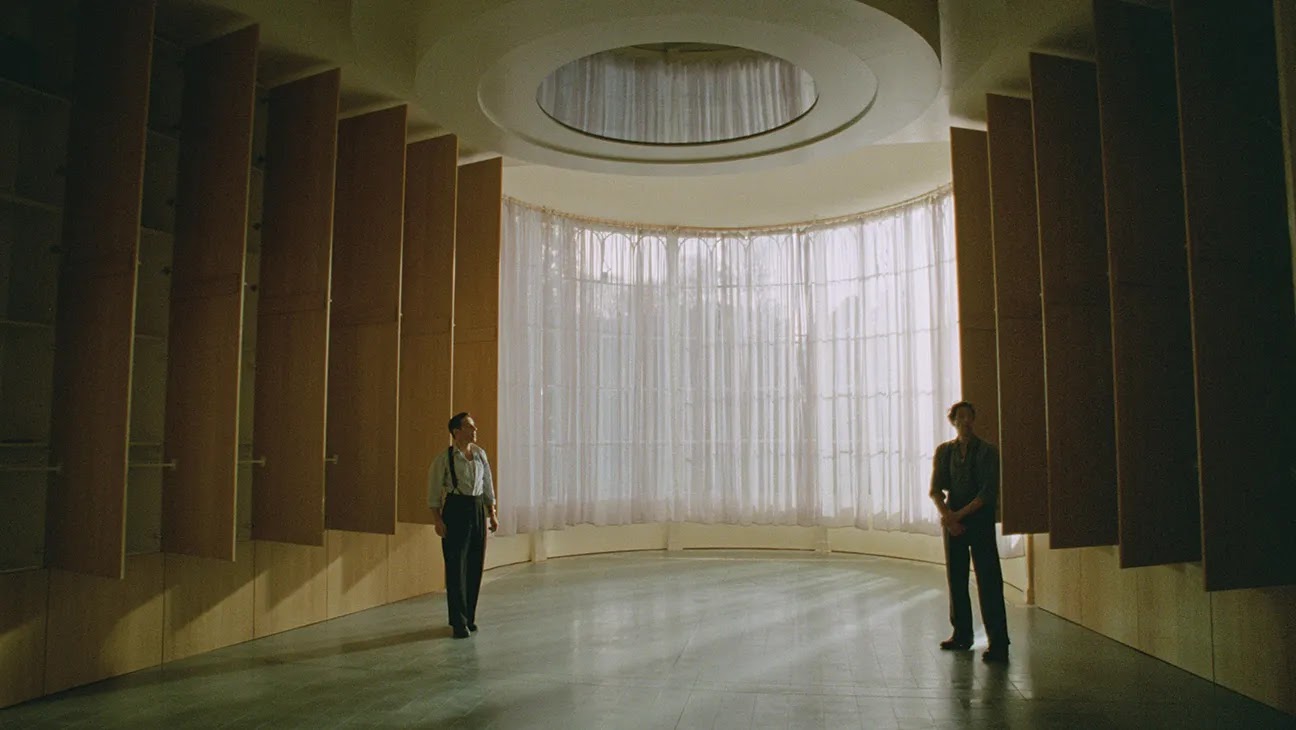
Keep the windows. Protect the books. Cantilevered doors hide the shelves and their precious burdens. But when Van Buren the Elder comes back, he isn't pleased ("I don't like surprises!"—Pearce, here, is at his foaming, berzerker best) because there's a BLACK man (one of the workers) in his drive-way, everything's different and his Mother's in the car. Get OUT! Get OUT NOW! No explanation is heard or good enough. "Miller and Sons" doesn't get paid for the commission. They have to pay the expenses. They'll be lucky if they're not sued. So, "of course", cousin 
László gets sacked by his own cousin. The assimilation gets set back a few years...if it was ever going to happen at all.
The Brutalist has a pace, but it's a herky-jerky one, sort of like the phrase a friend reminded me of the other day: "The days go slow, but the years go quick." Flash forward three years. László is a laborer shoveling coal, living in a charity house, addicted to heroin, his only friend is Gordon (Isaach De Bankolé) a single father also down on his luck—he was the guy seen in the driveway that Van Buren was so incensed about—working at the same facility. Then, one day Van Buren the Elder shows up at his work, invites him to lunch, and tells him a story.
At lunch, he shows Toth an article in an architectural magazine, extolling Van Buren and the library's aesthetic, and the magnate has done some digging, found out the name of the man who created the masterpiece he now owns and for which he, the owner, has been lauded. He's researched him, discovered the architectural work he did in Europe before the war, and...pays him for the work he did on the library. Toth's work has made Van Buren an exemplar of an aesthetic—even if he didn't know the name of the man who designed it or anything about why the fuss being made about his library—and he invites him to a dinner the next night so he can meet his society's circle and maybe...how he can be used in the future. Toth celebrates by taking the money and buying heroin.
At the dinner, Toth is fêted by the Van Burens, where he is treated as an honored guest and treated with an air of "your not one of us but we like what you do." He meets Van Burens' lawyer, the only other Jew at the table, who offers his work to try and patriate
Erzsébet and Zsófia out of Eastern Europe to America. And something else. The next day, Van Buren tells him of "a vision" he wants him to design and build. "Something boundless. Something new." There's a site on the highest point of his property overlooking the village of Doylesville, where he wants to build a tribute to his late Mother, a center consisting of a gymnasium, a library, a gathering center...oh, and per Doylesville request...a chapel. A Protestant chapel. Toth, thinks Van Buren—still aglow from his reflected light of Toth's work—is obviously the man for the job.
Maybe he is, but he's certainly the most handy. And, given Van Buren's patronage, if not sponsorship, he's the one who can achieve Van Buren's "vision." But, first, Toth needs to get his own vision approved, which is where Van Buren, who pulls a lot of strings, is at his most useful—besides funding the project.
And why shouldn't he fund it? It's a Van Buren version of a Pyramid, the grandest tombstone his mother—and probably any member of the Van Buren family could have. Toth's designs are different, large, blocky made of concrete and though not really brutalist in design, the brutalist school was very influential in the production of
government buildings and slums—and prisons. But a prominent negative-space crucifix atop it seems to reassure the doubters. The rest of the movie is of Toth's struggles—and they are constant—in trying to keep the integrity of his design (despite middle-men, budget-cuts, capricious "second-thoughts") in a Sissyphussian environment of anti-semitism, xenophobia, and just plain interference for interference's sake.
It's an example of that disease that suffuses American business (and I suppose any business), "office politics." For whatever reasons, egos clash, contrariness becomes the norm and the "Bad CEO" lords over the chaos, letting it happen, because he likes people "doing their jobs" even if it's at cross-purposes ("Leslie is a bastard." "Yes, he is. That's what we pay him for."). Toth tries to negotiate the madness, maintaining his vision of Van Buren's vision, and retreating into heroin when the pain becomes unbearable. Watching it unfold is like being a functionary at a terrible job at a terrible company, choking on its own cholesterol-like dysfunction.
And the building itself, the "Van Buren Institute", that great Pyramid to an industrialist's vain-glory? We never really get to see it. What we get to see are empty corridors and walk-ways, a vast inner chamber at its core, seemingly a shell of a building housing mazes and catacombs that a despondent man can get lost in and die. We never really get to see its scope or the wonders that might have impressed and inspired in the first place. It's a big vacuum in the center of the movie that might have done more than provide ambiguity. It's a "commission," nothing more. An idea, unrealized, at least in terms of the movie.
If that wasn't frustrating enough, the movie has a coda. It's 1980 and Toth is elderly, in a wheelchair, attending another 
fête, a retrospective of his work, and, because he is too weak to speak, his niece speaks for him, and says something that hit me with a thud and make me bitterly leave the theater, questioning the writers and if they knew what they were writing.
"Don't let anyone fool you, Zsófia" he would say to me as a struggling young mother raising my daughter during our first years in Jerusalem, "no matter what the others try and sell you, it is the destination, not the journey."** 
 
Well, that's just bullshit. Only an artist—be they architect or a manipulative director—an entrepreneur or politician (with visions of dictatorship dancing in their heads) can go along with that "the ends justify the means" thinking. Human experience informs us, changes us, manipulates our thoughts and our ideas. Often it is the journey—not the destination—that is important (Erzsébet after coming to America says this: "This place is rotten. The landscape, the food we eat. This whole country is rotten."). Yes, it's good to have goals. But, what do you have to become to achieve them? Is it worth getting what you want by—where you want— by sacrificing everything but the dream?
 
The sportscaster Red Barber had a wonderful rejoinder for the old "whoever has the most toys, wins" mind-set: "God doesn't count the toys. He counts the scars."
But, the edifice will excuse it all. After all, people still flock to the Pyramids; nobody cares what kinds of horrors inspired them or carried them out. Our Edifice Complex negates all that. Why (he says sarcastically) maybe the slavery was worth it, Ozymandias...
 
Tell that to the wrecking ball.
This piece has taken me forever to write—despite "The Last Word" at the bottom of the page I do not always find writing bad reviews "fun"—and I've been listening to and reading rave reviews for this film, trying to understand what they're seeing that I'm not. All I can conclude is that the framing, cinematography, and acting (all of which are quite good) have overwhelmed any critical thinking about content. "Style over substance".*** "Miller and Sons." That old trick. But not for me.
 
I like ambiguity. I cherish it in movies if it's not a stunt (as Hollywood so often makes it). You can even be vague about things. But, The Brutalist asks questions that it doesn't bother to answer, nor does it seem to care, as if a point of view was something beneath it to attempt. I shouldn't have to divine what it's attempting to say (if anything). It should be there on the screen so that I can share the artist's thoughts. That's the very basis of communication and the DNA of film. But, Corbet's film tries so hard not to tell a story, or to advocate for anything, other than that life, even a life devoted to your craft, is misery. In the end, The Brutalist is neither inspirational or aspirational. As such, as a work of art...it is useless.
I wouldn't be at all surprised if this wins the Oscar for Best Picture.
 
These days get me down.

* I've always loved the story Sidney Lumet tells—in his book "Making Movies" (©1995, Vintage Press)—of meeting his hero, director Akira Kurosawa, and asking him why he had framed one particular shot in Ran the way he did and the Japanese Master told him that if he'd panned the camera one inch to the left, the Sony building would have been visible and one inch to the right, an airport, neither of which were appropriate to a samurai movie. It's not all inspiration and artistic intent.
 
** Here's the thing—not even Toth believes that, if we're to believe the screenplay. If he had, why then would his time at Buchenwald inspire the dimensions of the Van Buren Institute (in the same speech, his niece says this: "The building referenced his time at Buchenwald as well as the deeply felt absence of his wife, my Aunt Erzsébet. For this project, he re-imagined the camp's claustrophobic interior cells with precisely the same dimensions as his own place of imprisonment, save for one electrifying exception; when visitors looked 20 meters upwards, the dramatic heights of the glass above them invited free thought; freedom of identity. He further re-imagined Buchenwald and his wife's venue of imprisonment in Dachau on the same grounds, connected by a myriad of secret corridors re-writing their history and transcending space and time so that he and Erzsébet would never be apart again.") So...in other words...his journey through the war years inspired the destination. Or is the niece putting words in the mouth of the elderly Toth, for his benefit to burnish his image, and so is she also a part of the same self-aggrandizement as, say, the nefarious benefactor Van Buren? Is everybody in this movie corrupt?
 
*** I'm reminded of the story Jerry Lewis told about Stanley Kubrick, who was wandering around during the days of making 2001: a Space Odyssey while Lewis was struggling to edit his abortive The Day the Clown Cried. Kubrick was sitting in the back of the editing room just hanging out, taking it all in when Lewis said over a particularly frustrating "cut," "That's it! You can't polish a turd!" To which Kubrick responded (after a thoughtful pause): "You can if you freeze it..."