Showing posts with label Zack Gailifinakis. Show all posts

Wednesday, August 8, 2018

Up in the Air

The Economy and how it grinds up people has been on my mind of late. Here are some movies I've written about in that subject matter. 

Written at the time of the film's release.

"Passing Over"

Down in the lower right hand corner of this review (and every review on BXC) there's a space for meta-data to help readers find similar personnel, year of release, director, major stars—basically general stuff.

But I also like to put the genre of where the film would fit, say, at the video store—nothing too specific.
Jason Reitman's new film Up in the Air is the first one to have me stumped. I lean towards "drama," but it's too clever and funny to meet that description. It's not a "comedy" as it deals with pain and contemporary issues that most comedies (most modern comedies, at least) steer clear of—although it's tempting to say that it's a "Judd Apatow comedy" for adults, taking on his basic "growing up" arc, but with a more mature, melancholy overtone. Yet it made me laugh out loud fairly regularly. And it made me think of what a sorry mess we're in.

Ryan Bingham (George Clooney) is a corporate hit-man for hire. His company (run by a tight-smiled cut-throat Jason Bateman) provides a termination service for struggling companies. Bingham flies to the home-offices and fires the people the weasley exec's are too cowardly to break the news to face-to-face. And business is booming.

"This is the biggest financial melt-down in our nation's history" crows Bateman's CEO. "This is our moment." And to make the most of it, he's hired a new 23 year old tyro named Natalie Keener
(
Anna Kendrick, who gets perpetually lost in the lunch-room in the "Twilight" movies*), who hopes to streamline the down-sizing process by doing it over the internet, rather than in person.
This throws the well-managed world of Bingham into a tizzy. No more frequent flier miles which he collects like office-absconded paper-clips. No more stipends and luxury cars for hire, and platinum service lounges. He'll be flying coach rather than first-class. Worse than that, he'll be stuck in a cubicle going nowhere, considerably worse than coach.
Not only will he have to get his own drinks, he may have to get a life. Bingham is in a groove, as personal and as transitory as the swipe of a card-reader. He is constantly between Point A and Point B and prides himself on finding the most efficient route. His life is reduced to a minimum of baggage—carry-on's with wheels that don't squeak, a packing ritual as choreographed as a Fosse number down to the split-second, and little contact with family. He knows the airport routine cold. And as a sideline, he gives lectures on travelling efficiently in the air and in life. "Our attachments weigh us down," he intones to his conference rooms of drones. "The slower we move, the faster we die. Make no mistake, moving is living. We are not monogamous swans. We are sharks."
Clooney's in full smug mode—a variation of his divorce attorney Miles Massey from Intolerable Cruelty played straight—he practically marches to the beat of "Come Fly With Me" and his smile is as practiced and measured as his patter...with everyone, business associates and family. His character has a part to play and when the show's over, it's "me" time, like the "James Bond" fantasy of living the high life while doing dirty jobs. Everything is first-class and preferred customer, his one goal being a targeted accumulation of miles over a life-time—his own personal best. He has an apartment, but he's never in it and it has the same empty utilitarian ambiance of a Ramada Suite. He's the personification of "fly-by-night" in slip-off shoes.

So are his relationships, such as they are. At the same time that he is forced to show Natalie "the ropes" of the "down-sizing" business, he's established a "ships that pass in the night" fling with fellow traveller Alex Goran (Vera Farmiga, finally getting a role that has more heft than "girlfriend"). Natalie, who probably has a Power-Point presentation for how her life is going to go ("I should be driving an Explorer by 23"), is horrified at the casualness of it all. She's just out of the starting blocks and doesn't know the pit-falls of the track ahead, with all the confidence and brashness of someone who doesn't know what she doesn't know, and how theory reacts when it collides with reality. It's a crash-course in transitioning, on the job and in real life, and the two veterans try to bring the kid down easy—at least to get her to remember to lock her wheels.
There'll I'll leave it, for to tell too much will ruin it. But I admire any movie that acknowledges the mature adult, that attempts to show that a life is segmented, complicated and compromised, where dreams could come true, but mostly don't, where decency is its own reward and the idea of "soul-mates" is a lot of hooey. A lot of hooey to sell soap.

And movies.

Jason Reitman grew up in movies—his father is Ivan Reitman—and with his first three films (the others being Thank You for Smoking and Juno) he has shown himself all too willing to throw sabo's into the gears of the Hollywood Dream Factory,** making contemporary movies of stylish form about tough choices and compromised principles in today's America, while still keeping them highly entertaining and unpretentious. One hopes he can sustain that promise and not flirt with issues of the elite, as so many of his peers have in the past, and buy into the fairy tale myth of mainstream Hollywood.

One hopes he can keep his feet on the ground.

* Kendrick is great, no doubt about it, but one hears a whine of feed-back in the false amplification of her performance. It is nuanced and studied, alright, and just a tinge robotic. The joy in the performance is watching the gears seize, the plugs mis-fire, and the LED's in her eyes dim. It's like watching a puppet turn into a real live girl. But she doesn't blow the other stars away, or "steal the movie." There's just a whiff of Dream Factory hype in this talk. As long as it stays in the publicity and stays off the screen, I'm all for it.

** If you do want an unequivocal happy ending and an example of dreams coming true, stay to the end of the movie. Reitman is a very generous man. And the song manages to perfectly distill the movie.

Friday, June 8, 2018

Disney's The Muppets

One for the kids...written at the time of the film's release.


"Of Muppets and Meat-Puppets"
or
"Old Feelings Being Felt"

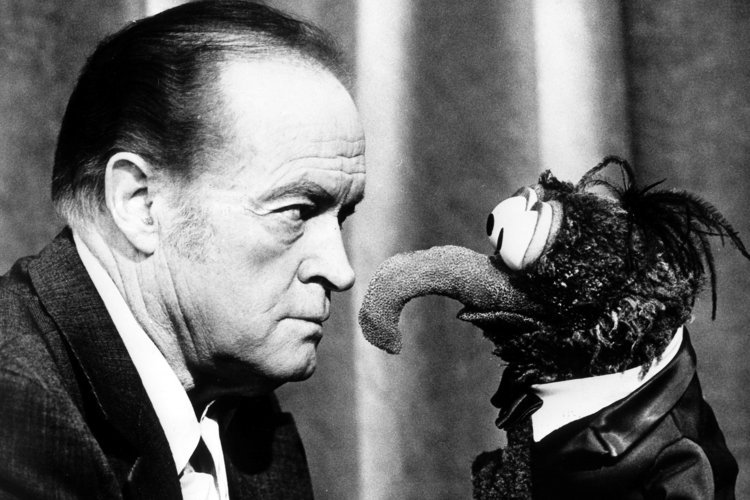
Back in the 1980's Lord Lew Grade made a ton of green with the syndicated "The Muppet Show," which took Jim Henson's cast of characters and had them stage a show in an abandoned theater every week, with practically every bi-ped celebrity host imaginable, ranging anywhere from Bob Hope to Johnny Cash, with the only possible exception being that of Steve Jobs.

Now it's the 2010's and (as the joke goes) not only do we have no Jobs, but no Cash and no Hope. But, at least we have legs. Pity the poor Muppets; they can't stand straight without somebody's arm supporting them!  Subsequently falling on hard times, with the prospect of their old theater being acquired and demolished for mineral rights by a greedy oil cowboy named Tex Richman (Chris Cooper, once again channeling his inner Shrub), Kermit the Frog (Steve Whitmire) must get the gang together to try and save the theater and protect the very integrity of the name "Muppet."  He has unlikely allies—Gary (SNL's Jason Segel, who co-wrote the hyper-joked, "fourth" wall-exploding screenplay with Nicholas Stoller) and Mary (Amy Adams, who is as goofily inspired in this as she was in Disney's Enchanted), who get mixed up in the plan because of Gary's devotion to his brother Walter (Peter Linz), who was born...a muppet.
Okay, okay, already the movie is straying into terri-story that has some under-pinnings of life-lessons to them.  Plug "muppet" into the "Mad-Libs" space where "developmental challenge" or "specified minority" would go, and you have a nicely anarchic spin to the usual "inspiring" story that...well, a studio like Disney likes to make every now and again. But, Disney always does best when it thinks "outside of the castle" and by re-tooling the Muppets for 21st Century kids* (and their parents who watched them in the 1980's), using Segel and Stoller's less-than-respectful approach to Muppets, mores and movies, a slightly hipper slew of cameos, and the musical supervision of Bret McKenzie (the part of "Flight of the Conchords" that is not Jemaine, and the songs are instantly identifiable as "Conchord" material), it has managed to breath new life into the franchise, while maintaining the integrity of the characters...and Henson's basic art-concepts of marionette-puppetry without resorting to CGI cheating. It's like watching a favorite performer make the artistic jump from vaudeville to a more challenging medium.**
It's easily the best of the Muppet movies, including (uh...) The Muppet Movie which this film makes loving tribute to. I still remember the fascination that first film had for me, being googly-eyed with puppetry at a young age and following Henson's first experimental work in the 1960's and marveling at how he was always pushing the form.*** With Henson's death in 1990 (it's been that long?), and the burgeoning directing career of fellow Muppeteer Frank Oz, the Muppet entity collapsed in on itself somewhat, as those two personalities (and accompanying arms) were the spines that kept the Muppets upright. 
But, this film gives one hope (even if Bob is gone) that the Muppets are in—and on—good hands. This film would be hilarious even without the Muppets, with the scripters and director James Bobin having a fine time playing with the concepts and the whole movie-musical world, and doing so very economically. All it takes is one shot for them to skewer or explain away a movie-magic cliché (a particular favorite—the end of a rousing musical number when the principals leave the screen and the dancers and extras hear "Okay, they're gone" and collapse in an exhausted heap), then move on to the next joke.
Everything works, and there's enough material seen in images and bits of trailers that didn't make it into the movie to assure that only the best stuff made it into the movie, with no "down"-time. It's solidly entertaining, fresh and funny, with surprises around every corner. It's not easy being green, but it's extraordinarily hard to re-boot a franchise when the principals can't even wear boots..and don't have a leg to stand on. The Muppets is highly recommended...for everybody.

You knew something was up, when this rather surprising trailer first appeared.
And only the most churlish could roll their eyes at the way the stars were "revealed."

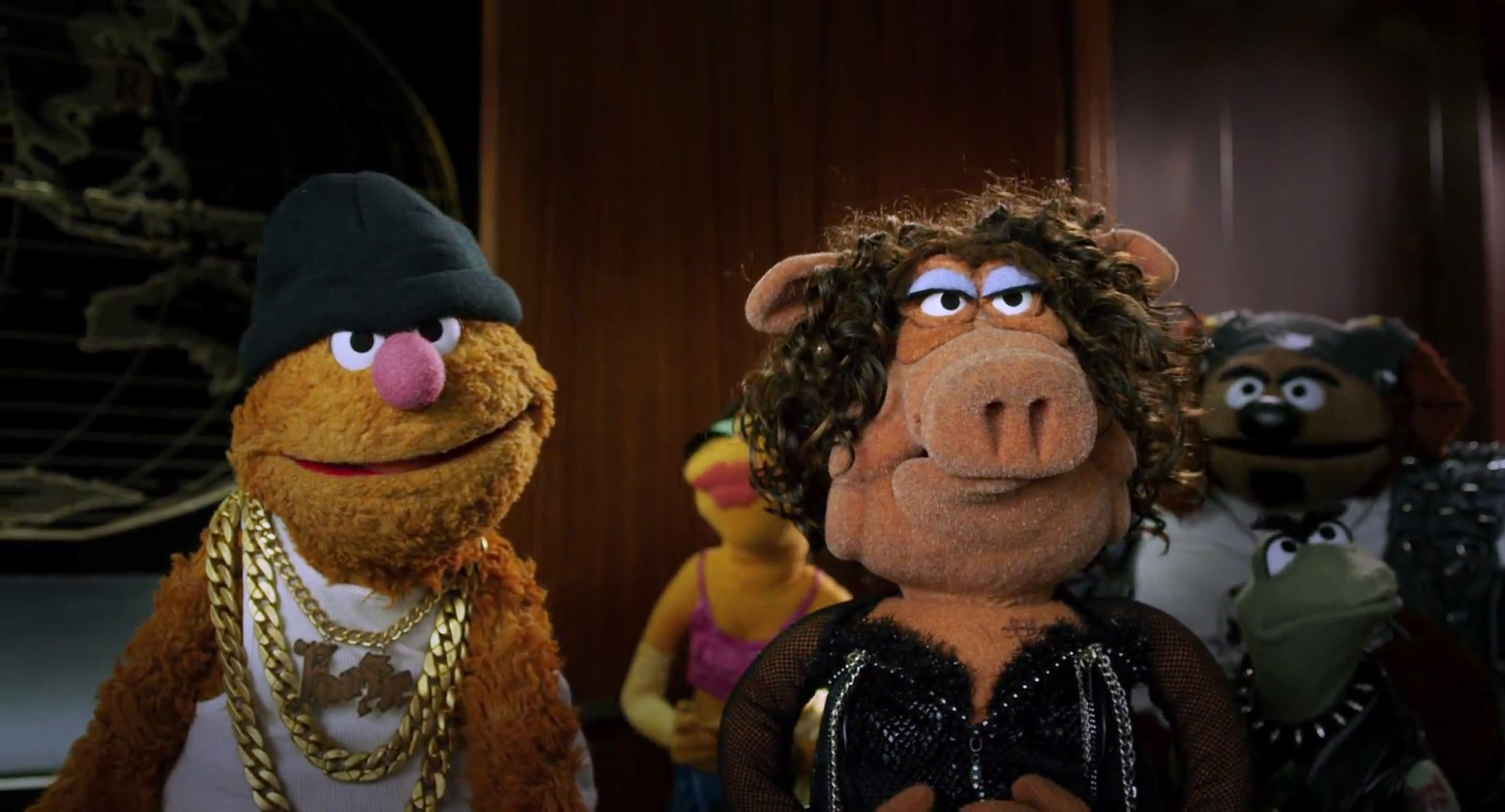
* It's rated "PG" (so as not to kill a more generalized audience than toddlers, I presume).  But, the only things I thought might warrant the rating was Fozzie Bear's invention of "fart-shoes" to generate cheap laughs, and the mere suggestion that Miss Piggy's "replacement" might be a transvestite (in itself a great joke and another instance of the movie "taking chances").

** And, really, are "The Muppets" any different from The Marx Brothers, The Three Stooges, Abbott and Costello and other vaudevillians?  It's why stage performers worked so seamlessly with them and why they match the "our heroes against the world" formula of such movies.  They also faced the same danger—being pigeon-holed into formula films that ill-suited them.  A Muppet Christmas Carol?  It was only a matter of time before The Muppets Go West!

*** Parents, don't let your kids read this asterisk!  One of the things about The Muppet Movie that I loved was seeing how Henson and crew moved their critters with hidden people attached to them out of the world of medium close-up into full-figured reality without missing a beat, like watching Kermit ride a bicycle (a simple employment of marionette techniques)...or the opening number, which featured Kermit playing a banjo sitting on a log in the middle of a real water-filled lake.  Hey, he's a frog, it's only natural (well, except for playing the banjo).  But, think of it, the puppeteer (actually two of them, one of whom was undoubtedly Henson himself, who "played" Kermit) had to be submerged in a water-tank to pull off that sequence.  It cemented for me the fact that the Muppets and movies were made for each other—both arts depend entirely on what is in the frame and what isn't to pull off the illusion of reality.

Friday, November 14, 2014

Birdman (or The Unexpected Virtue of Ignorance)

Walking the Walk and Talk
or
Every Man His Alcatraz (or That Obscure Object of Film-Making)

Riggan Thomas (Michael Keaton) is an actor who's been on a stale streak for awhile after making a name for himself in a string of superhero movies (as an act of integrity he didn't do the fourth one) and is now trying to make a forthright comeback of sorts by ambitiously staging a play on Broadway that he has written, is directing and is also starring in. The play, based on a Raymond Carver story* is as far afield from "Birdman" (the superhero character he played) as one can get, and the staging of the play proves to be problematic what with difficult actors, difficult material, and that the lead may be a bit crazy—cuckoo, if you'd rather. Left alone, which he rarely is, Riggan hears the voice of "Birdman" in his head berating him for past failures and current insecurities and, then, every once in awhile, Thomas displays a knack for telekinesis—moving objects without touching them.

Or more accurately, smashing objects without touching them. Riggan is a bit out of control, mercurial, and seems more than a bit unstable, all the while he's trying to keep his vanity project together. An accident (or is it?) on the stage one day eliminates the actor he's having the most problems with and replaces him with an improvement—Mike Shiner (Edward Norton), one of the better actors working, but also one of the most annoying, for his insistence on "truth" in performance. 
Is Thomas rolling his eyes, or is he willing something to happen?
Complicating matters is the presence of Riggan's daughter (Emma Stone) recently out of rehab, Shiner's wife (Naomi Watts), also in the play, a crusty theater critic (Lindsay Duncan) who is determined to trash the play sight unseen for Riggan's impertinence for trying to prove he's an actor instead of a celebrity, and Shiner's narcissism that hogs the limelight (and is in conflict with Riggan's narcissism). Through it all, Riggan's friend and lawyer (Zach Galifanikis) serves as buffer and punching bag.
Those who've followed the movies of Alejandro González Iñárritu (Amores Perros, 21 Grams, Babel, Biutiful) know that Birdman (or The Unexpected Virtue of Ignorance) is as close to a knockabout comedy as he can get. The self-possessed tribulations of actors amid the various roles they play are the stuff of both comedy and tragedy—tragedy in the intimate conflicts they struggle with within and without, and comedy in the lack of perspective they can possess entangled in those struggles. We're all actors. We all play roles, and sometimes we get lost in the performance of our lives—our self-made traps, self-imposed prisons. Every bird-man his Alcatraz.

Now, here comes Thomas, in the performance of his life, confined to a two-block radius of Broadway, trying to achieve more than he might be able to, and performing a dialogue with more than himself, trying to stretch himself in a flight of fancy while his past tries to sabotage it. He wants to soar, but the Birdman of his past keeps pushing him to the ground. 
Michael Keaton has never really retired from movies—he's been doing small parts here and there—but he hasn't top-lined a movie since his own fine directorial debut, The Merry Gentleman. But, it is good to have him back in something with a bit of substance. And, of course, he's perfect for this—an odd semi-meta-performance (at one point he says "I had a dream that I died in a plane-crash, and the picture they had in the paper was Clooney."). But, Batman never really held him back—fact is, he was always a better Bruce Wayne than Batman, a performance too still and cossetted in black rubber—it just didn't show him at his manic, quirky best. He's also better, like here, in an ensemble: in The Other Guys, one of his small parts of late, he has two scenes—one where he's playing off Will Ferrell and Mark Wahlberg, where he is funny and exceptional, and the other—a monologue—where he falls flat. He is a character actor, at his mercurial best bouncing off the talents of others, and he and Norton have great scenes that are joys to watch for how good both are, in completely different styles. The part is tailor-made for Keaton, and he rises, literally, to the challenge.
At one point, Iñárritu stages an action set-piece that looks like the chaos
of every CGI superhero movie ever made
And the director doesn't make it easy for him. The thing is about theater and Iñárritu keeps the locale focused in and around New York's St. James Theater (you get to know every nook and cranny of it) and shoots the movie in a seemingly seamless stream of long "takes," where the actors have to really act and for quite a sustained while, then migrate in steadicammed transitons of "walk-and-talks" that Scorsese used frequently and became famous as a fast, busy way to throw out exposition on TV's "West Wing"—it's just that nobody's tried this so steadfastly since Hitchcock's Rope—not even the supposedly continuous Cloverfield could resist interruptions of static to cover the gaps.   

At times, as is the writer-director's way, the film is very obtuse, trying to communicate something while not being obvious about it to the point where it's obscure and slightly unreachable. Throughout the course of the movie, he also makes no distinction between reality and fantasy, between inner and outer dialogue, so it's often not easy to trust the image or the sound on-screen: does Riggan have telekinesis or is this all in his head and just some manifestation of control that he thinks he has over his Universe? Why does the film resolve the way it does, with a self-inflicted act of violence, for the visual joke of the Birdman's costume, or is it being precious with a well-worn cliche about self-defeating actions?  Sometimes the deflection doesn't quite work, but just as often, as in the film's final shot, it makes for a sublime moment, not too obvious, and a fine melding of fantasy and reality.

* I don't know whether it's interesting or significant or not, but Riggan's adaptation is taken from the heavily edited version of Carver's story and even includes a monologue not written by Carver, but by his editor Gordon Lish.

Still-life Superhero:  Keaton's Batman never moved much and had his
performance cossetted by leather.