Showing posts with label Virginia Mayo. Show all posts

Saturday, September 23, 2023

The Story of Mankind

Saturday is typically "Take Out the Trash" Day. And while this is not the worst movie I've ever seen, it certainly comes wretchedly close....

The Story of Mankind
(Irwin Allen
, 1956) Before becoming "The Master of Disaster" of 1970's cinema, and even before his tenure of TV sci-fi schlock-meister in the 1960's, Irwin Allen was making movies of indeterminate quality and low budgets, first with RKO, where he produced movies as package deals teaming actors, writers and directors. We talked about one of them, Double Dynamite, here. That one starred studio boss Howard Hughes' favorite, Jane Russell, a down-on-his-luck Frank Sinatra...and Groucho Marx. He produced another film—also starring Groucho—before making his directorial debut with a documentary version of Rachel Carson's The Sea Around Us, a film that Carson loathed—she never again let Hollywood touch one of her books—but it managed to win the Oscar for Best Documentary Feature. And because it relied largely of stock footage, it also managed to turn a tidy profit.

After moving from RKO to Warner Brothers, Allen made another documentary and then turned his attention to The Story of Mankind. Based on a Newbury Award-winning children's book,* published in 1921, Allen did a very (very!) loose adaptation**, again relying mostly on stock footage, and a large cast that were paid day-rates and shuffled through production as quickly as possible.
The film centers around "The High Tribunal of Outer Space"—basically a three-tiered court-bench, a couple of desks and a floor of fog, with a circle of extras and as cheap a set as has been used in Hollywood—where the High Judge (
Cedric Hardwicke) is holding court. It seems that mankind has created a new weapon, a "Super-H-bomb" and the survival of the species is in the balance. So, a case is being made—not that it would apparently do any good—of whether mankind (or species-kind) should survive. Nothing is said of how the outcome will be dispensed or if any interference is going to be made to influence the outcome. 
At least, with a fantasy like A Matter of Life and Death, the stakes were small enough that events could be altered to accommodate the judgment, but here there is no apparent action—there evidently was no stock-footage available to make the point.
So, we're left with an impotent court-proceeding in judgment of mankind. It was a hoary concept then, and it was a hoary concept when Gene Roddenberry purloined it for the pilot of "Star Trek: The Next Generation". The prosecuting attorney arguing against the mass-plaintiff is Mr. Scratch, aka "The Devil" (played by 
Vincent Price, who seems to be the only player having a good time making the movie and who, therefore, seems to attract audience sympathy). For the defense is a singular non-entity called "The Spirit of Mankind" played by Ronald Colman (his last role) with the resigned air of a beleaguered "straight-man" going through the motions.
The Devil brings up all sorts of examples of humanity at its worst. Then, Allen illustrates it with set-design at its worst and trots out one of his day-players—
John Carradine as Khufu, Peter Lorre as Nero, Virginia Mayo as Cleopatra (the script actually says "Yes, Cleopatra was quite a girl..."), Marie Wilson as Marie Antoinette (the way she squeaks "Let them eat cake!" will set your teeth on edge), and...wait for it...Dennis Hopper as Napoleon.
Peter Lorre's Nero is extremely illustrative of the whole exercise.
"The Spirit of Man" counters with Moses (Francis X. Bushman), Hippocrates (Charles Coburn), Hedy Lamarr as Joan of Arc—with one really unfortunate transition between scenes***—Queen Elizabeth I (Agnes Moorehead) and William Shakespeare (Reginald Gardiner), Sir Isaac Newton (Harpo Marx...Harpo Marx?!!), Christopher Columbus (Anthony Dexter explains his theory of a round Earth to a monk played by Chico Marx!!), Alexander Graham Bell (not Don Ameche, but Jim Ameche), then wraps things up with a plug for The Bible and a kid representing the potential of mankind. Judge Judy would have cleared the room in seconds...with her boots. 
As he did with his earlier documentaries, Allen bridges scenes that he shot with stock footage from other Warner films to make it appear that some money was spent on the thing and it wouldn't surprise if he cherry-picked figures from the History that he had available images for.
You could make an argument that it all was an attempt at "camp" if the serious parts weren't taken so seriously and the comedy bits didn't fall flatter than the American accents used by all these international figures. No, it's all "1950's-sincere," which is merely hilarious in retrospect for all the silly import imbued in the thing. "Camp" implies you know what you're doing.
But, I will confess to enjoying a couple of things. Price's performance is enjoyably arch, and played with his typical game commitment to bad material. If he betrayed on ounce of condescension, it wouldn't work or be as entertaining as it is and one has to admit, he's a Hell of a trooper.
And then there's a Groucho Marx moment in his embarrassing segment of Peter Minuit robbing the island of Manhattan from the Natives, who declare the proposition "robbery!" ("That's quite true, but is it a deal or isn't it?"). It's just one line, but it made me laugh out loud. When Groucho/Minuit meets with the all-too Anglo-depicted Indians, he is greeted with the stereotypical "How..." to which Groucho replies "Three minutes and leave them in the shell!"—a Marxian non sequitur of such head-spinning irrelevance that for a moment I thought the movie might actually be turning clever.

Needless worrying. The segment was racist, sexist, inaccurate, and (worst of all) unfunny, showing how off the Marx The Story of Mankind is.

It should be preceded with a warning:

* You can read "The Story of Mankind" at the Project Gutenberg site.

** Star Ronald Colman cracked the movie was "based on the notes on the dust-jacket."
 
*** 
"But...but...I'll be inventing cell-phones and 'Fizzies'!"

Tuesday, January 3, 2023

Captain Horatio Hornblower (R.N.)

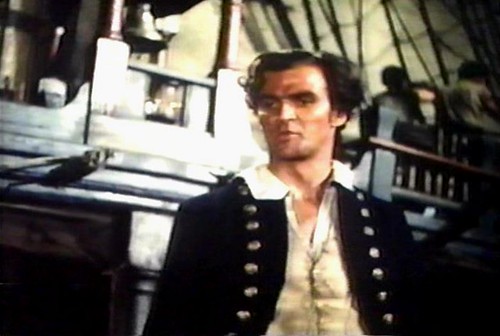
Captain Horatio Hornblower (R.N.)* (Raoul Walsh, 1951) Supposedly C.S. Forester himself adapted his first three Hornblower novels to make the screen-story for this swashbuckling distillation of the Royal Navy's fictional hero. It is 1805, and his majesty has sent the HMS Lydia on a secret mission. England is at war with Spain and France, and Hornblower must enlist the aid of a mad South American dictator in the war efforts a world away. But, upon arriving, Hornblower's distaste for the assignment and the "El Supremo" (Alec Mango) has him violating the Admiralty's standard orders, and when he captures the massive El Natividad (commanded by a very young Christopher Lee), he is forced to turn over the ship to the mad-man. Heading for home, he finds out that Spain is now England's ally (oops!) and he must re-take the massive ship on open seas, risking his crew and an unwanted passenger, Her Ladyship Barbara Wellesley (Virginia Mayo), sister to tthe Duke of Wellington and betrothed to Admiral Leighton (Denis O'Dea).
The crew is very British (
including a young Stanley Baker), but its Captain is played by the very American Gregory Peck
,** ramrod-stiff and stoic, so even though the accent is wrong, the attitude is just so—Forrester's Hornblower is a stoic, constantly questioning himself and his failings, reflected in his constant lecturing and drilling of his crew. And Raoul Walsh is the perfect man to direct, as the action director has a keen eye toward the psychological and characters with complicated motivations. Peck has the attitude, but is a bit uneasy when called upon to display the comical aspects of the still-upper-lip Hornblower—his uneasy "harumphs" are constantly dubbed in to make more of them than Peck could convey on-set. But for the brooding and irritation (and the authoritarian air), Peck is fine.
The battles are well-choreographed for the times—one can practically see the wires yanking pieces of ship-railing past the players—and sometimes the falling masts and ropes get a little out of control, but the model-work and staging are excitingly done. A fine way to spend a rainy afternoon.

* The added "R.N." because the British version of the title included them, the American did not. As with the recent Master and Commander, nothing is made of Hornblower maybe having to fight the American Navy, as he might have seven years in the future.
 
** The screen-rights were acquired for a vehicle for Errol Flynn, but after Flynn's previous movies had poor ticket sales (and the actor was proving difficult to manage), other actors (including Burt Lancaster) were considered. Peck got the part. Lancaster would star in The Crimson Pirate the next year.

Friday, July 12, 2019

White Heat (1949)

White Heat (Raoul Walsh, 1949) Did a podcast for the Large Association of Movie Blogs the other night with MovieRob—he's in charge of the "Acting School 101" segment, where they focus on a particular actor for the month (there's also a "Directing School 101") and the contributors post links to relevant posts they've made. This month's Acting 101 subject if James Francis Cagney (which is why you've seen seemingly irrelevant Cagney posts lately—I'm cleaning out the attic of the old blog I wrote and bringing them over here) and we had a rollicking discussion—I could've gone another couple hours on the subject, it was so much fun. But, my No. 1 pick of Cagney performances (Rob's was Yankee Doodle Dandy, a great choice) was White Heat, which Rob had never seen. "Ro-o-o-b," I bleated in my best Mary Tyler Moore imitation. "You've GOT to see White Heat!"

Everybody should. It's a late-forties return to form with Cagney in gangster mode...but with a big difference. Cagney's early gangsters were opportunists, falling through the cracks of bad economics and bad situations to eke out a living by the easiest way possible—crime.

But not White Heat's Cody Jarrett. When Cagney returned to Warner Brothers Studio to do it, he read the script, recognized the form but found it a little formulaic and, thus, dull. Cagney had a suggestion: "Let's make him nuts," and the script was altered and Cagney's criminal thus had no justifying excuses—Jarrett is psychologically damaged ("like his old man" says a gang-member)—all id, with no ego or conscience to curtail it. He's mother-fixated, greedy, jealous, and subject to debilitating headaches ("like a buzz-saw in my skull," he describes it). Whether it's caused by blood pressure, stress, PTSD, or just bad humours, he's due for a stroke if he doesn't curtail it. But, before he does, he's going to take out as much as he can, monetarily or in collateral damage. "Top of the world, ma" he toasts his mother in a perverse version of The American Dream. "Top of the world."
Jarrett's gang goes in for The Big Scores, robbing trains, pilfering payrolls, stuff that involves high risk with high rewards (except for those who succumb to the high risks). When the job's done, the gang splits up, finds a hide-out to lay low, with Mom Jarrett (Margaret Wycherly) in tow to monitor police efforts and plan the next heist. But, not for too long, as Jarrett gets antsy and the headaches start. Plus, there's Cody's wife Verna (Virginia Mayo) who loves the spoils, but not having Ma breathing down her neck and nagging. Jarrett keeps her under a watchful eye and a short leash, because he's just as suspicious of her as he is of weasels in his gang like "Big Ed" (Steve Cochran), who Jarrett knows would love to take over the Jarrett game and serve divorce papers to him from the barrel of a gun.
All that time keeping his enemies close also makes him a little myopic. After a train-heist that scalds one of the gang-members, Jarrett orders the mug shot rather than have to carry around a guy wrapped like a mummy everywhere.  But, the chosen executioner has a soft heart, he leaves the stricken thief alive, but only for so long. Police find the man, finally dead of his injuries, and do some forensics. It leads to a stake-out that traps Jarrett, Ma, and Verna, but Jarrett shoots chief investigator Philip Evans (John Archer) and starts a reckless police chase that ends, when Cody pulls into a drive-in.
But, Jarrett has an idea; at the same time he was pulling the train job out West, he knows a hotel job that was going down in Illinois by an acquaintance in crime, who has gone to ground. Jarrett is going to go to Chicago and turn himself in for the hotel robbery. He'll go to prison for two years, but not to the gas chamber for the deadly train robbery, and, when he gets out, he's got a lot of loot stashed. He leaves Ma in charge, and Verna stewing.
But, the Treasury Agents have a plan. They agree to Jarrett's light sentence—they don't kick at all—and they bring in "undercover specialist" Hank Fallon (Edmond O'Brien), who's just finished another long stretch in prison...posing as a con to get information, you understand. His job is to get close to Jarrett, find out what he can, what he did with the train job loot, and find the name of the mysterious planner who's been giving Jarrett his big ideas. Oh, and stay alive in a federal pen with a bunch of cut-throats.
That's the movie's set-up, and things, as they should, get complicated, but except for big issues like Life and Death, the details don't amount to much. What matters is Jarrett's reaction to them and Cagney's performance is the entire key to it. One hesitates to call it a "one-man" show (O'Brien is properly stalwart and Mayo and Wycherly do wonderful, vaguely comic work), but Cagney so dominates an audience's attention and challenges it, that the details seem to disappear.
Cagney's advice to actors was to "plant your feet and tell the truth," even though he was the most theatrical of performers. You believe him and what the character is going through. White Heat proved one thing—there's no over-the-top with Cagney; even the scenes where his crazy behavior scares the crap out of you, what he does feel genuine and, for all the hyper-emoting, and occasional jibbering, authentic. One also cannot argue with the visceral way he throws a punch.
The extremes of behavior of the Jarrett character would make any death scene a little disappointing, and so, director Walsh stages the most hysterically dramatic death for a character in the movies (short of Godzilla, anyway). It's almost supernatural in its implications, and as much as supporting characters are given lines to tone it down and bring it down to Earth a bit, it doesn't douse the ecstasy that comes out of Cagney as he shrieks his send-off line. It is spectacular, but more than that, it feels apt and right, because of the bigness of the portrayal. Cagney makes you realize that you just can't kill a creature like Cody Jarrett. You have to atomize him. And in a post-Hiroshima era, that takes a lot of will to not have qualms about it. 
And the scary thing is; Jarrett wants it, relishes it, and even helps it along. He feels he's earned it.

But, it's Cagney's performance that justifies so grand and volcanic an exit. And it's too intense and good to leave you wanting more.

Saturday, July 2, 2016

The Silver Chalice

The Silver Chalice (Victor Saville, 1954) Legend has it that when The Silver Chalice was first scheduled to appear on television, Paul Newman—who made his debut in the film—purchased an ad in Variety emploring people not to watch it. The movie was horrible and he was terrible in it, being the reasons.

Paul Newman was rarely wrong. And I can only hoist a glass of Newman's Own Virgin Lemonade to him that he was right on the money about this one.


No doubt designed to repeat the success of 20th Century Fox's 1953 adaptation of The Robe, The Silver Chalice is quite another kettle of loaves and fishes. Sure, they're both religious epics based on historical novels surrounding Christian relics and filmed in Cinemascope (to lure the crowd from their little television boxes). Sure, they have charismatic young stars making names for themselves (Richard Burton, Paul Newman). Sure, they're both movies.
Newman, trying to look casual in a toga.
But, The Robe is big in scope and epic in scale. A "cast of thousands" kind of thing. The Silver Chalice looks like it was shot in the studio with available crew as extras. It starts out with crowded street scenes, but eventually everybody goes home and the streets are deserted and bare, often resembling a bare stage with some odd architecture that might fit well in a movie designed by William Cameron Menzies. The interiors are "Star Trek" (the series) simple, done with an emphasis on stretched space for Cinemascope and design. The exteriors are achieved by model overlays obscuring the stages and lights.
The sets are "Star Trek" simple. 3rd SEASON "Star Trek" simple.
The plot is rather simple, too: Basil (Newman as an adult), a talented sculptor in Greece, is sold to a rich childless nobleman (E.G. Marshall) to be his son and heir, much to the consternation of Mr. Noble's brother. When the patriarch dies, Basil is sold into slavery, due to the corrupt machinations of the brother, the magistrate, and the craven testimony of one of the witnesses. Basil becomes a sculptor for a local artisan wanting to increase his trade. Upon adulthood, he is sold to Joseph of Arimathea, one of Christ's apostles, who tasks Basil with creating a silver chalice for the cup Jesus used at the Last Supper, to be designed with the faces of the Apostles and Christ.
Things are tough in Lego-Jerusalem
There is a side-story of the slave girl Helena (Natalie Wood as a child, Virginia Mayo as an adult—which defies belief) who becomes the courtesan and assistant of Simon the Mage (Jack Palance), a magician of simple illusions. Simon is approached by a sect leader (Joseph Wiseman) in Jerusalem, who sees the rise of Christianity as a "sapping of manhood" of the populace rising against Rome by following the ways of love and peace. In Simon, he sees an impressive, less passive alternative to Jesus and his miracles ("A true miracle is nothing but a good trick," says Wiseman's rabble-rouser, "They were VERY good," says Simon admiringly).
Helena and Basil have a "thing," but he is attracted to Deborah (Pier Angeli), a devout Christian. Although Basil does wonders with the faces of the Apostles, he has a block when it comes to Jesus, unable to capture his face to anyone's satisfaction. It is only when he travels to Rome, and with the love of Deborah, that the true face of Jesus is revealed to him.
Let's just call this bust of Jesus a work in progress.
The design of the The Silver Chalice (credited to Rolfe Gerard) is cheesy, a low-budget compromise to the vistas and exotica of DeMille and The Robe and the religious mainstays of the 1950's. But, the dialogue is the issue, a too-formal-by-half torturing of "marmish" speaking that turns lines of dialogue into paragraphs.* Nobody does well with this falderal, but Newman can't seem to find a grasp of it or any sense of human feeling to it. He sounds like he's reciting. The ones that fare best are the stentorians—like Alexander Scoursby and Lorne Greene—who deal with the purple dialogue by playing it without any sense of humor or irony, reading it like it was the Gettysberg Address, not unlike the way DeMille's actors intoned their way through his films. A lot of the acting is egregious with Wiseman coming off the best—he plays everything like he's grousing about a bad meal—Newman the worst, and Palance...Palance is off doing his own thing, but then, he's playing something of a demented charlatan, which is sometimes amusing, sometimes very puzzling.
Palance: what the hell is he doing...what the hell is he WEARING?
It's a mess, not unlike watching an Ed Wood movie, but with the disappointing sense that there is taste and intelligence not working somewhere. It just goes to show that if you're making a religious movie, you need a miracle or two to pull it off.

* Shakespeare is easier than this drivel. Harrison Ford threw a great line at George Lucas during the filming of Star Wars: "You can't speak this shit. It can only be typed." But that stilted B-dialogue of the old serials is brilliant next to this narration posing as dialogue. Newman must have had a hell of a time trying to dig out "the truth" of this doggerel with $5 words. There is no "method" here, only madness.