Showing posts with label Vincent D'Onofrio. Show all posts

Friday, June 26, 2015

Jurassic World

You Bet Jurassic
or
"We're Just Used to Being the Cat"

It was tough to find parking when I went to see Jurassic World the other day—the parking lot was filled. The film has achieved the status of having the "highest grossing weekend" of any movie in history (surpassing the original Avengers).* That says something: the word-of-mouth is good, the marketing strategy worked, its box-office achievement inspired more movie-goers. In fact, it has surpassed the original in terms of box office crunching. I find that odd. Steven Spielberg's follow-up sequel The Lost World didn't do this well, nor did Jurassic Park III, even though those films had the original stars of the first in them (Jeff Goldblum in Lost World, Sam Neill and Laura Dern in III) and only B.D. Wong is around from the first one here. You could say that all the dino's were the stars of the film, especially the veteran T-Rex's and ingenue velociraptors. The director has only made one other film, the considerably low budget Safety Not Guaranteed, and the films are now far removed from Michael Crichton's original books.  So...why now?
The answer can probably be found in one of the themes of the film—there are many, sourced from other Spielberg films and diverse movie references—the finally-opened-because-we-worked-the-bugs-out theme park attracts visitors, sure.  But, business has leveled off.  So, to bring in the patrons again, they're going for a new route for producing dinosaurs under the dictate "Bigger. Louder. More Teeth."
Spielberg reference: the bait is a great white shark
That sounds like a movie tag line, and I'm surprised it hasn't been used on a poster for this...yet. But, it is "bigger, louder, more teeth" and it has an element that the other "Jurassic's" didn't have—more victim potential. This is the one that follows through on the original intent of the first novel; they've actually opened up a theme park for rich tourists to go see all the cute, cuddly dinosaurs that have been bred for the purpose. The disconnect in the first film was that if they're making a tourist attraction, why breed the most dangerous— and carnivorous—of the dinosaurs that would pose a danger to the folks paying good money. Dead customers are not return customers (one could make the same point about zoo's; tigers are good and all, but you don't exactly having zoo-goers walking amongst them. The park at Isla Nublar turns the zoo concept backwards—the dinosaurs run free, it's the tourists who are behind glass (in this case not the old Range Rovers on a track like the first film, but roving perspex spheres that look very, very vulnerable and prove to be so in the film). One wonders why they would breed the most dangerous of the dinosaurs in the first place, but, hey, what good is a dinosaur park without a T-Rex?
We'll put in the pterodactyls later...or is it The Birds?
Less of an insurance risk, actually.

And...really, everything has gone so well there in the past, what could possibly go worng?
Let me count the ways. For one thing, they're breeding hybrid dinosaurs, creating a new one called the "Indominus Rex" from sources unknown. Then, there's a visit from an overenthusiastic and ambitious InGen "suit" (Vincent D'Onofrio) who is all giddy about the possibility of "weaponizing" dinosaurs (oh, that's a really good idea—set 'em loose, get the job done and wait for them to attack their minders). Then, we've got the surly park ranger, Owen Grady (Chris Pratt) who fancies himself a "raptor whisperer" attempting to train velociraptors—oh, there's a really, REALLY good idea. Part of the appeal of the 'raptors from the earlier films is that they were dinosaur bad-asses—you couldn't trust them and they were cunning and relentless. So, here's this guy who thinks you can train these things like a poodle. For the movie franchise, isn't that a bit like undercutting the brand? Say, like making "Godzilla" a good guy? (Oh, wait, they've done that).
Then, there's the Park's Operations Manager Clair N. Dearing (Bryce Dallas Howard), who while all of this is going down, meeting with investors, as well as a visit by the CEO of the corporate holding company (Irrfan Khan, always a pleasure), as well as having to take care of her two nephews who have been tossed by their parents (Judy Greer, Andy Buckley) who are hoping to have some time away from their kids so they can plan their divorce. She's also had a short-lived dating thing with Grady that didn't amount to much because they're such polar opposites. Things are probably problematic on a GOOD day, with so many guest-stars arriving, things will probably go south and in a big hurry.
Normal at Jurassic World
Now, don't get me wrong, Jurassic World is pretty-darned good, and in a way that's not so familiar in feeling to the other films, while being slotted to be an entertainment machine: it's constructed of so much past history of JP and a lot of other movies, it has a nicely formed cookie-cutter familiarity to it, which gives it a nice comfort level in its ability to provide discomfort. And it is so gleeful in its depiction of a corporate Disneyland with killing machines, it didn't remind me so much of an adventure movie, as say, Jurassic Park was, so much as a "Summer Movie" placeholder, designed to make audiences feel good. 
Not-so-normal at Jurassic World (it must be "Fog" theme-day)
Let me explain: Jurassic World does not put me in mind of Jurassic Park, so much as Jaws 2. Remember that one? The original Jaws was an adventure story about peril that disrupted a resort Summer. It was moody, and had high stakes, even while Spielberg was trying to milk as much screams and nervous laughter out of the material. Its sequel (which is odd because Spielberg had nothing to do with it, while he was part of the development of this film) had the trademarks of the first film (sharks chasing people, Summer, tourist season), but it had a peculiar mood, which featured cute teens in jeopardy, water-skiers in jeopardy, a general "fun-in-the-sun" kind of vibe that just didn't play well with any sort of adventure at sea aspect that was at the heart of the Jaws concept. It was Universal Studio's attempt to "theme-park" a meteoric success, to disassociate it from its roots and shoe-horn it into "Summer fun" activity.
Grady and Dearing realize they're going to have to do some re-stocking.
The Indominus Rex kills for sport.
Jurassic World has that same feel. As competently made as it is, one gets the feeling there's an attempt to shoe-horn more entertainment value by 1) putting tourists in jeopardy; 2) making the velociraptors more relatable to audiences, making them almost personalities (maybe the film-makers remember the dinosaur scene from The Tree of Life with its 'raptor that spares its helpless prey?); 3) promoting the Universal brand by emphasizing the "theme park" aspect of it and tying it into the "Summer" activity feel of things. Jurassic World isn't so much a movie blockbuster as it is a cross-promotional activity designed to re-emphasize the money-potential to be garnered by the corporation that produced it. It has more things on its agenda than merely being an entertainment in its own right. It has to be an advertisement, as well.
Probably the dumbest thing about Jurassic World:
"Release the 'raptors..."

*

Thursday, November 20, 2014

The Judge (2014)

Father Thy Honor
or
"You're a Big Boy"

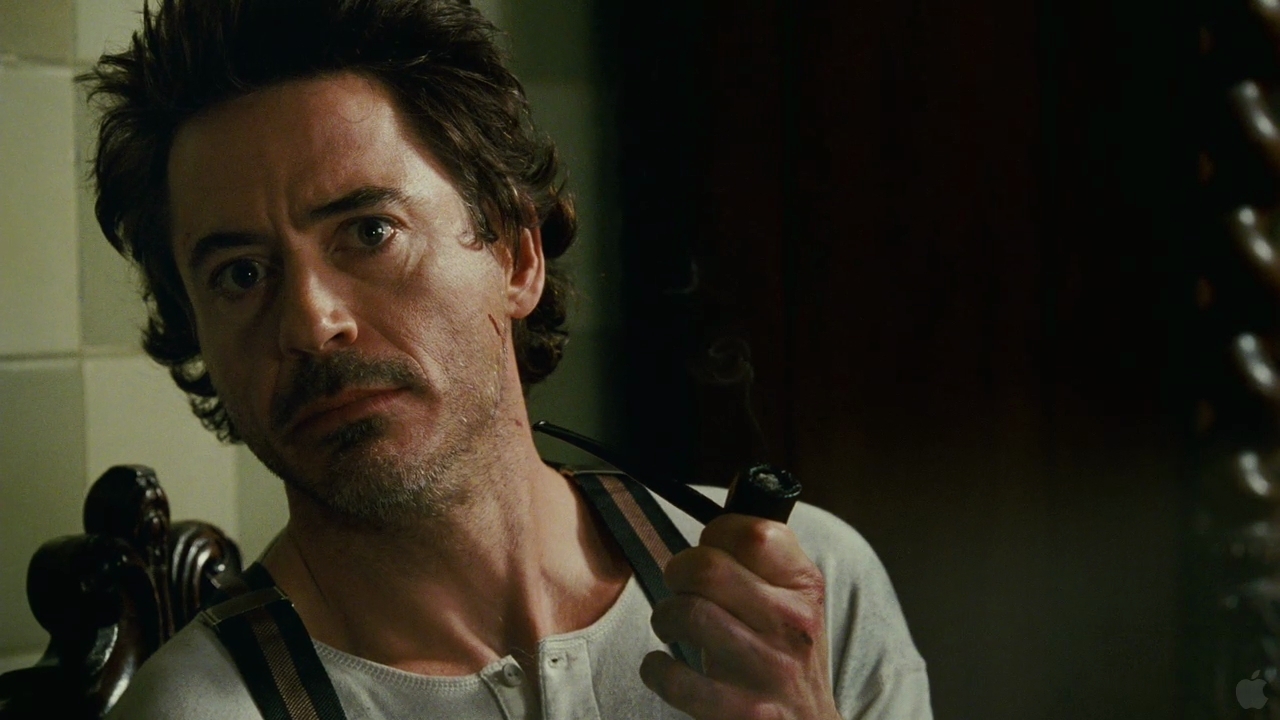
Robert Downey Jr's production company, Team Downey, produced its first feature, The Judge, and the verdict is a little mixed. One might dismiss this as a "vanity" project—he is headlining it, after all, if it wasn't such an effort to allow him to stretch out of his comfort zone as an actor (and Downey could hardly be said to have a "comfort zone") out of the iconic roles (Iron Man, Sherlock Holmes) that made him the most popular and successful actor in Hollywood.

And it is a bit of risk-taking on the actor's part. His smart-ass lawyer, Hank Palmer, is good—almost too good—at what he does in the courtroom. When asked how he feels defending the guilty, he shoots back "Innocent people can't afford me." Outside of the oak chambers, though, he's a bit of a mess. A lone wolf due to his off-putting sardonic nature, he's estranged from any family he's known; his wife is cheating on him and they're in the pre-nup phase of a divorce, and he has no contact with his family in his hometown of Carlinville, Indiana ("Grampa Palmer is dead to me," he says to his daughter when she asks why she can't go back there with him).
That's a particularly cruel and snarkily ironic way to say it to her, given the circumstances. Because he is going back home to Carlinville. His Mom is dead, and not just in a relationship way. She is dead, and he's been called home for the funeral after a decades long leave of absence. He hasn't been called by his father (Robert Duvall), who is a judge in Carlinville, but by his older brother Glen (Vincent D'Onofrio), who has never left. And so, Hank reluctantly but dutifully, drives to Indiana, knowing that disaster awaits him.

He doesn't know the half of it.

It's around this time (about fifteen minutes in) that The Judge gets in trouble, both in its story-line and behind the camera. Director David Dobkin (Shanghai Knights, Wedding Crashers) does a tight shot of Palmer driving back to Carlinville, pulls back from the SUV, then swoops around the vehicle to a high-overhead tracking shot of the surrounding (legitimately, quite lovely) countryside. It's a nifty high-tech shot, a combination of studio shot, motion graphics tracking and CGI.

But why? One could reach for an answer (moving from Palmer's self-contained city-view to the more bucolic , slower-paced country life of his youth), but...we're not there yet, and neither is the character. There is a lot of effort made to impress, and all quite unnecessarily. Dobkin is gilding the cinematic lily and without much rationale. That's a problem prevalent throughout The Judge, with an awful lot of craft going into too little art (one could say this about a lot of superhero movies, too). It times it distracts from what is going with the true focus of the story and where its strengths lie—situation and performance. Perhaps Dobkin didn't think he had enough to do, in which case, he hasn't learned one of the best rules of directing—do as little as possible. This flaw extends to camera placement and lighting, which is too often too dramatic—especially in the inevitable courtroom scenes, where it would appear none of the attorneys could actually read their notes, so dark and brooding is the lighting in these scenes (Spielberg's "prestige" cinematographer Janusz Kaminski did the photography).
"Justice is blind" they say
—probably because they didn't turn on the lights in the courtroom.
Yeah, it is dark in there, but one could say not much light is shed on the judicial process—this is more of a family drama, with familial conflicts representing the conflicts between judging and defending. Here, it's all tied up in a nice little bow. Soon after the funeral, the two Palmer's are locking horns, until the elder is placed under arrest for vehicular homicide—a felon the judge put away several years previously is out of jail and killed on the street, and the judge's car bears the marks of a collision with a body. The judge does not remember the incident—he swears he does not remember. And the animosity between father and son bubbles to the surface and becomes inextricably tangled with the advocacy/adversarial nature of court proceedings. Dad doesn't approve of his son's methods and so shuns his services for a defense; the son distrusts the father while also desperately seeking the approval the judge rarely dispenses. It's a torturous analogy—the two can only link and come to an understanding through the reversal of roles of judge to defendant and defense to prosecutor, and rely on their ingrained judicial respect to get at "the truth, the whole truth, and nothing but the truth."
So help me, God, I found the whole experience a little precious. Yes, there are interesting complications to distract: why the judge is reluctant to discuss the case for reasons physical, philosophical, and practical; the smarty-pants prosecutor (Billy Bob Thornton, bless him) whose ideals make him a vested opponent of the whole defense team; the victim's family whose vehemence only excludes torches and pitch-forks; and the township, which is divided between supporting the life-long judge and bringing him down for the justice he has meted out over the years.
The direction is problematic, but the performances can't be faulted across the line. Even Vera Farmiga, one of our best actresses, who is reduced to "the girlfriend" role, manages to rise to the occasion, and Downey and Duvall are well-matched flinty combatants, who, even as their characters veer off into territories that are hard to comprehend dramatically or logically (do either of these guys have any sense of self-preservation?) still manage to invest their characters with a sort of truthiness just short of perjury that makes one suspend disbelief...at least while the movie is going on. It's only in the cold light of deliberation that one comes up with a hung jury.