Showing posts with label Steve Martin. Show all posts

Tuesday, April 16, 2024

It's Complicated

Written at the time of the film's release...

"Karma is the Ultimate Bitch in this One"
or,
If You Can't Stand the Hot-Flash, Get Out of the Kitchen.


It's refreshing to see a movie about a mature couple of advanced age—mine—dealing with post break-up issues. I just wish they weren't being so immature while doing it.

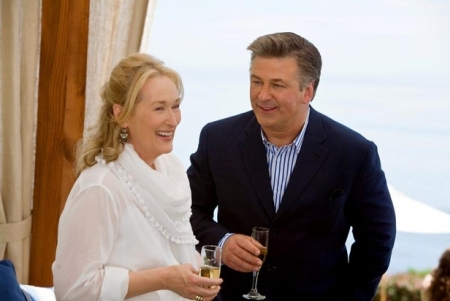
Jane Adler (Meryl Streep) is reaching a transition point in her life—approaching "empty nester" age: her oldest daughter Lauren (Caitlin Fitzgerald) is engaged to Harley (John Krasinski), middle daughter Gabby (Zoe Kazan) is moving out of the house, and youngest, Luke (Hunter Parrish) is graduating from college. Her ex-husband Jake (Alec Baldwin) is now married to young "Ms. Thang" Agness (Lake Bell), with an inherited son (from her last affair), Pedro (Emjay Anthony). She has decided that she's going to expand her nest...er, house so she can have "the kitchen she's always dreamed of;" she runs a salonish bakery, and she can cook (second movie this year—Julie & Julia from Nora Ephron, this one from Nancy Meyers, both of whom seem to be trying to keep Streep in the kitchen).
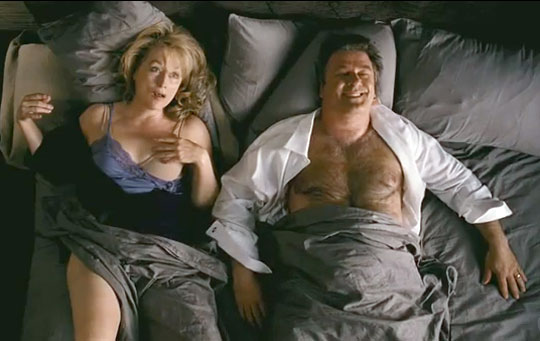
Youngest son's graduation pulls the whole family together in New York, with Jake "flying solo" due to family illness. Once there, the two old marrieds hook up, and once Jane is tanked, there occurs a "once more for old times' sake" canoodling that leaves him satisfied and her vomiting.
Most guys would take that as a sign, but not Jake
. Soon, he's spending too much time at Jane's, telling his ex-wife that his current wife doesn't understand him, and while it may seem like sweet revenge for Jane, she's also creeped out by it, so much so that she won't tell the kids, and allows it to interfere with a budding romance with her architect (Steve Martin). Now, maybe I've been watching too many "Nature" shows on elephants lately, but I could have used David Attenborough to explain this mating ritual to me.
Maybe it's that Martin and Baldwin are playing the roles the other should have taken:
Martin's love interest is a deferential, shell-shocked divorcee with a manner that reminded me of Charlie Ruggles, and Baldwin's in full pursed lips obnoxious priss mode (without the "30 Rock" irony) that makes his character not so much funny as alarming. And Streep, consummate pro that she is, works the material for all its worth, fluttering and kvelling and kvetching, making Jane seem two pastries shy of a brunch. There are times when there seems to be some acknowledgment of time—Jane is constantly fanning herself, as if caught in a hot-flash, but the next instant she's giggling like Juno.
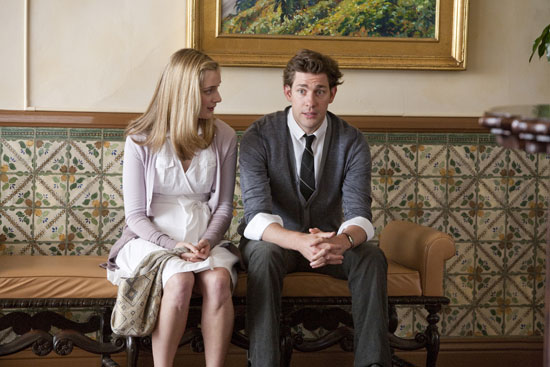
The one guy who seems to be doing something interesting is John Krasinski, as the not-yet husband who finds he's baby-sitting his future in-laws, and is the only one who seems to rise above the material to be doing something interesting—interesting and funny. As the only fully-informed character in the cast, he manages to convey the screwball nature of the situation, acting as the surrogate audience, eyes widening with each embarrassing compromise. He makes Meyers the director—with her sledge-hammer reaction shots and uneven pacing seem far more successful than she is.

Tuesday, December 20, 2016

Billy Lynn's Long Halftime Walk

Kevlar vs. Papier Mâché
or
That's Life in War-Time (That's Life in America)

It's hard to say just how good a film Billy Lynn's Long Halftime Walk is because no one outside of Los Angeles and New York has seen it in the way director Ang Lee intended it. 

His last film, the magical The Life of Pi, took full advantage of the latest film technology—3-D, IMAX, ATMOS-sound system—and the results were astounding, as it created a totally immersive experience, which made all subsequent viewings dull and dissatisfying by comparison. It made me wonder how The Life of Pi compared for viewers who'd only seen the "flat" version. Was the film as impressive to them as it was to me having seen it with all the bells and whistles? More importantly, would my opinion of the film change if I had not seen it in full format. One could tell, just by looking at The Life of Pi, that Lee had chosen camera angles, shot choices and transitions based on their effectiveness in three dimensions. Without that focus, the "flat" version of the film looks a bit disjointed—at least to my eyes.
Given all that, reviewing Billy Lynn is problematic. Ang Lee shot it in an ultra-high-speed format. Most films are recorded (and projected) at 30 frames per second (film was shot at 24 frames per second). Billy Lynn's rate is 120 frames per second (Peter Jackson's "Hobbit" films were filmed at 48 frames per second). I've seen films projected at such a rate—decades ago, actually—and the effect is akin to watching a high-definition videotape, the image is much sharper and more defined. But, it is also more unforgiving than standard projection, HD, or film. New techniques in lighting and make-up had to be devised, and even some of the acting had to be reconsidered for this format. Decisions that made an impact on the film at 120 frames per second ultimately will not make a difference in other formats, and so I'm in the uncomfortable position of reviewing a film that I haven't seen...at least in the way it was intended. Did I, then, actually see the film?
What is there in the 4k presentation is an uneven film that may be that way to allay any artificiality that the 120 frame process might have caused. Lee is no stranger to stylization in whatever genre he's working in. Billy Lynn, however feels a bit petrified in amber—how that might change in its intended presentation is hard to judge.
The story of an extended stateside tour for an Iraq unit that has just come off a well-publicized firefight caught on a reporter's phone-cam has at its basic core the nature of Truth. For Bravo Company, Truth is life and death. One of their own, Sgt. Shroom (Vin Diesel, in one of those performances where he thinks he's doing something very important) has been killed and Lynn was caught on-camera pulling the sergeant out of the line of fire. Now, as Sgt. Dime (Garrett Hedlund, giving what is genuinely the film's best performance—why didn't they peg him to play the young Indiana Jones?) tells his men "By the grace of God and the media, we are the face of the military." So, they are being escorted to the Thanksgiving game of the Dallas Cowboys to appear in an extravagant half-time show (with Destiny's Child, no less). Bravo Company and their story is a hot item; Hollywood's knocking on their door to buy the story (Hilary Swank is interested!) and they have a manager (Chris Tucker) who's doing all the negotiating.
"It doesn't have to be God or Country. Just find something bigger than yourself..."
The film veers between the events of the game and the time in Iraq that got them there and the film drips with irony going from the action in Iraq when boys are taking care of each other, and their PR tour where they're touted as symbols, but are treated as little more than set-dressing. "It's a little weird bein' honored for the worst day of your life," Lynn (newcomer Joe Alwyn) observes at one point. And when one of the Bravo's point out that it's been "a rough tour," they're asked "There or here?"
Shroom starts a mission by telling each one of his men that he loves them.
The last one says "Yeah, yeah. Let's get a middle school named after us."
The Bravo's know the game. "Yes sir, No sir. Look sharp." But, for all the "proud of ya's" there is the sense of false spectacle and hype. The Bravo's are just pawns going from cannon-fodder in Iraq to camera-fodder in Dallas, and there is marked juxtaposition between the very real stakes of war and the superficiality of just about everything stateside. And Billy has to make a choice: stay with his unit for another tour of duty, or jump off and maybe take advantage of the brief amount of fame that he's currently enjoying. How long that might last is anybody's guess, but the superficiality of their brief fling with "the show business" provides a pretty good clue that it will be brief and ultimately meaningless.
The temptations are many. A brief stop-over at his home in Stovall, Texas holds the same dichotomy—the family's proud, but they don't want to hear about the war, except for Lynn's sister (played by Kristen Stewart), who provides a lot of answers to why the 19 year old joined up in the first place. She's conflicted. She hates the war, but loves her brother, and feels an overwhelming guilt for her part in his decisions. She wants him home. They all do, but the rest of the family isn't quite comfortable talking about the war, not wanting to upset Billy, but not so that their sudden displays of temper at the family dinner table might set off his PTSD.
The hanger's-on and money-men behind the Cowboys event just know platitudes and say they're honored and proud and use the Bravo's to bolster their world-views, but aren't so proud and honored that they won't short-change the group for the rights to their story. And then, there's that cheerleader (Makenzie Leigh) who keeps catching Billy's eye who says all the right things, but...
One would expect, given Hollywood's own superficiality that there will be some big "reveal" to add drama. No, there's no big "freak-out" scene, no histrionics, and no epiphany scene, just the alternate views of life in war-time and life in these United States insulated from the war (other than our relationships to the ones fighting it). Ultimately, the ones who really know the war are the ones fighting it, free of illusions and filters. Everything else is just fantasy and platitudes. Fireworks, not flesh and blood. Loyalty, not gamesmanship.
Lee, in his quiet way, shows the difference between words and actions, flummery and truth. As he does with all his films, there is a coming-to-terms with reality versus illusion, a learning process of the self to determine who one is. Sure, it's focus is Billy Lynn, but it could be talking about America, too. It's one thing for us as a nation to say "we honor you" with our words, and belie that with our actions (as, unfortunately, seems to be the case). It's quite another to acknowledge the real sacrifice those that defend our right to be frivolous make. It's why it's entirely appropriate to play "The Star Spangled Banner" before our "oh-so-important" sporting events, to present a song about war-time to remind us exactly what it encompasses for us to be able to waste our time.

Saturday, September 10, 2016

Traitor

Written at the time of the film's release.

"I Wouldn't Make Any Plans, Man..."

Traitor is a taut, tough little thriller about the FBI (yes, the FBI) trying to track down a group of Islamic jihadists with plans to pull off a continuing string of bombings throughout the world. Their focus is on Samir Horn (Don Cheadle), born in the Sudan, and who disappeared while working for the government in Afghanistan. Word is that he found his faith working for the mujahadin, and now he's been tracked selling detonators to a terrorist faction in Yemen.

There, two FBI agents, Clayton (Guy Pearce, this time with a convincing soft Southern accent) and Archer (Neal McDonough) are tracking the faction's movements, and during a raid, Horn is captured, but will not turn over any evidence to help the investigation. Despite that, in prison, he is doubted by the fellow-jihadists as a possible informer to the U.S., and a target by some of the prisoners. Outside, he is not trusted at all, but as long as he's detained, he's not considered a threat.
Then, he breaks out. And he gets very busy contacting associates, sleeper-cells, and working on detonators for a coordinated attack.
At this point, to reveal any more of the plot might be unfair to anyone who wants to see a well-done "War on Terror" thriller, done in the shakiest "Bourne" style, with powerhouse performances by Cheadle, Pearce, McDonough and Jeff Daniels. Real tension is achieved throughout the story, as the stakes get increasingly higher. And writer-director Jeffrey Nachmanoff, working from a story by Steve Martin* (yes, that Steve Martin) keeps things simple and straight-forward--pretty amazing, given that his last credit was for screen-writing The Day After Tomorrow. Without much on his resume to indicate that he was capable of this, it will be interesting to see what he does in the future.
The other neat thing is seeing Don Cheadle in full "action-star" mode--tight, lean and fast, he pulls off several well-done fight scenes, while never sacrificing the wariness and intelligence in his eyes. At this point, it should be pretty obvious that Cheadle can play just about anything, and have the audience with him the whole way.

The view from 2016: This one has stuck with me over the years for many reasons: the excellent direction, Cheadle in full-on "star" mode, and the screenplay, that plays like a normal thriller (ho-hum) replete with shaky-cam, exotic, if shell-shocked, locales and a "trust me, we'll get there" air of non-disclosure. It then delivers on that tactic with one of the biggest surprises that year in movies—a surprise both wicked and shocking in its dark humor, but carrying with it a certain degree of satisfaction in its outcome, one that could be traced to Martin's sense of the absurd and his instinct for a killer punch-line. "You live by the sword..." you die by the sting. Traitor is more than a little brilliant in how it carries out its agenda, using a terrorist's tactics, working in anonymity, against itself. It still makes me smile...if not necessarily making me laugh.

 
* Sleeping on it, Martin's participation seems apt, rather than surprising. The denouement is the product of a Master of the Absurd, and thinking further on it, in the War on Terror, Absurdity is only a realization away from the insanity of the unthinking zealot. Maybe in the War on Terror, we need fewer strategists and more comedians. "Laugh? I killed 'em!"