Showing posts with label Shailene Woodley. Show all posts

Wednesday, May 16, 2018

The Descendants

Written at the time of the film's release (as will become abundantly clear). Ultimately, The Descendants won the Oscar for Best Adapted Screenplay (and that was it). The Artist swept most of the Awards that year.


"Finding Grace in Paradise"
or
"Keeping the Kidneys and Other Vital Organs Working and Hoping for the Best"

There's a lot of water in Hawaii. It's an island, after all, a string of volcanic mountains surrounded by water on all sides. Plus, there are the myriad rivers that course through, invading the land, falling off the mountains combined with the torrential rains that sometimes beat down with such ferocity that they turn highways into flood corridors, making negotiating trails on the islands difficult. All that water does have an advantage—it turns the volcanic soil green with lush verdant beauty.

And it also hides the tears.
Alexander Payne's adaptation of Kaui Hart Hemmings' novel The Descendants is something of a miracle, a nearly perfect adaptation, much like James L. Brooks' transformation of Larry McMurtry's Terms of Endearment (and if there's any justice...or taste...in Hollywood this awards season, Payne's film will be awarded as much gold as Brooks'). It retains Payne's way of nailing a particular culture, as he has with right-wing religion, high school politics, retirement wanderlust, and the pretentious pseudo-culture of Napa Valley. In The Descendants, it's the extreme casualness of the privileged Howlies, who have invaded the island culture, overcoming it like a tsunami.
But, there's a difference here. All of Payne's films have been a trifle dodgy, askew or off-kilter. Not The Descendants. It is a fine distillation of the book, taking the best of the dialogue, a perfect cast of vets and unknowns and bringing it together with polish, exquisite comic timing and poignancy.
Attorney Matt King (George Clooney) is the last in a long line of Kings of Hawaii, who trace their roots back to King Kamehameha, a family history that has held in trust 25,000 acres of undeveloped, still natural Kauai'i coastline which will be out of trust in seven years. Matt is the sole trustee, but is in negotiations with his family on how to deal with the land.  A decision is to be made soon.
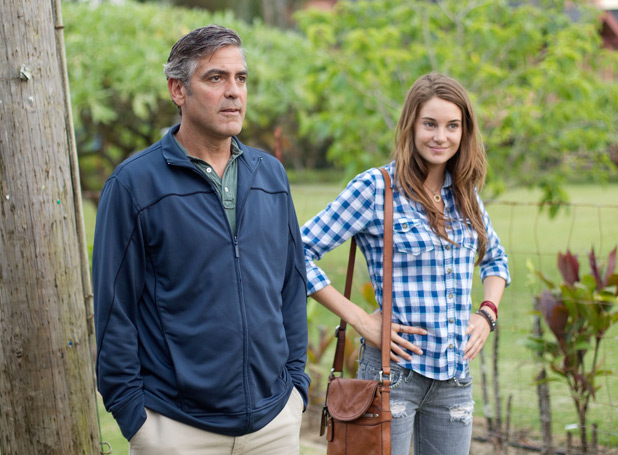
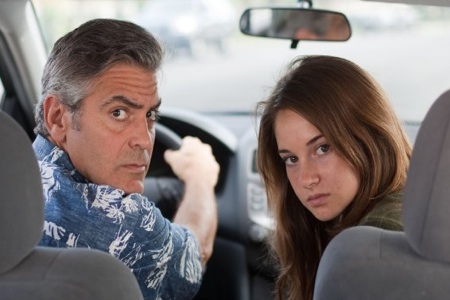
But, that's the least of Matt's concerns. His wife, Elizabeth, has been put in a coma from a boating accident. He is left with her medical decisions and the caretaking of their two daughters—Scottie, 10 (Amara Miller), and Alexandra "Alex," 17 (Shailene Woodley, I hesitate to mention he performance as a standout, because everyone is great)—a difficult task as the aloof and professional Matt is, for all intents and purposes, "the back-up parent." Scottie is starting to react to her mother's hospitalization in odd, destructive ways...and Alex? She's already been shipped to another island to a strict boarding school for dabbling in drugs and older boyfriends. "What is it with the women in my life that they want to destroy themselves?" Matt asks in one of the many narrations that dominate the film.
Good question. And the answers to that one aren't even explored in depth here.  Let's just say that Matt is responsible, and must be more responsible if he is to save his family, nuclear or extended. However diligent he might be as a man or a person, he cannot prep for the emergencies that life hands to him. He cannot research what to say or argue before the court of his kids, and absolutely must find a way through the briar-patch of mercurial emotions that has nothing to do with reason or law. There is no precedent to draw upon for what he is going through. This is life, not jurisprudence. There is no preparing for that. Life is off-the-cuff, on the wire, winging it because life is what happens (as John Lennon said) "while you're busy making other plans." In the film, Clooney's character must deal with both death and life and find the personal grace to do both, simultaneously, letting go of the past and dealing with the essential unforeseeable future. 
There are two axioms that I hold dear in life as true, and recently they came up again, in my life, to steer me to a clearer, calmer path. The first is "actions speak louder than words." Words are fine, nice, even comforting. But they are useless, and can be even considered lies if not backed up by a concurring action.* The other is one of the few things I take as absolute truth from the Bible and that is that "love never dies." I realized that with the death of my parents, but it is only reinforced to me, day after day. Like energy in science, once it's generated, love never leaves the Universe. It can change, sometimes savagely, turning into hate (at least, temporarily, because the opposite of love is indifference), but it never goes away...never "vanishes." And The Descendants, in its funny, quirky way, eloquently speaks to those truths.
I love this movie. There are choices that Payne and his co-writers have made in the presentation of Hemmings' novella that are oddly poetic, even beautiful, and with the clear-eyed collaboration of his actors, have made up some of the most memorable scenes in a film that have moved me this year. It is certain that many of them will show up as "Moments" in the year-end wrap-up of the best of 2011. This one might be the best film of the year.
But, the movie-year, despite being deep in its 11th month and on the cusp of the 12th, is still young. Who knows what lies ahead? 

The view from 2018: 2011 was a very good year for movies: Look at the Oscar nominees—War Horse, Hugo, The Tree of Life, Moneyball, Midnight in Paris, The Help—most of those I recall quite fondly and have stuck in my mind. But The Descendants is still probably my favorite of that year because it moved me so consistently (not that the others didn't) and so intensely. Just a good adaptation of a good novel with a mind of its own that sort of vaults it beyond "adaptation." I revisit it quite a bit.
* It's especially true of politicians.  Think of that during the next political campaign.

Thursday, October 20, 2016

Heroes and Villains, Part 2: Snowden

"When one is young it seems so very easy to distinguish between right and wrong. But as one gets older it becomes more difficult, the villains and the heroes get all mixed up." 
 Rene Mathis, Quantum of Solace 

The wisdom of the mob plays tricks with reality. You see it a lot, especially as age gives you longevity and experience. You remember incidents that time glosses over in pertinent detail. On the other hand, the demands of the "24 hour news cycle" creates an urgency for happenstance when the "tube" needs to be filled, often with speculation and mis-information that gets refuted later with the clarity of time. Information and time yin and yang separating truth from fiction—but not everybody gets the message. And depending on when the hearing happens, people tend to hear something and believe it, even if it gets refuted. People believe what it is easier to believe...or merely what they want, never mind the facts.

Over the next couple of days, recent movies about individuals who are judged by single acts, and whether they are heroes or villains, depends on your point of view in the audience.

Epic Shelter
or
...a Very Frustrating Individual

It's always difficult to say that an Oliver Stone film is "based on a true story." Every subject he makes a film about goes through "The Stone Filter," injecting his views, his "Daddy issues," his prejudices, whether they're called for or not. It's tough to separate the man from his movies, like Howard Hawks or John Ford (but even those film veterans changed over time). Stone is stuck in his mind-set and screenplay-template, and he will tailor the facts to meet his own expectations. Film-makers do this all the time, compressing characters into one, juggling time, and even inventing incidents and people to help drive home a dramatic point. But Stone is egregious about it and unapologetic. He is an auteur, and so, rather than serve the story or the material, he serves himself. And so, his films, be they fiction or non-fiction, biography or fantasy, whatever genre they're in, feel much the same.

Snowden, his latest, follows the same pattern,* showing the transformation of the young tech-savvy, politically-conservative** veteran (played by Joseph Gordon-Levitt) to eventual whistle-blower, after serving time in the military to timing servers in the CIA, working on intricate hacking scenarios and data collection, but running afoul of inter-agency politics and becoming paranoid and disenchanted with the breadth and depth of intelligence gathering and interpretation.
Stone starts the film in Tokyo, where Snowden has flown from his job in Hawaii after smuggling NSA files using a rigged Rubick's cube (wonder how high that is on the TSA lists these days). Snowden is in limbo. He's taken files, but that activity has not yet been discovered, and that won't happen until the contents have been published. To accomplish this, he needs documentation and verification. He meets documentary film-maker Laura Poitras (Melissa Leo), who will eventually make the film Citizenfour and Guardian reporter Glenn Greenwald (Zachary Quinto). Once they're informed, it's a race against time. He'll be tracked, investigated and hunted. There will be no room for error.

In the down-time waiting for confirmations before transmitting the files, he goes into his back-story negotiating his military service, discharge for injuries, his entree into the CIA. Why any of this back-story involves meeting his eventual girlfriend (Shailene Woodley), it's tough to say, but I'm sure it serves some journalistic function and might demonstrate some level of sacrifice for going into hiding. 

During the course of the story, we meet some influences: Professor Hank Forrester (Nicolas Cage), who, himself, has worked in the intelligence community and found the experience dispiriting and demoralizing. At the CIA, he meets another mentor, Corbin O'Brian  (Rhys Ifans, a wonderfully creepy performance without much effort), who, impressed with Snowden's skills, champions his course through intelligence. For Stone's by-the-book story-telling, the protagonist must choose between two opposed father-figures, each serving a role as angel or devil on the protagonist's shoulders. Lately, Stone has gotten subtler in his dependence on the "Daddy" trope—he even managed to undersell the huge one in W. But, in his early films, like Platoon and Wall Street, those conflicts form the very basis of the films. In such scenario's, you need to have the conflicting world-views in order for the guy in the middle to reach his own path, and Stone returns to the formula to tell Snowden's story. It isn't enough that he's frightened by the cavalier way his fellow intel-minders collect data. Any back-door, any un-shaded camera, anything can give them access into people's private lives. Snowden goes from disenchanted to paranoid, beginning to cover his laptop's camera aperture with tape, questioning motivations for the details, while also beginning to question "The Big Picture."
The special effects crew get their cameo's.
Pretty soon, he begins to magically morph with Stone's world-view: the intel-gathering is not, as it's portrayed, "to fight the terrorists," it's to protect "the Military-Industrial Complex," Stone's multi-tentacled monster (not that he's wrong, particularly, it's just that everything in his "non-fiction" films usually circle around to involving the preservation of the MIC as a conspiracy and underlying motivation for almost everything). He does pound on it as much as he has previously, but the man can't make a movie without a mention of it.
Back in Tokyo, the trio are joined by The Guardian's Ewen McAskill (Tom Wilkinson) and the four send the data to The Guardian's offices, where the managing editor (Joely Richardson) is being ultra-careful in deciding to publish. Greenwald finally loses it under the pressure and threatens other avenues of dissemination, post-scripted with a mention of The Guardian's reluctance. They get assurance that it will be published at a certain time and plans are made to book Snowden out of the hotel and to the next "undisclosed location."
"My name's O'Brien...oh, sorry...it's spelled O'Brian....what year is this?"
Stone bounces back and forth in time-lines using casual conversation as a segue, some of which works, some of which is merely contrivance, and he hauls out some special effects to represent "Internet-land," probably for those who can't grasp the concept of connectivity—which might approach absolute zero. He touches on Snowden's health issues perfunctorily, dabbles with "the girlfriend" issue, but, mostly, it seems  the warring fathers aspect is what he's concentrating on, expanding the two characters' importance beyond what they would appear...for two characters that are actually fictional. Just what part of this movie are we supposed to believe? And if we're being led down the Stone path, it would be nice to believe in something. The Tokyo sequences recall Citizenfour and the flashbacks could all be fever-dream or epilepsy-haze, but we're not given any indication that it might be anything less than rock-solid reality. 
Dramatization
So...hero or villain? Stone provides no perspective other than his own. Oh, there's a moment of negativity, but it's mostly from topical higher-up's like Clinton and Trump ("...they used to execute people like this...")—in other words, no perspective. And one's opinions will be informed by whatever political leanings one might have—whether they see Snowden as a hero for exposing domestic surveillance among cell-carriers*** or a villain for showing how extensive the data collection techniques are (in which case you might think him a hero for having something to do with hacking the DNC). The choice is in ourselves...and, like most controversial figures, he is judged for that one act in a lifetime (in much the same way as the protagonist of Sully). 
Reality


* Stone was reportedly reluctant to take on another contemporary subject, wanting to make a film about Martin Luther King. He took the project on after the King movie fell behind and after meeting with Snowden in Moscow.

** Just HOW conservative Snowden is/was, Stone keeps a little nebulous. During his first date with his soon-to-be girlfriend, she makes a crack about the government under Bush, and Stone has him say "I just don't like people bashing our government." Okay. It fits the "Stone Filter" that Snowden have a hero's journey from one extreme to another, ala Born on the Fourth of July, or JFK, while keeping an idealism that fuels both ends of the spectrum. 

*** I've always loved Steven Colbert's analysis: "Of course, they're checking personal phone records looking for terrorists. If you've ever called Verizon Wireless for customer service, pretty soon you're GOING to become a terrorist!"

Wednesday, April 20, 2016

The Spectacular Now

Written at the time of the film's release...

The Sins of the Sons of the Father
or
What if the Hokey-Pokey IS What It's All About?

(500) Days of Summer was one of my favorite movies a couple years back, a smart combination of naiveté, winsomeness, and cynicism about the whole "love" thing...especially from the needy/selfish male point of view, and was very charitable to the elastic female point of view...something you wouldn't find in your basic Woody Allen (or any male-written) love story.

The director, Marc Webb is off (er...) web-slinging on the re-booted "Spider-man" series, but writers Scott Neustadter and Michael Weber have done a new screenplay of Tim Tharp's National Book Award finalist The Spectacular Now, directed by James Ponsoldt, who's less flashy than Webb, a little less assured technically (especially in the sound department), but has a great casting eye as he's gotten a spectacular ensemble cast for this film.

When we first meet Sutter Keely (Miles Teller, who is brilliant in this, his face morphing between man and boy with split-second speed), he's filling out a college entrance question: "Describe a misfortune, hardship or challenge in your life: How did it affect you, and what did you learn from it for the future?" Sutter doesn't even hesitate: "Dear Dean of Admissions: Up until yesterday, I had the best fucking girlfriend in the world. Sorry, I probably shouldn't say 'fuck' in this..."

Miles Teller, the breakout performance of The Spectacular Now

It's true.  Sutter's just gone through a bad break-up with Cassidy (Brie Larson), who, in his eyes, was the perfect girlfriend and they were the perfect couple, the hit at every party (and there are a lot of them), but it's all come crashing down when she says "I'm done!" over Sutter helping his buddy get a girl, by giving a couple of fellow high-schoolers some of the ice-cooler'd beers he regularly stashes in his trunk. Sutter's good for that, but for Cassidy that's not good enough. They're through, so over and done.

Cut to the title. Next thing we know, we're looking up at a sun-blocking silhouette saying: "Hey!  Hello?  He-lllooo!  Oh my God, you're alive!"
It's 6 am. He's passed out on a lawn of a house he's not familiar with, his car is nowhere to be found, and standing over him is Aimee Finecky (Shailene Woodley, proving that her instinctually felt performance in The Descendants was no fluke), who is out doing her Mom's paper route, only to find a body on the way. They know each other from school. Aimee helps Sutter up, and the two continue the route with two missions: delivering the papers and looking for his car. The goals are short-term, which suits Sutter just fine.

It's clear early on that Sutter is a boat without a rudder (or even a paddle), and the women in his life, be they his Mom (Jennifer Jason Leigh, welcome back), Cassidy or the new Aimee, keep him focused and on the true. Or as true as Sutter will let himself be (and Teller has a wonderful ambling gait, which I started calling "The Sutter Strut" that is both assured yet not going altogether fast, keeping anything approaching at a measured pace). Fairly early on, we learn that Sutter may indeed be "the life of the party," but he's also considered a flake and unreliable. A heated discussion in the family kitchen produces a "Sometimes, you remind me so much of your father..." comment (and not in a complimentary way) from his mother and he's annoyed because a) his father, having left the family early with no subsequent contact, leaves a void about how that should be taken; and b) he harbors the notion that the reason Dad's gone is that it's Mom's fault, all evidence to the contrary gone missing. In the meantime, and for the moment, he is spending his critical senior year in High School marking time, regretting Cassidy and "hanging out" with Aimee.

"Dude, she's not a rebound!" he assures a buddy, but it's pretty clear she is, at least at the start, using her as an excuse to go see Cassidy at a kegger. It's a quid pro quo kind of arrangement: she can help him with algebra, he up's her social quotient—she's never had a boyfriend and he's an established arm to hang on. But before long, the conversations start to get deep, the facile conversations ("what's your 'thing?'") turn personal, the "maybe-I'll-see-ya's" become orchestrated "bump-into's" and the period apart starts to become a noticeable measure of time. They're starting to fall into something: for her it means someone to share her plans for the future and college; for him, a long-term commitment is asking her to the prom.
She already knows what he's just beginning to suspect.
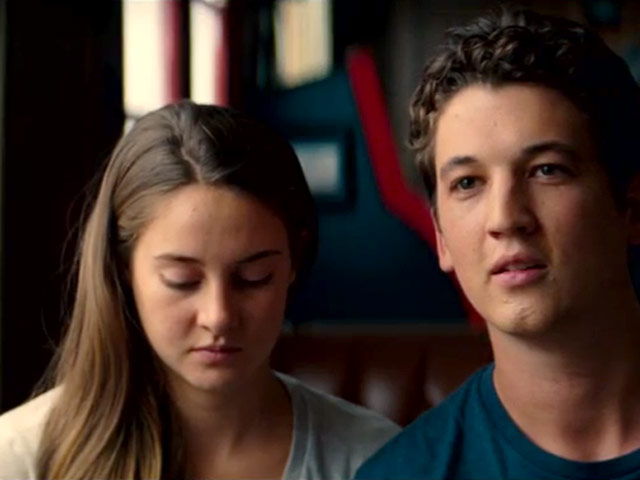
Now, before we go too far into this, let me say what a joy it is to watch Teller and Woodley riff off each other. The lines are established, sure, but the way they stumble, falter, eke out, and fly from each other's mouths colliding in awkward crashing cadences and emotional ranges between feigned self-assurance to tip-toeing fear is truly something to see and enjoy. Both actors are top of the line working with the other actors, but, with each other, there's a yearning sparring that feels like the magnetism of puppy-attraction. If it ain't convincing as love, it sure is convincing as fresh conversation that feels real (and spoken for the first time), and is as fine as any movie bantering I've seen in years between young actors.*
So, with all that raw talent going for it,** where does the movie go? There's been so much writing here, one worries that too much is going to be given away, and any particulars in subject matter and how it is revealed will result in the spoilage of any sort of subtle enjoyment of the film and how it subtly ingratiates and glad-hands you into darker territory. It skirts Afterschool Special territory, but does it in so circumspect a way that you may not even be aware of The Problem, until you are confronted with it in the same way Sutter confronts it, in reflection, but he sees it, not when he looks in the mirror, but when he is especially focused on something other than a short-term goal, but rather on the realization of a dream. Sutter has no depth, except in what he avoids, and he only realizes it to his horror and imagined shame. The Spectacular Now includes author Tim Tharp's original ending for the book, but the screen-writers give Sutter an "out" to end on an up-beat note in the grand Hollywood "bauble" tradition, but at least they take a page from Mike Nichols' play-book, and don't make it a comfortable one, but leaves him...and the audience hanging on a precipice, leaving the Spectacular Now and entering an Uncertain Future.***
"Stumble, falter, eke out and fly..."- Teller and Woodley


* Come to think of it, they remind me of the Andrew Garfield-Emma Stone hemming-hawing in The Amazing Spider-man.

** And I haven't even told you about Kyle Chandler, who plays against "type" and does it so unnervingly well, you want to start a barroom brawl with the guy.

*** The view from the "Now:" Talk about an uncertain future—Marc Webb got bumped off the "Spider-man" series after the under-performing Amazing Spiderman-2, Teller gained a more reputable role in Whiplash and doused it with Fantastic Four, and Shailene Woodley has very nearly wasted her talent with the "Divergent" series (Teller has co-starred in those). These are all talented people—what are they doing wasting their talents on "tent-poles?"

Friday, July 24, 2015

The Spectacular Now

Written at the Time of the Films Release.

The Sins of the Sons of the Father
or
What if the Hokey-Pokey IS What It's All About?

(500) Days of Summer was one of my favorite movies a couple years back, a smart combination of naiveté, winsomeness, and cynicism about the whole "love" thing...especially from the needy/selfish male point of view, and was very charitable to the elastic female point of view...something you wouldn't find in your basic Woody Allen (or any male-written) love story.

The director, Marc Webb is off (er...) web-slinging on the re-booted "Spider-man" series, but writers Scott Neustadter and Michael Weber have done a new screenplay of Tim Tharp's National Book Award finalist The Spectacular Now, directed by James Ponsoldt, who's less flashy than Webb, a little less assured technically (especially in the sound department), but has a great casting eye as he's gotten a spectacular ensemble cast for this film.

When we first meet Sutter Keely (Miles Teller, who is brilliant in this, his face morphing between man and boy with split-second speed), he's filling out a college entrance question: "Describe a misfortune, hardship or challenge in your life: How did it affect you, and what did you learn from it for the future?"  Sutter doesn't even hesitate: "Dear Dean of Admissions: Up until yesterday, I had the best fucking girlfriend in the world.  Sorry, I probably shouldn't say 'fuck' in this..."


It's true.  Sutter's just gone through a bad break-up with Cassidy (Brie Larson), who, in his eyes, was the perfect girlfriend and they were the perfect couple, the hit at every party (and there are a lot of them), but it's all come crashing down when she says "I'm done!" over Sutter helping his buddy get a girl, by giving a couple of fellow high-schoolers some of the ice-cooler'd beers he regularly stashes in his trunk.  Sutter's good for that, but for Cassidy that's not good enough. They're through, so over and done.

Miles Teller, the breakout performance of The Spectacular Now
Cut to the title.  Next thing we know, we're looking up at a sun-blocking silhouette saying: "Hey!  Hello?  He-lllooo!  Oh my God, you're alive!"

It's 6 am.  He's passed out on a lawn of a house he's not familiar with, his car is nowhere to be found, and standing over him is Aimee Finecky (Shailene Woodley, proving that her instinctually felt performance in The Descendants was no fluke), who is out doing her Mom's paper route, only to find a body on the way.  They know each other from school.  Aimee helps Sutter up, and the two continue the route with two missions: delivering the papers and looking for his car.  The goals are short-term, which suits Sutter just fine.


It's clear early on that Sutter is a boat without a rudder (or even a paddle), and the women in his life, be they his Mom (Jennifer Jason Leigh, welcome back), Cassidy or the new Aimee, keep him focused and on the true.  Or as true as Sutter will let himself be (and Teller has a wonderful ambling gait, which I started calling "The Sutter Strut" that is both assured yet not going altogether fast, keeping anything approaching at a mesured pace).  Fairly early on, we learn that Sutter may indeed be "the life of the party," but he's also considered a flake and unreliable.  A heated discussion in the family kitchen produces a "Sometimes, you remind me so much of your father..." comment (and not in a complimentary way) from his mother and he's annoyed because a) his father having left the family early with no subsequent contact leaves a void about how that should be taken; and b) he harbors the notion that the reason Dad's gone is that it's Mom's fault, all evidence to the contrary being missing.  In the meantime, and for the moment, he is spending his critical senior year in High School marking time, regretting Cassidy and "hanging out" with Aimee.

"Dude, she's not a rebound!" he assures a buddy, but it's pretty clear she is, at least at the start, using her as an excuse to go see Cassidy at a kegger. It's a quid pro quo kind of arrangement: she can help him with algebra, he up's her social quotient—she's never had a boyfriend and he's an established arm to hang on. But before long, the conversations start to get deep, the facile conversations ("what's your 'thing?'") turn personal, the "maybe-I'll-see-ya's" become orchestrated "bump-into's" and the period apart starts to become a noticeable measure of time.  They're starting to fall into something: for her it means someone to share her plans for the future and college; for him, a long-term commitment is asking her to the prom.
She already knows what he's just beginning to suspect.

Now, before we go too far into this, let me say what a joy it is to watch Teller and Woodley riff off each other.  The lines are established, sure, but the way they stumble, falter, eke out, and fly from each other's mouths colliding in awkward crashing cadences and emotional ranges between feigned self-assurance to tip-toeing fear is truly something to see and enjoy.  Both actors are top of the line working with the other actors, but, with each other, there's a yearning sparring that feels like the magnetism of puppy-attraction.  If it ain't convincing as love, it sure is convincing as fresh conversation that feels real (and spoken for the first time), and is as fine as any movie bantering I've seen in years between young actors.*

So, with all that raw talent going for it,** where does the movie go?  There's been so much writing here, one worries that too much is going to be given away, and any particulars in subject matter and how it is revealed will result in the spoilage of any sort of subtle enjoyment of the film and how it subtly ingratiates and glad-hands you into darker territory..  It skirts Afterschool Special territory, but does it in so circumspect a way that you may not even be aware of The Problem, until you are confronted with it in the same way Sutter confronts it, in reflection, but he sees it, not when he looks in the mirror, but when he is especially focused on something other than a short-term goal, but rather on the realization of a dream.  Sutter has no depth, except in what he avoids, and he only realizes it to his horror and imagined shame.  The Spectacular Now includes author Tim Tharp's original ending for the book, but the screen-writers give Sutter an "out" to end on an up-beat note in the grand Hollywood "bauble" tradition, but at least they take a page from Mike Nichols' play-book, and don't make it a comfortable one, but leaves him...and the audience hanging on a precipice, leaving the Spectacular Now and entering an Uncertain Future.
"Stumble, falter, eke out and fly..."- Teller and Woodley


* Come to think of it, they remind me of the Andrew Garfield-Emma Stone hemming-hawing in The Amazing Spider-man.

** And I haven't even told you about Kyle Chandler, who plays against "type" and does it so unnervingly well, you want to start a barroom brawl with the guy.

Friday, June 13, 2014

The Fault in Our Stars

Dear Brutus 
or
Wasting Away (Again) in Augustus-World

Alvy Singer: [addressing the camera] There's an old joke - um... two elderly women are at a Catskills mountain resort, and one of 'em says, "Boy, the food at this place is really terrible." The other one says, "Yeah, I know; and such small portions." 
Annie Hall, 1977

I never read the book by John Green (but I want to now, which is as high a compliment as you can pay any film adaptation), so I can say I walked into The Fault in Our Stars without prejudice. With that lack of preparedness, I would not miss my favorite lines, or shake my head that the actor I imagined in my head while reading isn't performing the role. Any potential aspect that might be terribly missed or changed is unknown. My admiration for it is remarkably clear-eyed (no, I didn't cry, but was moved...more by the writing than the situations), and came away from it with a healthy respect, although it belongs to a genre I'm always suspicious of, and slightly cynical towards—the movie love story.
But The Fault in our Stars is about so many other things than love, even as it broaches so many aspects of it.  It is also about existence and the melancholy contemplation of its loss, as its young adult protagonists, very early in their lives, confront the thoughts and fears of someone who might be middle-aged or older. They are spinning through life far too fast, suffering through it, and sad that it will end so quickly.


Such small portions.

Hazel Grace Lancaster (Shailene Woodley) has thyroid cancer that has spread to her lungs. In remission, she is still scarred from the disease, dependent on supplemental oxygen to keep up her strength (which isn't much—it's a struggle going up or down stairs), a nasal cannula perpetually in her nostrils, more embarrassing than braces, dragging behind her an oxygen system like her own private black cloud.
She's depressed. Her Mom (
Laura Dern, her best role in years) is worried. "Depression is not a side effect of cancer," 
says Hazel diffidently. "It's a side effect of dying" But, she is depressed, in ways she can't even tell her parents. "I'm a grenade!" she protests at a later point in the movie, capable of taking other people out, when she finally succumbs. This tears at her soul. She remembers the trauma of her parents when she was thirteen, a heart-beat from dying, and fears the next moment. She obsesses about a favorite book, "An Imperial Affliction," written by an expatriate recluse about a young girl with cancer, and her interest is in...what happens after to the other characters.
So, she is shuffled off to a cancer support group at a local church, led by a very earnest young man (Mike Birbiglia) who might not be the best choice to lead. One day, one of the group's members Isaac (Nat Wolff), who has lost an eye to cancer and will soon lose the other, brings along his friend Augustus West (Ansel Elgort) a former star basketball player in school, who's lost his right leg to cancer, but has a decidedly different attitude about life and the disease. He and Hazel lock eyes in the session in what one would call a reverse of a "meet-cute" (a staple of romantic comedies)—he surmises her with a smiling assumption; she parries with a cocked eyebrow challenge dialed all the way up to "Intimidate." They bicker wordlessly for a time, in a lovely display of story-telling without dialog. If they have one thing in common, it's that they think the support group is a crock.


The thing is, it's where they find the most crucial support they need—in each other.

Augustus is cocky ("I'm part cyborg, which is awesome?" he jokes at the group by way of introduction), winning, challenging—and with definite quirks that have been well thought-out to impress. He's a cancer patient who walks around with a cigarette in his mouth. The idea repulses Hazel: 

Hazel Grace Lancaster: Really? That's disgusting!
Augustus Waters: What?
Hazel Grace Lancaster: What? Do you think that is cool? Or something? You just ruined the whole thing.
Augustus Waters: The whole thing?
Hazel Grace Lancaster: Yes, this whole thing.
Hazel Grace Lancaster: Even thou you have freaking cancer, you are willing to give money to a corporation for a chance to acquire even more cancer? Let me just assure you that not being able to breathe? SUCKS. Totally disappointing. Totally.
Augustus Waters: They don't kill you unless you light them. And I've never lit one. It's a metaphor, see: You put the killing thing right between your teeth, but you don't give it the power to do its killing. A metaphor.
Neat idea. As I said, well thought-out. But, Augustus' brave little smoking metaphor betrays an insecurity, and is its own kind of crutch. He'll never light a cigarette, but he'll depend on them just as much as if he smoked two packs a day. Augustus is a brave face. Hazel Grace is an old soul. Together they make one healthy person, staring into the abyss.

To say any more will betray a lot of really good stuff—better than you'd find in most young adult fiction—stuff that's quotable enough that it sounds like a cliche the moment it's out of somebody's mouth (one of them at the bottom of this is lovely, even if it's going to be on a Hallmark card within the year). You get the sense that these kids are kids, despite having a familiarity with the most tongue-twisting of medical jargon, and the philosophical world-view of a pensioner.
The script, out of Green, by way of Scott Neustadter and Michael H. Weber (who wrote two of my favorite "young adult" movies of the past few years
(500) Days of Summer
and The Spectacular Now) touches subjects and grazes metaphors (other ones) of these two kids trying to eke out an existence despite not only the traps of their bodily handicaps, but of the spirit, as well. It is a rare movie that considers the concept of survivor's guilt and builds a character arc around it that embraces life, the moment, and the preciousness of it all.

But, it is not a "weepie."

It's that smart.

"Okay"