Showing posts with label Sean Patrick Thomas. Show all posts

Wednesday, November 16, 2022

Till

He Whistled at a White Woman
or
"Bo, Be Small Down There"
 
The term "galvanize" is defined as "to subject to the action of an electric current especially for the purpose of stimulating physiologically" or "to stimulate or excite as if by an electric shock."
 
I bring this up, as Till—the story of the lynching of 14 year old Emmett Till in 1955 and his mother's struggle for justice against the "individuals" that murdered him*— ends with a long list of story updates and the first one is that the murder "galvanized" the civil rights movement leading to the 1957 Civil Right Act. 

Sometimes in our world of (now) 8 billion people, the numbers become a little staggering and we tend to lose people in all the statistics. 6,636,235 Jews killed in the Holocaust, 1.07 million killed by Covid, 4,742 dead by lynching (that we know of), 480,000 deaths by smoking, 42,915 traffic deaths in 2021. That's a lot of bodies. But, if you think about just one...just one individual, one life, then maybe...just maybe...the numbers become less staggering and maybe empathy allows one to imagine that one single, solitary life.** 
Mamie Till-Bradley (played magnificently in Till by Danielle Deadwyler) didn't know that at the time. All she knew was that she had sent her son to see family in Mississippi, and despite repeated warnings, admonitions and entreaties to "be small down there," the youngster (played by Jalyn Hall), who grew up in Chicago because his Mother "wanted him to be a boy and not have his childhood taken away from him" walked around as if he had possibilities in a place where black hopes went to die.
I won't go into the details—you can look them up in the "Emmett Till" link above (and if I recount them it will turn into a frustrated screed), but the movie does an excellent job of staying true to the facts and the intricate details of what happened and the nightmare that Bradley went through when her son disappeared, when his mutilated body was found in the Tallahatchee river, when there was a concerted effort to not return the body to Chicago, her subsequent decision to have an open casket funeral to show the public—and the press—the torture the boy endured, and the subsequent mockery of a trial held in the jurisdiction for the men known all too well to have committed the crime. They were acquitted after an hour of deliberation by the all-white male jury (I remember that one of the jurors said it would have been shorter if they didn't stop for sodas).
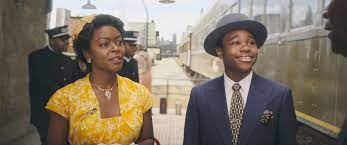
But, the nation noticed, even if the Mississippians merely shrugged and said "so what?" The accused men then admitted to the crime for an interview for Look magazine (for which they received $400), as the double jeopardy rule kicked in. One looks at what happened and one can only shake their head at the malignant cock-sure hatred exhibited during the trial, seeing a rampant injustice done at the top of its braying lungs. It makes one want to take action. It does indeed galvanize.
So...how is the movie? Well, with a lot of support from EON Productions (the James Bond people), the movie has a lot going for it. The direction—by
Chinonye Chukwu—is fascinating, reminding of the precise machinations of Hitchcock, the camera at that perfect spot to lend a pictorial commentary on what's transpiring on-screen. It doesn't prettify with flattering angles and subtly manipulates without relying on tricks, barely even calling attention to itself. There is one verrrry slow "Vertigo" shot (that's brilliant) and some very subtle CGI work for the purposes of distancing figures from the background. It's old school film-making, but what it's recording is far more heart-rending than anything Hitchcock shot.
And that's in the performances. It's going to be a sad award season if Deadwyler doesn't get any bling for her performance, which is simultaneously raw and calculated. She carries the movie on her shoulders—no small feat—and traverses the many journeys from shock to steely resolve that Till-Bradley must conquer to make just another lynching injustice into a personal crusade. The most precise definition of galvanize is "to coat iron (or steel) with zinc" in order to carry an electric current. Both her performance and the film itself fit all those definitions to a "T". 
* Non-Spoiler Spoiler Alert: It happened in Money, Mississippi, so she didn't get it and there wasn't any...justice, I mean. 
 
** This will answer any questions about "why the girl in the red coat?" in Spielberg's Schindler's List. 

Tuesday, April 13, 2021

The Fountain

Written at the time of the film's release...

Tapping a Dry Well

First off, this is the best-sounding film I've heard from 2006, with a subtle, supple sound design that makes great use of the stereo field to direct your attention. Secondly, it's one of the most beautiful--a truly different looking set-bound "green-screen" film that doesn't go for vast (and busy) pixilated papier-mache-feeling vistas ala Sky Captain or The Lord of the Rings. There is a perpetually claustrophobic feel to it, despite the exotic locales that extend from an ancient Mayan temple to "the vast reaches of space."

And yet....one expects great things of a Darren Aronofsky film—not just in the images, but also in the ideas. Both Pi and Requiem for a Dream were visually and thoughtfully stunning, so one wanders into The Fountain expecting to be transported to new places, not only visually and aurally, but within the mind as well.

That's why I found The Fountain very disappointing. Though trying to say something profound, it offers up an idea so obvious that it occurs to me only every time I sit down for a meal, and that is: Out of Death Comes Life. To make its point, there are three time-lines in the film: the first takes place in the present day as a researcher named Tom studies treatments of brain tumors in a frenzied race to save his wife Izzy's life. He is so bent on finding a cure that he loses all the precious moments he could be sharing with her. 
Izzy is writing a fanciful book of a Spanish explorer named Tomas (wait, wait...don't get too far ahead yet. I mean, you're right. it's that obvious, but bear with me for a couple more sentences) who invades a Mayan tribe trying to find a fountain of youth (which is actually the sap of a specific tree) for his doomed queen Isobel—the story's a sort of parallel-o-gram to the researcher to wake up and see what he's missing. 
The next time-line features an older Tom, beneficiary of his research that has found the secret of long life (which involves the bark of a certain South American tree), in space-transit to restore his wife...from a tree...by means of the energy of a star (Xibulba) that figured in the Mayan legend of the explorer...well, everything relates--all the elements fall back on themselves in a self-referential heap.
* 
All the Tom's of the film (portrayed by
Hugh Jackman) are after Eternal Life in some form or another for their Queens...but mostly for themselves, while the Isabel/Isobel's (played by Rachel Weisz) know they will never achieve it. It takes him a near-eternity to learn that life is an eternal process (only not individually!) and that death is a necessary ingredient for it. 
The only original idea in the film is to state that to aspire to immortality is, rather than overcoming death, to deny the process of life and renewal. The idea
should be profound, but it comes across as simplistic...and obvious. And dramatically inert. The tag-line for the film is "What If You Could Live Forever?" and the answer appears to be "Then You'd be a Selfish Bastard!"

Still, there is a sense of relief in, for once, seeing a film where death is the inevitable conclusion and you don't start whispering "So DIE already!" underneath your breath (curiously, part of the gorgeous sound-design has the film saying it for you...though not those exact words...frequently through the movie), but it did plant the seed of Elton John's "The Circle of Life" in my head for days for which it must be held accountable. And needless to say, The Fountain won't be at the top of the NetFlix list for the Schindler household.

The View from 2021: Aronofsky has gone on to make The Wrestler (which we'll re-post a review of tomorrow), Black Swan, Noah, and mother! and I'll still go to see any of his movies in a theater because even if he doesn't deliver on story, he does deliver on image, making him one of the more interesting film-makers working. And when he delivers on story...well, the movie will haunt you for days, maybe the rest of your lifetime. Aronofsky is one of the really good ones, even if individual movies are less than satisfying.

* The Fountain had a troubled production history. Millions of dollars were wasted in the first attempt at it (when it starred *shudder* Brad Pitt and Cate Blanchett—they would subsequently star in Babel and The Curious Case of Benjamin Button). One can only wonder if, when re-started with half its original budget, whole sections of the screen-story that might have given it depth, were ash-canned (I haven't read Aronofsky's graphic novel, which ala Neil Gaiman's "Signal to Noise" might be closer to his original vision) which is a pity. But I don't know. Aronofsky was supposedly inspired to attempt this film by The Matrix, which is just one more thing that overrated geek-flick needs to answer for.