Re-Writing History Re-Writing the Future
or
"Saved Three Billion Lives. Enough of a Resumé For You?"
James Cameron is back to the Terminator franchise, the one he started way back in 1984, now credited as Executive Producer and Story-Author of Terminator: Dark Fate, which basically ignores the other franchise movies after Terminator 2: Judgement Day no matter how much or how little they featured Arnold Schwarzenegger and serves as a direct sequel to Cameron's Judgment Day—rubbing out all of the three movies that have come in-between.
Which makes Cameron a Terminator of sorts behind the camera.
Basically, he's spiffing up the timeline because it WAS getting a little confusing—now is it Linda Hamilton or Emilia Clarke as Sarah Connor?; and fer pity's sake, how many JOHN Connors have there been—Christian Bale or Jason Clarke or Nick Stahl or Ad Infinitum? The series has had more reboots than any other for such a short expanse of existence, and for all of that, the future still looks the same in all the movies—it's only the present that keeps changing.
Except, of course, for Arnold. It seems you can't make a "Terminator" movie without him, even though it's becoming increasingly clear and inevitable—like sand through the hour-glass—that maybe they should...IF they're going to keep making them. And unless they start doing something fresh with the concept besides merely a rock'em-sock'em robots display, there is no reason to.

Dark Fate starts with a reprise of a video of Sarah Connor (Linda Hamilton, this time) from Judgement Day recounting her vision of the nuclear holocaust that will destroy humanity, ending with her freaking out about "anybody not wearing two million sunblock is going to have a bad day." Cut to 1998. It's three years after the events of Judgement Day, Skynet and Cyberdyne Systems have been eliminated and the future is safe (despite what the other three films say). Sarah Connor and her son John are living a peaceful life in Guatamala...when suddenly a T-800 (Schwarzenegger model) appears and shoots John, killing him. Guess there were some left-over T's hanging around. Well, if the other three movies weren't irrelevant before, they certainly are at this point.

Cut forward and a new terminator shows up from the future—this is Grace (Mackenzie Davis), a cybernetically enhanced soldier, who seeks out Daniella Ramos (Natalia Reyes) because...plot. Grace is teleported to protect "Dani" who will become a resistance fighter against the new future threat to humanity—LEGION—which will be a part of an AI defense system that has gone out of control. At the same time, another terminator (Diego Luna) has been sent to kill her, and this terminator, the REV-9, is a hybrid construct made of a liquid metal metal body supported by cyber-endoskeleton, allowing it to separate and attack from two fronts. Not sure why they didn't start out with those, instead of with the T2 T-1000's.

The REV manages to wipe out Dani's family (as is the norm for terminator movies, it seems), oozing himself into the form of Dani's father in order to invade her work-place in Mexico City, where the security must be a little lax. Why? Because Grace manages to get there, too—NO METAL DETECTORS✅—to stop the evil cyborg from taking the kid out and making it a 30 minute movie. Just one more reason to hate terminators.
Grace and Dani escape from the Rev and there ensues a chase across one of Mexico's more empty highways where enough mayhem happens that you'd think there'd be some sort of traffic-jam that would halt travel for miles. I mean, that's how it usually happens. But, instead, there are long expanses of open asphalt for there to be a lot of kineticism with relatively little impedance to momentum or contained property damage.
And, just when things look bad for our heroes, they unleash the deus ex machina, with the exception that she's not a machine, it's Sarah Connor—who's about as anti-machine as one could get—bad-assing her way out of an Land Rover and packing a lot of heavy heat. Ratta-tatta-BOOM. Bye-bye, terminator. Hasta la vista, ba-bies.
 |
| Ratta |
 |
| Tatta |
 |
| Uh-huh... |
How the hell does Sarah Connor show up just in the nick of time-travel? Well, since the death of her son and the inevitable nervous breakdown (I assume if we want to inject some reality into this movie), Sarah has been a one-woman terminator-terminator, tracking down T's that have been teleported in the interim (although with John dead one wonders...why?), directed by mysterious text messages with the coordinates of each arrival and a haunting signature—"For John".
In their brief down-time (while the Rev repairs itself—and a brief aside here, how do they expect to kill them?), Grace and Sarah compare futures—between the deposed Skynet and the up-coming LEGION—and Grace does some finagling with Sarah's text messages, tracing them to a location in Laredo, Texas. They go off the grid, and hop a freight-train carrying a large number of immigre's crossing the border to Laredo to the source of the texts.
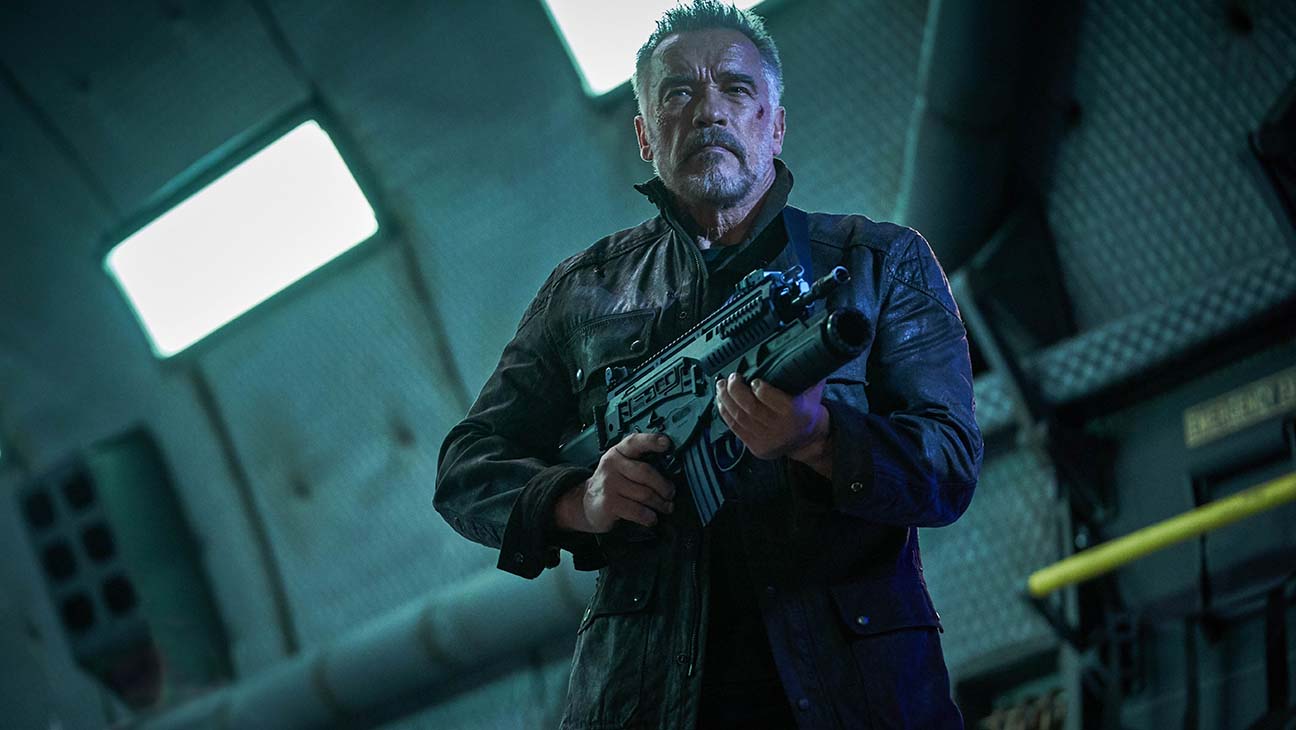
There, they find Carl (played by Schwarzenegger), who is a drapery and interior specialist with a wife and son and a whole lot of of weaponry stashed in the shed. Carl turns out to be the T-800 who killed John Connor.
Let's take a moment to look at some distracting pictures while you ponder that concept.
Still with us? Okay. Carl's a terminator. He's also kinda crusty-looking, losing his hair, has a gray beard and a bit of a gut. Bear in mind, he's a robot, kids. Is the T-800 artificially aging him/itself to fit in and to not draw suspicion (he's Schwarzenegger, so, of course, he's always going to draw suspicion). Then, why is he out in the public as an interior designer? Does his wife wonder about his lack of expression and modulated emotional range—not to mention the occasional clanking, grinding sounds he makes? Does this make any sense whatsoever, except as comic relief?

I guess Cameron insisted Schwarzenegger be in this, but...wow...there's a lot of lame explanations piling up to explain his presence, and a serious lack of owning up to his appearance. Replacing the real guy with a CGI replica would have been more expensive—although one is used in the earlier sequence—but it might have spared a lot of stupidity that would need to be explained away or, as this movie does, just ignores.

And for me, this is where Terminator: Dark Fate goes completely off the metal rails on multiple levels. We are expected to believe that the well-armed Sarah Connor would work alongside the very terminator that assassinated her son in the coldest blood without being constantly tempted to direct it to the nearest compactor. We are also expected to believe that one of these future killing machines would be capable of developing a conscience—don't talk to me about T2, as that model was programmed to PROTECT John Connor. On top of the issues of a terminator leading a quiet life of retirement after completing its mission, these issues make the story just too difficult to digest.

Add to this, Tim Miller's directing style. One would think, after his work on Deadpool, that the man was a natural for action movies. But, the work he did on Deadpool 2 was pretty clunky. Still, one would think that given good material under the auspices of James Cameron, you could expect a bit more expertise. After all, Robert Rodriguez, who is no slouch in the action department, did some good work with Cameron on Alita: Battle Angel. But, Terminator: Dark Fate looks sloppy and slap-dash, especially in comparison to Cameron's films. Cameron is an engineer, as well as a director, and he has a way of putting together set-pieces that are large and operatic, and by that I mean, his presentation is to piece together big moments, setting them up and paying them off in spectacular, memorable fashion. You remember key moments in Cameron's movies because you were prepared for them by the director, that support buttressing the pay-off moments, making them for more satisfying when they occurred.

The action is bombastic and over-the-top in Terminator: Dark Fate, designed to occur at regular intervals over the course of the movie, but they hammer away with no sense of rhythm and no sense of relationship or place; what should have been an amazing donnybrook in the hold of a transport-plane has you trying to keep track of the characters while they're being thrown around a fairly simple cylindrical structure. The trouble is it's staged, shot and edited in such a way that you don't know who's doing what in what sequence and you lose track of individual characters and what they might be doing in the situation to get out of it. There's no suspense and there's no integration—there's no story-telling, just effects, and ultimately, it's that constant thrumming of consequence without the modulation of character that makes this entry feel less like what Cameron intended—a continuation of his work from T2—and more like the weaker entries in between that he was trying to erase.
There's a terminator-like lesson in there somewhere amidst all the twisted metal and drone-like hammering. Something about repeating history...even if it comes from the future.
 Re-Writing History Re-Writing the Future