Showing posts with label Lynn Collins. Show all posts

Wednesday, November 17, 2021

X-Men Origins: Wolverine

Noooooooo! Written at the time of the film's release....

Shmukt!: Claws for Alarm
   
When the X-Men movies lost its chief stylist Bryan Singer to do Superman Returns it was a double disappointment. X-Men III: The Last Stand was the most expensive movie ever made—at the time), and looked terrible. Top-heavy with stars that not only bloated the budget but capsized the script to fulfill their demands, it brought the X-series to a sad ending, x-hausted, x-cessive, and x-cremental (while Superman Returns felt like going to The Church of Kal-El and Klan).
 
Time to re-boot, so here we have, rising as he always does from his own ashes, "Wolverine Begins" with Hugh Jackman reprising his break-out role. It's a smart move. Jackman was "the" star of the "X-men" movies and after the first, they were tailored for him, like his strategically ripped wife-beaters. One is hard-pressed to think of another movie where he is used so effectively (and succeeded at the box-office).
But this is a curious re-boot. At a time when most super-hero movies are dusting off the cliches,
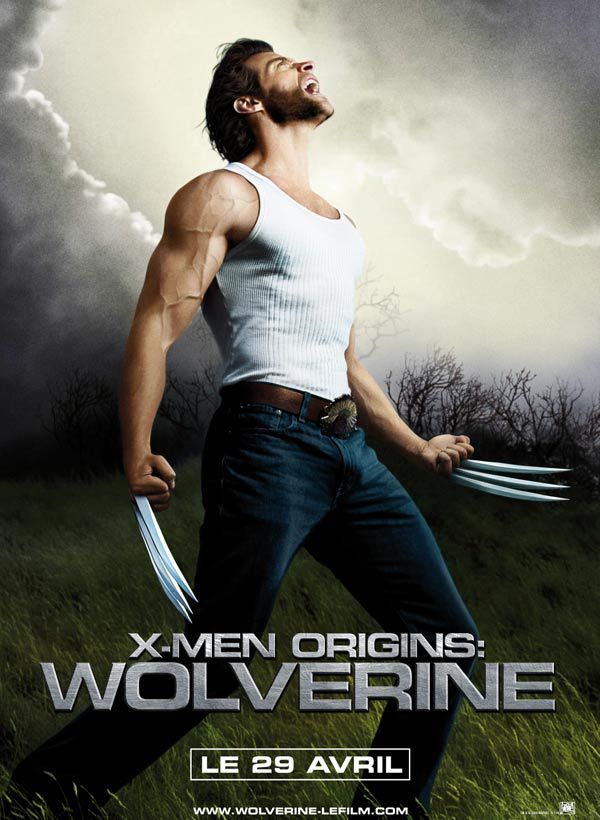
X-Men Origins: Wolverine (the title says it all) coats itself in the dust and the muck and the mire and revels in it. For instance: there is not one, but two scenes where Jim Logan (Jackman) looks up at a conveniently omniscient overhead camera and yells his frustration to the skies and his x-communicating God
.
 
Are you kidding me? Hasn't that shot been decommissioned after all the easy laughs it's garnered on "The Daily Show?"**
It has. But nobody told director
Gavin Hood (Rendition). He seems unconcerned about cliches or recycled material (or "sell-past" dates), as the movie lurches like lead villain Sabretooth (Liev Schreiber, but it was Tyler Mane in the original where they didn't know each other) bounding from one bad idea to the next, linked as they are by that most mainstream of transitions—the one-to-one dissolve. We get a lot of them in the Main Title. After the Bruce-Wayne-Meets-Oedipus childhood trauma opening, Hood shows the brothers Logan fighting in war after war, guns fading into guns and helmets into helmets. It's quite "artily" if unimaginatively done,* but Hood keeps using it until you start looking for the detail he might use in the next transition. Flames? Ocean waves? How about a dusk to dawn transition? That hasn't been done since...well, since I started writing this.
A lot of the problem is that
Marvel—"The House of Ideas," as it likes to trumpet—has culled so much from other stories that the whole Wolverine opus reads like a Reader's Digest Omnibus of Comic Literature. Logan gets recruited to join a Dirty X-Dozen black-ops unit, then declares himself "Wolverine no more" and becomes a lumberjack (and that's okay) until his school-teacher gal-pal is killed, and he swears revenge (cue the overhead camera and the underhanded cliche). 
He then submits to a "Frankenstein" experiment under the control of his former superior Stryker (Danny Huston, prequeling for Brian Cox), that coats his skeleton with indestructible adamantium. He escapes Stryker, and hides out with an old farm couple, the Kent's...er, no, the Hudson's, before being attacked—again—and hooking up with Gambit (Taylor Kitsch) for a full assault on the villain's headquarters, where like Spartacus, he leads a "mutie" revolt, that includes a young Scott Summers (Tim Pocock, looking like Ben Stiller rather than James Marsden). 
Ryan Reynolds' first depiction of Deadpool, an event which he never forgot and has inspired countless jokes about Hugh Jackman, as well as a very popular larky film about the character—...oh, and Deadpool 2.
 
There are lots of Marvel folk appearing (briefly): Bolt, Deadpool, The Blob, Agent Zero, and Kestrel. The inconsistency with their comic-book counter-parts will drive some fan-boys nuts (not to mention Wolverine's brylcreemed pompadour from the first two films is gone, too). This fan-boy had trouble with the fights, all based on other movies: the war action from Saving Private Ryan (by way of Crank), another based on John Woo's hyper-dramatics and aerodynamics, and another, straight out of the "Star Wars" prequels. 
So much recycled material to so little effect. Using the character's own onomatopoeia, it's ten pounds of snikt!TM in a five pound bag.  
"C'mere, Kid. Got a lousy movie to show ya!"

* If you ever want to see it done to death, check out Danny DeVito's direction of Hoffa. 

** A word of explanation from 2021: This refers to "The Daily Show" when Jon Stewart was hosting it...he'd make frequent use of an overhead shot (in moments of duress) and scream to the heavens "Noooooooooooooo!" Often they'd put a reverberating echo on it (That's how it SHOULD be done!)

*** Spoiler Alert: Good place to put spoilers, isn't it? In case you think you're missing something, you're not. There's a cameo by Professor X (Patrick Stewart reprising his role), although why is Scott (Cyclops) the only guy X was reaching out to?—seems he could have contacted all the escaping mutants (because it would have killed the suspense is why), and the by-now standard "Marvel Tag" at the end of the credits is no big deal—Wolverine at a bar: "Drinking to forget?" "No. Drinking to remember." Supposedly, there are three others. If they're all that "good," don't bother collecting them all.


Wednesday, August 9, 2017

John Carter

Forewarned is Four-Armed
or
"Men are for Mars, Women, Curvaceous"

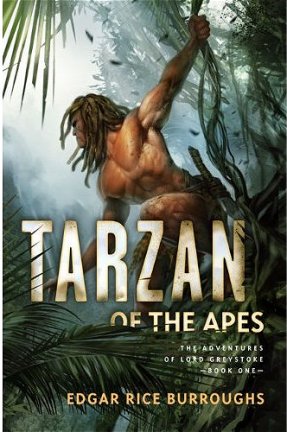
Edgar Rice Burroughs not only created Lord Greystoke (otherwise known as Tarzan of the Apes), but he created another hero who commuted between different worlds (albeit across space-time) that being John Carter, a Civil War vet, who managed to mentally displace himself from Earth of the 19th Century to the planet Barsoom—as the natives called it.

We Earthers, however, call it Mars.
 
The "John Carter" books were solid pulp (after the paper it was printed on), but they were (and are) soaring adventures, with lusty Barsoomian princesses, and warring political and tribal factions—including a race of 15 foot four armed insectoid inhabitants who were frequently at odds with the more humanoid Martians. 
 
These stories inspired all sorts of science fiction writers like Bradbury and Clarke (and scientists including Carl Sagan) and film-makers from Lucas and Spielberg to Cameron and any author whose hero leads a Walter Mitty fantasy existence on another continent, planet or Universe. 
It's the 100th Anniversary of JC's creation, and it's about time that somebody made him take the astral projection from book-paper to celluloid...or pixels—not that there haven't been attempts over the years. The books have rarely been out of print—probably inspired by the lurid covers painted by Frank Frazetta and Boris Vallejo that neatly made Burroughs' vivid descriptions real—and some sort of adaptation has been potentially in the works for the last couple of decades. Now, finally, Disney took a chance with it—although they don't seem to have a clue how to sell it—with director Andrew Stanton, one of Pixar's shining lights (directing both Finding Nemo and WALL·E).
And, hell, if they don't pull it off, making it work and seem fresh (if highly reverberant, as so many others projects in the sci-fi/fantasy field have borrowed liberally from the series for years), while also recalling the straight-faced brio of biblical epics, combined with the cheese-factor of movie serials. It's pulpy, old-fashioned, and definitely of the "white-guy-saves-the-natives" school,* but it has fun with it, playing off the duality of practically everybody in the script, reflecting the "two worlds" concepts inherent in the series.**  And why shouldn't Carter have an exploitable advantage over the Martians? The planet's lesser gravity allows him to bound like a flea across landscapes and from precipitous tower to precipitous tower (although one loses that concept when Carter is shown getting winded climbing up steep hills). 
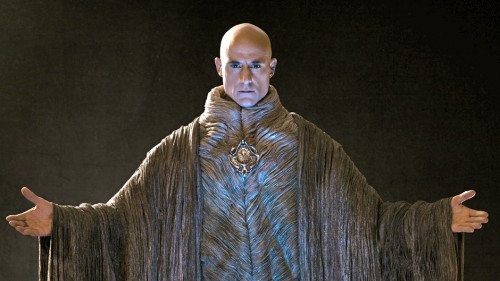
And the Barsoomian concepts of ERB-dom are in full abundance, gathering details from the series—the white apes, the Therns (the duplicitous Gods of Mars), Carter's ways of dealing with passage between worlds (and covering up his disappearances on Earth), the participation of "Ned" Burroughs in the telling of the tales, and the environmental struggles of the dying Mars (although the canals of Mars are mostly gone, Stanton and co-screenwriters Mark Andrews and Michael Chabon, have created a gargantuan crawling city of Zodanga that sprawls across the planet's surface, leaving decimation in its wake.
Yes, it's pulpy. Sure, it's cheesy. But in the same way that any romance story is, (and Burroughs wrote romance novels for men), and this is boy-hokum space romance fantasy, without much logic to it, but enough momentum and emotion to keep so many of the quibbles at bay, and Stanton has shaped it in a fine, breezy style that kicks the story along at a good clip—check out the economy he uses to make note of Carter's indefatigable fighting instinct in the film's second sequence (the first is a rousing, dis-orientingly brusque Martian air battle) in trying to escape forced re-enlistment at the hands of his former Captain Powell (the now ubiquitous Bryan Cranston), then jumping from Western tropes (filmed in Monument Valley, of course) to Bibical epic trappings, to its own weird amalgamation of the two, with a bizarre twist on familiarity. 
Where the movie roars are in the sword fights and hand-to-hand battles that bring to life Frazetta's "berserker" illustrations, that push the envelope of what can be presented in a PG-13 rating.
It's a grand ride, energetically told, imaginatively realized, with a good cast of fine actors, committed to doing it all with a straight face, and selling the fantasy, without any betrayal of the mechanics that had to go into this thing (a tough job to do that has bested others in the last few years). I've read a few reviews by some critics that strike me as rather cranky about the film being derivative (in a reverse engineering way of looking at things), but, frankly, I don't think they saw the right movie. Kill me if I ever get that sophisticated I can't have fun at something done well. To this kid, who grew up reading the Barsoom books, (as Bradbury once wrote) Mars is Heaven.

First edition depiction of John Carter and Dejah Thoris
from the initial hardcover dust-jacket
Frank Frazetta's iconic cover to "The Princess of Mars"
The production design of John Carter owes a little bit to both.

* It was, after all, written in 1912.  What's Avatar's excuse?

** Even the titular Princess of Mars has a nick-name in the film.  Carter calls her "Perfesser."  Carter's Thark name is Dojahr Sojak, but also "Virginia," after a miscommunication in greetings from Tarkus. 

Thursday, April 28, 2016

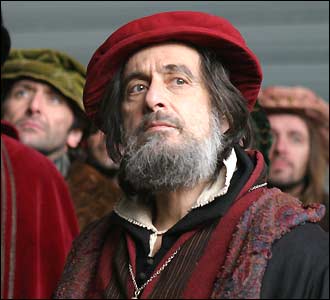
The Merchant of Venice (2004)

The Merchant of Venice (Michael Radford, 2004) Wm. Shakespeare's most problematic play for modern audiences gets a sumptuous presentation (without PC-intended cuts) in this production, the first sound version of this oft-quoted play; problematic in that, taken merely by folio content, it has a vitriolic anti-semitic tone that runs counter to its classification as a "comedie." But, director Radford, with one stroke—and, indeed, one shot—manages to restore some semblance of perspective, if not judicious balance to the piece.

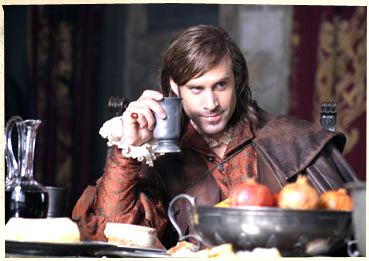
It is 14th century Venice and ardent Bassanio (Joseph Fiennes) is in love. The object of his desire is fair Portia (Lynn Collins, replacing—very well—Cate Blanchett), an heiress in the village of Belmont. But, a fool with money, he can ill afford to make the trip, and so turns to his frequent benefactor Antonio (Jeremy Irons) to lend him three thousand ducats to make the trip. Antonio, a wealthy merchant, is a bit strapped for cash at the moment—he has three ships in transit on a business venture that will surely reap great profits. 
So, the elder man agrees to guarantee a loan from whoever Bossanio can get one, and he does so from Shylock (Al Pacino), a money-lender in the Jewish ghetto of Venice. But, Shylock and Antonio have issues: the city is divided between Jew and Gentile with much tsuris and animosity between the two groups, the former frequent victims of abuse and scorn by the latter, and Shylock is miffed that Antonio undercuts his business by offering loans with no interest. So, the agreement comes with an odd rider—should Antonio default on the loan, Shylock will extract from him "a pound of flesh." Given the going rate of flesh in the meat and prostitution markets (both of which Radford sees fit to show), it seems like a pretty good rate, and with a deal in the works, Antonio, readily agrees to "the bond."
But, if there weren't complications, it wouldn't be Shakespeare: for Antonio, his ships go missing; for Shylock, his beloved daughter Jessica (Zuleikha Robinson) follows her heart, defying her father, running off with her suitor, a Gentile, and converts to Christianity. That news is devastating to Shylock, who, when the loan defaults, takes Antonio to court to get his due, and some measure of satisfaction for the wrongs that have been meted out upon his people.
It's extraordinarily well-done, with the context of Venician abuse of the Jewish community made explicit and evident, and the feelings displayed, especially during the hearing, angry and ugly. But, the players' interpretations are all-important here, especially Pacino's. His Shylock has hurt etched into his eyes, and the actor's power is never more evident as when he's displaying grief—Dustin Hoffman wanted this role, but one can't imagine Hoffman capable of the towering rage—especially when his voice reaches the upper registers—that Pacino can command. One never loses the context of past humiliations against Shylock here, and that, now, this time, he will exact his revenge. Pacino's Shylock is sympathetic, even, if, during the trial, he is cast in the role of "villain."
It is at the end, though, where Radford has his bond. While the citizens of Venice, wink and cajole and tease and wench, there is a single shot of Shylock, presumably in Temple, as his brethren leave him, and, in a cinematic move that seems to recall Pacino's Michael Corleone at the end of The Godfather, but more appropriately, John Wayne's racist Ethan Edwards in The Searchers, the doors of the Temple are shut on him, first one, then the other, isolating him. The message is clear. His own tribe is shunning him. The root of it is not that he is "The Jew," but that he is uniquely Shylock, and his own character, not his race, not his religion, not anything but himself is the cause of his implacability. And it is rejected by his community. The fault, dear Brutus, lies not in our stars (or our God) but ourselves. The quality of mercy certainly is not strained. It can be given, but if it is not offered in kind, it can be taken back.

And that, my friends, is a true bond, that no court can recognize.
I would be far more sanguine if some similar fate awaited if the spitters and sneerers and anti-semites among the goyim revellers received a harsher fate than some humiliation by their women-folk, but the play's the thing. And one brushes up their Shakespeare at their peril.