Showing posts with label Liev Schreiber. Show all posts

Thursday, September 7, 2023

Repo Men

Written at the time of the film's release...

"I Sold My Soul to the Company Store"

Who is Miguel Sapochnik and why haven't I heard of him before?*

The reason is simple—he's been attached to a lot of projects that fell by the way-side for one reason or another, not the least of which is probably studio cold-feet at risking a lot of dollars on a director whose only previous credit has been a 15 minute short ("The Dreamer," 2000).

The release of
Repo Men will, hopefully, change that. Sapochnik's sci-fi noir (based on the novel "The Repossession Mambo" by Eric Garcia, who co-wrote the screenplay with Garrett Lerner) posits a future corporatocracy (the credited "futurist" is Ben Bova) in which everything is for sale. You think unrestrained capitalism in health-care is bad now, you just wait. The scenario here is that rather than having diseased patients waiting for organ donors to supply replacement parts, manufactured items are used instead, manufactured by several bio-mechanics corporations.
A franchise called "The Union" arranges the transplants and supplies the tickers and goo-gah's to be implanted, at a cost that is extremely prohibitive. But, that's okay, there's an easy payment plan to fit any budget (the APR is 19.6%, which elicited knowing whistles in the audience). But you'd better read the fine print. After 90 days your account goes into arrears, and The Union has the right to repossess your equipment. They hunt you down, taser you (at which point they read to you that you have a right to an ambulance or any emergency medical care if you can afford it, not that it'll do you any good while stunned) and then proceed to saw, scissor, scalpel their equipment out of you (and maybe it's just me, but I find this scenario very plausible).
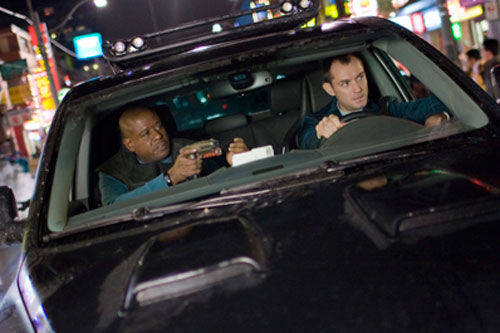
The best repo-man The Union has is Remy Stark (Jude Law, he's terrific in this, for once bringing a strong presence to a starring role), partnered odd-couple style with Jake (Forest Whitaker, clearly having fun), but Remy is getting pressure from home to get out of the repo biz and into sales, which has more regular hours and solves that nasty blood-stain problem with the laundry. The decision is made for him on one job recalling a heart, when his portable defibrillator used to stop the victim's heart back-fires and ends up stopping his.
In one of those ironies that they teach in Screenwriting 101, Remy winds up in the hospital possessed of his own ticking time-bomb in his chest, and, having a literal change-of-heart, suffers sympathetic pains with his victims and
can no longer...operate. Complications pile up: his wife, because he's now stuck in the repo job kicks him out, his weakened condition makes work harder even if he can get the gumption to start cutting, and he soon runs out of money and, yes, time.

As if there would be any doubt.
Repo Men is Logan's Run cross-stitched with Coma, and the Urban Legend of the guy in the bath-tub of ice, but it's in the telling of the tale that the movie sails through the material like a hot knife through butter. Sarcastic, caustic and beating to an eclectically quirky soundtrack (everything from Rosemary Clooney with Perez Prado to Mama Cass), the movie is rude, ironic and fiendishly funny, almost gleefully detailing the trap that Stark puts himself into, and not conceding to the squeamish in the cracking of chests, the popping of knees and the squirting of arteries (there's a protracted operation that plays almost like a love scene late in the film that had people fidgeting and crossing their legs throughout the theater). The action scenes become a bit unbelievable as the movie goes on, and steadily more blood-thirsty. Plus a third-act change of tone—the humor drops about 40% 'round about the time the fights start—hampers some of the nasty enjoyment of the thing. But Sapochnik (who started out in the art department) makes the movie go a long way on a limited budget, and his odd future hybrid—there are blimps, light-rail and overhead lines in the same shot—keeps things down to Earth. >Whitaker and Law are helped by a wonderful dead-pan performance by Liev Schreiber, and Alice Braga's third sci-fi damsel role in as many years (after I Am Legend and Blindness).
Definitely not for the squeamish, but
Repo Men is a promising feature debut for the director. The only reason it doesn't get a total rave is because of the derivative climax. It'd be nice if a science fiction movie ended with something other than a fight every once in a great while.

* 2023 Update:  Repo Men did not do well at the box-office, and there are no future features listed for him. But, don't weep tears for him, as he's been directing a lot of TV—little things like "Under the Dome," "True Detective" and a little something called "Game of Thrones" and its prequel series "House of the Dragon."


The rather witty poster campaign for Repo Men (before the tamer one with the stars appeared).

Tuesday, August 15, 2023

Taking Woodstock

Written at the time of the film's release...

"I Haven't Slept in Three Days, My Hip is Acting Up, and the Beer is Warm."/
"So...you're Good."
 
Ang Lee has spent almost his entire career showing the common humanity in the disenfranchised, whether they be the lower rungs of Class Society, gay cowboys, set-apart and -upon martial artists, political spies, and Incredible Hulks—the commonality of the different. Even with the slightly lighter touch he employs here, he does the same for Catskill Jews and Hippie culture in Taking Woodstock. Both groups are isolated and flung apart, but come together—initially uneasily, but soon in mutual satisfaction, to produce something intangible and real, that would change everything.
 
For a little while.
 
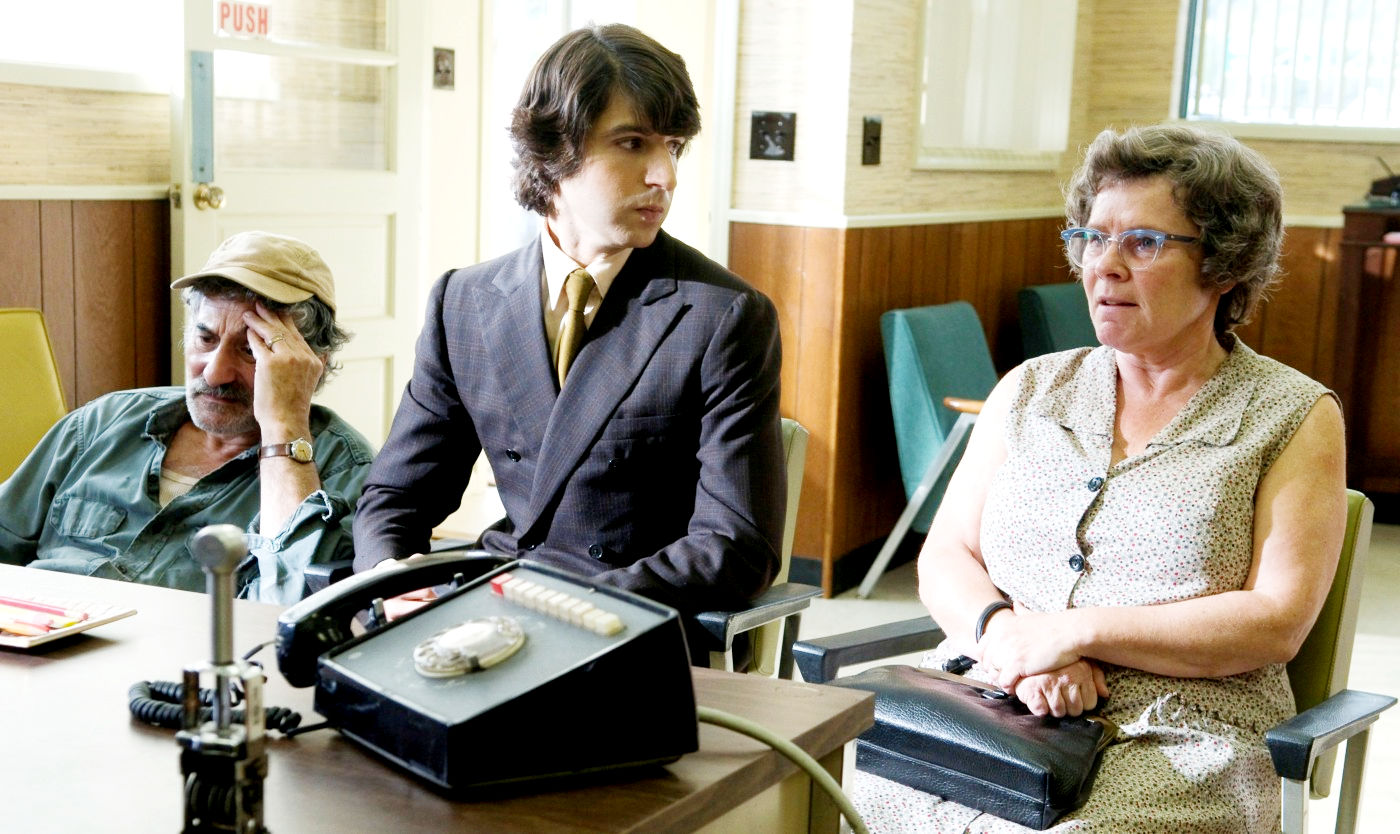
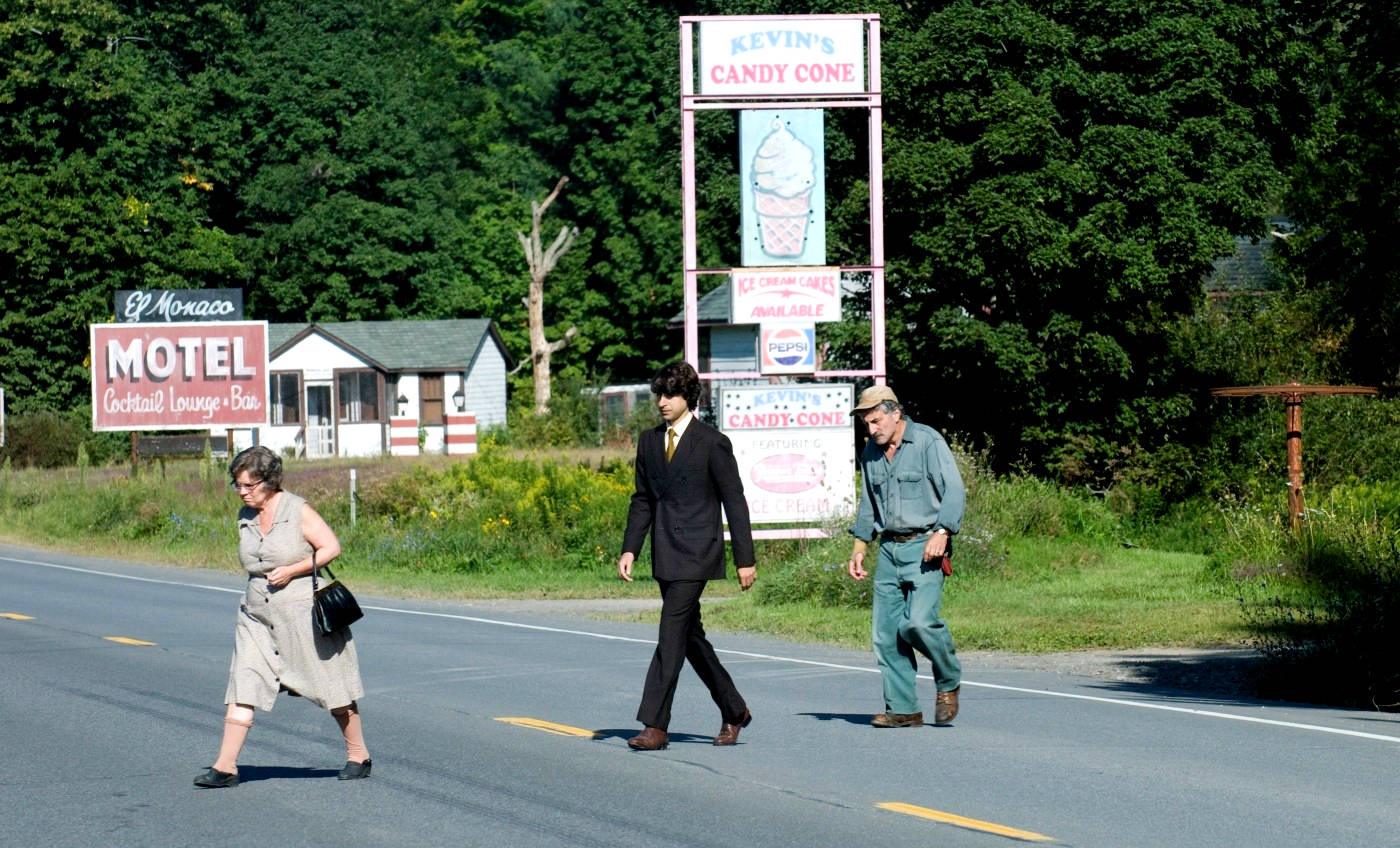
Elliott Tiber, nee Tieschberg, (Demetri Martin) is a repressed jangle of contradictions, a cosmopolitan boy lost in the woods. He's hasn't quite left the nest of his parents (Henry Goodman, Imelda Staunton) who own—barely—the El Monaco Hotel in the Catskills town of White Lake. He hasn't quite left the closet, either. A painter, he hasn't met with success in The Big Apple. He deals with the banks about the Hotel's financing, but has nothing to say about how it's run, despite trying to stir up business. He's the President of the White Lake Chamber of Commerce...which is basically just a Chamber, but in a Church basement, and little Commerce.
The one thing he has going for the Hotel is a low-key Arts Festival he puts on every year, featuring a couple folk-singers and the gonzo theater-troupe who inhabit the barn on their property. Until...the planned "Woodstock" festival with a few choice acts is driven out of their original venue by the locals, and Tiber makes it known to the organizers that he has a permit for an arts festival, a rare thing with the reluctant townspeople, who are content with the "regular crowd" and don't want much disruption. Pretty soon, the Tieschberg's and
local dairy farmer Max Yasgur (a genially subdued Eugene Levy, making more of less) are persona non grata around town as the area is crowded with a motley crew of organizers, "suits," crew-men, helicopters, expectant hippies, and, as the concert grows closer, one of the largest traffic jams in the Nation's history.
By that time, the Tieschberg's are in constant motion as their hotel is over-crowded, water-shortaged, beer-deficient and out of control, if not for the efforts of Mr. Tieschberg and self-appointed head-buster Vilma, a trans ex-Ranger with a baseball bat (Liev Schreiber, in a bad blonde wig and a Southern Belle's wardrobe, looking just like you'd expect him to, and bringing a rueful dignity to the enterprise).
As long as Lee focuses on the chaos, the film is a raucously good-natured train-wreck. Once he leaves the side-show for
Elliott's Odyssey to "The Festival," the film becomes one of those earnest little movies that tells you its important but can't show you, just as it can't show the concert going on. Oh, you hear snippets of song-track that was featured at Woodstock, but not the actual performances (as they're owned by somebody else, I guess) reverberating in the background. There's a couple of FX shots that suggest the scope of the thing (one an LSD-influenced version that shows the crowd turning into an undulating sea-scape that would be more effective...oh, if you really were on acid, say), but the whole sequence is not only un-involving, it diminishes the event...far-off, rather than far-out.
Woodstock has been romanticized so much over the last 40 years that it might better be called "Three Days of Peace, Love and Understanding and All the Crappy Parts You've Forgotten." But, Lee doesn't shy from the problems (segmented into easily focused nuggets of information through a split-screen technique which was the vogue at the time), although nothing is dwelled upon: the famous "brown acid" is mentioned, the muddy conditions,
the interminable traffic jams, the inconsistent weather and jerry-rigged wiring that combined to cause so much metal on the grounds to shock when touched, the unsanitary conditions, the constant air-lifting of accidents and overdoses. and the fact that damned few people heard much music. It was enough to "be there," and that entailed a super-human ability to "go with the flow," of which, with the rain, there seemed to be plenty. It's all catalogued, but briefly, because like a lot of movies about "big events," it boils down to who's telling the story and how much they really played a part in it.
For the sub-title of the movie should be "
Elliott Tiber and what he did at Woodstock." Tiber's account has been questioned by organizer Michael Lang
* who claims that he may have had the permit, but he wasn't present at all the places he claims he was. And so the movie is reduced to the old conundrum of who gets to re-write history as Tiber shows "how Woodstock was important to him," as well as how "he was important to Woodstock." This might have been a bit more convincing if Tiber weren't portrayed by Demetri Martin. Martin is a gifted comedian as his stints on "The Daily Show," and his own "Comedy Central" series have amply displayed. But, "Taking Woodstock" shows none of the puppyish energy that makes his observations so hilarious. Instead, his Tiber is slackly reminiscent of Chance the Gardener in Being There, wandering like a ping-pong ball through the movie, with just as much dramatic weight. He is handily eclipsed by Goodman and Staunton, Schrieber and Emile Hirsch's "Charlie"-obsessed Viet-vet.
In the end, it's a let-down—like being stuck in the traffic jam and missing the concert, although Lee does manage to show us a lot of entertaining portraits while missing the big picture.
In the final irony, the cost of a ticket to the "real" Woodstock was $8.00. An evening ticket to "Taking Woodstock" costs upwards of 10.
*Lang is played by Jonathan Groff as an intensely smooth corporate hippie, who never seems to sweat the small stuff...or the big stuff, for that matter. In fact, he rarely seems engaged in any of the complexities of the festival, concentrating on "The Big Picture."

Wednesday, November 17, 2021

X-Men Origins: Wolverine

Noooooooo! Written at the time of the film's release....

Shmukt!: Claws for Alarm
   
When the X-Men movies lost its chief stylist Bryan Singer to do Superman Returns it was a double disappointment. X-Men III: The Last Stand was the most expensive movie ever made—at the time), and looked terrible. Top-heavy with stars that not only bloated the budget but capsized the script to fulfill their demands, it brought the X-series to a sad ending, x-hausted, x-cessive, and x-cremental (while Superman Returns felt like going to The Church of Kal-El and Klan).
 
Time to re-boot, so here we have, rising as he always does from his own ashes, "Wolverine Begins" with Hugh Jackman reprising his break-out role. It's a smart move. Jackman was "the" star of the "X-men" movies and after the first, they were tailored for him, like his strategically ripped wife-beaters. One is hard-pressed to think of another movie where he is used so effectively (and succeeded at the box-office).
But this is a curious re-boot. At a time when most super-hero movies are dusting off the cliches,
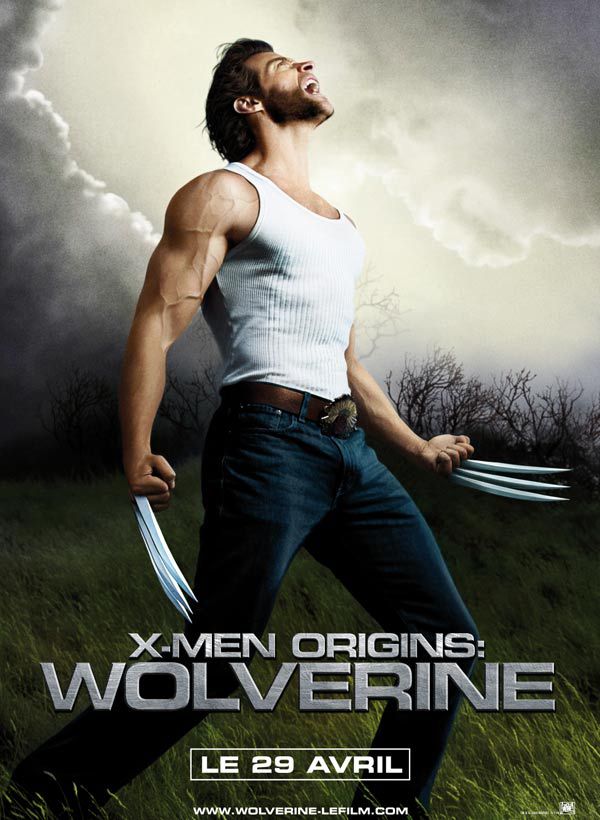
X-Men Origins: Wolverine (the title says it all) coats itself in the dust and the muck and the mire and revels in it. For instance: there is not one, but two scenes where Jim Logan (Jackman) looks up at a conveniently omniscient overhead camera and yells his frustration to the skies and his x-communicating God
.
 
Are you kidding me? Hasn't that shot been decommissioned after all the easy laughs it's garnered on "The Daily Show?"**
It has. But nobody told director
Gavin Hood (Rendition). He seems unconcerned about cliches or recycled material (or "sell-past" dates), as the movie lurches like lead villain Sabretooth (Liev Schreiber, but it was Tyler Mane in the original where they didn't know each other) bounding from one bad idea to the next, linked as they are by that most mainstream of transitions—the one-to-one dissolve. We get a lot of them in the Main Title. After the Bruce-Wayne-Meets-Oedipus childhood trauma opening, Hood shows the brothers Logan fighting in war after war, guns fading into guns and helmets into helmets. It's quite "artily" if unimaginatively done,* but Hood keeps using it until you start looking for the detail he might use in the next transition. Flames? Ocean waves? How about a dusk to dawn transition? That hasn't been done since...well, since I started writing this.
A lot of the problem is that
Marvel—"The House of Ideas," as it likes to trumpet—has culled so much from other stories that the whole Wolverine opus reads like a Reader's Digest Omnibus of Comic Literature. Logan gets recruited to join a Dirty X-Dozen black-ops unit, then declares himself "Wolverine no more" and becomes a lumberjack (and that's okay) until his school-teacher gal-pal is killed, and he swears revenge (cue the overhead camera and the underhanded cliche). 
He then submits to a "Frankenstein" experiment under the control of his former superior Stryker (Danny Huston, prequeling for Brian Cox), that coats his skeleton with indestructible adamantium. He escapes Stryker, and hides out with an old farm couple, the Kent's...er, no, the Hudson's, before being attacked—again—and hooking up with Gambit (Taylor Kitsch) for a full assault on the villain's headquarters, where like Spartacus, he leads a "mutie" revolt, that includes a young Scott Summers (Tim Pocock, looking like Ben Stiller rather than James Marsden). 
Ryan Reynolds' first depiction of Deadpool, an event which he never forgot and has inspired countless jokes about Hugh Jackman, as well as a very popular larky film about the character—...oh, and Deadpool 2.
 
There are lots of Marvel folk appearing (briefly): Bolt, Deadpool, The Blob, Agent Zero, and Kestrel. The inconsistency with their comic-book counter-parts will drive some fan-boys nuts (not to mention Wolverine's brylcreemed pompadour from the first two films is gone, too). This fan-boy had trouble with the fights, all based on other movies: the war action from Saving Private Ryan (by way of Crank), another based on John Woo's hyper-dramatics and aerodynamics, and another, straight out of the "Star Wars" prequels. 
So much recycled material to so little effect. Using the character's own onomatopoeia, it's ten pounds of snikt!TM in a five pound bag.  
"C'mere, Kid. Got a lousy movie to show ya!"

* If you ever want to see it done to death, check out Danny DeVito's direction of Hoffa. 

** A word of explanation from 2021: This refers to "The Daily Show" when Jon Stewart was hosting it...he'd make frequent use of an overhead shot (in moments of duress) and scream to the heavens "Noooooooooooooo!" Often they'd put a reverberating echo on it (That's how it SHOULD be done!)

*** Spoiler Alert: Good place to put spoilers, isn't it? In case you think you're missing something, you're not. There's a cameo by Professor X (Patrick Stewart reprising his role), although why is Scott (Cyclops) the only guy X was reaching out to?—seems he could have contacted all the escaping mutants (because it would have killed the suspense is why), and the by-now standard "Marvel Tag" at the end of the credits is no big deal—Wolverine at a bar: "Drinking to forget?" "No. Drinking to remember." Supposedly, there are three others. If they're all that "good," don't bother collecting them all.


Thursday, August 15, 2019

Taking Woodstock

50 years ago today, the Woodstock Festival began...

Written at the time of the film's release.

"I Haven't Slept in Three Days, My Hip is Acting Up, and the Beer is Warm."
"So...You're Good."


Ang Lee has spent almost his entire career showing the common humanity in the disenfranchised, whether they be the lower rungs of Class Society, gay cowboys, set-apart and -upon martial artists, political spies, and Incredible Hulks—the commonality of the different. Even with the slightly lighter touch he employs here, he does the same for Catskill Jews and Hippie culture in Taking Woodstock. Both groups are isolated and flung apart, but come together—initially uneasily, but soon in mutual satisfaction, to produce something intangible and real, that would change everything. For a little while. Elliott Tiber, nee Tieschberg, (Demetri Martin) is a repressed jangle of contradictions, a cosmopolitan boy lost in the woods. He's hasn't quite left the nest of his parents (Henry Goodman, Imelda Staunton) who own—barely—the El Monaco Hotel in the Catskills town of White Lake. He hasn't quite left the closet, either. A painter, he hasn't met with success in The Big Apple. He deals with the banks about the Hotel's financing, but has nothing to say about how it's run, despite trying to stir up business. He's the President of the White Lake Chamber of Commerce...which is basically just a Chamber, but in a Church basement, and little Commerce.
The one thing he has going for the Hotel is a low-key Arts Festival he puts on every year, featuring a couple folk-singers and the gonzo theater-troupe who inhabit the barn on their property. Until...the planned "Woodstock" festival with a few choice acts is driven out of their original venue by the locals, and Tiber makes it known to the organizers that he has a permit for an arts festival, a rare thing with the reluctant townspeople, who are content with the "regular crowd" and don't want much disruption. Pretty soon, the Tieschberg's and local dairy farmer Max Yasgur (a genially subdued Eugene Levy, making more of less) are persona non grata around town as the area is crowded with a motley crew of organizers, "suits," crew-men, helicopters, expectant hippies, and, as the concert grows closer, one of the largest traffic jams in the Nation's history.
By that time, the Tieschberg's are in constant motion as their hotel is over-crowded, water-shortaged, beer-deficient and out of control, if not for the efforts of Mr. Tieschberg and self-appointed head-buster Vilma, a tranny ex-Ranger with a baseball bat (Liev Schreiber, in a bad blonde wig and a Southern Belle's wardrobe, looking just like you'd expect him to, and bringing a rueful dignity to the enterprise).
As long as Lee focuses on the chaos, the film is a raucously good-natured train-wreck. Once he leaves the side-show for Elliott's Odyssey to "The Festival," the film becomes one of those earnest little movies that tells you its important but can't show you, just as it can't show the concert going on. Oh, you hear snippets of song-track that was featured at Woodstock, but not the actual performances (as they're owned by somebody else, I guess) reverberating in the background. There's a couple of FX shots that suggest the scope of the thing (one an LSD-influenced version that shows the crowd turning into an undulating sea-scape that would be more effective...oh, if you really were on acid, say), but the whole sequence is not only uninvolving, it diminishes the event...far-off, rather than far-out.
Woodstock has been romanticized so much over the last 40 years that it might better be called "Three Days of Peace, Love and Understanding and All the Crappy Parts You've Forgotten." But, Lee doesn't shy from the problems (segmented into easily focused nuggets of information through a split-screen technique which was the vogue at the time), although nothing is dwelled upon: the famous "brown acid" is mentioned, the muddy conditions, the interminable traffic jams, the inconsistent weather and jerry-rigged wiring that combined to cause so much metal on the grounds to shock when touched, the unsanitary conditions, the constant air-lifting of accidents and overdoses. and the fact that damned few people heard much music. It was enough to "be there," and that entailed a super-human ability to "go with the flow," of which, with the rain, there seemed to be plenty. It's all cataloged, but briefly, because like a lot of movies about "big events," it boils down to who's telling the story and how much they really played a part in it.
For the sub-title of the movie should be "Elliott Tiber and what he did at Woodstock." Tiber's account has been questioned by organizer Michael Lang* who claims that he may have had the permit, but he wasn't present at all the places he claims he was. And so the movie is reduced to the old conundrum of who gets to re-write history as Tiber shows "how Woodstock was important to him," as well as how "he was important to Woodstock." This might have been a bit more convincing if Tiber weren't portrayed by Demetri Martin. Martin is a gifted comedian as his stints on "The Daily Show," and his own "Comedy Central" series have amply displayed. But, Taking Woodstock shows none of the puppyish energy that makes his observations so hilarious. Instead, his Tiber is slackly reminiscent of Chance the Gardener in Being There, wandering like a ping-pong ball through the movie, with just as much dramatic weight. He is handily eclipsed by Goodman and Staunton, Schrieber and Emile Hirsch's "Charlie"-obsessed Viet-vet.
In the end, it's a let-down—like being stuck in the traffic jam and missing the concert, although Lee does manage to show us a lot of entertaining portraits while missing the big picture.

In the final irony, the cost of a ticket to the "real" Woodstock was $8.00. An evening ticket to Taking Woodstock costs upwards of 10.


* Lang is played by Jonathan Groff as an intensely smooth corporate hippie, who never seems to sweat the small stuff...or the big stuff, for that matter. In fact, he rarely seems engaged in any of the complexities of the festival, concentrating on "The Big Picture."