Showing posts with label Jena Malone. Show all posts

Saturday, October 19, 2024

The Neon Demon

It's still October, still Hallowe'en month, and today is "Take Out the Trash" Day. But, instead of a trash-bag, this garbage has a highly stylish wrapping. It's still garbage, though.

The Neon Demon
(Nicolas Winding Refn, 2016) I remember this hitting theaters and purposefully not seeing it for a couple reasons—1) it was directed by Nicolas Winding Refn, whose Drive I found half-baked and a bit pretentious (looked nice, though...) and 2) because it was getting a reputation for being "sick"—never a good word-of-mouth for me. And its star was 16 year old Elle Fanning, whose acting I've found competent but not compelling. The fledgling Amazon Studios bought it for distribution and that signaled to me that if I missed it in theaters, it would show up—and quickly—in their streaming service.
 
It did. But I never watched it. That's on me, not the film.

I occasionally do podcasts where the host, guests, and I talk about movies—they being articulate, me being hesitant, umming and uhhhing and nattering on until I forget the point of what I was saying (Thank God for editing!) and The Lambcast had me scheduled for one of their Movie of the Month podcasts, where people submit films they want to talk about and it gets voted on by folks with the Large Association of Movie Blogs, the winner getting its time in the spotlight. Last March, The Neon Demon was voted to be the MOTM and I dutifully watched it, so that I might give my thoughts on it.
Those thoughts were pretty damn dark. "I hate it with the heat of a thousand suns" I recall saying. Hyperbolic that may be, but it was only a matter of degree. For Refn's film, under the guise of making a point of exploitation, only reflects that exploitation while not saying anything new, unique, or even realistic about its subject. "The Demon" that the movie tangentially and unsuccessfully tries to make some sort of analogous reference to (the title's use of "neon" suggests the city) is basically the film itself, and it's just as clumsy, despite its scrupulous framing and art direction. It's a gilt-wrapped presentation that opens to find...absolutely nothing, lovely to look at (on occasion), but hollow not only to its core, but everywhere.
Stylish—but to a fault—The Neon Demon follows the path of 16 year old Jesse (Fanning) who's come to Los Angeles following the death of her parents and the film opens with a blood-soaked static photo-shoot she's having with a photographer she's met on the internet. As it's the first thing we see, we wouldn't be surprised that Jesse is already dead, as she lies lifeless on a couch, blood dripping down her arm onto the floor. That's all that's required of her—no personality, no expression—she's just an image, a concept, a commodity to sell something (god knows what...). After, Jesse is struggling to wipe the red Karo syrup off her body and is helped by her makeup artist Ruby (Jena Malone), who doubles as a mortuary cosmetician (natch!).
♪I love L.A.♫
Through Ruby, she gets a room at a fleabag hotel (run by a sleazy Keanu Reeves in one of his "please, don't speak" roles) and an interview at a modeling agency. She falsely signs a parental consent form and is told she should answer to 19...as 18 is a little..."you know." She then starts to make the rounds of cattle-calls, where she runs into two models in particular, Gigi (Bella Heathcote)—who's all about cosmetic surgery—and Sarah (Abbey Lee)—who's all about sleeping around to get jobs. They're catty and jealous and more than a little aggressive in their judging Jesse (I mean why not, the job's all about judging), who's a neophyte, probably a virgin, and has nothing going for her except her looks...like them.
But, Gigi and Sarah are more so. After one of those casting sessions that Jesse gets but Sarah is passed over for, Jesse cuts her hand in the bathroom and is shocked when Sarah tries to suck her blood. See where we're going with this?
The toxic male gaze; the female ambivalence to it
Yeah, that's where it's going...so I'd find the nearest cut-off (believe me, there'll be plenty of that later in the movie). Refn is portraying a predatory L.A.—something I admit I've always felt deep in my bones whenever I would visit the city—where the young models must contend with the predations and the manipulations of agents, the whims of self-designated artistes, and the jealousies and resultant scorn of their competitors and its products visited upon them. The predators being both male and female, there's plenty of blame to go around.
But, the movie only works as a metaphor and The Neon Demon gets it ass-backwards. Most horror films use the horror as a metaphor for everyday life, but Demon uses real-life to get to the horror. I don't see it as spoiling anything by revealing what eventually happens, but more of a public service. In their covetousness and jealousy, Ruby, Sarah and Gigi kill Jesse in a swimming pool and eat her. That's not a euphemism or a typing error. They eat her. Apparently to consume her youth, which they want. Great metaphor, huh?
Now, we don't see this past Jesse bleeding out at the bottom of the pool, but at the next photo-shoot, during a break, Gigi hoarks up one of Jesse's eyeballs...which Sarah then eats (waste not, want not, apparently). One might "buy" this, but the fact of the matter is Jesse was...what 5'9" and weighs 54 kg (according to some Elle Fanning web-site or other) and it beggars the imagination that the two rail-thin, near-anorexic models who supposedly consumed her don't look like they've had any more caloric intake lately than what one could suck from a celery stick. Argue all you want that they probably did some purging in the meantime, but...c'mon. Ozempic couldn't have solved this one.
I mean, yuck. The Neon Demon doesn't work as body horror, metaphor, or "pieces-of-meat" societal critique and for all the professions of "the cinematography is great" that is true in only some instances throughout the film's length and even then, those images are static, stylized, and sporadic. Most times, Refn is just "getting the shot" that he can. And although I hate to use this Pauline Kael quote (because when—panning Barry Lyndon—she used it she was wrong) but sometimes it's true that a director "
isn’t taking pictures in order to make movies, he’s making movies in order to take pictures."
 
And Refn has a great future filming obtuse perfume commercials.
"The Neon Demon...only at Macy's"

Friday, July 5, 2024

Horizon: An American Saga - Chapter 1

Costner's Folly, Chapter 2 ("Nobody Knows Anything")
or
Going For the Fences
 
You've got to hand it to Kevin Costner. He takes chances. He's parlayed his television success on "Yellowstone" to make a movie he's been dreaming of for a couple of decades, in times both fallow and flush, cast it with a steady stream of great character actors who've never passed onto the A-list, split it into two chapters (although hopefully there will be more) and released the first one—in which various story-lines do not intersect—as a 3-hour set-up...the sum of which would spell box-office poison to a movie-going audience that wants its product pre-digested and easily grasped like fast-food.
 
And who can blame him? He's done it before. When he was making it, Dances with Wolves was being derided as "Costner's Folly" for making a Western when they weren't fashionable, for it's extensive location shooting, for the supposed grandiosity of writing, directing, producing and starring in it, for it's planned use of sub-titles, and for its cost overruns. 
 
But, as William Goldman wrote, nobody in Hollywood knows anything. Dances with Wolves became a box-office smash, its elegaic, and unconventionally seditious, story becoming a hit with audiences and garnering the Best Picture Oscar, beating out Goodfellas (which some may argue was a mistake, but, to my mind, really wasn't).
So, here's "Coster's Folly" Chapter Two, the ungainly titled Horizon: An American Saga - Chapter 1
, with a story by Mark Kasdan (who co-wrote Silverado, a favorite of mine), Costner and Jon Baird, photographed by J. Michael Muro, who shot Costner's lovely Open Range.
 
And it's great. Simply great.
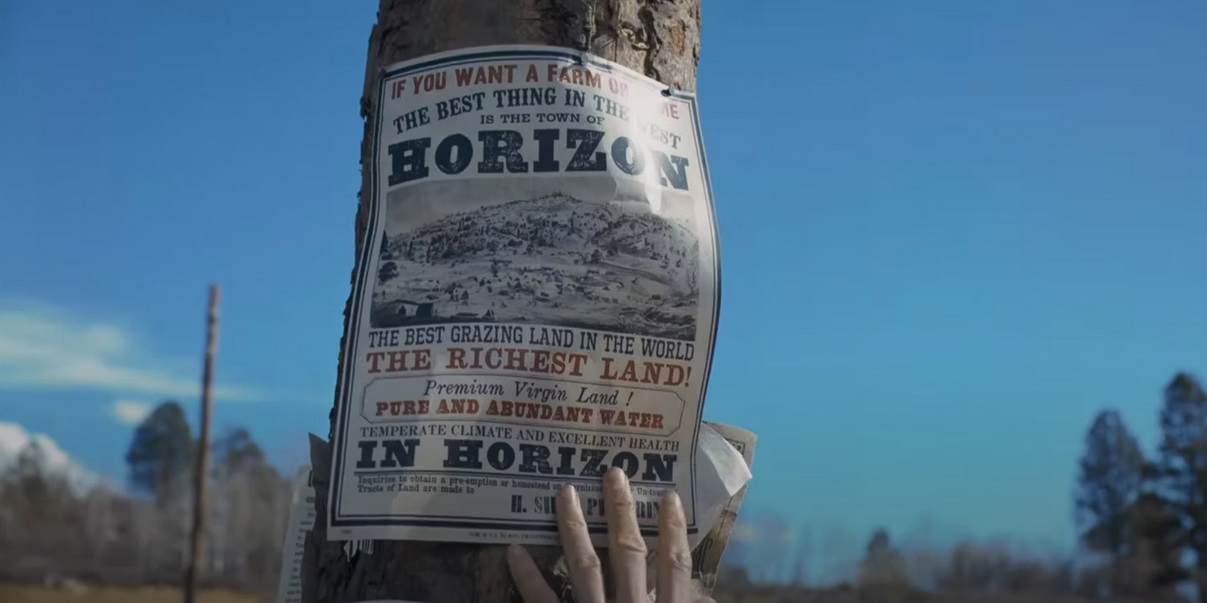
For a 3-hour movie, it sails right by, packed to the sprockets with detail, period and story-wise, never seeming to waste a frame in telling three...four? five?...stories about a plot of land in the San Pedro Valley in the American west that may—or may not —be available for homesteading, and the people who are attracted to the promise of it (whether it is true or not) and the people already living there who take it for what it is. 
 
There are the first white settlers, there to survey and parcel, but as they're alone in the wilderness and, unbeknownst to them, surveying Apache hunting grounds, they soon fall victim to a war party. Their graves are the first semi-permanent structures of Horizon. They won't be the last.
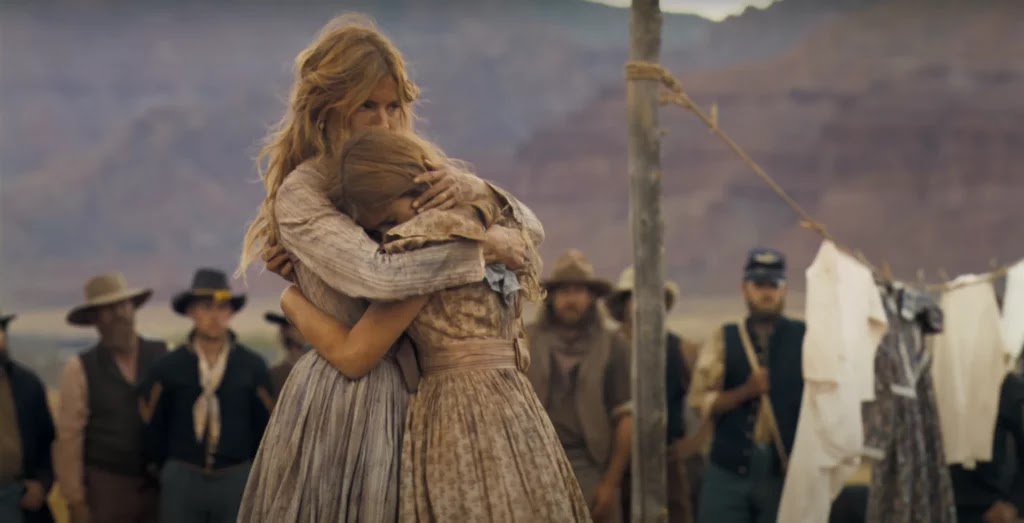
But, the pattern will remain the same. By 1863, there is a well-established colony on the site, across the river from those three original graves. They, too, are attacked by Apache, leaving a limited number of survivors: some, like Frances Kittridge (
Sienna Miller) and her daughter, Elizabeth (Georgia MacPhail) will take shelter at nearby Fort Gallant; others, like the boy who rode to the fort to get help, Russell (Etienne Kellici) form a hunting party to track down the Apache who burned down the encampment.
That attack has caused a dispute between the leader of the war party, Pionsenay (
Owen Crow Shoe) and the leader Tuayeseh (Gregory Cruz), resulting in the younger man splitting from the tribe, taking one of Tuayeseh's sons with him. 
In Montana, James Sykes (
Charles Halford) is shot by Lucy (Jena Malone), who takes her son David and flees for the Wyoming territory. Sykes' sons Junior (Jon Beavers) and Caleb (Jamie Campbell Bower) are sent to find her and the child. They catch up with her where she now goes by the name Ellen, married to hopeful lands-trader Walter Childs and living with a local prostitute Marybelle (Abbey Lee). When the Sykes boys show up, there is a confrontation between the vicious Caleb and saddle-tramp Hayes Ellison (Costner), a potential customer of Marybelle's. She and Hayes and the child escape town to avoid repercussions of the murder.
Also heading for Horizon is a wagon train, moving along the Santa Fe Trail, under the auspices of Matthew Van Weyden (
Luke Wilson), who is having trouble keeping the eclectic group of settlers (including a naive British couple and the family of Frances Kittridge's late husband) of the mind that, although they may be headed for a paradise, they're not there yet, and water and team-spirit are in short supply in a desert.
In the mix are interesting characters, like the leaders of the Army detachment at Ft. Gallant, who are straight out of John Ford's Cavalry films: Lt. Trent Gephart
(Sam Worthington, the most effective performance I've seen of his), who's a pragmatic soldier and would just as soon have settlers somewhere else and the "indigenous" (as he calls them) left to their land to keep the peace, a sentiment acknowledged but considered historically unrealistic by Gallant's leader, Col. Albert Houghton (Danny Huston) and his sergeant major, Thomas Riordan (Michael Rooker, in a slightly less garrulous version of the parts Victor McLaglan played in Ford films). One likes these people and you get the feeling everybody's doing the best they can under the conditions and the inevitability of time.
That's a novel's worth of people and a lot of stories and one suspects everybody's going to converge in Horizon (the town itself will probably end up being the focus of the series), their characters already established and with ensuing complications in the offing—Costner has previews of the next chapter at the end of this one and my appetite for it is whetted.
Despite the obvious nods towards Ford, Horizon: an American Saga, so far, feels more in the vein of the sprawling How the West was Won, but, in character, more like "Lonesome Dove", where individuals weave in and out of the fabric of the narrative, and sometimes—as in life—are never to be seen again in an indifferent Universe, lost in the stream of History. Costner may love his Westerns, but he acknowledges there's less romanticism to it when the survival rate hovers around 50%.
It was in Ford's film The Man Who Shot Liberty Valance, where a reporter states "This is the West, sir. When the legend becomes fact, print the legend." Ford's career peeled back veneers of western legend varnish in his films and in his later work stripped off more layers of his own earlier myth-making. Costner goes even farther, taking into account the grubbier myths of Leone and Peckinpah (and Eastwood) with his hard-scrabble porous towns in need of light and cleaning and extermination. He goes a step further by putting back all the practicalities of the settler experience that Ford cut out—the burying of the dead, the scarcity of water, the bugs and critters, the difficulty of killing a man with ball-shot, the necessity of self-sustainment by farming, the ritual of hard work, more important community matters than tea-dances and ceremonies.
If there's anything more to wish for, for me, it would be that there's more of it (despite others quibbling about length). A couple transition sequences seem to have been excised just to speed things along that might not have added much but may have smoothed a passage of time.
It's still early days, but one gets the sense that Costner will be making a point that the beauty of the West that we admire may not be just a matter of the dirt and stone carved by time and tide but also foundationed by the bones of those who walked before us. 

Wednesday, July 8, 2020

Into the Wild

In a time when the toppling of statues and monuments have been making the news, one may have missed your attention. Officials have removed the "Into the Wild" bus from its position in Denali National Forest in Alaska. The bus, where the body of adventurer Chris McCandless was discovered, has been a macabre destination for tourists and fans of the Jon Krakauer book and Sean Penn film made from it. But, many came ill-prepared. Many rescue operations had to be dispatched, and there were some deaths. And so, authorities flew in on one last rescue mission to end all rescue missions and end the possibility of any more tragedies that might echo that first one. 
Here's the review of that film, written at the time of its release.


Finding Oneself and Getting Lost

There is a pleasure in the pathless wood,
There is a rapture on the lonely shore,
There is society, where none intrudes,
By the deep sea, and music in its roar:
I love not man the less, but Nature more,
From these our interviews, in which I steal
From all I may be, or have been before,
To mingle with the Universe, and feel
What I can ne'er express, yet cannot all conceal.

Lord Byron

The films of Sean Penn's directorial career have all carried the underlying theme of obsession. But until now, he has always shown the dark side of it—The Indian Runner, The Crossing Guard, The Pledge (the latter two focusing on revenge, of sorts)—the Need to get even, to balance the books, to set the world and Nature right. But with his Oscar-winning role in Clint Eastwood's Mystic River, he seems to have cauterized that need from his system. His new film, Into the Wild, is just as obsessive but presents more of a spiritual quest. Nature is already balanced. Now one must become a part of it. Based on Jon Krakauer's book (which is expanded from his articles on "Outside Online"—originally called "Death of an Innocent" and not available on the site at this time), it dogs the footsteps of Christopher McCandless, who upon graduating from college, disappeared on a journey across the country and eventually to Alaska, where he tried to live off the land, and his body was found by moose hunters in an abandoned bus. If he wanted to become one with Nature, he achieved it. But there's no great trick doing that. As so often happens, the destination isn't as important as the journey.
Penn (who also wrote the complex screenplay) presents McCandless' Odyssey as a rite of passage, literally divided into chapters, starting with his shedding of everything tying him to a middle-class life like his parents (played cold and shrill, by, respectively, Willian Hurt and Marcia Gay Harden), and simply disappearing, leaving no trace, and ensuring that he would have at least a couple months head-start before anyone knew he'd left. These chapters serve as flash-backs of a sort (given the opening of the film, the whole thing could be a flash-back) to McCandless' day-to-day life living in the abandoned bus/hunting drop that would unwittingly be his last stand. 
The narrative is punctuated by McCandless' writings in dreamy, floaty script, and a journal-like view from home from the perspective of his sister (played by Jena Malone). Each chapter begins with an extended montage played over songs by Eddie Vedder (which sounds like it could be horrendous, but Vedder's introspective lowing is the perfect counter-point to the images and one begins to look forward to the transitions). The results are never less than hopeful while never losing sight of the hardships along the way, the lessons learned and the experiences along the way.
Or the people. Along the way in the form of jobs worked, beds crashed, and meals shared, McCandless (who travels by the name of "Alexander Supertamp") encounters reflections of his parents and free spirits who push him to abandon his mental baggage, that, instead of establishing lasting ties, only steels his determination to complete his trek to Alaska. Here the movies shines with wonderful performances by Catherine Keener, Vince Vaughn (who's great), Hal Holbrook (who is heart-breakingly good-he should be recognized for this) and some folks that Penn just found on location (including a guy named Brian Dierker, who runs a ski shop in Flagstaff, Arizona--first movie--endearing performance). 
And its here that if the movie has a weakness, it is that Everybody Loves Chris, wanting him to settle, and by having that be the sole reaction, one's manipulation-shield is engaged, wondering if Penn is stacking the deck, making his McCandless not merely charismatic, but near-messianic. Counter that with the fact that these people are road-blocks to his purposes, while being necessary way-stops on the journey, and those quibbling mountains become mole-hills.* 
I suppose one could have done more to balance his character (for example, including the opinions of the native Alaskans who thought him merely "stupid"), but short of showing him rolling a drunk, I'm not sure that such a pruning would be all that worthwhile. His encounters are already showing the roads not taken, it is THIS path that is the subject of the film. Anything else would be a detour.
I didn't want this film to end, frankly. It's truly exciting to see a director use a kaleidoscope of techniques to tell a story that celebrates life.

Even if it ends in death.

* I wrote this entire review without mentioning the amazing work of Emile Hirsch as McCandless--the guy's in the ENTIRE movie, and if McCandless is too much of a good thing, it's because Hirsch's performance is so constantly winning, and focused. You're compelled to keep watching this kid, and fear that his next step will be wrong. It's an involving, remarkable performance. While Penn's work is astonishing, he has the best co-conspirator in Emile Hirsch. His next role? He's playing "Speed" Racer. Sure, he looks just like him, but...I mean, c'mon, man. AAAAUGH!

Wednesday, March 25, 2020

Sucker Punch (2011)

Written at the film's escape. Further thoughts after the repeat, with some video point/counter-point.

"Girls Acting Badly (Acting Badly)"
or
"Showgirls—The Sequel"

Look. I'm a healthy, red-blooded American male and I can certainly appreciate gorgeous, pouty young women in provocatively scanty attire. But Zack Snyder's semi-new Sucker Punch just made me angry. And not just because the thing is so derivative as to be wholly unoriginal—that's usually not a deal-breaker with me, as my enthusiasm for Star Wars or Rango will attest.

But don't tell me you're making a movie about empowering women while objectifying them to the Nth degree in the manner of a "women-in-prison" film. A women-in-prison film with a red-curtain veneer of strip-club in it. Don't make an action film where giant things toss the femi-ninjas through walls and across rooms without their make-up getting messed up (violence without consequences), and don't make the message of your film "Fight" and contrarily show 4/5 of those fighters being taken down (through their own actions) and the only one survivor being the one who isn't sure of the struggle. 

The messages are so mixed as to be incoherent.
But one shouldn't expect nutrition from eye-candy.

It's all about the illusion in this one, the presentation, and the surface. It's "Alice in Green-Screen-Bump-and-Grinder-land: the Video-Game." All paste-up and no depth, just a good job of dry-wall, in the de-saturated style of Sky Captain and the World of Tomorrow.* Looks great. But rotten to the core.
And it is too bad. We need more women-heroes. We need more women-hero movies. We just need someone with more enlightenment to create them so that they don't simultaneously make them strong and tear down the message by tarting them up (like William Moulton Marston, the shrink who created "Wonder Woman" and liked to put her in bondage situations). I'm not saying all women-characters should be pedestal-toppers. Let's just not kick the dignity out from underneath them.
And any writer worth his word processor shouldn't be undercutting his message, anyway.

If you're going to lower the bar so far you have to dig a trench six feet deep to do so, you might as well complete the job, dig the grave and toss the whole enterprise into it.
Young "Baby Doll" (Emily Browning) is having a bad time of it. Her mother dies, and she and her sister are left in the care of her evil step-father (Gerard Plunkett) with nothing but abuse on his mind. "Baby Doll" (that's her only name) tries to shoot him when he attempts to rape her sister, but ends up killing her with the bullet, instead. As if this scenario weren't dire enough, Snyder films it all over-cranked to give it a lethargic, dreamy "bad portent" feel.  It's the type of overkill you can expect throughout the entire movie. No lock goes bolted or unbolted except in clanking close-up. Nothing is relevant unless it's in your face (AND it's in IMAX).
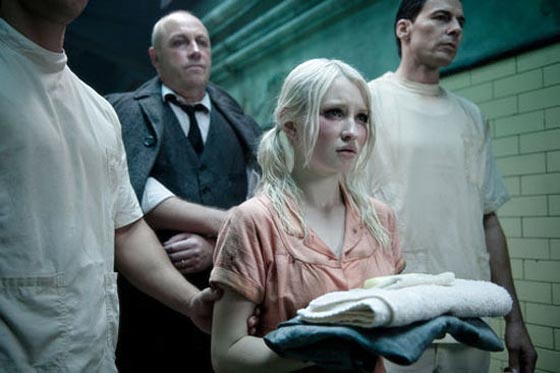
ES-F has "Baby Doll" committed to the Lennox House for the Mentally Insane, where he bribes an orderly (Oscar Isaac, no scenery goes un-chewed) to lobotomize "Baby Doll" to shut her up so he can inherit his wife's fortune uncontested and in the five days before the doctor (Jon Hamm, who's actually subtle in this movie) arrives for the procedure, the girl fantasizes a scenario in which she's not in an asylum, but a strip-club/bordello and she recruits four other girls—"Blondie" (Vanessa Hudgens), "Amber" (Jamie Chung) and the sisters, "Rocket" (Jena Malone) and "Sweet Pea" (Abbie Cornish)* to plan an escape, an escape concocted in a "delusion within a delusion" (Hello, Inception!) when she rehearses her dance number for the john (whose the lobotomist in the slow-mo reality) to whom her virginity will be sold in five days. This dance number is apparently so erotic that it paralyzes all, male and female, who watch it, so that the other girls can acquire those articles needed to escape.
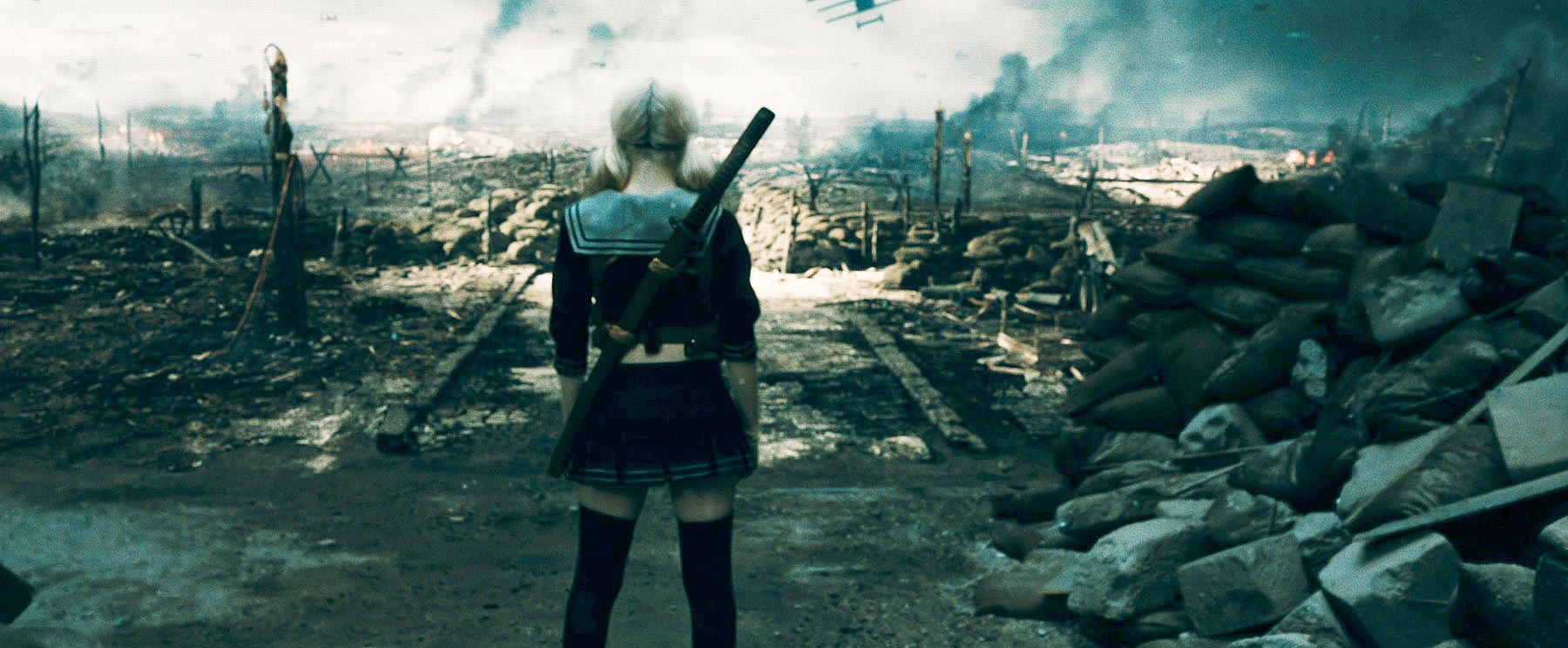
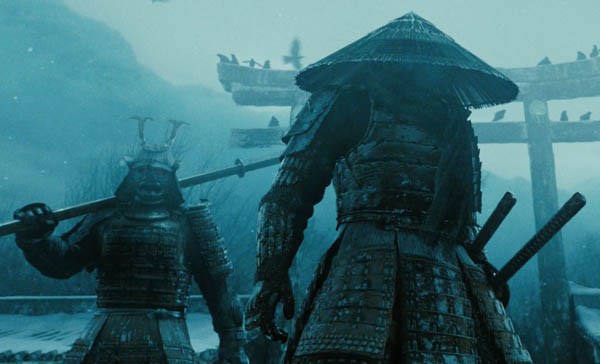
We don't see the dance. We see the resulting fantasies "Baby Doll" imagines in order TO dance, and these make up the action scenarios in the film: the first, a snowy martial arts fight with three giant statues; the second, a WWI fight in the trenches with steam-punk Nazis; the third, a Peter Jackson-ish Middle-Earth with dragons and Orcs; the fourth, a SCI-FI battle on a bullet-train that's part super-hero and part Matrix—it becomes readily apparent that most of the thought and work of this film went into these second-level fantasy sequences, all played out over Moulin Rouge!-styled song mash-ups.
It is also apparent that the entire movie is a pre-lobotomized fantasy (only I think they got the timing wrong!).
So many good ideas are borrowed from other movies. But, just because the ingredients are good doesn't mean the dish they create doesn't taste like dog-food. I used to be a fan of Zack Snyder. I thought 300 was dumb, but had flashes of clever presentation. I genuinely admired his adaptation of Alan Moore's Watchmen, and still do. But now with the 1-2 sucker-punch of Legend of the Guardians: the Owls of Ga'hoole*** and...Sucker Punch, I'm going to have to do a gut-check before dropping all pretense that I can be objective before going to see another of his films. 

Which will be the new "Superman" film. I don't even think The Blue Boy Scout can pull a rescue of that one. We shall see...
After-thoughts: First off, "I am shocked, shocked" that there is objectification going on in this movie. It IS Zack Snyder, after all, who made 300 and who is equally adept at showing both male and female pulchritude—actually, with all the super-hero movies out there, maybe that's WHY we go to movies anymore. Also, the film has a lot of Japanese manga sensibility to it, so, the women will be big-eyed, and under-dressed. Blame pop-culture, where a lot of this film resides.

I still think the narrative is confused, and it depends on whether you think it is "Baby Doll's" story (which I think it is, as the long preamble would indicate) or whether it is "Sweet Pea's" story (and "Baby Doll" is merely the "body-image/avatar" in her mind used to escape). That's an interesting interpretation, but I don't think I believe it, but it just goes to show how porous the scenario is that you can pour that defense into it and it seems to stick.

Also, the "violence without consequence" comment? It's fantasy sequences, and so "Looney-Tune" rules apply. And "derivative" might have been part of the point, given the pop-culture "call-backs" for the fantasy sequences, which are all "quest" narratives. 

Snyder has a habit of throwing so much information into his movies—sometimes to the point of obfuscation—that narratives can become muddled (which is very problematic when he has to do a course correction, as he had to do with his DCEU movies, where his films are left with dangling plot threads that never get resolved...even with his "extended cuts"), but there is a real problem when it's a point of debate of who the protagonist is and what has been accomplished on all planes of the endeavor.

There are some interesting points about "empowerment" and how, in the war between men and women, that empowerment may be merely exploiting the weaknesses of your opponent (starting with their own feelings of superiority), without having to "own" the means of exploitation. It made me wonder how much of a woman's time is spent "in disguise" for survival. We all do, to a certain extent, but what a different world might come of dropping pretense and just "being." I must, at least, thank Sucker Punch for putting that thought in my head.

Below, two videos on the film: one, with a condescending chip on its shoulder, but a surprising number of good points; and the other from the long-running (and entertaining) "Cinemasins" series that still takes things to task while acknowledging the meta-narrative.


* We'll be talking about this tomorrow (digital fingers crossed) and Rango when we delve into a couple of "shelter-in-place" weeks of Westerns.

** Throughout, I kept imagining the nasty Twitter message Jane Campion would be sending her Bright Star lead after seeing this movie. 

*** Now, the question is: do I re-publish the reviews for these films or just do a "Now I've Seen Everything Dept." career overview of Zack Snyder? The latter would probably have better insight than the "first-blush" reactions.

Tuesday, April 23, 2019

Pride and Prejudice (2005)

Pride and Prejudice (Joe Wright, 2005) One must ask oneself can there be anything more done with "Pride and Prejudice"—the much-adapted jewel in the Jane Austen tiara? It turns out that, yes, verily, there can. Director Joe Wright, in his first full length motion picture (after some shorts and mini-series work), takes some of the stuffing out of the classic novel (aided and abetted by screenwriter Deborah Moggach with some additional material stuffed into it by Sense and Sensibilty scribe Emma Thompson) and makes it move in its own frenetic dance for the first 3/4 of it. The many dances and balls are choreographed and photographed to maximum effect, in ways that, at times, are sublimely comic—the way I prefer Austen to be treated—as well as the ways in which the 19th Century mating rituals and business marriages are carried out amongst classes and stations seem to intersect naturally with Wright's searching, shifting camera moves during the film's country dance sequences.
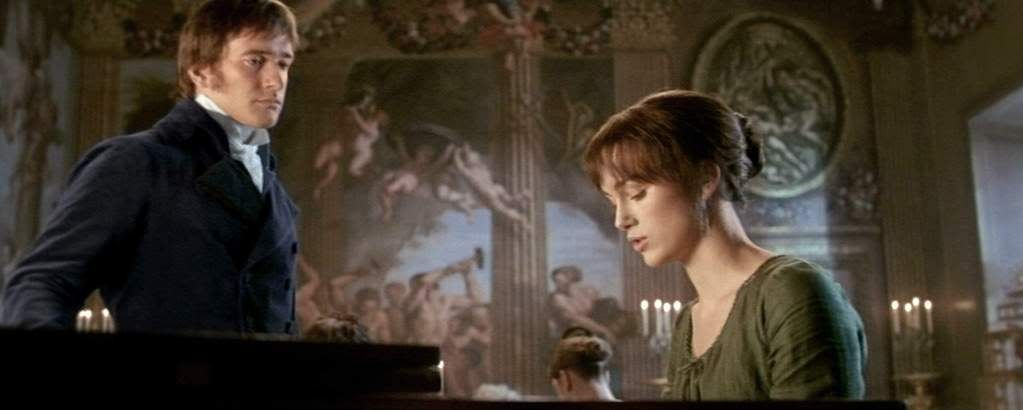
Then, in moments that Austen would call "high dudgeon"—and what I would call "money-shots"—Wright's camera stops and Nature takes over, culminating in two eerie scenes: one, a confrontation between Elizabeth Bennet (Keira Knightley) and her object of obsession Mr. Darcy (Matthew Macfadyen) staged in an unyielding Greco-Roman pogoda during a thunderstorm; and later during a bizarre shot where Elizabeth, locked in emotional and physical paralysis, spends an uncertain day in one spot as the sun and Nature move around her, a fascinating way to pull off her receiving Darcy's letter of regret without really receiving him.
Sometimes, Wright goes a bit too far blowing the dust off this classic—a spinning camera from Elizabeth's point of view on a swing seamlessly, and a little nauseatingly, shows the passing of time. And he can't resist a "money shot," a gorgeous, overly dramatic shot of Elizabeth on cliff-top at Stanage Edge, ensuring that her new perspective on things is in Panavision. 
But he's also aided immeasurably by extremely naturalistic performances (including those of Brenda Blethyn and Donald Sutherland as the Bennett parents) from an ensemble encouraged to stumble over each other's words to take the starch out of the formality, including outstanding turns from soon-to-be stars Rosamund Pike and Carey Mulligan, a performance by Dame Judi Dench in full "battleaxe" mode, and another of those extremely mercurial performances by Keira Knightley, whose Elizabeth Bennett goes from apple-cheeked gushing teenager to stormy-eyed character assassin in hardly a blink.
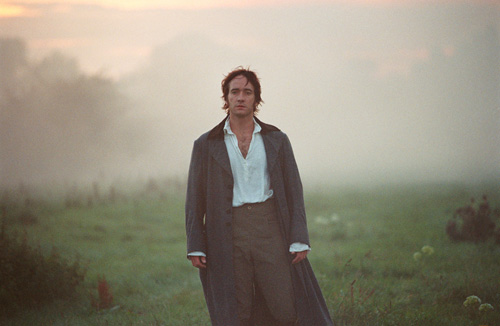
Of course, any "Pride and Prejudice" stands or falls on the chemistry between its Elizabeth and its Mr. Darcy, who is here played by Matthew Macfadyen, in what is always the toughest role—he has to play a standoffish prig but still be attractive enough to pull off the transition to ardent suitor, especially an accepted ardent suitor. And, here, Knightley's fierceness plays to the advantage of that relationship. You can believe that she's smitten by the man as much as she's infuriated by him, a fine example of the maxim (used by me a LOT) that Love and Hate are not opposites, but merely two sides of the same coin; the true opposite of love is indifference. Darcy may feign indifference, but it is pretense, given his position and family objections.

Maybe it should have been titled "Pride, Prejudice, and Pretense." That certainly works better than "Pride and Prejudice and Zombies."