Showing posts with label Abbey Lee. Show all posts

Saturday, October 19, 2024

The Neon Demon

It's still October, still Hallowe'en month, and today is "Take Out the Trash" Day. But, instead of a trash-bag, this garbage has a highly stylish wrapping. It's still garbage, though.

The Neon Demon
(Nicolas Winding Refn, 2016) I remember this hitting theaters and purposefully not seeing it for a couple reasons—1) it was directed by Nicolas Winding Refn, whose Drive I found half-baked and a bit pretentious (looked nice, though...) and 2) because it was getting a reputation for being "sick"—never a good word-of-mouth for me. And its star was 16 year old Elle Fanning, whose acting I've found competent but not compelling. The fledgling Amazon Studios bought it for distribution and that signaled to me that if I missed it in theaters, it would show up—and quickly—in their streaming service.
 
It did. But I never watched it. That's on me, not the film.

I occasionally do podcasts where the host, guests, and I talk about movies—they being articulate, me being hesitant, umming and uhhhing and nattering on until I forget the point of what I was saying (Thank God for editing!) and The Lambcast had me scheduled for one of their Movie of the Month podcasts, where people submit films they want to talk about and it gets voted on by folks with the Large Association of Movie Blogs, the winner getting its time in the spotlight. Last March, The Neon Demon was voted to be the MOTM and I dutifully watched it, so that I might give my thoughts on it.
Those thoughts were pretty damn dark. "I hate it with the heat of a thousand suns" I recall saying. Hyperbolic that may be, but it was only a matter of degree. For Refn's film, under the guise of making a point of exploitation, only reflects that exploitation while not saying anything new, unique, or even realistic about its subject. "The Demon" that the movie tangentially and unsuccessfully tries to make some sort of analogous reference to (the title's use of "neon" suggests the city) is basically the film itself, and it's just as clumsy, despite its scrupulous framing and art direction. It's a gilt-wrapped presentation that opens to find...absolutely nothing, lovely to look at (on occasion), but hollow not only to its core, but everywhere.
Stylish—but to a fault—The Neon Demon follows the path of 16 year old Jesse (Fanning) who's come to Los Angeles following the death of her parents and the film opens with a blood-soaked static photo-shoot she's having with a photographer she's met on the internet. As it's the first thing we see, we wouldn't be surprised that Jesse is already dead, as she lies lifeless on a couch, blood dripping down her arm onto the floor. That's all that's required of her—no personality, no expression—she's just an image, a concept, a commodity to sell something (god knows what...). After, Jesse is struggling to wipe the red Karo syrup off her body and is helped by her makeup artist Ruby (Jena Malone), who doubles as a mortuary cosmetician (natch!).
♪I love L.A.♫
Through Ruby, she gets a room at a fleabag hotel (run by a sleazy Keanu Reeves in one of his "please, don't speak" roles) and an interview at a modeling agency. She falsely signs a parental consent form and is told she should answer to 19...as 18 is a little..."you know." She then starts to make the rounds of cattle-calls, where she runs into two models in particular, Gigi (Bella Heathcote)—who's all about cosmetic surgery—and Sarah (Abbey Lee)—who's all about sleeping around to get jobs. They're catty and jealous and more than a little aggressive in their judging Jesse (I mean why not, the job's all about judging), who's a neophyte, probably a virgin, and has nothing going for her except her looks...like them.
But, Gigi and Sarah are more so. After one of those casting sessions that Jesse gets but Sarah is passed over for, Jesse cuts her hand in the bathroom and is shocked when Sarah tries to suck her blood. See where we're going with this?
The toxic male gaze; the female ambivalence to it
Yeah, that's where it's going...so I'd find the nearest cut-off (believe me, there'll be plenty of that later in the movie). Refn is portraying a predatory L.A.—something I admit I've always felt deep in my bones whenever I would visit the city—where the young models must contend with the predations and the manipulations of agents, the whims of self-designated artistes, and the jealousies and resultant scorn of their competitors and its products visited upon them. The predators being both male and female, there's plenty of blame to go around.
But, the movie only works as a metaphor and The Neon Demon gets it ass-backwards. Most horror films use the horror as a metaphor for everyday life, but Demon uses real-life to get to the horror. I don't see it as spoiling anything by revealing what eventually happens, but more of a public service. In their covetousness and jealousy, Ruby, Sarah and Gigi kill Jesse in a swimming pool and eat her. That's not a euphemism or a typing error. They eat her. Apparently to consume her youth, which they want. Great metaphor, huh?
Now, we don't see this past Jesse bleeding out at the bottom of the pool, but at the next photo-shoot, during a break, Gigi hoarks up one of Jesse's eyeballs...which Sarah then eats (waste not, want not, apparently). One might "buy" this, but the fact of the matter is Jesse was...what 5'9" and weighs 54 kg (according to some Elle Fanning web-site or other) and it beggars the imagination that the two rail-thin, near-anorexic models who supposedly consumed her don't look like they've had any more caloric intake lately than what one could suck from a celery stick. Argue all you want that they probably did some purging in the meantime, but...c'mon. Ozempic couldn't have solved this one.
I mean, yuck. The Neon Demon doesn't work as body horror, metaphor, or "pieces-of-meat" societal critique and for all the professions of "the cinematography is great" that is true in only some instances throughout the film's length and even then, those images are static, stylized, and sporadic. Most times, Refn is just "getting the shot" that he can. And although I hate to use this Pauline Kael quote (because when—panning Barry Lyndon—she used it she was wrong) but sometimes it's true that a director "
isn’t taking pictures in order to make movies, he’s making movies in order to take pictures."
 
And Refn has a great future filming obtuse perfume commercials.
"The Neon Demon...only at Macy's"

Friday, July 5, 2024

Horizon: An American Saga - Chapter 1

Costner's Folly, Chapter 2 ("Nobody Knows Anything")
or
Going For the Fences
 
You've got to hand it to Kevin Costner. He takes chances. He's parlayed his television success on "Yellowstone" to make a movie he's been dreaming of for a couple of decades, in times both fallow and flush, cast it with a steady stream of great character actors who've never passed onto the A-list, split it into two chapters (although hopefully there will be more) and released the first one—in which various story-lines do not intersect—as a 3-hour set-up...the sum of which would spell box-office poison to a movie-going audience that wants its product pre-digested and easily grasped like fast-food.
 
And who can blame him? He's done it before. When he was making it, Dances with Wolves was being derided as "Costner's Folly" for making a Western when they weren't fashionable, for it's extensive location shooting, for the supposed grandiosity of writing, directing, producing and starring in it, for it's planned use of sub-titles, and for its cost overruns. 
 
But, as William Goldman wrote, nobody in Hollywood knows anything. Dances with Wolves became a box-office smash, its elegaic, and unconventionally seditious, story becoming a hit with audiences and garnering the Best Picture Oscar, beating out Goodfellas (which some may argue was a mistake, but, to my mind, really wasn't).
So, here's "Coster's Folly" Chapter Two, the ungainly titled Horizon: An American Saga - Chapter 1
, with a story by Mark Kasdan (who co-wrote Silverado, a favorite of mine), Costner and Jon Baird, photographed by J. Michael Muro, who shot Costner's lovely Open Range.
 
And it's great. Simply great.
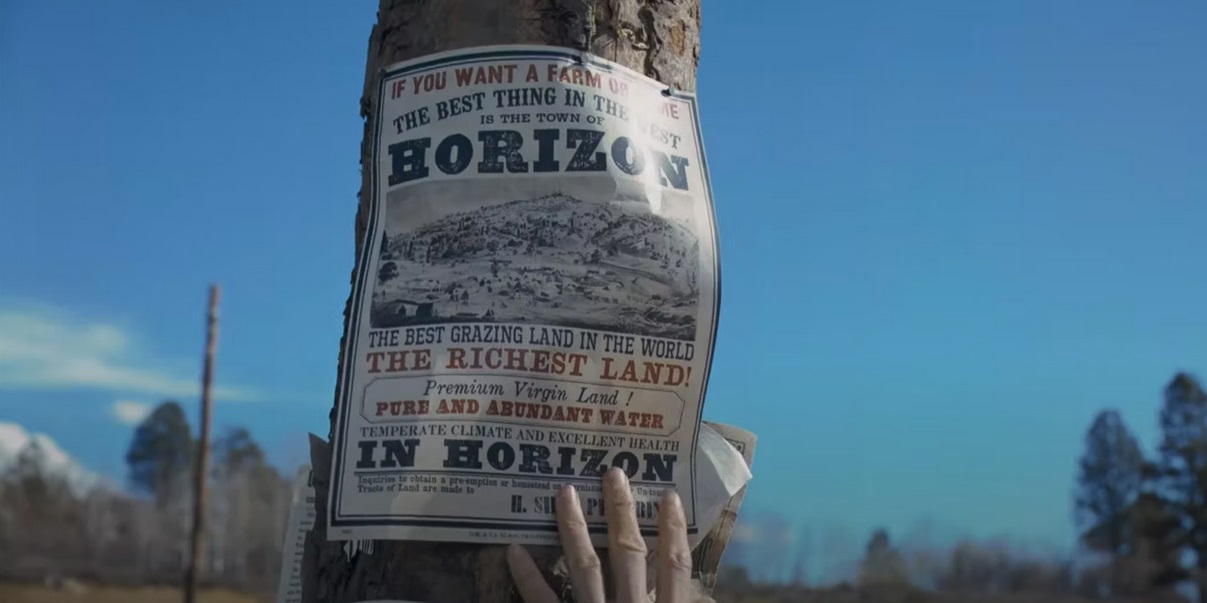
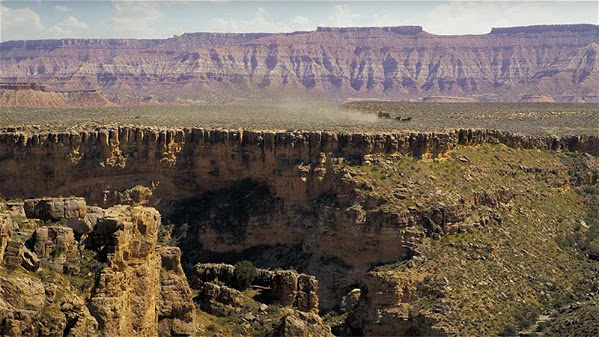
For a 3-hour movie, it sails right by, packed to the sprockets with detail, period and story-wise, never seeming to waste a frame in telling three...four? five?...stories about a plot of land in the San Pedro Valley in the American west that may—or may not —be available for homesteading, and the people who are attracted to the promise of it (whether it is true or not) and the people already living there who take it for what it is. 
 
There are the first white settlers, there to survey and parcel, but as they're alone in the wilderness and, unbeknownst to them, surveying Apache hunting grounds, they soon fall victim to a war party. Their graves are the first semi-permanent structures of Horizon. They won't be the last.
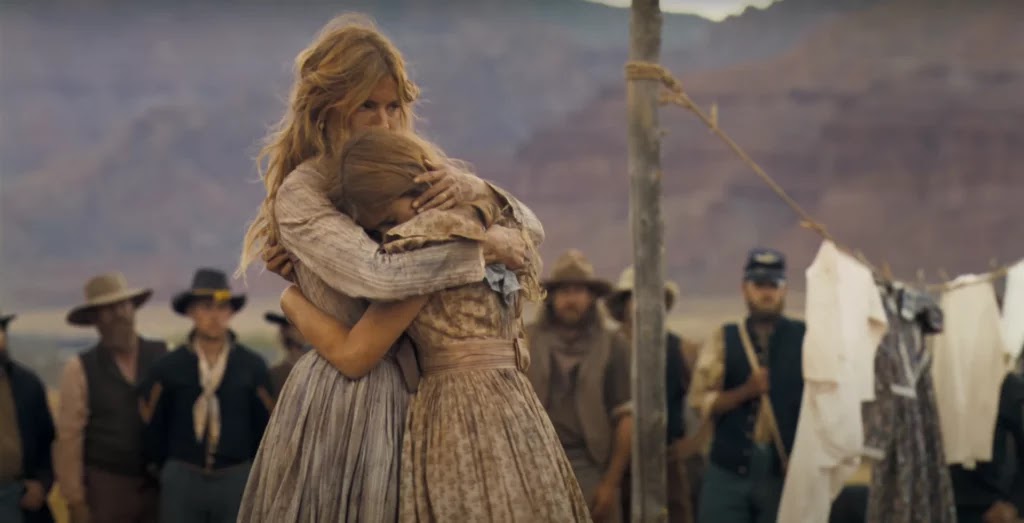
But, the pattern will remain the same. By 1863, there is a well-established colony on the site, across the river from those three original graves. They, too, are attacked by Apache, leaving a limited number of survivors: some, like Frances Kittridge (
Sienna Miller) and her daughter, Elizabeth (Georgia MacPhail) will take shelter at nearby Fort Gallant; others, like the boy who rode to the fort to get help, Russell (Etienne Kellici) form a hunting party to track down the Apache who burned down the encampment.
That attack has caused a dispute between the leader of the war party, Pionsenay (
Owen Crow Shoe) and the leader Tuayeseh (Gregory Cruz), resulting in the younger man splitting from the tribe, taking one of Tuayeseh's sons with him. 
In Montana, James Sykes (
Charles Halford) is shot by Lucy (Jena Malone), who takes her son David and flees for the Wyoming territory. Sykes' sons Junior (Jon Beavers) and Caleb (Jamie Campbell Bower) are sent to find her and the child. They catch up with her where she now goes by the name Ellen, married to hopeful lands-trader Walter Childs and living with a local prostitute Marybelle (Abbey Lee). When the Sykes boys show up, there is a confrontation between the vicious Caleb and saddle-tramp Hayes Ellison (Costner), a potential customer of Marybelle's. She and Hayes and the child escape town to avoid repercussions of the murder.
Also heading for Horizon is a wagon train, moving along the Santa Fe Trail, under the auspices of Matthew Van Weyden (
Luke Wilson), who is having trouble keeping the eclectic group of settlers (including a naive British couple and the family of Frances Kittridge's late husband) of the mind that, although they may be headed for a paradise, they're not there yet, and water and team-spirit are in short supply in a desert.
In the mix are interesting characters, like the leaders of the Army detachment at Ft. Gallant, who are straight out of John Ford's Cavalry films: Lt. Trent Gephart
(Sam Worthington, the most effective performance I've seen of his), who's a pragmatic soldier and would just as soon have settlers somewhere else and the "indigenous" (as he calls them) left to their land to keep the peace, a sentiment acknowledged but considered historically unrealistic by Gallant's leader, Col. Albert Houghton (Danny Huston) and his sergeant major, Thomas Riordan (Michael Rooker, in a slightly less garrulous version of the parts Victor McLaglan played in Ford films). One likes these people and you get the feeling everybody's doing the best they can under the conditions and the inevitability of time.
That's a novel's worth of people and a lot of stories and one suspects everybody's going to converge in Horizon (the town itself will probably end up being the focus of the series), their characters already established and with ensuing complications in the offing—Costner has previews of the next chapter at the end of this one and my appetite for it is whetted.
Despite the obvious nods towards Ford, Horizon: an American Saga, so far, feels more in the vein of the sprawling How the West was Won, but, in character, more like "Lonesome Dove", where individuals weave in and out of the fabric of the narrative, and sometimes—as in life—are never to be seen again in an indifferent Universe, lost in the stream of History. Costner may love his Westerns, but he acknowledges there's less romanticism to it when the survival rate hovers around 50%.
It was in Ford's film The Man Who Shot Liberty Valance, where a reporter states "This is the West, sir. When the legend becomes fact, print the legend." Ford's career peeled back veneers of western legend varnish in his films and in his later work stripped off more layers of his own earlier myth-making. Costner goes even farther, taking into account the grubbier myths of Leone and Peckinpah (and Eastwood) with his hard-scrabble porous towns in need of light and cleaning and extermination. He goes a step further by putting back all the practicalities of the settler experience that Ford cut out—the burying of the dead, the scarcity of water, the bugs and critters, the difficulty of killing a man with ball-shot, the necessity of self-sustainment by farming, the ritual of hard work, more important community matters than tea-dances and ceremonies.
If there's anything more to wish for, for me, it would be that there's more of it (despite others quibbling about length). A couple transition sequences seem to have been excised just to speed things along that might not have added much but may have smoothed a passage of time.
It's still early days, but one gets the sense that Costner will be making a point that the beauty of the West that we admire may not be just a matter of the dirt and stone carved by time and tide but also foundationed by the bones of those who walked before us.