Showing posts with label Gert Frobe. Show all posts

Friday, October 1, 2021

The Thousand Eyes of Dr. Mabuse

The Thousand Eyes of Dr. Mabuse (Fritz Lang, 1960) Peter Barter, respected journalist and broadcaster for a German news program, has gone missing for his evening news program. It turns out he IS the news; he's been murdered on the way to the studio by an unknown assassin, who has fired a shot into his neck while the reporter is stopped at a street-light. The other cars in the jam move on, but a traffic policeman investigates what the hold-up of one car is, and discovers Barter slumped over the steering-wheel, dead.*

But, the unusual thing about the assassination is that the local police had been warned of it before it happened: Inspector Kras (Gert Frobe) had received a call from the blind clairvoyant, Cornelius (Lupo Prezzo), who has seen the future crime happening in his mind's eye. Kras visits Cornelius, and expresses his cynicism about the mystical. What he responds to is cold, hard clues—like the thin blade discovered in Barter's neck that came from a secret military weapon that was under development—but strangely vanished—from the United States.
It's just one of a string of unsolved crimes that have occurred, and they have only one thing in common—the victims have all previously stayed at the Hotel Luxor in Berlin, and the authorities are starting to concentrate their investigative efforts there. That's a lucky thing as the Luxor has another crisis going on that day. Marion Menil (Dawn Addams) is standing on a high ledge of the Hotel, threatening to jump. The police can't reach her, but the American millionaire Henry Travers (Peter Van Eyck) is staying at the Luxor—he's just negotiated buying a British rocket company—and his window is a life-saving arm's length away from the distraught woman. His soothing words and offers to help convince her to come in off the ledge.
Her psychiatrist—who happens to be in the same building—is called. He is Professor Jordan (Wolfgang Preiss) and is treating Marion with hypnosis as she has become agitated by the manipulations of her estranged (and club-footed) husband. The Luxor seems to be the busiest joint in town with Travers and Kras and Jordan and Menil and the husband—and the busy-body press!—all bustling around the rooms and halls and very busy bar. And then there's the vociferous Heironymous B. Mistelzweig (Werner Peters), an insurance agent (and doing good business evidently!) always tagging along trying to get information on leads. It's enough to make the manager, Berg (Andrea Checchi), dehydrate from his constant sweating.
But, Berg knows something about the Luxor not everyone knows—it used to be a Nazi stronghold, designed for and fitted with false rooms (the better for spying) and, keeping up with the times, outfitted with secret cameras and microphones. No one's safe from having their business monitored almost constantly. But, who's doing the watching? 
Interpol has a strange theory: they think that it might be the work of Dr. Mabuse, a crime-kingpin, who had a spider's-web network of contacts and a magician's ability to cloud victim's minds. It's crazy, but we have seen a van of thugs (answering only to numbers) circling around the city-streets in radio contact with the purported voice of Dr. Mabuse
giving them orders to carry out—including the murder of that reporter. Then, Kras' office is bombed, that missile plant Travers was buying is sabotaged and Cornelius warns Travers off Marion by saying that a woman would lead to his death.
The film is filled with double-identities, double-tricks, trapped rooms, and a paranoid world-view that would only unimpress the most aluminum-capped conspiracy theorists. It's a continuation of a series that Lang had started on in Nazi Germany, and, returning to post-war Germany and making this film at the age of 70 (it was his last film), it's themes are just as relevant on the pervasive and slippery nature of Evil. But, now that world is not limited to the rarefied world of spies and criminals. As with the films of Hitchcock—most recently in his 1959 film North By Northwest—it spills over into the every-day, invading the nightmares of people just living their lives and turning their normality of quiet desperation ass over tea-kettle. No longer are they being spied on from around corners and through un-draped windows. Now, they're being monitored by technology in the Holy name of Security (as opposed to these days where it's in the Holy names of Convenience and Consumerism). And evil wraps itself in superstition and assumes a mantle of power only because it tells you it's there.
And the thing is, it works...just as well as it did in the Silent Era. The nightmares may have changed over time, but Lang's ability to create them, whole and fresh and insinuating, never ebbed.


* Lang used a similar sequence in his The Testament of Dr. Mabuse, filmed 27 years earlier.

Friday, April 23, 2021

Anytime Movies #10: Goldfinger

While I catch up on the reviews still in "Draft" phase here, I'll re-run a feature I ran when I first started this blog seven years ago,* when it was suggested I do a "Top Ten" List.

I don't like those: they're rather arbitrary; they pit films against each other, and there's always one or two that should be on the list that aren't because something better shoved it down the trash-bin.

So, I came up with this: "Anytime" Movies.


Anytime Movies are the movies I can watch anytime, anywhere. If I see a second of it, I can identify it. If it shows up on television, my attention is focused on it until the conclusion. Sometimes it’s the direction, sometimes it’s the writing, sometimes it’s the acting, sometimes it’s just the idea behind it, but these are the movies I can watch again and again (and again!) and never tire of them. There are ten (kinda). They're not in any particular order, but the #1 movie IS the #1 movie. 


I’m an unrepentant James Bond fan.


Yes, the movies are sexist and exploitive--frozen in the hardened amber of 60’s attitudes and prejudices.

They’re filled with mink-lined sadism, clueless Brit' snobbery and snarky humor only drunken frat' boys laugh at.

I love it.  And Goldfinger (1964) is the epitome of it all.

Call it a “guilty pleasure” if you must and place it at the end of this list, but homage must be paid and credit given.

There may be better films in the series (that would be its predecessor, the slightly more sober From Russia With Love- and I have warm spots in my heart for OHMSS, the nasty/silly Diamonds Are Forever, The Living Daylights and "the Craigs"). Certainly there are more elaborate and flashy ones, with more spectacle, where you walk out talking about the sets (and not much else).
But Goldfinger has it all, managing to take a middling Fleming thriller (even though Anthony Burgess listed it in his “99 Novels: The Best in English Since 1939” as representative of the Bond series) and improve on it—a rarity in the films. The screenplay (by series veteran Richard Maibaum and utility closer Paul Dehn) is an efficient series of traps and foreshadow-dropping gold nuggets of information that pay off later in the story: Bond’s improvised electrocution of an assailant in a seemingly-unrelated pre-titles sequence sets us up with information for another situation later, as does a casual conversation about discharging firearms in a pressurized airplane cabin (since disproved by the “Mythbusters”) Maibaum and Dehn toss out a group of characters early (and fittingly) to streamline the Big Set-Piece—Goldfinger’s raid on Ft. Knox—and go Fleming one better; instead of the unworkable book idea of physically stealing the gold, the screenwriters just devise a way to irradiate it, making it unexploitable, crashing the U.S. economy while increasing the worth of the villain’s holdings. Neat. They also update the book’s nasty “Perils of Pauline” sequence with a circular saw by strapping Bond to a slab of gold being bisected by the recently-developed laser beam.
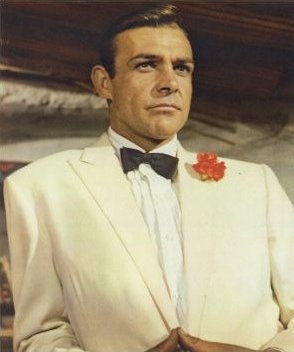
Maibaum excelled at plot and structure, but it was Dehn, a radicalized gay writer who had worked as a propaganda instructor at the OSS "Camp X" during WWII, who tossed in the more cheeky touches. There’s a cool re-appraisal of Bond as a hero in this film. He’s basically kicked between situations beyond his control, something which irked star Sean Connery who saw Bond as an active investigator. Connery was also miffed at some Bond set-ups—the seagull disguise at the very beginning of the film, although he did embrace Bond stripping off a wet-suit to reveal a white linen tuxedo jacket, which he wears to a seedy South-of-the-Border bar (The “cluelessly-overdressed Bond” joke would be done to death in the films until Timothy Dalton put an end to it --although Pierce Brosnan still had his Bond pathologically straighten his tie, even underwater).
His third time out, Connery is finally casual with Bond while tossing in odd little bits of business to suggest that Bond is inches away from being clobbered on a regular basis. The villains are memorable, and the women have defined personalities (for once) with Shirley Eaton’s “golden girl” displaying as much aggressive sexuality as Bond (Eaton, and Gert Frobe, as Goldfinger, had their vocal parts dubbed by other actors). Of course, there's also the gadgetry: the "homer," the lethal bowler hat, the hi-tech exoticism of the laser beam. 
And then, there’s the car.
John Barry’s score is the blaring frosting on the cake: repeating chimes announcing the presence of the villain or anything having to do with gold; sinuous strings, compounding like snakes, creep during the laser beam sequence and Goldfinger’s signature theme blats out in brass clusters. And although other artists’ Bond songs have topped the charts, no one’s topped its theme song (with lyrics by Leslie Bricusse and Anthony Newley) for brio and outrageousness. No one has ever “belted” a song like Shirley Bassey does this.
It also has my two favorite lines from any Bond film. The first, adapted from Fleming:
This is gold, Mr. Bond. All my life I’ve been in love with its color, its brilliance, its divine heaviness.

And from Maibaum and Dehn, a line so good, it’s amazing no thriller had used it yet:
Bond: Do you expect me to talk?
Goldfinger: No, Mr. Bond, I expect you to DIE!

At the time this film was released—1964—all of this was new and glittering like the bullion Goldfinger hoped to exploit. Now, the Bond series has passed the 50th anniversary (appropriately golden) from its first release, and has become something of an institution, spawning imitations, copies, inspirations, and parodies—the glut of "tentpole" superhero films take their playbook from the audaciousness of the Bonds. The series has had to re-invent itself several times in its history, and seems to be in a zenith with the films featuring Daniel Craig. As the line from Skyfall put it, Bond's hobby seems to be resurrection. Now, A-list directors and major stars are making the Bonds, a sign of respect and affection. And, although the prospect has seemed doubtful every now and again, "James Bond Will Return."
It's a sign of the power of the franchise that when it was announced that the latest Bond film would be delayed (just two tantalizing weeks before its opening) due to the Coronavirus pandemic, other films started falling from their scheduled dates like bad gold-plating. All of Hollywood is waiting for Bond to save the day...and the theater box-office. With any luck—and some "discipline, discipline" on the part of the populace—the latest Bond film, No Time to Die, will release in the U.S. in October 2021...

Anytime Movies
Goldfinger
Bonus: Edge of Darkness


* And, on Sunday, we'll put up a "Don't Make a Scene" feature from each week's film.

Saturday, August 11, 2018

He Who Must Die

He Who Must Die (aka Celui Qui Doit Mourir)(Jules Dassin, 1957) A French production of a Greek story directed by an ex-patriated (and blacklisted) American, He Who Must Die is based on a story by Nikos Kazantzakis (who also wrote the novels that formed the basis of Zorba the Greek and The Last Temptation of Christ). 

The time is 1921 during the midst of the Greco-Turkish Wars. Turk forces are taking over Greek cities and if there is no cooperation from the populace, they are burned to the ground and its people forced to relocate. Such is the fate of one such nameless town, and its priest, Father Fotis (Jean Servais—the star of Rififi), gathers his flock to make them ready to embark on a journey by foot in the Greek wilderness, to find help and land to restart their devastated community and a new way of life in exile. One old man carries the bones of his father and grandfather in a sack on which to build the foundation of their new imagined town, the church being its center.
As they start their journey, it is a time of celebration in the occupied town of Lycovrisi, overseen by the Turk governor Agha (Gregoire Aslan). Every seven years, they stage their own version of the Passion Play, the participants chosen by the town priest Grigoris (Fernand Ledoux) and the mayor Patriarchos (Gert Frobe): a mendacious peddler Yannakos (Rene LeFevre) is chosen to play the apostle Peter; the mayor's son Michelis (Maurice Ronet) will play the apostle John; Kostandis (Lucien Raimbourgh), the cafe owner is chosen to play James; the town butcher, Panagiotaras (Roger Hanin) will play Judas, a role he rejects but is forced upon him; and the most surprising choices are the town's widow (and prostitute) Katerina (Melina Mercouri) to play Mary Magdalene, and a stuttering, shy shepherd Monolios (Pierre Vaneck) is chosen to play Christ.
At first, the players are unnerved by the heavy responsibility of their roles (especially Manolios, who is afraid to speak in front of crowds), but the authoritarian Grigoris will not change his mind. The Passion Play will go on and the die (and the Play) has been cast. 

But, the arrival of the burned town's refugees changes everything. Flotis implores Grigoris to help his people. They have walked for 21 days and many have died enroute. All they ask is a barren parcel of land and maybe some food to eat until they are established. But, the town priest will have none of it, banishing the refugees, and spreading the idea that the dead among probably didn't die of starvation or exhaustion, but of cholera. The refugees are stunned by the town's lack of charity, but decide to leave—lest they be attacked by the locals—and make their way to an area of the foothills of the mountain Sarakina that overlooks Lycovrisi.

But, their plight, and their priest's harsh attitude toward them, which borders on persecution, stirs something in the Passion players. Yannakos is the first to visit, on a mission from rich townsman Ladas (Dimos Starenios) who has sent him to see if he can take any of the refugees' jewelry in exchange for food or water. But, Yannakos has a crisis of conscience when he goes up the mountain and sees how destitute they are. Michelis soon follows, and then Manolios, who is so moved by the refugees that he finds his voice and implores the people of Lycovrisi to offer charity, despite the derision heaped upon him by Grigoris who tells him that the role of Christ has gone to his head and he's become an anti-Christ. He tells Michelis in private that it is dangerous for a Turk occupied city to help rebels against the Turks.
But, Manolios will not be deterred, and when Michelis, the mayor's son, says that he will help Manolios and the displaced villagers, Grigorios expels him from the village and threatens the shepherd with excommunication. It doesn't even phase Manolios, and Michelis confronts the angry priest with a venomous "If Jesus Christ came back to Earth, he would be crucified again again. And you would be the one to drive the nails in." His fiancee begs him to not go or she'll break off their engagement, but Michelis is steadfast. He will go with Monolios. His betrayal of his father and the town, causes the mayor to fall under ill health. But Michelis will inherit the town, the deeds, everything, when his father dies and such is his convictions that he is willing to give the people in the mountains the deeds to start a new life.
The priest, Grigoris, will not stand for that. His authority has been defied, and Manolios' message already shows the danger of spreading, further undermining his own power. So he goes to the Turk Agha and tells him that if he wants to keep control of the village and, eventually, occupied Greece, that he must quell the rebellion. He demands that Agha bring Manolios to him personally—for what purposes he doesn't say, but it probably won't be Confirmation. Probably more like Last Rites.
Agha takes an armed guard and goes to the compound in the city where Michelis has taken in some of the refugees and Manolios goes over the barricade to talk to him. The Turk tells him that Grigoris just wants to talk, that he (Agha) is a politician, not a fighter, but if Manolios really wants to do some good, he'll come quietly, so that Agha doesn't order his men to fire on the people behind the barricade. Manolios ponders, takes a stick, attacks the soldier manning the mounted machine gun and runs. Volleys fire back and forth—men on either side are killed, and Manolios is taken prisoner.
Dassin is in his element here. His years in Hollywood before the blacklist gave him ample opportunity to hone his craft and purge himself of any indulgences and take a harder edge with his subject matter. His approach is straightforward, unsentimental, but no less, for want of a better term, impassioned. And his work on social issues and the world of film-noir provides a bitter undercurrent to what is a religious film...in Cinemascope, no less.
I'm not sure what the issue is, but it is a tough road to buy a copy of He Who Must Die—you can see a rather dulled, sub-titled version online, slightly cropped of its full Cinemascope width, but at least it's not pan-and-scanned. Maybe the ideas are a little...revolutionary, but that's not stopped films before. It's safe to say that Dassin would later strive to make better films, more far-reaching films, but never one as powerful as this one. It might be his masterpiece.

Saturday, August 27, 2016

Triple-Cross (1966)

Triple-Cross (aka The Fantastic History of Eddie Chapman, Terence Young, 1966) Fresh off the success of his third James Bond movie, Thunderball, director Terence Young took on a personal project he'd been trying to get to the screen for awhile—the story of a former flat-mate who spent the war (so he says) playing both ends against the middle, spying for both the Nazi's and the British.

Eddie Chapman (Christopher Plummer) is a safe-cracker, and a good one, part of a team of plastique experts called The Gelignite Gang who would blow safes and keep low enough to avoid detection. Chapman has a criminal record a mile long and is well-known to authorities with many outstanding warrants. But, by happenstance, when serving time in a prison in Jersey, France, he comes up with the scheme of all schemes. seeing the Nazi's land on the shore of Jersey, he demands to see the Nazi high command. 

Chapman is such a slick operator and facile enough to tell anybody what they want to hear, that by his first meeting (with Gert Frobe and Romy Schneider) he already has the suspicious Nazis thinking that they might have an upper hand in their efforts to undermine British defenses using Chapman as a field operative. He is given the name Franz Graumann and tested in procedures and given a nice snappy Nazi uniform and careful (very careful) supervision. Chapman/Graumann is so slippery that, at first, they can't believe that an Englishman would so casually betray his country until they realize...you can't believe anything he says. He becomes both a source of amusement and suspicion for the Germans who realize that, for a buck (or a mark or a pound), he'll betray anybody.
The Nazis put him through their paces, training, testing, and trying to break him, all with the patronage of one Baron von Grunen (Yul Brynner—he could have built a career out of playing Nazis) that, eventually, Chapman is given a bit more free reign. As long as he's closely monitored and closely watched, it doesn't matter how cavalierly he acts, he gets the job done to their satisfaction. Or enough for Chapman to convince them he's on the level.
But, what Chapman wants is to get back to England—it was the initial pitch at his first meeting about his value as an asset for the Axis. He gets his first chance when he's dropped out of an airplane where he's supposed to make radio contact. To his dismay, he finds he's still merely in Germany; the Nazis have taken captured ordinance and are testing Chapman to see what he'll do when he thinks he's back in Old Blighty. He quickly makes the discovery and radios back for pick up where he lets his superiors know that he is not pleased and pushes to be sent to England for real.


Chapman meets with the French Resistance (who, of course, must be Claudine Auger)
That comes with his next mission where he's smuggled into England via steamship and once in London he goes straight to the British Command, who are even more suspicious than the Nazi's. He's vetted, sweated, and when his information pans out, he is given a meeting with British Intelligence MI5 (led by Trevor Howard), who make their own negotiations with Chapman—a slightly larger sum of money and his criminal record expunged if he continues to convince the Nazis he's working for them and passes along misinformation to the benefit of the Allies. His first mission for the Nazis and the British: infiltrate the work-force of the Vickers bomber plant and destroy the facility—or do enough damage to make it look convincing. The British choose a portion of the plant not vital to the manufacture of the bombers and conspire with Chapman to blow it up—spectacularly—and do enough damage to fool Nazi aerial reconnaissance. Things go so well that Chapman receives The Iron Cross for his efforts.
And, at this point, one must say that this follows the dictum of most "Based on a True Story" movies that are produced with an eye towards the dramatic rather than the truth, best expressed in Blake Edwards' Sunset, "It's all true—except for a lie or two." Yes, there was an Eddie Chapman. Yes, he played "Yojimbo" between the Nazis and Britain during the War. The Iron Cross only went to military personnel, which Chapman was not, and it was the de Havilland plant and not Vickers, one of the prominent Nazis is shown being shot and killed for his participation in the plot of kill Hitler (did ya see Valkyrie?"), when he actually survived the war, remained lifelong friends with Chapman and even attended his daughter's wedding. Details, details. They get in the way of a good story.
But if the devil isn't in the details, he certainly was in Eddie Chapman. That much is true. You have to be something of a narcissist, a sociopath and not even casual friends with the truth to pull off the stuff he did on record, and Young and his scenarists have romanticized this story and Chapman to the "nth" degree, no doubt wanting to recreate the "charming rogue" or "gentleman spy" Young got away with in his initial Bond films. 
In that, he has an able and willing accomplice in Plummer, who plays Chapman in so casual a manner that one becomes used to the fact that Chapman doesn't deal with facts. He's always quipping, making snide comments under his breath, and constantly making the case for himself that he is a complete bounder...and just doesn't care what anybody thinks about it. Variety (when the film came out) called Plummer's acting "listless" but that is a mis-characterization of what Plummer is doing. Plummer doesn't display much emotion on his face because Chapman doesn't show much of any genuineness, whether it's for the Nazi's or the British, and if anything comes through his eyes, it's the hint of surprise or wariness of something doesn't go exactly according to surprise, which quickly evaporates while he joshes his way out of it. It's a performance so completely amoral that one almost doesn't want to root for him, so much of an anti-hero the character is. 
Young directs in his usual style of brightly-lit busy master shots punctuated with mid-close-up's and subliminal attention to detail. Young was considered a more able "host" than director with a fine eye and slightly seedy good taste, and his way of directing action is to set up a few cameras and get as much usable coverage out of the confusion as possible (in one scene of a German garrison being strafed by an RAF fighter, it's pretty obvious that Young used a couple angles of the same plane to pad out and inflate what meager means he had to create the scene). If there is a bit too much detail and some unnecessary plotting to create tension, that's a bit of Young's style, too. The film's subject, Eddie Chapman, did not think much of the film (it did take a lot of liberties with the story, but so did Chapman's version of it) and the film did not achieve the cult status of Young's work on Bond, where the film did far better in Europe than it did in the U.S.
"So tell me, Eddie: whose side were you really on?"

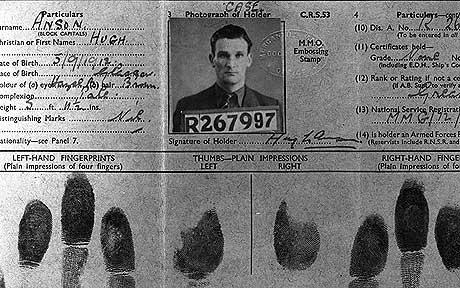
Chapman's forged papers to enter Portugal

Thursday, April 17, 2014

Anytime Movies (Transplanted): Goldfinger

While I have a few reviews "in the works," It's as good a time as any to re-boot (actually transplant from the old movie blog) a feature I started years ago, when it was suggested I do a "Top Ten" List.

I don't like those: they're rather arbitrary; they pit films against each other, and there's always one or two that should be on the list that aren't because something better shoved it down the trash-bin.

So, I came up with this: "Anytime" Movies.


Anytime Movies are the movies I can watch anytime, anywhere. If I see a second of it, I can identify it. If it shows up on television, my attention is focused on it until the conclusion. Sometimes it’s the direction, sometimes it’s the writing, sometimes it’s the acting, sometimes it’s just the idea behind it, but these are the movies I can watch again and again (and again!) and never tire of them. There are ten (kinda). They're not in any particular order, but the #1 movie IS the #1 movie.


I’m an unrepentant James Bond fan.

Yes, the movies are sexist and exploitive--frozen in the hardened amber of 60’s attitudes and prejudices.

They’re filled with mink-lined sadism, clueless Brit' snobbery and snarky humor only drunken Frat' boys laugh at.

I love it.  And Goldfinger (1964) is the epitome of it all.

Call it a “guilty pleasure” if you must and place it at the end of this list, but homage must be paid and credit given.

There may be better films in the series (that would be its predecessor, the slightly more sober From Russia With Love- and I have warm spots in my heart for OHMSS, the nasty/silly Diamonds Are Forever, The Living Daylights and "the Craigs".) Certainly there are more elaborate and flashy ones, where you walk out talking about the sets (and not much else).
But Goldfinger has it all, managing to take a middling Fleming thriller (even though Anthony Burgess listed it in his “99 Novels: The Best in English Since 1939” as representative of the Bond series) and improve on it—a rarity in the films. The screenplay (by series veteran Richard Maibaum and utility closer Paul Dehn) is an efficient series of traps and foreshadow-dropping gold nuggets of information that pay off later in the story: Bond’s improvised electrocution of an assailant in a seemingly-unrelated pre-titles sequence sets us up with information for another situation later, as does a casual conversation about discharging firearms in a pressurized airplane cabin (since disproved by the “Mythbusters”) Maibaum and Dehn toss out a group of characters early (and fittingly) to streamline the Big Set-Piece—Goldfinger’s raid on Ft. Knox—and go Fleming one better; instead of the unworkable book idea of physically stealing the gold, the screenwriters just devise a way to irradiate it, making it unexploitable, crashing the U.S. economy while increasing the worth of the villain’s holdings. Neat. They also update the book’s nasty “Perils of Pauline” sequence with a circular saw by strapping Bond to a slab of gold being bisected by the recently-developed laser beam.
Maibaum excelled at plot and structure, but it was Dehn, a radicalized gay writer who had worked as a propaganda instructor at the OSS "Camp X" during WWII, who tossed in the more cheeky touches. There’s a cool re-appraisal of Bond as a hero in this film. He’s basically kicked between situations beyond his control, something which irked star Sean Connery who saw Bond as an active investigator. Connery was also miffed at some Bond set-ups—the seagull disguise at the very beginning of the film, although he did embrace Bond stripping off a wet-suit to reveal a white linen tuxedo jacket, which he wears to a seedy South-of-the-Border bar (The “cluelessly-overdressed Bond” joke would be done to death in the films until Timothy Dalton put an end to it --although Pierce Brosnan still had his Bond pathologically straighten his tie, even underwater).
His third time out, Connery is finally casual with Bond while tossing in odd little bits of business to suggest that Bond is inches away from being clobbered on a regular basis. The villains are memorable, and the women have defined personalities (for once) with Shirley Eaton’s “golden girl” displaying as much aggressive sexuality as Bond (Eaton, and Gert Frobe, as Goldfinger, had their vocal parts dubbed by other actors). Of course, there's also the gadgetry: the "homer," the lethal bowler hat, the hi-tech exoticism of the laser beam. 
And then, there’s the car.
John Barry’s score is the blaring frosting on the cake: repeating chimes announcing the presence of the villain or anything having to do with gold; sinuous strings, compounding like snakes, creep during the laser beam sequence and Goldfinger’s signature theme blats out in brass clusters. And although other artists’ Bond songs have topped the charts, no one’s topped its theme song (with lyrics by Leslie Bricusse and Anthony Newley) for brio and outrageousness. No one has ever “belted” a song like Shirley Bassey does this.
It also has my two favorite lines from any Bond film. The first, adapted from Fleming:
This is gold, Mr. Bond. All my life I’ve been in love with its color, its brilliance, its divine heaviness.

And from Maibaum and Dehn, a line so good, it’s amazing no thriller had used it yet:
Bond: Do you expect me to talk?
Goldfinger: No, Mr. Bond, I expect you to DIE!

At the time this film was released—1964—all of this was new and glittering like the bullion Goldfinger hoped to exploit. Now, the Bond series has passed the 50th anniversary (appropriately golden) from its first release, and has become something of an institution, spawning imitations, copies, inspirations, and parodies—the glut of "tentpole" superhero films take their playbook from the audaciousness of the Bonds. The series has had to re-invent itself several times in its history, and seems to be in a zenith with the films featuring Daniel Craig. As the line from Skyfall put it, Bond's hobby seems to be resurrection. Now, A-list directors and major stars are making the Bonds, a sign of respect and affection. Although the prospect has seemed doubtful every now and again, "James Bond Will Return."
Filming on "Bond 25" begins later this year.


Goldfinger
Bonus: Edge of Darkness