The Force is Strong with this One
or
"You've Got to Start Some-where..."
Even though, as they say, I had "a bad feeling about" it, maybe this selling "Star Wars" to Disney may have been a good idea.
Rogue One: A Star Wars Story comes with the hype and anticipation as any entry in the saga "a long time ago in a galaxy far, far away" will. But, Rogue One goes in uncharted territory: it doesn't start with the big "Star Wars" crescendo and an opening crawl to infinity and beyond, the cast is unfamiliar and made up of mostly new characters.* And the synopsis we already know—it was in the opening crawl of the first "Star Wars" movie in 1977:"It is a period of civil war. Rebel spaceships, striking from a hidden base, have won their first victory against the evil Galactic Empire. During the battle, Rebel spies managed to steal secret plans to the Empire's ultimate weapon, the Death Star, an armored space station with enough power to destroy an entire planet."

Rogue One is the story of those rebel spies, and it's a curious mixture of taking things in new directions while being devoted to the first film's original intentions. One thing that's always bothered me about the "Star Wars" films—after that first one that basically exploded a brand new Universe in a Big Bang and being so rich in detail, the sequels—all of them—collapsed on themselves. Sure, they'd visit a new planet with a singular eco-system (an ice planet, a "gas-planet," a "forest moon," a city-wide planet, a lava-planet), but they'd pretty much stage a galactic war in one place—budget considerations, probably. This movie gambit made that supposed galaxy-wide conflict pretty much a bottle-world where an event in one little corner would affect the Universe. Some "Empire."

But, Rogue One takes us all over the space-place, some new, some familiar. In fact, it jets around from one planet to another, not unlike the first film and the only other one that did, pre-tinkering, Revenge of the Sith. Those used to the usual limited-Universe view may actually become a bit confused at some point wondering "what planet is this, again?"

Before we get to the other aspect of it I liked, a brief synopsis: The building of the Death Star has fallen behind schedule and Imperial Director Orson Krennic (Ben Mendehlson) travels to the home of Galen Erso (Mads Mikkelson), one of the original engineers of the project, who has retired to a simple life of farming. Krennic's arrival is not welcome and Galen instructs his wife Lyra and daughter Jyn to go into hiding to avoid detection. Krennic will not hear of Erso's protests that The Death Star will not actually "bring peace to the galaxy" but terror. "You have to start somewhere," replies Krennic (with my favorite line of the movie).
Protests aside, Krennic takes Erso away, Lyra is killed and little Jyn goes into hiding, where her pre-arranged rescuer is Saw Gererra (Forest Whittaker), veteran of The Clone Wars and a leader of the Resistance.

It's 13 years later and the Death Star nears completion, which creates an up-tick of activity among the Rebels: an Imperial pilot named Bodhi Rook (Riz Ahmed) has defected, charged with taking a holographic message from Galen Erso to the Rebels. Their main base is the fourth moon of Yavin, where they bicker about strategies and have doubts about the Empire's so-called "super-weapon" (after thirteen years, no wonder!) Rook makes it to Gererra, now on the planet Jedha, and who is seen as "too radical" by the main force of the rebellion, and Jyn (all grown up to be Felicity Jones)is rescued from an Imperial Labor Camp by rebel Cassian Andor (Diego Luna) and a re-purposed Imperial droid named K-2SO (voiced by Alan Tudyk, who makes the most of his lines) to be taken to Jedha in the hopes of her leading them to Galen, so the rebels can kill him.

Well, they get to Jedha just in time for an uprising against the Rebellion by the populace, aided and abetted by two "Protectors" of "the Whills,"** Cherrut Imwe (Donnie Yen), a blind warrior dedicated to the ways of The Force, but not a Jedi and his companion Baze Malbus (Wen Jiang) a mercenary sharp-shooter (when you're a blind swordsman against Storm-troopers with blasters, it's good to have one of those around!). They all get captured by a group working for Gererra, who has a complicated history with Jyn that needs going over before he can show her the hologram of her father.
In the message, Erso tells his daughter that he has been forced to work on the Death Star against his will, but has taken pains to create a defect in the system that they can find out by procuring the weapon's plans held by the Empire's version of "Iron Mountain" on the planet of Scarif.*** Jyn wants to go to the area of space where the Death-Star is being built to try and rescue her father (which the Rebels are all-too-willing to agree to, since they want to KILL her father).
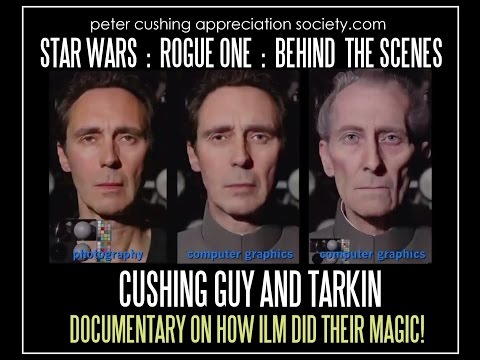
Things do not go so well for both the Rebels and Krinnic: Krinnic's control of the Death Star is undermined by the knowledge that he has let slip a security breach (oh, those uncontrolled servers) and this allows the Grand Moff Tarkin (Guy Henry, CGI'd to look like Peter Cushing****) to take control of the Death Star. His first target: the rebel base at Jedha. If you've seen "Star Wars," you're all too familiar with the sequence of events—a lot of switch-throwing, reaching for dials, and SSHHHHZZZZT! But, this is not the Death Star at full-power—it's firing just enough to wipe out a city, which it does with extreme effectiveness in a mult-plumed mushroom cloud. As K-2SO says, "There's a problem on the horizon. There IS no horizon!!"

The man battle and where things come to a head is the security facility on Scarif, which features an all-out assault between the Empire and the Rebels to get hold of those plans and director Gareth Edwards (he directed 2014's austere and weirdly effective version of Godzilla), where the disparate band of fighters with aerial support from Yavin fight to get those plans against everything the Empire has to throw at them, including things we only saw in the sequels. It's a terrific sequence that has genuine moments of edge-of-your-seat direness, and in case you think there's going to be a follow-up to this movie, there isn't...unless you count the original Episode IV.

And that's one of the things I like about Rogue One: it is its own movie, to be sure, but it is so tuned to the zeitgeist on the inspiration for "Star Wars" that it seems less removed from Lucas' sources than even Lucas managed. There are strains of Kurosawa throughout this, a level of disparity among the roles, not just in ethnicity but also in background story. Some are inspired by religion, some by revenge, some just because they're bad-asses itching for a fight. This Magnificent 7 are all scruffy, none of them polished—even K-2S0 is a might rusty—and the world they fight in is smudged, lived in and full of little goo-gah's that don't call attention to themselves, but exist as if they're part of the real world, not because they serve a dramatic purpose in the story-telling.
 |
| The TIE-fighter doesn't appear in the movie, but it sure is cool-looking, in'it? |
There's a strain of seriousness in the story-telling (not that there aren't lots of laughs along the way), it's just that Rogue One plays for keeps and is a bit more mature in its story-telling and less of (as one friend puts it) "a cheese-fest" than the rest of the "Star Wars" series. This is what happens when a "Star Wars" maker gets "serious" (oh, and is talented...there are way too many serious fan-flicks out there that suck) and is faithful to the spirit but not slavish to the style of a series. Great things can come of that.
Rogue One doesn't diminish "Star Wars" (as I think The Force Awakens does). It builds on it, makes it a bigger Universe with more potential.
And that's what the series has needed since it started making sequels.
* Oh, don't worry. There are a lot of familiar faces...and face-plates...scattered throughout the movie, some of whom may surprise you.
** "The Whills" is a piece of Star Wars arcana dating way back to the novelization of Star Wars (released before the movie came out) written by Lucas and Alan Dean Foster based on Lucas' notes, the original "Star Wars" story was taken from "The Journal of the Whills" which was a tome...like the Bible...of ancient stories of the Galaxy. I remember there was a line attributed to Princess Leia Organa at the beginning—"They were at the wrong place at the wrong time. Of course, they became heroes."
*** They might have saved a half-hour of screen-time of Galen had just said in his already super-secret message that he took pains to smuggle out: "Look there's this thermal exhaust port, right below the main port—it's about two meters wide that if you send a proton torpedo down it, it'll set off a chain reaction and blow the whole thing up!. Get a really sharp pilot, you know, like a moisture-farmer who can bull's-eye womp-rats, like in Beggar's Canyon on Tattooine." But, he doesn't say that. He tells them to go get the plans at Scarif and figure it out for themselves. What, you can only have one secret per hologram in this Universe?
****