Showing posts with label F. Murray Abraham. Show all posts

Saturday, April 2, 2016

They Might Be Giants (1971)

They Might Be Giants (Anthony Harvey, 1971) It's the same writer/director/composer team as The Lion in Winter, but a decidedly off-kilter product is this out-of-circulation curiosity from the era immediately following George C. Scott's Oscar win for Patton. Set in the "modern" age, which might be quite a few years too late for it, They Might Be Giants—yes, it did inspire the band's name—tells the story of Justin Playfair (Scott), a retired judge, and in whose grief after the death of his wife, now thinks he's Sherlock Holmes. The Sherlock Holmes.

That might be useful, actually, but Playfair is now convinced that everything wrong with the world (and there's a lot wrong in New York around 1970) is the work of Holmes' nemesis, the "Napoleon of Crime," the infamous Professor Moriarty. That includes the blackmail being played against Playfair's brother Blevin, who wants to pay up and be done with it, but the Judge, being Sherlock Holmes, forbids it until he can resolve the crime—and he's the one with all the money—so the brother decides to have him committed. Evidently without a decent phone book (they had those in 1970), he picks the worst person in the world to examine the Judge in order to declare him insane, a psychiatrist named (of course) Watson (Joanne Woodward). With a gaffe like that, the brother deserves all the grief he can get.
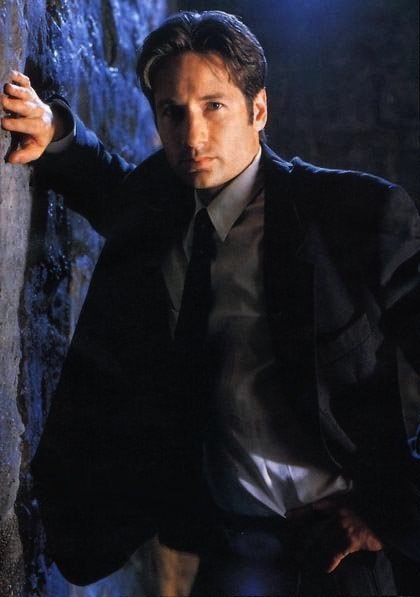
In the course of her examination, Playfair leads her on the wildest of goose-chases, trying to track down Moriarty, finding random clues in the detritus of the city, and introducing her to his own version of The Irregulars, the niche-dwellers all but abandoned by the hustle-bustling population and see nothing wrong in Playfair's behavior. In fact, they marvel at it, admire it, and wish to emulate it. Meanwhile, Holmes and Watson run the gamut of scenes of crimes displaying apathy, greed, gracelessness, and rampant consumerism in Society while Playfair rails against Moriarty's presence behind it all.* Watson serves as the Doubting Thomas (Scully to Scott's Mulder?), but eventually succumbs to Playfair's way of thinking. Professionalism, be damned.
The writer is James Goldman, brother of William (The Princess Bride, Butch Cassidy and the Sundance Kid, The Marathon Man), writer of the afore-mentioned The Lion in Winter, as well as Robin and Marian, Nicholas and Alexandra, and...White Nights. And the problems with the movie is in James' screenplay, full of wonderful detail and dialog, but precious (to the point of cloying) in scene concepts relating to the larger point. The mystery's good, but the clues suck. Fortunately, he's got actors like Scott, Woodward, Jack Gilford, Rue McClanahan, F. Murray Abraham, Al Lewis, Gene Roche, Paul Benedict, and Emmet Walsh, all of whom can spin gold from cotton candy temporarily, but can only go so far to improve the material in the long run. 

The film is as twee as twee can be, more in keeping with—Vincent Canby had this right in his negative review—the time of You Can't Take it With You and Arsenic and Old Lace and the sunny-side-up attitude (despite eyes being open to the negative) of Frank Capra. But it's not Capra, it's Anthony Harvey, terrific editor and Hepburn-favorite director. Harvey's really good at designing a film, its ambience and lighting, but he's not the best at forming image to idea, which the best directors can do merely by having empathy with the material. Harvey doesn't judge in his projects, but he also rarely comments at all, good at staging, but not at direction...that is, direction of you, the audience to a feeling the material should provoke. For a former editor, his weakness as a director is editorial. Odd.
The analyst in me cringes at the movie in its romantic notion of insanity—I've long wanted to do an "out there" version of "Harvey" where Elwood P. Dowd self-medicates in all sorts of ways besides booze—but, the wide eyed moon-calf that was me who first saw this film (probably to hear the score, as I am a fan of its composer, John Barry, and will also see anything with Scott in it), still has an affection for it, guarded though it has become. I also have a fondness for its ending, which drives audience members who are looking for air-tight Holmesian solutions crazy and let down, but for me, is a perfect little nugget of an ending whose power (the acting,** the lighting effects, the music?) one can't explain away. I'd put a spoiler alert here, but, really, this ending spoils nothing—it only enhances...and makes up for what has gone before.

Sadly, John Barry's score for this film (conducted by Ken Thorne) has never been released.


* Here's two examples, both out of the mouth of Playfair:
"Because, you see, we live in Eden. Genesis has got it all wrong — we never left the Garden. Look about you. This is paradise. It's hard to find, I'll grant you, but it is here. Under our feet, beneath the surface, all around us is everything we want. The earth is shining under the soot. We are all fools."
and
 "Well [Don Quixote] had a point. Of course, he carried it a bit too far. He thought that every windmill was a giant. That's insane. But, thinking that they might be... well… all the best minds used to think the world was flat. — But, what if it isn't? — It might be round — and bread mold might be medicine. If we never looked at things and thought of what they might be, why, we'd all still be out there in the tall grass with the apes."
** Scott's feral growl and playing of "Now!  Do you see him now?" always gives me chills.

Saturday, April 5, 2014

The Grand Budapest Hotel

The Art of Artifice
or
"Faint Glimmers of Civilization in This Barbaric Slaughterhouse That Was Once Known as Humanity"

Wes Anderson's latest film, The Grand Budapest Hotel, takes him out of the contemporary U.S. (as was a visit to India in The Darjeeling Limited) and into pre-war Europe. But, just as Woody Allen's European adventures still feel like transplanted versions of his New York films, despite the change in venue, this one lies squarely in Andersonville.

The framing device is like a set of Matryoshka dolls (which, in turn, are shot in different screen aspect ratios as are illustrated below—a movie version of "nesting"): in the present day, we see the statue of a famous writer, then a filmed address by said writer (played here by Tom Wilkinson), who introduces the tale of how he (in the form of Jude Law) heard the tale originally: on a stay at the relic of a once luxurious hotel and spa for the rich, The Grand Budapest in the Republic of Zubrowka, he meets its reclusive owner, one Zero Moustafa (F. Murray Abraham), who, for some reason, habitually stays in the one closet-like room reserved for lobby boys. The man is monied, propertied, so what possible reason could there be for such a humble practice?

Over a long dinner in the Grand's nearly empty dining room, Moustafa tells the writer of the heady days of the Grand, pre-War in 1932, when he first arrived and took a position as a lobby boy under the tutelage of Monsieur Gustave H. (Ralph Fiennes, who takes the role between his teeth and wrestles it like a beloved chew-toy), the long-in-standing concierge of the Grand, whose adherence to societal protocol and near-psychic attendance to his guests' needs belies a roué's cynicism and a melancholic (almost necrophiliac) nostalgia for the past. The Grand's hoity-toity love him as he is unfailingly solicitous, calling everyone "darling," and because he will personally see to their whims and desires, even their carnal ones.

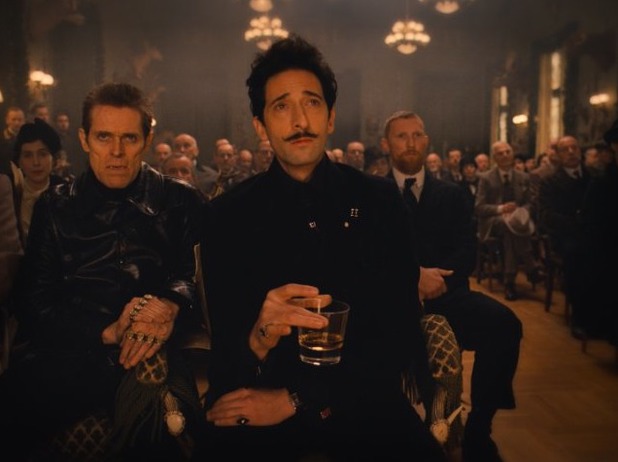
But, when one of his "ladies" (with the improbable name of Madame Desgoffe-und-Taxis, played by Tilda Swinton) is found dead after her visit to The GBH, Msr. H. is suspected of murder (a very slow one, evidently). He is accused (by the Madame's son, Dimitri, played by Adrien Brody) arrested and thrown into prison, which then throws the Hotel into disarray. It's a conspiracy of sorts, and it is up to the young lobby-boy to make it right. One does, after all, have to anticipate one's needs in hotelry.

Present Day: The Telling of the Telling of the Tale
It's very fine (and fun) how Anderson takes us back in time, visually, without having to rely on a long "word-crawl," explaining who, what, where, when and how, but, instead taking us back in time (and scope) to present his world of large halls (that remind one of The Overlook in The Shining) and tiny details that are presented in life-size and miniature, 30 frames a second and stop-motion. It's not supposed to be real. It's supposed to be quaint, in a fairly demented way. And he's aided and abetted by his all-star cast, made up of a top tier of new faces with a taste for quirk, and cameos by the ever-loyal (and growing) Anderson stock company (Owen Wilson, Jason Schwartzman, Bill Murray, Willem Dafoe, Edward Norton, Bob Balaban, Jeff Goldblum).
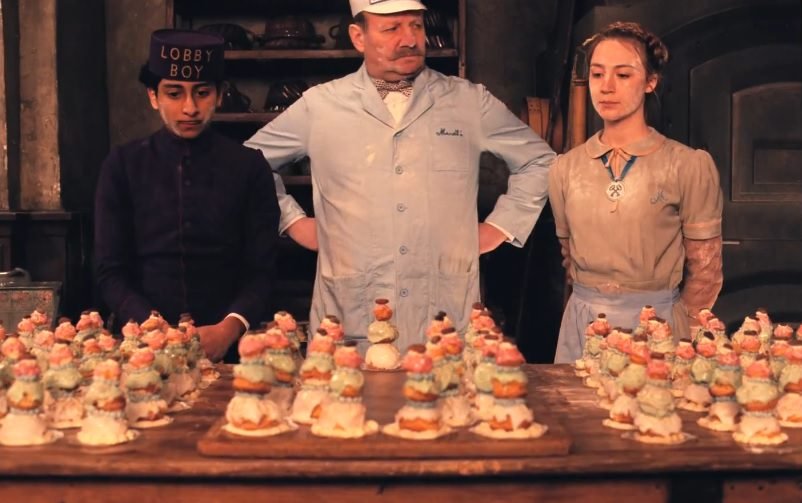
The word for this movie is "confection," more so than any other of Anderson's films, which have always carried an air of preciousness to them; for example, much is made of a certain baker's in Zubrowka, by the name of Mendl's, makers of intricate desserts in perfect little boxes that open at the pulling of a ribbon. Anderson's film has the same intricacy and fragility as those desserts (and one can't help looking at Anderson's framing as "little boxes"), but is played at such a savage and swift pace at times, it dares itself to fly off the rails, as if all that planning and detail was meant to be merely thrown in one's face for a laugh, like a carefully sculpted pie.

1968: The Telling of the Tale
It never does topple, perhaps due to Anderson's now-customary one-point perspective framing, so controlled as to be mirthful in its own right. His elaborate right angle cross-cutting—at one point, in the 1968 sequence, he shows four different angles on the elder Zero Moustafa, north, south, east and west between shots of him being discussed—is focused so as to not jar the eye-line from shot to shot. That's some careful visual architecture working there. In fact, some of the fastest cutting and movement in the film is done with those strictly balanced shots, as if willing itself, by energy, to turn into a rudimentary 3-D film. Or a particularly aggressive cartoon.
1932: The Tale
It is precious, but not in the slow, self-satisfied way that Anderson's early films have often been, but snappily, stylishly, as if in a blur, like a passing fancy or a former way of life, run over by happenstance and the future's inexorable pace. The Grand Budapest Hotel waves a customary handkerchief as it passes by, but passes, nonetheless, blithely, chirpily, and entertainingly, zipping away with a fading laugh.

Wednesday, February 5, 2014

Inside Llewyn Davis

I'm SO Not There
or
Negatively Fourth Street

Llewyn Davis (Oscar Isaac) is the remaining 1/2 of the singing duo Timlin and Davis, a not-successful folk act—although they have one pressed album floating around. Timlin committed suicide by jumping off the George Washington Bridge, leaving Davis, the talented but not as charismatic part of the group, to fend for himself.  

"Well, shit," says an unsympathetic car companion on a trip to Chicago (played by John Goodman) "I don't blame him. I couldn't take it if I had to sing 'Jimmy Crack Corn' every night."


It's the era when Bob Dylan burst forth in the consciousness during the folk renaissance in New York's Greenwich Village, but this movie isn't about Bob Dylan (although he's alluded to at the end). It's not even based on the life of Dave van Ronk, whose reminiscence, "The Mayor of McDougal Street," inspired Inside Llewyn Davis.  

Don't look for history here, though. This is a Coen Brothers movie; we're in the land of Myth.
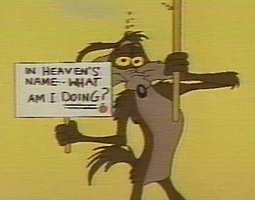
It's another in a long line of their "tough luck" films where they play God and some poor schlimazel* plays Job (or maybe Sisyphus—or his Looney Tunes equivalent, Wile E. Coyote—if they've got a screw loose or have stopped caring) like H.I. McDonnough (Nicolas Cage) in Raising Arizona, Barton Fink (John Turturro) in that film, "The Dude" (Jeff Bridges) in The Big Lebowski, or Larry Gopnik (Michael Stuhlbarg) in A Serious Man. All those movies tread the razor's edge of comedy and tragedy, every step a little painful to watch, no matter which tradition the film ultimately lands in. Inside Llewyn Davis falls in the ice-encrusted mud puddle of tragedy, but the protagonist survives. And as we all know, anything that doesn't kill you...

Well, that doesn't really apply here.
The film begins with Davis performing at the Gaslight Cafe. He ends his set with his standard line "If it's never new and it never gets old, it's a folk song." Interesting line. He's then told by the cafe's owner, Papi, that someone's outside waiting for him.
When Llewyn goes outside, a man in the shadows begins to pick a fight, then beats him up, leaving him in the alleyway, bewildered as to what that was all about.
He wakes up the next morning, having crashed at the pad of fans of Timlin and Davis, the Gorfeins, their cat staring him in the face. He pads around the house, finds a Timlin and David album, plays it, and it's the same song he sang at the beginning of the movie, but with Timlin, it's sweeter, more hopeful, more of a crowd-pleaser and less of a lament. It's the same tune, but it's the singer, not the song.
We don't see Timlin much, just his image on that record cover. But folks remember him, talk about him fondly, leaving Davis feeling like a widow and a bit like chopped liver. He's trying to make it on his own and not doing a good job of it, sleeping on a series of couches where he hasn't overstayed his welcome yet and depending on other people's kindnesses, while his mounting frustration with every slight makes him more petulant and ornery.
And there are disappointments around every corner and city-block, unforeseen details and happenstances that frustrate, confound, cost money he doesn't have, or provide a revelation for that thing that happened last week that might have been something if...
Well, if he hadn't been such an asshole. Or was a little more forgiving, or not so reliant on living in the moment, and for the next crisis. But, he's not. He's Sisyphus, the Greek king, who, for his deceit, was punished by the gods to roll a boulder up a hill only to have it roll back down on him to the valley, to begin the long process again and again. Wince and repeat. For all eternity.
Davis has that quality; he has a tendency to make the same mistake more than once and then fall back to the familiar—it's never new and it seems to never get old. That's folk music. And when we reach the end of the movie and he's again beaten up in an alleyway by a "friend," we have to ask ourselves: is this a reality—does he actually get beaten up in the same way by the same guy? Or was that first sequence a dream (we never really see him pick himself up and go to the Gorfeins to crash) and he's just fulfilling the only kind of dream he can? The only one he has? Or is he really doomed to repeat the same sequence over and over. 
There's always that sense of Sisyphusian repetition in the performing arts—a guitarist once told me "As many grains of sand on the beach, that's how many times Carlos Santana has played "Black Magic Woman"—but the Coens turn it into a cruel fate, a myth that reflects life (as it's supposed to), that cautions us and makes us say "...glad I'm not him" no matter how many endless failures we might have looking for a job, or the monotonous grind of the 9-to-5 that has us praying for the weekend (if we get a weekend), the rejections, the humiliations, "the thousand natural shocks."  
"Glad I'm not him." It's tough to recommend Inside Llewyn Davis for the casual movie-goer who "wants to have a good time" (imagine the same argument for 12 Years a Slave!). Its humor is dark, subtle, and he's a creep, and there's no real vicarious satisfaction to be taken in his struggles. It is, however, a great film, one to be appreciated after so many cookie-cutter CGI-fests this past year that are so much pixilated cotton-candy that are out of theater/out of mind. Inside Llewyn Davis stayed with me for weeks, which was a rare treat.
A Columbia recording gig in Inside Llewyn Davis for a novelty song, 
written by Timberlake's "Jim," "Please, Mr. Kennedy.' 
This is Llewyn's bad attitude on "light" and his reactions to the third singer (Adam Driver) are hilarious.
Even this has a downside. 
"Dink's song" (aka "Fare Thee Well") as sung by inspiration Dave van Ronk

 
* At this point, we need to remind you that a schlemiel is the person who spills the soup, the schlimazel is the one who has the soup spilled on them. The distinction is important.