Showing posts with label Everett Sloane. Show all posts

Wednesday, July 24, 2024

The Men (1950)

 
In all Wars, since the beginning of History, there have been men who fought twice. The first time they battled with club, sword or machine gun. The second time they had none of these weapons. Yet this by far, was the greatest battle. It was fought with abiding faith and raw courage and in the end, Victory was achieved. This is the story of such a group of men. To them this film is dedicated.
 
Soon after director Fred Zinnemann's contract with M-G-M was up—he was stuck directing things like My Brother Talks to Horses but ended his time there with a prestigious low-budget film, The Search—he began working independently for producer Stanley Kramer, a collaboration that culminated in the classic film High Noon. Two years before that western, Kramer, Zinnemann, and High Noon scenarist Carl Foreman made another socially-conscious film about the problems dealt with by injured war veterans who'd lost the use of their legs due to combat wounds.
That film, The Men, is largely set in the Birmingham Veterans Administration Hospital, where Foreman and and the film's star did their research for it, and employed many of the patients there as extras and for speaking parts.
 
That the star is Marlon Brando—in his film debut—makes the film notable, and a touchstone of sorts in terms of film and screen acting. Although Montgomery Clift—also, like Brando, a student of the "Actor's Studio"—had already brought that less theatrical approach to the screen in The Search and the yet-to-be released Red River, it was Brando who had lit the fire on stage in "A Streetcar Named Desire", making his brutish Stanley Kowalski something of a force of disreputable nature and creating a sensation in theatrical circles.
But, "theatrical circles" ain't "Mom and Pop Ticket-Buyer of Everytown U.S.A." And The Men was a fortuitous way for the unconventional actor to make his debut. Brando's portrayal of the embittered paraplegic soldier Ken Wilocek came with its own explanation for why the character would be not-traditionally sympathetic and Brando could avoid any exaggerated sentimentality playing the role.
But, Brando is a stark contrast to the more theatrical performances of 
Teresa Wright, Everett Sloane, Jack Webb (that's just "the facts") and Richard Erdman. (look real carefully and you'll even see "Star Trek"'s DeForest Kelley playing, naturally, a doctor*). It's unconventional, at least in Hollywood terms of 1950. Check out the review of his performance from Variety of that era: "Brando fails to deliver with the necessary sensitivity and inner warmth which would transform an adequate portrayal into an expert one. Slight speech impediment which sharply enhanced his Streetcar role jars here. His supposed college graduate depiction is consequently not completely convincing."
 
Ouch. But, then, Variety is a company-town rag which serves as "rah-rah" material for the status quo; it's never been one for spotting innovation.
Maybe it's because I'm used to the Brando eccentricities and (for the most part) appreciate them, but I found his portrayal—"speech impediment" or not—the least affected of the major performances—and I'm a big fan of Wright (Shadow of a Doubt), Sloane (Citizen Kane), and, yes, even Webb (Dun-da-dun-dun). But, Brando feels real. Everybody else comes out and tells you how they feel and why; when Brando's Wilocek finally gets around to saying what he means (which happens rarely) you've already seen it in his face. And when he reacts to something, it's a bit like an explosion—it's fast and unexpected. His Wilocek takes knock after knock, tries and then wallows in self-pity. The cures that Sloane's doctor recommends—exercise, recreation—don't work for him. And the other patients' means of coping, be it drinking or gambling, or intellectualism or exercise are merely distractions from the obvious—they have lost their mobility, and to a large extent, their freedom. Wasn't freedom what they were told they were fighting for?
A piece of narration at the beginning is too blunt about it: "I was afraid I was going to die. Now I'm afraid I'm going to live." When he went to war, he was engaged to Wright's Ellen. But he comes back and he has no future—he can't walk her down the aisle and there's a question of whether he (or rather "they") can have kids (the film circles around that question during a hospital Q and A, no doubt due to Hays Code regulations). But, his injury has not only blown through his spinal chord but also his expectations of a "normal" life. He withdraws and, in a case of self-fulfilling prophesy, he rejects her, insisting that she stay away from the hospital, as he no longer is the man she fell in love with.
Sloane's doctor is a big believer in physical therapy as well as a tough-love version of psychotherapy. Initially hesitant to allow Ellen to visit, he relents and Wilocek, while at first reluctant to allow himself to hope, begins to soften. 
It sounds very "pat", like the path of a "very special" and "truly inspirational" story-line, but Kramer, Foreman and Brando don't allow it to go smoothly, with added complications and frailties among even the most optimistic and noble of the characters. It's tough on audiences, and Brando's insistence towards playing the part without inviting audience pity makes it a bit more sophisticated...and even a little rebellious from the "socially-conscious" norm. But, it's worth watching...if only to see a moment when Hollywood standards began to shift...and change forever.
Brando clowning on-set.

*  

Saturday, June 19, 2021

The Big Knife

Saturday is traditionally "Take Out the Trash" Day

The Big Knife (Robert Aldrich, 1955) 

"Odets, where is thy sting?" George S. Kaufman 

How much you like this movie depends on how much you like Clifford Odets and his writing. 

Me, not so much. 

Clifford Odets has always grated on me, his writing seeming like a creative writing parody of Tennesee Williams. He's of the "cookie made out of arsenic" school,* where every metaphor is tortured and every character is an overwrought drama-queen, pontificating in the most flowery way possible their transparently obvious thoughts, often at the top of their lungs. Their world comes down to good and bad, the bad being moustache twirling scene-stealers and the good down-trodden martyrs. It's a theater-world as realistic as a proscenium arch and as subtle as projecting to the back of the house. 

The Big Knife is no better. An "exposé" of Hollywood corruption written in the '40's, but filmed in 1955—a decade saturated with industry self-loathing—the film suffers from its over the top theatricality. Robert Aldrich has never been the most tasteful of directors, but his stylishness with dreck has never been questioned. He can make chopped liver look like foie gras (even though it still tastes like chopped liver). Directing The Big Knife** (the year after directing the brutal, but terrific Kiss Me Deadly) he barely leaves the ornate living room of screen idol Charlie Castle, nee Charlie Cass (Jack Palance), well-payed but agonizing over signing a seven-year contract with a studio that might not be artistically fulfilling. At the time of the signing, he's artistically throwing himself into a boxing picture, so already his motivations are suspect. Mrs. Castle (Ida Lupino), recently separated from Castle, doesn't want him to sign (they're separated for Castle's philandering—what does she care?).

The reason Charlie's even considering signing is the hit-and-run accident that the studio has covered up to keep Castle's reputation with the public spot-less. And studio chief Stanley Shriner Hoff (Rod Steiger) is only too willing to spill the beans if Castle doesn't co-operate and limits his work to his studio. As a signing bonus the studio just might eliminate the only witness to the case (Shelley Winters).

Odets prided himself on being of the "Kitchen Sink" school, but here he expects you to feel sorry for the plight of the privileged boo-hooing through their silk handkerchiefs rather than tissue paper. By the time of writing "The Big Knife," Odets was making good money, so maybe it was more artistically fulfilling to write about his contemporaries "in the biz," than take on the troubles of Ma and Pa Average. He also has no problems with Charlie being a perpetual letch and philanderer, but "a sell-out?" Horrors! One might ask Frances Farmer her opinion of his choices. 

John Garfield, who was Odets' stage mouth-piece, played Castle on Broadway in 1949. But the role is beyond Jack Palance—he didn't yet have the polish to play (or be) a Hollywood leading-man, so he mostly just seethes and heaves himself around the room. Ida Lupino, one of the best actresses around, is reduced to soap opera sop work here. The only actors who seem able to cope with Odets' purple prose are Winters with a force of cluelessness and Steiger, who just powers his way through like a bull—no hesitations, no apologies, which works well for the character—a studio mogul of the Louis B. Mayer/Harry Cohn ferocity. 

The final act of the film is a mess of theatrical hysteria and misdirection that compresses a lot of story and reactions off-screen, while a running narrative informs us (or rather misinforms) about what all that hub-bub is upstairs. Perhaps Aldrich rushed through it to cut through the giggle factor, but the material is lumpen at any speed. You need a bigger knife than this movie's got to make it play.


* A bit "on-the-nose", that, as Odets wrote that line for The Sweet Smell of Success.

** I keep seeing The Big Knife being referred to as a film noir. Nah. Sure, it's got a gritty title, and it's filmed in black and white, and the souls are sordid and Aldrich directed noirs--but, this is as much a film noir as The Oscar is!

Friday, June 18, 2021

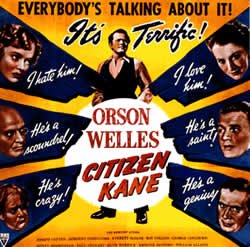
Anytime Movies #2: Citizen Kane

While I catch up on the reviews still in "Draft" phase here, I'll re-run a feature I ran when I first started this blog seven years ago,* when it was suggested I do a "Top Ten" List.

I don't like those: they're rather arbitrary; they pit films against each other, and there's always one or two that should be on the list that aren't because something better shoved it down the trash-bin.

So, I came up with this: "Anytime" Movies.


Anytime Movies are the movies I can watch anytime, anywhere. If I see a second of it, I can identify it. If it shows up on television, my attention is focused on it until the conclusion. Sometimes it’s the direction, sometimes it’s the writing, sometimes it’s the acting, sometimes it’s just the idea behind it, but these are the movies I can watch again and again (and again!) and never tire of them. There are ten (kinda). They're not in any particular order, but the #1 movie IS the #1 movie.


So obvious a choice.

Yet Citizen Kane (or RKO 281) has been fielding off re-appraisals and critical backlash since the day of its premiere. Is it really "the greatest American film ever made?"

Yes.

So far….

Part of the argument against it is that it can’t be since it was the product of a 26 year old who had never made a film before. But
Orson Welles was a 26 year old who grew up pampered and precocious—who read Shakespeare at an age when other kids are reading Seuss. As a teen he made his way in the world by his brio and his considerable talents and his nerve to try just about anything. He was an artistic sociopath who staged alternative Shakespeare productions and avant-garde radio plays for years before being given, as Kane puts it, “the candy store”—a carte blanche contract with a film studio to make any film of his choice, any way he wanted with final cut and a stipulation that said no one could alter it in any way in perpetuity (This is the reason why Turner Broadcasting in its rush to colorize movies could never put so much as a pink pixel to Citizen Kane. Some contract!). With it, he gathered his seasoned Mercury Theater actors (some of whom would go on to major Hollywood careers), one of the most innovative and painterly cinematographers, Gregg Toland, young, daring editor Robert Wise, the arrogant and brilliant composer Bernard Herrmann, and the amazing technical crew at RKO who produced such amazing feats as King Kong and the Astaire-Rogers musicals and turned them loose on Herman Mankiewicz’s long-in-the-planning screenplay that he believed could never be produced.

Out of all that talent at the top of its game, Welles produced the best American movie ever made, and as a reward he was never allowed that freedom again. Ever. No good movie goes unpunished.
His next film, The Magnificent Ambersons was a more mature and accomplished–looking film, but RKO chopped it up, re-shot the ending giving its albeit happy finale a certain incomprehensibility and threw it on the bottom of a cheesy double bill. Welles always thought it would have been his best film and the evidence certainly indicates it might have been.  He then barely worked in Hollywood again, except as an actor, and used the funds to make films dear to his heart or sensibility (which veered from Shakespeare to pulp) on a catch-as-catch-can basis. Welles’ Falstaff movie The Chimes at Midnight was the project closest to his heart, and might be better if not for the logistical and technical hurdles Welles had to jump in order to make it.

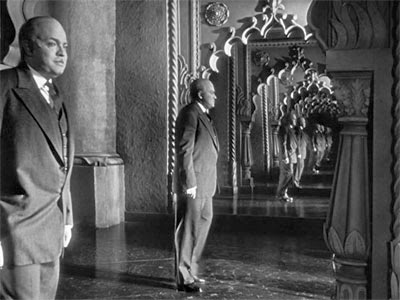
But Kane is the grail—the stuff of legend, and has been looked on ever since with avarice by would-be auteurs with more guts than talent, and therein lies the danger. That reputation could make Kane as cold and lifeless as one of the statues in Xanadu’s basement. It’s actually more like one of Susan Alexander Kane’s puzzles—intricate and maybe unsolvable without a lot of effort. There’s one shot where Welles shows his hand. It occurs after Susan has left him, accompanied by the screeching cockatiel superimposed on the screen (“I wanted to wake the audience up at that point,” Welles joked. Really, Orson? Right there?) and right after he trashes her room—destroying the acquisitions of her life and his—Kane picks up the snow-globe that will fall from his hand at his death. “Rosebud,” he murmurs (both times) and then walks as in a daze out of her room, into the hall, and past his servants. He then crosses through a mirrored hallway that reflects an endless line of Kanes that recede and disappear. After Kane (and his many reflections) has passed, the camera then pushes into the mirror and out, back to the sequence's surrounding reverie of the butler (“Sentimental fella, aren’t you?” “Mmm. Yes and no.”)
That shot is the exit from the worlds of memory through which we have seen many reflections of Kane—the house of mirrors that makes up the bulk of
Citizen Kane, the movie. It is also our last image of Kane, himself, in the film. He’s talked about through to the end, of course, but that splintered mirror-shot is our final impression of him (Kane—and Welles—are not even seen in the End Credits review of actors). At that point it becomes clear (as crystal) that the entire film is like that hall of mirrors that reflected back the aspects of Kane important to each narrator—a process that began with the newsreel that quickly jumped through the highlights of Kane’s life as a public figure and set up the film’s surface mystery—what is the meaning of Kane’s last word (and so serves as a stand-in for “who was Kane, really?”).
In the course of the various reflections there are all sorts of legerdemain—little tricks and in-jokes—that Welles, who was an amateur magician, clearly loved pulling off even if an audience didn’t immediately “get” them. One of my favorites is the craning shot through the model of the “El Rancho” nightclub where ex-wife Susan Alexander performs and drinks herself into a stupor every night. The night of the first attempt at an interview by newsreel reporter Thompson, it’s storming outside and flashes of lightning hide the camera’s passage through the roof sign and through the glass transom into the nightclub inside. When, half the movie later, we again travel through that transom it’s broken—presumably by our first trip through it. In the film’s original framing (unfortunately not in the DVD presentation) there is the slightest nudge of the camera to the right in the rather severe shot of Mrs. Kane signing little Charles away to the banker, and we see, just on the edge of the frame, that significant snow-globe that keeps popping up in dramatic moments. In the newsreel there is a shot of a newspaper of the entire Kane family. Later in the film, we actually see that shot being taken. Another is the way Kane’s hectoring “Sing-Siiiiing!” to “Boss” Jim Gettys is cut off by a shutting door, but it is continued by a braying car-horn out on the street. These are little filigrees to the grand architecture of lighting, framing and editing tricks that Welles and his crew pull off.** 
But that central question “who was Kane?” is purposely never answered, not by a word, not by an object, and not by a person. In the end, the film says that it can’t solve the problem, that it can only present it, and leave us with the acknowledgement of its complexity.

So what are we left with as the remnants of Kane and his life fly up from the furnace of Xanadu? An answer to the mystery of "Rosebud," but not an answer to the man. For Kane was many things to many people, but as Kane himself passed judgment on himself, he was never great. Given gifts that many of us will never ever have, he ultimately squandered them. Insular, wasteful, in his house of mirrors, he is left alone to contemplate himself.

We all have our gifts. What do we do with them? Citizen Kane is like that glass globe that we can peer inside and see the illusion of life…and consider our own lives. And in the end we are left with its final image to contemplate, and one may consider in that contemplation that Kane was a master illusionist himself, pretending greatness where there was none, and utilizing the very same tools used by those other illusionists—magicians and very young film directors—to create those illusions.

Those tools being smoke…and mirrors.

Anytime Movies:
Citizen Kane
Once Upon a Time in the West
-Only Angels Have Wings
The Searchers


* And, on Sunday, we'll put up a "Don't Make a Scene" feature from each week's film.

** Orson Welles is unique in the group of directors of movies that I’ve seen in that every time I exit from a new film of his, I come out looking at the world with new eyes…or with a new perception of the old world--one that seems filled with possibilities.

Wednesday, June 11, 2014

Anytime Movies (Transplanted): Citizen Kane

While I have a few reviews "in the works," It's as good a time as any to re-boot (actually transplant from the old movie blog) a feature I started years ago, when it was suggested I do a "Top Ten" List. 

I don't like those: they're rather arbitrary; they pit films against each other, and there's always one or two that should be on the list that aren't because something better shoved it down the trash-bin. 

So, I came up with this: "Anytime" Movies. 

Anytime Movies are the movies I can watch anytime, anywhere. If I see a second of it, I can identify it. If it shows up on television, my attention is focused on it until the conclusion. Sometimes it’s the direction, sometimes it’s the writing, sometimes it’s the acting, sometimes it’s just the idea behind it, but these are the movies I can watch again and again (and again!) and never tire of them. There are ten (kinda). They're not in any particular order, but the #1 movie IS the #1 movie.

So obvious a choice.

Yet Citizen Kane (or RKO 281) has been fielding off re-appraisals and critical backlash since the day of its premiere. Is it really "the greatest American film ever made?"

Yes.

So far….

Part of the argument against it is that it can’t be since it was the product of a 26 year old who had never made a film before. But
Orson Welles was a 26 year old who grew up pampered and precocious—who read Shakespeare at an age when other kids are reading Seuss. As a teen he made his way in the world by his brio and his considerable talents and his nerve to try just about anything. He was an artistic sociopath who staged alternative Shakespeare productions and avant-garde radio plays for years before being given, as Kane puts it, “the candy store”—a carte blanche contract with a film studio to make any film of his choice, any way he wanted with final cut and a stipulation that said no one could alter it in any way in perpetuity (This is the reason why Turner Broadcasting in its rush to colorize movies could never put so much as a pink pixel to Citizen Kane. Some contract!). With it, he gathered his seasoned Mercury Theater actors (some of whom would go on to major Hollywood careers), one of the most innovative and painterly cinematographers, Gregg Toland, young, daring editor Robert Wise, the arrogant and brilliant composer Bernard Herrmann, and the amazing technical crew at RKO who produced such amazing feats as King Kong and the Astaire-Rogers musicals and turned them loose on Herman Mankiewicz’s long-in-the-planning screenplay that he believed could never be produced.

Out of all that talent at the top of its game, Welles produced the best American movie ever made, and as a reward he was never allowed that freedom again. Ever. No good movie goes unpunished.

His next film,
The Magnificent Ambersons was a more mature and accomplished–looking film, but RKO chopped it up, re-shot the ending giving its albeit happy finale a certain incomprehensibility and threw it on the bottom of a cheesy double bill. Welles always thought it would have been his best film and the evidence certainly indicates it might have been.  He then barely worked in Hollywood again, except as an actor, and used the funds to make films dear to his heart or sensibility (which veered from Shakespeare to pulp) on a catch-as-catch-can basis. Welles’ Falstaff movie The Chimes at Midnight was the project closest to his heart, and might be better if not for the logistical and technical hurdles Welles had to jump in order to make it.

But Kane is the grail—the stuff of legend, and has been looked on ever since with avarice by would-be auteurs with more guts than talent, and therein lies the danger. That reputation could make Kane as cold and lifeless as one of the statues in Xanadu’s basement. It’s actually more like one of Susan Alexander Kane’s puzzles—intricate and maybe unsolvable without a lot of effort. There’s one shot where Welles shows his hand. It occurs after Susan has left him, accompanied by the screeching cockatiel superimposed on the screen (“I wanted to wake the audience up at that point,” Welles joked. Really, Orson? Right there?) and right after he trashes her room—destroying the acquisitions of her life and his—Kane picks up the snow-globe that will fall from his hand at his death. “Rosebud,” he murmurs (both times) and then walks as in a daze out of her room, into the hall, and past his servants. He then crosses through a mirrored hallway that reflects an endless line of Kanes that recede and disappear. After Kane (and his many reflections) has passed, the camera then pushes into the mirror and out, back to the sequence's surrounding reverie of the butler (“Sentimental fella, aren’t you?” “Mmm. Yes and no.”)


That shot is the exit from the worlds of memory through which we have seen many reflections of Kane—the house of mirrors that makes up the bulk of Citizen Kane, the movie. It is also our last image of Kane, himself, in the film. He’s talked about through to the end, of course, but that splintered mirror-shot is our final impression of him (Kane—and Welles—are not even seen in the End Credits review of actors). At that point it becomes clear (as crystal) that the entire film is like that hall of mirrors that reflected back the aspects of Kane important to each narrator—a process that began with the newsreel that quickly jumped through the highlights of Kane’s life as a public figure and set up the film’s surface mystery—what is the meaning of Kane’s last word (and so serves as a stand-in for “who was Kane, really?”).
In the course of the various reflections there are all sorts of legerdemain—little tricks and in-jokes—that Welles, who was an amateur magician, clearly loved pulling off even if an audience didn’t immediately “get” them. One of my favorites is the craning shot through the model of the “El Rancho” nightclub where ex-wife Susan Alexander performs and drinks herself into a stupor every night. The night of the first attempt at an interview by newsreel reporter Thompson, it’s storming outside and flashes of lightning hide the camera’s passage through the roof sign and through the glass transom into the nightclub inside. When, half the movie later, we again travel through that transom it’s broken—presumably by our first trip through it. In the film’s original framing (unfortunately not in the DVD presentation) there is the slightest nudge of the camera to the right in the rather severe shot of Mrs. Kane signing little Charles away to the banker, and we see, just on the edge of the frame, that significant snow-globe that keeps popping up in dramatic moments. In the newsreel there is a shot of a newspaper of the entire Kane family. Later in the film, we actually see that shot being taken. Another is the way Kane’s hectoring “Sing-Siiiiing!” to “Boss” Jim Gettys is cut off by a shutting door, but it is continued by a braying car-horn out on the street. These are little filigrees to the grand architecture of lighting, framing and editing tricks that Welles and his crew pull off.* 
But that central question “who was Kane?” is purposely never answered, not by a word, not by an object, and not by a person. In the end, the film says that it can’t solve the problem, that it can only present it, and leave us with the acknowledgement of its complexity.

So what are we left with as the remnants of Kane and his life fly up from the furnace of Xanadu? An answer to the mystery of "Rosebud," but not an answer to the man. For Kane was many things to many people, but as Kane himself passed judgment on himself, he was never great. Given gifts that many of us will never ever have, he ultimately squandered them. Insular, wasteful, in his house of mirrors, he is left alone to contemplate himself.

We all have our gifts. What do we do with them? Citizen Kane is like that glass globe that we can peer inside and see the illusion of life…and consider our own lives. And in the end we are left with its final image to contemplate, and one may consider in that contemplation that Kane was a master illusionist himself, pretending greatness where there was none, and utilizing the very same tools used by those other illusionists—magicians and very young film directors—to create those illusions.

Those tools being smoke…and mirrors.
-Only Angels Have Wings
The Searchers
Mr. Smith Goes to Washington
Chinatown
American Graffiti
To Kill a Mockingbird
Goldfinger

Bonus: Edge of Darkness


* Orson Welles is unique in the group of directors of movies that I’ve seen in that every time I exit from a new film of his, I come out looking at the world with new eyes…or with a new perception of the old world--one that seems filled with possibilities.