Showing posts with label Eva Mendes. Show all posts

Saturday, January 1, 2022

The Other Guys

Written at the time of the film's release...

Saturday is traditionally "Take Out the Trash" Day. (Remember when Adam McKay made comedies?)

"Did That Go the Way You Thought It Was Gonna Go?""Nope."
or 
"Anything You Say Can and Will Be Used...(what's the rest?)" "As a Flotation Device..."

More comedy, and this one's even very funny for its first half, but then, once one scene goes sideways and doesn't work, the whole thing falls apart like a hostage situation gone wrong.  And the audience is the hostage, waiting for it to kick back in...but it never does.

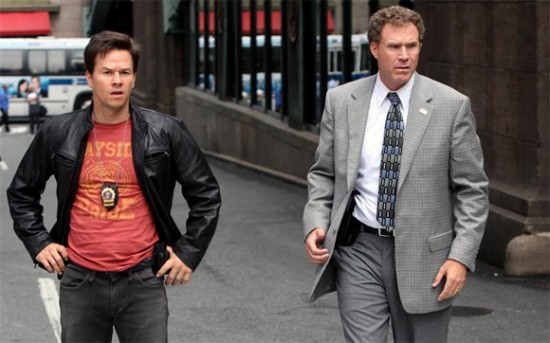
Allen Gamble (Will Ferrell) and Terry Hoitz (Mark Wahlberg) are two New York City detectives working in the considerable shadow of detectives Danson and Highsmith (Dwayne Johnson and Samuel L. Jackson in nice parodies of their "serious" screen-work), a team of glory-hounds for whom property damage is all in a day's conflagration, but who refuse to do the paperwork.  Gamble is self-described as "an accountant for law-and-order," and Hoitz is riding a desk-job after a shooting that goes wrong.* Gamble loves the mundane filing, but his partner Hoitz, itches to be "in the field." "I'm a peacock!" he is fond of remonstrating. "You've got to let me fly!" At which point, he is reminded that peacocks do not fly.** 
Unperturbed, and when advancement in the ranks becomes possible, the two glom onto a white-collar crime that Gamble has discovered that has connections to a series of high-profile robberies. 
The mis-matched pair
(Hoitz is volatile, Gamble is eerily up-beat) are completely street-dumb and their investigation is constantly being dis-railed (sometimes literally) by distractions and their lack of ability to resist the charms of their high-rolling suspect's lifestyle. Their increasing frustration with the case and each other (as well as Hoitz's relationship problems, in contrast with the milquetoast Gamble's inexplicable attractiveness to women) is fertile ground for situations that explode in conflict.
It works and works gang-busters for the first hour. The combination of loose script and improvisation is beefed up by all the actors (especially Ferrell and
Michael Keaton
, who does quick-silver wonders with the cliche "harried Captain" role), especially when the story is building and we're getting to know the characters. The "left-field" surprises come fast and loose, and the timing by the actors (and the editing) is crack. One senses trouble early on when Anne Heche (uncredited, by the way) is given a thankless role in which she's really not allowed to do anything funny...or much of anything. But Ferrell, for the most part, is at the top of his game playing the contrary stiff in a room full of crazies, and Wahlberg who, depending on the material, can be brilliant, plays pathetic frustration hilariously.  Even Eva Mendes acquits herself well in the mix, milking laughs out of the role of Gamble's absurdly perfect wife—Gamble's sexual magnetism makes for a great series of running gags throughout the movie.
But, right at the point where Bob, the union rep, gets dissed and leaves the room, the entire movie goes flat.*** Maybe the improv was getting too expensive and they decided to "coast." Maybe the assurance of an "action-filled" finale made them scrimp on the script.  Maybe the irrelevant story-line getting in the way changed the tone. Maybe everyone got tired. But, for whatever reason, The Other Guys is two movies..."Good Cop" comedy and "Bad Cop" comedy.
Interestingly, the most useful part of the movie is the end credits where the increasing disparity between the incomes of the top 1% earners and the rest of us is presented in chilling graphic detail.
"Wilhelm" Alert @ 1:30
 
* Hint:  He's called "The Yankee Clipper" around the squad-room.

** What can I say?  It's New York, and the Bronx Zoo is the closest they come to a peacock.  Peacocks do indeed fly, but it's a brief, clumsy, scary thing to watch—which I think was the point of bringing it up in the movie.

*** It's funny I can pinpoint it, because that's where the movie became NOT funny, and I thought to myself..."Well, THAT didn't work..." and watched to my amazement as very little worked after.

Tuesday, May 14, 2019

The Spirit (2008)

Another of my "bad comic book movie" reviews—this time directed by a revered creator of comics adapting the work of another revered creator of comics—with disastrous results. Again, this was written at the time of the film's release, and the only thing I would amend is that the industry has gotten much better at making these "green-screen films" look more credible—although Miller's aim here was to create a deliberate comics-like stylization. Chalk it up to film-making by committee, extensive pre-production and pre-vis, actors becoming more comfortable with the "look-over-here" method of acting, and advances in both CGI technology and artistry. Still doesn't guarantee a good movie, though.

"The Spirit is Willing, but the Film is Weak..."

"The Spirit" is one of those "pure" super-hero concepts from the '40's, like Superman and Batman. Created by Will Eisner in 1940, "The Spirit" combined film-noir with masked vigilantes and "Terry and the Pirates" femme-fatales. His origins were always a little murky, but "The Spirit" was the born-again/ reincarnated/ revived corpse of policeman Denny Colt, "killed" in the line of duty. He wore a blue business suit, hat and gloves, a red tie, and (to appease editors' requests for a "super-hero") a mask.

He had no special powers other than being good in a brawl and irresistible to women. Eisner's artwork and story-telling sensibilities were innovative and is credited with being one of the great creators of comics "language" in much the same way that D. W. Griffith established film language.
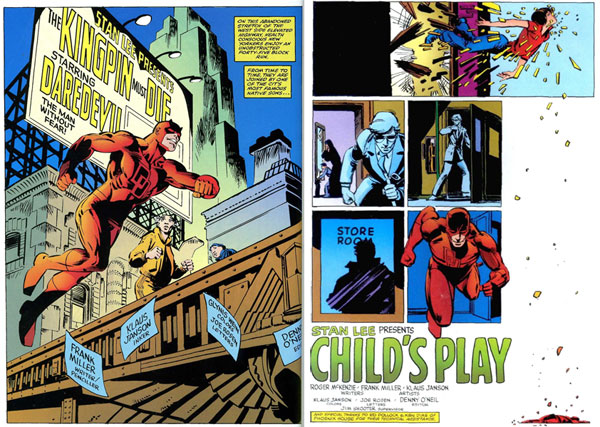
One of Eisner's "disciples" and students is Frank Miller, whose ground-breaking work on Marvel's "Daredevil," and DC's "Batman" made him a super-star in the field of comics. Miller began his own series of ultra-violent neo-noir black-and-white comics under the banner "Sin City." The stories could have been a bare-bones story-board for a film, and Robert Rodriguez (with Miller as co-director) made a well-received film of a clutch of the Miller stories for his Sin City film.*
Given Miller's status as co-director (and his obvious influence in the design of the film) it was only a matter of time before he was given his own directing job, and naturally, in this super-hero season of the movies, it was going to be "The Spirit" as the subject of his debut.
Will Eisner must be trying to emerge from the grave Denny Colt-style to strangle him.
For instead of Eisner's creation, Miller has made a Frankenstein monster of a film that tries to update "The Spirit," making him an indestructible fighting machine with mysterious revivification powers, and the ability to run across telephone wires. In addition the film is...stacked...with an assortment of prominent female stars in subsidiary roles—Eva Mendes as villainess Sand Saref, Scarlett Johansson (she's uncharacteristically terrible!) as Silken Floss, assistant to "The Octopus" (we're saving him for last), Paz Vega as Plaster (of Paris), Sarah Paulson ("Studio 60 on the Sunset Strip") as Ellen Dolan, daughter of the police commissioner (Dan Lauria); all of these fine actors are capable of doing better work, but you'd never know from the lack-luster performances and awkward timing of the scenes.
It's all meant to be sexy, hip and edgy, but rather than re-create Eisner's light-hearted mix of comic and noir, it falls back on the same "camp" qualities evident in the third and worst season of the "Batman" television series, as well as Joel Schumacher's troubling "Batman" films.
Frequently you'll watch a scene with awkward staging, bad timing, knowing full-well it was done in front of a "green-screen" to put in some background that, if they'd thought about it, might have helped the lumbering quality of the foreground actors. Either Miller didn't know how to make it work, or just assumed that it would work, given his expertise with the material. 
After working in two dimensions for so long, three seems to be beyond him. As it is, it feels like lazy directing--kind of like Miller's last "Dark Knight" comic where he drew in the foreground figures and let his colorist wife, Lynn Varley, provide the backgrounds. The results look just as cheap and unprofessional in both mediums.
Now, let's save the worst for last: Most egregious of all the performances is Samuel L. Jackson as "The Spirit's" nemesis "The Octopus." Limited to shots of his gloves in the comics, Jackson is all out-front and comic-satirical in this which doesn't work, although he does manage to mine some laughs out of his material. "The Octopus" is saddled with goons, evidently cloned from Curly of "The Three Stooges." They're all morons, but disposable at a moment's notice. 
At one point, "Spirit" and "Octopus" engage in a mud-pit death-match that has all the sensibilities (and realism) of a "Tom and Jerry" cartoon—at one point "Spirit" is hit over the head with a lead pipe that comes away with a head-shaped U-indentation. Unfortunately, that's what passes for humor in this train-wreck. In fact, a train-wreck would probably pass for humor in it, too.
All in all, for all its creative advancements in "getting it all up there," the "green screen" type of film environment has managed to confound some accomplished film-makers (ie. George Lucas, Robert Rodriguez, hell, even Kerry Conran is more accomplished!) creating impressive computer wall-papers but leeching the drama right out of their movies. Instead of taking movies forward, they've taken them backwards in terms of performance and film-language. If those guys couldn't overcome the awkwardness of the rootless film with no sets, what made Miller think he could? One suspects its the same flaw that plagues so many of the cartoonist's creations: hubris.


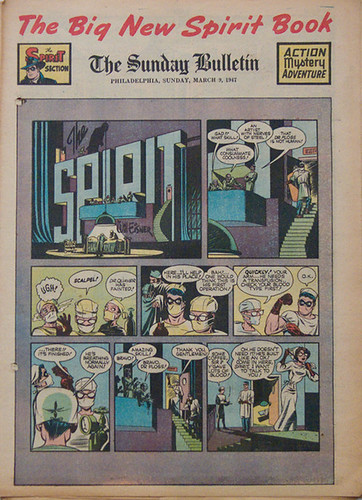
One of Will Eisner's block-titled "splash" pages: Now that's "The Spirit"


* Well-received by everybody but me. I thought the literal translation of "Sin City" the comic to Sin City the movie showed just how much different information specificity permeates both mediums. And never the twain shall meet. Sin City (the movie) didn't work because once you fill in the 23 frames of action that Miller didn't provide in his drawings, the super-human heroics of ordinary people takes on ludicrous overtones. And, conversely, Sin City (the movie) exposed just how weak, snuff-pornish, and lunk-headed Miller's original material ("Sin City" the comic) was in the first place. There are some things the "strobed highlights" of comics and graphic novels do very well, that don't work in the movies (and vice versa). Movies based on comics have to be able to translate the four-color flash-cards that comics represent from static two dimensions to moving three-dimensions--which is why The Dark Knight for all its plot-holes, conceits and cheats manages to be a good "real-world" representation of the freak-show aspects of Gotham City.

Friday, April 27, 2018

Holy Motors

Rich Man, Poor Man, Beggar-man, Geek...
or
The War of the Grease-paint...

All the world's a stage, And all the men and women merely players; They have their exits and their entrances, And one man in his time plays many parts...
William Shakespeare

You may be an ambassador to England or France
You may like to gamble, you might like to dance
You may be the heavyweight champion of the world
You may be a socialite with a long string of pearls
But you’re gonna have to serve somebody, yes indeed
You’re gonna have to serve somebody
Well, it may be the devil or it may be the Lord
But you’re gonna have to serve somebody
                                                                      Bob Dylan 


The latest film by Leos Carax, Holy Motors, is a fascinating polyglot of life imitating art or vice-versa, and by the time it's over, you're not sure which.  It's a film brimming over with tantalizing ideas ranging from the rational to the surreal that it puts the brain into over-drive while constantly changing the landscape, shifting gears episodically while maintaining a singular day-in-the-life storyline for its central character Oscar (Denis Lavant), a trouper if ever there was one.  Oscar is an actor of extraordinary gifts.  In a gigantic white-stretch limo, driven by his scheduler Celine (Edith Scob of Eyes Without a Face, which Carax nods to briefly), he applies make-up, dons costumes, prepares for the next gig on the schedule in a rolling tour of Paris, all precincts, all life-styles, and most importantly to Carax, all genres.

In one scene, he's a motion-capture artist in a completely empty studio performing fight moves, running gun-battles, and a bizarre alien love-scene without a clue as to what the finished product will look like.  In another, he's a gangster sent to assassinate his doppelganger. 
On to the next gig—Oscar in Holy Motors
His assignments are given to him in a notebook with all the specs and requirements.  He opens up his kit of make-up prosthetics, ruffles through his rack of costumes, Celine lets him out and he's on-stage.  As the jobs go from one to the other, the questions bubble up: who is he working for—not only for the booking agency, but also, who are the clients?  Reality blurs.  A call from a teenage daughter could be his real daughter, but one suspects not—he's wearing a wig, and she's never seen again.  The gangster segment could be for anybody.  But, how about the segment where he's a disfigured geek who interrupts a photo-shoot with Eva Mendes--is it to throw off the photographer or to transform the model from a fantasy figure into a person of emotional worth, phantom of the opera-style.  And who is the death-bed tableau for, as the woman he plays it with is also an actress (one suspects that it might be for the loyal dog sleeping on the bed).  An encounter with another actress (Kylie Minogue) turns into a musical number, and a wacko marching band-with accordions-could be for anybody.
But, those are the details.  Ultimately, it's a fantasia about the roles we play in our everyday lives.  We adjust, we tinker, take on different suits and attitudes with every situation that crosses our path in the give-and-take of daily life.  We make an entrance, role-play, act-out, ad-lib, pose, and exit stage-right.  All the world's a stage and we all gotta serve somebody, the devil, the Lord, or ourselves.
Holy Motors keeps you guessing and keeps you challenged, and is one of those rare films that elicit bigger thoughts than the whole, leaving questions that anyone can answer, given their respective roles.