The Detective (aka Father Brown)(Robert Hamer, 1954) It's quite the scandal when Father Brown (Alec Guinness) is arrested by the local constabulary when he is caught in the act of "burglarious purposes" in front of an open safe. At police headquarters, the humble English vicker tries to explain that he was only trying to return the "swag" ("I believe that's what it's called—'swag'") for one of his parishioners (he admonishes him for being "an incompetent thief...clearly incapable of earning a dishonest living") whom he had convinced to forego a life of petty thievery and, in return, Brown would return the stolen good to the rightful place. That's when the police arrived.

A night in the hoosegow (which he finds "most interesting" and thanks the police for their "hospitality") and he's identified by the church authorities and sprung. So, of course, when he's hauled before the Bishop, he assumes it's for the arrest—he having a reputation in the diocese as "an odd one". But, it's of another matter entirely: it's seems that the Eucharistic Congress is soon to be held in Rome. And the Bishop has decided to send the Holy Cross of St. Augustine, which is twelve centuries old and currently resides in Father Brown's parish church. Father Brown considers the cross "not valuable...priceless," so he's alarmed when informed by a local Inspector than an "imminent criminal is intent to intercept the cross en route." The criminal's name is Gustav Flambeau* (Peter Finch) and Father Brown is only too aware of the master-thief's reputation—"a human chameleon" such an expert of disguise that no one knows what he looks like. When Brown is informed of the precautions, the father-detective goes into a sort of distracted trance—in his mind, he's figured out three different way that the cross could be stolen. "So, if I, an amateur, can steal the cross in three ways , one can only think what Flambeau will do!" Brown volunteers to take the cross himself—"one priest indistinguishable from hundreds carrying one cross undetectable from hundreds" But, the inspector and the Bishop are in agreement: they will have undercover men make their way to Rome in the hopes of intercepting the wiley thief. To Brown, this is "lunacy!" He makes his own arrangements to carry out his conception of a plan.
 Now, as a recovering Catholic, I must confess that the closest I get to religion these days is through Father Brown, the sleuthing priest created by author G.K.Chesterton in 1910 (predating Agatha Christie's sleuths by a decade). I've watched the Mark Williams series, having seen nearly every episode, and read a few of the stories and have always found a kind of solace in the character's rock-solid faith and his unorthodox application of it when dealing with the near-occasion of sinners. He does not judge, believing not that people are good or evil, but merely people, and those that have strayed can always be moved on to the better path. He is not naive, or a cross-eyed optimist, but will argue that his faith is even more pertinent in a world where virtue is challenged. At one point in The Detective, he says: "My son, you think that you are a man of the world and that I am not. But
I assure you, my 'innocent' ears encounter every day stories of a
horror that would make your sophisticated hair stand on end. Although I
wear funny clothes, and have taken certain vows, I live far more in the
world than you do." It's a world where his ability to pick locks, or judo-wrestle are useful tools, particularly when employed for good. He'll even pick a pocket (but only to prove a point when he returns the "swag").
Now, as a recovering Catholic, I must confess that the closest I get to religion these days is through Father Brown, the sleuthing priest created by author G.K.Chesterton in 1910 (predating Agatha Christie's sleuths by a decade). I've watched the Mark Williams series, having seen nearly every episode, and read a few of the stories and have always found a kind of solace in the character's rock-solid faith and his unorthodox application of it when dealing with the near-occasion of sinners. He does not judge, believing not that people are good or evil, but merely people, and those that have strayed can always be moved on to the better path. He is not naive, or a cross-eyed optimist, but will argue that his faith is even more pertinent in a world where virtue is challenged. At one point in The Detective, he says: "My son, you think that you are a man of the world and that I am not. But
I assure you, my 'innocent' ears encounter every day stories of a
horror that would make your sophisticated hair stand on end. Although I
wear funny clothes, and have taken certain vows, I live far more in the
world than you do." It's a world where his ability to pick locks, or judo-wrestle are useful tools, particularly when employed for good. He'll even pick a pocket (but only to prove a point when he returns the "swag").


When I found that there was a "Father Brown" movie, particularly to my delight that Alec Guinness played the part, I began an exhaustive search to find it. It took years, but it can now be found** And it exceeded my expectations. I've never been disappointed by a Guinness performance*** and his Brown is very much a sheep in wolfs clothing. He's as sharp as they come, if a bit idiosyncratic, and when called upon Guinness overplays the "twee" nature of Brown, his awkwardness hiding a quick-wittedness—although his humility will never allow him to admit it. The Detective also has two of my favorite British performers: the ever-beguiling Joan Greenwood, (who'd starred with Guinness in a couple of his comedies) as one of Father Brown's more well-off parishioners and confidantes; and Bernard Lee (who would go on to play MI6 head "M" in the first 16 films of the Bond series) as an undercover police officer doggedly pursuing Flambeau, and who finds Brown's deft interference almost in itself criminal.
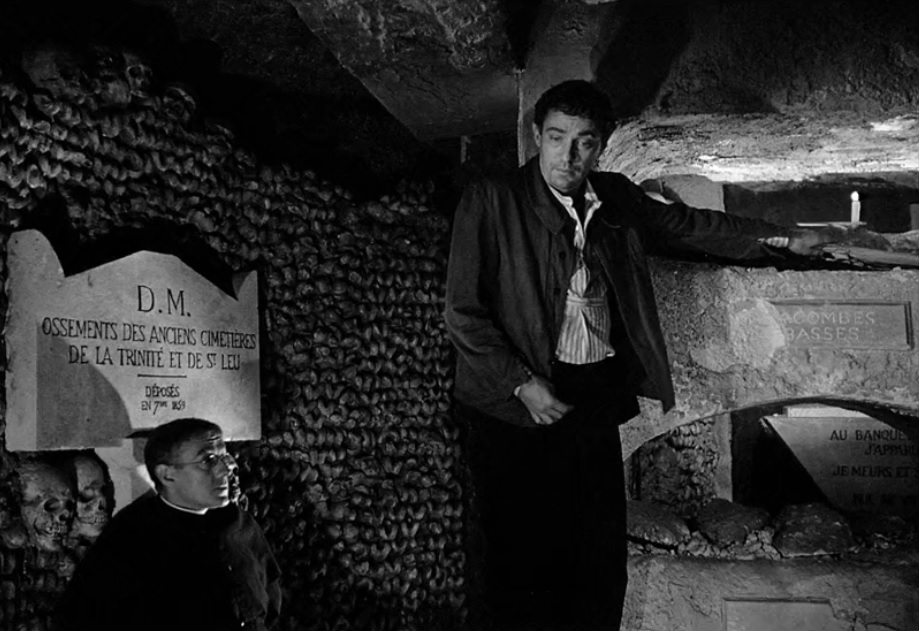
 But, the surprise is Peter Finch as master-thief Flambeau. Up to this point, Finch could be rather stiff in his roles, but, here, he's light-hearted and charming, pulling off the character-work in disguise, and, when unmasked, giving off the air of a bon-vivant, quite happy in his mis-deeds. Guinness and he have a lot of dialog together and they spar winningly.
 Based rather loosely on Chesterton's first Father Brown story "The Blue Cross," It's absolutely delightful and was well worth the wait.



* Interesting that they call him "Gustav" Flambeau as Chesterton gave him the christian name of "Hercule"—perhaps to not confuse him with Christie's Poirot, who debuted 10 years later—and the character is supposed to be French, and Gustav is considered a Swedish or German name.
** On the streaming service Tubi, but the Lord only knows how long it will remain there.
*** Okay, there is one. It is Hitler: The Last Ten Days where I found his performance as The Führer rather dull. Time Magazine's critic said it was only useful in showing "the banality of evil." Curiously, IMDB says it's the only performance Guinness was completely happy with, having campaigned actively to play it.


