Showing posts with label David Warner. Show all posts

Thursday, October 22, 2020

From Beyond the Grave

Oh, that's right. October is "Hallowe'en Month." "Guess I best pay attention to Horror movies." 

From Beyond the Grave
(Kevin Connor, 1974) It was not the best of times for the British film industry around the time this was filmed...but there were advantages. A cheap horror film, like this one, could always be made and because of the low overhead, often made money, even though times were tough. Plus, thanks to some industry-encouraging tax laws, even a film like this one could attract some very good talent, no matter how lurid the subject matter might be. 

From Beyond the Grave is a horror anthology film, collecting four tales under a central umbrella wrap-around story. All four parts were based on the work of British horror writer R. Chetwynd-Hayes, not exactly Edgar Allan Poe or H.P. Lovecraft or even Stephen King, but he had enough output with enough genuine creepiness that he made good fodder for this type of story.
The central conceit is a London hole-in-the-wall called "Temptations Limited"—"Offers You Cannot Resist," run by an elderly and deceptively frail proprietor (Peter Cushing). With one exception, the stories revolve around buyers who cheat the proprietor, but pay a price in the end.

-- "The Gatecrasher" Smarmy Edward Charlton (David Warner) buys an antique mirror from the proprietor, buts cons him into letting him have it a lower cost claiming it a forgery. Charlton, considers himself a high-roller and an amateur spiritualist, but he gets far more than he bargained for when the mirror reveals itself to be possessed by the spirit of Jack the Ripper (Marcel Steiner), who implores Charlton to murder so that he "can feed," which brings dire consequences to both victims and murderer.
-- "An Act of Kindness" Pity poor Christopher Lowe (Ian Bannen); he gets it from all sides: stuck in a lousy middle-management, too old to advance and too young to retire and in an abusive marriage with Mabel (Diana Dors) and a disrespectful son. The only respect he does get is from a matchstick salesman Jim Underwood (Donald Pleasance), veteran of "the war". Lowe tries to impress him that he's a vet, too, claims to have a medal—but resorts to buying one at Temptations Limited, even though he doesn't have the citation for it—and Underwood invites Lowe for dinner where he meet's Jim daughter, Emily (Angela Pleasance, daughter of Donald), who, frankly, is far too attentive to be comfortable—but, when she turns out to have occult powers, Lowe's life becomes more complicated by being made simpler.
-- "The Elemental" Different in tone from the other stories, as it is played for laughs more than chills. Ian Carmichael plays Reggie Warren, a well-to-do businessman and stuffed shirt who buys an antique snuff box after switching the price tag (the proprietor sends him off with a cheery "I hope you enjoy snuffing it!"). On his way, he's informed by the mad psychic Madame Orloff (Margaret Leighton, perfectly happy to play over-the-top) that he has an "elemental" on his shoulder and he should call if he needs her services. Well, Reggie goes home and his dog's gone missing, and his wife (Nyree Dawn Porter) has been attacked by some poltergeistial presence. Hilarity ensues, but not for Reggie.
-- "The Door" Well, not only does Temptations Limited sell mirrors, they also sell doors—ornate ones, and William Seaton (Ian Ogilvy) buys a rather sinisterly-carved one to shutter the pantry, a bitter over-the-top, at least in the opinion of wife Rosemary (Leslie Anne-Down). But, Seaton soon learns that the price for storing your dry goods could be your eternal soul, as passing through the door leads to another time and dimension controlled by the occultist, who had the door made, and that you may go in to get oatmeal, but you might leave your soul behind.
This was Kevin Connor's first directing gig—and he is still directing—won by his editing skills, which is more in abundance than his staging or framing. The film abounds with 1970's stylistics like hand-held shaky cams, and absurd distortions through fish-eye lenses, but every so often something stands out, whether it's the sheer creepiness of Angela Pleasance's performance or how the image in the mirror of "The Gatecrasher" sort of heaves into view creating a sense of dread. In anthologies the strongest story is usually the last one, but here, it's the first one (the placement is due to the protagonists in "The Door" being the only survivors of the movie because they didn't cheat the proprietor). It ultimately isn't much, but there's a lot of talent on display. Think of it as on a par with some good "Night Gallery" episodes.

And I know that "From Beyond the Grave" is a more grabber of a title, but the name of the film really should have been "Caveat Emptor."

Thursday, September 3, 2020

Time After Time (1979)

Time After Time (Nicholas Meyer, 1979) He really wanted to direct. 

Nicholas Meyer enjoyed a couple of best-selling books—one of them, "The Seven Percent Solution", had been made into a film for which he supplied the screenplay—and dabbled in screen-writing—he wrote the script for "The Night That Panicked America" about Orson Welles' Hallowe'en broadcast of "The War of the Worlds." But, directing...that was a tough job to get even if you were a lauded writer, screen-writer, and proved you could crack the public's consuming zeitgeist. I mean, who d'you think you are...John Huston?

Meyer had been given fifty-five pages of a novel that a friend was writing and wanted Meyer's opinion—seeing potential in it, he optioned the story which featured 19th century author H.G. Wells going into the future via time machine to pursue Jack the Ripper into the 20th Century. Meyer took that nugget of story, wrote a screenplay and sold it to Orion Pictures with the caveat that he was to direct.

Meyer's "time" had come.
H. G. Wells (Malcolm McDowell) is upset about the current times of 1893. He holds a dinner party for some friends (are you getting a sense of deja vu yet?) to show them his recent invention—a time machine, which he intends to use to seek out his vision of "Utopia" by using the device to travel into the future. But, his device isn't so fanciful as the one in his novel; it has a couple of safety features of his own devising to prevent such accidents as might happen when traveling through time...and should one mis-lay their time machine in their travels.

His little dinner party is interrupted, however, by the police who are investigating the Whitechapel murders and its perpetrator, known as "Jack the Ripper." A search is made of Wells' house and two things are discovered: a doctor's bag containing bloody gloves that belong's to Wells' guest, the surgeon John Leslie Stevenson (David Warner); Stevenson has gone missing, and with him Wells' time machine. "Jack" has escaped into the future, and Wells, with no machine, cannot pursue him.*
Ah, but those safety devices that might prevent the time machine from being used by "Morlocks" or something—here's where they come in handy. One of them is a key, or, more specifically, a "non-return key" that, as long as it's in the machine, keeps it in the designated time. Stevenson, not having it, is left in the future as Wells' machine travels back to its original time after a certain period. Pretty handy, that. As is the second device a "vaporizing equalizer," another key, which prevents the traveler from journeying through time without the device.

Wells' time machine returns like a well-fed dog and he ascertains that Stevenson has traveled into the future, specifically November 5th, 1979 and, with keys well in place, he takes the journey in his machine—a safe bet, after all, as it seems to have worked for Stevenson. Wells makes it, finding himself still in his time machine, but which seems to have made its way to 1979 San Francisco (explained because the machine—at the time—is loaned to an S.F. museum for an exhibition on H.G. Wells). Wells starts to become acquainted with 20th century customs like fast fried food, aeroplanes, television, the vagaries of fashion, and "fish-out-of-water" tropes in movies. 
But, he's after Stevenson and his first bit of detective work is to divine where a man of his century would go to exchange money of the 19th century for that of the 20th. There, he meets Bank of London employee Amy Robbins (Mary Steenburgen)—who seems to be getting more of these requests than she's ever seen in her employ. She directs him to where the previous gent asking about the exchange rate for old currency is currently keeping himself.
Wells finds Stevenson and he seems to be adapting quite well to the new age. All Stevenson has to do is turn on his hotel room television and show Wells the carnage going on in the world, telling him "Ninety years ago, I was a freak. Now, I'm an amateur." Wells insists that Stevenson return to their time and face justice, but Stevenson will have none of it, trying to get the "non-return key" from Wells, and, in a struggle that spills out of the hotel and into the streets, Stevenson gets hit by a car. Wells, thinking Stevenson is dead, stops his pursuit.
But, Wells knows nothing of cars or of modern hospitals...or of the implacability of his quarry. Stevenson is quite alive...and up to his old ways. And one of his intended victims is Amy, whom he has rightly deduced led Wells to him. And as Amy and Wells have developed a budding relationship, the stakes become very personal...especially after a short jaunt to prove the viability of his time machine has shown her that (via a future newspaper headline) that she will become one of the Ripper's victims in three days' time.
It seems strange that one could make a charming romance out of a story using one of the most infamous of serial killers, but Meyer's Time After Time manages to do it. That has less to do with the Jack the Ripper plot, but more with the way Meyers makes a romance between McDowell's Wells—who thinks he's ever so sophisticated for a man of his time—and McDowell's Amy—who's decades ahead of his Victorian thinking and is more than casual about it. Meyers has fun with it—he loved taking the Star Trek crew out of their element in Star Trek IV: The Voyage Home—and his dexterity keeping the Wells-Robbins scenes frothy are the parts that will delight someone seeing this film for the first time.
It's Meyer's first film directing, but the film has the flair of a much more accomplished director, partly because Meyer seems to have taken his direction from more classic films—it just seems to have the edge of a Billy Wilder, while also retaining his romantic quality. Part of that might be the atmosphere provided by Miklós Rósza, who provides the sort of sophisticated, ardent film score that he had previously produced for Hitchcock...and Wilder and brings the sense of a by-gone era that fits well bridging both the 19th and 20th centuries.
It's a good, literate little film that provides the thrills and wonder of its earlier inspiration—Wells' novel and the George Pal film made of it—while also bringing something new to the party, this time around.


* "Sure, he could," you say. "All he has to do is build another time machine and go" (In this instance, time does wait...) Yes, I counter, he can build it, but to go where—or more correctly, when? He doesn't know where Stevenson/Jack has gone—into the anonymous past or into the unknowable future. So, Meyer's little safety devices are necessary...or else we'd have no movie at all.

Wednesday, December 27, 2017

Time Bandits

Time Bandits (Terry Gilliam, 1981) As a filmmaker, Terry Gilliam grew up with the making of Time Bandits, while still maintaining the childish sense of fun and menace that permeated his work before and during his days with the Monty Python flying circus. Time Bandits is a work of pure imagination, a four-ring freak show that just might kill you, where time is the scene of the crime, and even God and Satan are susceptible to the charms of a precocious little boy with a taste for adventure and the voracious team of avaricious little people that he happens to partner up with. One's tempted to say it's Gilliam's version of Snow White or a flipped version of The Wizard of Oz, but that would be taking the piss and anarchy out of it. Those others would not have the temerity or the audacity of just leaving their tween with a heart-warming life-lesson, but actually challenge him to apply it without the benefit of having a safety net. But, in Gilliam's mind, his hero's fate is unarguably better than the unquestioning materialistic zombie-hood that he would be subjected to with his parents.
11 year old Kevin (Craig Warnock) is fascinated with Ancient Greece, which some parents might find a sign of a curious intellect but inspires nothing but neglect in his parents. One night, the wardrobe in his bedroom is shattered by a horse-bound knight who bursts through it and gallops down a forest road that has suddenly appeared—clearly something is amiss in the space-time continuum! The next night, Kevin wants to go to bed early, but instead of a knight-errant, he's visited by a crush of six thieving "little people." They're demoted employees of The Supreme Being (voiced by Tony Jay, but will appear later as a doddering Ralph Richardson)—seems their previous job of designing trees and bushes was sub-par and they're now tasked with fixing rends in the fabric of space-time. But, being particularly (how should we say?) "entrepreneurial" they've seen that their map of black holes can take them to other Earth-eras, from which they can pillage whatever they can carry in a necessarily brief time. 
"Necessarily" because they're being pursued by extremes of Good and Evil (aren't we all?), with T.S.B. wanting his map back and the personification of Evil (David Warner, clearly relishing the role) coveting the map, so that he can fix T.S.B.'s mistakes and make the Universe more to his liking.
Gilliam's film then hops and darts and falls into an episodic structure, where the diminutive fugitives "crash" various eras, including Sherwood Forest in the era of Robin Hood (John Cleese, doing a hilarious version of Prince Charles), a campaign of Napoleon Bonaparte's (a nearly incomprehensible Ian Holm), who is obsessed with puppet shows (because they're smaller than him), the HMS Titanic (served "neat"), and, to Kevin's delight, Ancient Greece, where he befriends King Agamemnon (Sean Connery*), who is first seen battling a Minotaur
Most of it works and works hilariously, even when Gilliam veers into the surreal...and the budgetarily spare. Still, the low-tech miracles Guillam pulls off with limited resources (5 mil' financed by George Harrison's Handmade Films) are awe-inspiring, not only for their realization on film, but also for the sheer visual splendor—and squalor—Gilliam's considerable imagination envisioned (and still does). It's an amazing spectacle, and if the film stutters a bit pace-wise (especially during the Napoleon segment), the delights to the eye tend to gloss over any story-telling problems. Gilliam's pictorial eye would become bolder and his subject matter richer, but Time Bandits was the transition-point between a sketch-comedian/animator and a true film-maker and visionary.
What all the fuss is about


* The script (by Palin and Gilliam) reads: "The warrior takes off his helmet, revealing someone that looks exactly like Sean Connery, or an actor of equal but cheaper stature." Gilliam was shocked that not only had Connery read the script, he wanted the part, and even suggested a disconcerting cameo at the end.

** Northumbrian Tin Soldiers has made sculpts of the bandits, listed as "Dwarf Robbers:"

Friday, May 20, 2016

The Seagull (1968)

The Sea Gull (Sidney Lumet, 1968) Reading Sidney Lumet's book "Making Movies" he mentions that he got the idea to make this film of Anton Chekhov's play when working with James Mason, Simone Signoret, Harry Andrews and David Warner on The Deadly Affair in 1966. Lynn Redgrave, sister of Vanessa, also worked on The Deadly Affair. By the time the financing was arranged and filming was set for Sweden, Lumet pretty much had his dream cast. Also, a couple times in the book. he announces "the theme" of The Sea Gull: "Everybody loves the wrong person."

No kidding...


He could also talk about the various strata of life stages and work-worth going on, of folks who are successful, or post-success, or craving success in their lives and how their attractions are reflected not only in their choices of who to imprint on (and they are choices), but also in how they regard other folks inside their strata and more importantly outside of it (Oh, this is getting complicated...and we haven't even gotten to the irony of success and getting to do what you want having nothing to do with happiness or self-worth, but, man, I keep digressing further and further here...).


The point is "everybody loves the wrong person" is such an obvious and simplistic break-down of The Sea Gull that you want to shake Lumet and say "anything else?" Oh, it's there, and the actors are superb in playing it, but Lumet, as a director, imposes his technology on it in a ham-fisted way, choice of angles, edits, he's still directing for television and for a "rube" audience that might not get it if he doesn't beat you over the head with it, and as it's a character piece, any decision that the director chooses to show his hand (and the material's) just gets in the way of the communication between actors and audience. We'll get to that in a second.
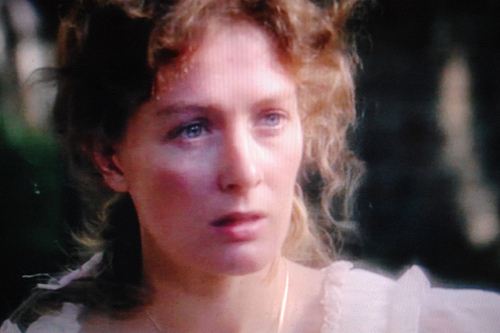

It's a less than idyllic retreat at the lake side getaway of Sorin (Andrews), who's in failing health.  His sister Irina (Signoret) has brought her lover, the successful writer Trigorin (Mason) with her to visit her son Konstantin (Warner), an aspiring playwright whose ambition for the stay is to stage an esoteric play about the death of the Earth with his love Nina (Redgrave, Vanessa), an aspiring actress, who lives on the neighboring estate. Sorin's place is being maintained by an out-of-work civil servant (Ronald Radd) and his wife (Eileen Herlie) and their daughter Masha (Kathleen Widdoes), who is pursued by Medvedenko (Alfred Lynch), despite that she is in love with Konstantin.   Konstantin is in love with Nina, though Nina is enamored of Trigorin.  The bailiff's wife is in love with Dr. Dorn (Denholm Elliott), whose affections are suspect. 

Things begin to get complicated when Konstantin stages his play within the play, an avant-garde work of the future Earth describing its decay at the hands of its now extinct population of human beings, a role played by Nina. Irina scoffs at the play, Trigorin dismisses it by his lack of of commenting on it, and Konstantin storms off, humiliated, while Nina, despite the group's apathy, is entranced with her time on stage. It sets in motion the group's interactions as Konstantin, coveting Trigorin's success while critical of his work, and jealous of the writer's relationship with his Mother, increases his anti-social behavior, which further drives a wedge between him and Nina, who is drawn to Trigorin.
It's Lumet's presentation of the Konstantin's play here that frustrates and, frankly, its effect that keeps me from fulling embracing Lumet as a master film-maker. How he presents the play is to keep the stage (and Redgrave performing her scene) out of focus, and keeping the far field across from a lake IN focus. Dramatically and intellectually, one might defend it—the play within a play has Nature "speaking" and so maybe it makes some sort of sense to have the scenery in focus instead of the foreground action, or it's out of focus to reinforce that it is a "bad" play. However, those contrarily focally challenged shots are inter-cut with the reaction of the people watching it and they are very much in focus, which creates this bizarre unease to the watcher of the film.  Is this a mistake? Is there a "point" being made? If so, why ruin it by interrupting it with sharply photographed reactions that call attention to the falsity of the effect? And if it is to show that it's a "bad" play, isn't that communicated by the reaction shots?


It is this "going for a temporary effect," even on an intellectual level, at the expense of the experience of everyone in the scene as a whole, and the film's naturalism in toto. Film is an illusion already, there's no point in calling attention to the fact, unless you want to just explode the whole intention of presenting a moment in time truthfully to the best of your craft. And Lumet, especially, in his earlier films, has a tendency to just grand-stand at the risk of the film entire.

Still, it's a brilliant cast—Mason is a marvel here, and one should be grateful that we get a chance to see Redgrave's Nina (even if she might be a bit old for the part). One cannot fault the amazing performances, even if the frame, pacing, cutting scheme might show them at a disadvantage.