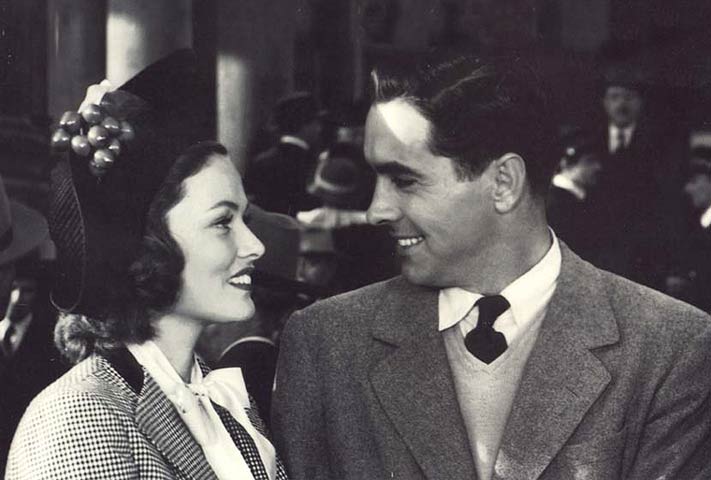
The Razor's Edge (Edmund Goulding, 1946) "The Razor's Edge" is a favorite book of mine, one I was inspired to read after a disappointing film adaptation, starring Bill Murray, who stood out from an otherwise respectful version like a howling sore thumb. But, it had been filmed before, in 1946, under the tutelage of producer Darryl F. Zanuck and directed by Edmund Goulding, only two years after the novel's first publication.
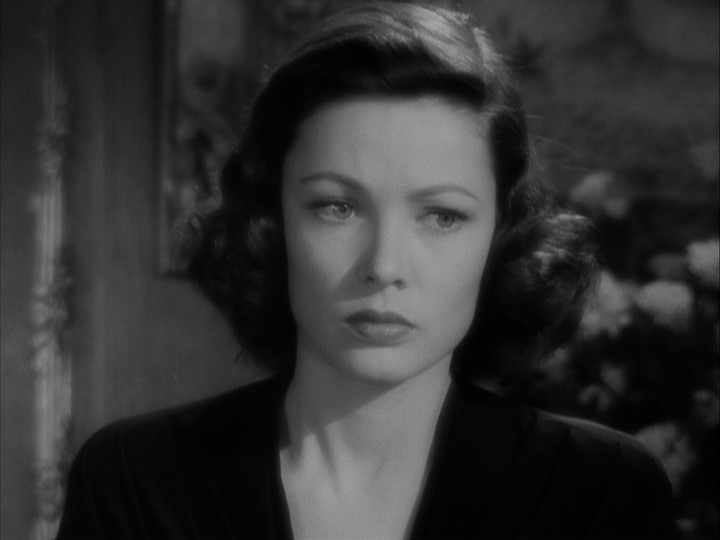
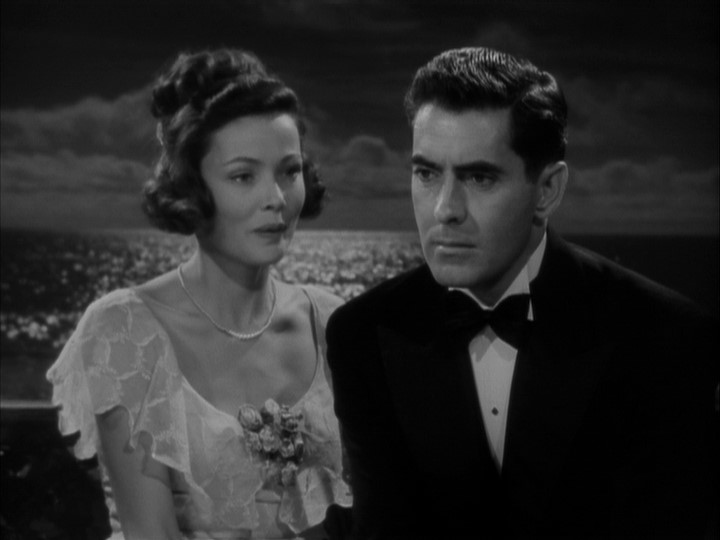
W. Somerset Maugham's book documents (in absentia) the travels of Larry Darrell (played in 1946 by Tyrone Power), who returns from pilot duties during World War I,* deeply affected by the death and devastation he's seen, and takes a period of time to "find himself"—a lot of time. This seems odd to his high society friends, especially the family of his fiancee, Isabel (Gene Tierney), who can't seem to understand why Larry won't settle down, put his nose to the grindstone and make sure that she gets to live in the manner she's accustomed to. Larry travels to Paris, ostensibly under the supervision of Isabel's prissy Uncle Elliott (Clifton Webb) (who does NOT approve), but Larry would rather live the life of a bohemian, working menial jobs. After a year's separation, Isabel comes to visit and is appalled by Larry's simple living conditions. She breaks off the engagement after taking one last attempt to seduce Larry back to her way of thinking, then returns to Chicago, where she marries Larry's millionaire friend.

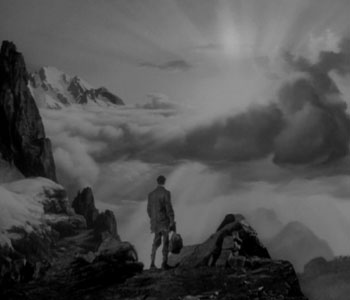
Larry continues his life in Paris, still searching for answers. Eventually, he makes a pilgrimage to India,** where, after studying and living a monk's existence in the Himalayas, he achieves a measure of happiness, finds his answers and returns to Paris to find that Isabel and her husband have lost everything in the 1929 crash, and are now living off her Uncle's charity. His old friends have all suffered various tragedies and are at a loss how to cope...and Isabel still loves him, complicating everyone's lives.

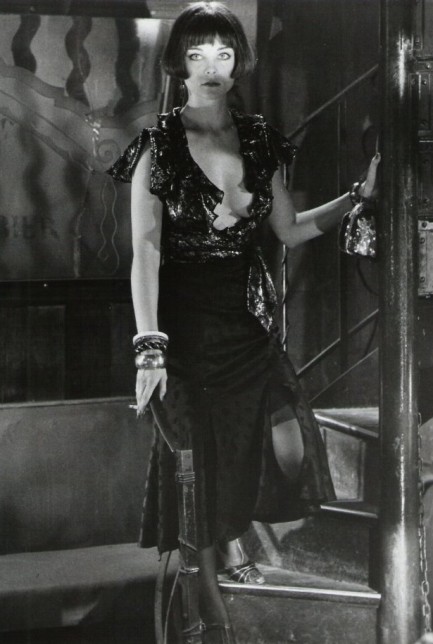
The Goulding version hews fairly close to the book, dulling the razor edges that might have ruffled the feathers of the Hays Office, and implying what could not be said in Maugham's book—Uncle Elliott's gay, Isabel is a too-willing adulteress, and their mutual friend Sophie (Anne Baxter), who suffers her own tragedies, has turned to drink and prostitution. Larry would seem to be the answer to everyone's problems, but he knows that the problem lies in living in a material world and the cheapening of human life to get ahead. And the 1946 version also includes one character that the '84 version excluded—the author (played by Herbert Marshall). Maugham wrote "The Razor's Edge" as a roman a clef, an observance as he made his way between world wars through society as a successful author, settling in Paris and the Riviera. The post-war version relies a bit too heavily on him, while the John Byrum version with Murray manages to make due without. The author becomes a sounding board in the book and first film, revealing characters' innermost thoughts—a little too forthcoming, actually (one should never get too cozy with an author)—and revealing a little too much about what they're feeling.

Power is a good Larry, but not a great one (whereas Bill Murray could have been great, if his propensity for ad-libbing goofily hadn't gotten the better of him). It's a little too hard to distinguish just what about him changes from "troubled" to "enlightened," other than a little too much intensity in the eyes. Not the greatest of emoters, his war-weary Larry seems merely peeved and a shade brittle, but his post-pilgrimage Larry seems not so enlightened as slightly moony when reflective and somewhat superior and self-satisfied when things go his way. Gene Tierney's Isabel seems far more shallow than the actress is capable of and when she turns vindictive, its done with a raising of the eyebrows and a haughty air—it's more a pose than a performance (as opposed to Catherine Hicks who wasn't afraid to make Isabel conspiratorial. Clifton Webb has as much fun with Templeton as Denholm Elliott did (a role John Gielgud coveted), and Anne Baxter has some very good moments as Sophie, although her theatricality gets the better of her in the more demonstrative scenes (it did win her an Oscar, though), but she doesn't hold a candle to Theresa Russell's "fragility with a spine" Sophie.

One comes away with no definitive screen-version of "The Razor's Edge:" you'd like to take the supporting cast of the 80's version, find a new Larry and keep the later's travel footage as a replacement for the pristine (and wholly set-bound) ashram from the '46 version (were they trying to evoke Shangri-La from Lost Horizon? Why does it look like a Hollywood hotel lobby designed by Frank Lloyd Wright?). The dissatisfaction is high with both, with flaws impossible to overlook, but there is a great movie in there somewhere, and each film supplies some answers to what that might be like.
The pilgrimage continues.
* In the Murray version, he was an ambulance driver.
** In the the latter version, he goes to Tibet.
_______________________________________________________________________________
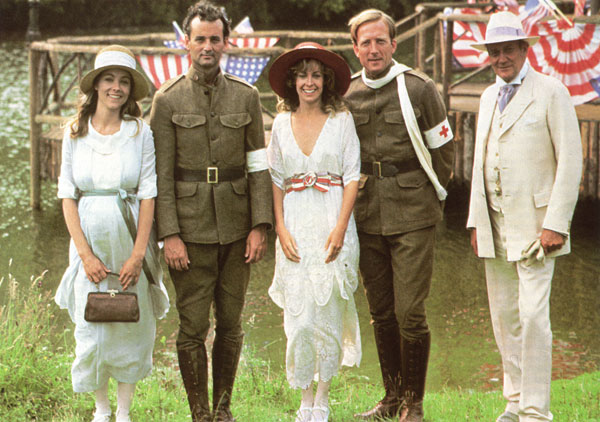
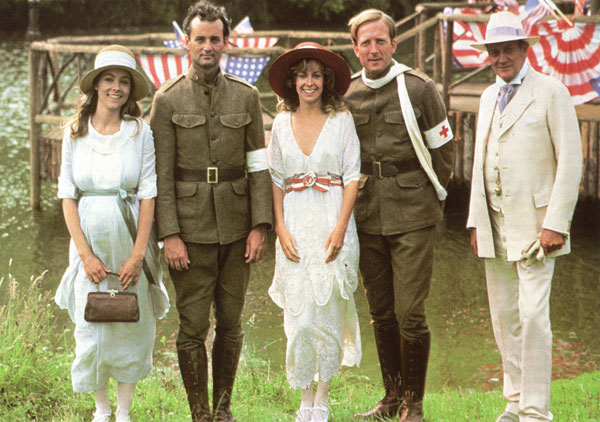
 The Razor's Edge (John Byrum, 1984) The collaboration between Bill Murray and John Byrum on the screenplay is a case of good and bad: the screenplay's very good, respectful of Maugham, but also digging into Larry Darrell's experiences in World War I that made him a part of the "lost generation," and seek a higher truth than his social-climbing friends; the bad part is that Bill Murray stars in it.
At this point in his career, Murray was a popular comic genius, taking a rather lackluster first year on "Saturday Night Live," and parlaying it into a film career where he virtually ad-libbed Meatballs into a surprise box-office success. Stripes, Where the Buffalo Roam, Caddyshack, Tootsie (uncredited, so as not to distract) all built his reputation to where he was becoming a box-office phenomenon (and the capper, Ghostbusters, he agreed to star in to secure The Razor's Edge being made).

Byrum does a fine job directing the film: the locations (particularly the Tibetan ones) are lush and filled with color, and the performances are spot on: Theresa Russell does wonders with a role that can fall into cliche, but she brings a freshness to it that makes it all the more poignant, and Catherine Hicks makes her "Isabel" more sympathetic and far less hissable than she was in the 1946 adaptation.
The "sore thumb" is Murray—but not entirely. When called on to be dramatically appropriate he is there, but the temptation for the young star to punch up scenes with ad-libs that seem too contemporary or are dramatically inappropriate was not squelched by the director*—either because he owed Murray too much for getting it made, or because he didn't want to throw a bushel over Murray's "star-power."

And one can understand why Murray did it. Larry Darrell is supposed to be an attractive, if slightly remote and disconnected, man. There has to be a reason people care about him so much, especially as he abandons them to go off on his spiritual quest, and why Isabel takes the course of actions to keep him to herself. Tyrone Power, in the 1946 version, employed a "thousand yard stare" to suggest deep-seated consciousness, unconvincingly—and, he was Tyrone Power, and the man's "star quality" was sufficient motivation. But, Murray turns Larry from a "party-boy" to a troubled "slacker" with a goofy sense of humor. He's always the funniest guy in the room, and his quips are his expression of affection for his friends. It's the "silver chord" that is shared by pre-war Larry and post-war Larry, and that binds him to his old friends. It's a neat solution to the problem of Murray not being Tyrone Power in looks. But, Murray's funny is a bit too hip for a 1920's room. And though it may occasionally crack up his co-stars, it also makes him the odd man out in the entire scenario.

It's too bad. Given a bit more restraint, this might have been the adaptation of one of Maugham's best books. As its stands, it did make me dissatisfied enough to want to search out the original book, for which I'll always be grateful.
* The most egregious being Larry's empathetic subterfuge of presenting the stricken Uncle Elliott a much desired invitation to a function and Murray's ad-lib: "If it's a costume party you could wear that cute little bunny suit..." It's so out of left-field, especially at that particular juncture, that it undercuts one of the most dramatic moments of the movie, and Denholm Elliott's terrific performance, it's a bit grand-standing on Murray's part. Maybe I'm being unfair and it wasn't supposed to make the final cut and Columbia insisted there be more "Murray comedy," but it is such an artistic gaffe, that you would think that someone would have objected.
The Sea Gull (Sidney Lumet, 1968) Reading Sidney Lumet's book "Making Movies" he mentions that he got the idea to make this film of Anton Chekhov's play when working with James Mason, Simone Signoret, Harry Andrews and David Warner on The Deadly Affair in 1966. Lynn Redgrave, sister of Vanessa, also worked on The Deadly Affair. By the time the financing was arranged and filming was set for Sweden, Lumet pretty much had his dream cast. Also, a couple times in the book. he announces "the theme" of The Sea Gull: "Everybody loves the wrong person."
No kidding...
He could also talk about the various strata of life stages and work-worth going on, of folks who are successful, or post-success, or craving success in their lives and how their attractions are reflected not only in their choices of who to imprint on (and they are choices), but also in how they regard other folks inside their strata and more importantly outside of it (Oh, this is getting complicated...and we haven't even gotten to the irony of success and getting to do what you want having nothing to do with happiness or self-worth, but, man, I keep digressing further and further here...).

The point is "everybody loves the wrong person" is such an obvious and simplistic break-down of The Sea Gull that you want to shake Lumet and say "anything else?" Oh, it's there, and the actors are superb in playing it, but Lumet, as a director, imposes his technology on it in a ham-fisted way, choice of angles, edits, he's still directing for television and for a "rube" audience that might not get it if he doesn't beat you over the head with it, and as it's a character piece, any decision that the director chooses to show his hand (and the material's) just gets in the way of the communication between actors and audience. We'll get to that in a second.
It's a less than idyllic retreat at the lake side getaway of Sorin (Andrews), who's in failing health. His sister Irina (Signoret) has brought her lover, the successful writer Trigorin (Mason) with her to visit her son Konstantin (Warner), an aspiring playwright whose ambition for the stay is to stage an esoteric play about the death of the Earth with his love Nina (Redgrave, Vanessa), an aspiring actress, who lives on the neighboring estate. Sorin's place is being maintained by an out-of-work civil servant (Ronald Radd) and his wife (Eileen Herlie) and their daughter Masha (Kathleen Widdoes), who is pursued by Medvedenko (Alfred Lynch), despite that she is in love with Konstantin. Konstantin is in love with Nina, though Nina is enamored of Trigorin. The bailiff's wife is in love with Dr. Dorn (Denholm Elliott), whose affections are suspect.
Things begin to get complicated when Konstantin stages his play within the play, an avant-garde work of the future Earth describing its decay at the hands of its now extinct population of human beings, a role played by Nina. Irina scoffs at the play, Trigorin dismisses it by his lack of of commenting on it, and Konstantin storms off, humiliated, while Nina, despite the group's apathy, is entranced with her time on stage. It sets in motion the group's interactions as Konstantin, coveting Trigorin's success while critical of his work, and jealous of the writer's relationship with his Mother, increases his anti-social behavior, which further drives a wedge between him and Nina, who is drawn to Trigorin.It's Lumet's presentation of the Konstantin's play here that frustrates and, frankly, its effect that keeps me from fulling embracing Lumet as a master film-maker. How he presents the play is to keep the stage (and Redgrave performing her scene) out of focus, and keeping the far field across from a lake IN focus. Dramatically and intellectually, one might defend it—the play within a play has Nature "speaking" and so maybe it makes some sort of sense to have the scenery in focus instead of the foreground action, or it's out of focus to reinforce that it is a "bad" play. However, those contrarily focally challenged shots are inter-cut with the reaction of the people watching it and they are very much in focus, which creates this bizarre unease to the watcher of the film. Is this a mistake? Is there a "point" being made? If so, why ruin it by interrupting it with sharply photographed reactions that call attention to the falsity of the effect? And if it is to show that it's a "bad" play, isn't that communicated by the reaction shots?
It is this "going for a temporary effect," even on an intellectual level, at the expense of the experience of everyone in the scene as a whole, and the film's naturalism in toto. Film is an illusion already, there's no point in calling attention to the fact, unless you want to just explode the whole intention of presenting a moment in time truthfully to the best of your craft. And Lumet, especially, in his earlier films, has a tendency to just grand-stand at the risk of the film entire.
Still, it's a brilliant cast—Mason is a marvel here, and one should be grateful that we get a chance to see Redgrave's Nina (even if she might be a bit old for the part). One cannot fault the amazing performances, even if the frame, pacing, cutting scheme might show them at a disadvantage.
 The Razor's Edge (Edmund Goulding, 1946) "The Razor's Edge" is a favorite book of mine, one I was inspired to read after a disappointing film adaptation, starring Bill Murray, who stood out from an otherwise respectful version like a howling sore thumb. But, it had been filmed before, in 1946, under the tutelage of producer Darryl F. Zanuck and directed by Edmund Goulding, only two years after the novel's first publication.


 The Razor's Edge (John Byrum, 1984) The collaboration between Bill Murray and John Byrum on the screenplay is a case of good and bad: the screenplay's very good, respectful of Maugham, but also digging into Larry Darrell's experiences in World War I that made him a part of the "lost generation," and seek a higher truth than his social-climbing friends; the bad part is that Bill Murray stars in it.