Showing posts with label Diana Dors. Show all posts

Saturday, April 17, 2021

Man Bait (1952)

Saturday is traditionally "Take Out the Trash" Day.

Man Bait (aka The Last Page)
(Terence Fisher, 1952) Even British noirs are a bit more refined than those in the States, as lurid as they try to make them in their marketing strategies. Take Man Bait, which—as one might suspect—is not the first or last time that title has been used in the history of cinema. It holds the distinction of being the first film of the Hammer Studio to be directed by the director who would become most associated with it, and who would direct the best films of the studios' output, Terence Fisher.

Now, we've all got to start somewhere, and Fisher does a fairly decent job of keeping the movie cruising along and maintaining a slightly tawdry air. The script is by the fellow who wrote the stage play "Dial 'M' for Murder" and one can see little similarities in style: wronged people, compromised positions, the doting yet stalwart "third wheel", conflicting truths and the telling little detail that gives all away despite having no significance whatsoever. It's just the genders are reversed, and for that reason, the stakes seem a lot less crucial.
Pity poor store manager John Harman (George Brent) of Pearson's Rare Books on Oxford Street. He works relentlessly, with little time off, and he has an invalid wife with a heart condition. The man is a saint. Why, the worst thing the man does in a day is to reprimand blond, dishy clerk Ruby Bruce (Diana Dors) for clocking in late. She says it won't happen again, but it will, and there will be consequences. 

Those consequences involve her lack of judgment and an incident that occurs later in the shop when she spots a sharp, Jeff Hart (Peter Reynolds) trying to shop-lift a rare and expensive book. Now, Hart is a grifter and a cad at selling a line. He makes Ruby promise not to report the incident...and promises to meet him at a club later, after work. The girl has issues. But, she still is available for working after-hours with the manager.
Harman and Ruby work late, with her in her off-the-shoulder party frock. He reminds her not to be late in the morning, and the two seem to have put the day's earlier animosity behind them. How the kiss happens, neither one of them can remember, but it results in a rip in her blouse. Harman becomes apologetic, and promises to give her the funds for a new one, and Ruby goes off on her date.

Hart awaits her at the club, ready to be on the make, and sets the mood by letting her know that she's late, and the story comes out. And he puts it in Ruby's head that she can get much more out of her boss than just the cost of a blouse, if she plays her cards right. And he'll tell her just how to play it.
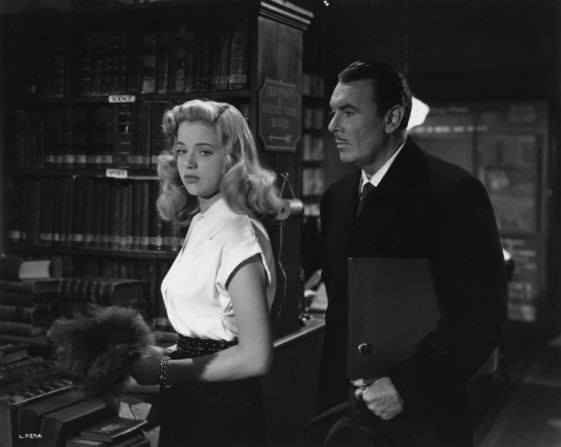
Harman is planning a trip with his wife, their first vacation in years, and assistant Stella Tracy (Marguerite Chapman) is only too happy for him. She has turned down better paying jobs in the past, but feels obligated to Harman as, even though he is completely unaware of it, she admires him and secretly loves him. She doesn't know what happened between him and Ruby, but she notices that the girl is spending more and more time in the office.

That's because she's blackmailing Harman, and, with Hart's coaching, she is demanding more and more from Harman, even going so far as to threaten to write a letter to his wife, telling her about the incident. He can do nothing but comply, but he is outraged by it, and he can't fire the girl or everything will come out. He's trapped.
Well, it wouldn't get any good unless things got extremely out-of-hand, and they do, it short order, with Harman ultimately becoming a fugitive from justice, and a rather ingenious way to be shown for book-sellers to hide a body. One does not find this very enjoyable, though, as the supposed innocent party is not all that innocent, even if he is not ultimately guilty of what transpires.

Star George Brent was a serious actor—he had done eight films with Bette Davis and you have to be on your "A" game with her. But, here, he gets a "D" or "D-". Maybe he didn't like the material, maybe he was playing beneath his gifts, but those gifts are on short display, as he plays his put-upon exec like he'd just read his lines and didn't think about what they meant. It's a flat emotionless performance that has all the sincerity of reading a phone-book. And when he does have to emote, he goes "0" to "60" in half-a-tick, and then forgets that he just yelled. He makes Man Bait no fun at all.
The rest of the cast isn't much better—Reynolds is too fey to be slick and Chapman goes for the Joan Crawford section of the theater. Surprisingly, the best thing about Man Bait is the bait itself. Diana Dors is still very early in her career at this point, but, at least there's subtlety in what she does, and any conflicting emotions about her character's actions just keeps you guessing. She's terrific in this and you miss her when she goes away 3/4 of the way through the film. Dors was always touted as being "Britain's answer to Marilyn Monroe." But, that hardly seems fair. The camera certainly loved Monroe more, but Dors was consistently a better actress.

Saturday, January 23, 2021

King of the Roaring Twenties: The Story of Arnold Rothstein

Saturday is traditionally "Take Out the Trash" Day here.

King of the Roaring Twenties: The Story of Arnold Rothstein (aka The Big Bankroll) (Joseph M. Newman, 1961) In the early 1960's, "the Roaring 20's" was a big deal. "The Untouchables" was on TV and there was even a series called..."The Roaring 20's." It seemed to break up the glut of westerns, gumshoes, and family-comedies—as well as the Kefauver Hearings—that saturated small screens in the 1950's.  

Amidst all this, there were a spate of low-budget movies that also looked back at those days, but it was not what you would call a trend. Mickey Rooney starred as "Baby Face" Nelson. Rod Steiger as Al Capone. Charles Bronson as "Machine Gun" Kelly. There was Studs Lonigan. Just before this film was The Rise and Fall of Legs Diamond.

And at the tail end of the cycle was King of the Roaring 20's: The Story of Arnold Rothstein. Rothstein was featured in Legs Diamond. Nicknamed "The Brain", he is credited with putting the "organized" into organized crime, turning the scatter-shot "wild west" approach of mobstering into a business model of bankrolling potential racketeering schemes (but just be advised to check your receipts). I suppose at the end of the film-cycle, after finishing all the tommy-gun action, they had to include the accountants. You're not done until you do the paperwork.
KOTR2:TSOAR (geez, even the abbreviation is too long!) follows Rothstein's rise  in turn of the century New York as a troublesome kid-grifter (played by Jimmy Baird), giving the local police guff and his upright, serious father (Joseph Schildkraut) so much tsuris for not applying his mathematical gifts to rabbinical studies like his older brother. Rothstein (eventually played by David Janssen) would rather calculate odds and gamble, and eventually, partnering first with a neighborhood pal (Mickey Rooney) on booking centers and poker networks and then with "Big Tim" O'Brien (Jack Carson) on casinos and bigger game.
The film is a little vague on what made Rothstein so successful, other than a careful sizing up of the percentages, making sure that he got his cut and finding strategies that would either undercut the pay-out to his partners or negotiate deals that would have lucrative rewards to himself if his partners screwed up and have to sell out.

One such long con is the eventual prosecution of a tarnished cop (Dan O'Herlihy) who always made sure Rothstein got nicked from boyhood on. The obsession—at least in Jo Swerling's treatment (his last credit)—would prove to be his undoing, as well as a long-held desire to win a poker game with a royal flush. Everything else is as spur-of-the-moment as a dice-roll, and with as much attention as that requires, such as selling out his friends and a "fair-weather" marriage to a chorus girl (Dianne Foster).
That would take somebody extraordinarily charismatic to pull off, and the saddest thing about King of the Roaring 20's is that David Janssen, fine as an actor as he could be, is incapable of doing it. Always an interior kind of actor—as he proved in his long stretch as TV's "The Fugitive"—Janssen is more than capable of luring the audience in and winning their respect if not sympathy, without resorting to theatrics. But here the role is so repellant than no amount of casual inscrutability provokes any interest. And his lack of remorse—or much of anything beyond surface cool—inspires nothing but our own indifference. The audience reflects the performance.

It's too bad because the cast is flush with good character actors—Rooney, O'Herlihy, William Demarest, Keenan Wynn, Diana Dors (in a "blink-and-you'll-miss-her" role), and, one of my favorites, Jack Carson in his last role before his death. But, they're circling around an empty suit, and there's not even enough venom in Janssen's performance to inspire that he get his just desserts, which occurs in a contrivance that's too "on-the-nose." All the way around, the movie's just a bad bet.

Thursday, October 22, 2020

From Beyond the Grave

Oh, that's right. October is "Hallowe'en Month." "Guess I best pay attention to Horror movies." 

From Beyond the Grave
(Kevin Connor, 1974) It was not the best of times for the British film industry around the time this was filmed...but there were advantages. A cheap horror film, like this one, could always be made and because of the low overhead, often made money, even though times were tough. Plus, thanks to some industry-encouraging tax laws, even a film like this one could attract some very good talent, no matter how lurid the subject matter might be. 

From Beyond the Grave is a horror anthology film, collecting four tales under a central umbrella wrap-around story. All four parts were based on the work of British horror writer R. Chetwynd-Hayes, not exactly Edgar Allan Poe or H.P. Lovecraft or even Stephen King, but he had enough output with enough genuine creepiness that he made good fodder for this type of story.
The central conceit is a London hole-in-the-wall called "Temptations Limited"—"Offers You Cannot Resist," run by an elderly and deceptively frail proprietor (Peter Cushing). With one exception, the stories revolve around buyers who cheat the proprietor, but pay a price in the end.

-- "The Gatecrasher" Smarmy Edward Charlton (David Warner) buys an antique mirror from the proprietor, buts cons him into letting him have it a lower cost claiming it a forgery. Charlton, considers himself a high-roller and an amateur spiritualist, but he gets far more than he bargained for when the mirror reveals itself to be possessed by the spirit of Jack the Ripper (Marcel Steiner), who implores Charlton to murder so that he "can feed," which brings dire consequences to both victims and murderer.
-- "An Act of Kindness" Pity poor Christopher Lowe (Ian Bannen); he gets it from all sides: stuck in a lousy middle-management, too old to advance and too young to retire and in an abusive marriage with Mabel (Diana Dors) and a disrespectful son. The only respect he does get is from a matchstick salesman Jim Underwood (Donald Pleasance), veteran of "the war". Lowe tries to impress him that he's a vet, too, claims to have a medal—but resorts to buying one at Temptations Limited, even though he doesn't have the citation for it—and Underwood invites Lowe for dinner where he meet's Jim daughter, Emily (Angela Pleasance, daughter of Donald), who, frankly, is far too attentive to be comfortable—but, when she turns out to have occult powers, Lowe's life becomes more complicated by being made simpler.
-- "The Elemental" Different in tone from the other stories, as it is played for laughs more than chills. Ian Carmichael plays Reggie Warren, a well-to-do businessman and stuffed shirt who buys an antique snuff box after switching the price tag (the proprietor sends him off with a cheery "I hope you enjoy snuffing it!"). On his way, he's informed by the mad psychic Madame Orloff (Margaret Leighton, perfectly happy to play over-the-top) that he has an "elemental" on his shoulder and he should call if he needs her services. Well, Reggie goes home and his dog's gone missing, and his wife (Nyree Dawn Porter) has been attacked by some poltergeistial presence. Hilarity ensues, but not for Reggie.
-- "The Door" Well, not only does Temptations Limited sell mirrors, they also sell doors—ornate ones, and William Seaton (Ian Ogilvy) buys a rather sinisterly-carved one to shutter the pantry, a bitter over-the-top, at least in the opinion of wife Rosemary (Leslie Anne-Down). But, Seaton soon learns that the price for storing your dry goods could be your eternal soul, as passing through the door leads to another time and dimension controlled by the occultist, who had the door made, and that you may go in to get oatmeal, but you might leave your soul behind.
This was Kevin Connor's first directing gig—and he is still directing—won by his editing skills, which is more in abundance than his staging or framing. The film abounds with 1970's stylistics like hand-held shaky cams, and absurd distortions through fish-eye lenses, but every so often something stands out, whether it's the sheer creepiness of Angela Pleasance's performance or how the image in the mirror of "The Gatecrasher" sort of heaves into view creating a sense of dread. In anthologies the strongest story is usually the last one, but here, it's the first one (the placement is due to the protagonists in "The Door" being the only survivors of the movie because they didn't cheat the proprietor). It ultimately isn't much, but there's a lot of talent on display. Think of it as on a par with some good "Night Gallery" episodes.

And I know that "From Beyond the Grave" is a more grabber of a title, but the name of the film really should have been "Caveat Emptor."

Sunday, February 9, 2020

The Unholy Wife

I'm going to try to cut down some of the long-drafted posts that I haven't gotten around to. So, since we haven't done too many of these Saturday posts in awhile, let me re-acquaint you that the spot is traditionally "Take Out the Trash Day."

The Unholy Wife (John Farrow, 1957) One of the last films produced by RKO's film division, this one is an exercise in pure pulp, originally a TV presentation on the CBS "Climax!" anthology series (the second season episode called "The Prowler") gussied up with some religious pretensions to assuage those who didn't show up to ogle starlet Diana Dors portraying a "bad girl" who confesses to committing "the perfect murder" just hours before her execution.

Well, to say it's "the perfect murder" may be a delusion of grandeur, nor is it in any way shape or form true, so the audience is already having to deal with an unreliable narrator as we watch her unfold the tale. But, given the convoluted machinations that Dors' Phyllis Hochen takes to get what she intends, one is tempted to just give up on the character and have them gas her early.

But, the film (filmed in Technicolor—and one is tempted to say that, despite the poor quality of the available images, it's not likely anyone will mourn it not being remastered) begins with a black and white view of morality that will be ignored throughout the film: "I know that in your book, there's no such thing as a perfect crime. Right always comes out on top. Good always triumphs over evil. The guilty always punished. And yet, I did manage it. The perfect crime." Then, in flashback, she walks out the front door of "the house I hated—the one they now call "The House of Death" and fires a deliberately aimed bullet from a revolver.

Subtle.
It's a hell of an opening, but it's a false flag. She's not shooting anybody. She's just trying to convince her doddering mother-in-law (Beulah Bondi) that there's nobody out prowling around the house. This may be a little extreme outside anything but an NRA convention, but extreme is usually the way Phyllis plays it, as will become evident throughout the movie, even if Dors' performance of it is rarely above the cool, calm, and colluded variety. At any rate, daughter-in-law randomly firing a gun outside the house seems to assuage Mom's jitters (eh?), so off she goes to bed.
That allows Phyllis to have a little rendezvous in The House of Death's kitchen—The Kitchen of Death?—where she meets up with rodeo cowboy San Sanders (Tom Tryon), the fellow who's been prowling outside the house, who she's evidently having a fling with, as her husband...well, who the Hell knows where her husband is at this point because Phyllis is telling her story in flashback and only gives us the set-up—she doesn't tell us how it all started. 

And it starts with her being a floozy.

Phyllis is a single-mother, originally from England (in case Dors' accent slips), married to an Air Force sergeant who seems to have flown leaving her with a young son while she hangs out at bars trying to latch onto a high-roller. In comes sauntering vintner Paul Hochner (Rod Steiger) from the Valley and his pal, Gino (Joe DeSantis). Paul's in a good mood and finding Phyllis (not a tough thing to do) just makes him that much happier. Paul is smitten and proposes that they spend the next day at the beach, so he can get to know her son, Michael. Paul, due to a war-wound, can't have children, but Michael would realize his dream of having an heir for the vineyard that has been in his family for generations. Phyllis sees Michael as a burden, but Paul and Michael bond, despite Michael's jealousy of Paul's new attention to his mother.
Phyllis tries to warn off Paul by telling him of her past, but he is not swayed and the two marry. But, from her perspective, the marriage is not a happy one, and Phyllis takes up with the rodeo cowboy. Phyllis tries to send Michael off to a boarding school so she can have more time unsupervised, but Paul refuses the idea and so, thwarted, she begins to plot. That shot in the dark at the beginning of the movie sets up the circumstance. When there's a dust-up between Paul and Gino at an industry fair, Phyllis runs home to shoot Paul when he comes in the door. When the person she kills turns out to be Gino, returning to apologize, Paul determines to take the blame to keep her from being deported, rather than calling the sheriff and portraying the shooting as an accident.
Phyllis plants evidence on the body implicating Paul, and the police arrest him and charge him with murder. This might seem like enough for Phyllis, but when she learns—from Paul's priest-brother—that the judge may acquit him, she doubles-down testifying on his behalf, implicating herself in such an amateurish and clumsy way that everyone believes that she's just lying for her husband and so he MUST be guilty. It's tortured logic and how everything get resolved is even more tortured and a bit convenient for things to come around to the point at the beginning of the film.
If you're wondering why the emphasis on "Unholy" in the title, it's because of the presence of Paul's brother, a priest, who spends a lot of time doing unpriestly things, but still has enough credibility—despite his obvious prejudices—of being able to convince a lot of righteous people about the errors of their ways. Everything is just a little on the hysterical side, but, then the thing has so much pulp in it, you wonder if it might even extend to the wine Paul produces. Everyone tries gamely, especially Dors (who could be better and seemed to excel at comedy), but no one can rescue this one.
Speaking of pulp, you can't find a DVD of The Unholy Wife anywhere—the only copies available are on VHS (hence the quality of the screen-grabs—inspiring one of those rare "I cleaned my glasses for this?" moments)—but until that time when some video-house decides the time is right and the demand is there for a "Diana Dors Collection" there won't be any remastering project in the future. So don't hold your breath, but considering holding your nose when watching this unholy mess.

Saturday, May 14, 2016

I Married a Woman

I Married a Woman (Hal Kanter, 1958) This may be one of the oddest movies in John Wayne's CV. It's a glorified cameo, really, where he plays "John Wayne," idol of the screen and movie "ladies' man" (um, really?) someone for the main character, Mickey Briggs (George Gobel), a Madison Avenue advertising type, to look up to and be jealous of, as his model-wife, Janice (the va-va-vooming Diana Dors) gazes adoringly at the on-screen Wayne as "the perfect man," dumbstruck while absently eating popcorn (and spilling it down her cleavage) in the movie theater. Maybe Wayne was doing somebody (or the studio) a favor, but he shows up twice in the movie and both times, his segment is the only thing in color in a black-and-white film. When the couple go to see him in the theater, the film is in color (okay, some weird logic there, but let's go with it in a metaphorical sense—he and the movies are much more colorful than the gray black-and-white world they live in, okay, good, somebody write a paper about that), but then, when the "real" John Wayne is seen later on a cruise-ship, he's in color there, too. Well, that blows any "deep-thought" out of this movie!

As I said, odd.

I Married a Woman was a vehicle for George Gobel, a name that has, sadly I think, disappeared from cultural significance. "Lonesome George" was a comedian of a decidedly low-key dead-pan delivery, folksy and rambling,* and he had a television variety show in the 1950's that was very popular, probably because it was something of an antidote to the hyper-antics on "The Milton Berle Show." He was a quick-wit and his comedy-concepts were sneakily brilliant, so deceptive was his delivery of them. On his variety show, he worked well with others and he could do sketch-comedy after a fashion.

So, RKO signed him to a movie deal. 

And for this study in contrasts, he plays a corn-fed Mid-westerner in a gray flannel suit, "Mickey" Briggs, as plain as a bumpkin on a log, married to an almost-cartoonishly gorgeous wife of the Marilyn Monroe variety who adores him. The comedy is, of course, that such a plain guy could be married to such a doll and not have some serious insecurities, despite her protestations of fidelity. The insecurities are fueled by his mother-in-law, played by the acid-tongued Jesse Royce Landis, who couldn't be more dry, tossing off zingers that Gobel's character just deflects. 
An ad exec for the Sutton Advertising Agency, run by old man Frederick W. Sutton (Adolph Menjou) as if he were running the Ottoman Empire, Briggs has been sailing along on the strength of his one big "win," the Luxenberg Beer account, for which he had the idea of creating a "Miss Luxenburg" contest, won by Miss Janice Blake, who is now Mrs. Briggs. But Sutton is pushing for something new, something different, in order to keep the account alive and in the Sutton roster. Mickey is driving himself crazy trying to come up with a new concept, to the point where he's neglecting the home-fires, leading Mom-in-Law to suggest that he might be running around on Janice.
Nothing could be further from the truth, but his behavior has been so erratic with all the stress and from living in his own little pressurized bubble, he thinks that she might be cheating on him, which he'd realize as folly if only he wasn't so exhausted, spending long hours at the office and passing out as soon as he comes home. Not that there aren't lots of candidates for Janice's attention, like his sleazy fellow ad-man Bob (Steven Dunne). But, just like a lot of people in the communications business, sometimes the message never gets through.
Hilarity ensues. Well, not quite hilarity. Tempered chuckles, maybe. Gobel tries very hard; the movie calls for more energy than he was used to delivering and he compensates with a weird bouncing walk that might be a bit silly for his character. He's good at the physical stuff, a little forceful in his comic delivery showing a certain level of discomfort, but he's ably supported by the rest of the cast, a group of tried and true character actors who knew their own strengths and how best to apply them to the material.
The biggest surprise is Dors. Born Diana Mary Fluck of Swindon (in the UK), this was her first Hollywood picture (at the age of 25, the film was made in 1956 but not released until 1958). She was obviously supposed to be a Monroe-type, but she is far too forceful a presence and too self-assured to ever be confused with Marilyn, and, at least technically, she was a far better and smarter actress than her predecessor. What she doesn't have that Monroe has was magic, an indefinable "otherness" that glowed out of the screen and (as Laurence Olivier discovered) could not be directed out of her. Dors is a trooper—she knows what's expected of her and plants her feet and falls back on that good British training. You never feel a vulnerability from Dors, and you never feel empathy for her, either.
And Wayne? What is Wayne doing here? Well, as with The Seven Year Itch,** I Married a Woman (the film came out the same year as I Married a Monster from Outer Space!), has a similar summing up that the grass isn't always greener, and when Briggs takes Janice on a romantic cruise, he spies Wayne (in color!) gazing longingly out at the sea, melancholy. He's on the cruise with his wife, and life isn't as roseate in Technicolor as it is on the big screen.
That is, ultimately, the big lesson of I Married a Woman—"Don't Believe the Movies!" A healthy sentiment, that. Especially when it's a refracting fun-house mirror like this picture. There may be kernels of truth hidden in the popcorn, but the rest is just empty calories. 
The director, Hal Kanter was a very well-established writer who did a lot of work for Bob Hope and Milton Berle and he did, good, safe work ushering in this, his second film directing (the first was an Elvis Presley flick) and he exemplified comedy as comfort food—his longest stint was his association with the Academy Awards broadcast, particularly when Hope was M.C.  I Married a Woman was written by one of the great wits of radio and television, Goodman Ace, who described it as the best thing he'd ever written and one of the worst movies he had ever seen.
Diana Dors in a publicity shot for the movie.

*
This will take awhile to watch, but it's worth it.
This is one of the best episodes of Johnny Carson's "Tonight" Show,
where as the host puts it, he "lost control," with "unscheduled" appearances 
by Bob Hope and Dean Martin, followed by Gobel, who lays out everyone
with one of the wittiest lines ever delivered on the show.

** The Seven Year Itch was written by George Axelrod, who, along with Neil Simon, was one of the comedy students at CBS taught by I Married a Woman author Goodman Ace,