Showing posts with label Carole Lombard. Show all posts

Friday, May 5, 2023

To Be or Not To Be (1942)

To Be or Not To Be
(Ernst Lubitsch
, 1942) "The Lubitsch Touch" (that undefinable "something" that made the films of Ernst Lubitsch work) had so many elements connected to the man himself--the instincts, the East European sensibility for craft, the worldly wisdom and the timeless humor. What was it that made Lubitsch such a master of what ever material he chose to over-see?*

But this one's a tricky one, and it didn't do well at the box-office during war-time, but not for want of trying. To Be or Not To Be
** focusses on a Polish theater troupe during the days just before the Nazi occupation. It stars Jack Benny (he rarely did films, but his crack slow burn double takes are on brilliant display here), Carole Lombard (at her best, too--this was her last film before being killed in a plane crash coming back from a War Bonds rally), and it just roasts the Nazi's over the coals, mocking their blustering bureaucratic-ness, while hinting at their dark, dark designs. it's just one of the films that was poking Hitler in the eyes during the '40's. Today, one looks at it with eyes popping and jaw dropping every few minutes for the forwardness of the material. It did not tread lightly, and never less than entertainingly.
But even so, the populace was getting a daily dose of Hitler-slamming (
Chaplin had made The Great Dictator in 1940,
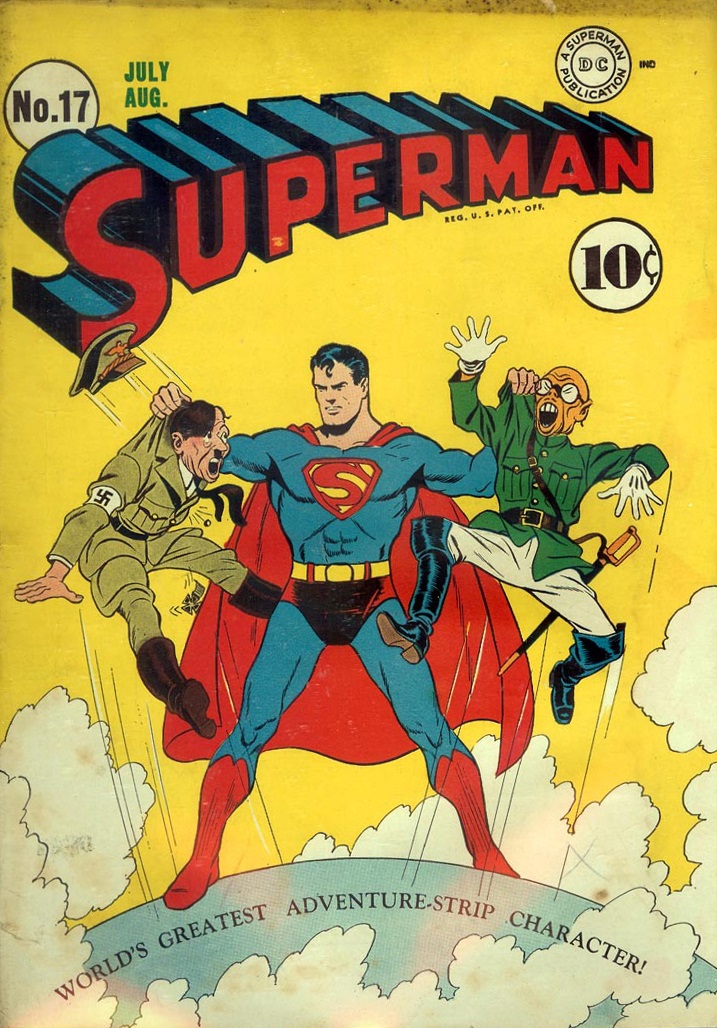
you could see comic book super-heroes kicking the tushes of caricatures of Adolf and Tojo, and Spike Jones had a nice novelty hit with "In the Feuhrer's Face"), and the majority of Americans had loved ones in the service while being rationed gasoline, sugar, rubber, nylons and all sorts of American luxuries to provide for the more pressing needs of the military, up to and including buying war bonds. It might have been too much to expect them to take this one in too...even for a nickel.
Still, looking at it today without the constant barrage of war-news from Europe, it's still a credible comedy, although there are some timing problems in the second act. It begins with one of the most used comedy bits in war documentaries, when an actor portraying Hitler walks into the room to be greeted by snappy salutes and a unison "Heil Hitler." To which, "Hitler" raises his hand and says "Heil myself." Benny doesn't stray too far from his radio persona, as a cluelessly vain actor and leader of a theater troupe (One of the Nazi's says of him: "Oh, yes I saw him in 'Hamlet' once. What he did to Shakespeare we are now doing to Poland." uh...your jaw—you might want to pick that up), oblivious to the fact that his wife is the big draw, and that she plays host to any number of dashing pilots who dash into her dressing room the moment he begins one of his drawn-out soliloquys, where he can have the spotlight all to himself. Lombard does not play cute in this one, but turns on the glamour, while never losing her comic timing--a nice trick, that. Her Mrs. Tura is just as vain as her husband, but a good deal smarter and the wit emanating from her and about her are some of the best lines in the movie. Her dashing pilot is played by a very young and very one-note
Robert Stack, long before he would find better roles that would benefit his limitations.


Quibbles aside, it's still a great example of miraculous "The Lubitsch Touch."*** When the final laugh-filled shot went to black, K. said, "Now I know why you like old movies." Smart, funny, poignant, the grand masters of the cinema, like Lubitsch, transcend the passage of time and circumstance.

* Want to see "The Lubitsch Touch" in action? Rent Shop Around the Corner with James Stewart and Claudette Colbert, and watch its modern redress You've Got Mail with Tom Hanks and Meg Ryan. Same story, basically. Worlds apart as far as quality and craft, and even timeliness, of all things.

** Not to be confused with the crass remake starring Mel Brooks and Anne Bancroft--again, same story, but who's behind the wheel makes all the difference.


*** I think I've mentioned the story before of Billy Wilder and William Wyler leaving Lubitsch's funeral and Wilder sighing, "Well, no more Lubitsch." To which, Wyler replied, "Worse than that. No more Lubitsch pictures."

Tuesday, May 2, 2023

My Man Godfrey

Turner Classic Movies' Star of the Month is William Powell, who seems to have fallen out of the consciousness and discussion of Great Hollywood Actors. I will avail myself of seeing a bunch of his films, as I've always found him astonishingly creative and real.

My Man Godfrey (Gregory LaCava, 1936)  Bill Powell isn't given nearly enough credit in Hollywood history.

Popular in his day, he worked just enough to maintain his reputation and dignity, then retired and kept to himself. But you watch him in something like My Man Godfrey—a not quite screwball comedy of the "The Rich, They are a Peculiar Lot" school—and you see him stretch a little bit, and definitely see him playing a different character than the familiar Powell persona (even an extended drunk scene is played differently than his pleasantly soused Nick Charles from the "Thin Man" series), but still retains that measure of insinuation that took every line of dialogue and made it spin on its heels. His character, Godfrey Pike, starts out as a bum living in a dump underneath the Brooklyn Bridge, where he's picked up by socialite-heads as part of a charity scavenger hunt for the idle rich.
He attracts the attention of Irene Bullock (Carole Lombard, formerly Mrs. Powell) probably because he's different, a genuine "find," and he does stick out like a sore, if well-manicured, sore thumb among the derelicts. Articulate and dignified, he's quietly worldly-wise, politely sarcastic (neat trick to pull off, that) and keeps a cool eye on the rich partiers for whom he's an oddity, a curiosity—like watching a car wreck—and slightly discounted, although he's  probably better than all of them as a human being. Mentored by Irene, he assumes a position as a gentleman-butler for her family, a job that's bested a steady stream of other men. But he does the job well, keeping his opinions to himself, the most sane man in a palatial asylum.
And an asylum it is, with the father (the foghorn-voiced Eugene Pallette, staple of Capra comedies) the only one with any sense (or schedule), and who has long given up on his family making any steps to adulthood. Mother (Alice Brady) is a drama queen, who can only be distracted by her protege Carlo (Mischa Auer) and other daughter Cornelia (Gail Patrick) has to fill her empty life with schemes and conspiracies.
But Irene is a dreamer. In Godfrey, she finds a competent supplement, practical, in marked contrast to her flibbertigibbet, caring to her carelessness.
Such a creature, alien to her environment, makes her fall in love with the old boy, while he still tries to make his way through Society, and back to the life he has previously abandoned.
It's all high-style and fast-paced. And even though Lombard's society gal is a comic cry-baby notched up to "11" on a scale of "10," she is leavened somewhat by the tolerating, sly performance by Powell—who insisted that Lombard, his ex-wife, get the part.

Powell was the epitome of well-mannered play-acting, while never, ever betraying a dull moment. He made style which—when done in the hands of amateurs can look confining—seem effortless, while also being insouciant, and fun.