Showing posts with label Biography. Show all posts

Wednesday, August 14, 2024

Jim Henson: Idea Man

I'm Your Puppet
or
Having a Hand in Everything
 
When I was growing up, I fixated on several things to the point of obsession. One was the comic-strip Peanuts. One was America's Space Program. Howdy Doody. Looney Tunes cartoons. J.P. Patches (if you know, you know).
 
Puppets. I think I watched everything that Paul Winchell did. Kukla, Fran and Ollie, Shari Lewis.
 
And Jim Henson. This was before he became the creator of "The Muppets," and was an up-and-coming skit contributor—he'd appear on "The Ed Sullivan Show" and other variety venues, and he had a regular "gig" on "The Jimmy Dean Show" with Rowlf the Dog.
 
But, Henson did things differently. His "bits" would be his bizarre looking puppets (including one which would become well-known as "Kermit the Frog") lip-syncing to some popular record and the bit would usually end with some 90° turn, sometimes violently. They were hilarious and seemed to erupt from some fertile ground of imagination that none of the other entertainers on "The Tube" seemed to have access
.
Henson hadn't intended to become a pioneering puppeteer. He just wanted to get into television, a medium that fascinated him. Although he'd been introduced to puppetry watching the tube, he wasn't personally involved with the art until his last year at Northwestern High School in Hyattsville, Maryland, continuing to study it at The University of Maryland, College Park, where he met his "Muppets" partner and future wife, Jane Nebel.
With wife Jane, Henson devised the skits and bits that the Muppets performed on local and national television shows, as well as doing commercials. On weekends, he began experimenting with film projects, exploring stop-motion animation, rhythmic editing, and juxtaposed cross-cutting. His first, Time Piece, was Oscar-nominated for "Best Live Action Short" in 1965 (it's presented in its entirety below).
Kermit's origins began from the discarded green coat of Henson's mother.
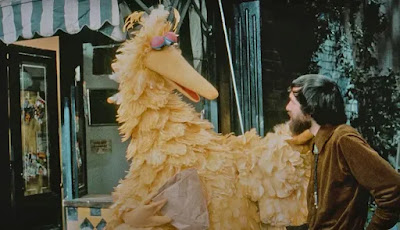
The rest you no doubt know, from Henson's work on Sesame Street—also directing many short avant-garde films for various "numbers" segments—with its vast array of puppets and full-size figures to walk on-set, "The Muppets Show" and movies, "Fraggle Rock," a brief recurring stint on the first season of "Saturday Night"—the percursor title for "SNL," the films The Dark Crystal and Labyrinth. Hundreds of hours of content for movies and television. Plus innovations in puppet-performing, animatronics, special effects, and film-making...not to mention overseeing the construction and manufacturing of building imaginative creatures.
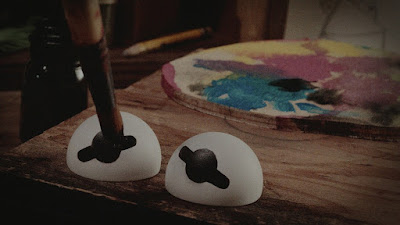
Painted halved ping-pong balls for eyes...
Now, Ron Howard just made a documentary about Henson—Jim Henson: Idea Man—and has been the case for Howard's product lately, it didn't get a theatrical release, but went straight to Disney+ for streaming (except for an appearance at the Cannes Film Festival) on May 31, 2024. So, what was it doing as an ABC special this past Sunday? Disney+, being notoriously stingy with their streaming product, put it on broadcast television within 3 months of its premiere...that's a bit unprecedented. But, follow the logic: Henson's Muppet properties (except those wholly owned by Henson) are owned by Disney. Disney also owns the ABC network, and the night it premiered NBC was airing the closing ceremonies of a much-storied Olympic Games. ABC needed to put something special up rather than roll over and die in the ratings. It's as simple as ABC. Or ABC/Disney.
The fledgling Muppet crew
Howard, who has had an illustrious career as a director—aside from his acting career—has turned in another "safe" documentary. Chapter headings, talking heads (good ones!), a smorgasbord of clips that would even please The Swedish Chef, and a design sense based on things Henson himself had innovated. It's by-the-numbers, like a Ken Burns documentary without that director's eye towards the breath-taking shot, the spurious but telling anecdote and the impeccable eye towards getting the most out of a photograph. Howard colors inside the lines.
Howard is no innovator. His films have no mystery, they never haunt, and they never linger in the mind with deeper implications. He tells the story, simply, effectively, and gets out leaving no after-image. Where a recent documentary on Fred Rogers by a great documentarian like Morgan Neville will leave you in contemplation, Howard makes you feel like you've heard the story enough to feel satisfied. It's like a bed-time story told by a competent nanny. Henson would have never done an auto-biographical film, but he would have made it a thrill-ride with thrills, near-spills and a bit of danger to it.
Those elements are best inhabited by the words of Henson's co-workers, kids, ships that passed, and stars that shined for him. Like Frank Oz, who joined Henson as a high-schooler and under his tutelage became a brilliant puppeteer, actor, personality and director and in his interview seems to share a weight of gratitude. Rita Moreno talks about guesting on "The Muppet Show" and blowing take after take because she couldn't stop laughing until the last take where she barely holds it together...and they used it! "The nostril-flares tell you I'm about to lose it." Jennifer Connelly talks about being a 14 year old on a Henson set...co-starring with David Bowie and feeling like the place was a playground.
 
And in a way, it was, one that we all had access to and could play in. We couldn't see the dollars spent, the hours of prep, the uncomfortable positions (try holding your arm up for 10 minutes!), nor could we see the actual performers, merely their avatars, hidden behind desks, tables, props, out of sight and, rather miraculously, out of mind—even to the people they were performing with. We saw the tip of the ice-berg of creativity, that by the time it appeared on-screen had been honed to a science, made easy to laugh at, without having to consider the men (and women) behind the curtain. 
 
Like Oz.

Henson never played it safe. Maybe, someday, there will be a documentary that will take his same radical tack at looking at this man perpetually behind the curtain while simultaneously so on-stage and call the man what he was: a magical genius.
 

Wednesday, February 2, 2022

The Iron Lady

I recently was pulled into a "Meryl Streep Draft" where, like sports brackets, the participants picked what they thought would be the best collection of movies featuring Meryl Streep to win the competition. Weird what film enthusiasts do.

If you want to listen to the podcast where they were selected, it is here.

If you want to vote for me, the ballot is here. If I lose, voting machines will be seized.

Curiously, I did not pick The Iron Lady—I don't think any of us did—although it is Streep's usual competent display (and she won an Oscar—that counts for...something).

Written at the time of the film's release.
 
Keeping Up Appearances
or
"Don't Want to Dig Around Too Much, M'. You Don't Know What You Might Find."

The Weinstein's last bid in 2011 to win an audience of Anglophiles seems a trifle desperate and might be a bit too early to give the subject proper justice, like Oliver Stone's Nixon or W.we're still too close to the Thatcher years to have any sort of perspective, other than a cursory glance at the events that shaped the Conservative years of the '80's. What damage was done, what was gained, is still unknowable, especially given the subsequent Blair years and how British-American relationships changed and coalesced. We get highlights and lowlights, but no illumination, and, instead, we get a look-back, not unlike Nixon's drunken reverie, but this time filtered through Maggie's Alzheimic reflections, with the dementia-figure of her dead husband Denis' presence as a Iago-like devil's advocate (played by Jim Broadbent, in just the way you think he would, a little dotty, but with a puckish edge). Really, both of them deserve a little better, no matter what one thinks of the politics.
But, the Alzheimer's is a good tool if someone wants to do a hatchet-job.  The disease brings the past into crystal clarity (for the afflicted, not for the story-teller), while also undercutting the reliability of the narrator in the present day.  Hardly seems fair, as the two women who wrote and directed
The Iron Lady
(
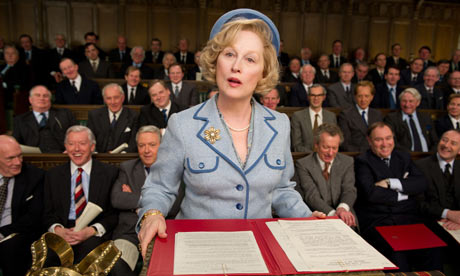
Abi Morgan and Phyllida Lloyd) do seem sincere about presenting the hurdles that Thatcher had to overcome in her ambition to seek change, achieve office, and, in becoming a political animal, save her party and become PM. The role could have easily gone into caricature, were it not for Thatcher's best supporter in the film, Meryl Streep.
The role ultimately won
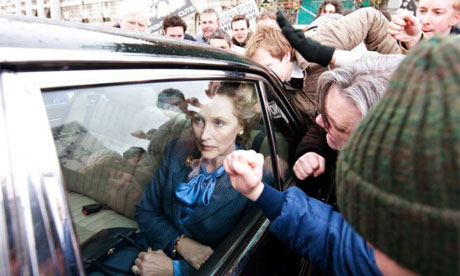
LaStreep another Oscar (and, say what you will about the "unfairness of it all," she does deserve it—this is an amazing performance) and it contains her hallmark studied approach with the same intricate nuances she brings to every role—the rock-solid accent, the filigreed gestures, the interesting way she fills up the pauses and held-shots with interesting choices that are unexpected, but deeply felt. In the elderly sections, she doesn't quite have the "thousand-yard-stare" I've seen in Alzheimer's patients, but the frailties are there, right down to the quaking-arms-under-pressure and the processing pauses that flash through without making a big deal of them. Streep's always good, good enough that one might take her for granted, but this one's practically a one-woman show and certainly the best thing in a film that's "too little-too soon."


Tuesday, August 24, 2021

Respect

re: 'Re
or
Tell You What She Means To Me...
 
There had been an Aretha Franklin bio-pic in the works for some time, and it was inevitable with the successes of Ray, Walk the Line, Get On Up, Bohemian Rhapsody, and Rocketman. Supposedly, Franklin didn't mind the project and did some work approving it before her death in 2018. It's debut last Christmas was delayed by the Corona virus pandemic and it managed to make its debut on-screens near the anniversary of her passing.
 
It is expecting too much for the resulting movie, Respect, to do her justice. Franklin was an original, one of those barrier-breakers who created a genre by doing her own thing, galvanizing the music of the past and sending it soaring into the future, doing it her way, not just as a stylist, but as a creator. An established song in Aretha's guardianship became something else entirely, almost unrecognizable from the source. She had a fierce discipline in the studio, and an evangelical core of inspiration and expression. 

And her voice was powerful, scarily rafter-shaking. When Luciano Pavarotti called in to The Emmy's one year, pleading illness, it should have come as no surprise that Franklin, as a last-minute replacement, would knock it out of the theater (and probably cure Pavarotti's cold, as well!)—one can see that performance in one of the clips provided below. She was the Queen of Soul, in a time when jazz and gospel greats were still around to say "Amen." And probably "Hallelujah!"

The first scene sets the stage. The Rev C.L.Franklin (Forest Whittaker) wakes up a 10 year old Aretha (Skye Dakota Turner) to tell her she's supposed to sing for his party guests. As she makes her way to the living room, she waves to her Dad's acquaintances, "Hi, Mr. Tatum!" "Hi, Uncle Duke!" "Hi, Aunt Ella!" "Hi, Uncle Sam!" Hey, no pressure, kid. But, she manages to belt out her song impressing the luminaries. Aretha and her sisters live with their father and grandmother in Detroit, while their Mother (Audra McDonald) lives apart. Aretha lives for those visits with her mother, who counsels her to never let any man control her, that she never has to sing if she doesn't want to, or speak if she doesn't want to.
Whether her mother ever spoke those words is a matter of conjecture, but they might be a dramatic contrivance as Aretha, once her Mother has passed, stops speaking, stops singing (until counseled by Rev. James Cleveland—played by Tituss Burgess—that "music will save your life!"), and is victimized by a pedophile-friend of her father's, resulting in her first pregnancy at the age of 12. Then, her father starts using her in his services and she begins to sing during events for the Rev. King. At this point, we have a confused young woman torn between her gifts and others' desires to control them, which frustrates her and makes her succumb to "her demons." Such as taking up with bad-boys, like her first husband and eventual manager Ted White (Marlon Wayans), much against her father's wishes. It will be a contentious marriage with physical abuse and a wrestling match over crowing rights when she becomes a success.
But, that success doesn't come quickly enough for Aretha, who is grateful to be signed with Columbia Record (Tate Donovan plays producer John Hammond, and rather unctuously), but spins out four records of standards without a hit—the frustration is palpable as she is separated in her vocal booth from a studio full of white orchestra men. A dust-up at a club performance by a hacked-off Dinah Washington (Mary J. Blige in full dudgeonous diva mode), who suspects Franklin of riding her coat-tails and wasting her own talent, has her making a move (through the machinations of White) to Atlantic Records and producer Jerry Wexler (Marc Maron—priceless), who is willing to give her just enough leverage for her to sign.
But, rather than record in New York, as she's used to, Wexler takes her to Muscles Shoals, Alabama, with a motley crew of white musicians with attitude, where tensions run a little high, but Franklin starts getting the sound she wants. She starts to chart and as her star rises, so does White's desire to be seen as the genius behind the sound.
There have been enough of these "rock-star biographies" that one could walk in with a list of check-boxes and start marking them off—professional jealousy, bad partner, shady managers, unfulfilling success, going off the rails, substance abuse (with stage fall), and revelation followed by redemption. One wishes that the scripts emphasis on Aretha seeking love and approval might make it unique, but that's about every music-biography through-line (whether "based on a true story" or fictional) that's ever been done. I told a friend that I'd seen Respect and the reply was "Isn't that the Tina Turner story?" and after a beat, said "Well, actually, yes...yes it is!"
 
The only difference is we're talking about Aretha flippin' Franklin, and the talent that can't be denied, and however familiar the trail, that is still one mountainous talent that one has to try and duplicate.
It's got to be a daunting task to play Aretha Franklin, but Jennifer Hudson is up to it. You can quibble with the sound (maybe, but, jeez' she's as close as you can come), and she's got Franklin's speaking voice and demeanor down. It's like director John Milius said about casting Arnold Schwarzenegger for Conan the Barbarian: "If we didn't use him, we'd have to BUILD one!" That's how tough it is. Franklin's in our shared musical DNA—one of the voices in our collective heads. Doing an imitation will get you through a song, but not a full-length movie, and Hudson barrels her way through it and does the hardest work with her eyes. Look, if Rami Malik can win an Oscar for Freddie Mercury, Hudson should be a sure thing for this performance, both acting AND singing an indomitable role. Let's just give it to her NOW.
And now, Aretha Franklin...


Tuesday, May 18, 2021

Lincoln

Noisy and Messy and Complicated
 
or 
WWLD?

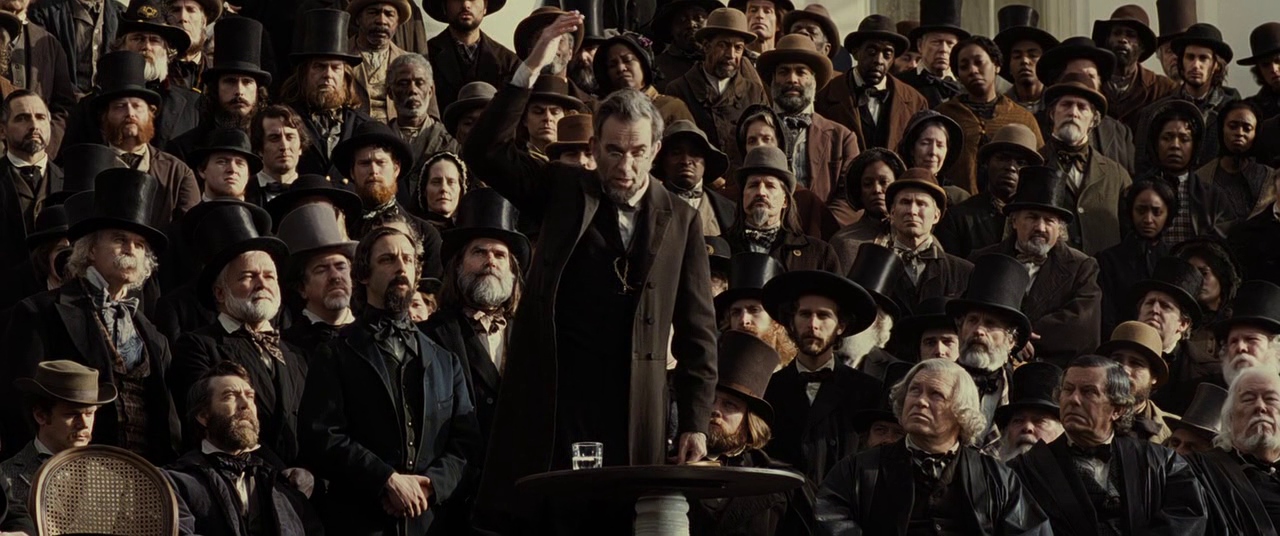
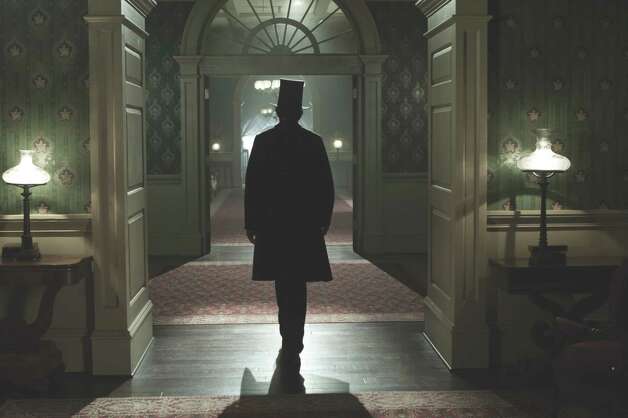
At the end of John Ford's Young Mr Lincoln, "the jack-legged country lawyer" (as played by Henry Fonda) walks up a blighted horizon in the darkening gloom, as thunder rolls in the background, the rough-hewn fence he trudges along taking on the look of military barricades, as the young Lincoln walks with his long stride into the storm of history awaiting him. Steven Spielberg's Lincoln starts where Young... left off—with the sound of thunder over credits, which evolves into cannon-fire before placing us straight on in the middle of the Civil War, blue-on-gray, white-on-black (and the reverses) amid the blood and the mud of the Earth. The shots of the battlefield are tight, confusing, with no sense of place, no horizon—just a frame filled with humans killing each other by any means. No glory. No higher purpose. Just the immediacy of conflict. 
War is the point at which politics breaks down, and politics is where Spielberg's film is concerned to compare and contrast with today's stew of chicanery, graft, and playing fast and loose with the facts to the purpose of getting your way.  'Twas ever thus, and it was no different in Lincoln's time—they just didn't have cameras documenting everything then.

Young Mr. Lincoln: walking into a History still to occur.

\The approach is as good a starting place as any—that is, ending with Ford's last gambit—linking the two, as both films' main goal is to take the monument out of the man, and put him within reach of attainability, wart and all. The canonization of Lincoln began at the moment of his death with the pronunciation "now he belongs to the ages" and his visage, homely, homespun, ragged sunken and contemplative, has been preserved in nickel, bronze, marble, granite to the point where one can hardly imagine it as flesh and blood anymore. 
As portrayed by
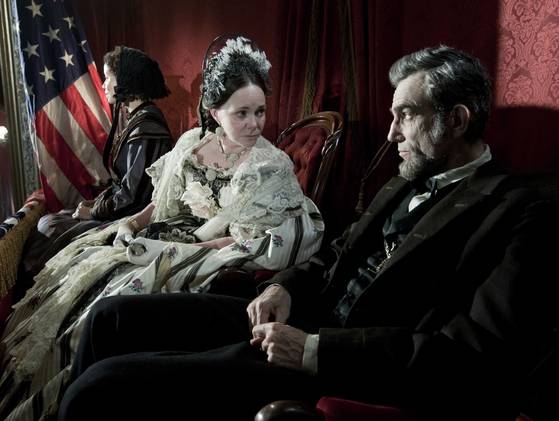
Daniel Day-Lewis, Lincoln is pitch-perfect, not only in his make-up, but his high tenor rasp of a voice, and—the remarkable part for me—in his still-legged gait that kicks and plants itself on the earth, not too steps away from the ragged dance of Wyatt Earp (Fonda, again) in My Darling Clementine. It's a big, robust cast—I had error alerts for all the names I tried to cram into this article's meta-data labels—but the hub of it all is Day-Lewis' Lincoln. Soldiers (including Lukas Haas) quote his Gettysburg Address back to him (which the President tries to staunch: "Been there, delivered that."*) His wife (Sally Field) constantly badgers him—but then she consistently badgers everybody, his cabinet is frequently frustrated by him, by his prevarications, his story-telling that constantly derails conversations to his agenda, and his thought processes which annoy them. "Actually," says Secretary of State Seward (David Straithairn) after Lincoln quotes verse, "I have no idea what you mean by that."
What he means may be too pragmatic for them, it's just how he expresses it that confounds. In one exceptional scene—Tony Kushner worked on this script for a long time and it shows—Lincoln explains in minute, often harsh, detail how he employed his newly granted War Powers Act and it comes down to what he thought he could get away with, legally.
His concern, in the waning days of the war, is to pass the 13th Amendment, thereby abolishing slavery, and it takes every trick, every dodge, every promise and appointment in the middle of a lame-duck Congress before the war could end. The timetable is critical: Lincoln has just been re-elected and is riding a wave of popularity; a crucial number of Congressmen are in their last days of their jobs and are looking to their futures and not to the wishes of their constituents; and, if the war ends, the urgency to pass the Amendment will dwindle, amidst the rebuilding of the Nation. Lincoln's Republicans will vote for it, but they need to tone down their rhetoric. The Democrats are dead-set against it, but getting Democrats to agree on anything is like herding cats and Lincoln wants to exploit the party's fractures into fissures.  
So, the problem is attacked from several fronts (if only the war had started that way): Preston Blair (Hal Holbrook), prominent Republican and journalist, is sent to the South to negotiate a Southern settlement, which the South is anxious to do (although Lincoln is reluctant). Meanwhile, he wheels and deals with the largesse of power, offering appointments, threats, anything to curry votes, and unleashes a trio of stooge-lobbyists (James Spader, John Hawkes, and Tim Blake Nelson) to press the flesh and pass the greenbacks (not "officially," though). Votes are critical. On the home-front, Lincoln's son Robert (Joseph Gordon-Levitt) is back from college, but feeling the weight of his kinship with the President and wants to enlist, which sends wife Mary Todd into another accusatory tailspin as she has barely survived the death of their son, Tad.
Throughout, Lincoln keeps his counsel. but sometimes erupts into spasms of frustrationwith "Molly" (as he calls her), the congress and his cabinet, choosing his moments and pressing his advantage, knowing no peace except what he can create for himself.
As good as Day-Lewis is, he's matched by Tommy Lee Jones as House Republican Thaddeus StevensIn chambers, Stevens sits and fumes, then reaches his limit and bursts out in loud insulting harangues, just in control enough to get his point across, and even smiling tightly—very tightly—when when dressed down by Mary Lincoln over his tight reins over The White House purse strings. Jones finds different ways to make his speeches crackle, while never betraying any sense that the words haven't sprung originally from his head. And Spielberg has given special attention to casting key roles with the like of great character actors like Bruce McGill, Michael Stuhlbarg, and Lee Pace who make their relatively small parts punch out and become memorable.
And Spielberg's eye for painterly detail shines, as Lincoln moves through the gloomy corridors of The White House or sets up an eerie dream sequence for the President. And in one lovely scene, between Lincoln and Ulysses S. Grant (Jared Harris), where the war's toll on Lincoln is expressed in Day-Lewis' exhausted eyes and the shadows of a long rank of soldiers trudging in front of a setting sun play across his face.  
You can't see the moving shadows

Spielberg's regular team of artists: Kaminski, Kahn, Carter, and Williams construct a great quilt of imagery and dynamics, making Lincoln a fascinating display of historical intimacy writ large.  It would make a superb triple bill sandwiched between Young Mr. Lincoln and The Conspirator.


* There's a nice contrast of Lincoln delivering a dedication at a flag-raising ceremony that lasts a measly few lines.  "That's my speech" he says as he tucks his paper back into his stove-top hat. They can't all be gems.

Thursday, December 15, 2016

Dr. Ehrlich's Magic Bullet

Dr. Ehrlich's Magic Bullet (William Dieterle, 1940) Credit Adolph Hitler for inspiring this film after decreeing in 1938 that "scientific discoveries by Jews are worthless."  There are all manner of refutations to such drivel, but producer Hal Wallis chose to focus on Dr. Paul Ehrlich, who, mere decades previously in Der Fuehrer's domicile, managed to rise above the medical community's flirting with anti-semitism by the sheer brilliance—and obvious results—of his research with the body's own facilities for fighting infections by creating blood serums for diseases, starting, along with Emil Behring, with diptheria in 1894.

But, that was just the beginning for Ehrlich. He began research on immunizations, their techniques, and other types of basic forms of therapy—what he termed, for the laymen and the money-men, "magic bullets" that would target and kill the diseases without harming any of the blood-stream's useful cells. 


John Huston worked on the screenplay (which won an Oscar nomination, losing out to Preston Sturges' The Great McGinty) and one can see the same template he would use to tailor the screenplay for his later film of Freud. We start seeing Ehrlich (played by Edward G. Robinson, who was anxious to get away from his gangster/thug roles) as the medical school nerd, barely tolerated by the senior staff at the medical facility because 1) he's Jewish, 2) he's curious, more so than the other students and 3) he uses an extensive amount of lab time on his own research, which is dismissed as frivolous.
It's hardly frivolous, but it's a stepping stone for more accurate diagnoses than the circumstantial evidence favored and relied upon by the older doctors (and form the basis of their expertise...and seniority). Ehrlich is experimenting with various dyes to enhance the parts of cells so they can easily be discerned through the microscope. The research is championed by one of his classmates in favor with the older doctors, Emil von Behring (Otto Kruger), who sees the value of isolating the nuclei of cells for diagnostic purposes. 
Now, that there is a procedure, a test subject is needed. Ehrlich attends a lecture on tuberculosis, and is able to obtain a sample of the bacterium for study. After much experimentation, he is able to tailor his techniques to isolate and target those cells with his identifying techniques, but in the process, catches the disease himself.
For recuperation, he goes to warmer climates of Egypt with his wife (Ruth Gordon), and in discussions with the doctors there, learns of their studies of the body's immune system and with Behring's help, starts work on a diptheria vaccine for an epidemic that is raging through the country's children at the time. His work is hailed as a major break-through in the treatment of disease through anti-biotics and immunization, but his own country looks at the work with skeptical eyes.

There's an interesting parallel between the science and the political: just as Ehrlich makes his greatest strides, the resistance to his work becomes stronger, as a disease will grow in its own resistance against treatment. Ehrlich will suffer set-backs both in his work and in the arena in which he pursues it, equating professional jealousy and outright prejudice as diseases in their own right. Given the tenor and nature of the the times in which the film was made, it's a carefully embedded message to attack a problem that might be cured in the subconscious, making the film a "magic bullet" of its own.

Dr. Paul Ehrlich c. 1908

Thursday, January 7, 2016

Trumbo

Credits Where Credit Is Due
or
Black-marketing The Black List

You can't find a more dull subject for a movie than writers. The drama is always internal and only externalized by the image of fingers flying on keys in solitude. That's the writing. 

The drudgery gets even worse with the inevitable re-writing and the editing and the second thoughts that threaten to snuff the spark of creativity before it can ever turn to flame. It is only those things, the outside influences that keep a writer from writing, that make for good drama, whether it's drink or love or psychological terror.

Or people that don't like their work. Or their politics. Or them.


A writer not writing is far more dramatic than a writer who is.


For Dalton Trumbo, the roadblocks are manifest, but inconsequential to his output—nothing can stop a writer who loves to write, really, and Trumbo loved writing, as it was an expression of his ego and his own activist zeal. Not even being called to testify before HUAC and going to prison for contempt of Congress, being black-listed by quelling studio-heads bowing to pressure from Hollywood's right wing, he still managed to keep writing through a variety of means and psuedonyms and winning Oscars while doing so—Oscars that would take years before the nom de guerre used could be expunged and his own name could be acknowledged as the source. 

The subterfuge was that he was always an employable writer. It's just that no one could acknowledge they hired him to write, or they would be tarred with the same brush as a communist sympathiser. Lillian Hellman called it "Scoundreltime," where one hand did something while the public face lied about it. Trumbo was perfectly fine with playing that game and protecting those who stuck their necks out for him, as he had a family and he liked to eat.

Others were not so lucky. The stakes in the best of show business times are high and the opportunities slim, and producers are all "scared rabbits" (as the line goes in All About Eve) not willing to take a chance at minimizing their potential profits. And that's in the time of high confidence. In a time of fear, wagons will be circled and shutters drawn and phones unrung and unanswered, and in the product, there will always be the safest of happy endings, no matter how unlikely. It's a time of black and white, and anything gray is suspicious and untrustworthy.
Not that Trumbo—the real one, not the movie concoction—was comfortable in the gray zone, either. Even a casual glance at his work shows his screenplays were full of black/white-good/evil demarcations. Trumbo, the writer, couldn't help but make the antagonists of his heroes hissable with more than just bad intentions towards them. The prison guards in Papillon are sadistic, the nun who betrays him later in that movie is brittle and pharisaical. General Crassus in Spartacus is not only vain-glorious and opportunistic, but also bi-sexual (which was rather phobic for the liberal Trumbo, but even liberals in the 1950's could "protest too much" about masculinity). The real Trumbo wasn't afraid to stack the decks in his writing, rather than going a more subtler route. But that bluntness in thought and word could also create masterpieces like "Johnny Got His Gun" (which Trumbo himself directed for the screen in 1971), one of the most searing and uncompromising "anti-war" novels ever written.
In Jay Roach's Trumbo, Dalton Trumbo is portrayed with some of the warts and all—an affected, high-toned, pugnacious workaholic, with the air of high-minded authority (Bryan Cranston plays him with more than a bit of John Huston to him, probably to suggest that patrician attitude), loving of his family but will exploit them by bringing them in as workers in his script factory after he serves time in prison for "contempt of Congress" (which prompts a line another member of the Hollywood 10 employed) and finds himself blacklisted by the majority of Hollywood studios (who, in turn, are bullied by the Motion Picture Alliance for the Preservation of American Ideals to not hire communists, lest their own immigrant status be highlighted in the press).
In a page right out of one of Trumbo's scripts, the Motion Picture Alliance is portrayed as a monolithic front, with far more power than they actually had. They used other people's power to intimidate. and they attacked through money and people's ability to earn it. All it would take to disarm them would be to simply stand up to them and defy them. Tellingly, the only one who does is one of its own members, John Wayne* (David James Elliott), and that's in a scene where he out-guffs Hedda Hopper (portrayed by Helen Mirren as if she were the Wicked Witch of West Hollywood) when she begins to threaten him for "going soft." That sounds a little "Hollywood" to me. But there's a lot of Hollywood in Trumbo, where, not unlike Hitchcock from a few years ago, they get the main story right, but they get the facts wrong.

The problems of several of the Hollywood Ten are heaped on the created character of Allen Hird (Louis C.K.), who is Trumbo's constant critic within "the Ten" ("You talk like a radical, but you live like a rich guy," Hird gripes at Trumbo after a group meeting discussing legal strategies. "The radical will lose," Trumbo parries back, "but the rich guy wins with the cunning of Satan"). Hird's story runs a parallel course to Trumbo's—conviction of contempt of Congress, imprisonment, no writing jobs, then becomes part of the writing mill that Trumbo creates for the King Brothers, a B-movie exploitation movie-maker that was the only studio that would employ them (It's been revealed that Trumbo wrote the classic Gun Crazy for the King Brothers in 1950). But even then, the fictional Hird can't help himself but try to throw in some left-leaning polemic in the basest of material. On top of that, he has issues in his private life and health issues that couldn't come at a worse time.
Trumbo, in the meantime, keeps writing. Obsessively, compulsively. Long into the night, and, when inspiration leaves, in his bathtub (a statue of him** writing in the bath was erected in Grand Junction, Colorado, not far from his hometown of Montrose), popping benzedrine, and making life strained at home. Still, despite being black-listed, he won two Oscars for his work, which were credited to "fronts" or psuedonyms—Roman Holiday and The Brave One—until there was a competition between Kirk Douglas and Otto Preminger over who would actually name him as their pictures' screen-writer (and get the credit for "breaking" the black-list). Even when Spartacus—Douglas' picture—came out, it was picketed by the American Legion, until John Kennedy finally made the issue of Trumbo's black-listing moot by crossing the picket lines to see the film while President. The only way to fight a conspiracy is another conspiracy, like a back-fire. The fact that Spartacus made a lot of money for Universal Pictures helped, too.
Trumbo is worthwhile in that it gets the story out, if not right. Performances are solid from the main characters (although I have problems with Cranston's affected performance) and John Goodman is a stand-out—again playing another Hollywood producer, as he did with The Artist and Argo—but the film does a bit of a disservice to the times, almost making those times a "Hollywood problem." 
 
It wasn't. It just got more of the publicity, where a lot of the battles took place. There is no triumph in Trumbo—as close as it gets is an odd shot where his Spartacus credit is reflected in his glasses, which feels oddly unimportant in the scope of it all. But, there's no real sense of the over-arching tragedy as dissent was punished and the wildly hysterical was given credence. Maybe that's why it doesn't register much, emotionally or psychologically. It feels too much like today.


* And I'm not sure I'm even buying that one. Wayne was a righteous anti-communist, no doubt about it (and no doubt because he was one of the few male stars who sat out World War II in Hollywood—something his mentor, John Ford, never let him forget). He was proud of it. And he had a hand in destroying many a career in Hollywood during the 1950's. Conversely, once The Red Scare had passed, he held no grudges—blacklisted screenwriter Marguerite Roberts was sure Wayne would reject her script for True Grit, but he surprised her when he told the producers "Don't touch a word. It's perfect." But, Trumbo would have you believe that Wayne was the only person in Hollywood who stood up to Hedda Hopper. Not buying it. And I'm not buying how Edward G. Robinson (played by the ubiquitous Michael Stuhlbarg that doesn't suggest Robinson at all) is portrayed as naming names. He never did. And even though David James Eliott looks nothing like Wayne, he still has the voice and bearing perfectly, whereas Dean O' Gorman, who resembles Kirk Douglas, doesn't recall the actor at all.

**