This was part of a series of reviews of the ASUW Film series back in the '70's. Except for some punctuation, I haven't changed anything from the way it was presented, giving the kid I was back in the '70's a break. Any stray thoughts and updates I've included with the inevitable asterisked post-scripts.
Rosemary's Baby(Roman Polanski, 1968)Rosemary's Baby opens with this theme:* it's a lullaby, sung charmingly off-key by Mia Farrow, its star, but underscored with even more off-key, sometimes baleful accompaniment. And as this lullaby oozes out on the soundtrack, the image we see is of a line of New York apartments--not an unusual opening shot for the beginning of a movie, in fact, it's pretty much of a cliche.
And so is the opening situation--two young newly-weds-in-love house-shopping. We've seen it hundreds of times. It's an everyday occurrence. The apartment is lovely, the couple buys it, and everything is quite normal.
Until a new-found friend of Rosemary's commits suicide, and Rosemary's relationship with her eccentric neighbors turns rather familial, and a bizarre fate befalls the fellow who got her husband's job. Now, that it looks like success for them, they decide it's time to have a kid...and see, there's this chocolate mousse...
Well, I don't have to go any further for I'm sure the legend of Rosemary's Baby has preceded it.
But what separates Rosemary... from other gothics is the perverse outlook of its director, Roman Polanski. Yes, everything's normal, and it is that very normalcy that makes the intrusion of Demonic Forces so doubly terrifying. One can accept odd happenings on a dark and stormy night on a cliff-top castle, but on a sunny day in a New York apartment complex?**
It makes the horror so much more palpable to be surrounded by normalcy for it increases the possibility of something happening to you. And thus, Polanski places threats in such "normally" innocent and reassuring things as a chocolate mousse, or Ralph Bellamy (who had hawked aspirins for years on the tube) playing a "witch" doctor, if you'll excuse the pun.
It's an unorthodox approach to the Gothic Horror Story...at least it was in 1968, when it was released, and to paraphrase an ad for Polanski's latest film, The Tenant, "No one does it to you like Roman Polanski."***--not William Friedkin in The Exorcist, or Richard Donner in The Omen. Polanski's Rosemary's Baby is head and shoulders...and horns, above them.
Broadcast on KCMU-FM on October 22 and 23, 1976
Still true, but, my God, after Polanski's conviction of child-rape, that's one hell of a movie tag-line on The Tenant! Polanski's arrest, trial and conviction would come later, two years after The Tenant was released, but it sure is the ultimate sick joke.
As for Rosemary's Baby, it still tops the lists of "Movies No Pregnant Woman Should Watch" and it still takes the prize as the best "Devil Walks Amongst Us" movie (sorry, Damien and Regan), and it's no small part due to Polanski's sick sense of humor—Orson Welles, in one of his conversations with Peter Bogdanovich, referred to him as "one of those morbid boys"—and his way of mixing the mundane and the sacrilegious.
The most entertaining parts of Rosemary are the elderly and uncomfortable neighbors—the "legacies" of the Bramford Hotel, and the best of them is sprightly Ruth Gordon, who won an Oscar for her role. It resurrected Gordon's career, and she went on to star in a long list of films in her twilight years. But, there are others, like Patsy Kelly, Ralph Bellamy (the joke in his early roles was that he was always the dullest of leading men and Polanski makes full use of that reputation here), Elisha Cook, Jr. (a favorite of producer William Castle), Hope Summers, and Phil Leeds (he would end up a fixture on "Seinfeld"), all semi-familiar faces that, in other circumstances, might provide comfort, all part of a conspiracy to make an anti-domestic situation to welcome the Anti-Christ.
Add to it the presence of Mia Farrow, the urchin break-out star of TV's "Peyton Place" who'd just married...Frank Sinatra!...and had a quality that could charitably be called "odd." You're not sure if she's going crazy, has a pre-postpartum depression, or if something weird is actually going on, and it keeps audiences on a tightrope tension of sympathy for/suspicion of Rosemary, the yin and yang of our sympathies and cynicism. And, of course, Polanski (out of Ira Levin, who cloned Hitler and roboticized housewives in other thrillers) turns that into your worst nightmare.
Producer William Castle had a carnival-barker-showmanship to him, gimmicking customers into screenings of his goofy-creepy thrillers and horrors and after Hitchcock (inspired by Castle's box-office receipts and asking "what if someone good did it?") managed to best his efforts with Psycho, he wanted to do the Master of Suspense one better. With the solid story-ideas of Rosemary's Baby, head and tails above what he could conceive, he was able to get that much better and gain some industry clout, although he ultimately had to cede most of the creativity to Polanski, and his Paramount studio-bosses. He would always be a B-movie-maker, but Rosemary's Baby made him see the promised land of the A-list.
* Yeah, there's nothing wrong with your computer--there is no song. I usually backed my radio-reviews with an appropriate piece of music, and for this one, I used the actual theme on the soundtrack (that I recorded on cassette from a TV broadcast...I used to do that).
Here it is:
** Ironically enough it's the high-end and rather exclusive Dakota building, standing in for the "Bramford." John Lennon would be shot in front of the Dakota a decade later.
*** EEE-Yikes!
Legendary producer-showman William Castle appears outside the telephone booth for a cameo.
Whenever I was doing any sort of search for "Edge of Darkness"—one of the "Anytime Movies" from here—I would have to distinguish it was the 1985 British mini-series...or, eventually, the 2010 film adaptation...or another film done back in the 40's. I was always curious about that wartime propaganda film, and thanks to TCM I finally got to see it a couple weeks back.
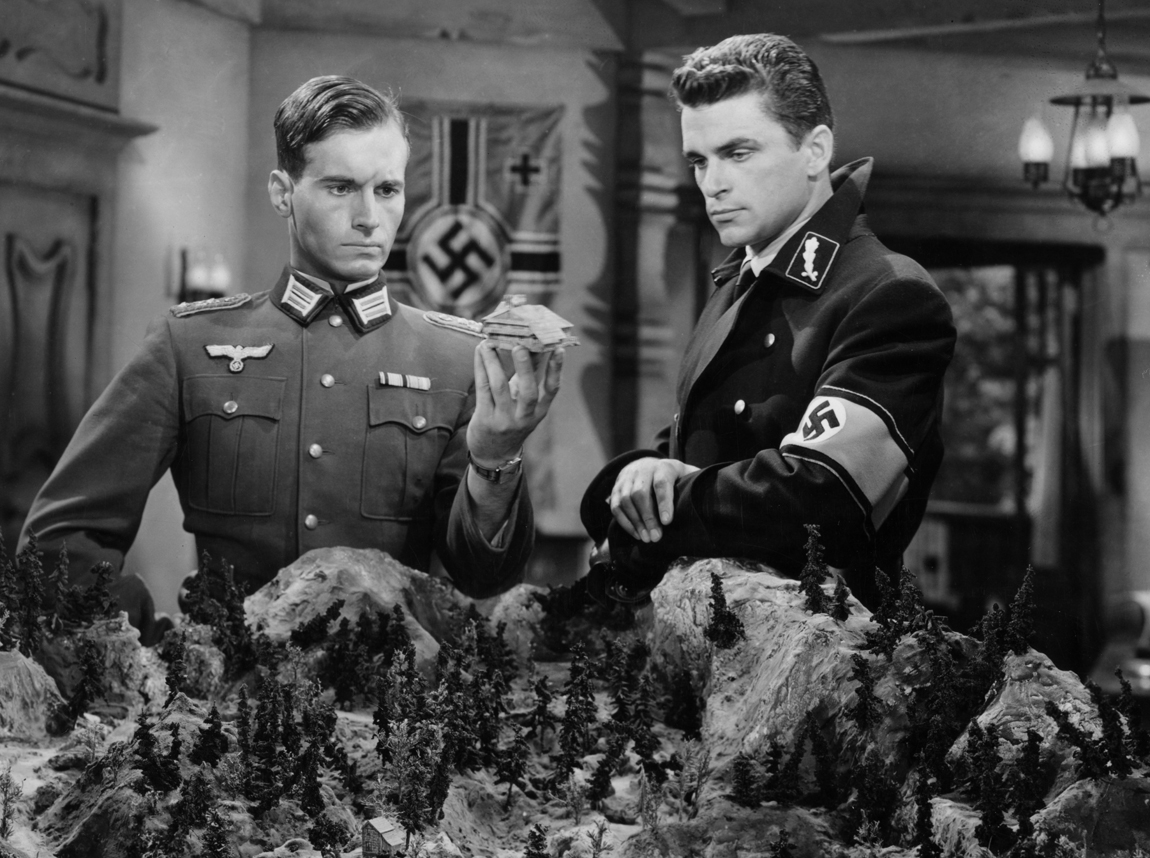
Edge of Darkness(Lewis Milestone, 1943) A German reconnaissance plane flies over the occupied town of Trollness, Norway to find the unusual circumstance of a Norwegian flag flying over one of the buildings. The crew radios back to send a squad to find out why the expected Nazi flag of Germany isn't flying.
When troops are sent out, they find a town of corpses. They're everywhere—German and Norwegian alike—filling the streets, even going up to the Nazi commandant's office, where he still sits upright in his chair, dead. There has been a massacre and Trollness is deserted, save for one townsman, raving and extolling the Nazi's. He's clearly off his head, so they execute him without a second thought. So much for loyalty.
Being Nazi's, they probably wouldn't have spared his life even if they'd known his past. He was Kaspar Torgerson (Charles Dingle), the well-to-do owner of the town's cannery and their strongest supporter in town: as long as the Nazi's were in control and there were no conflicts, no danger of strikes, and the cannery kept running and he was making money, what could be the issue with them? And Torgerson would only be too happy to report one of his neighbors to the Nazi's as a troublemaker (which in the Nazis' view is "every man, woman, and child!"—and here I thought Nazi's discriminated)
The thing is, most of those "troublemakers" are relatives of his. Oh, brother-in-law Dr. Martin Stensgard (Walter Huston) remains neutral—presumably to "do no harm"—and his wife, Anna (Ruth Gordon) is merely passive. It must skip a generation because one of the most ardent members of the underground is their daughter Karen (Ann Sheridan), who, with lover Gunnar Brogge (Errol Flynn), heads the Nazi resistance—there are 150 Nazi occupiers and over 800 villagers, but as the Nazi's say "we have guns and they are afraid to die"—so the villagers must wait until arms are delivered to them from English submarines—it is, after all, a fishing village and boats are going out all the time.
Not that everybody is on board with the idea: Stensgard's son (John Beal), recently returned from university, is considered a Nazi sympathizer, and the town's priest (Richard Fraser) lectures from the pulpit about violence and God's judgment. And some folks, like the doctor, just don't want to get involved. But, if there is one thing Nazi's are good at, it's they can turn apathetic villagers to angry action. They're just like Frankenstein that way. It's the only thing they are good for.
Fairly soon, the arrogance turns to harassment then to rape and murder and even the most faint-hearted are soon flogging Nazis in the street, which allows the situation to escalate to horrific displays of aggression and violence that doesn't allow for any nuance of philosophy or conscientious objection...like any good piece of propaganda should. Made in 1943, it was a well-oiled agitprop by the studio that jumped on the war wagon first, Warner Bros. So, the performances are resolute and clear-eyed earnestness set against mustache-twisting villainy. Milestone, who'd started out in the silent era and who's All Quiet on the Western Front had won the Best Picture Oscar thirteen years earlier knows how to keep things moving quickly while not hesitating at outright manipulation to get the point across. Finish it off with Roosevelt's "Look to Norway" speech and you have a story that Americans can relate to, two years into the war effort.
Dr. Ehrlich's Magic Bullet(William Dieterle, 1940) Credit Adolph Hitler for inspiring this film after decreeing in 1938 that "scientific discoveries by Jews are worthless." There are all manner of refutations to such drivel, but producer Hal Wallis chose to focus on Dr. Paul Ehrlich, who, mere decades previously in Der Fuehrer's domicile, managed to rise above the medical community's flirting with anti-semitism by the sheer brilliance—and obvious results—of his research with the body's own facilities for fighting infections by creating blood serums for diseases, starting, along with Emil Behring, with diptheria in 1894. But, that was just the beginning for Ehrlich. He began research on immunizations, their techniques, and other types of basic forms of therapy—what he termed, for the laymen and the money-men, "magic bullets" that would target and kill the diseases without harming any of the blood-stream's useful cells. John Huston worked on the screenplay (which won an Oscar nomination, losing out to Preston Sturges' The Great McGinty) and one can see the same template he would use to tailor the screenplay for his later film of Freud. We start seeing Ehrlich (played by Edward G. Robinson, who was anxious to get away from his gangster/thug roles) as the medical school nerd, barely tolerated by the senior staff at the medical facility because 1) he's Jewish, 2) he's curious, more so than the other students and 3) he uses an extensive amount of lab time on his own research, which is dismissed as frivolous.
It's hardly frivolous, but it's a stepping stone for more accurate diagnoses than the circumstantial evidence favored and relied upon by the older doctors (and form the basis of their expertise...and seniority). Ehrlich is experimenting with various dyes to enhance the parts of cells so they can easily be discerned through the microscope. The research is championed by one of his classmates in favor with the older doctors, Emil von Behring (Otto Kruger), who sees the value of isolating the nuclei of cells for diagnostic purposes.
Now, that there is a procedure, a test subject is needed. Ehrlich attends a lecture on tuberculosis, and is able to obtain a sample of the bacterium for study. After much experimentation, he is able to tailor his techniques to isolate and target those cells with his identifying techniques, but in the process, catches the disease himself.
For recuperation, he goes to warmer climates of Egypt with his wife (Ruth Gordon), and in discussions with the doctors there, learns of their studies of the body's immune system and with Behring's help, starts work on a diptheria vaccine for an epidemic that is raging through the country's children at the time. His work is hailed as a major break-through in the treatment of disease through anti-biotics and immunization, but his own country looks at the work with skeptical eyes. There's an interesting parallel between the science and the political: just as Ehrlich makes his greatest strides, the resistance to his work becomes stronger, as a disease will grow in its own resistance against treatment. Ehrlich will suffer set-backs both in his work and in the arena in which he pursues it, equating professional jealousy and outright prejudice as diseases in their own right. Given the tenor and nature of the the times in which the film was made, it's a carefully embedded message to attack a problem that might be cured in the subconscious, making the film a "magic bullet" of its own.
 Rosemary's Baby opens with this theme:* it's a lullaby, sung charmingly off-key by Mia Farrow, its star, but underscored with even more off-key, sometimes baleful accompaniment. And as this lullaby oozes out on the soundtrack, the image we see is of a line of New York apartments--not an unusual opening shot for the beginning of a movie, in fact, it's pretty much of a cliche.
  Rosemary's Baby opens with this theme:* it's a lullaby, sung charmingly off-key by Mia Farrow, its star, but underscored with even more off-key, sometimes baleful accompaniment. And as this lullaby oozes out on the soundtrack, the image we see is of a line of New York apartments--not an unusual opening shot for the beginning of a movie, in fact, it's pretty much of a cliche.
  Well, I don't have to go any further for I'm sure the legend of Rosemary's Baby has preceded it.


.jpg)