Showing posts with label Angus McLane. Show all posts

Thursday, June 23, 2022

Lightyear

To Xfinity and Beyond
or
Just Goes to Show a Movie Can Have Too Much "Buzz"

Buzz Lightyear (Chris Evans), Space Ranger, is on a mission for Star Command, when he's awakened by a signal telling him that they're nearing a planet with life on it. He goes out to explore the planet alone, leaving a team of scientists in hyper-sleep aboard his ship. Alone is what Lightyear does—he's a lone wolf and it's easier to do things himself. The thing is he's not alone: his commander on the mission, Alisha Hawthorne (Uzo Aduba) has tagged along, surprising the bejeezus out of him and noting the fact that he's "narrating again," which Buzz confesses is him doing his Mission Log (which no ever listens to). It helps him focus. What doesn't help him focus is the other member of "The Away Team," a rookie—with a not-very-reassuring reddish color on his uniform (for those of us who know "sci-fi tropes")—named Featheringhamstan (Bill Hader), whose defense stance seems to be "approaching panic." That would be the way to go, actually, as the planet has a slightly spongey surface, all the better for the tentacled underground dwellers to travel through and for the above-ground spider-crabs to scramble over.
 
But, it doesn't bode too well for any sort of colonization, so after tussling with those species (that's it?), Buzz and Alisha and Feathinghair...Farthinghamster..."the rookie" get back to the ship to try and lift off the thing—noting that their ship (let's call it "The Turnip" because they do) is sinking into the ground. Buzz mans the controls, while Alisha primes the hyper-space crystal for launch. Buzz is determined to get them off the ground, but the ship crashes, leaving them stranded on the planet...and worse for Buzz, leaving the mission uncompleted.
Okay, a diversion. But not as big as the one this crew takes to become deserted, so no big deal. Let us explain (as the movie does) that what we are watching is the movie that inspired the "Buzz Lightyear" toy from the always reliable "Toy Story" series that launched Pixar Studios into feature films in 1995 (Andy, the real-live boy from the series, loved the movie and his mom bought him one). So, this is not the toy we're watching, with it's round googly-eyes and the Tim Allen voice and the purpose of comic relief, this is a science fiction adventure film (with humor), rather than a comic film about toys having existential crises. It's a different animal, only tangentially related to the Toy Story franchise. 
 
Affirmative?
 
Let's move on.
The marooned colonists call the planet T'Kani Prime and their goal is to survive, use the planet's resources and build a launch platform to get them back to Star Command, and within a year, they have built an impressive "Gerry Anderson" inspired complex, complete with a bug-zapping fence and a launch vehicle to get them into space. But, first, they must test the newly-developed hyperspace fuel that could get them home. And that's tricky. They rig up a test-vehicle and select Lightyear—the fellow who crashed the original craft stranding them in the first place—to pilot the ship.
The test flight goes well...until it doesn't. That hyperspace fuel becomes unstable and Lightyear is unable to achieve the speed necessary to go full-hyperspace (it's amazing how similar the sequence looks to the early test flight in Top Gun: Maverick), but, he's able to get the ship back to planet, even though the mission is, technically, a failure.
But, he's greeted with surprise, even shock. "Buzz! It's good to see you!" For Buzz, the trip took hours. For the colonists it took "4 years, 2 months, and 3 days." The speed that Buzz achieved on-board his ship created "time dilation" so that a moment for him, would be days or weeks for everybody else—please see Interstellar for reference. Relatively speaking, Buzz has missed the 4 years plus, the colonists have experienced and there have been changes—in technology and people. To deal with the psychological consequences, Buzz is given a robotic therapy cat, Sox (
Peter Sohn), but what he's itching to do is test the new hyperfuel again to see if it has made enough improvement to get everybody home.
So, he goes up again, with the same results. The hyper-fuel becomes unstable, and when he lands another 4 years have gone by: Alisha is in a relationship, his friends are older, the colonists have made more improvements and they have a new fuel prototype.
So...it's time to test again. Buzz goes up, the hyper-fuel becomes unstable, he lands, and another 4 years have gone by. Alisha is married, pregnant, and there's a new hyper-fuel. You get the pattern.
Buzz goes up again and again, each trip adding another 4 years to everybody else's life while Buzz stays in place in a sci-fi metaphor for life passing him by. Until the day that he goes up and the hyper-fuel—now designed by Sox the robo-cat in a long gestating project—is able to maintain integrity to make the jump to hyper-space. He's done it. The mission is achievable. He's able to get everybody home.
But, no one wants to leave. The jump to hyper-space has increased the time dilation so that 22 years (14 weeks, 3 days) has elapsed. Alisha is dead, her children grown, with grandchildren and the colony has made a stable life for everyone concerned. Buzz's mission is no longer relevant. But, a new threat has emerged: Zyclops robots, led by the evil overlord Zurg (
James Brolin), have occupied the planet, the colony protected by a laser shield that is constantly under attack. And, there's a "rag-tag" group of defense forces—Darby Steel (Dale Soules), Mo Morrison (the ubiquitous Taika Waititi), and Izzy Hawthorne (Keke Palmer), Alisha's granddaughter, who join up with Buzz to try and defeat the Zyclops army.
Lightyear
is absolutely gorgeous, as the Pixar team of artists have (again) pushed the limits of detail and design to bring the world—and new worlds—to life. But, the film disappoints. It's not because of Evans as the voice of Lightyear (he's great, paying homage to Tim Allen's legendary work as toy-Buzz, while giving this Buzz his own tamped-down personality), and it's certainly not due to any issues having to due with a same-sex relationship which flits by in the background while Buzz Lightyear obsesses over his one true purpose. These are prickly little "dog-whistle" issues that don't even deserve an internet comment (although there are many, all deserving to be dismissed).
No. The problem is the character of Buzz Lightyear, who is—necessarily—not the same goofy, though good-hearted, character of the "Toy Story" films, but is—in all senses of the term—his own man. Almost buffoonishly so. While the rest of the world changes, he stands, alone in his own stubbornness. He's a misanthrope, a Rip Van Winkle, out of time and space. In a way he's a bit like Ethan Edwards in The Searchers (but without the virulent racism) or The Outlaw Josey Wales (without the tragedy)—he even inherits an ersatz family which he initially scorns, ala Josey. But, unlike those he doesn't have a distinctive emotional epiphany—oh, he has one when he's confronting himself (and to explain that, you'd have to see the film), but it's so weighted down with an action sequence that one might be forgiven if it escapes one's notice. 
 
And it takes so long for him to come to his conclusions that he seems a little dense to what is going on all around him. Maybe it's all that narrating....spending too much time in his own bubble helmet.
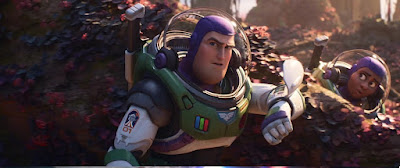
Maybe I'll revisit Lightyear in 4 years, 2 months and 3 days, and perhaps find some aspect that might make him a hero...or even someone you'd want an action hero figure of.
Because for someone whose catch-phrase is "To Infinity...and Beyond(!)" he should perhaps choose "Affinity," instead. Until then, Lightyear will just be another lackluster choice in endless rotation on Xfinity.


Tuesday, June 28, 2016

Finding Dory

I Had a Great Title For This Review, But I Forgot What It Was...
or
WWDD?

They did it again. Pixar's sequel to Finding Nemo, Finding Dory is such a good movie as to defy any objections. It's one of those rare movies (although not so rare when considering Pixar's output) where I can simply say "just go." Don't let anything, external or internal, keep you from seeing this in the best possible theater experience.

It's that good.


In fact, if you liked Finding Nemo, you may be surprised to discover that its sequel joins that rare list of films that is better than its predecessor.


But, how does it improve? It takes one of the more problematic of the earlier characters, focuses on it/him/her and provides value to a character that was, basically, comedy relief. At the same time, it teaches family-friendly, inclusive life-lessons that won't raise the blood pressure of either autocratic or laissez-faire parents, be they conservative or liberal. while keeping the whole thing entertaining, without needlessly villifying anybody, and having no scary moments that will necessitate the "hands-over-the-eyes" routine.*
The humor will not go over most kids' heads, but the ironic stuff might (irony being something that kids don't appreciate, as it's usually creates something that bursts their little bubble Universe—irony makes kids frown without knowing whether to laugh or cry). Finding Nemo, at the time of its release, was one of those Pixar bench-marks producing an artistic leap in how the physical world was represented digitally (late-comers to it might wonder what the fuss was about, considering the leaps they've made over the years). Finding Dory is as impressive in its depiction of the underwater world as The Good Dinosaur is showing the surface-world. But, its characterizations are far more sophisticated (and entertaining), while using a poignant story about memory and loss with the forgetful blue tang (voiced...memorably...by Ellen DeGeneres).
We go forward by going back: baby Dory (Sloane Murray) is being taught by her parents Jenny (Diane Keaton) and Charlie (Eugene Levy) how to introduce herself—"Hi, I'm Dory and I have short term memory loss." Dory's memory-stick is faulty and the parents (voiced by two of the best actors for portraying neurosis) worry about their little juvenile, warning her of the dangers of the deep (watch out for the undertow, don't stray too far from home) and hoping that some of it will make its way into her memory. But, they can only hope, because Dory can't stay focused or still enough for things to sink in. In the meantime, they do the best they can, hoping that it's enough.
We're back in Finding Nemo territory here, which was, basically, a movie about parenting. Yes, it was about finding yourself and taking chances and being more than you think you're capable of, but it was mostly about parenting, about loving something more than yourself that you would do all those things you wouldn't do otherwise. That Dory is a "special needs" child makes the movie even more poignant. The parents can only do what they can. It is up to the child to apply the lessons learned.

But, what if they can't remember the lessons?
Because it's a movie (rather than a short subject), of course Dory gets caught up in the undertow and is separated from her parents and left in the open ocean to say to every fish that passes "Hi, I'm Dory and I suffer from short-term memory loss. Have you seen my parents?" Of course, they haven't. But there are a lot of fish in the sea. And a year later, she encounters Marlin (Albert Brooks) who has also lost something, his son Nemo, and the movie flips to the ending with, that movie having been done thirteen years ago, Marlin and Nemo re-united, and Dory nearby, her own quest unfulfilled (not that she remembers).
But, images keep snapping into her mind. She talks in her sleep. One day, accompanying Nemo on a field-trip, she remembers something about "the undertow," and she associates it with her parents, and, together with Marlin and Nemo, she sets off to try and find a mysterious place she mentions after being knocked out by a migrating school of manta-rays—"The Jewel of Moro Bay, California."
In one of the few call-backs in the film (something that encourages me that a sequel has its own soul), the three catch the California current with Crush and his brood of migrating turtles and make their way to the U.S.'s West Coast, where an encounter with a squid manages to place them right where they want to be.
One of the neat things about Finding Dory is that it has a nice subliminal visual scheme to it. As the clowns and tang get closer to California, the ocean surface is littered with garbage from a Volkwagen beetle (which looks like it dropped out of Cars) and a sunken tanker of containers—at one point, Dory is swimming around with a plastic six-pack ring, which complicates her life for awhile.
And there are lots of new characters—Hank the camouflaging octopus (Ed O'Neill) who has a missing leg ("that would make you a septopus!"), Destiny the near-sighted shark (Kaitlin Olsen) and Bailey the beluga (Ty Burrell) with faulty echo-location, as well as sunning seals Fluke (Idris Elba—brilliant) and Rudder (Dominic West). If you're sensing a pattern in this, it's that "The Jewel" has a lot of damaged oceanographic life, where Dory fits right in.
And yet this doesn't dawn on you until late in the picture. Most of the sea-folk in the larger two-thirds of the movie are parked in a handicapped space, but, when left to their own devices, are just as capable, or even more so, than their blithely-"together" water-buddies. This realization colors the reactions of the schools of fishes that ignore, snub, or scuttle away from Dory's clueless pleas about her parents. It's a story about the invisibility of the handicapped, invisibly woven through an adventure story about the formation of relationships and its strengths...and in the words (improbably, but true) of Warren Beatty "the sanctity of family."
Because it's one thing for Marlin and Nemo to be in jeopardy and for us to feel for their plight. It is quite another for Dory and Hank and Destiny and Bailey to have their own survival systems and networks and feel that everything is going to be okay. Yes, there are tight spots. Yes, there are moments of indecision and desperation. But, the second-guessing and neurosis of Finding Nemo is refreshingly absent. No one needs convincing here (except for Marlin...again)—everybody is heroically zen-Yoda "Do or do not. There is no try." The pay-off is a goofy, ludicrously over-the-top chase sequence capped by a hilariously extended slow-mo denouement with a musical accompaniment that is both entirely inappropriate and dazzlingly perfect.
It's why I find Finding Dory a better film than Finding Nemo. Yes, the former has Marlin learning a lesson about overcoming his fears to find his son. All well and good. But, Finding Dory goes the extra step. It teaches to be fearless, despite adversity, despite handicaps, despite...anything. I like that message for being a life-lesson, rather than an answer to a problem. Yes, fine, don't be so neurotic is a good enough lesson to start. But "just keep swimming" is both a good philosophy and a good course of action.
Do not leave early at the "the end" credit because the movie has a nice end-note that continues issues from the film, but also from Finding Nemo.

Also, go early enough that you see Alan Barillaro's pitch-perfect short piper, which is amazing in its visual story-telling, mind-boggling in its photo-realistic animation, and admirable in its refusal to anthropomorphize its subjects.


*I missed roughly 20% of To Kill a Mockingbird when I was 7, thanks to that move. Thanks, Mom!