Showing posts with label Adam Driver. Show all posts

Saturday, September 28, 2024

Megalopolis

Marcus Unrealius
or
Utopias Turn to Dystopias
 
"Look back over the past, with its changing empires that rose and fell, and you can foresee the future too."
Marcus Aurelius, Meditations

More than a decade ago, at a second-hand book store, I picked up a tome called "The Greatest Movies Never Made,"* which detailed a lot of films that had been proposed, had gotten to the script stage or pre-production and then for whatever reason, it was never made—films like Jodorowsky's conception of Dune, Hitchcock's Kaleidoscope, Philip Kaufman's Star Trek film: Planet of the Titans...
 
 
Now, that book was written a couple decades ago, but the sound of it was intriguing, although a little vague about the details.** It sounded like Fritz Lang meets Ayn Rand in a sci-fi setting. But, Coppola was determined to get it made.
A concept drawing of Megalopolis that I remember from that book.
 
And now, using his own money, he has, at the age of 84. 
 
"A man's worth is no greater than the worth of his ambitions."
 Marcus Aurelius, Meditations
 
Based very loosely on events known as the Catilerian Conspiracy, Coppola's film tells the story of Cesar Catilina (Adam Driver), nephew of the rich and powerful Hamilton Crassus III (Jon Voight) and head of the Design Authority of New Rome in the "Third Millennia, 21st Century," a city divided between the extremely rich and the poor. Catalina has access to a wonderful substance called Megalon—another wonder-element along the lines of adamantium or unobtainium—the purpose of which is simultaneously vague and omni-versatile. With it, Catilina intends to build a "perfect school-city for the future" in the heart of New Rome, while the Mayor of New Rome, Francis Cicero (Giancarlo Esposito) would rather build a new casino, another pleasure-dome for the rich and idle. At a televised unveiling for the proposed gambling complex, Catilina interrupts by reciting Hamlet's soliloquy (almost all of it) and accusing Cicero of being nothing more than a slum-lord.
But, before one gets any further into the plot, there is one curious thing to mention: In the preliminary sequence of the film, it's shown that Cesar seems to have the ability to stop time. Walking precariously to the edge of the Chrysler Building, he leans over and stops time—the fleeting clouds halt and the traffic below comes to a standstill with nary a honk. And in that gap, Cesar rights himself, defying gravity and moves back away from the edge. That would seem to be a really big story-point, but except for another sequence where he does it and some business about losing the ability later in the script, not much is done with it. Is it a fantasy (could be)? A vision (there is evidence of such in Megalopolis)? A delusion (there, too)? As a thesis statement for a movie, it's a powerful one, but rather than hammer it home, it's a neglected conceit. 
 
The movie will have a lot of those.
"The art of living is more like wrestling than dancing, because an artful life requires being prepared to meet and withstand sudden and unexpected attacks."
 Marcus Aurelius, Meditations
 
If Cesar was just in conflict with Mayor Cicero, things would be easy, despite the considerable clout the Mayor commands (aided and abetted by characters played by Jason Schwartzman, Dustin Hoffman, and others). But, there's others including his cousin Clodio Pulcher (Shia LaBeouf), heir to the Crassus fortune, who despises Cesar and seems to live for outliving his uncle to gain his inheritance, a deep-seated attraction to debauchery and finding any means to thwart Cesar at any cost. Then there's Wow Platinum (Aubrey Plaza), a tele-"journalist" with a ravenously ambitious streak attracted to power, starting first as Cesar's mistress and then marrying Crassus with the aim of becoming a rich and powerful widow. 
All of these characters are, to say the least, self-obsessed, but, then, so is Cesar, even if his devotion is to seeing the creation of his Megalopolis and done to his precise vision of what could be possible with Megalon. Aiding him in his quest are his chauffeur/historian Fundi Romaine (
Laurence Fishburne), and a fascinated acolyte, former good-time girl Julia Cicero (Nathalie Emmanuel), daughter of the Mayor, who begins to become fascinated with Cesar after witnessing him stop time during the demolition on the Megalopolis site (how come she isn't frozen and does anybody else notice that...?...let's not quibble as you're not going to get any answers).
The film follows the burgeoning relationship between Julia and Cesar and the various machinations to discredit our hero and his ambitions, even as we're led through the decadence and the moral lassitude of the upper-crust of New Rome, living like there's no tomorrow while the vast majority of New Rome can only gawp at them through chain-link barriers. Oh...and there's one other complication—A Russian space station has become de-stabilized in orbit and will probably land square on New Rome causing mass destruction on a convenient scale.
Coppola has been working on this project since Apocalypse Now, actually starting filming it in 2000—that's where he's getting the city-spires reflecting golden hour magic on a grand scale—but financial ruin, studio cold-feet, 9-11, and his fortune-making wine business all delayed progress, while he dabbled in small films with smaller budgets to see how he could make things more economically. All the time events in the press influenced the script, concept-artists came and went, and Coppola tinkered, re-wrote and tinkered again, the idea always in the back of his mind.

"It is the responsibility of leadership to work intelligently with what is given, and not waste time fantasizing about a world of flawless people and perfect choices."
 Marcus Aurelius, Meditations

So, how is it? A bit of a mess, really. But, a glorious mess. Not unlike his movie Twixt, and not unlike the Redux cut of Apocalypse Now—with the pace-killing French plantation scene which the under-the-gun Coppola finally cut completely, making a tighter more-focused film. One should always be wary of Directors' so-called "dream projects"—sometimes they're just too close to the things to be rigorous about it and lose the sense of the audience's dispassionate perspective. It's nice to have complete control, as long as you don't Ayn Rand the thing to death with the "purity" of your vision. There are whole little bits where the actors are encouraged to improvise (I'm thinking of a scene in Cesar's office where he's supervising co-workers in forming an odd human pyramid to create a geometric shape that—although it might have been fun to do on-set at the time—seems completely nonsensical and...unnecessary to advancing the story) that might have been better left on the cutting-room floor.

Though this be madness, yet there is method in't. 
 Hamlet (Polonius, Act 2 Scene 2)
William Shakespeare
 
But...but...there are moments where the imagery is just too exquisite to ignore. Coppola has always had a great eye, whether as a consumer or as a producer of movies, and there are odes to Fritz Lang (especially his Metropolis which is a spiritual cousin to this), German expressionism in general—even an ending nabbed from The Great Dictator—and his own experiments with practical effects in Bram Stoker's Dracula, Apocalypse Now, and techniques of the silent era—so many irises, split screens, and layered images (his way of showing the satellite's destruction of New York is far more interesting than just another CGI shock-wave and he had one act of violence that propelled me out of my seat) that you can't help but be dazzled.
But maybe not seduced. For all the luxuriousness of the visuals, the story is a little threadbare, lacking some connecting tissue that might have propelled the story along, little details (something Coppola is so good at) that might have prevented some thought-stuttering that wrenches you out of the flow of  experience that a more assured story-narrative would ensure. There are just too many leaps of faith that make the watching less comfortable and more precarious.
It also might have something to do with Coppola being much more versed in the Catilerian Conspiracy than your average movie-goer. Although there's nothing wrong with aspiring to connect with the lowest common demoninating audience, I doubt that many folks will recognize his references—"Oh, yeah, that 'vestal virgin' thing!"—and be merely puzzled as they go over your head like so much satellite debris.
"Everything we hear is an opinion, not a fact. Everything we see is a perspective, not the truth."
Marcus Aurelius, Meditations
 
So, what do we have in Megalopolis?  Let's call it a tentative failure. One should always be cautious with first impressions, even though one should trust their instincts. But, the shock of the new may blind-side you—it happened with Apocalypse Now, after all—and I'm always a bit cautious with late-era directorial efforts, like the casual dismissals of Stanley Kubrick's Eyes Wide Shut or John Ford's 7 Women, both of which get better with every viewing. And one should always give extra credit to a director swinging for the fences even if they never get out of the infield. 
One might go forward by looking back. Coppola has made a wide variety of films, some of which have connected with audiences and some that haven't. With very few exceptions—I'm thinking The Conversation—they have dealt with interconnectedness, of people relating to each other despite differing perspectives, and different personal agendas.
And they're about family, whether it's a formalized family or not, nuclear or not—of the stoic and disciplined against the passionate and unprincipled. And they're about ambition and how it can inspire...or destroy. Those conflicts can exist in any person, but most obviously in artists. It's like Coppola has been making autobiographies about his own conflicting artistic instincts in the same way Howard Hawks' "teamwork" movies were inherently metaphors for making movies. A much younger Coppola would have made Megalopolis end as a cautionary tale. The older, wiser, more hopeful Coppola ends this one with positive reconciliation.
 
Perhaps reappraisals can start with that.

“The first rule is to keep an untroubled spirit. The second is to look things in the face and know them for what they are.” 
 Marcus Aurelius, Meditations
 

* Or something like that. I lent it to someone and, as I'd read it cover to cover, I didn't care if I got it back. Since it's publication, there've been a couple of other books with similar titles about the same subject. 
 
** Coppola always played things tight to the vest. I read an interview with Coppola in Andrew Sarris' "Interviews with Film Directors" where he was asked about what his next movie was (this was around the time of The Rain People) and he answered "I've written a script called "The Conversation". It's about a guy on his 50th birthday." Technically true, but he left a lot of it out.

Wednesday, November 8, 2023

J. Edgar

The F.B.I. (Love) Story
or
"What Determines a Man's Legacy is Sometimes That Which Isn't Seen"

J. Edgar Hoover ruled the Federal Bureau of Investigation for 45 years under the Department of Justice. Over the course of his tenure, he made the FBI his personal weapon in defending the nation from threats as he saw them, even as they changed form—from Bolshevik radicals to hayseed bootleggers and bank robbers to Communists to Civil Rights Activists to his very bosses. He did this unsubtly and unequivocally with press-trumpeted raids and whispered-about secret files that, if it didn't make him (as the phrase goes) "the most powerful man in the country," he was certainly the most feared. It was always assumed that Hoover had "the goods" on everyone, and guaranteed his long-held government post with weapons in manila files.
When he died (in office), Hoover's mug had
the well-known face of a haggard bulldog—keeping secrets is something that can age you rapidly—and keeping secrets is something Hoover did best. Not only those of others, but his own.  Rumors swirled about the nature of his relationship with FBI Associate Director Clyde Tolson—that they were secretly gay lovers rather than "gentleman cops," that Hoover was a cross-dresser, and that the reason Hoover didn't pursue the gangsters of La Cosa Nostra in the '40's and '50's was because of compromising photographs in the hands of Meyer Lansky. Nothing has ever been confirmed. It's all just rumor, the smirking kind that the powerful get (but there's never any proof).


Which is why news of a Hoover bio-pic, written by Dustin Lance Black and directed by Clint Eastwood seemed so intriguing. Eastwood isn't afraid to take chances, turning cliches on their ear and Black's clear-eyed script for Milk garnered an Oscar. Their film J. Edgar promised "red meat," of the kind that could be delightfully and salaciously chewed.
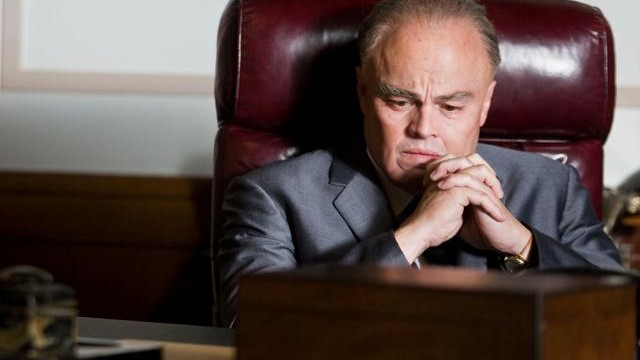
And the two men have taken chances...but not with the result you would think.  Rather than being a rant or skreed, J. Edgar is actually a sympathetic look at the FBI director and his peccadilloes and shortcomings. There's nothing hysterical (save for one fist-fight that breaks out between Leonardo DiCaprio's Hoover and Armie Hammer's Tolson) in script or direction, but it offers a look at a severely closeted man who had to be in the times he lived and with the mantle he carried. Ambitious, yes. Paranoid, certainly. Vain and glory-hunting, without a doubt. Hoover craved the spotlight and his role in being "Head G-Man," while at the same time operating in the shadows, single-mindedly hoarding the secrets of others, while keeping his own is the height of ironies. At the same time that he espoused the Bureau ethic for red-blooded American males as agents, one wonders if it is done for appearances' sake, a beard that would mask his own leanings while also serving as a "hiding-in-plain-sight" revelation of his own taste in men.

Black and Eastwood conduct the story-telling in flashback, as
Hoover in his latter years, decides to set the record straight, dictating his memoirs to an amusingly rotating number of agent-stenographers who disappear as soon as a point is questioned, or a weakness revealed. The story is a white-wash, reflecting the man's "official" view of the Bureau's history in a mix of incident and myth. At many times, J.Edgar is a bit reminiscent of Citizen Kane, with its fracturing point-of-view, shifting perspective, and ironic commentary on some of the incidents.*

It also shares Kane's sense of the unattainable summation of a life. C.F. Kane's had little to do with "Rosebud," just as Hoover's gay leanings was a small part of his whole story. It began with
a controlling mother (Judi Dench), determined to keep young John Edgar from becoming a drunk like his father. Groomed to become "the most powerful man in the country," Mother Hoover controls her son's life to make him the image of the perfect son, diction lessons to force past a stammer, impeccable grooming, and the enforcement of all of her prejudices. And the nullification of any behavior less than manly. He is made in the image of his Mother's "perfect son," even though that image may be completely counter to reality. It sets him on a lifelong course of fighting her battles, never really being his own man, as much as posing in the presentation he wanted to project. A performance. An act. Myth and lies.

It is a story soaked in ironies: the man who kept secrets on everybody, but the biggest being his own; the investigator who saw no harm in exposing other's private lives, while keeping an iron grip on his own; the policeman who targeted and made war on many enemies, the primary one being himself. Black and Eastwood present
a case for sympathy, even empathy, for a man who shaped, and was shaped, by his times, who rose through the ranks of power in society, to not be shunned by it, and who searched for verifiable fact while living in denial, and closeted by the bureau of his own making.

Hoover and Tolson at their regular table at The Stork Club.

* Not to mention that DiCaprio's "old-man" make-up makes him look more like the aged Charles Foster Kane than the jowly Hoover (still, it's better than the never convincing make-up that Hammer sports as an aging Tolson), and the shots of Hoover witnessing the Inaugural parades of Franklin Roosevelt and Richard Nixon are shot from the same angle as the "newsreel" shot of Kane in a balcony appearance with Adolph Hitler.

Saturday, March 18, 2023

65

Saturday, here, is traditionally "Take Out the Trash" Day; it doesn't matter if it's old trash or new trash. It's still trash.

Nice Planet to Visit...But I Wouldn't Want to Live There
or
Stuck Between a Rock (Falling) and a Tar Pit
 
65 ("from the writers of A Quiet Place") is a good idea for a movie. But a bad movie. Oh, it does its job efficiently, providing the beats we've come to expect, the tropes, all of the recycled cliches—of the horror, sci-fi, and reluctant guardian variety—even a couple of Spielberg call-backs (as tribute, or just because they're "expected" in a dino-movie?) 
 
But, it never becomes inspired. It never does anything newish. It has that initial bright shining idea bulb that gets progressively duller until it finally fizzles out and then, at the tail-end, re-iterates the premise to remind us that it was a good idea. But, by that time, even that good idea has become hum-drum and (dare I say it?) pedestrian.
 
Which is too bad, because it's got Adam Driver in it, and he's doing something new.
 
And he's the only one who is.
It is 65 million years ago, "titles" tell us."Prior to the advent of man...in the infinity of space...other civilizations explored the heavens." Good premise (if the inclusion of "man" being merely us sounds a little speciest...and sexist). It's a long time ago in a galaxy far, far way. Commander Mills (Driver) is spending time with his nuclear family on their planet as he's about to go on a mission—that will last two years—ferrying an exploratory group to some far-flung part of the Universe. It's not a mission he wants to undertake, but he's doing it for economic reasons. His daughter (Chloe Coleman) is very sick and his wages will pay for her medical expenses. But, he'll be gone for years (if all goes well), and he's spending as much time with his family as he can before he leaves.
Note to self: plan your route.

Well, there wouldn't be a movie if it all went well, and Driver's ship gets caught in an unexpected asteroid field en route, which batters his ship and forces an emergency landing on a planet that just happens to be in the neighborhood—amazingly fortuitous when your commuter route is in light-years. The ship breaks up, killing the vast majority of his passengers (save one, but that's for later) and his command section is miles away from where the "escape pod" with any sort of rocket thrust has landed. He puts out a distress signal, checks the air, and does some recon of his camping site.
You know the drill—it's described in the movie's posters. He's on Earth of 65 million years ago, during the Cretaceous period—if you don't know the particulars, that puts you in the same boat as him. Let's just say that things are a little rough, what with tar-pits and hot-springs, the sometimes unexpected explosive geysers, quick-sand, bad bugs and badder lizard-things, including trex's. All very hungry, as if they haven't been fed in weeks. The movie goes by the dramatic rule of "Chekhov's Gun"—if you see something in the movie, it's assured that it's going to be used (which is fine and all, but it eliminates any anticipation of surprise. One could bring a score-card, write down one sees and then just check them off as they're utilized for drama.
Not exactly watching each others' backs!
 
That includes all the dangerous flora and fauna of Olde Earth, but also Mills' sick daughter, and the charge that he takes on—the lone crash survivor named Koa (Ariana Greenblatt), who (of course) reminds Mills of his own daughter, and forms a grumpy "you watch my back/I'll watch yours" relationship, despite their speaking different languages and the traditional old guy/punk kid relationship that is tried and true to the "reluctant family" story-line of so many films. But, they're the only game in town; that's certainly what the dino's see them as—game, I mean.
But, at least it gives Adam Driver a chance to morph out of his "geek" role that we've grown accustomed to and into a more-standard somewhat grudging pater-familias along the lines of the Alan Ladds and latter roles of the John Waynes and Clint Eastwoods, trying to survive while also dragging a kid along to make him a more charitable protagonist. It's the "Lone Wolf and Cub" trope among the dinosaurs, and that's an elevator pitch that can be done within half a floor. Maybe even before the door closes.
All this is to reinforce that 65 is nothing new and nothing that hasn't been seen before in different packages—just not done as well. I was thinking that even a dumb movie like Robinson Crusoe on Mars, although short on science and long on special effects that depend on the viewer's charity, is still entertaining and intriguing, whether your a kid at a matinee (as I was when I saw it) or an oldster (as I am now) who can still find it charming. 65 is not charming. Nor is it innovative in any sense. The only sense of wonder it instills is you wonder if the film-makers could milk the same water-downed formula until there is no nutritional value whatsoever.
 

Friday, January 13, 2023

White Noise (2022)

Let's Face the Music and Dance
or
"That's a Little Stupid." "It's What Happens to Desperate People."

White Noise (noun) Merriam-Webster
1 : a: a heterogeneous mixture of sound waves extending over a wide frequency range
compare pink noise
b: a constant background noise
especially : one that drowns out other sounds
2 : meaningless or distracting commotion, hubbub, or chatter
 
Wikipedia page of White Noise (novel) sub-section: Analysis
"White Noise explores several themes that emerged during the mid-to-late twentieth century, e.g., rampant consumerism, media saturation, novelty academic intellectualism, underground conspiracies, the disintegration and reintegration of the family, human-made disasters, and the potentially regenerative nature of violence. The novel's style is characterized by a heterogeneity that utilizes "montages of tones, styles, and voices that have the effect of yoking together terror and wild humor as the essential tone of contemporary America."
 
One could mistake Noah Baumbach's film of White Noise as a meditation on current times with pandemics, conspiracy theories, and just plain crazy people...if the film weren't based on a Don DeLillo novel written in 1985. Funny how really good writers "get it right." Not funny how the human collective keeps making the same mistakes over and over and over (and over)...as if we were crazy or something.
The protagonists are the family of J.A.K. Gladney (
Adam Driver, ubiquitously), an academic at "The College On the Hill" teaching an "Advanced Nazism" course—he's not "pro," he's "con" but does deep-dive analysis on the self-proclaimed "Thousand Year Reich" (they got that wrong, too!)—and his analyses (and those of his peers at the college) sound an awful lot like that Wikipedia "analysis" of DeLillo's novel. His wife, Babette—call her "Baba"—(Greta Gerwig)—"We're each other's fourth"—has (as a colleague notes) "important hair," and focuses on self-improvement, running the steps of the college's stadium and taking "posture classes." They have four kids from four marriages, but seem to be settling in to the chaos, despite the constant conversation, the randomness, and the clash of personalities and interests.
They are white, liberal, self-satisfied and pretentious, the latter being honed to a fine art, as Gladney's lectures on the rise of Nazism border on performance (Driver is brilliant at this) and life is good. It's so good, that any trivial subject can be analyzed and micro-scoped for nuance and monlogued over where, if done right, it can scrape raw hints of guilt and self-loathing. The inherent capacity for human beings to be fascinated by car crashes, for instance—as is lectured about by Murray Siskind (
Don Cheadle) in the opening sequence. We, as a species, seem to be drawn to disaster.
 
Well, as the saying goes: "Watch Out What You Wish For." In fact, that sounds like a lecture, too.
White Noise is split into three parts, the first of which is:
1. Waves and Radiation
It serves as an introduction to the characters when times are good and we see them at their best and most convivial. Things are so good that one can be a bit jejune and deprecating about it, while feeling superior at the same time. But, things are simmering under the surface and all it will take will be some catastrophic event to test the rigor of the self-satisfied complacency of the extended nuclear family.
2. The Airborne Toxic Event
Some rando truck driver carrying explosive chemicals is reaching for his bottle of Jack Daniels, distracted just enough that he doesn't see the guard-rail come down for a crossing train—that is also carrying explosive chemicals—and plows into it, derailing it, and causing a massive explosion with a resulting cloud of burning schmutz, that causes the evacuation of nearby towns.
The Gladneys make a run for it to one of the camp-grounds stipulated as evacuation sites for the populace. But, so is everyone else, so the resulting snake of traffic keeps them in place for a much longer time than one can be complacent about. They are refugees from suburbia, displaced with as few comforts as they can carry. It's a far-cry from the comforts they are used to, with a looming chemical waste that can kill you if you're not sheltered in place. Of course, there are theories and fears and resentments that bubble up among the many strangers lumped in together without the comforts of drywall and fences.
For J.A.K.—that's "Jack"—this merely exacerbates his growing unease of death which haunts his dreams with sheeted figures in his bed that have replaced his wife and which strangle him with scarred hands, granting him no peace. And, there is the fear that the toxins have poisoned him, as well, since he left the safety of the get-away car for the 2½ minutes it took to fill it up with gas. The government officials who analyze and herd the evacuees give little comfort ("You are not to leave the facility. That means if you come up to me later and ask 'Can I leave?' the answer will still be no"). By the time, they get home, J.A.K. is starting to obsess about his
2½ exposure and seeks medical advice. But, there's something wrong with Babette, too.
3. Dylarama
Well, you've got to have some surprises, so the less said the better. But, it wraps up a lot of things that have been brewing in Parts 1 and 2, concentrating on the domestic drama tilting the seemingly self-satisfied and stable Gladney house. 
Baumbach keeps things off-center with long takes without too much directorial show-boating, but making sure everything's paced briskly and usually with a comedic punctuation at the exit. The tone is set by a lush Danny Elfman score, that, at times, evokes Randy Newman's score for Baumbach's previous film. The performances are uniformly excellent and manage to make the characters less insufferable than they could be.
I loved it, but, then I tend towards the dark, finding it cheering (and probably as I also tend to the pretentious, finding it amusing). In fact, I was quite thrilled with it, having to recommend it heartily to whoever would hear it. Probably because in the course of a film with heavy themes and dour prospects, it is so optimistic.

Saturday, January 22, 2022

Annette

Caraxing the Maelstrom
or
Beauty and the Bastard
 
I've been wanting to watch this one since enjoying Edgar Wright's The Sparks Brothers documentary—which ended with an extended discussion about the band's next project, a musical film directed by Leos Carax. They'd almost done one with Jacques Tati, and then another with Tim Burton, but this one was going to be the one where a career-long goal was being fulfilled. The film had a controversial showing at Cannes (although Carax won Best Director at the festival) and an extremely limited run in theaters before streaming on Amazon prime. It was always going to be a fringe-watch, as Carax is a director whose projects are not everybody's cup of tea and Sparks is a vintage band with a long career, but have never had a pop hit in their entire tenure. It would only be some miracle of some aspect to it that would pack the mask-restricted cinemas with this one—like uniting Tobey Maguire and Andrew Garfield. 
 
But, Annette doesn't have that, other than a curiosity factor. And that's only good for killing cats (regular cats, not Cats, the musical).
Adam Driver plays Henry McHenry, a provocational comedian stage-named "The Ape of God," who's a combination of Andy Kaufman and Richard Pryor, but less interested in laughs (Pryor) than in getting a reaction from his packed audiences (Kaufman). The entertainment channels are thrilled that the bad boy is romantically involved with Ann Desfranoux (Marion Cotillard), a renowned opera singer, but although the media delight in showcasing the mismatched pair, they two have their own fears that they may not know each other well enough to have a lasting relationship. Despite that, they marry, and soon have a child, Annette.
We'll stop the plot points there. Because at this point, you may go "full-stop" on the film. Baby Annette is portrayed by a marionette. No, they didn't use a real baby—a real baby isn't a good idea when you want it to be a passenger on a motorcycle. CGI? Well, you can't hold a CGI baby or interact with it. There are all sorts of rules and regulations using children in movies. And it has to interact. And babies are notoriously bad at taking direction. Parents can't direct them, so a French director/stranger couldn't have any chance at getting a performance out of a baby (they're so "in the moment/method"). So, it's not going to be a realistic or an even real baby. Get over it. It's a marionette. A quite good one.
If you can't get past that, you might as well not go on. The film is 2 hours 21 minutes and you'll just come away bitter. If you do go on, you'll get a tragic story of exploitation and hubris and several Sparks songs that may not be much lyrically—they're quite repetitive—but will become ear-worms in your head for many days to come.
And you'll get a film that tries mighty hard to be distinctive with some lovely shot compositions, but ultimately is not as inventive as any of the videos the Mael brothers make for their compositions. Driver does a hell of a good job in a tough role as a narcissistic pop personality that will do anything to stretch out his fifteen minutes of fame. But, the story feels a bit like a surreal version of A Star is Born (any of them). It doesn't end well.
But, if you're a completist Sparks fan or Carax fan or Driver fan, it's interesting to see, and you'll be glad that it's one more check-box you can pencil in your fanaticism. I hope it doesn't mess up another chance for Sparks to do another long-form project. But, Annette, ultimately had its own review, penned by the Maels themselves:


When you're a French director, it seems la vie est belle
Women say "oui, " they long to be, top of the bill, oh well
When you're a French director, you're an auteur as well
What does that mean?
Every scene must be obscure as hell
When you're a French director
You never smile, what's the deal?
Hollywood guys, with their CGI eyes smile
But their films lack "le feel"


So...you think doing it all in one take is easy?
And—what the hell—one more Sparks song