Wednesday, August 27, 2014

Boyhood

Our Annual Family Reunion
or
"May the Circle Be Unbroken"

So, what has director Richard Linklater been doing the last twelve years? Well, he's been making mainstream movies (School of Rock, a remake of Bad News Bears) interesting indies (Me and Orson Welles, two of the "Before" movies with Ethan Hawke and Julie DelpyBefore Sunset and Before Midnight—and Bernie), even a dramatic knock-off of a documentary (Fast Food Nation). He also made A Scanner Darkly, an experimental low-budget animation, live-action hybrid of a Philip K. Dick story.

But in the background, he's been doing something even more ambitious—pushing the boundaries of cinema possibility—by transcending cinema-time—with an untitled project he's been filming in dribs and drabs every year, like a family reunion. Like Orson Welles (of whom he knows quite a bit), he'd film a little when he had the money, his cast able to assemble, and the germ of an idea for what to film.  


The idea is at once ambitious and as simple as could be—to film the interaction between children and parents over twelve years, from first bursts of independence to young adulthood. The result, finally titled Boyhood, is simultaneously an extraordinary idea for a film and a bit of a letdown as a film, probably because of the loosy-goosy nature of the story—when Linklater has a solid script, he rocks it; when he's being improvisational—well, he takes what he can get.
This idea of watching actors age naturally on-screen is hardly new—Francois Truffaut did several films in the Antoine Doinel series, and Satyajit Ray made the Apu trilogy over a series of years (Hell, we can even throw in the "Harry Potter" films for the amazing growing up we, as an audience, got to witness in the actors—the best thing about that series, actually).

The difference here is that Linklater does it in one 2 1/2 hour film and we see the changes those twelve years make quickly. In the space of an edit, another year has passed and the changes to the kids in the film (primarily Ellar Coltrane and Lorelei Linklater, the director's daughter, who plays Coltrane's sister) are profound, starting out subtly and then galumphing in large strides in their teen years. In the early sections of the film, you don't even know that time has passed until some indication that something has happened in the lives of the birth-parents (Patricia Arquette and Ethan Hawke...again).

And a lot happens. When we're first introduced to the already-gone-nuclear family, Mom is struggling singly with the kids and a whiny relationship with some guy, and Dad takes them on the occasional weekend, when he's down from Alaska (they're in Texas). The kids wonder if they're going to get back together, but it's not going to happen—they married as kids and quickly grew apart, as she thinks about family and he (being male) thinks about himself. She moves the brood to Houston to live with her Mom and to attend classes at the University.

She begins a relationship with one of her professors (Marco Perella), they marry and the two families blend, and without much difficulty. But the professor has a different way of raising kids than Mom does, and that leads to clashes and he begins drinking and abusing her. She and the kids escape to a friend's house, splitting the family apart.
Mason jr., prone to video games to escape
Mom begins teaching psychology at the University and becomes established, and begins dating one of her students—she doesn't learn anything at this University—and young Mason, now a teen, discovers girls...and drugs...and alcohol. Mom marries her student, and, once again, the cycle of alcohol abuse begins anew.
The incidents start small and become incrementally larger and life-changing. Dad marries a Christian woman and semi-cleans up his act. Mom gets out of another abusive relationship, as the kids grow older and start their own. While watching Boyhood, one gets the sense that nothing much is happening, as kids approach adulthood and their parents approach the realization of what their lives have amounted to. But, with the perspective of time, one sees the cyclical (and cynical) nature of life in broad strokes in the film—the incidents seem less important than the overall arc, the shape of it.  

And if that is the intent, then the film is best appreciated in the remembering than the experience. If Linklater did build the film to show the parallels of parent to child, of experience and folly handed down from generation to generation, then maybe it is saying something profound, about life and its nature, of how the generations learn from their parents and might be doomed to repeat the same cycles, despite trying to break free and achieve their own sense of independence, finding their own way—but not entirely, just doing things a bit differently—from the paths imprinted on them by their parents.

I can't say I enjoyed Boyhood. But it has stayed in my brain, a memory that only has achieved a profound resonance over time. Not too unlike life itself.

Sunday, August 24, 2014

Don't Make a Scene: Unforgiven

The Story: Even as this scene unspools in Clint Eastwood's valedictory western Unforgiven, you know that it is a classic scene--a moment of summing up and reflection on violence and its effects, something that doesn't occur in most westerns, certainly most modern westerns. Certainly most of the westerns that starred Clint Eastwood when he was working with such masters of the form as Sergio Leone and Don Siegel. Both directors were interested in taking their genre films and doing something more. Now their star, after some twenty years of directing films, moved into a new deepening understanding of not only what film could do, but what it was capable of. Unforgiven is dedicated to those directors who had gone before, "to Sergio and Don."

The Setup: Former gunslinger William Munny (Clint Eastwood) takes on a bounty hunter job to save his failing pig farm. But he finds that old habits die hard, but men die just as easy. He and his partner The Schofield Kid (Jaimz Woolvert) have just taken care of part of the job, and are awaiting payment.

When you're ready....


EXT. OPEN COUNTRY - DAY
Open country at sundown seen from a low hill, and you can barely make out a lone RIDER approaching in the extreme distance.
VIEW ON MUNNY
Standing on the rise and watching the rider in the distance.

THE KID: Is that what it was like in the old days, Will?... Everybody ridin' out shootin'... smoke all over the place an' folks yellin' an' bullets whizzin' by?
The Kid is behind Will sitting under a large oak drinking from a whiskey bottle.
MUNNY(absently): I guess so.

THE KID: Shit... I thought they was gonna get us.
The KID: I was even... scared a little... just for a minute.(pause)
The KID: Was you ever scared in them days?
Munny turns from watching the rider's slow approach and walks over to The Kid who can't see the rider from where he's sitting.

MUNNY: I can't remember. I was drunk most of the time.
The rider is a little closer now and the sun is a little lower. It is very beautiful.
THE KID (drinking heavy): I shot that fucker three times. He was takin' a shit. He went for his pistol an' I blazed away... first shot got him in the chest...
The Kid wipes whiskey from his chin. He has been working hard to make the hysteria he feels into a high... but it won't quite come.
THE KID: Say, Will...
MUNNY: Yeah.
Munny is watching the rider and the rider is closer.

THE KID: That was... the first one.

MUNNY: First one what?
THE KID: First one I ever killed.
MUNNY (preoccupied with his vigil): Yeah?

THE KID: You know how I said I shot five men... it weren't true. (long pause) That Mexican... the one that come at me with the knife... I just busted his leg with a shovel... I didn't kill him or nothin,' neither.
Munny is watching the rider and the rider is much closer but coming at a walk and and he's trying to make The Kid feel okay when he says...

MUNNY: Well, you sure killed the hell outta that fella today.
THE KID (forced bravado): H-hell yeah. I killed the hell out of him... three shots... he was takin' a sh-sh-shit an'... an'...
The Kid is shaking, becoming hysterical, he can't go on.
MUNNY: Take a drink, Kid.
THE KID (breaking down, crying): J-Jesus Ch-ch-christ... it don't... it don't seem... real... How he ain't never gonna breathe no more... e-ever. How he's dead. An' the other one too... On account of... of just... pullin' a trigger.
Munny walks back to the edge of the rise and watches the rider and it is a lovely sunset happening and he is talking to no one in particular.

MUNNY: It's a hell of a thing, killin' a man. You take away all he's got... an' all he's ever gonna have...
THE KID (trying to pull himself together): Yeah well, I gu-guess they had it... comin'.
MUNNY: We all have it comin', Kid.


Pictures by Jack N. Green and Clint Eastwood

Unforgiven is available on DVD on Warner Home Video.

Sunday, August 17, 2014

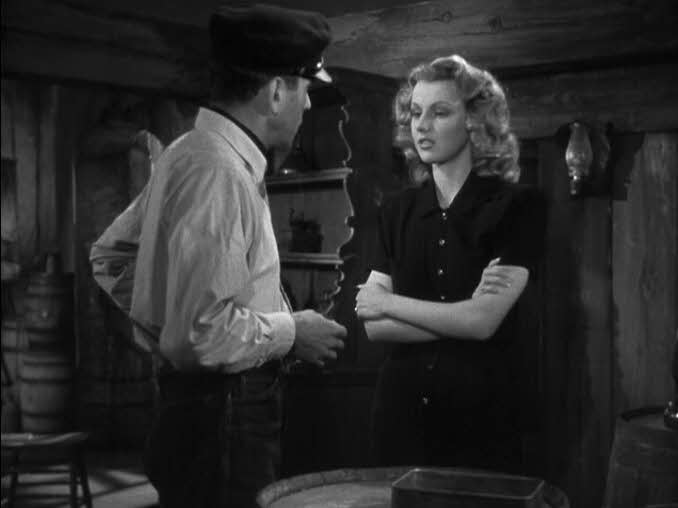
Don't Make a Scene: To Have and Have Not

The Story:  The "other" celebrity death this week stood in marked contrast to the other one. Betty Joan Perske, whose stage-name was Lauren Bacall, died last week one month shy of her 90th birthday. If we can mourn the succumbing to weakness, we should celebrate strength as represented by the tough, stalwart life of Betty Joan Perske Bogart Robards.

Betty Joan was 19 when the wife of Howard Hawks, Nancy Keith (known as "Slim") saw her on the cover of Harper's Bazaar (see below). Hawks was working on an adaptation of what he considered Ernest Hemingway's worst story "To Have and Have Not" and Hemingway agreeing with him, the two worked out an adaptation story, which was hammered into shape by Jules Furthman and William Faulkner (and re-written, constantly (as was his wont) by Hawks. Bogart was attached to star and Hawks had informed him "you are probably the most insolent man on the screen and I'm going to make the girl a little more insolent than you are." Then, Nancy brought him that Bazaar cover and Betty's die, and "the girl" was cast. Hawks was known for creating strong female characters in his films, but Lauren Bacall was something else. She was the equal to her male co-star and the two acknowledged it in their performances.  

The story is that Hawks made her go into the Hollywood hills and scream (or read lines at the top of her lungs depending on what story you hear) until her high voice frayed and husked into the feminine purr it became, a mature voice that carried authority from her first performance. "Slim" Keith developed her style and Hawks her attitude and screen persona.

And then there was Bogart. "I saw your screen test," he told her. "We're going to have a lot of fun together."  In that test, Bacall was nervous and her face and voice quivered in tension. To fight it, she lowered her head, chin to chest, and cast her eyes upward. It became "The Look," what Bacall would become known for. And in the first two weeks of filming To Have and Have Not, when Bogart and Bacall did most of their scenes together, it became apparent to everyone on-set that sparks were flying between the two. So much so that Hawks (who probably had romantic designs on Bacall as well) decided to chastise her (and Bogart), but finally acknowledged that whatever was happening was electrifying his movie. Bogart was 44. She was 19. Hollywood is full of fantasy May-December romances on-screen. But "Bogey and Baby" (as they became known) stuck. There was no fantasy. They married in 1945, made four films together, had two kids, and were together until Bogart's death from cancer in 1957. For the rest of her life, she was Bogey's wife—but not his widow. "Being a widow is not a profession," she told Michael Parkinson in an interview. She dated Sinatra. She married Jason Robards—it lasted eight years.

She died last week, Betty Joan Perske Bacall Bogart Robards, born in the Bronx of two Jewish emigrees, Natalie Weinstein-Bacal (Romanian) and William Perske (Polish). She was stalwart and true. Fiery and flinty. She persevered, almost defiantly. She stood up to some of the strongest men in Hollywood, and was a game collaborator with some of the strongest actors in the town. She could be soft and a battle-axe. She lived a lifetime, of both pain and joy, in the glare of the spotlight, and made it to the age of 89.

She was magnificent.

The Set-Up: Harry Morgan (Humphrey Bogart) an independent fishing tour captain is having his independence challenged on several fronts, it being World War II and all.  Not friendly with the Vichy government in Martinique, he takes a job smuggling a French resistance activist aboard his boat. The reason he's doing it is rather contrary: he's looking to book passage for an American stuck on the island, one Marie Browning, (Bacall), whom he nick-names "Slim," and for whom a serious romance is starting to catch fire. He's basically doing a job he doesn't want to do to get rid of a girl he doesn't want to get rid of.

Hmmph.  Men!

The smuggling operation goes badly with the wounding of the patriot. Cutting the bullet out of his charge, Morgan stays with his "patient" and the man's wife (Dolores Moran) while he recuperates in a temporary hiding place. It is morning, and the sun has just come up on a short and troubled night.

Then Marie walks in.

Action!

HARRY Why'd you ever come along with him on a trip like this? 
Mme.DE BASAAC I loved him. Wanted to be with him. 
HARRY That's a reason. 
Mme.de BURSAC There's another reason. They told me to come. Our people did. 
Mme.de BURSAC They said, they said no man was much good if he left someone behind in France for the Germans to find and hold.
HARRY Makes sense. 
Mme.de BURSAC I told them that I'd only be in the way. 
Mme.de BURSAC That I could do no good. That I was afraid. 
Mme.de BURSAC But the worst of it is it's been so hard for him to have me along. Because I've made him that way too. Now he's afraid. 
 HARRY Well, he didn't invent it. 
Mme.de BURSAC Invent what? 
HARRY Being afraid. 
Mme.de BURSAC Thanks, Mr. Morgan. 
HARRY Well, the fever is gone. 
Mme.de BURSAC Do- 
HARRY I'm no doctor, but he looks good to me. 
HARRY If he wakes up give him another one of these pills.
Mme.de BURSAC Mr. Morgan. 
Mme.de BURSAC Mr. Morgan -I-
Mme.de BURSAC -I- 
HARRY You're not going to faint again? 
Mme.de BURSAC No. I'm just having a hard time trying to say something. 
HARRY Go ahead, say it. I'm not going to bite you. 
Mme.de BURSAC Well, if it hadn't been for you, Paul might have-
Mme.de BURSAC I'm sorry for the way I've acted. 
HARRY Oh, you're not sorry at all. You're just sorry you made a fool of yourself. 
Mme.de BURSAC I have haven't I? 
HARRY Uh-huh. 
Mme.de BURSAC You don't make me angry when you say that. 
Mme.de BURSAC I don't think I'll ever be angry again with anything you say. 
HARRY Another screwy dame. 
HARRY Now how can you- 
MARIE Morning. 
MARIE I hate to break this up but I brought some breakfast. 
Mme.de BURSAC Morning. 
MARIE How's your patient? 
HARRY Oh, he'll be all- 
MARIE Or haven't you looked lately? 
HARRY He'll be all right. 
HARRY I'll be back this evening. If you need me before then be sure and call me. 
Mme.de BURSAC I will. 
MARIE Yes, and I hope you have everything you need here. The eggs may be a little hard boiled- 
Mme.de BURSAC That's all right. I like them that way. 
MARIE You're lucky. 
MARIE Isn't she? 
HARRY I'm gonna get some sleep. I'll see you later. 
MARIE Thanks. 
HARRY What do you want? 
MARIE I could use a match. 
MARIE Thanks. Now I need a cigarette. 
MARIE Here, I can do that. 
HARRY Look. 
MARIE Oh, come on let me help. 
HARRY Look, when I get ready to take my shoes off, I'll take them off myself. 
MARIE All right. 
MARIE Want something to eat? 
HARRY No. 
MARIE Just a little breakfast. 
HARRY All I want to do is get some sleep. 
MARIE It's a good idea. 
MARIE I can help you there. 
HARRY Hey, now where are you going? 
MARIE I'm going to fix you a nice hot bath. It'll make you sleep better. 
HARRY Look, Junior. I don't want you to take my shoes off, I don't want you to get me any breakfast,
HARRY I don't want you to draw me a nice hot bath. I don't want you to - 
MARIE Isn't there anything I can do Steve? 
HARRY Yes, get the- 
MARIE You know Mr. Morgan, you don't make me angry when you say that. 
MARIE I don't think I'll ever be angry again... 
MARIE ...at anything you say. 
MARIE How am I doing, Steve? Does it work the second time?
HARRY You've been wanting to do something for me, haven't you?
MARIE Mm-hmm. 
HARRY "Mm-hmm."
HARRY Walk around me. 
HARRY Go ahead, walk around me. 
HARRY Clear around. 
HARRY Did you find anything? 
MARIE No. 
MARIE No, Steve. There are no strings tied to you. 
MARIE Not yet. 
MARIE Oh, I liked that. 
MARIE Except for the beard. 
MARIE Why don't you shave and... 
MARIE ...and we'll try it again. 
FRENCHY Harry. 
HARRY Later, Frenchy. 
FRENCHY No, Harry, wait. Renard Inspector is down stairs. You'd better come down. 
HARRY I can't do that. I got to get a shave. 
FRENCHY He's got Eddie. 
HARRY He's what-
FRENCHY Eddie. He's giving him drinks and asking him questions. 
HARRY I was afraid of that. 
HARRY Good thing you didn't get me in that tub. 
MARIE Look out for those strings, Steve. 
MARIE You're liable to trip and break your neck. 
FRENCHY Strings, I didn't see any strings. 
MARIE They just don't show, Frenchy.


Pictures by Sidney Hickox and Howard Hawks

To Have and Have Not
is available on DVD from Warner Home Video.
 
If Heaven exists, this is what I imagine it is for these two souls