Friday, September 23, 2022

The Invitation (2022)

Good Help With Good Taste Are So Hard To Find
or
"That's the Whitest Man I've Ever Seen"
 
I'm not a big fan of horror movies and rarely write about them unless there's something that makes the genre rise above the form. I usually confine them to the month of October—Hallowe'en month, of course—when you're SUPPOSED to pay attention to them. The rest of the time...meh...there's enough horror in the world...
 
But, I wanted to see The Invitation for a very specific reason after seeing the previews. I won't say why, because it's irrelevant to the movie, and there's a post I'm doing in October that will explain all. But, I was interested, but not so much that I put off seeing it for a week or two.
 
The Invitation has so many cliche's running through its blood-stream that one can hardly stop giggling all the way through it. First shot—an up-lit "spooky house" with an animated lightning strike (with instantaneous thunder) that lights up the screen. When the lightning strikes twice, we're not in the same place, the flash hiding a cut to the interior, with a soundtrack of creaks, groans, chains (chains?) and distant thunder and every knock on the door spells doom. Director Thompson leans so far into the horror conventions that when something different does happen (the background score even contains a theremin-like melody), you're apt not to believe it.
Evie (
Nathalie Emmanuel) is a "caterer" in New York. Actually, she's a waitress, while she working on her MFA in ceramics, like she's going to have a ghost of a chance at that. Anyway, her last job had a goody bag in it with a DNA test, and as her folks are dead, she has a sudden desire to look for family...and to be used in all sorts of criminal investigations. Big surprise, she finds a cousin, Oliver Alexander (Hugh Skinner), who is only too overjoyed to find another relative and insists that she accompany him to a family wedding in England. His treat. 
 
There has to be a movie so she accepts. Horror movies cannot exist if people only do smart things. It's also why democracies are so tenuous.
She's almost a little too American for the family housed at Carfax Abbey (Carfax Abbey...why does THAT sound familiar?), an ancient mansion that appears to be made of white LEGO blocks. She bonds with "the help," is a little clumsy while she goggles at the grandeur of it all, and seems to get on the bad side of butler Mr. Field (Sean Pertwee) when she meets the lord of the mans', Walter De Ville (Thomas Doherty). De Ville is charming in an intense, rather animalistic sort of way and takes a delighted interest in Evie. His approval makes things easier on her when she meets the family, but she is still uneasy. She sees the face of a woman that stares at her in moments of unease. Floorboards creak, the shrikes outside are restless, shadows undulate...and so does the canopy of her bed (are those hands?).
But, Walter is there to soothe with his too-wide smile and his habit of wearing a wife-beater. He seems to be the most sympathetic member of the tri-family, certainly more than cousins Viktoria (
Stephanie Corneliussen) and Lucy (Alana Boden)—Viktoria is particularly a jealous sort and Lucy...(wait a minute, Lucy?).
Well, it starts to get a little too familiar...not only between Walter and Evie, who start snogging, but also with the story, which seems to be following the line of a particularly famous horror story, which has been filmed many times and may be owned by another film studio that he is not named.
Sure enough, Walter is He-Who-Cannot-Contractually-Be-Named and his intention is to make Evie his new bride—the others being Viktoria and Lucy. How will she escape her fate? How will it all be resolved? Why doesn't everybody have fangs? Why do they cavort in the day-time? Oh, that's all dispensed with quick shots and some throw-away references to "rumors." Nothing new under the moon. Geez, there aren't even any bats!
What's different is that the story is usually told with a "women are victims" bite, and this one stakes new territory, in the wake of the #metooth movement. Evie—Evie?—is the first woman (well, besides, Buffy) to take an active part in the dispatching of her oppressors. Given that most of the talent behind The Invitation are women, one can only say "it's about damn time." But, whether that becomes a trend...well, this vampire has a long track record. We'll see if that trope stays staked.

Thursday, September 22, 2022

See How They Run (2022)

The Play's the Thing...
or
"So Far, Soporific"
 
Remember the movie made of Agatha Christie's hit play, "The Mousetrap?" You don't? Well, it's no mystery—the reason why is one has never been made. Oh, there have been unofficial pastiches in foreign markets, but there has never been a filmed version of "The Mousetrap." Legal reasons: When Agatha Christie signed the deal to have it produced it was stipulated in her contract that a movie version wouldn't be made for at least six months after it closed.
 
And it's been running—at the St. Martin's Theater in London's West End—since October 6, 1952. There was an interruption starting in 2020 due to COVID, and it re-opened on May 17, 2021. It's 27,500th performance was staged on September 18, 2018. The estimation is that there have been 28,500. A running tally exists on a wooden counter in the theater's lobby. And so, because the play has never officially closed, there has never been a film of "The Mousetrap," and may never be.
That back-story is the whole raison d'
être for See How They Run, a Christie-like mystery pastiche centered around the play and the extraordinary circumstances that start when it celebrates its 100th performance. It is entirely fictional, although some of the actual names are not changed—for example "Dickie"—or Richard as he is better known as actor and director—Attenborough (played by Harris Dickinson) did appear in the first run of the play along with his wife, Sheila Sim (played by Pearl Chanda). And there was a film producer named John Woolf (played by Reece Shearsmith), who did indeed produce The African Queen and bought the movie-rights to "The Mousetrap," anticipating a film adaptation (which never materialized).
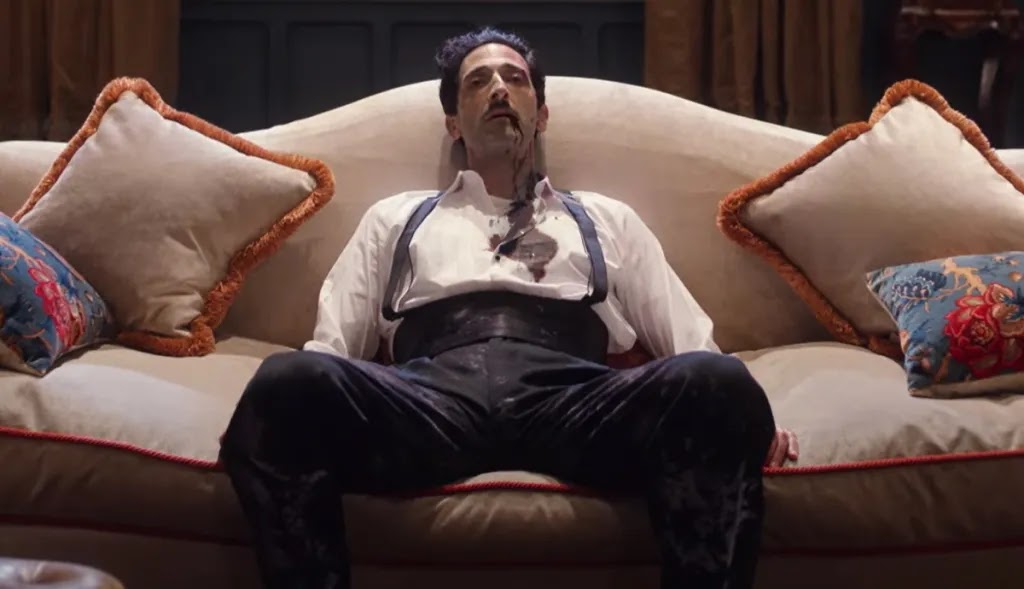
Well, on the night of the 100th performance, a celebration party takes place, at which the intended American director for the film-version, Leo Köpernick (Adrien Brody) gets drunk, makes an ass of himself and gets into a fight with (among others) Attenborough. But, he's such a louse that he makes enemies with anyone he makes eye-contact. No surprise, then, that he ends up murdered. Big surprise, though, that he's narrating the film (that is, if you haven't seen Sunset Boulevard—the neat thing about dead narrators is that they know everything, even if their opinions might be wrong).
The police show up: First, Constable Stalker (
Saoirse Ronan), who's new and nervous and by-the-book—her own notebook with which she feverishly takes notes that she sometimes can't read; then Inspector Stoppard (Sam Rockwell) bumbles in—he's the rumpled DI in a mac, designed to be underestimated by the unsuspecting suspects: the show's producer (Ruth Wilson) and the disgruntled screenwriter (David Oyelowo) and their hangers-on, the Attenboroughs, and everyone who'd been offended by Köpernick—and that includes everyone.
It appears like an open-and-shut case. Kopernick was clobbered by a ski and bludgeoned with a sewing machine in the costume room. But, who is the mysterious figure that is only fleetingly seen around the murder scene...and could be anyone? Well, that's hear-say. And it's only down to Stoppard and Stalker as Scotland Yard is over-taxed dealing with "the Rillington murders" (one of the little in-jokes that abound in the screenplay—Attenborough starred in a film about the case—that are there to tease but lead nowhere).
And that may be part of the issue I have with See How They Run. I enjoy mysteries, not necessarily the solving of them, but the cleverness of the solution—the kind that make you go back and read "that section" that you missed among the chaff of the rest of the story. And, for all its cleverness and jokiness about the form, the central mystery is not all that compelling...and neither are the investigators (despite being played by Ronan and Rockwell). There are so many red herrings—about affairs and ex-wives and duplicitous relationships—and dead-ends that by the time the solution comes out of the wings—oh, it's related to "The Mousetrap" but not relatable to anyone familiar with the play—that one is simply underwhelmed with how it's wrapped up...and in a way that has previously been excoriated earlier in the movie. And Brody's continued role as victim/narrator just makes you wish that murder was possible in the after-life.
 
There are clever touches—Stoppard's hobby is to make jigsaw puzzles—but even that's a dead end and is just a half-hearted way to give him some "character." Ultimately, I found it not clever in the spine and too clever in the details—when it should be the reverse. If one is going to make a comedy "whodunnit", it should not turn out to be a "whocares." Hoping that Glass Onion and The Menu turn out better.


Wednesday, September 21, 2022

Higher Ground

Written at the time of the film's release...

"Blessed Assurance"
or
"Jesus Is __________"

The first thing I ever saw Vera Farmiga in was The Departed in "the girlfriend" role, and I was none too impressed. Then, came Up in the Air and her wistful performance as a "fellow traveler" who hooks up with George Clooney—two "stop-overs" that pass in the night—and it was an amazing performance.

Now, with her first film as director, Higher Ground, she stakes out indie territory as something of a maverick. It's a film about religion without hysterics, without condescension, without judgement, without prejudice...which is a far cry from the scripture Hollywood habitually reads from.
Higher Ground tells the story of Corinne (Farmiga, and played at younger ages by her sister Taissa and McKenzie Turner), daughter of divorced parents (Donna Murphy and John Hawkes), who answers the call of her minister (Bill Irwin) to accept Jesus into her life ("He's knocking at your door...") but finds herself standing at the threshold, believing but not wholly accepting, finding herself, as a woman, relegated to a role "submitting" to her husband and the male hierarchy of her church, seeing her best friend, the earthy Annika (Dagmara Dominczyk) finding her own personal way in Life and Faith and coveting it (When Annika effortlessly speaks in tongues—an act frowned upon by her church—Corinne blurts out "I want that!" but never manages it-in fact, one of the best scenes is Corinne, alone in the bathroom, exorting Jesus to speak through her, and finally schlumping out in frustration).
What makes her study of a woman struggling with Faith
(with a capital "F") within a strict Christian community (albeit of somewhat counter-cultural "flower"-children) different is that it never wavers from the precept that religion is good.  People are flawed, yes, as her believers are, but faith is a nurturing, fulfilling way of Life that sustains and helps throughout our trials. This is a far cry from the way faith is usually portrayed these days, where the Believer is at least a hypocrite and at worst, some kind of predator. One could argue the point, but Higher Ground revealed to me some of the conditioning such repetition has achieved over the years in me, an agnostic. Here, one expectantly waits for any hint of a gouge in the old wooden cross, where any of the characters is guilty of anything, but sanctimony—the most intense that fear occurs is at a talk with an in-faith marriage counselor who insists on seeing Corrine alone without her husband (
Joshua Leonard), which makes one wonder if he's going to fulfill the role of "the creepy one," but, no, all he wants to do is good, offering sage advice more for her faith than for her marriage.

Not that there aren't others who fulfill those roles, and, Lord have mercy, if it isn't the non-believers who turn out to be the hypocrites and suspicious ones (exemplified by a welcoming neighbor who stops by to warn Corinne and her visiting Mother of "religious nuts" who might live nearby, while the woman of faith keeps her counsel, instead stuffing her face on a gift of offered doughnuts that might have a bit of a bitter quality to them), and
the Irish mailman on her block who takes such an interest doesn't turn out to be all that's delivered. The points are not written with judgmental heaviness or pulpit-pounding, but are merely observations of a perpetual outsider looking in.

As someone who has struggled with religion all his adult life, I found refreshing the simple expression that faith can lend grace to one's life, without hammering the point home as many of the "message" movies have a tendency to do.
And that the film chooses to portray Corinne's struggle as difficult, even heart-rending, and faith being anything but easy, only makes the faith of those not embroiled in such a battle seem stronger by comparison. I admire that so much. If there are any complaints to be made, it is that sometimes the film veers into Corinne-fantasy mode for easy laughs, or too-easy satire. The film doesn't require or it or need it, and director Farmiga should have had more faith in the simple power of her film to stay clear of it.


Can't wait to see what she does next.

2022 Update: Still waiting....

Tuesday, September 20, 2022

The Departed

Written at the time of the film's release...

Institutionalized Ball-Busting  
 
Call it the Scorsese Thesis: First a guy tells you what he's gonna tell ya, then Marty shows ya, then you're on your own. 
 
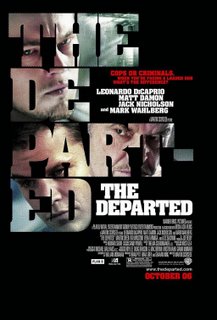
In the case of The Departed "the Guy" is Jack Nicholson's Frank Costello, a seedy Boston crime-lord from "some years ago." "I don't want to be a product of my environment," says the shadowy Frank (Scorsese's way of showing Frank as a younger man). "I want my environment to be a product of me."
 
Nicholson's Costello makes good on that promise on two fronts—in the scenario of The Departed, and the movie, itself.  Costello's control over his Boston turf (or, using the accent Martin Sheen employs here, "too-urf") is so absolute, his reach extends from his surly band of criminals to the police department, culminating in one of his own crew (Matt Damon) infiltrating the very task force investigating his activities. Simultaneously, the player on the other side, Captain Queenan (Sheen) has trolled the new recruits to find his own mole (Leonardo DiCaprio) to infiltrate Costello's crew. 
It turns into a complicated
Spy Vs. Spy with both moles straddling the moral fence, while completely unsure of their footing on either side. And while trying to rat out their suspected counter-part while not drawing attention to their own treacheries. They're mutually duplicitous. As Costello says in the Thesis: "When I was growing up, they would say you could become cops or criminals. But what I'm saying is this. When you're facing a loaded gun, what's the difference?"
It's a complicated game of
Jack's Straws...set in a house of mirrors. Drop Nicholson's weight into the middle of it, and the whole thing threatens to pancake...much like the movie. This first collaboration with Scorsese is similar to
Marlon Brando's eccentric performance in The Missouri Breaks, where an actor so drapes himself in business that he attracts the eye in the same way as a car-wreck—you wonder what in Hell this crime-clown (it is much like Nicholson's Joker in Batman without the make-up) is going to do next. Damon and DiCaprio were not clued into his on-set antics and so their scenes are played with the right touch of paranoid hesitancy. There's a strained wariness behind their eyes and they've rarely been better.
As good as they are (and excessive as Nicholson is) best among the cast is
Alec Baldwin as a fast-talking division head, but the real revelation here is Mark Wahlberg. Marky-Mark walks away with the picture and dominates every scene he is in, no matter who's in it with him. In fact, in the one scene Baldwin and Wahlberg share, Scorsese throws in a couple of Raging Bull camera moves for a verbal feint and parry between the two. It's a director's nod to two extraordinary actors doing solid work, free of gimmicks.
As for Scorsese, if you're looking for a return to his greatest efforts, this isn't it. It makes you wonder what he's up to. This story is nothing new, and is in fact based on a Chinese film (and its two sequels, actually) that owes more to the early personal style that he fails to deliver on here. What's the fascination? We've seen the cop/criminal discotomy, as well as the conflicts of working undercover in better films. He's doing program work, not personal work. This isn't Raging Bull or Mean Streets or KunDun or Goodfellas. This is Alice Doesn't Live Here Anymore. Or New York New York. Or The Aviator. One senses he's pacing himself, keeping his hand in the game doing agency "package" movies until the next inspiration comes along. Perhaps he should ditch DeCaprio, and find that last, good DeNiro project. He's too good a film-maker to waste on remakes and empty biographies. Maybe after the struggles he went through to bring his last personal project to the screen he's asking himself at this point in his career "What's the difference?"

Monday, September 19, 2022

Don't Make a Scene: The Wind and the Lion

The Set-up:
This is one of those scenes that always makes me laugh when I see it—and laugh inappropriately at theater-screenings. 

It is a consummate balloon-popping of a "David Lean moment" from John Milius' The Wind and the Lion, which took a forgotten moment of American history and turned it into into a rousing, fictionalized adventure story about international gamesmanship and American impetuousness in its initial forays as a world power. There is so much sabre-rattling that the movie could almost suffer from metal-fatigue.

But, Milius' own arch sense of humor shines through, both reveling in and mocking the political "cowboy diplomacy" on all sides, while making a case for attitudes of bravissimo, rather than merely playing it safe.

Milius clearly is on the side of the wily Raisuli—as he is with President Theodore Roosevelt (played spiritedly by Brian Keith)—while also poking fun at the man's naiveté that he might actually have control of the situation. Thus, there is this moment of braggadocio, with its slow pan across a barren majestic landscape (accompanied by Jerry Goldsmith's romantically exotic score) as Sean Connery dreamily lists off his CV in order to impress his captor (who is none too impressed). My (faulty) memory of the scene had Connery barking "You have nothing to say?" after a significant pause with no reaction, but the playing of it is much more subtle...and I always seemed to miss Candice Bergen checking her nails during this scene in unimpressed defiance (what else is she going to do?) until I saw it picking out significant moments for this piece.

It's a small part of the film, but one I always look forward to when I revisit the film (which I do often).
 
The Story: It is 1904. Morocco is a hub of activity as various interests are trying to establish a strategic foothold. Into the mix, comes Mulai Ahmed el Raisuli (Sean Connery), who intends to embarrass the Moroccan chiefs by kidnapping an American, Eden Pedecaris (Candice Bergen) and her family, and start a civil war. 
 
Action.
 
RAISULI This is the Rif.
RAISULI
I am Mulai Ahmed Mohammed el-Raisuli the Magnificent.
RAISULI
Sharif of the Riffian Berbers. I am the true defender of the faithful.
RAISULI
The blood of the Prophet runs in me and I am but a servant of His will. 
RAISULI You have nothing to say?
EDEN PEDACARIS
It has never been my intention to encourage braggarts.
RAISULI Your shell is strong like a turtle's.
RAISULI
But it is brittle.
EDEN PEDECARIS
Your tongue is clever and fast. 
EDEN PEDECARIS Be careful you do not trip over it.
RAISULI You...are a great deal of trouble.


The Wind and the Lion

Words by John Milius

Pictures by Billy Williams and John Milius

The Wind and the Lion is available on DVD and Blu-Ray from MGM Home Video.


Friday, September 16, 2022

The Mill and the Cross

"Every Picture Tells a Story, Don't It?"
or
"Framing the Argument" (The Uncanny Valley to Cavalry)

Anyone who tries to do something new in films should be applauded, no doubt about it.  But one should not come away from the experience calling to mind other films and experiences—then you merely get the sound of one hand clapping. Or the white-noise bustle of a disinterestedly browsing museum-crowd (with which the film begins and ends).

Not that film-maker Lech Majewski didn't try something new. His new film The Mill and the Cross takes as its subject matter Flemish painter Peter Brueghel's painting "The Way to Calvary," and constructs the scenario inside the painting, with the artist (played by Rutger Hauer) and his patron (Michael York) walking through the painting as the artist sketches, puts it all together in his mind and takes it to completion.
Films are, themselves, like paintings, if you can go with the analogy—both are contained in frames and there is the implied understanding that those frames are the limitations of our vision, that maybe without the frame they might go on to dimensions of breadth or depth and that what we see is the scope of the artists' vision, directing us to what is important, the focal point of the subject matter.  Some of the most gorgeous films I've seen, like Barry Lyndon or The Leopard, inspire a wish to merely hang images from them on my wall.
 

No such thoughts crept to mind during The Mill and the Cross, as ingeniously as Majewski endeavored to bring the many facets of "The Way to Calvary" to life.  Rather than having any "life" to it, it feels like a passionless exercise, the characters impenetrable cyphers,
meandering around trying to "inspire" the moment of the painting (which holds far more activity than the film seems to want to evoke). All those new ideas are solely in the design and conceptual stage and not in the actual realization of the film. Pretty much limited to sets and blue screen, there is a flatness of tone that sometimes occurs when actors are restricted to surroundings that are uninspiring. And even with the technical wizardry required to pull it off, there is a tendency for the actors to appear visually separated from their backgrounds (as if the lighting were off) in the same way that the blue-screened citizens of Tokyo seemed like they were never in danger of being trampled by Godzilla.

But, it's not only technically that the movie falls...as flat as a canvas. There's a paucity of dialogue for any of the characters, so that their motivations and actions are completely unclear. Things happen, people are tortured, bread is baked,
Christ is crucified—then what that's over, everybody gets up and dances away like the fools at the end of The Seventh Seal, but without Death leading the way. It is, after all, only a painting (no one was killed in the making of this picture, all the subjects got up and went home).

Besides The Seventh Seal, The Mill and the Cross also reminded me of a graphic novel that I've long admired,
Neil Gaiman's "Signal to Noise,"* in which a dying film-maker decides to make his one last epic, a project that he knows will never be put to celluloid.  And so, because it remains in script-form, it will be as close to his original vision without the compromises of budget or time...or collaboration.  It is as pure as it can be, only susceptible to the impressions it forms in the reader's mind.  In a sense, all the barriers—technical, budgetary and time—that must be overcome from written word to image on film or video are opportunities for compromise that can erode that concept from its inception as inspiration to its final presentation.  In attempting to get below the paint of "The Way to Calvary," Majewski, rather than explaining, expanding, and presenting the process of the artist and the "life" of the art only gets further afield of the source in an intellectually safe, shallow interpretation.  We get the surface and never the depth of the characters that he presents, and so, The Mill and the Cross is an exercise of adaptation—just as a film-maker adapts the written word (a novel, say, and part of Majewski's source for the film is Michael Francis Gibson's analysis of the painting)—that fails.  The only thing unique and laudatory about it is that it attempts to "realize" another medium.  But the result—technically savvy but paper-thin—makes it a kindred spirit with so many of the current CGI blockbusters—an art-house version of a "Transformers" movie.

"The Way to Calvary"—far more interesting than the movie

* In pre-digital audio terms, "signal to noise" is the ratio of pure program sound to static or interference inherent in the analog medium on which it is imprinted.  It is a measure of signal quality, a meter (if you will) for perfection, which Gaiman then ascribed to purity of vision).