Friday, March 26, 2021

Chloe

Written at the time of the film's release...

"We Used to Do Everything Together"
 
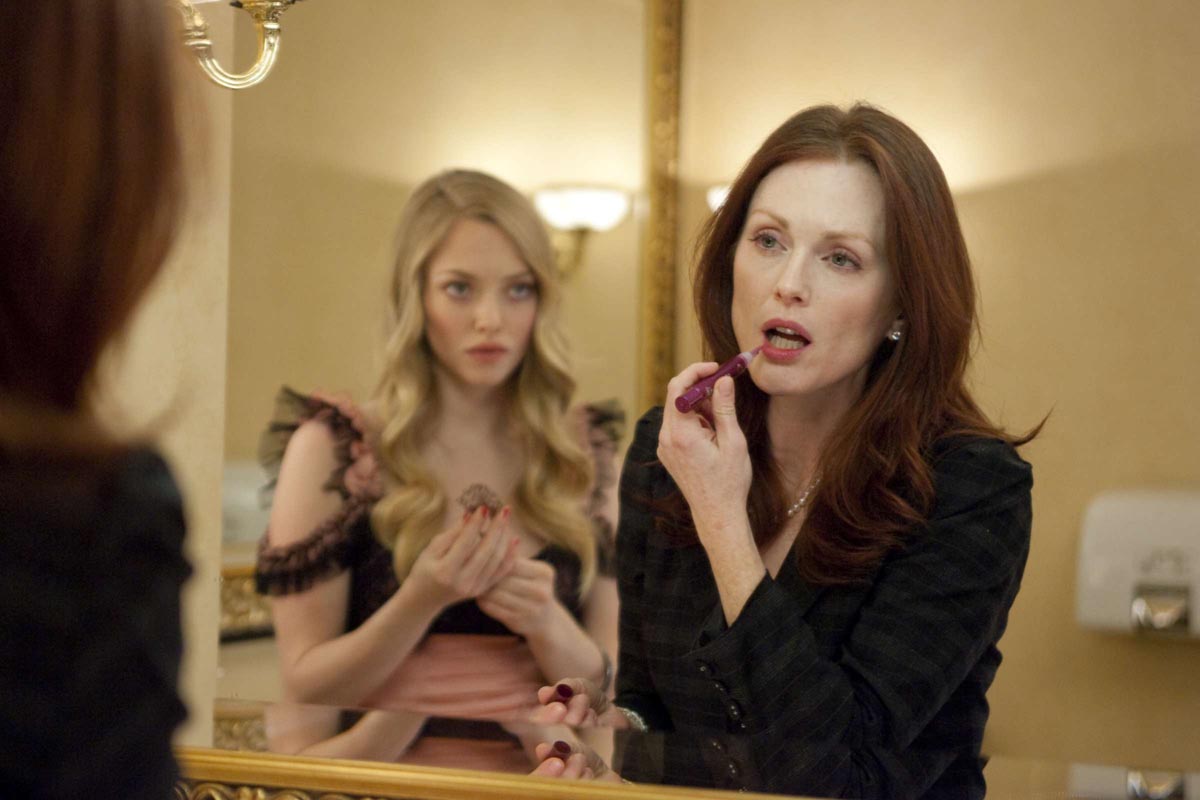
Atom Egoyan's Chloe (based on the movie Nathalie...) is a throwback to the '70's, and that cusp of movie-making history before cable began making the sexually-charged obsession films that used to draw folks into the cinemas. Take a theme of Hitchcockian prurience (including a bit of his fashion sense), slime it with some DePalma directness (without the use of power-tools) and spice it with just a pinch of Kubrickian cruelty and that's Chloe.
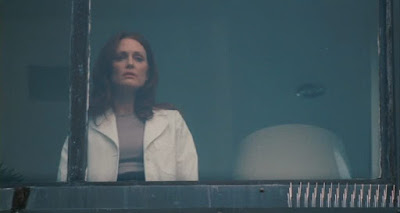
Dr. Catherine Stewart (Julianne Moore) has a successful practice as a clinical OB/GYN—very clinical. "It's just the contraction of muscles," she informs a patient who's never had an orgasm. "There's nothing mysterious or magical about it."

In any Hitchcock thriller, such expert dismissal clamors for a cum-uppance. 
Fact is, she's worried about her marriage to classical music scholar David (Liam Neeson). There's not a lot of communication in it. For instance, she throws a surprise party for him, which he misses completely, when he fails to catch a shuttle from New York. Smartie, smartie has a party... She's hurt, embarrassed, vulnerable, and suspicious. David's evasiveness and a happened-upon text message lads her to suspect he's having an affair, despite his protestations (well, she can see him flirting with anything in a skirt!). The couple may be talking, but nobody's listening
A chance encounter with student-aged escort Chloe Sweeney (Amanda Seyfried, all eyes and lips) gives her an idea; she hires the young hooker to flirt with David—just to see what happens (just to confirm what she suspects in her mind). "What's the client's name?" asks the girl. "He's not the client," the doctor orders. 

Of course not. That would imply somebody else has control. The situation is about her, willing to tempt fate to tempt her husband, and make concrete her suspicions. An arranged casual meeting at lunch confirms her fears—David is interested in the girl. Very interested
This creates a series of triangulations that are liable to hurt somebody with its knife-like edges. The issues become the usual ones in sexual politics: who's in control, what's the motivation, what's the risk, who has the headache. 
This would be a great deal of fun if it was more...fun. For all the frank-talk and
the abundant nudity on the part of Seyfried and Moore, little is left to the imagination. And imagination is what the film is all about...or should be. In her voice-over, young Chloe boasts that she is skilled enough to become "your living, breathing...unflinching dream." It's an example of how the screenplay is clever with its words and quite precise in its usage. But it has no wit. It takes everything so seriously to the point of ludicrousness, and can't even laugh at its own contrary prudishness. It's like a partner more concerned in acting the part in their performance than with the act itself. It's not fun. Kinky for awhile, but not fun. 
Some of Hitchcock's naughty sense of humor would be nice, even some of his comic mother issues, as opposed to the earnestly oppressive ones here, would have been fine. Hell, I wouldn't have minded a power-tool or two—just something a little over the top, or off of it. Something that might make it a shade more ironic, iconic or comic. It shouldn't be such a conscientiously cautionary tale. What fun is that? 

Ultimately, Chloe is simply cloying. As disappointing and tasking as a bad date. 

Thursday, March 25, 2021

Body of Lies

Written at the time of the film's release. 

At the time of writing the Iraq War had been going on since March of 2003 and "officially" ended December of 2011—three years after this was written. The war in Afghanistan began in October, 2001 and is still on-going.

"Killing the Future with the Past"

There have been a great-many films about The Iraq War; emphasis on the "many," not so much on the "great." None have penetrated the box-office top five, and the movie-going public, with a constant dose of it (when things are going badly) on the news, have made the conscious decision to avoid paying attention at every opportunity. It may seem a disparaging thing to note, but, the public seems to have better sense than the government representing it.

Body of Lies with the one-two star punch of DiCaprio/Crowe, under the direction of Ridley Scott did manage to gain an audience (though not enough to topple the reigning champ-Beverly Hills Chihuahua), and it's just as well—it's a summation of just about every "Bush-war" film that has gone before, without adding anything new.
Part of the problem is Ridley Scott, who more often cares about how his films look than what they say. Part of the problem is William Monahan's script (which covers much of the same ground as the other films dealing with a high-tech war in a low-tech country, where boots on the ground see more than eyes in the sky--it just got there last, is all). And the other problem is that the war has gone on so long, that we might be running out of things to say about it, at least until some of the secrecy veil is lifted about the machinations going on in the marble halls and scrub rooms of Washington and Virginia.
Not to say the film doesn't have a lot to say. At one point--with a tight deadline to meet--I checked my watch to see if the film was about to wrap up, it being so full of incident and detail, and was shocked to see that an hour hadn't even gone by yet. There was still another hour to go! There is such a flood of realistic sounding information that it probably resembles the tsunami of information Homeland Security has to sift through with their Cray's. All of that research, all that sound and fury and the all the movie comes up with is "Tell the Truth."

Thanks. We knew that going in.
The points writer and director make are obvious:

DiCaprio, in "The Big Sandbox", has more of a grasp of what's happening, despite his getting marching orders from puppet-master Crowe in Langley. Scott repeatedly makes the point as DiCaprio curses at Crowe over his ear-bud, while Crowe's character is dealing with domestic needs at home. While DiCaprio's Robert Ferris is doing wet-work, Crowe's Ed Hoffman is SUV-ing the kids to school, with all the icy coolness of the uninvolved. And that happens frequently.
Ultimately, it's a waste of time, and is another of the many Ridley Scott projects that looks good, but doesn't add up to much in the long run. We've seen this story before.

Now, give us a good ending.


Wednesday, March 24, 2021

Promising Young Woman

#Me3
or
";^)"

One thing I think everyone can agree on: Promising Young Woman would be a terrible date movie.

But, even as I say that, it might be a very appropriate date movie.

The debut film of Emerald Fennell, showrunner for the second season of "Killing Eve," is a black comedy fueled by rage, inspired by the sort of activity exemplified by the #MeToo movement, more so for the systematic ignorance that was exposed by it, rather than by any surprises that there is existence of sexual exploitation in the name of unequal power dynamics. It's an old story to women. What was new was that it would be called out, that what had been hushed up for so long would be made an open secret, and that, if there was any sort of justice, there would be consequences for it. Payback is a bitch, but the ones using it aren't.  

It's a seizing of power that was assumed wasn't there, not unlike the 1969 Stonewall uprising when gays decided they'd had enough oppression and would not be relegated to the shadows of shame, and once they'd seen the light, saw, too, that they were disarming the very weapons used against them. That is the destruction of the fantasy of power. For power can only live up to its definition if it is agreed to by both parties: the ones inflicting it, and the ones subjected to it. Without that common ground, it does not exist. "No" is a very powerful and forthright tool against it, but only when it is backed up by resolute action.
Cassandra Thomas (Carey Mulligan) has an off-beat dating ritual. She'll go, unaccompanied, to bars and as the evening progresses, alone and drunk, she'll attract the attention of the leering lounge-lizards, hunting in packs. As in Nature, they'll figure out the weakest prey and go in for the kill. Cassandra is easy pickings. We see her, arms out-flung, steadying herself between the headrests of naugahyde couches, when the most aggressive of the pack (Adam Brody) approaches her and takes a charitable stance in her situation. She's obviously in a bad way—she's alone, vulnerable, and three sheets to the wind. He's a good guy and offers to take her home; a knight in shining intentions. He helps her navigate the stairs and into an Uber, and—as long as they're on the way to her place—why don't they stop at his for a little night-cap, hair of the dog?
When "Mr. Nice Guy" gets her behind closed doors, his intentions of getting her home have completely changed, and instead offers her some cumquat liqueur (has there ever been a more ludicrously suggestive-sounding booze?) which she gasps is "terrible," he kisses her—to which she does not respond...at...all—but when she suggests she needs to lie down, he's only too helpful. She's conked out, and right at the point he's taking down her knickers, her eyes pop open, she sits up, looks him right in the eye and says "Hey! What're you doin'?" He can only stammer that she seems more than sober. "I said...'Hey! What're you DOIN'!?"

Bait...and switch.
Run title sequence...set to "It's Rainin' Men."

Cassie, it seems, has been doing this a lot. She's 30 years old, still living in her old bedroom at her folks' (Clancy Brown, Jennifer Coolidge). She has a dead-end job at a coffee-shop and has no intention...actually has no interest...in moving out or moving on. She knows she's stuck—or rather is choosing to be stuck—and the only signs of life in her are her snarky sense of humor and her clubbing activities, which are never violent, but more concerned with teaching self-proclaiming "nice guys" that they're actually misogynistic date-rapists taking advantage of low-hanging fruit.* She's telling these opportunistic letch's that they're assholes. And she's been doing it...a lot.
Maybe for six years. We're looking at obsession, and with that knowledge, a visual joke of Cassie opening her notebook and marking down another notch—among hundreds—at first gasp is a laugh, but on second thought is troubling. Why is she this way? Sure, there's sympathy when she badgers the next guy "We've got a connection? What do I do for a living? What are my interests? What's my NAME?" But, what's the motivation besides an anti-misogyny mission. Is she trying to overthrow a paternalistic power-structure one guy at a time?
We get a little bit of her history when a guy walks into the coffee shop and recognizes her—they went to med-school together. Now, he's a pediatrician and she's...well, she's working in a coffee shop and spitting into his coffee because she dropped out of med-school (even though she was at the top of her class). He asks her out, but she re-buffs him—even though he knowingly drinks the coffee. He comes in again, and he's a genuinely nice guy. They have coffee. They have lunch. They go to a movie. They pass his place and he asks if she wants to go up for....and no. She refuses. Adamantly. He apologizes. She says it's not him, it's her. But she kicks a garbage can in frustration. All alike.
At this point, anything further as far as description will be full of spoilers. But, one can speak in general terms that her encounter with a former school-mate sets off a more specific level of activity, laser-focusing her ambitions to address the past, while also meting out some revenge-lessons to both men and women (she's an equal-complicity judge and jury—as the old Monty Python line goes "she's cruel...but fair!"). No matter the righteousness behind her actions, though, there is the persistent uncomfortableness of them and the fear that she will cross the line—although, any permanent damage she does is to complacency.
It does walk the tightrope, though, and leaves the audience there, as well, slightly off-balance. Fennell is as fearless, challenging comfort-zones, layering the soundtrack with sexualized songs (that contextualize the atmosphere of a predatory and demarcated culture) and pertinent classical pieces—there's also a couple of pointed references to The Night of the Hunter. If the film has a weakness, it might be her use of religious imagery, which she sneaks in subtly, but often enough that you notice, casting Cassie as a Joan of "Arc-hetype," intensifying the risk as she goes off to do battle in a good cause, even if that cause might abandon her. One line hits home hard: one of her victim bleats "It's every man's worst nightmare, getting accused of something like that." She replies "Can you guess what every woman's worst nightmare is?"
"Can you guess what every woman's worst nightmare is?"

Promising Young Woman gives you the same black-comic back-slap as Dr. Strangelove—of admiring the cleverness, but horrified at yourself for admiring it, not knowing whether to laugh or throw up. It's a comic tragedy. It's a martyr's farce. Everybody gets their just desserts in the end, but sacrifices had to be made, so there's no inclination to pump your fist in the air in triumph. The world still sucks, the problems are still there, and the only consolation is that this little film is smart enough that it might make some impact, be they as small as notches in a notebook.

Yeah, maybe it would make a good date movie. The after-film discussion would certainly clue one in as to whether should be another.

* Fennell's casting, like everything in this movie is fascinating. For her collection of assholes she's hired guys who've been TV heart-throbs in the past and probably had their posters on a lot of teens' walls. It's just that little added texture of twisting the knife for any thoughts of complicity.

Sunday, March 21, 2021

Don't Make a Scene (Redux): Once Upon a Time in the West

I just hosted an episode of The Large Association of Movie Blogs' "The Lambcast" where Once Upon a Time in the West was discussed as the Movie of the Month. I'll put up the link for it here when it is made available. (which it is now).

The Set-Up: This scene is pure evil.

In it, Sergio Leone is paying tribute to the westerns he loved. The scene--an isolated pioneer family falls under attack--is a direct steal from The Searchers, especially the detail of the desert insects going quiet. So, too, is the cloud of dust that the evil railroad gang emerges from; it's from the visual metaphor tricks of Akira Kurosawa and John Ford--even the Earth is made restless by the deeds going down. But the big event that Leone was counting on, and planned for, was the circling shot around the shoulders of the gang to reveal the face of the leader, Frank, and the star who was playing him.

Leone had always wanted to work with Henry Fonda. He'd wanted him to play Col. Mortimer, the role Lee Van Cleef played in For a Few Dollars More. But with the substantial budget Paramount Pictures gave him for Once Upon a Time in the West, he could now afford big stars in his movie (that certainly applied to Claudia Cardinale in Italy--not so much Charles Bronson and Jason Robards, though they're both excellent in their roles). Fonda was reluctant. "What does an Italian know about the American West?" he recalled wondering on the "Parkinson" interview program on the BBC (the pertinent section of the interview is below). He called up Eli Wallach, who'd just played Tuco in The Good, The Bad, and The Ugly. "Don't even worry about it," said Wallach. "Go! You'll have the time of your life!"

So, Fonda prepped for the role. He figured that, for the villainous Frank, he should adapt a look more like John Wilkes Booth, and he darkened up his look, including using brown contact lenses to cover up what he called his "baby blues." When Leone saw the make-up, he pitched a fit. "It goes!!" he screamed in Italian. What Fonda didn't realize was that Leone had planned for that elaborate reveal. He wanted the camera to come around, and the audience to recognize him and gasp "My Gawd! That's Henry Fonda!!"

The star and director got on famously, and Fonda clearly relished the chance to play The Heavy in the form of Leone's Ultimate Western Villain. The two men would work again in My Name is Nobody.


Now, there is no way the following series of screen-caps can communicate the power of this scene--it doesn't indicate music or timing, and can only hint at the extremes of Leone's complicated camera moves. With so very little dialogue, the soundtrack and the visuals take on much more potency with Leone's work. Here, those elements are all-important, and a scattering of screen-caps can only suggest the blue-print of a scene, like a storyboard. 

But, it will have to do.

The Scene: On the isolated McBain ranch (you can't really call it a farm), the Irish family is scratching out a living, but today they're celebrating. Arriving soon on the train is Ed's new wife from New Orleans, Jill (Claudia Cardinale). Her arrival will set up a series of events that will involve disparate parties and the encroaching metal monster that is the transcontinental railroad. But that's tomorrow. Today, they're hunting pheasant, and setting up a big spread for the happy welcome. But living this close to the land, the least little thing is noticeable.

For some reason, the usual chatter of the cicadas has gone silent.

Action!

(The cicadas stop chirping--a sure sign that something's approaching, but a pan around the farm shows the McBains that no one is in sight.)
(A flock of birds flies up from the brush, and Maureen relaxes--they must have stopped the insects, and she approaches the table to watch them--the same table the rifle is leaning against)

(As all eyes are on the birds, a shot rings out, but no birds fall.)
(McBain looks over at Maureen, who is clutching her stomach and falls over, dead. With growing horror, he realizes that his family is under attack)

McBain: Maureen!
(McBain runs towards his dead daughter, as well as the rifle, and is taken out in mid-run)
(Son Patrick is cut down from the buck-board)
(McBain makes one last desperate attempt to reach his revolver and is killed)
(Running foot-steps echo on clap-board floors as the camera emerges from the house-interior to the blinding sunlight)
(Young Billy McBain looks over the bodies of his slaughtered family, then his eyes are drawn to some movement in the scrub)
(Five men in long duster-coats emerge from hiding, the four men on either side waiting for the man in the middle, who hands off his rifle as they approach the boy)
(The camera comes around from behind the gang-leader to reveal his face)
Heavy: What're we gonna do with this one, Frank?
Frank: Well, now that you've called me by name....


Once Upon a Time in the West

Words by Dario Argento, Bernardo Bertolucci, Sergio Donati, Mickey Knox, and Sergio Leone

Pictures by Tonino Delli Colli and Sergio Leone

Once Upon a Time in the West is available on DVD and Blu-Ray from Paramount Home Video.