Saturday, July 30, 2016

Argo

Hoo-Ray for Hollywood (grumble)
or
The Best Bad Idea We Have...By Far

The 1979-1981 Iranian hostage crisis, the 444 day ordeal of the American Embassy workers captured and held by a well-organized angry mob (funny how those angry mobs in the Middle East have a sustainable infrastructure that can keep the ball...and the U.S...in the air for over a year), was an event that gave us our first taste of extremist Muslim terrorism and the presidency of Ronald Reagan (Way to go, Iran!  Can't wait to see the inadvertent fallout from your nuclear program!).

One of the back-stories of the whole magilla was what became known as "The Canadian Caper," where six of the workers walked out of the Embassy and stayed at the Canadian ambassador's residence for a nice chunk of the crisis and managed to fly home under the noses of the cracked-down Iranian security thugacracy.  \What was not known was that the operation to extricate those workers—on the QT, hush-hush, and only recently declassified—was the work of the very agency that was being blamed for the Shah's presence in the first place*—the CIA.
The story of the very weird "Mission: Impossible"-styled rescue is told in Argo, the third film to be directed by Ben Affleck (after Gone Baby Gone and The Town) and it's his most assured movie to date. It's also his safest and least nuanced. Maybe the story is so bizarre, so full of dangerously easy irony and satire, that the director in Affleck felt the need to tone things down on his style (much the same way that Affleck the actor does here, as well, in his performance as CIA adviser Tony Mendez) and just "stick to the facts" and get his recreations down right (there's enough pride in this that the end-credits show a split-screen of archive footage and movie film footage to prove the point), thinking he'd be guilty of "gilding the lily" or even undermining it by...I don't know...showing any "style," other than switching film-stocks and shooting in a "found-footage" way of snatch-and-grab. And yet, were that true, the film might have had a far more different ending, rather than the one Argo actually presents. It would have been nice to throw in some of Affleck's previous shooting ingenuity, rather than create the dichotomy that Argo ultimately presents.
It is a story that captures the imagination. Six of the American embassy workers in Tehran manage to hole up at the residence of the Canadian ambassador, but time is of the essence as the Iranian guard are closing in on their location after carefully piecing together intel from the embassy. The wonks at the State department and CIA try to come up with a scenario that might get the workers over the border—bicycles—but Mendez is skeptical of putting the six out in the open for a "casual" bike trip of a couple hundred miles. Mendez's scheme (hatched after a viewing of a "Planet of the Apes" movie) hides them in plain sight—have them pose as a scouting group for a sci-fi movie that needs a desert location (like, say, Iran) and have the group (who have appeared out of nowhere) just fly out under those assumed roles and identities working on a project viable enough to be fact-checked at the time of departure.
So, Mendez recruits an industry friend, John Chambers (John Goodman), who has done extensive make-up and prosthetics work for the CIA and the Army (as well as winning an Oscar for his monkey-faces on those "Planet of the Apes" movies) to start a project that has enough publicity splash to make it all the way to Iran. A producer, Lester Siegel (a fabrication and played by the masterful Alan Arkin), is recruited to lend industry cred and get the word out to the press, allowing Mendez to fly to Tehran to train the hostages on their roles, synchronize watches, and sweat the details, which are many and widely scattered.
The idea is so crazy and "out there" that it "just could work." The beauty of it is that it did, but not quite in the way Affleck and scripter Chris Terrio would have us believe. In fact, the final "ex-filtration" is so nested with complications and roadblocks—and a seeming need to fulfill some perceived action quotient—that it becomes frustratingly conventional in a "Hollywood" sense. 

This is slightly gear-grinding. By now, we should be so used to The Movies' need to dramatically enhance actual events, that it shouldn't come as a surprise that some fact-tinkering is involved. But, Affleck's film is so cynical of Tinseltown tampering,** that it's a little cake-eating to then rely on such notions for a white-knuckle finale, as the actual situation is tense enough without having to also (oh, I don't know) stage a gunfight on the sinking Titanic. And it strains credulity that at each checkpoint on the way out, everything must come down to the wire, in the very nick of time...every...single...time. I mean, didn't anything go right on this mission? Sure, the whole thing was a "Hail Mary" pass, but some of the planning had to have come off. The story had a genuine happy ending. Did it have to be The Ultimate Happy Ending?
Maybe the election year has got my fact-checker in overdrive, because up until then, Argo is a measured, understated, restrained, almost bloodless film, that manages to be smart, clever, and tense. And while there's very little of the flair displayed in his first two films, it is a fine example of Affleck's impeccable sense in casting (although—quibbling again—he might have found someone genuinely Latino to play Mendez), and having the great good sense of staying out of his actors' way.
It might not be Affleck's best work to date, but for all that could have gone wrong, the results are quite impressive.  Hmm. Maybe art does imitate life.
The "Canadian Caper" embassy workers with President Carter

Actual Argo concept art, created by comics veteran Jack Kirby
* The movie gives some back-story but is a little cagey in what it leaves out. The CIA "coup" displaced the democratically elected Persian prime minister Mossadegh who had the affrontery to nationalize the Iranian oil industry (pissing off the British) and flirting with communists (pissing off the Americans) and returned the Shah, who'd only fled the country fearing a communist take-over, to power.

** There are more zingers at the expense of the film industry than any movie since Altman's The Player.  My favorite: "We're going to make a movie in the most desolate, dangerous, paranoid place on Earth." "Universal City?"

The Town

Written at the time of the film's release.

"Prince of Thieves, Pillar of the Community"
or
"Taking Down the Cathedral of Boston"

Ben Affleck's directorial debut for Miramax, Gone Baby Gone revealed a film-maker of complexity and subtle visual skills, creating an intriguing film noir of corruption in high places for the best of intentions and the moral ambiguity of holding true to an ideology versus the considerations of pragmatism. It was an ambiguous film that resolved the mystery, but not the implications of its characters' actions, and guaranteed lively debate long after its ending.

But what was clear was Affleck's ability to find the perfect shot and staging for making his points, along with a documentarian's eye for the lived-in detail; Affleck's vision extended beyond the bubble inhabited by the culprits in the scenario, and into a real recognizable, even mundane world.
So, my anticipation for his second film, The Town, has been high.  My respect for Affleck the actor has never been high (save his subtle work as TV-Superman George Reeves in Hollywoodland), but Gone Baby Gone made you sit up and take notice of Affleck the director and writer.
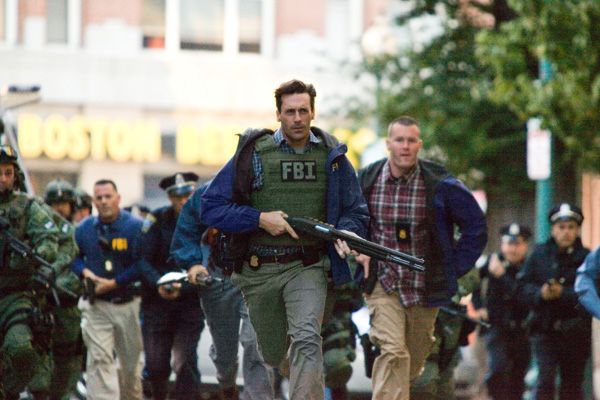
I'd have been happy with more of the same, but Affleck has changed gears impressively for this crime drama about a foursome of expert knock-over artists (the FBI agent assigned to the investigation—played by Jon Hammcalls them "The Not-Fucking-Around Crew") trained from endless hours of watching the endless array of CSI shows on TV, and the second generation of Charlestown townies doing the dirty work their fathers have engineered, or are paying the price for. It looks like robbery, but it's more like literal class war-fare (with automatic weapons) between the have-nots and the "Hahvard" elite of Cambridge. Affleck stages three intricate robberies, each one different in scope and technique and each with their own visceral power that catches one off guard with some truly impressive ways of presenting them. The first, a bank robbery, starts with a black and white silent image (save for some electronic telemetry sound-design) from a security cam that explodes into color and sound when they burst through the door. The second, an armored car robbery, with an elaborate get-away through tight streets and back alleyways that is truly frightening. The third...I won't even say. But, it recalls some doom-laden Alamo-like circumstances from a lot of fine film-makers of the past, and, like the other action set-pieces, it's filmed efficiently to provide just enough information, and propel forward to the next gut-wrenching development. Howard Hawks once said of Don Siegel's hard-hitting approach to film violence "That stuff's hard to do." Affleck makes it look easy, and he avoids embraced movie-cliches nimbly; he even provides one of the most inelegant fights since the fight in the bar in The Treasure of the Sierrra Madre.
The Town has a great screenplay, too. Frustrating, deep and complicated, it also provides nice grace notes that reverberate throughout the movie, and hang in the mind on the way home.
The story begins with that first robbery. One of the managers (Rebecca Hall, who plays fragility as well as she does brittleness) is forced at gun-point to open a time-lock safe, while the crew spends as much time destroying incriminating evidence, as they doing sacking the loot. An alarm is tripped and so she is taken hostage by the gang led by Jeremy Rennerdoing great repugnant work—and Affleck, and released at the ocean's edge. The trigger-men soon realize that she lives in their neighborhood, and it's decided to deal with her, which to avoid Renner's John Coughlin killing her, Affleck's Doug McRay takes over, and he becomes smitten as he sees the effects the trauma has wrought on her. Unaware of his part in their crisis, they begin a tentative relationship, and soon, he's caught in the middle, trying to hide double-truths from both his girl and his gang
"I'm sorry," he says (quite honestly) as she relates her fears about the incident.  "It's not your fault," she says, automatically...and the banal nicety hangs like an indictment between the two.
Affleck is less concerned with the expressive image here, and more concerned with the impactful presence, coding his film with broad strokes that link characters with circumstances and localesIt's a broader, more tough-as-nails approach to film-making than his first film, and that extends to his portrayal of violence which is presented unflinchingly and coldly and fast. Lives end in an instant, and the deaths are unromantic and not pretty. In the meantime, the tensions of all things good and bad unravel skeins of connection, and the film ends unresolved...but not ambivalent.

Friday, July 29, 2016

The Complex Art of Film Noir: Winter 2007

Written at the time of the films' releases. I still find it interesting that both these movies were released on the same day.

I: "Before The Devil Knows You're Dead"*

In Broad Daylight

The road to Hell is paved with good intentions. Just ask Andy and Hank Hanson. They both need money because they want to do right by their families: Andy, so he can get out of debt and maybe move with his depressed wife to Rio de Janeiro; Hank, because he's a few months late in child support, and he wants to do right by his daughter...oh, and his mistress, and ...well, all of Hank's dreams are short-term.

But Andy has a plan that's fool-proof: a robbery. "No one gets hurt. It's perfect." Trouble is, Hank's a fool, and he agrees before he knows all that it entails. Andrew, a real estate accountant, gives him a down-payment. "There's $2,000. See what that does for you. Imagine the rest."
They can't imagine. Because, as they say in the magazine-shows, things go "horribly, horribly wrong."
Before the Devil Knows You're Dead might belong to that sub-genre of comedy films called "The Incredible Mess," where seemingly simple plans go increasingly awry, but it's no comedy, except in the perverse way perfect disasters pile upon perfect disasters. 
I would contend, however, that the movie, as written by Kelly Masterson, is a film noir, that species of film where the world maliciously has it in for an honest man, and corruption runs so deep that it's manifested in a shade of fathomless blackness--"where the world is dark with something more than night," as the saying goes. One of the laureates of the proto-noir story was Raymond Chandler, who laid out the ground-rules for his brand of detective fiction in an essay titled "The Simple Art of Murder," first published in 1944, and quoted extensively below.** In it, he railed against the "drawing room" brand of detective fiction as weak and unrealistic, and that a detective-hero must try and find Truth in a fabric of deception, obfuscation, and agendas so thick it's like wading through a cess-pool. 
Before the Devil Knows You're Dead is so steeped in layers of corruption that any transgression amplifies to the worst possible conclusion, and by chain reaction drags the innocent down as well as the guilty in a tragedy of Shakespearean consequences. No one is immune from the veil of evil. The world of Before the Devil Knows You're Dead is so corrupt, there is no hero. And it all happens in broadest daylight.
There have been "daylight-noirs" before, like Gun-Crazy, and, of course, Chinatown, which takes place in sun-blasted L.A. But Devil is centered in New York, and mostly gentrified New York at that. New York, because the director is Sidney Lumet, who quite rarely makes a movie anywhere else. Lumet's an odd choice for a noir film, although he's made many films in The Big Apple's squalor—SerpicoThe PawnbrokerPrince of the CityQ & A, and he's made many movies that intertwine family and crimeDog Day AfternoonMurder on the Orient Express, and Family Business. As a director, he's not very stylish, and is, in fact, pretty clunky, as in Twelve Angry Men, and Fail-Safe, or, dare I mention it, The Wiz. Lumet expends his energy on performance, rather than construction. In fact, Lumet has rarely risen above his roots as a director of live television: a master shot, the occasional close-up, and that's about it. His camera work is utilitarian at its best, sometimes inelegant, brightly lit, nothing fancy. He tends to downplay using film scores (except as punctuation, however, when he wants mood, he will overdo it, as per Murder on the Orient Express), thinking them too pervasive and detracting from a scene's manufactured reality. When he does try something different (in other films, it was crudely distorting lenses) it's always in your face. Here, it's an editing transition that flashes forward and back three to four times, similar to the "druggy" transitions in Easy Rider, but with an annoying clacking noise at each edit. The story-telling technique employed is similar to that of another noir, Stanley Kubrick's The Killing, where the actual caper is viewed from one character's point of view, then rewinds back to another participant's during the same time period and beyond. The plot advances and coalesces in increments until the inevitable end-game where all stories come together. And Devil ends in the only way this noir-in-daylight could end.
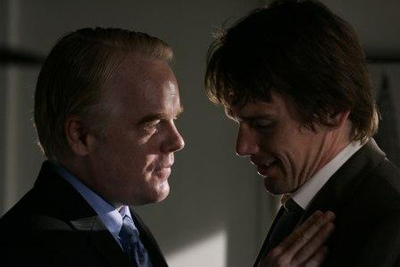
Because it's Lumet, it's the performances where the movie shines: Philip Seymour Hoffman is all sweating self-pity as Andrew, Ethan Hawke is Hank, a pitiful train-wreck doing a poor job of trying to appear "together", Albert Finney goes a bit over the top as their father Charles, and Marisa Tomei shows the promise that her early Oscar win belied as Andrew's wife, caught in the middle. But the smaller performances of minor characters like Michael Shannon and Aleksa Palladino stand out as well. It's a blackly depressing film that owes whatever greatness it achieves to the writing and performances.

II: "Gone Baby Gone"

That, in All Things

Now, walk down these mean streets a little further--all the way to Boston. Here you'll find private detective Patrick Kenzie, the very definition of the term John D. MacDonald used to describe Raymond Chandler. "He writes," said MacDonald "like a slumming angel." Kenzie knows the back-alleys, the crack-dens, the gang-bangers, the dealers, the dive bars and the angles and he knows how to handle them with a cock-suredness that belies his years.*** But that street cred only takes you so far, because although he's lived in Boston his entire life, New Orleans transplant detective Remy Bressant (Ed Harris--extraordinarily good) tells him "I've been here longer than you've been alive."
And Bressant has seen the long continuous story of those places Kenzie merely visits. But if Bressant knows more, nobody tops Captain Doyle (Morgan Freeman, completely dominating the three scenes he's in), whose daughter was kidnapped and killed, and has dedicated his life to making sure it doesn't happen again on his watch. 4½ year old Amanda McCready has gone missing from the neglectful eye of her good-for-nothing mother and Kenzie and his partner Angie Gennaro (Michelle Monaghan) have been hired by an aunt to find her, however reluctant they are to take the case. Within 24 hours, there's a good chance they can find her alive and unharmed. She's been gone, now, for 60.
And soon, after all the slumming and the chance-taking, the compromises with the police and the stake-outs gone bad, the case comes to a dissatisfying end, and like any good noir dick, that's just not good enough for Kenzie. He has to keep pushing for Truth, no matter how hidden, no matter the consequences. But the Truth hurts and can lead to decisions made for the best of reasons but the worst of consequences. And this "slumming angel," this noir-hero by Chandler's precise description, will suffer the consequences for his decision, both personal and professional. But because he is the hero, he must fight that corruption even if the result is not a more perfect world, but the same tainted world as when he began. And maybe, even one that's worse.
As it happens, there is no moral high ground here. There is no "right" and "wrong" for the situation is too far out of control for there to be a "right" and a "wrong" and the two step over each other's line as often as a police tape is crossed. The resolution of the story, the choices made can be argued for days, and the last shot of the movie damns even as it takes the film to a logical conclusion.
This has been a great year for Casey Affleck. First, he stepped out of the star-crush to become more than a glorified extra in Ocean's 13, carried the bulk of The Assassination of Jesse James by the Coward Robert Ford, and now holds his own against Morgan Freeman and Ed Harris at the height of their powers. His performance in Gone Baby Gone shows great versatility and an amazing range. 
But if Casey's potential has come to fruition, the emergence of Ben Affleck as a director is nothing short of a revelation. Here he shows a command of time and place, and a wonderful eye for faces that lend authenticity to the grime of the surroundings. An action scene at night may not be as focused and suspenseful as it should be, but the rest of the movie is assured, and negotiates moral discussions without getting bogged down in high-handedness or slowing the movie down. That fine directorial touch extends all the way to the wickedly oblique final shot that will creep on you days after the fade to black. Given this auspicious debut, one looks forward to the next film featuring Ben Affleck behind the camera.

The view from 2016: Before the Devil Knows You're Dead was Sidney Lumet's last film; Gone Baby Gone was Ben Affleck's first. I still find Lumet's approach to making films limited and dispassionate. As a director, he is not subtle in how he shapes a film to get a reaction out of an audience with his invasive angles and choice of lenses. He is not so much a story-teller as a propagandist—and not in the sense of having a political leaning, although he had one, which has nothing to do with his film-making approach. Lumet makes directorial choices that does not let an audience make up its own mind...on anything. That technique approaches the dictatorial in how he presents—when Lumet makes a point, he makes it with all the subtlety of a brick through a window. In a way, I think Lumet has never trusted an audience. If he had, he might have played things a little looser, which might be why, when he's attempted a comedy, they've tended to fall flat.

Which is why the pairings of Gone Baby Gone and Before the Devil Knows You're Dead is of such interesting coincidence. I'm not going to say that first-time director Ben Affleck is a better director than Sidney Lumet, but he sure does trust the audience more. He leaves you with such a complex moral dilemma that it generates more questions than answers. Lumet would never allow questions and would telegraph the answers. Lumet may generate outrage, but he doesn't generate thought (unless he's so obtuse, you wonder what his point was). Affleck, with this movie and his second film The Town**** (but not Argo, his crowd-pleasing Oscar-winner—that one's pretty cut-and-dried) did not telegraph easy answers or opinions. If anything, he left you hanging with ambiguity, wondering what came next. Starting out, at least, his movies seemed to indicate that they continued to have life after he shut off the camera. Affleck leaves you wanting more. Lumet says everything that he has to say.

Affleck has had the benefit of more hind-sight than Lumet and less time in the director's booth of TV. That's an advantage, and his movies feel less staged and less in a bubble-universe all their own than Lumet's.

I guess that this is an explanation that all these years later, that I think Affleck's first film is better than Lumet's last. Interesting.


* After the Irish toast: May you have food and raiment, a soft pillow for your head. May you be forty years in heaven before the devil knows you’re dead.

** Raymond Chandler, perfectly describing the fetid world of "noir" in "The Simple Art of Murder:"

"The realist in murder writes of a world in which gangsters can rule nations and almost rule cities, in which hotels and apartment houses and celebrated restaurants are owned by men who made their money out of brothels, in which a screen star can be the fingerman for a mob, and the nice man down the hall is a boss of the numbers racket; a world where a judge with a cellar full of bootleg liquor can send a man to jail for having a pint in his pocket, where the mayor of your town may have condoned murder as an instrument of moneymaking, where no man can walk down a dark street in safety because law and order are things we talk about but refrain from practicing; a world where you may witness a hold-up in broad daylight and see who did it, but you will fade quickly back into the crowd rather than tell anyone, because the hold-up men may have friends with long guns, or the police may not like your testimony, and in any case the shyster for the defense will be allowed to abuse and vilify you in open court, before a jury of selected morons, without any but the most perfunctory interference from a political judge.

It is not a very fragrant world, but it is the world you live in, and certain writers with tough minds and a cool spirit of detachment can make very interesting and even amusing patterns out of it. It is not funny that a man should be killed, but it is sometimes funny that he should be killed for so little, and that his death should be the coin of what we call civilization."

***
Raymond Chandler, "The Simple Art of Murder" again, describing the detective hero:

"In everything that can be called art there is a quality of redemption. It may be pure tragedy, if it is high tragedy, and it may be pity and irony, and it may be the raucous laughter of the strong man. But down these mean streets a man must go who is not himself mean, who is neither tarnished nor afraid. The detective in this kind of story must be such a man. He is the hero, he is everything. He must be a complete man and a common man and yet an unusual man. He must be, to use a rather weathered phrase, a man of honor, by instinct, by inevitability, without thought of it, and certainly without saying it. He must be the best man in his world and a good enough man for any world. I do not care much about his private life; he is neither a eunuch nor a satyr; I think he might seduce a duchess and I am quite sure he would not spoil a virgin; if he is a man of honor in one thing, he is that in all things. He is a relatively poor man, or he would not be a detective at all. He is a common man or he could not go among common people. He has a sense of character, or he would not know his job. He will take no man’s money dishonestly and no man’s insolence without a due and dispassionate revenge. He is a lonely man and his pride is that you will treat him as a proud man or be very sorry you ever saw him. He talks as the man of his age talks, that is, with rude wit, a lively sense of the grotesque, a disgust for sham, and a contempt for pettiness. The story is his adventure in search of a hidden truth, and it would be no adventure if it did not happen to a man fit for adventure. He has a range of awareness that startles you, but it belongs to him by right, because it belongs to the world he lives in.

If there were enough like him, I think the world would be a very safe place to live in, and yet not too dull to be worth living in."


**** Preview of Coming Attractions:  I'll post the review of The Town and Argo tomorrow.

Wednesday, July 27, 2016

Roxie Hart

Roxie Hart (William Wellman, 1942) Think of it as Chicago without the music and dancing (except for a couple numbers), because that's exactly what it is. This version, adapted (by Nunnally Johnson and Ben Hecht,) from the play and 1927 movie version called Chicagotells the same story of a dancer, Roxie Hart (Ginger Rogers) near the end of her career, who decides to take the rap for the murder of booking agent Fred Casely, found dead in Roxie's apartment. Roxie didn't do it (a difference from the other versions, thanks to the Production Code), but like a certain hotel developer, when things are sagging somewhat, you should do something really crazy to get attention.

The movie is done in flashback in a bar (one run by William Frawley) that's a hangout for newsies. "The new kid" (Ted North) is working a murder investigation and is full of stories. In an ink-stained version of "Can You Top This?" veteran newsman Homer Howard (George Montgomery) tells him the story to end all bets—a murder case he covered in 1927.

George Montgomery serves as the Teller of the Tale at a bar frequented by newsies.
He tells the story of Roxie Hart and how, when the agent is murdered in the Hart apartment (presumably by her husband as the police suspect), she is persuaded to "takes the fall" because a woman would never be convicted of murder in Chicago. Besides, any publicity is good publicity. Her husband, Amos (George Chandler) hires courtroom sheister Billy Flynn (Adolphe Menjou) to defend Roxie by using the press to gain sympathy, depict her as a weak woman who acted in self-defense...and show a lot of leg to the all-male jury.
Roxie enjoys the headlines and the attention, confident that she'll never hang. But, then disaster strikes—another woman is convicted of a horrible crime and calls are made to be less lenient on female criminals and it knocks Roxie out of the headlines. The only thing to do is up the ante with more salaciousness and hearts and flowers.
For Rogers, who, after letting Astaire lead for most of her career, it was another opportunity to do something a little different and show off her comedy and acting gifts. With Roxie Hart, she takes a big gamble—looking unsympathetic to the audience. Roxie Hart is a deeply, cynical black comedy with a lot of laughs (it made Stanley Kubrick's "Top Ten Favorite Films" in 1963) and an assured directorial hand by veteran director William "Wild Bill" Wellman (who'd already straddled many genres with The Public Enemy, Nothing Sacred, A Star is BornBeau Geste, and the first "Best Picture" Oscar winner, Wings). Its stinging farcical tone still resonates—enough for Bob Fosse to update it in 1975, where the unholy marriage of justice, news-mongering, and fame felt remarkably contemporary.
But, even the resultant musical doesn't diminish the sense of raucous, crass fun in this film version of Roxie Hart.


In 1963, when asked by Cinema Magazine what his favorite films were, director Stanley Kubrick chose these:

I Vitelloni (Federico Fellini, 1953) 
Wild Strawberries (Ingmar Bergman, 1958) 
Citizen Kane (Orson Welles, 1941) 
The Treasure of the Sierra Madre (John Huston, 1948)
City Lights (Charles Chaplin, 1931)
Henry V (Laurence Olivier, 1945)
La Notte (Michelangelo Antonioni, 1961)
The Bank Dick (W.C. Fields, 1940)
Roxie Hart (William Wellman, 1942) Note: at one point, he said this was his favorite film
Hell’s Angels (Howard Hughes, 1930)

Tuesday, July 26, 2016

"Oh, Wasted 'Sleuth'"

Sleuth (Joseph Mankiewicz, 1972)

"In Olden Days/ a Glimpse of Stocking/ Was Looked On as Something Shocking/ now I suppose/Anything Goes"

"Sleuth" started out as a hit 1970 play by Anthony Shaffer. It was inevitable that a movie would be made of it, and in 1972, a spit-and-polished version of "Sleuth" hit the screen. Shaffer wrote the screen-play, and it was directed with a rich panache by Joseph L. Mankiewicz (who knew a thing or three about theatricality) and the cast could not be improved upon; top-lined by Sir Laurence Olivier as fictionally-famed mystery writer Andrew Wyke, and Michael Caine as the London hair-dresser Milo Tindle, currently having an affair with Wyke's wife. Shaffer's play already has a lot of pedigree and heft to it, while all in malicious fun, but to see these two thespians tear into the material is delicious maliciousness.
Mankiewicz's film of it is devilish fun, a clash between The Old World and The Terminally Hip (which is why Olivier and Caine, two different generations of actors—and acting styles—are perfect for it) with the battleground being Wyke's gadget and gee-gaw filled Manor House (designed by Ken Adam). Frost it with John Addison's frothy harpsichord score and however dark the film becomes (and Mankiewicz gives it a creepily saw-toothed edge), it is never less than fun to watch, especially seeing Olivier energetically dashing through each scene, precisely mimicking accents and dialects—a brilliant murderous man-child forever playing games and Caine keeping up, trotting warily, like a besotted dog, behind. 
At the time, that theatricality and staging made everything seem a trifle--a little bon-bon for the rinse-set. But over time, one can't help admiring the energy brought to the fore by Mank and Olivier, defying age and frailty to knock another one out of the park. And Shaffer's play is filled with all sorts of opportunity to...play. It stands as definitive...a champion documentation of the play.

Sleuth (Kenneth Branagh, 2007)

Good Authors, too/Who Once Knew Better Words,/Now Only Use Four Letter Words/Writing Prose/Anything Goes.

It just must have seemed too tempting an idea to resist and such a good idea to re-do it. With Michael Caine now old enough to play the Wyke role, and with (who else?) but Jude Law as Tindle, this updated, revised and shellacked Sleuth is more like "The Battle of the Alfies" (and if you think this is coincidence, a couple of lines makes it obvious that it was uppermost in the film-makers' minds). 

Then, to adapt (at one point Wyke says, cheekily, "You know what the word 'adapt' means, don't you?"), the great Harold Pinter, and to direct, Kenneth Branagh, both men who can mine rich veins out of depleted quarry. With so much talent, how could it possibly go wrong? And the result? 
Well, "Sleuth" is still there in skeletal form—it's still Wyke vs. Tindle, but only one line of the original still remains*—but it's been completely stripped. The fussy old-school mysteries the original Wyke wrote are gone, replaced by the "crime novels" that regularly turn up on British telly, exemplified by sweating policemen grilling suspects. Milo's now an actor, who does hair on the side, and does the occasional chauffeur job. As a thespian, he plays "killers...sex-maniacs, perverts mostly." That might be a little too convenient, and certainly the original didn't mention it...or need to. That was kind of the fun of it.
But, not only is the dialog stripped down to essentials (and in nice....short little...bursts), so is the attitude. Any veneer of civility (even false civility) from the play has been scraped away, starting in the first moments with the chilly pause before a hand-shake when the two men first meet. No, they start off scrapping and spitting at each other right from "Hello" using all manner of Anglo-Saxon terms for each other, mutual contempt hurled in both directions. 
Which tends to throw the rest of the play (what's left of it) on shaky ground. I suppose the makers didn't think Caine could pull off a stuffy, fusty Brit, and made it two working-class "toipes" throwing knives between their two sets of blue eyes. It takes the class warfare sub-text completely out of the center of the thing, leaving it all to ring just a bit hollow. The play pretty much runs its course, but the Second Act is considerably shortened, and the Third Act, if you will, is dragged on and on (despite all this, new-Sleuth lasts a mere 86 minutes—the first was 2 hr, 18 m—but seems longer) All this is staged in a hi-tech sterile interior (Wyke had nothing to do with it, he claims which seems...odd). And although there's a lot of bantering and word-play, sometimes annoyingly non-sequitir, it's just NO fun at all. Not a jot. 
At the end of the original, there is the satisfying finish with two simultaneous wails, along with mocking laughter. Then a curtain comes down. Here, nothing. Silence. 

Not even the impulse to applaud.

* "The shortest way to a man's heart is humiliation."