Vampyr(aka Vampyr: Der Traum des Allen Grey,Carl Theodor Dreyer, 1932)Dreyer is most well known for his previous work The Passion of Joan of Arc, the landmark silent film, done mostly in tight close-ups and its over-arching sense of doom and fatality, as well as the performances, most notably Falconetti's in the title role. His next film, Vampyr, done four years later with sound and a more mobile camera, couldn't be more diametrically opposed both in subject matter and technique. Where Passion was about the knowledge of certainty even at the expense of one's own existence, and of holding steadfast to the truth, even if it's only the truth of your faith, Vampyr is a lot more squishy, there's not much certainty of anything, and it could all be just a fever-dream of an outsider, who, at times, isn't sure if even he's real. None of the performers on-screen are actors, just "faces" Dreyer found and cast. In fact, his "star" of the film is the fellow who financed it. And rather than being closeted in a film studio, Vampyr is shot on location in the natural world, made unnatural by the wayDreyer envisioned itand photographed it, with soft focus and a very mobile camera.
It is a horror film, but at a time when the recorded image was still new and growing. Fantasy, horror and science fiction had all made in-roads in cinema—George Melies had already made spectacular silent fantasy films on a stage environment in which he pushed in-camera effects and other photographic tricks in a controlled environment. Dreyer took those effects and threw them into the natural world, encroaching on the safety and security of the spaces we are used to and invading them with the other- and nether-worldly. It makes leaving the theater for the security of the real world a more uncertain thing.
It's certainly that way for Allan Gray (Nicholas de Gunzberg nee Julian West). He arrives at an inn near town and is awoken in the middle of the night by an old man (Maurice Schutz) who crept in and leaves him a package that says "Open in the event of my death." Picking up the parcel, Gray leaves the inn and encounters shadows that compel him to an ancient castle where the shadows cavort without the benefit of anything corporeal to create them, save for two elderly people he hasn't seen before. Creeped out, he leaves the castle and finds a nearby house where he sees the man who gave him the parcel, and is horrified to see him murdered before his eyes. Gray rushes to the door to be let in to help the stricken man and is let in by the house's servants. The man is dead, and Gray is compelled to stay the night. He meets Gisele (Rena Mandel), the man's daughter, who informs him that her sister Leone (Sybille Schmitz) is very ill and acting strangely.
Like walking outside the house in the middle of the night. Gisele and Gray follow her and find her unconscious, bite marks on her neck. They carry her back to the house and it is then that Gray opens his parcel—it is a book about vampyrs. Reading, Gray deduces that Leone is the victim of a vampire attack. The village doctor arrives to treat Leone and Gray remembers him as one of the old people he saw at the castle the previous night. Fearing that Leone is near death, Gray offers his own blood for a transfusion and the girl revives. But, when Gray wakes up later, he finds the doctor attempting to poison Leone. He pursues the doctor back to the castle and is beset by visions of himself being buried alive. Awaking from the dream, he conspires with one of the servants to pursue the doctor and hunt the vampyr to relieve the family of the curse hanging over the manor-house.
It may seem "old-hat" in these times of carnage by the gallon in cinema, but the aim of Vampyr was not to shock, but to impose on its audience a feeling of dread and distrust. Not only of the events of the story, but in the very way it is perceived—as if in real life. The camera slinks around rooms like someone pacing and scanning. Despite Rudolph Mate's glossy cinematography, a clear vision of things is frequently obstructed through fog, mist, distance and glass. We can never be "sure" in this world of Dreyer's. Is it real? Is it dream? Is it a little of both?
We can never be sure, and perhaps that dread is more horrible than anything born of curses and laboratories and cruelty. It makes our steady rock-solid world more precipitous and as sure as quick-sand.
Dancing About Architecture or "Woah! Woah!.....Wooooow" Phillipe Petit's astounding personal goal of walking a line between the towers of the World Trade Center (which occurred on August 7th, 1974 while the world was engaged in watching Richard Nixon's imminent resignation that evening) makes for an astounding movie by Robert Zemeckis in, what is simply entitled,The Walk—the story of Petit's inspiration and the subsequent six year plan to do something amazing, astounding, heroic and fool-hardy...and for damn sure illegal...and pull it off without a hitch, a wobble, and no harm done. It captures the imagination, the brio, the craziness, and the sheer over-arching artistry the event encompasses that can only leave one shaking their head in wonder. The story has been told in the wonderful documentary Man on Wire, which is a fine telling of the event, itself so much bigger than a simple presentation could do justice to. But, there is some magical about The Walk, one of the few movies designed to make maximum advantage of both the 3-D process and IMAX that seeing it in any other way might diminish it somewhat—the too-visceral recreation of real objects that no longer exist and the vertiginous sensation that must be a part of the experience (and enhance the drama) are entwined in the format and make them part of the DNA in a way that few movies could compete with. It begins with a shot of such chutzpah and imagination it immediately sucks you in, a combination of setting and presentation that only a vivid imagination with a dramatic sensibility would even conceive of, knowing full well that it might evoke laughter for its outlandishness, bur daring to do it anyway. very appropriate that it is our first introduction to Joseph Gordon-Levitt's portrayal of Petit, explaining his philosophy of life—and not death—while standing in the torch of the Statue of Liberty while in the background New York spreads out, the Twin Towers its centerpiece, as it will be for the entire movie. That is one wacky way to introduce the movie, but with a protagonist like Petit, who provides a running commentary throughout the film, it sets a tone of wildly big ideas and challenges, with just a touch of the romantic.
The movie begins with Petit's fascination with tightrope artists and how he teaches himself the fine art of walking a line. He becomes a street performer, silent except for his juggling and balancing skills in Paris, which Zemeckis throws all of the special effects and 3-D tricks he can to keep the sequence amusing. He is mentored by a long-time circus performer, Papa Rudy (Ben Kingsley), who teaches him the pointers on presentation and rigging, which will become critical throughout his career and particularly for the still-in-the-future WTC walk.
A fateful trip to the dentist's office is where the vision hits, when Petit first sees an artist's rendering of the proposed Trade Center, and immediately, like love at first sight, Petit's vision only sees the buildings with a line across it and himself walking across that line. It becomes his obsession and his raison d'etre, which Zemeckis illustrates with a special effect so subtle it might be missed—Petit steals the picture from the magazine and, at home, traces a pencil mark between the proposed towers. At one point, the shot becomes from the picture's perspective of Petit drawing the line, with the audience looking through the now-transparent paper at the concentrated Petit, drawing the vision in his mind and making it complete for the first time.
There's enough wizardry going on, story-wise and movie-wise—and Gordon-Levitt's portrayal is so radiantly buoyant that this section still manages to entertain, even going through the obligatory love story and the recruitment of a "posse" who are enthralled with Petit's scheme and want to be a part of it. Eventually, Petit and crew travel to New York to live and do the scouting and detail work associated with the mammoth undertaking.
Months of preparation go into the planning, with Petit daily going to the towers, still under construction, becoming a fixture and a familiar face to the workers and officials, who never suspect he has no business being there other than to learn the secrets and intricacies to getting up the towers to the top where he plans to stage his coup. Along the way he gathers confidantes and specialists who are intrigued and, more importantly, can keep their mouths shut, as Petit's stunt is completely and thoroughly illegal.
The main reason for the movie, of course, is that walk between the towers, so anything else is prologue. Fortunately, the elaborate planning and skull-duggery that go into the engineering and realization of the stunt is just as intricate and plays out like a "Mission: Impossible" movie with elaborate plans and unforeseen road-blocks that manage to get in the way of Petit's vision.
But, once there, after a sleepless night of preparing and rigging, Petit has only himself and his goal, and Zemeckis makes the most of the feat, with a dramatic presentation as the fog rolls in off the harbor at dawn and Petit must make good on his vision. He has one chance to do it, as no one could conceive of such a thing, but once attempted, it would never be allowed to happen again. There are no second chances and no room for screw-up's. It comes down to one man, his talent, and his will.
It is at this point one should mention that The Walk is stunning to look at—beautiful in its presentation and cinematography throughout and, of course, ingenious in the elaborate effects it took to recreate the event from every conceivable—and inconceivable—angle. There have been reports that people (probably those "sensitive" people everyone has to be mindful of these days) have gotten dizzy and even vomited at the sequence. It seems silly to me. For me—someone who's not so much scared of heights as FALLING from them—it is thrilling and, yes, beautiful...as Petit has always described it. It is almost unbelievable, were it not for the abundant photographic evidence and the witness testimony—especially of the NYPD (those poor cops!) who could only watch from the edge of the towers and marvel, unable to do anything but bear witness.
Once he placed both feet on the wire, he says, he was no longer afraid—he was in his "element," familiar, friendly, joyful—and it was a place to perform, like any other.
Once on the wire, Petit lost all fear of the feat. He walked across once, and sitting on the opposite tower and contemplating what he had done, he was compelled to do it again, and again, and again...at one point, kneeling on the wire to salute the horizon, the City of New York and the audience below gaping at him. He went so far as laying down on it, even toying with the police, getting close to them, then neatly pirouetting and scampering away from them. It was a performance...and it was a coup, one that captured imaginations.
The Wire may be the most enjoyable film I've seen this year. I'm often unsure of the films of Robert Zemeckis—he's-hit and-miss with me—(I say this, of course, on the day everybody is thinking of Back to the Future, and, of the trilogy, Back to the Future II is my favorite, for retreading and warping the original like a Möbius strip). One of his most popular movies, Forrest Gump, I thought was an enormous bore, and worse, a movie that seemed to believe its own "simplistic" wisdom—Being There but without the satire. More often than not, I see his movies as technical exercises without much heart—they're merely an excuse to solve a narrative problem or to show off some special effect wizardry (which he employs very well) that makes the movie seem more like the tail wagging the dog. But, not The Walk. It IS a fine balancing act keeping the movie afloat before you get to the third act, but Zemeckis pulls it off amazingly well, and there's not an aspect of the film I didn't think was inspired...and just a little mad, not unlike its protagonist. Run, don't walk, to see it...and see it in as big and as dimensional as you can. This movie fills the frame.
I was in New York in 1990 in the home of the brother-in-law of the friend who accompanied me. Gene ran a chain of Midas Muffler stores throughout New York State. He asked what we planned to see and my answer was probably vague. Gene didn't like "vague." "You are NOT leaving New YORK until you have TAKEN the Staten Island FERRY!" Yeah, but... "LISTEN. You are NOT leaving New YORK UNTIL you have TAKEN the Staten Island FERRY!!" Yeah, but... "Listen! (pause) YOU...are NOT leaving NEW YORK...UNTIL you have TAKEN the Staten Island FERRY!!" I looked over at my companion, Gene's brother-in-law, Walter (who grew up in Brooklyn) "You up for a trip on the Staten Island Ferry?" Walter replied "Might as well..." "You will not regret it" was Gene's response, satisfied. So, we did. We drove all the way from Brooklyn to Staten Island in the early morning dawn and joined the bustling commute into Manhattan. Pretty soon, it became apparent what "the draw" was. Sailing past Ellis Island and the Statue of Liberty were awe-inspiring, tracing the route so many had taken traveling to America. But Manhattan and its familiar skyline was the next stop. Dominating it all was the World Trade Center, gleaming—glowing—in the early morning sunlight. The ferry churned towards it as if being drawn like a magnet and the towers grew from a curiosity to an awe-inspiring sight to a wonder. Impossibly tall. Elegantly structured like a gate without a limit. Your eyes were drawn to the towers and you could not take your eyes off them as they beckoned, grew, loomed, and dwarfed you, majestically. It was a simple beckoning that became a challenging welcome to the country's greatest city. It moved me as the best moments traveling do, and, yes, not only did I not regret it, it became the most vivid memory of the trip, now as then, without any dimming or coloring in the passing of time and events. Those towers are still there in my mind. And they will never leave.
The Story: And now, submitted for your pleasure and Hallowe'en pre-functioning, this cautionary tale of getting into the real estate trade.
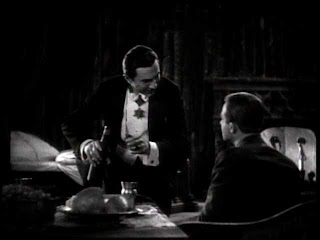
Poor, poor Renfield. Not only did he take the place of Jonathan Harker in the transition from Bram Stoker's novel to the 1931 movie version of Dracula, but he was also played by Dwight Frye, whose over-the-top capering would inform many a hunched lab assistant in the years to follow (If he had a nickel for every time he said "Master..."). The changing of Renfield to the man Count Dracula has over for dinner simplifies the story somewhat, but also severs the tragic ties that Stoker's story eventually leads to in the fate of Mina Harker.
In the film Ed Wood, Tim Burton partially chronicles the friendship between the hapless titular director and the fading film star Bela Lugosi. Here is the man in his prime, in fact, his pinnacle. Bela Lugosi never had greater fame than as the vampire Count, playing him to ecstatic reviews on Broadway and then on film—a few times, in fact, where he bolstered ever-weakening scripts, breathing life into them quite counter to his role as a blood-sucker.
And it's not a theatrical performance, as the impressionists have made it.* The secret to Lugosi's Dracula is a preternatural stillness—the creepiness instilled by one who stares at you for too long. A stalking look that bides its time. That stillness is used all too rarely in horror films, but you can still find it on occasion. In fact, I'd bet the Oscar Anthony Hopkins won for his Hannibal Lecter in The Silence of the Lambsis partially owed to Bela Lugosi.
Stillness is also part of Tod Browning's directing scheme: there are...a lot...of awkward...pauses, emphasizing Renfield's unease, and very few of Browning's shots move—this was, after all, one of the early sound movies and the cameras were bulky and inflexible—but when they do move...cover your throat. Here, he trucks the camera towards Dracula when he sees the blood seeping from Renfield's finger, in a sort of cinematic blood-rush?
The Set-Up: Renfield (Dwight Frye) has arrived at the Transylvanian castle of the Count Dracula (Bela Lugosi). The Count has written in interest of leasing Carfax Abbey in a fresher clime. And Mr. Renfield has endured quite a bit for his client in transit. The last carriage ride was particularly upsetting. But now he has entered the Count's castle and is dwarfed by the immensity of the foyer, which is in some disrepair...and seems to be infested with...armadillos. Now, his host descends the vast stair-way gated by huge spider-webs to show him his room and see to his needs.
A meal has been prepared.
Action! THE CASTLE FOYER
Renfield enters the Count's castle, he's dwarfed by the ancient entry-way and looks around warily, his attention distracted by bats hovering by a window and strange creatures that seem to appear from the crevices of the walls. He doesn't even notice his guest walking quietly down the stairs.
DRACULA: I am...Dracula.
RENFIELD: It's really good to see you. I don't know what happened to the driver and my luggage and...well...with all this, I thought I was in the wrong place.
Dracula: I bid you welcome.
Dracula pivots and heads upstairs.
Offstage: Wolf call
DRACULA: Listen to them...children of the night. What music they make!
The Count turns and ascends the stairs, seeming to pass through vast collections of spider-webs the criss-cross the landing.Renfield follows Dracula, breaking a path through the spiderwebs. DRACULA: A spider spinning his web for the unwary fly. DRACULA: The blood...is the life, Mr. Renfield. RENFIELD: Why, yes. RENFIELD'S BED-CHAMBER Enter Dracula and Renfield DRACULA: I'm sure you will find this part of my castle more inviting. RENFIELD: Oh, rather! It's quite different from outside. Oh, and the fire! It's so cheerful. DRACULA: I didn't know but that you might be hungry. RENFIELD: Thank you. That's very kind of you. RENFIELD: But I'm a bit worried about my luggage. You see, all your papers were in... DRACULA: I took the liberty of having your luggage brought up. Allow me. RENFIELD: Oh, yes. Thanks. The Count takes Renfield's coat and bags to an aft-chamber, the doors seeming to open on their open, and shortly he returns. DRACULA: I trust you have kept your coming here...a secret? RENFIELD: I've followed your instructions implicitly. DRACULA: Excellent, Mr. Renfield, excellent. And now, if you're not too fatiqued... DRACULA: ...I would like to discuss the lease on Carfax Abbey. RENFIELD: Oh, yes. Everything is in order, awaiting your signature. RENFIELD: Here...here is the lease. I hope I've brought enough labels for your luggage. DRACULA: I am taking with me only three...boxes. RENFIELD: Very well. DRACULA: I have chartered a ship to take us to England. We will be leaving...tomorrow...evening. RENFIELD: Everything will be ready. DRACULA: (pointing to bed) I hope you will find this comfortable. RENFIELD: Thanks. It looks very inviting. Renfield cuts his finger on a paperclip. RENFIELD: Ouch! DRACULA stealthily approaches Renfield Renfield's crucifix falls over the cut finger. DRACULA turns quickly away, as if stricken, shielding himself with his cape. RENFIELD: Oh, it's nothing serious. RENFIELD: Just a small cut from that paperclip. RENFIELD: It's just a scratch. DRACULA: (pouring a glass of wine) This...is very old wine. DRACULA: I hope you will like it. RENFIELD: Aren't you drinking? DRACULA: I never drink...wine. RENFIELD: Well... RENFIELD (drinks): ...It's delicious. DRACULA: And now, I'll leave you. RENFIELD: Well, good night. DRACULA: Good night, Mr. Renfield. Dracula lingers at the door, watching his guest. Dracula exits. Renfield is left to survey his surroundings, and is overcome with a wave of sleepiness.
 Vampyr (aka Vampyr: Der Traum des Allen Grey, Carl Theodor Dreyer, 1932) Dreyer is most well known for his previous work The Passion of Joan of Arc, the landmark silent film, done mostly in tight close-ups and its over-arching sense of doom and fatality, as well as the performances, most notably Falconetti's in the title role. His next film, Vampyr, done four years later with sound and a more mobile camera, couldn't be more diametrically opposed both in subject matter and technique. Where Passion was about the knowledge of certainty even at the expense of one's own existence, and of holding steadfast to the truth, even if it's only the truth of your faith, Vampyr is a lot more squishy, there's not much certainty of anything, and it could all be just a fever-dream of an outsider, who, at times, isn't sure if even he's real.


 Renfield follows Dracula, breaking a path through the spiderwebs.