Sunday, May 7, 2023

Don't Make a Scene: The Searchers

The Story: Another one of those posts about the visual economy of John Ford.

There are stories (oh, there are stories) of John Ford's respect for the word on the printed page. Or lack there of.

There's the (maybe apocryphal) story of Ford on location, and a producer came up and complained that Ford was three days behind schedule. "Three days?" Ford rasped at the exec. Then, he took the shooting script, thumbed through it, counted out the number of pages he could shoot in three days...and ripped them out. "There!" he growled. "We're on schedule!"

Here is a section of The Searchers that is pure John Ford, the director telling his story through pictures...leaving out words...and cliches. Now, notice that there are few words here, and they're not from the script. They're "suggested" by the script, but Ford presents them in an entirely pictorial light, improving the little snippet of "business" and adding something extra—character.

Here's how the script has it, as written by Frank Nugent, from the novel by Allen LeMay:
EXT. THE EDWARDS' HOUSE -- DAWN LIGHT As Ethan emerges he is brought to a momentary halt by sight of a couple -- Brad and Lucy -- in each other's arms, standing near the saddled horses of the posse. Clayton and Jorgensen following him out, spot the couple, who now belatedly are conscious of their audience. 
JORGENSEN Brad!... Is no time for lolly- gagging... 
In confusion, Lucy runs back around the side of the house as Brad -- unrepentant -- grins at his irascible old man and heads for his waiting horse. Clayton chuckles and turns toward Martha, who has followed them out.
 
And there's this, from earlier in the script:
Ethan -- cup to his lips -- looks over its rim at Martha as Aaron starts to put on his shirt. Their eyes meet briefly, then she looks away. Ethan sloshes the dregs of his cup into the fire -- some of it spattering Mose. 
 
The implication is that there is some unspoken something between Ethan Edwards and his sister-in-law Martha, but neither of them would dare reveal it and only take the moment to acknowledge it while Ethan's brother has his shirt over his head.
 
Ford,, instead, combines the two, drops that second part, and implies it a different way. And while he's at it, makes sure that the Rev. Clayton sees the passing affection, but will stay silent, acting like he knows nothing of what he's seen. 
 
It is only done with a handful of shots. But, that chaste indiscretion speaks volumes of the unspoken feelings between Edwards and his sister-in-law...and provides a large part of the vengeful impetus for Edwards throughout the entire picture.
 
It's amazing. Ford was a genius at making "pictures". 

The Set-up: Ethan Edwards (John Wayne) has come to the home of his brother Aaron (Walter Coy), wife Martha (Dorothy Jordan), and their three kids Lucy (Pippa Scott), Ben (Robert Lyden), and Debbie (Lana Wood). Ethan fought for the Confederacy, never surrendered, and disappeared, probably on a vengeful crusade of robbing and looting. He's not talking. But, the visit is short; Comanche warriors have stolen cattle from the distant Jorgenson ranch, and the Reverend Captain Samuel Johnson Clayton (Ward Bond) is recruiting a posse to try and bring them back. Preparations are being made.
 
What they don't know is that the rustling party was merely a ruse. Soon, the Edwards clan will all be dead.

Save for one.

Action.
 
EXT. THE EDWARDS' HOUSE 
DEBBIE AND BEN: Brad and Lucy!
DEBBIE AND BEN:
Lucy and Brad!
DEBBIE AND BEN:
Brad and Lucy! Lucy and Brad!
LUCY EDWARDS:
Debbie and Ben Edwards, I'm gonna tell Ma on you!


The Searchers

Pictures by Winton C. Hoch and John Ford

The Searchers if available on DVD and Blu-Ray from Warner Home Video.
The scene starts at the 3:30 mark of this video.

Saturday, May 6, 2023

Apollo 18

Saturday is traditionally "Take Out the Trash" Day. This one was so memorably bad, I'm surprised I hadn't brought it over from the old site yet. I STILL have regrets seeing this monstrosity!

"I Didn't Ask for the Anal Probe"
*
 or 
 "Houston, We've Got a Prob**skkss..."
 
Apollo 18 is like an anal probe.  I'll get to that in a bit.
 
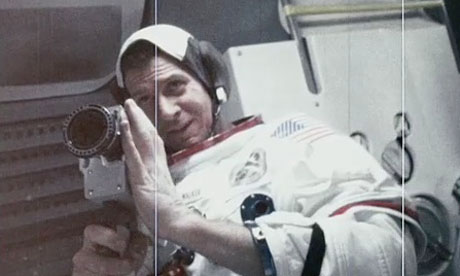
First off, this is all hooey, the latest in the "Found Footage" school of horror movies (ala The Blair Witch Project and Paranormal Activity—a genre that, actually, can be traced back to Orson Welles' Hallowe'en broadcast of "The War of the Worlds"**). One simply uses cinema verite techniques, particularly of the budget-friendly low-didg' variety, to give a "you are there, filming" feel to a series of events, preferably horrific—it takes full advantage of the camera's limited frame of view to show you stuff that happens at a reactive speed, one step (and panicked "whip" pan) behind what went down.
The thing is, this is just the sort of thing that can inspire the deluded (or Rosie O'Donnell) to come up with conspiracy theories that it might all be true—how many "Moon Landing Hoax" "experts" came out of watching Capricorn One (the Peter Hyams film about a staged Mars landing in a remote desert-area sound-stage, because "it doesn't work.."). The "post hoc ergo propter hoc" logic being..."if we could go to the Moon back then, why didn't we ever go back?"
The true answer is simple: budget cuts. One could be even more cynical and say "poor ratings." It's hard to believe that the reasons could be so shallow, but as John Oliver of "The Daily Show" pointed out in his coverage of the final shuttle launch, it was a "seminal moment in History, when America looked at its highest aspirations and said 'Ah...f____ it!'"
It was as simple as that. Budget cuts. Nixon was in the White House, he was a big fan of the program—all those photo ops! and he got to sign those plaques on the Moon!—but, at a time of runaway inflation, going to the Moon wasn't very popular, the declining ratings for the Missions being proof of it. So, the last three missions were scrapped (those being 18, 19, and 20) in a literal case of "Been There, Done That" (and we've got enough rocks, thanks a lot).Those cuts necessitated the re-assignment of
Harrison Schmitt, the only astronaut-geologist being bumped up to the "17" crew to assuage the scientific community, who were already threatening to take down Mission Control in Houston with rock-hammers. 
 
Budget cuts. Now, there's your horror film for you ("Attack of the Fiscal Conservatives!").
So, Apollo 18. Because of the nature of the film, the director,
Gonzalo López-Gallego, abandons the long-take structure of most of these "found-footage" things. The movie veers from video footage to 16 mm movie footage at different speeds, hand-held to stationary-cams, NASA stock-footage to staged bits. Little of it is convincing, as much as they try to replicate the grain and shaky cam feel that's required for the "feel" of it
Also, there seem to be stationary-cams "all over" the Lunar Module, not to mention tons and tons of film—look, the original 16mm footage for the Moon landings were mostly taking a shot every few seconds...so they wouldn't run out of film...here, the photo budget seems to be unlimited (of course, that completely ignores the 'weight" issue—more weight equals more fuel, which could never be in enough supply). The Lunar Module is a sturdy old thing, able to survive blows with a rock-hammer...even though the real Lunar Module, being a solely space-worthy vehicle had very, very thin walls (that 'weight" issue, again)—the real-life Astronauts were very concerned about putting their boots through them.
And while we're on the subject—the Mission is lost...how'd they get the footage back? Did they have it delivered? Does it come back automatically, like a homing pigeon?

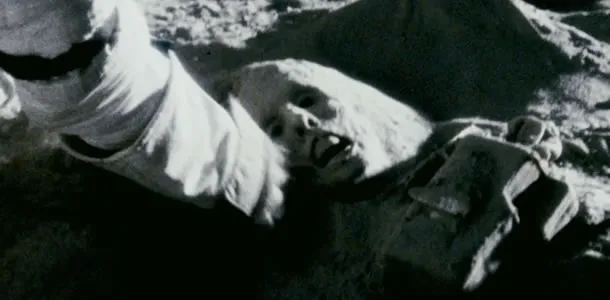
We can get very technical here—the staged lunar walks show no evidence of a lesser gravity (unless they use the stock footage), and the way they get around it is having the "astronauts" shuffling slowly along the surface, with no evidence of the dust-clouds the real astronaut boots kicked up. When "something new" is added in the element, it looks as fake as from Destination Moon, George Pal's 1950 film. The scares are of the cheap variety (the only good one is a prank), but it's not enough to let you accept what you're seeing, and every so often it's good to ask..."who took that footage?" (They're right! There is something on the Moon! And it seems to be extra cameramen!).
They throw every problem at the crew that they can...despite any of them being grounds for immediate lift-off and escape...Communications problems? Come home. LEM power failure? Come home. Out of Tang? Come home. But, these guys get all that (well, not the "Tang"), plus mysterious tracks, spaceships they didn't know were there, unexplained damage to the ship, "somebody" stole the flag, and things that go bump in the lunar night—they frequently skirt the "no sound in space" rule, although sound designer Wylie Stateman, who does sound work for Oliver Stone, Quentin Tarantino, and Paul Haggis, does yeoman's work on this, even if some of the "alien" sounds are a little too electronica.
But, Apollo 18 is "The Blair Space Project," ending in the dumbest way possible. A by-the-flight-plan exercise on autopilot, baiting-and-switching every fifteen seconds to keep any form of agitation going (and even that makes no sense). Not exciting, not clever, and utterly illogical, denying any respect for the audience (who, in turn, should give none of it back), not obeying its own rules or the rules from the "other" space monster movie it's ripping off, it's an almost total failure on every level.
Which leaves me with one burning question..."If we could send a man to the Moon, why did we have to make a movie like Apollo 18...?"  
 
Apollo 18 is a Waste of Time (Good thing I didn't watch the 17 prequels!!).
 "Hi! I'm a rumor! I've come to eat your brain!"
 
These are much more fun....A talk-show guest convinced that Stanley Kubrick directed fake moon-walks for the U.S. Government...("Hey, we're just talking...!" Yeah, talking like morons.)

And the French-made mockumentary that probably got him started on it (it's never been aired in this country...Ooooo, let the conspiracy theories bloom!) And, of course, they did.
Okay...there's the arguments. Here's the common sense.


* Let me explain: in John Sayles' Passion Fish, there is a terrific monologue by an actress named Nina (played by an actress named Nancy Mette, who does a great job with it).  She is hired to play the victim of an alien abduction in a science fiction movie, but she decides it's an opportunity to be seen...wait, wait...it's on-line...better you just watch it
 
** Where Welles, his Mercury Theater of the Air, and writer Howard Koch, did a "modern dress" version of the novel (on radio) where the first half took the form of "Special bulletins" of alien invasion interrupting a radio program of dance music.

Friday, May 5, 2023

To Be or Not To Be (1942)

To Be or Not To Be
(Ernst Lubitsch
, 1942) "The Lubitsch Touch" (that undefinable "something" that made the films of Ernst Lubitsch work) had so many elements connected to the man himself--the instincts, the East European sensibility for craft, the worldly wisdom and the timeless humor. What was it that made Lubitsch such a master of what ever material he chose to over-see?*

But this one's a tricky one, and it didn't do well at the box-office during war-time, but not for want of trying. To Be or Not To Be
** focusses on a Polish theater troupe during the days just before the Nazi occupation. It stars Jack Benny (he rarely did films, but his crack slow burn double takes are on brilliant display here), Carole Lombard (at her best, too--this was her last film before being killed in a plane crash coming back from a War Bonds rally), and it just roasts the Nazi's over the coals, mocking their blustering bureaucratic-ness, while hinting at their dark, dark designs. it's just one of the films that was poking Hitler in the eyes during the '40's. Today, one looks at it with eyes popping and jaw dropping every few minutes for the forwardness of the material. It did not tread lightly, and never less than entertainingly.
But even so, the populace was getting a daily dose of Hitler-slamming (
Chaplin had made The Great Dictator in 1940,
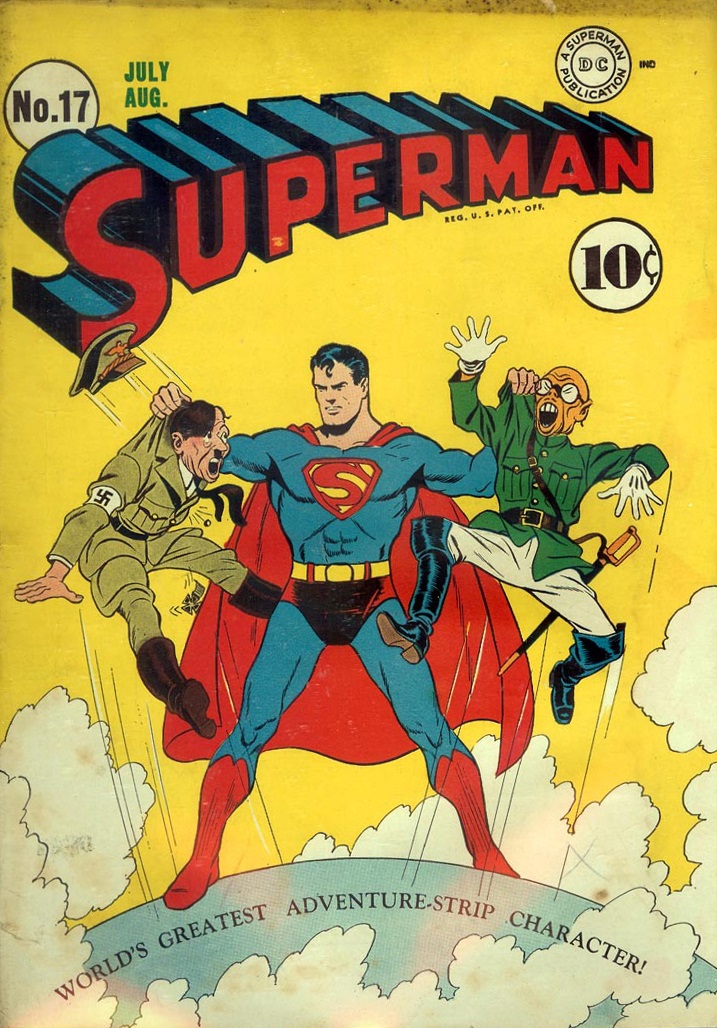
you could see comic book super-heroes kicking the tushes of caricatures of Adolf and Tojo, and Spike Jones had a nice novelty hit with "In the Feuhrer's Face"), and the majority of Americans had loved ones in the service while being rationed gasoline, sugar, rubber, nylons and all sorts of American luxuries to provide for the more pressing needs of the military, up to and including buying war bonds. It might have been too much to expect them to take this one in too...even for a nickel.
Still, looking at it today without the constant barrage of war-news from Europe, it's still a credible comedy, although there are some timing problems in the second act. It begins with one of the most used comedy bits in war documentaries, when an actor portraying Hitler walks into the room to be greeted by snappy salutes and a unison "Heil Hitler." To which, "Hitler" raises his hand and says "Heil myself." Benny doesn't stray too far from his radio persona, as a cluelessly vain actor and leader of a theater troupe (One of the Nazi's says of him: "Oh, yes I saw him in 'Hamlet' once. What he did to Shakespeare we are now doing to Poland." uh...your jaw—you might want to pick that up), oblivious to the fact that his wife is the big draw, and that she plays host to any number of dashing pilots who dash into her dressing room the moment he begins one of his drawn-out soliloquys, where he can have the spotlight all to himself. Lombard does not play cute in this one, but turns on the glamour, while never losing her comic timing--a nice trick, that. Her Mrs. Tura is just as vain as her husband, but a good deal smarter and the wit emanating from her and about her are some of the best lines in the movie. Her dashing pilot is played by a very young and very one-note
Robert Stack, long before he would find better roles that would benefit his limitations.


Quibbles aside, it's still a great example of miraculous "The Lubitsch Touch."*** When the final laugh-filled shot went to black, K. said, "Now I know why you like old movies." Smart, funny, poignant, the grand masters of the cinema, like Lubitsch, transcend the passage of time and circumstance.

* Want to see "The Lubitsch Touch" in action? Rent Shop Around the Corner with James Stewart and Claudette Colbert, and watch its modern redress You've Got Mail with Tom Hanks and Meg Ryan. Same story, basically. Worlds apart as far as quality and craft, and even timeliness, of all things.

** Not to be confused with the crass remake starring Mel Brooks and Anne Bancroft--again, same story, but who's behind the wheel makes all the difference.


*** I think I've mentioned the story before of Billy Wilder and William Wyler leaving Lubitsch's funeral and Wilder sighing, "Well, no more Lubitsch." To which, Wyler replied, "Worse than that. No more Lubitsch pictures."

Wednesday, May 3, 2023

Seeking a Friend For the End of the World

Doing my Index for the site, I've stumbled across all sorts of reviews for films I have fondly remembered, but never pulled over here. This is is one of them—a film in a very similar vein to Don't Look Up, but with less of the focus on obstinate deniability.

I Got Stoned and I Missed It
or
"As Well as All Your Favorite Classic Hits..."

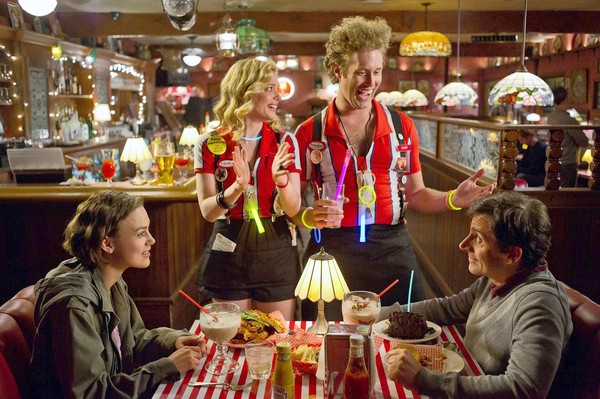
Right off the bat, Seeking a Friend for the End of the World, starts with a great joke. Dodge (Steve Carell) and his wife Linda (Nancy Carell-heh—how "inside") are sitting in the car, listening to the news on the radio. It's not good. The space shuttle Deliverance has not been able to destroy or even divert the asteroid "Matilda" that is headed for Earth and will bring all life to an end. "Stay tuned for all the latest developments on this ongoing story, as well as all your favorite classic hits."
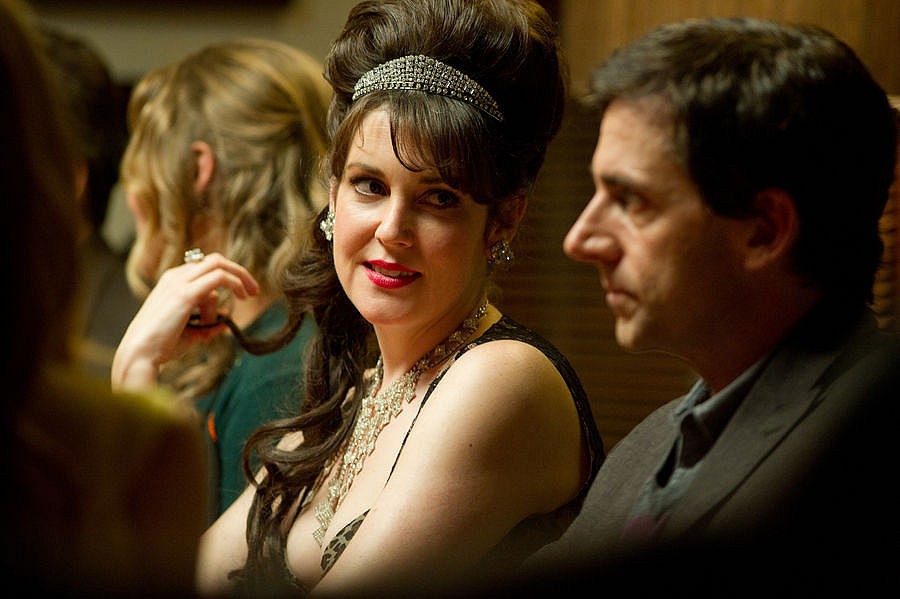

There's silence in the car. Then, husband and wife look at each other. Wife opens the car door. And runs as fast as she can...away, into the night, leaving hubby gaping. "What just happened?"
That's the tenor of the humor of SAFFEOW—a kind of horrific slapstick that feels frightening, as well as inevitable, like a Blake Edwards comedy. You know a radio station would end a horrific story...even of Armaggeddon...with a reassuring tag-line. And the wife's reaction? Without a word of explanation, escaping her settled life? Eh, that one feels real, too.
Dodge is the calm of the storm for all this chaos
. Where his friends are freaking out along with the rest of society, he is quietly considering his fate and deciding what he can do with his time, rather than quickly self-destructing. The first part of the film is full of dark humor as Dodge goes to work as an insurance broker ("No, sir, it isn't covered in your policy"), botches a suicide attempt that only garners more responsibility, and everything and everybody systematically shuts down. The skein of traffic comes unraveled, TV reporters freak out ("We're f@&%ed, Bob...") and the lack of consequence—or a future—bring out the worst in people.

Dodge reflects, and as circumstances happen, he decides to seek out "the girl who got away," along with "the girl along for the ride" (Keira Knightley) who has a similar quest—finding a plane to get her back to her parents in England. She's got a car. He says he knows somebody with a plane, so the two contract to maneuver through the chaos to achieve their very short-term goals.
It turns into a road-trip movie
, without "the light at the end of the tunnel" and the two may be the last two sane people on Earth. Just when you think someone along the way is normal...or at last coping...there's a surprise. It all plays out in the way that you think it might—circumstances soften the resolve and their zeal for their goals and their attitudes towards each other. Even if the world has an expiration date, there's still enough room to change your mind (in much the same way that Dodge's wife does at the beginning).

Knightley's fine in this
, still determined to not let her looks get in the way of an idiosyncratic performance. She is one odd goose, as long as she's not standing still on a runway. Carell's just the opposite here—an internalized performance that maintains a simmering calm. The face changes expression constantly, but the brow is always furrowed, like it's reflecting the first shock-wave that hits Earth. He wouldn't betray any unnecessary emotion, even if the world IS coming to an end, and there are nice turns by William Petersen and Martin Sheen, and bombastic ones by Rob Corddry and Patton Oswalt (and though it might not be fair) acting the way I think they'd act if they knew the world was coming to an end.


It's a neat trick Lorene Scafaria (she made Nick and Nora's infinite Playlist) pulls off here: the idea couldn't be more "high-concept" and in the hands of, say, Mike Bay, or Mimi Leder, or Roland Emmerich it would be more parts spectacle and surviving than anything having to do with as universal a thing as "coping." The only "high ground" to be found in those films is the one everybody's running to, while the pixel-people to the rear are never seen or heard from again (and never really mattered enough to be portrayed by actors, anyway). Scafaria provides no high ground of safety, but only the artistic high ground of keeping the scale human, the emotions raw, and running the risk of turning sentimental or, worse, encouraging the audience's wrath (being hit with an asteroid would be more humane). She doesn't cheat, keeps it edgy, and allows things to play out...tidily.


And her musical taste? Spending the last night of your life before the power goes out listening to The Walker Brothers? Brilliant.

Tuesday, May 2, 2023

My Man Godfrey

Turner Classic Movies' Star of the Month is William Powell, who seems to have fallen out of the consciousness and discussion of Great Hollywood Actors. I will avail myself of seeing a bunch of his films, as I've always found him astonishingly creative and real.

My Man Godfrey (Gregory LaCava, 1936)  Bill Powell isn't given nearly enough credit in Hollywood history.

Popular in his day, he worked just enough to maintain his reputation and dignity, then retired and kept to himself. But you watch him in something like My Man Godfrey—a not quite screwball comedy of the "The Rich, They are a Peculiar Lot" school—and you see him stretch a little bit, and definitely see him playing a different character than the familiar Powell persona (even an extended drunk scene is played differently than his pleasantly soused Nick Charles from the "Thin Man" series), but still retains that measure of insinuation that took every line of dialogue and made it spin on its heels. His character, Godfrey Pike, starts out as a bum living in a dump underneath the Brooklyn Bridge, where he's picked up by socialite-heads as part of a charity scavenger hunt for the idle rich.
He attracts the attention of Irene Bullock (Carole Lombard, formerly Mrs. Powell) probably because he's different, a genuine "find," and he does stick out like a sore, if well-manicured, sore thumb among the derelicts. Articulate and dignified, he's quietly worldly-wise, politely sarcastic (neat trick to pull off, that) and keeps a cool eye on the rich partiers for whom he's an oddity, a curiosity—like watching a car wreck—and slightly discounted, although he's  probably better than all of them as a human being. Mentored by Irene, he assumes a position as a gentleman-butler for her family, a job that's bested a steady stream of other men. But he does the job well, keeping his opinions to himself, the most sane man in a palatial asylum.
And an asylum it is, with the father (the foghorn-voiced Eugene Pallette, staple of Capra comedies) the only one with any sense (or schedule), and who has long given up on his family making any steps to adulthood. Mother (Alice Brady) is a drama queen, who can only be distracted by her protege Carlo (Mischa Auer) and other daughter Cornelia (Gail Patrick) has to fill her empty life with schemes and conspiracies.
But Irene is a dreamer. In Godfrey, she finds a competent supplement, practical, in marked contrast to her flibbertigibbet, caring to her carelessness.
Such a creature, alien to her environment, makes her fall in love with the old boy, while he still tries to make his way through Society, and back to the life he has previously abandoned.
It's all high-style and fast-paced. And even though Lombard's society gal is a comic cry-baby notched up to "11" on a scale of "10," she is leavened somewhat by the tolerating, sly performance by Powell—who insisted that Lombard, his ex-wife, get the part.

Powell was the epitome of well-mannered play-acting, while never, ever betraying a dull moment. He made style which—when done in the hands of amateurs can look confining—seem effortless, while also being insouciant, and fun.