House of Bamboo (Samuel Fuller, 1955) When is a film noir not a film noir? Well, director Sam Fuller shoved the envelope on that thriller sub-set as far as it could go with this crime drama set in Japan, filmed in Tokyo in Cinemascope and Deluxe color. A remake of The Street with No Name—same script idea by Harry Kleiner (who is credited), but a different setting half a world away, no FBI co-operation, but most importantly, different director—the two films couldn't be more different—although both films boasted extensive filming on location (the earlier film hedged its bets by filming in the grimier parts of Los Angeles, which it dubbed "Carver City").
Tokyo, on the other hand, was a bustling metropolis, something director Fuller sought to convey. This led to a change in casting; originally, Gary Cooper was slated to top-line the film, but he was too big a star not to avoid unwanted attention and ruin shots in crowded streets. So, Robert Stack was picked, as he was not so well known in Japan, and that enabled Fuller to film street-scenes from parked vehicles—to avoid paying filming permits—and get something that seemed authentic without autograph-seekers and the curious looking right at the camera.
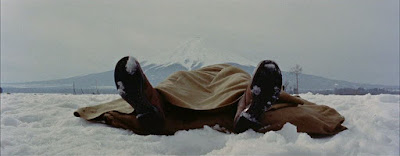
The film begins with a train robbery...but not just any train robbery. A military munitions train bound for Tokyo from Kyoto is robbed by a well-timed team of criminals, who are able to steal guns and rounds from Army guards and Japanese police. The heist is done with military precision and a "take-no-prisoners" attitude—if one of their own gets shot or injured on the job, there are no heroics, but are shot and killed on the spot. The Army and Japanese police have no leads, until a subsequent crime is pulled off with the very weapons that were stolen from the train robbery...and, despite the gang's shooting of one of their wounded, that hood, Webber, manages to survive...just long enough to blurt out his wife's name, Mariko (Shirley Yamaguchi), and give the cops a letter in his possession from an Army buddy named Eddie Spanier, who Webber has invited to Japan after he gets out of prison.

Sure as shootin', Eddie (Robert Stack) gets off a boat in Tokyo and makes his way to Mariko, after first trying to track her down with a dance company and then at a bath. She's scared that Eddie is actually part of the gang who killed her husband, but after telling her about the letter he sent, and showing her a photo of him and Webber together, she begins to trust him...and trust him even more when he tells her to lay low, lest his old gang-mates try to find her.
Eddie, however, is disappointed. That letter promised a job, but no way to contact the dead man's gang. He decides to freelance, and see how far that will get him. He goes to local pachinko parlor's and shakes down the owners for protection, garnering just enough to get him some seed money...and the attention of criminal Sandy Dawson (Robert Ryan), whose territory Spanier has managed to cross. When he tries to shake down another pachinko hall, Spanier—who also dabbles in the protection business—has him beaten up and crashes into a meeting with his gang to provide a warning to get out of Japan. And "sayonara".

Eddie doesn't scare that easily. So, Dawson has him framed for a robbery and arrested, thereby allowing the Japanese Police to get his rap sheet wired to them, and an insider at the force forwards the info to the mob-boss. Dawson's intrigued. Intrigued enough to invite Eddie into his gang of dishonorably discharged ex-servicemen. But, he has to met certain standards: he has to swear an oath of loyalty, and he has to clean himself up—get a good suit and stop looking like a bum. He's an Organization man now.
Truth is, he always was. Because Eddie Spanier is actually Eddie Kenner, an Army investigator sent to infiltrate Dawson's gang for the joint Military/Japanese Police investigation of that train heist in the opening. He recruits Mariko to be his "kimono girl" so that if he gets embroiled in gang activities, she can go warn the authorities about any jobs going down...and maybe she'll find out who killed her husband.

From then on, it's a cat and mouse game, Eddie playing along with the Dawson gang, Mariko playing along with Eddie, while the authorities hang back expecting word from an operative who could get smoked if he so much as twists his ankle during a job. Except something curious happens: during a robbery on one of Japan's docks, Dawson's crew comes under fire from the guards—one gets hit and is immediately shot, lest he get captured and can give evidence. But, then Eddie gets shot in the leg and just as he's about to be put out of the gang's misery, Dawson himself grabs him and helps him escape.

That's not S.O.P. for the gang and pretty soon, Griff (Cameron Mitchell) who is Sandy's "ichiban" in the group starts noticing that Dawson is favoring Eddie over him, and is wondering if he has lost his position and prestige. Griff is a hot-head, Dawson knows that, so right before a big raid, Sandy tells him he's out of the gang until he cools down. That job, though, is cut short when Eddie sends Mariko to tip off the police, and when Sandy's informant in headquarters lets the boss know that plans are set in motion to capture them, he calls off the operation in mid-heist, and thinking Griff tipped off the cops, sets out to personally exact revenge in one of the most abrupt and shocking murders in noir.

Fuller's direction in House of Bamboo is tight and formal, even in the scenes shot undercover in the streets, but never more so than in that assassination scene—all done in one shot as Dawson breaks in on Griff taking a bath and then shooting him point blank, the bullets going through the wooden tub, the water draining through the bullet-holes. But, the scene continues as Ryan's Dawson stares into the dead face of his former number one boy and tries to understand "why'd you do that, Griff? Why'd you betray me?" Stack may be the erstwhile hero in the film, but he's just stiff enough to be unsympathetic, whereas Ryan's mob-boss comes across as a competent, slick operator, well in command and capable of feeling betrayed.

That ups the stakes in the game that Kenner is playing because Dawson may be a cool customer, but any sense of betrayal turns him murderous, and once the bath-murder scene occurs, one is never certain just how unhinged Dawson may become where no one is safe. This is a far cry from the movie's source The Street with No Name, but Fuller has been playing fast and lose with that original story from the moment he kept Kenner's identity a secret. With the unfamiliar Japanese surroundings, and his manipulations of the original story, the House of Bamboo is, quite literally, a world apart from its origins.
 |
| DeForest Kelley caught in the shadows of The House of Bamboo |
The last scene, a final reel shoot-out, makes it explicit: where The Street with No Name ended in a night-time chase and shoot-out in a warehouse, the one in The House of Bamboo takes place in an office building with an amusement park on the open top floor. There's no rushing around in the shadows; it all takes place in the open daylight overlooking the city on a preposterous merry-go-round around a world sculpture. Surreal and dangerous, it is an over-the-top ending to an exotic blend of dark and light, in bright eye-popping colors using a movie musical's pallete to a story of the dark side of society.