Sunday, October 7, 2018

Don't Make a Scene: Rear Window

The Story:
Perfection. Broken, wheel-chair-bound photographer L.B. "Jeff" Jeffries has a problem with it. Too bad he's in such a nearly perfect screenplay (by John Michael Hayes, with the visual supervision of Alfred Hitchcock).  When we first encounter him, Hitchcock, in one of his greatest instances of visual story-telling, informs us of Jeffries' career, and how he probably ended up with his leg in a cast, panning over an example of his studio work (in negative), on to his broken camera equipment and finally settling on a hair-raising shot of an on-coming accident at a race-track.


Jeffries prefers to photograph life in chaos, so it is no wonder that in his narrow view (through a view-finder), he questions perfection. Now, in an insular world, with his injury providing the blinders, he can ruminate on his world-view, and his romantic "problems"—his relationship with Lisa Carol Fremont (played by a stunningly gorgeous Grace Kelly). It doesn't help that through the limited scope of his Rear Window, he can see a virtual museum filled with dioramas of relationships going sour. Window-boxes of love, like flowers in varying stages of decay.  For a man who thrives on excitement (though he merely observes it through a lens), it is disheartening, dis-spiriting, and throws him into a dour curmudgeonly funk that darkens his room and colors his perceptions.

That window also provides the means of escape for a trapped man—trapped in his frailties and also his world-view. Through it, he will find—or perceive—a mystery, one that will threaten the woman he doesn't want to commit to, but realizes he can't live without. And, discovering that, he will throw himself, again, into harm's way to resolve the situation in his limited, vulnerable way. He will risk everything to protect the woman that, before, he so blithely has taken for granted. He will come full-circle, the events of the film showing him the reality of the relationship, rather than seeing it, prismatically, through his own preferred filters.

A perfect screenplay.

The Set-Up: "Jeff" Jeffries (James Stewart) is a broken man. Laid up with a work-related injury, it is time for his visit from the insurance company nurse, Stella (the wonderful Thelma Ritter) for a little re-adjustment, and maybe some slapping around. At the end of this scene, he will begin the journey to the cure for what ails him.

Action!


Sections not appearing in the final film appear in RED.

INT. JEFF'S APARTMENT - DAY - CLOSE SHOT
The CAMERA is very low at one end of the divan. Jeff's head,
half-buried in the sheet, is large in the fore-ground. Beyond him Stella looms large and powerful-looking.

JEFF I think you're right. There is going to be some trouble around here.
Stella takes a handful of oil, slaps it on his back. He winces.
STELLA I knew it!
JEFF Don't you ever heat that stuff up.
STELLA Gives your circulation something to fight.
(Begins massaging his back)
STELLA What kind of trouble?
JEFF Lisa Fremont.
STELLA You must be kidding. A beautiful young woman, and you a reasonably healthy specimen of manhood.
JEFF She expects me to marry her.
STELLA That's normal.
JEFF I don't want to.
STELLA (Slaps cold oils on him) That's abnormal.
JEFF (Wincing) I'm not ready for marriage.
STELLA Nonsense. A man is always ready for marriage -- with the right girl. And Lisa Fremont is the right girl for any man with half a brain, who can get one eye open.
JEFF (Indifferent) She's all right.
She hits him with some more cold oil. He winces again.
STELLA Behind every ridiculous statement is always hidden the true cause.
(Peers at him)
STELLA What is it? You have a fight?
JEFF No.
STELLA (After a pause) Her father loading up the shotgun?
JEFF Stella!
STELLA It's happened before, you know! Some of the world's happiest marriage have started 'under the gun' you might say.
JEFF She's just not the girl for me.
STELLA She's only perfect.
JEFF Too perfect. Too beautiful, too talented, too sophisticated, too everything -- but what I want.
STELLA (Cautiously) Is what you want something you can discuss?
Jeff gives an exasperated look.
JEFF It's very simple. She belongs in that rarefied atmosphere of Park Avenue, expensive restaurants, and literary cocktail parties.
STELLA People with sense can belong wherever they're put.
JEFF Can you see her tramping around the world with a camera bum who never has more than a week's salary in the bank?
JEFF (Almost to himself) If only she was ordinary.
Stella sprinkles powder on his back, spreads it around.
THE CAMERA PULLS BACK as she helps Jeff to a sitting position. He buttons on his shirt.

STELLA You're never going to marry?
JEFF Probably. But when I do, it'll be to someone who thinks of life as more than a new dress, a lobster dinner, and the latest scandal.
JEFF I need a woman who'll go anywhere, do anything, and love it.
THE CAMERA MOVES IN as she helps him into the wheelchair, listening to him with exaggerated attention. He, stops as he notice her attitude. Then he goes on with less conviction:
JEFF The only honest thing to do is call it off. Let her look for somebody else.
STELLA I can just hear you now. "Get out of here you perfect, wonderful woman! You're too good for me!"
JEFF (After pause) That's the hard part.
She swings him around in front of the window. He starts to look out.
STELLA Look, Mr. Jefferies. I'm not educated. I'm not even sophisticated. But I can tell you this -- when a man and a woman see each other, and like each other...
STELLA -- they should come together -- wham -- like two taxies on Broadway.
STELLA Not sit around studying each other like...
STELLA ...specimens in at bottle.
JEFF There's an intelligent way to approach marriage.
STELLA (Scoffing) Intelligence! Nothing has caused the human race more trouble. Modern marriage!
Jeff swings his chair back to look at her.
JEFF We've progressed emotionally in --
STELLA (Interrupting) Baloney!
STELLA Once it was see somebody, get excited, get married -- Now, it's read books,
STELLA ...fence with four syllable words, psychoanalyze each other...
STELLA ...until you can't tell a petting party from a civil service exam.
JEFF People have different emotional levels that --
STELLA (Interrupting again)Ask for trouble and you get it. Why there's a good boy in my neighborhood who went with a nice girl across the street for three years. Then he refused to marry her. Why? -- Because she only scored sixty-one on a Look Magazine marriage quiz!
Jeff can't help smiling.

STELLA When I married Myles, we were both maladjusted misfits.
STELLA We still are. And we've loved every minute of it.
JEFF That's fine, Stella. Now would you make me a sandwich?
She relaxes.
STELLA Okay -- but I'm going to spread some common sense on the bread. Lisa Fremont's loaded to her fingertips with love for you. I'll give you two words of advice. Marry her.
JEFF (Smiles) She pay you much?
Stella leaves for the kitchen in a huff. Jeff turns his chair to the window.


Rear Window

Words by John Michael Hayes

Pictures by Robert Burks and Alfred Hitchcock

Rear Window is available on DVD from Universal Home Video.


This scene begins at 08:44

Friday, October 5, 2018

Juggernaut (1974)

Juggernaut (Richard Lester, 1974) Made in the shock-wave of such star-culling epics as Airport, The Poseidon Adventure, Earthquake, and The Towering Inferno that had the gall to ask: "Who Will Survive?" in its posters, Juggernaut played the same game. See? All the stars are lined up like ducks in a gallery reading to be pinged, just like those other all-star slaughter fests.

Juggernaut plays the game differently, though, while maintaining the conventions. This film is as soapish as the others in terms of interpersonal relationships. But in other disaster movies, people are collateral damage to the epic depiction of crumbling masonry. Lester's film is all about character—the "disaster" is man-made, the people at-risk are portrayed intimately, if not by stars, by strong character actors (
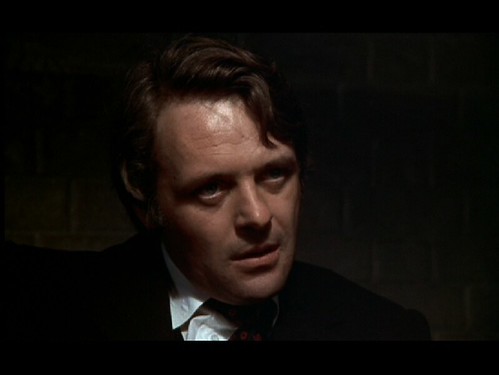
Clifton James, Shirley Knight, Michael Hordern, Cyril Cusack, Julian Glover, Roy Kinnear—Lester's favorite buffoon is given a part to shine in this film—Ian Holm, a pre-fame Anthony Hopkins) you begin to care about. 


The cast is filled with faces who would become more familiar in later roles, but the two leads are Omar Sharif at his dyspeptic best as the Captain of the threatened ship and Richard Harris, who was never better than he is in this movie.
The cruise ship SS Britannic is half-way across the Atlantic Ocean when the line's president (Holm) receives a phone call from "Juggernaut" saying there are seven barrels of high explosive rigged to go off the next day at a predetermined time. Unless a ransom is paid, the bombs will go off and the ship will sink. With the ransom, instructions to defuse the bombs will be sent. Any attempt to defuse the bombs will cause them to explode. Holm's president wants to pay the ransom quickly, but the British government threatens to pull his operating subsidy if he negotiates with terrorists. While Hopkins' Scotland Yard detective attempts to find "Juggernaut," bomb expert Tony Fallon (Harris) and his crew are sent out to the Britannic, dropped in the ocean, and clamber onto the boat.
The focus shifts to Fallon, who sees all defusing jobs as a form of psychology—he's not trying to figure out the bomb, he's trying to figure out the man who made the bomb, and the tense scenes of Fallon examining one bomb to relay instructions to his crew are a whispered monologue of a man on the edge of death attempting to read the mind of the puzzle-maker in a battle of wills.
For director Lester, who is fond of games and puzzle solving, the film is one of his obsessions brought to life with the bomb design being particularly devious. Given its nature, one is put immediately into the Fallon mind-set that he is battling a man and not a bomb. And it is this interplay, where one man must rely on his skills and his knowledge, rather than the tides of Fate, that makes Juggernaut sail past the other films in the sub-genre.

Thursday, October 4, 2018

Eastern Promises

It's October..."so maybe I should pay attention to horror films." How cliché.

I have some planned and in the hopper, but I noticed "The Large Association of Movie Blogs" is showcasing director David Cronenberg, so I'm also going to be throwing in a bunch of Cronenberg reviews from the past and the retrospective present. After all, you can't have a Cronenberg movie without a little bit of horror...somewhere.

Written at the time of the film's release.


Every Picture Tells a Story, Don't It?

Eastern Promises is the latest film by David Cronenberg, Master of the Uncomfortable, Enemy to the Squeamish. As with A History of Violence his star of choice is Viggo Mortenson, who after years of "body in a suit" roles where he barely registered, became a star with the "Lord of the Rings" trilogy. His post-"Ring" choices have been interesting, including two films by Cronenberg where he could use his inscrutable demeanor to maximum advantage. His Nikolai--ostensibly "The Driver," but to others, "The Undertaker"--is a lieutenant in the Russian mob in contemporary London. His boss is Kirill (Vincent Cassel), the unreliable son of Semyon (Armin Mueller-Stahl), owner of the Trans-Siberian supper club, and "King" of the mob. There are many facades in Eastern Promises, whether they're legitimate businesses that front prostitution, or the quaint grandfatherly demeanor that Semyon presents. *
Into this world of death comes mid-wife Anna (Naomi Watts) or "Anna Ivanovna" as Semyon, from the old country, calls her) who oversees the birth of a baby girl to a heroin addict who dies in childbirth. Trying to return the child to relatives, Anna takes the girl's diary to try and glean any information from it. As it's written in Russian, she turns to the Russian community for help. Her timing couldn't be worse as warring factions are busy slitting the throats of their enemies and it's a world where innocence can be completely subsumed in everyone's search for "a better life."
Cronenberg doesn't make "feel-good" movies, and all of his films take you places you don't want to go. Fans of Viggo Mortenson will see this film and be nicely rewarded with a finely layered, laid-back performance using an accent that approaches parody. But be warned: It's a violent flick with two graphic throat-cuttings, a scene where a dead man's fingers are snipped off to prevent identification, and in the major set-piece of the film, Mortenson's Nikolai is attacked in a bathhouse by two toughs with box-cutters. Yes, ladies (and gentlemen), you get to see his package, but the price you pay is sitting through one of the crunchiest, gristleiest, gooiest fights in a long, long time.
But that's the price you pay.


*The only truths are those tattooes charred into the bodies of the mobsters, from their days in the Russian work-camps—their lives, their stories are burned into their skin for all to see.

Wednesday, October 3, 2018

Searching

Inter-Drag-net
or
Oh, What a Tangled World Wide Web We Weave

Searching, the excellent, very clever thriller by Aneesh Chaganty begins with a 15 minute sequence so gut-wrenching to the heart that it reminded me of the beginning of Up, which was a masterpiece of tugging the emotions. The two sequences have a comparable story-telling strategy—laying the foundation for the story to come, setting up the ground-work to show the prologue that will serve as motivation for what will come, and act as a salve when things get rough.

The story for Searching is simple—the strategy telling it is not. There have been so many "missing children" movies, it could have it's own genre...from The Searchers to Close Encounters to Taken, the story of the search for a child is compelling no matter what the setting of the film is.

But, Searching is unique. It could be thought a "found footage" movie, but it isn't. It takes the strategy of Paranormal Activity and does it a few steps better for the computer age and it's announced with it's very first image (which takes a momentary pause of orientation to realize that all the studio credits have ended), so common—but only for the last 30 years—and so much a part of our world that one might feel cheated by the idea that it's cheap film-making. It's a shot of a computer-screen with a family wall-paper on it. And for the next 106 minutes, you will rarely leave that page. So pervasive is computer technology now that you don't need to tell a compelling story without moving away from the screen. As movie-goers, we're watching a screen, anyway, but there's an eerie kaleidoscopic effect when you're watching screens within screens—like being in a hall of mirrors. It focuses your attention—as opposed the split-screen experiments started in the 1960's, which divided it—and you find yourself lasering in on the information, and you don't have to go far to find it—the landscape is very limited. 

Plus, you're in the position of the person in front of the screen.
We meet the Kim's—through home video at first—David (John Cho), Pamela (Sara Sohn) and daughter Margot (played at various ages by Alex Jayne Go, Megan Liu, Kya Dawn Lau, and mostly by Michelle La)—video's first, then e-mails, PM's, calendar's, Google searches—especially the one for "lymphoma" and "fighting lymphoma as a family"—as we see the arc of a young family, loving, bonding, and eventually in crisis.
It's a brilliant way to tell a story, through archived material, compressing time and efficiently jumping from highlight to highlight, until the story is complete. Director Chaganty doesn't even have to do a transition into present day. "Real time" is presented with Personal Messages, a "Facetime" call. Dad David calls daughter Margot to tell her she forgot to take out the trash. It's a big deal to him, requiring escalation from text to video and Margot picks up to tell him she can't do it right now, that she's in a study group. Okay, says David. when will you be home? I'll probably be going all night, she says. Dad's not pleased but urges her to talk to him when she's done.
David talks to his brother Peter (Joseph Lee), who's trying to prepare a meal that David's wife Pam had "down." David can't help but notice the container of weed on the kitchen counter, which Peter says is actually oregano and they squabble, like returning to a subject both have gone over again and again, which neither one wishes to re-visit. Glumly, Peter goes into Pam's partition of the computer and send him the recipe. He isn't feeling well, and the next we see of him he's asleep, a bottle of pills in the foreground in front of the computer's cam. 

Margot texts. It goes unnoticed. She calls once, twice. Unanswered.
The next day David is at work, tele-conferencing, and he hasn't heard from Margot. He's pissed. She's grounded. But, as the day wears on, he starts to investigate. Margot takes piano lessons on Fridays. He doesn't know the teacher. He searches, finds her number, calls. The teacher's a bit annoyed that he called during a lesson, but he asks to talk to Margot. Then, there's a bombshell: Margot hasn't been coming to her lessons for six months and had, in fact, canceled them. Well, he gave her money for the lessons—what happened to that? Margot conveniently left her laptop behind and David starts to use that and Pam's files to start calling friends and acquaintances—the study group is unhelpful (kids!), but talking to the mother of one of Margot's childhood friends gives him some hope—a bunch of them were going to the mountains, Margot was invited, and they're out of cell-range. Of course! David calms down, and waits for Margot to call.
She doesn't call. The friend does. Sure, he invited Margot, but she didn't go with them and he hasn't heard from her. David panics and calls the police, filing a missing person report. Eventually he's contacted by Det. Rosemary Vick (Debra Messing) with the San Jose police department. He checks up on her, is impressed and starts doing his own investigative work, contacting Margot's friends, determining where they were on that Thursday night and coming up with an alibi database for use by the police. But, he's obsessive about it and that worries Vick. His work leads him down blind alleys and he starts accusing people who are taking a more cavalier attitude to Margot's disappearance. He's losing sleep and becoming more agitated...and more of a loose cannon.
But, as David does some more obsessive spelunking, he finds some disturbing things—thast Margot is a little isolated at her high school, that her photos cached on Facebook are a little glum, that she's started a blog and a chat channel and some of the participants there are a little sketchy, He sees that she's been depositing the money intended for the music lessons in an account of her own, and that she had recently withdrawn it. Then, Vick calls and says that they've found some security footage of Margot's car leaving a gas station on that Thursday night and leaving town. She also produces a fake driver's license under another name. Vick is convinced that Margot is a runaway. And David comes to realize that he may not know his daughter at all.
Let's stop there. Going any further will produce spoilers, even for the blind alleys and wrong turns in the investigation. But, that is the gist of the details.
Searching does a great job of subtly showing the positives and negatives of the social age and archiving your life on it. It's a source for sharing and expression, but it is also porous and public. Despite all the security protocols in the background, it's all out there and can be disseminated to anyone, good, bad, and maliciously indifferent. One has to be careful, for at the same time you're being open with your life, you're also opening it up to scrutiny and manipulation, where intentions can be decidedly mixed—just read the comments of...anything.
Searching throws that into stark relief, both as distraction and as plot-point.
One could nit-pick. Searching doesn't always live up to its rigorous intended mise-en-scene—there are some liberties taken in the third act with the point-of-view, and you get the impression it's not happening solely on David's or Margot's computer. It's not a cheat, really, it's just a little disappointing that the focus gets a little fuzzed up. There's not a real need to open it up, but the story demands to get resolved in some way and David can't be a passive watcher to that. He has to participate, and so perspective changes. Understandable, even if it also does make the denouement feel a bit tidy and rushed...and more importantly, less amateurishly captured.
What one cannot argue with is the performance of John Cho—he is nearly on the screen every single moment and we see him go from a young family man to one shouldering pain to an absolute frazzled mess. The actor must have lost a lot of sleep during the making of this movie because you can see him physically age throughout the movie without benefit of make-up and merely by simulating the trauma that the character goes through, the lines in his face deepen, he becomes more haggard and you become worried that he is going to fall apart. It is stunning work, and if I had my choice right now, I'd put him on the short list for the Best Performance by an Actor Oscar.

Tuesday, October 2, 2018

Up

Written at the time of the film's release...

"Let Go/Don't Let Go"

First, the important stuff: Go.

Don't even hesitate. This is another of those Pixar films that not only entertains, but pushes the form of animation, the more specific discipline of computer animation...and basic film language.


You do not have to see it in 3-D, as the effects are subtle, though expertly done. 3-D does not make or break Up and I suspect it will be just as lovely and dimensional on a cyclopian screen (in fact, it might even be better, as the provided 3-D prism glasses tend to mute the film's Maxfield Parrish-like color palette).

Though just as rollicking as other animation films, Up stays somewhat down-to-Earth—no super-annuated cars or toys, no anthropomorphic mice (however, there are talking dogs, thanks to their master's creating speaking collars for them, in a situation that recalls The Island of Dr. Moreau—I kept expecting them to break into "Be Our Guest" at some point), and pains have been taken to keep the natural world natural: water-falls feel wet, however improbably they may be, you can practically feel the spray in a fog-bound scene, sunlight lazes across a wall convincingly, and vistas of escarpments or clouds seem picture-perfect.* It takes your breath away.
But there's a maturity to Up in its story-telling that's quite unlike any other Pixar film before it, not that the kids will care. As with the previous Wall•E, the opening sequences are the killer, as directors
Pete Docter and Bob Peterson map out the life of Carl (Edward Asner) and Ellie Frederickson, two kids with a mutual passion for adventure, dare-devil Charles Muntz (Christopher Plummer), and eventually each other. The sequence is done with a moving simplicity (with a stunning attention to detail) and no dialogue, just images telling the story of a marriage in all its depths. That sequence haunts the entire movie, not only for its subject matter but also for the task of trying to top it.

It gets enticingly close many times** and when it doesn't you're usually roaring with laughter,*** but the rest of the movie seems almost prosaic in its predicaments and complications. You don't want this one to end like your typical chase movie, and even though it does, it does so better than the vast majority of them. Even while the hi-jinks ensue you can't help but think that even these situations work best as allegory in setting up the big gambit of the movie, with precipitously floating dirigibles and houses and many, many situations of making the vertiginous decision to let go or not let go.
For technique, creative thoughtfulness and a painter's eye, Pixar's team of magicians and imagineers are unsurpassed in continuing to influence the art of film.

Update: Glenn Kenny has a concise "halleluia" for Up at "Some Came Running" that addresses some of the many joys encountered therein, but also touches philiosophically on the critical ennui of writing about the latest Pixar release ("Ho-hum, another brilliantly conceived and executed Pixar film"). There's no pleasing some people ("Hello, Stephanie Zacharek and Joe Morgenstern!" Perhaps their reviews were "inspired" by a bad meal at Cannes with a snooty waiter...) who have become so jaded with consistent quality that they wouldn't know A Great Movie if they tripped over it in a darkened theater.

* And for me, the favorite sound design element is the sound of the balloons above the house bouncing together, sounding like rubber petals.

** 
Including a "taking flight" sequence that is among the best in cinema


*** Best line: "Well, that won't work..." The adults in the audience laughed for a full minute. You have to be there.