Sunday, November 5, 2017

Don't Make a Scene: A Foreign Affair

The Story: Sometimes you pick out a scene...for whatever reason...and time changes it. What started out for me as a fine example of Billy Wilder's grasp of the complexity of character and his sharp writing (and another chance to showcase the genius that is Jean Arthur) turned into something a little different when viewed through the lens of recent events, as we continue with the seemingly never-ending evolution from ape to man.

The scene has always seemed creepy to me—"rapey" is the term I've been using the last few years as I've been looking at older movies (and more than a few new ones)—in the "movie" version of the affairs between men and women. What might have been intended—and previously seen—as cinema romance, now comes across as aggressive and devious. It is no excuse that this scene from Billy Wilder's A Foreign Affair is, purposely, a bit of both.

Sexual harassment in Hollywood has been in the news lately (were any of us surprised? Probably only if you were male...or incredibly naive). But the evidence has always been there. Hell, it's even in the product, part and parcel of Hollywood's propensity of making melodrama out of drama (in as few frames of film as possible), and thereby influencing our behavior by its example. Do any of us see the romance of movies as real? Probably, whether we wish to admit it or not.

Take A Foreign Affair, Billy Wilder's post-war burnt-at-the-lace valentine to his country of origin (he fled in the early days of the Nazi gleichschaltung), and an attempt to educate Americans on Marshall's occupation/rebuilding efforts, with a small injection of Hollywood funds as aid, and a melancholy rumination of a country in ruin, physically and morally (at one point, over shots of the crumbling husk that was Berlin, the soundtrack plays "Isn't It Romantic?").

Here, a straight-laced congressperson goes all weak-kneed over the manipulations of her military escort, who is only attempting to seduce her while trying to derail her efforts investigating his lover, a former Nazi collaborator (who has never lost her zeal for better living by charming whichever side is winning). She's duplicitous and he is her perfect match. He knows he's doing wrong playing around with a Nazi chanteusse, but can't help himself and to keep her...and him...from being found out, he'll resort to any blackmail, the snake.

This one's tough to watch with more modern sensibilities—in its way, it is its own little version of immoral capitulation in the guise of light entertainment, and the way the film ends? Well, it may seem all rosy at the fade-out, but after the light's come up? After the movie ends? Things can't end well. But, then, Wilder was just starting to come into his blackest noir phase with Sunset Boulevard and Ace in the Hole on their way (to be followed by his comedy in a POW camp, Stalag 17). He would still have a moral center to his work, but he would tread in dark alleys that even his mentor, Ernst Lubitsch would not enter. Even when producing the most piquant of wines it will eventually turn to vinegar.

The Set-Up: Post-war Germany. The SECOND post-war Germany. A congressional delegation has flown to Berlin to investigate the morale and the morals of the military force occupying the country and to make sure tax-money is being well spent, efficiently and not being squandered (obviously this takes place in the past century, not this one). This is why they fly there in person, spending tax-payer's dollars, to make sure tax-dollars are not being squandered (couldn't they have sent cables?). Congresswoman Phoebe Frost (Jean Arthur) is shocked to learn that a former Nazi hanger-on, Erika von Schluetow (Marlene Dietrich) is making a much-better-than-living wage than her job as a saloon singer might rake in; she suspects there may be some collusion between one of the occupying force and this notorious femme fasciste. And in a case of not seeing the forest for the trees, she does not know that the captain assigned to accompany her investigation, Captain John Pringle (John Lund), is the one who has been colluding with Fraulein von Schluetow...and colluding with her practically every night.

Action.

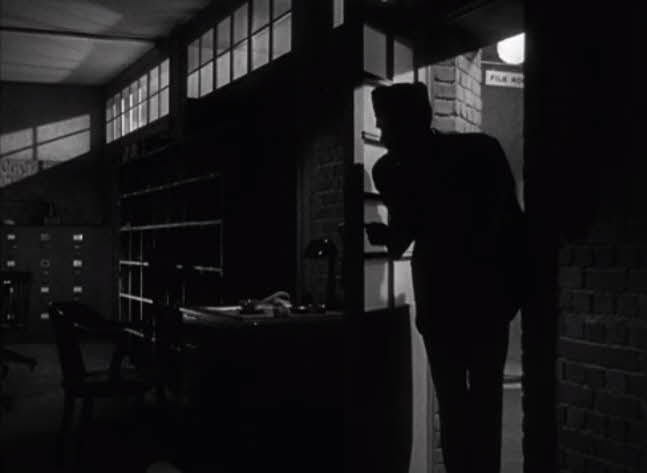
FROST: Schluetow, Schluetow. S...S...S... S, S, S, S, S, S... SCH to ST. This is where it would be.
PRINGLE: If it is at all, but I don't think it is.
FROST: Well, let's make good and sure.
PRINGLE: Sure.
FROST: Come on, open it, open it.
PRINGLE: Schlage, Schlangenberg, Schlagenspitz, Schlitz...
PRINGLE: Seems that some of them never got to Milwaukee.
PRINGLE: Schliemann, Schlissel, Schluetow...
FROST: There, there, there.
PRINGLE: Here's the Schluetows. Anton, Emil, Fritz, Gottfried, Waldemar...
PRINGLE: No Erika.
FROST: No Erika.
PRINGLE: Told you so. Gone to Nuremberg. Gone to Nuremberg.
PRINGLE: C'mon I'll take you back to your billet.
FROST: Erika VON Schluetow.
PRINGLE: Yes?
FROST: Von! It's under von.
PRINGLE: Oh, no.
FROST: Well, it would be like O'Brien. You wouldn't look under B, you'd look under O.
PRINGLE: All right, let's look under O.
FROST: Under V.
PRINGLE: V as in "vindictive.
FROST: What was that, Captain?
PRINGLE: I pity anybody who has you on his trail.
FROST: You pity a man who's consorting with a notorious Nazi? (Von Resnicek, von Reudesheim...)
PRINGLE: Did it occur to you there might be extenuating circumstances?
FROST: I expect any man who's over here wearing his country's uniform...
PRINGLE: Oh, that one. You expect him to be an ambassador.
PRINGLE: A salesman of goodwill. You want him to stand there on the blackened rubble of what used to be the corner of what used to be a street with an open sample case of assorted freedoms...
PRINGLE: ...waving the flag and giving out with the Bill of Rights. Well, that's not the way it works.
FROST: ...von Salm, von Salzburg, von...
PRINGLE: Suppose you stop for a moment and ask yourself how come he skidded off the road?
FROST: I'll tell you how. No moral brakes.
PRINGLE: That's it, going too fast. Only during the war, he couldn't go fast enough for ya. "Get on that beachhead, get through those tank traps, get across the Rhine. Step on it, step on it!"
PRINGLE: Faster, a hundred miles an hour, 24 hours a day, through burning towns and down smashed autobahnen.
PRINGLE: Then one day the war is over. You expect him to jam on those brakes and stop like that. Well, everybody can't stop like that! Sometimes you skid quite a piece, sometimes you go into a spin and smash into a wall or a tree and bash your fenders and scrape those fine shiny ideals
PRINGLE: ...that you brought from home.
FROST: It's about time such wrecks were hauled back into a garage. Anyone who forgets he's an American...
PRINGLE: Don't you forget that he's also a human being. What would you know about that?
FROST: Von Schlegel, von Schlittenheim...
PRINGLE: The loneliness is all stored up in him right down to his boots and it's driving him crazy.
PRINGLE: One day a pair of open-toed shoes come along. You want him to start asking  questions? Hey, what's your Party affiliation? What's your Social Security number?
FROST: Yes, I want him to ask, I want to make sure he's not doing something subversive.
PRINGLE: Are you qualified to call the pitch on this, Miss Frost? What's your life, anyway?
PRINGLE: Committees and sessions and adjournments and budget cuts and appropriations. What do you do for laughs? What do you do for tears for that matter?
FROST: For tears... for tears I cry, Captain Pringle. It may interest you to know I once cried for a man - till my eyes were half washed out of my head. -
PRINGLE: Not really.
FROST: I was serving on a very important subcommittee, there were five of us. One was a Southern Democrat. His convictions were as different from mine as night from day. I hated everything he stood for. I despised his politics.
FROST: But I loved him... insanely. I loved the Southern syrup in his voice. His mint julep manners. The way he'd look at me through his long thick eyelashes
FROST: ...when I was vetoing an amendment. He'd put his arm around me, just kind of lazy-like. Lean his head against my cheek. His hair had a deep wave in it. You know what he was trying to do? -
PRINGLE: What?
FROST: He was trying to sway my vote.
FROST: Once he drove me home from an all-night meeting, stopped his car on Earl Street.
FROST: For no reason at all, he said, except he was yearning for my lips. To tell you the truth, I was yearning for his.
FROST: But it would have meant betraying my platform and my constituents. -
PRINGLE: What did you do, Miss Frost?
FROST: I filibustered.
PRINGLE: You what?
FROST: I just kept on talking. The constitution, the Bill of Rights, poems, Longfellow, anything I could think of.
FROST: Von Schloss, von Schlossen,
FROST: von Schlumann, von Schlurmann, von... -
PRINGLE: No other man since the mint julep guy? -
FROST: No. -
PRINGLE: No more what you call yearning? -
FROST: No. -
PRINGLE: Sure? -
FROST: None of your business.
PRINGLE: Because I've been doing a little yearning ever since you stepped off that plane.
FROST: Captain Pringle! -
FROST: Don't! -
PRINGLE: Why not? You're not a Nazi. Don't tell me it's subversive to kiss a Republican.
 FROST: I am a Congresswoman.
PRINGLE: Yeah. Now I know how I'll cast my absentee ballot come re-election.
FROST: I'm here on official business. -
PRINGLE: This is official.
FROST: Oh! Now, listen. Listen.
FROST: "Listen, my children, and you shall hear of the midnight ride of Paul Revere
FROST: "On the 18th of April in '75,
FROST: ...hardly a man is now alive
FROST: Who remembers that famous day and year
FROST: "He said to his friend, 'lf the British march by land or sea from the town tonight" 'Hang a lantern aloft in the belfry arch of the North Church tower as a signal light."
FROST: Ooohhh...'One if by land and two if by sea "
FROST: 'And I on the opposite shore shall be ready to ride and spread the alarm "
FROST: 'Through every Middlesex village and farm
"'For the country folk to be up and to arm... '"Then he said 'Good night! ' and, with muffled oar, silent..."
FROST: Oh! ohhhh.
PRINGLE: Now, Congresswoman, may I have the floor?
FROST: You are entirely out of order.
PRINGLE: Objection overruled.
FROST: Oh! OH!
PRINGLE: Just, er, checking up on Paul Revere.
MP: Oh, sure.

A Foreign Affair

Words by Charles Brackett, Billy Wilder, and Richard L. Breen

Pictures by Charles B. Lang and Billy Wilder

A Foreign Affair is available on DVD from Universal Entertainment.

Saturday, November 4, 2017

Against the Wind: Indiana Jones and the Kingdom of the Crystal Skull

I was cleaning up some dead links on the blog and doing some random editing and corrections, when I noticed there were a couple of things that never made their way onto this blog, even though I mentioned them in some posts). That irritated me, probably more than the casual accidental blog-tourist who might have discovered nothing there. So, in that spirit, some corrections...and a new (semi-)feature, where I'm in a different frame of mind than the Wisdom of the Tribe. The Tribe isn't going to change it's opinion (too many of you--it'd be like herding cats), but, I'm not changing my mind, either. So, I make a case for it, and leave it to settle on its own. I'll post these on Saturday's (which is usually "Take Out the Trash" day here) under the collective title "Against the Wind."

Making Mountains Out of Mole-Hills

I've heard this film being called "critic-proof", and I'm not even sure what that means, but it implies that whatever the reviews say, people are still going to line up to see it, as if it's a critic's job to discourage people from going to see something they want to see, like it's part of the job description to trash something on your "Must-See List." And that if something truly acidic and toxic is written about it (and a Big Tall Wish is made) nobody'll see it (And they call this movie unrealistic!) Even Ford, Lucas and Spielberg were all talking (before the film's premiere at Cannes) that it was going to get savaged, and, since these guys are pros who know their stuff, it has been in some circles, mostly by mouth-breathing fan sites where "sux" dominates the descriptors.

So, despite the lowering of the bar of expectations by the film-makers, does it suck?

No. No, it doesn't.

In fact, I have to say I haven't been this delighted with a film in a long time. I will even go so far as to say that Indiana Jones and the Kingdom of the Crystal Skull fulfills the promises made by the very fine, original Raiders of the Lost Ark, something that its two sequels, however enjoyable they are in parts and particulars, never did.***

Before we go further, let us go back and recap what happened in the previous chapters...

This series (like I shouldn't have to tell you) is based on pulp serials in the B-movie tradition--episodic, cheesy, toying with History and making it up as it goes along. This one, being set in the late 50's, has to have more of a sci-fi bent than the religious-themed stories of the past set in the 30's and the 40's. It is, after all, the first adventure we've seen of Indiana Jones in a post-nuclear world. Think on that for a moment. Crystal Skull fits the period, at least cinematically, however much it messes with folks' expectations of what the film "should be" about (and let's face it, the biggest obstacle Lucas' films have are people's expectations for the "next" installment, and whether it compares to the film they already have in their head—in that case, you can't compete with what they have in mind*). Indiana Jones' timeline has finally caught up with the memories of George Lucas and Steven Spielberg.
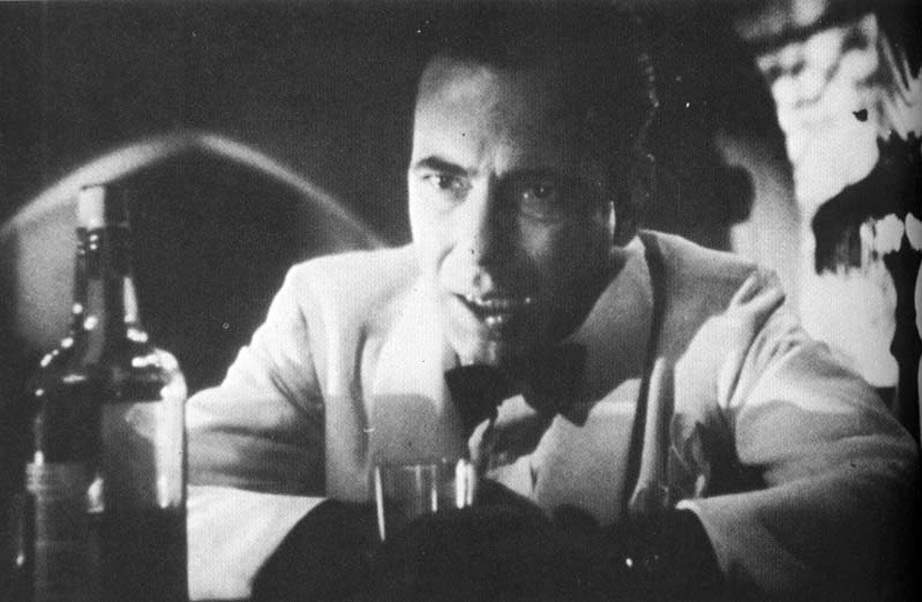
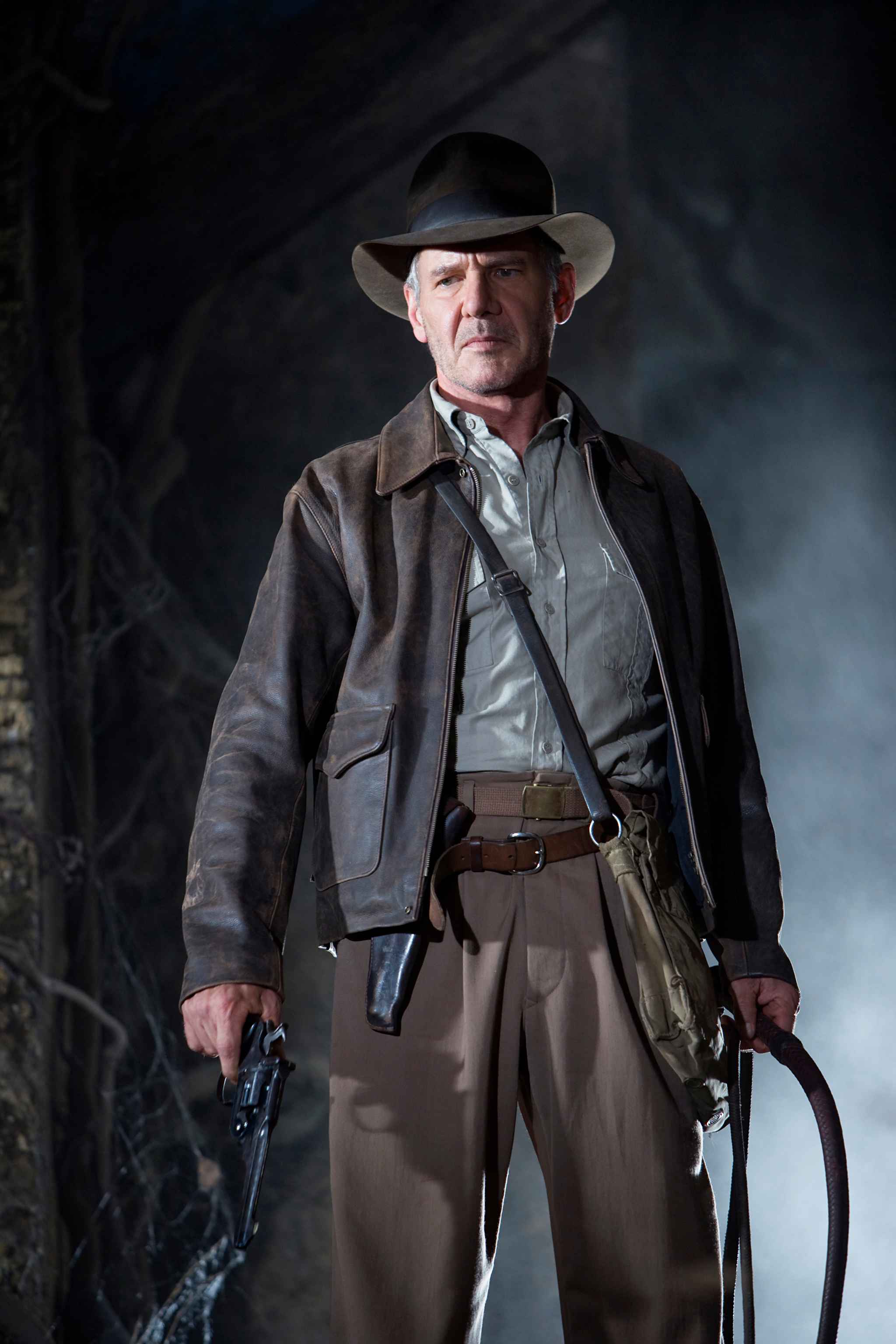
The filmmakers can't escape the fact that it's been 19 years since the last installment (and they've set it nearly twenty since the events of Last Crusade), and Harrison Ford's appearance is the nearly-constant reminder of it--he's broader, shlumpfier, more doughy in the face. But something magical happens a couple times in the film (once at a malt shop, once at a Mayan burial ground). Whether it's some CGI-gauze trick, or Ford's sense-memory playing the character kicking in, but once the dialogue turns to ancient civilizations and archaeology, the lines seem to disappear from Ford's face, and he slots back into the old/ young Indiana Jones the same way the camera "slotted" into the Bogart-drinking-his-sorrows Casablanca-shot in Raiders after Jones has seen Marion supposedly killed in a truck explosion. It's eerie, but like the occasional forays into the transcendent in the series, it's a good kind of eerie.
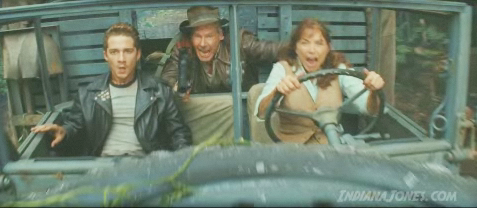
We've mentioned Marion, and, as the posters tell you, Marion Williams nee Ravenwood (Karen Allen) is back, and she's terrific--a breath of fresh air after Kate Capshaw's and Allison Doody's ingenues (the one too high-pitched, and the other tamped-down into irrelevance). The years have treated her far better than Ford, and she still has that incandescent smile and has been given a lot of "Dr. Jones-take-down" dialogue that suddenly snaps Ford's performance into a higher level of energy. Allen has remained well-versed in what Spielberg informed her during the first film was the "Sam Peckinpah School of Acting," something that Cate Blanchett is equally fine at--she's looser and more fun than she's been in years, and just the sight of her Commie commandant standing in a careening jeep during a bumper-cars jeep chase through the Amazon jungle is one of those things you think you'll never see.
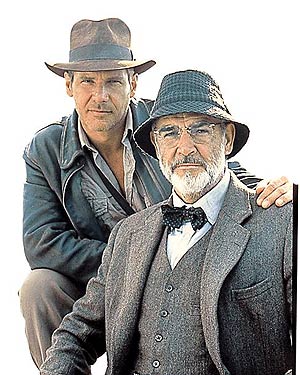
So, Shia LaBoeuf. Is he "Short-Round"-irritating, or made too much a thing of? Neither, though he has a prominent role throughout. For some reason, whether it's the magnitude of the project, or Spielberg directing, LaBoeuf's not as energetic or inventive as he's been--maybe we should call his character "Short-Leash"--but, he's a good foil for Ford and their interaction, especially in one pause in a motorcycle chase deliberately recalls the Ford-Sean Connery relationship in Last Crusade.** One is never sure if he'll be pulling out a comb or a switch-blade when he reaches into his motorcycle jacket (his aping of Marlon Brando's gear in The Wild One is a clever 50's variation of Indy's gear), and there is a great visual joke when he confronts an Amazonian resident with the same hair-cut.
As for director Spielberg, he reportedly re-studied his earlier "Indy" films to recall the way "kid-Spielberg" shot films and there are plenty of his early "headlights-into-the-camera" adrenaline shots (and even one of his Sugarland Express pans), but the takes are a bit longer-held, he's not quite so anxious to cut away, and his cinematographer Janusz Kaminski brings a new visual beauty that supplants the grit-in-the-lens of the earlier films. The elder Spielberg is also incessantly filling the film with visual ironies--grace-notes--that the younger Spielberg would save for a separate shot. There's an awful lot of stuff going on under the surface of the fire-fights, the explosions--some big ones--that betray the more mature film-maker, and man, Spielberg has become. And unlike the last two, which were short on background, and long on chase sequences, this film is over-stuffed with references, languages and the accustomed meta-recall of the past films.*** 
Not to say there isn't a lot of action. There is. That Amazon-chase between the particulars (the film is structured like a race--like Raiders and Last Crusade--with the good-guys and bad-guys all after the same thing and never too-far away from each other) is an invigorating combination of possibilities like a puzzle with every combination of inhabitant in vehicle and opponent in combat possible. It's dizzily constructed. And just when you start to think, "Wait a minute, where's..." your questions are answered.
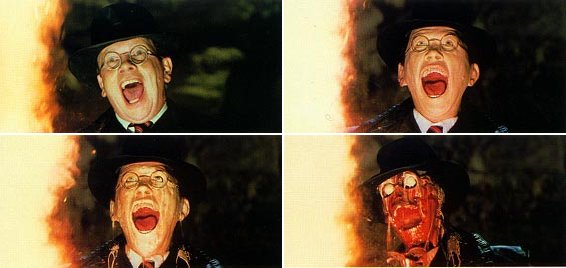
A lot of the action is outlandish, but, surprise! It always has been. How can you complain about verisimilitude when you've had melting Nazi's from the vampire-angels and God's death-ray of the Ark of the Covenant, or Thuggee priests pulling out sacrificial victim's flaming hearts, and how some victims in a lava pit burn, but the heroine-in-diaphenous pants doesn't, or 700-year old Knights Templar still guarding the Holy Grail. Get real, people. Because the movies aren't. Like Indy in The Last Crusade film-goers have to make a leap of faith, and it needs to be done with an open heart. Or at least an uncynical one. Or one open to the possibility of enjoying oneself.****
Okay now, go out there and have fun.

Wilhelm Alert: the book-carrying nerd in the library during the motorcycle chase.
-------------------------------------------------------------------------------------------------
* Somewhere along the way I've talked about "Mom's Apple Pie Syndrome"--where our memory of a cherished movie runs counter to the actual quality of the work, ie. "Nothing tastes as good as mom's apple pie," but only because that was your first run-in with the concept, and your impression of what "good" apple pie should be like may include a runny interior and scorched crust (I was blessed with a mother--God love her--who was a lousy cook, so I tend to be immune). So, too, the cherished movies of your youth may actually be crap, though we may delude ourselves otherwise, with our 'gee-whiz" innocent first impressions. The phenomenon became real for a few incredulously chagrined "Man from U.N.C.L.E." fans who, seeing the series for the first time in years on DVD last year, endearingly wondered why MGM chose to run the shows through a "crap filter" making the sets look like back-lot sound-stages with cheap "foreign" localization, lousy effects, obvious writing and some horrible performances. Ah, deluded youth. Nothing is so sweet as a young man's fancy for a film of their childhood. And nothing is so rancid as the bitterness that follows a fan-boy's crush.

But it's not the film's fault. Ever. Beauty is in the mind of the beholder.

** And if you haven't figured our the "Indiana" Jones-"Mutt" Williams relationship yet, what can I say? You're either a) five years old, b) this is your first movie or c) "denial ain't just a river in Egypt, honey." Look at their names, kids, and remember where Dr. Henry Jones, jr. came up with the name "Indiana." These films are all about clues.


*** Sometime, when Summer is over and there are no more surprises, I'm going to do a big-old analysis of this movie and why it is the natural sequel to Raiders. (Hint: It involves the clockwork-intricacies of ancient civilizations as well as the conflicts when a Man of Science is confronted with the "hard rain" of spiritual mythology) It's roots go pretty deep--which is refreshing after the previous two--and bear a full airing of the secrets buried within it. To do so now would give away far too much and contain too many spoilers of large and small varieties.
VVVVVVVVVVVVVVVVVVVVVVVVVVVVVVVVVVVVVVVVVVVVVVVVVVVVVVVVVVVVVVVVV
**** Do I have ANY complaints? Yes, the frankly extraneous character of "Mac" McHale played by Ray Winstone. McHale is designed as an untrustworthy character, but he is so untrustworthy that one wonders why he's not just shot by either party at any time during the proceedings. He's so greedy he's a bit reminiscent of Daffy Duck in a hall of treasures: "Mine, Mine, Mine!" The character is such an unnecessary plot contrivance that he might have earned the name "Aringarosa" if the name hadn't already been taken.
--------------------------------------------------------------------------------------------------------------------------

"Indiana Jones and the Terrible Age of Wonders"

Last year's fourth entry in the "Indiana Jones" saga was met with derision while it raided a diamond mine at the box-office (making it to the top of many lists of 2009's more successful films—including a conservative publication that used its Commie villains to claim that it heralded a surge by the public to right-minded films, despite the fact that the rest of the films mentioned on the list flopped...and flopped badly; Indy 4 alone raised all boats). There were complaints that it wasn't as good as the first three (a clear case of "Mom's Apple Pie" syndrome* among the fandom in fedoras—I felt it wasn't as good as the first one, but that's it): there was too much "Mutt" (Shia LaBeouf) and CGI, the familial complications too obvious, some characterizations a bit spurious,** and that it "nuked the 'fridge"—which briefly supplanted "jumped the shark" for hitting a false note in the national media (they always chortle when the fan-base eats its own) before they went back to not reporting the news. 
That last one stuck in my craw; it showed that the fan-base didn't "get" what the movies are—a post-modern, hi-tech take on the past and the low-ditch movies' past, in particular. It didn't have to adhere to "reality"—it never did. Look at Raiders of the Lost Ark, admittedly the best of the bunch—a 30's film filled with flying flap-jacks, Nazi's (Nazi's everywhere, even melting ones), Hitler myths, and tales of apocalyptic power. Nobody questioned "who" would put the rolling rock back after it crushes an intruder. Nobody asked why a tomb unopened after centuries would still have live snakes in it. One or two might have asked how Indy rode the back of a sub all the way to Nazi Island (It didn't submerge? At all? Then, why'd they take a SUB?!). Nobody questioned the ark.  It didn't have anything to do with reality, but rather with a mythic age of B-movies and wishful thinking that never existed, a cross-roads ("'X' marks the spot") between gritty, slithering reality and far-fetched fantasy, and the other films in the first trilogy followed that same map of fictional territory. 
But not as well.  Where the other two films, The Temple of Doom and The Last Crusade, failed to engage me were their wholesale abandonment of the what made the first film a Boy's Adventureland, and became a series of drawn-out chases, and half-hearted attempts at Mythos. The Temple of Doom—a favorite among some film-critics, as it challenged Indy's hero-concepts and went to darker psychological places than mere musty caves—bugged me not so much for its inaccuracies (the long fall from a plane on a life-raft, the ripping out of a sacrificial victim's flaming beating heart to the SV's—and the audience's—disbelief), but it's insistence to present a Disneyland-like "mine-shaft ride" that looked for all the world that it was populated by puppetoons. Then, there's the small detail of it being a prequel in which Jones "learns" that there's more to his mythic quests than robbing graves for fun and profit—which is intrinsic to the character, and is part of the make-up of the somewhat less-than-honorable "Indiana" Jones we first meet in the chronologically later Raiders. That lesson must not have "stuck."
But, what they do have in common—what they all do—is slap the stubbornly reality-based Jones into a sense of wonder: Raiders... confronts "Indy" with a full-on-Wrathful presentation of something that he dismissed with a casual "if you believe that sort of thing."  ...The Last Crusade makes him take a literal "leap of faith" to save both his life and his father's, and also smashes his long-held preconceptions about his Dad. "...Temple of Doom" has that previously mentioned quick-dissolving lesson of the Sankara stones and re-defines what "Fortune and Glory" can be to the doctor. "Indiana" Jones is a teacher, but in his movies, he must learn things. His character must start with a cherished "truism" and he must learn that although he may have all the answers, there are more questions that he hasn't even considered.  At one point in ...The Kingdom of the Crystal Skull, "Mutt" asks "Indiana:" "You're a teacher?"  And Spielberg weights the reply down, as it's an important one: "Part-time."

The rest of the time, he's a student himself, still learning.
In Indiana Jones and the Kingdom of the Crystal Skull, Dean Charles Stanforth (Jim Broadbent), says to Dr. Henry Jones Jr. (Harrison Ford): "We seem to have reached the age where life stops giving us things and starts taking them away." They have both aged, lost colleagues and parents, and their jobs are on the line. And "Indy" has just ridden the crest of a nuclear shock-wave in the Nevada desert, where he has seen two amazing things, off and on the Earth: the corpse of an ancient astronaut, and the limit of Man's power in the form of the mushroom cloud of a hydrogen bomb. This is the extent of our knowledge on Earth and it is a fearsome one, one that could mean our destruction at the hands of our abilities and our arrogance to use it. Behold the power of knowledge and fear.
This is the first of two images (that Spielberg deliberately composed) of "Indiana" Jones in rapt observation of an unfathomable thing that buttress Indiana Jones and the Kingdom of the Crystal Skull. In both, he is dwarfed by the event, small and helpless—all he can do is watch. In the first, he is witness to the extent of Man's knowledge.  In the second, as he watches the launch of an alien race's*** craft to inter-dimensionally travel "the spaces between spaces," something far beyond his ken and catechism. The one represents all that we know, and the other opens up another Chamber of Secrets. "Indiana" Jones can travel the four corners of the Earth, and there is still so much more territory to explore, and, indeed, more than he can know for certain. 
The personal myth that Jones must resolve is that of age and the taking away (the bomb) and the giving (the new experience). For the loner Jones, that includes new worlds to conquer...and that is celebrated here...but he also, like The Outlaw Josey Wales, finds himself, in this one, acquiring a family he didn't know he had and never wanted, flying in the face of Stanforth's gloomy assessment of their lives as being "one foot in the grave" (like "Indy" hasn't been there before). In this terrible age of wonders, there is always more to learn...more "treasure," translated by the Incas to "knowledge" and prized more than gold. Life, no matter how old we get, never stops giving.  

Not if we're observant, anyway.

For me, ...The Kingdom of the Crystal Skull represented the best, most true, antecedent to the original Raiders of the Lost Ark, fully embracing the era it is set (the 50's) and the B-movie concepts being put out at the time, and it is the strongest presentation of the concept of the "learning teacher" since Raiders...  ...The Kingdom of the Crystal Skull represented, to me, the true sequel, while the others were just regurgitating concepts. This one, like Raiders, raised the stakes.


MY only disappointment with it was, that if it's set in a 50's B-movie world, where's the giant scorpion that the hydrogen bomb creates—there were all sorts of "nukular monsters" in the films of the time, their own metaphors of the costly nature of Knowledge. But Lucas and Spielberg's intentions were to turn that metaphor inside out. Knowledge isn't destructive. It inspires creation. And new worlds to explore.
-----------------------------------------

There is talk (and only talk) of a fifth Indiana Jones movie, and while it has moved some to despair, for me it has given me fits of giggling anticipation. Imagine Indiana Jones in the B-movie drive-in 60's, with the good doctor investigating SDS students planning a lysergic acid dump in a city reservoir, while a Beatle-browed Mutt has joined a Hell's Angels sect that practices Trascendental Meditation, and only an exploration of "The Silver Chord" can save Indy from the Ultimate Bad Trip. Meantime, there are rocket-packs, video-phones, IBM computer-rooms, and ESP experts, all figments of a 1960's that briefly sparked the imaginations of the time, but never seemed to catch on. We were too busy going to the Moon, at the time.

I think it would be groovy, man.

Call it "Indiana Jones and the Electric Kool-Aid Acid Test."

* "Mom's Apple Pie" syndrome is the one where fan-boys says that the movies they liked as kids were better than anything that had come before or since (like "Mom's Apple Pie"), a clear indication that they have a narrow focus and experience.  The corrollary is that expressed when a film-maker changes a movie for whatever reason and the fan can't come to grips with it—"They raped my childhood!"—a despicable sexually ignorant comment that indicates the person hasn't known anyone who has been (or might have been) raped or attacked.

** Admittedly so, with the characters of  "Mac" (Ray Winstone) and Oxley (John Hurt)—the latter a last-minute re-write when a "retired" Sean Connery decided not to reprise his role as Indy's father. He probably decided there weren't any golf courses near filming, or his dismal experience filming The League of Extraordinary Gentlemen in Prague left such a mark it didn't compensate for his affection for Spielberg, Lucas and Ford.

*** Here's another instance of last-minute tinkering.  Lucas wanted aliens, and Spielberg with three E.T. movies under his belt didn't want to go there.  So, the ancient astronauts became "inter-dimensional" beings, rather than space-aliens.  It actually works better that way.  Aliens = space.  We know all about space.  But, other dimensions?  That's a concept that expands the mind and the territory we inhabit.  "There are more things in Heaven and Earth..."  And even, in between.

Friday, November 3, 2017

Love Nest (1951)

Love Nest (Joseph Newman, 1951) Budding novelist Jim Scott (William Lundigan) comes back from military service in Europe, stationed in France, only to find that he's changed jobs and addresses. In his absence, wife Connie (top-billed June Haver) has taken the money he's sent home and put the down payment on a New York brownstone, complete with noisy water-pipes, a coal-fired furnace (coal deliveries are problematic) and eccentric tenants.

He meets them pretty quickly; he walk in on the shower of one of them when he finds that Connie has moved to the English basement to accommodate all the tenants and for their convenience--the upper floors all have the nice rooms and, after all, they can fix things up. The tenants include the usual lower middle class families, widows, and "kravitzers," all with issues, but take more of an interest in things when Jim comes home. For him, his first hours home are a "boot camp" of things that can go wrong, like that chandelier he keeps bumping his head on, and the entryways that are just a little too low. Civilian life will be painful and take some getting used to.

That's why you have friends, like Ed (Jack Paar--yup, that Jack Paar), who barges in on their reunion night with a bottle of champagne, a welcome home present for Jim (a hammock), and a little too much unwanted attention to Connie for Jim's comfort. That's the thing about this apartment building--everybody is in some sort of love confluence, or pining for it. It makes things...complicated.
Take Bobbie Stevens--when an apartment upstairs goes empty, Jim is only too happy to offer it to his "old Army buddy" (as he tells Connie). But, when Bobbie shows up, it's in the form of Marilyn Monroe (take note, if you're watching just for her, she doesn't show up until 33 minutes into the movie), much to Connie's suspicions, and her name is actually Roberta, former WAC. Jim's been tasked with repainting the place to spruce it up, but with all the PG shenanigans going on, the only appropriate color would be green. It turns a darker shade when Ed takes an interest in Bobbie, and her apartment seems to become the party center of the address. 
Then, there's kindly Mr. Patterson (Frank Fay)--call him "Charley"--who takes an apartment, pays with cash that he produces from a wad of bills, and who takes unexpected business trips that he's a little vague about...but he comes home flush with cash, and renews his interest in the local ladies who find him gentlemanly in the "old school" way and not entirely unattractive. Everybody likes "Charley"...except when Connie and Jim go out for an anniversary dinner and find Charley at the same restaurant dancing with another woman...when he's said that he's out of town on a business venture. Seems Charley is a lothario making his living fleecing lonely widows out of spending money.
Love Nest was written by I.A.L. Diamond, who'd done quite a few screenplays, but was about to have his closest partnership with Billy Wilder--they'd be collaborating on Love in the Afternoon (released in 1957) and work non-stop until the end of their careers. You can tell Diamond's light touch with just a dash of sauciness--his next work would Monkey Business for Howard Hawks (he did a lot of work with Monroe), but with an affectionate wink that never turns salacious (at least until his work with Wilder in the 1960's). Director Joseph Newman keeps everything light and breezy and nobody seems discontented for long, not even when building complications come along and Jim and Connie start actively seeking selling the place.

I was attracted to look at Love Nest for one reason...it was the last film of Frank Fay, who originated the role of Elwood P. Dowd in "Harvey" on Broadway. One can see where Fay might have been successful in the role; his Charley is always generous and affable, but slightly seedy and the way he plays it can't help giving you the feeling that he's hiding something. His Elwood must have certainly been darker than James Stewart's, which might have been one of the reasons that the play was the fourth longest running drama in Broadway history.
One other note: if the title tune "Love Nest" seems familiar to older folks, it's because it was used as the theme song for "The Burns and Allen Show" from 1950 to 1958--it was originally composed in 1920.

Thursday, November 2, 2017

Harvey (1950)

Hallowe'en is over (but like things in most horror movies, it WILL be back), but it doesn't entirely leave, haunting as it does, so here is a review for a movie that is not quite "Hallowe'en dark," but deals with the supernatural...in spirit.

Harvey (Henry Koster, 1950) Mary Chase finished her play "Harvey" in 1944; she'd been working on it for two years, inspired by a neighbor who'd lost her son in the second world war—"could I ever make her laugh again?" was her spark of inspiration, and, having written a couple of Broadway flops, the work was slow going. She woke up one morning at 5 a.m. with the vision of a psychiatrist being followed by a large white rabbit.

That was Chase 's pilot light for the play which would become one of Broadway's longest-running hits, win the Pulitzer Prize for Drama in 1945, and become a staple of local theatrical troupes when a season of Strindberg, Ibsen, and Albee doesn't bring in the patrons. Long associated with James Stewart in the role of the "bubble-off-plumb" protagonist, Elwood P. Dowd, the play premiered and became a hit with actor Frank Fay in the part, which goes to show how infectiously pleasing the play is; Fay was a popular vaudevillian, but despised in real life for being a drunk, a fascist, and an avowed white supremacist, who (it is rumored) might have been the inspiration for the character of Norman Maine for "A Star is Born" after his 1928 marriage to Barbara Stanwyck saw her rise to stardom, while his career sank...that is, until "Harvey." (Fellow vaudevillian Milton Berle once said that "Fay's friends could be counted on the missing arm of a one-armed man"....ouch).
The film rights for the play were purchased for $750,000—a huge extravagance at the time—and not made until 1950, as the production was contractually bound not to be produced until after the play's stage-run had completed. Many actors were considered for the lead of Dowd ("Elwood P.")—Bing Crosby (maybe, but could get too folksy), Cary Grant (too aggressive), Gary Cooper (if we're thinking Capra, sure), Jack Benny (oh...the comic timing on that one), and James Cagney (a little too authoritative, maybe), but it came around to Stewart, who'd appeared in the Broadway version during Fay's sabbaticals. Josephine Hull as his sister Veta followed from the stage and manages to overshadow Stewart in her scenes, winning an Oscar doing so.

The film follows an eventful day in the life of Elwood P. Dowd, never married, frequent tippler, and affable to a fault, making friends wherever he meets, including with a 6' 3 1/2" tall rabbit named Harvey, a pooka spirit that no one but Elwood can see. Dowd's complacency with his imaginary friend is a constant burr under the bonnet of his sister Veta (Hull), whose main concerns are keeping up appearances and the encouragement of any "gentleman callers" to collect at the door of the Dowd estate that might make an attractive mate for her daughter Myrtle Mae, whom, of all the Dowd's is certainly the Dowdiest.

But, on this day, Elwood has hung a portrait of him and his friend and something in Veta snaps. She decides that she is going to have Elwood committed to the local sanitariun, but to the institution's administrator, Dr. Chumley (Cecil Kellaway), the calm mild-mannered Elwood seems completely sane, while his apoplectic sister, in explaining her situation, comes off as completely bonkers. She ends up being institutionalized, while Elwood is allowed to skip out and make his rounds. This causes enough complications in the lives of the institution's workers, particularly in the threatening of one of the examiner's, Dr. Sanderson (Charles Drake), that Elwood comes under scrutiny for his peculiarities.
It turns into an examination of who might really be the sane among us, calling into question what is "normal" and what is merely a tilted version of the world, with the experts seeming to be at a disadvantage. They come across as neurotic and with unsatisfied needs, as if poking around into other people's souls for so long has prevented them from taking much of a look into their own. 
It's a fairly straight-forward presentation of the play, with a bit of softening of Elwood as a drinker (the Hays Code did not encourage this for characters of a good nature). Stewart was well-versed in the play and gave director Henry Koster the suggestion of filming him off-center, allowing there to be physical space on the screen for the invisible rabbit to inhabit, but also to show the slightly askew demeanor of the seemingly normal Dowd—Stewart plays him so kindly that the visual imbalance only helps reinforce that his character is a bit "off." And, following, the play's dictates "Harvey" is never seen, leaving the audience to question...until the last possible moment...whether he "really" exists, or is merely a figment of Dowd's hazy imagination.
I've always been enchanted by "Harvey," even as a kid, but adulthood has made me entranced with the melancholy aspects of the story...of the fellow, devoted to his parents, who has filled the empty space in his life after their deaths with a wish-fulfillment of the same sort of closeness he had with them. I've seen it played for laughs—as in the movie—and I've seen it (on stage) played for pathos (only semi-successfully) and came to the realization (although that, too, might be imagination) that the fine tightrope that the presentation presents needs to be gingerly trod or else the whole exercise turns into a disaster. I've often contemplated that, and what a more modern version of "Harvey" might be like, even though it hearkens back to old world values and manners. Spielberg was actively trying to do a new version of it, first approaching Tom Hanks to star (who begged off, thinking it would be folly for him to try and follow Stewart's interpretation) and then, for awhile, Robert Downey Jr. was set for it—you'd think that would be a lock, but Downey insisted on script changes that Spielberg was not happy with. Spielberg chalked it up to casting issues and abandoned a remake.
Is "Harvey" a manifestation of Dowd's drinking or his melancholy ache for companionship? Either interpretation works. But, I always had in mind a different interpretation, a more modern one, that hinged on one particular actor who might be able to pull it off—Jack Nicholson. There's something about his persona that I've always thought might fit Elwood Dowd to a tee. Elwood's just a little aggressive ("I would like to invite you to dinner..." "Oh, that would be lovel-" "When?") and a bit vague and lost. Maybe Elwood smokes weed rather than drinks, or maybe he's experimented with hallucinogenics...which might explain the "Harvey" manifestation. But, also not entirely (as it should be). Elwood has no family of his own—he has his parents' family, and with his mother's death, he's more than a little adrift, with death as a seen presence of life. Maybe he's drawn to Harvey...or has drawn Harvey (depending on your point of view)...because Harvey can't die. Already being a spirit, he represents a friendly manifestation of death...that can never be lost to it. It's a win/win that can never be lost. No wonder Elwood's so cheery.
No, combine a bit of Nicholson's Southern lawyer in Easy Rider, his adrift musician in Five Easy Pieces, some of the impishness of McMurphy of One Flew Over the Cuckoo's Nest and you have a good starting point for a new Elwood, old and wise enough to know the rules of engagement in the modern world, but just not giving a damn. It's his little bubble-verse, damn it, and you're welcome to climb in (glad to have ya), but don't go round poking at the bubble...or it'll burst. I'd like to see that "Harvey." Heck, I'm always delighted to see this version of Harvey.

It's a win/win that can never be lost.