Sunday, August 7, 2016

Don't Make a Scene: Batman (1989)

The Story:  Hallowe'en's coming. The costumes are coming out of moth-balls. Here's a scene featuring the one get-up that shows at every party, because the idea's just too powerful and too easy to get and everybody knows it. Plus, it's easy to do. And since The Dark Knight, you don't even have to do it well.

This scene is the "coming-out party" for "The Joker" from the Tim Burton version of Batman, done in 1989, on the 50th anniversary of the title character's creation. A "Batman" film had been talked about in Hollywood for many years, but nobody had the right "formula" for how to present it. "Batman" has always followed "Superman" in media: first, in comics. then as cheap movie serials, then television, with "Batman" making a bizarre addition to pop culture by emphasizing the bright-colored "antic" nature of the medium, which was labeled as "camp." Audiences didn't stay focused for long (two and a half seasons), so when "Superman" made his big budget movie splash in 1978, a "Batman" film seemed a natural next step. But how to play it? Like the television series, or like Superman: The Movie

It took Warner Brothers Studios (who own DC Comics, the owners of Batman) eleven years to figure it out. 

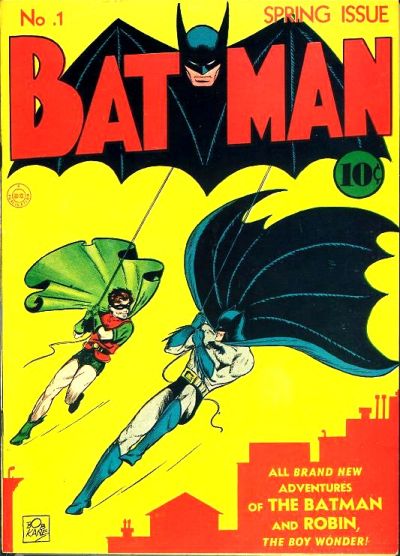
The Joker had been flitting around Batman since those days in 1939—he was one of the first of the Batman "rogues gallery" (in fact, there were not one but TWO "Joker" stories in the first issue of "Batman" comics. In the 60's, the Joker was a little late to the game, not showing up on the Batman TV series until the third week (after The Riddler and The Penguin).

Over the years, though, "Joker" has become THE Batman villain, eclipsing all the others (and the one the writers seem to have the most fun using to compare and contrast with the Batman—order versus chaos, that sort of thing).  In the beginning, he was just another freakish hood, robbing banks, killing people. Then, he was softened to be more clownish, with an off-beat sense of humor as to how he'd pull off crimes. In the 70's, the comics writers took him back to his roots—murderous, mad, and motiveless. Lately, he's become truly grotesque in the dark "New 52" world of the comics—with a forked tongue, and now wearing his own face as a mask. Yeesh. 

The scene, as displayed, could use Danny Elfman's antic circus music in the background, but you've got the videos for that. 

The Set-Up:  A robbery by the Grissom gang, a notorious gangster mob in Gotham City, has been stopped at the Ace Playing Card Co.  One of the victims of the police shoot-out is Jack Napier (Jack Nicholson), first lieutenant to Carl Grissom (Jack Palance) and rival for the attentions of Grissom's woman, Alicia (Jerry Hall). A stray bullet has hit Napier in the face, and despite his best efforts, The Batman (Michael Keaton) cannot prevent the hoodlum from falling into a vat of toxic chemical waste. Incredibly, Jack survives, but an early morning visit to a butcherous physician cannot help matters on the face of it. 

Action!


INT. GRISSOM'S PENTHOUSE - NIGHT
The private elevator HISSES open. JACK steps out, bundled up in a trenchcoat, muffler, and slouch hat -- his face concealed from view. He plops in the big plush swivel chair behind Grissom's desk.
GRISSOM (O.S.) That you, sugar bumps?
Grissom WADDLES IN fresh out of the shower, a towel wrapped around him. Using a smaller towel to dry his hair, it's a moment before he sees the bundled-up figure at his desk.
GRISSOM Who the hell are you?
JACK It's me. "Sugar Bumps."
GRISSOM Jack? (advancing cautiously) Thank God you're alive. I heard you'd been... 
JACK Fried. Is that what you heard?
Jack stands and gestures him over to the empty chair. Grissom moves when he sees the gun pointing at his belly.
JACK YOU SET ME UP! (beat)
JACK Over a girl. You must be insane!
Grissom surreptitiously reaches for a desk drawer.
JACK Don't bother.
GRISSOM Your life won't be worth spit.
JACK I been dead once already. It's very liberating -- You have to think of it as therapy.
GRISSOM (beginning to panic) Jack, listen -- we'll cut a deal --
JACK Jack? Jack's dead, my friend.
JACK You can call me...
JACK ...Joker.
He flings away the hat. RIPS THE MUFFLER from his face. And --
as Grissom gasps in shock --
stands revealed in his full horrendous glory. His flesh is bleached bone-white. His hair is a luminous seaweed-green. And his cheeks are torn and puckered from the bullet wound, TWISTING HIS MOUTH INTO A HIDEOUS, PERPETUAL HARLEQUIN'S GRIN.
JACK And as you can see, I'm much happier.
Jack begins to GIGGLE, building to hysterical LAUGHTER.
Grissom makes a lunge towards his desk drawer.
Jack FIRES.
AND FIRES AGAIN 
...UNTIL THE CLIP IS EMPTY.
EXT. GRISSOM'S BUILDING - NIGHT We TILT UP the facade of the skyscraper, arriving finally at the TOP FLOOR: a PLATE GLASS WINDOW spiderwebbed with cracks where Jack's bullets hit.
INT. GRISSOM'S PENTHOUSE - NIGHT (THAT MOMENT)
Darkness. JACK -- or, as we'll know him from this moment on, The JOKER -- sits in Grissom's swivel chair and surveys the moon-drenched city.
JOKER (nostalgically) Gotham City.
JOKER It always brings a smile to my face.
As he swivels in the chair he notices a copy of the Globe (now blood-splattered) lying on Grissom's desk.
The head-line catches his eye. WINGED FREAK TERRORIZES GOTHAM'S GANGLAND.
JOKER: "Winged freak..."
JOKER: "...terrorizes"
He picks up the paper and starts HUMMING.
JOKER Watch it, Batman. Wait'll they get a load of me.
JOKER Oooooooo....
JOKER  Ooop.  Ooop....
Joker begins to GIGGLE, building to hysterical LAUGHTER.

Batman

Words by Sam Hamm and Warren Skaaren

Pictures by Roger Pratt and Tim Burton

Batman is available on DVD from Warner Home Entertainment.


The Defector

The Defector (Raoul Levy, 1966) The Defector is mostly known for being the last film starring Montgomery Clift. That casts a pall over a minimalist spy film that already has a dark melancholy tone in stark relief to the high-contrast spate of spy films bring released at the time that had more to do with Fu Manchu and Dr. Mabuse than with anything to do with the real-life geo-politik of the Cold War. The Defector is a few Hitchcock steps below even his rather sedate Cold War thrillers Torn Curtain and Topaz, resembling the former in outline, but not in form.

The film is based on a 1963 Paul Thomas novel "L'Espion" which took advantage of the recent construction of the Berlin Wall (ground-breaking and barbed wire installed August 13, 1961) to expose the porousness of the wall (or its lack) in the early days of the physically divided city (as did the similar "The Spy Who Came in From the Cold," published the same year). Crossing over—by any means—became an act of heroism and defiance. It was the very stuff of drama in real life. But, what sort of person would make the attempt?

American physicist James Bower (Clift) is approached by a CIA operative (Roddy McDowell) who proposes Bower take a detour on his vacation to West Germany by making contact with an East German associate named Grushenko, who is willing to smuggle microfilm containing results of Russian missile tests to the West...but only if Bower will be the one who couriers it. The two are distant colleagues—one's in the U.S. and the other behind the Iron Curtain, so Bower is a little reluctant. But, when the CIA threatens to interfere with his grant processes, Bower agrees.
When Bower gets to the East, he is met—"welcomed" is too strong a word— by "Public Relations Counselor" Heinzmann (Hardy Kruger, the movies' second favorite Aryan after Oscar Werner), who has been tasked by party operative Orlovsky (David Opatashu) to take Bower's visa with the assurance that it will be returned once Bower gives him the location of Groshenko—which, at this point, Bower doesn't know. The American protests, but is powerless to do anything about it and so is released, but under surveillance. When he gets to his hotel, he finds that he's been moved, without his authorization, to another room. He calls the management, but they insist he stay in that room.
There's a reason for that,  Bower begins to hear voices, the phone rings with no one on the other end of the line, the room begins to spin and pretty soon Bower is completely disoriented as the East tries to brainwash Bower into revealing Grushenko's whereabouts. While Orlovsky pushes for more invasive means of persuasion, Heinzmann tells him that Bower will be his responsibility solely.
After the surreal brain-washing sequence, the movie turns into a true cat-and-mouse game as Bower attempts to make contact with Grushenko and must come up with a plan to cross the border into West Germany without the benefit of papers. Clift, despite being in poor health, does his own stunts, in a long semi-tense sequence where he must negotiate a waterway that is routinely guarded by soldiers who are alerted to looking for an American physicist.

The Defector is a perfunctory spy movie—one cannot use the word "thriller" ("confuser" might be a better term)—that is not without irony (can you make a spy film that doesn't have that?) and at least accomplishes its goal of having a beginning, middle and end...and a final bitter denouement, in which anything pure must be expunged. Nothing, really, can be done without sacrifice.
 
Clift died three months after making this movie.

Raoul Levy committed suicide six moths after the film hit theaters.  

Thursday, August 4, 2016

The Secret Life of Pets

Neutered Pets
or
"...no biscuit."

The creators of Despicable Me have come out with a new semi-original movie The Secret Life of Pets and top-loaded it with an entertaining trailer. But, as lovely a film as Despicable Me was, it didn't deserve (unless you count the box office) a sequel or the flood of seemingly endless Minion knock-offs that generate thoughts of minion-cide. Directors Chris Renaud and Yarrow Cheney know a money-train when they see one and when they hit the jackpot they appear to stay at the same table in the hopes of another jackpot rather than count the diminishing returns.

So, it's a relief of sorts to see them come up with a new concept and The Secret Life of Pets seems to fill the bill. It is one of the mysteries of life what your quadruped friend does when you're absent. I, myself, suspected that my last animal was day-trading on the computer, while the less imaginative of us merely suspects that it's peeing on something. I've had the opportunity to watch my dog on an internet-fed closed-circuit of the doggy daycare he went to, and his behavior was, in the company of strangers, typical. He would shun attention, turning his back on the caretakers, but inch closer to them as if to say "I'm here, ya know. You could pay attention to me if you wanted to, not that I really want that, of course." 


My dog was an aggressive breed. But, he turned around to be passive-aggressive.
Renaud and Cheney exploit our curiosity with this movie. They start with a basic recap of the trailer—various domesticated's doing what we might suspect they'd do given thumbs—parakeets geeking out with flight simulators, cats exploiting privileges, including kitchen privileges, animals messing with our stuff for reasons that they would find practical, but mostly wasting time while we slave away to keep them kibbled. The two directors mine this stuff for laffs, occasionally straining the point where the behaviors of dogs belie their appearance—a snooty poodle hammers away to death-metal while his patron is away. Okay.
The film focuses on one dog, Max (voiced by Louis C.K.), devoted to his master Katie (Elle Kemper) to the point where he spends working hours staring at the door, waiting for the sound of her keys. If one is looking for The Secret Life of Pets, Max is the least interesting prospect. Then, inexplicably, Katie comes home with Duke (voiced by Eric Stonestreet) a very large, overpowering dog who has boundary issues, much the same as Max. They spend a restless night battling over territory. Okay. Conflict. Got it.
The next day, the two conspire against each other creating a Terrible Mess in which they're both on the street and eventually having to negotiate with The Society of Flushed Pets—a loose association of amazingly non-carnivorous animals, who are against the very concept of domestication, a concept I find hard to believe because most groups with an agenda have a tendency to eat their own (we are in the middle of an election cycle).
There begins a story of Duke and Max having to put aside their differences against adversity, while the other animals, who normally are living a sedentary life while their masters are away, go against their natures to bond to try and rescue their pals.
Maybe I'm being too discriminating (I am, after all, more than 12 years old) but that's the template for just about every animal cartoon that's been released to the unsuspecting public in the last few years. If the "Despicable/Minion" series hadn't shown Renaud and Cheney to be great proponents of recycling, then "Finding Max and Duke" The Secret Life of Pets shows them to not be innovative even when supposedly striking new ground.
In the criticism game, you're supposed to talk about the thing as is, not what you would want it to be, but this one has me wishing that the story they put out wasn't where they could have taken this. I would like to have seen more of that "secret life of pets" idea as put forth in the trailer. I doubt one could sustain it for the ninety minutes it would take to flesh out a feature, but it would have been better than spending the length of this movie wondering "why isn't this better?" and "Pixar might have done something worthwhile here, given a little strategic thinking." As it is, The Secret Life of Pets probably should have stayed secret.

Wednesday, August 3, 2016

Café Society (2016)

The Impending Twilight of The Magic Hour
or
What Makes Bobby Run Away?

I have not seen American Ultra—the second pairing of Jesse Eisenberg and Kristen Stewart (after their 2008 Adventureland), but I'll hazard a guess it isn't anywhere nearly as impressive as the work from either of them as Café Society is. Woody Allen's new film, set in the 1930's features the two as on-again, off-again lovers in Hollywood with big dreams and big hearts, all the better to crush them with.

This is Allen's version of "The Great Gatsby," with more domestic judaism and less dream-swept into absurdity, and thus, it is more relatable for that. The setting is more Hollywood than West Egg and so the surface glamour seems thinner and less substantial and more easily dismissed than the Ivy League prestige that is taken SO seriously. Legacy, ya know.
Bobby Dorfman (Eisenberg) moves to the West Coast from the Bronx without any prospects. His mother Rose (Jeanne Berlin) calls her brother Phil Stern (Steve Carell), an established Hollywood agent, to give Bobby a leg up and maybe find him some work. He's family, after all. Stern is a big wheeler-dealer and a name-dropper of some magnitude, and, if anything, he'd just as soon forget he has any family on the East Coast, but after a week of prevaricating, he deigns to see Bobby and likes what he sees—an eager, puppy-eyed, but not naive intellectual who obviously looks up to his Uncle. There's no job in the mail-room, but maybe he can do some odd-jobs for Stern, he'll let his assistant Vonnie (Stewart) show him around town, and, hey, there's a party Phil's throwing where Bobby can meet a lot of IMPORTANT people. Important people.
Bobby does well. He mingles professionally, and meets a nice couple Steve and Rad Taylor (Paul Schneider and Parker Posey), who take a liking to Bobby. And his city-tours with Vonnie are his favorite part, riding around town looking at the extravagant homes, taking in shows at the bijou (the Stanwyck The Woman in Red is showing so it must be 1935), talking, getting familiar, both with the city and with Vonnie, with whom he starts to fall in love. For her part, Vonnie likes him but she has a boyfriend-journalist she tells Bobby about and they remain friends and confidantes.
Back in the Bronx, the Dorfman's are excited about Bobby's prospects, but the family is in turmoil with the youngest being so far from home—Rose worries but father Marty (Ken Stott) is unconcerned, sister Evelyn (Sari Lennick) and her communist husband Leonard (Stephen Kunken) are fighting with their neighbor, and brother Ben (Corey Stoll) has moved up from being a petty thief to a shady businessman with gangsterish tactics.
Back in Hollywood, the boyfriend falls out of the picture and Bobby and Vonnie become lovers. Bobby is already thinking about moving back to the Bronx with her as his wife, by Vonnie is slightly ambivalent about the prospect. Before long, the absent boyfriend comes back and Vonnie chooses him over Bobby, and he is left bereft-especially considering who that boyfriend is. 
Anyone who's seen a Woody Allen in the past might be able to predict who the boyfriend is (even if IMDB didn't "spill the beans" in their "spoiler free" synopsis). The Woody-verse is pretty limited, even when doing multiple stories in a single movie (like To Rome With Love), so the acorns don't fall too far from The Woodman. There is no way Bobby can live with the humiliation, so he slinks back to the Bronx, back to his family. Brother Ben takes him at the juice joint he's running (the former business partner having become the cornerstone of some highway in the outskirts).
He makes a "go" of it, the nightclub becoming a New York hot-spot attracting the rich and powerful and under indictment. It's where Bobby meets his socialite shiksa wife (Blake Lively), also named Veronica, and life moves on successfully.
But, life has a way of cycling back on you, and Vonnie shows up at the nightclub like Ilsa Lund in Casablanca, and Bobby goes from the BMOC to also-ran in the blink of an entrance. He's happy and successful, but his disappointing past shows up to haunt him. And despite his success he still has to right the wrong. How messed up is that?
It's "Gatsby," yes, with a little bit of Billy Wilder thrown in to the mix, because Allen can't help but make things a little bit more complex than Fitzgerald was capable of—Allen is just as much a romantic, but can't quite get past the point being a realist about it, and looking past the glamour. It's only natural—that Hollywood angle again. Allen has always been deeply cynical about the veneer of Hollywood—maybe it's the constant sun (one of his early jokes was "I'm red-haired and fair-skinned; I don't tan, I stroke!"), the appropriated architecture. Hollywood both fascinates and repels; it's a foreign country to Allen as much as Rome or London or Spain. 
And, with the artist's touch of Vittorio Storaro, Café Society is assuredly the most beautiful movie Allen has done since he and Gordon Willis parted ways...but in color, a popping, vivid color that suggests a 24 hour sunset (or what they call in the trade "The Magic Hour"). Not the rainbow Technicolor that Allen suggests in his opening narration (he's starting to sound his age), but Storaro's organic rich color from his work with Coppola and Bertolucci. It's a revelation that makes the most of Allen's compositions and Santo Loquasto's production design, which usually is invisible in Allen's lived-in world, but becomes exotic in the light of Storaro.
But where Allen lucks out is in the casting. He has gotten two very subtle transformative performances out of Eisenberg and Stewart, two young actors who've taken a lot of hits lately—Eisensberg for his manic, burbling Lex Luthor in Batman v Superman, Stewart for her "damsel" roles in Twilight and Snow White. These two are character actors, not stars. They have quirks and rough edges that make them interesting. If you scraped them down to the least common denominator to make them more palatable and A-list, they'd only become more dull.
They're anything but dull here. Stewart is the "Daisy" it's been impossible to recreate in the official "Gatsby" adaptations, undeniably smart but with the annoying tendency to be vapid in moments of comfort and leaning to the path of least resistance, inspiring the need to strangle in the same moment you want to hug her. She's capable of showing you the woman you want her to be, while steadfastly being the woman she wants to be, even if they're in opposition. That, in "Gatsby" has lead to a character seeming weak or indecisive, but Stewart never betrays that or her character. And Eisenberg does something amazing here. The temptation is to say he's the "Woody Allen stand-in" for this movie, but the character and the way he plays it belies that. Bobby is too smart, too forthright. He doesn't natter or stammer uncertainly, for all the puppyish enthusiasm at the beginning, he pretty much knows who he is and stays direct, which is far afield from Allen's typical characters. He doesn't waffle. And when conflicts come, if anything, he internalizes, going uncharacteristically quiet when confronted with Vonnie again, and when appraising his situation in the latter part of the movie, his eyes don't appear to be seeing, but looking inward, not looking for a way out, but trapped in a self-realization that paralyzes him. For all the talk of dreams and romance, those eyes betray a melancholic amusement at his own fallibility. 
Allen is lucky to have these two. They raise Café Society out of its slim pretensions and give it a living, breathing soul.

Tuesday, August 2, 2016

Adventureland

Adventureland (Greg Mottola, 2008) Nicely done coming-of-age comedy that has the same genial vibe of Meatballs, or Caddyshack, where, amidst a cast of eccentrics, the problems of the young leads are really, really serious (really...!).

New grad James Brennan (
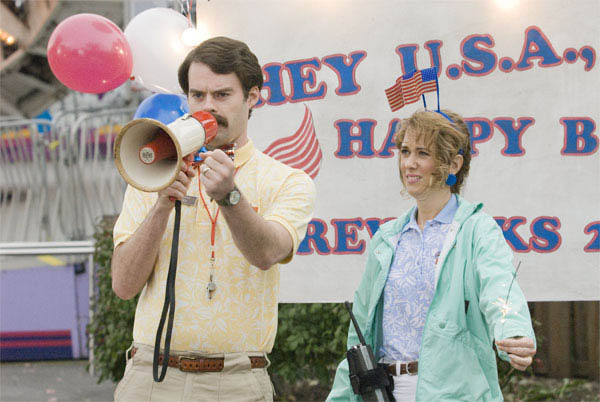
Jesse Eisenberg) did have plans to travel Europe over the Summer before proceeding with his studies, but his family's economic situation means his little entitlement parachute has developed a leak. He has to find a job with no discernible work-skills and a major that doesn't really translate to employment ("unless you're restoring a fresco or something"), so he takes a crappy job—"doing the work of lazy, pathetic morons" says work-pal Joel (Martin Starr)—as a carny at a Pittsburgh amusement park, Adventureland, run by Bobby (Bill Hader) and Paulette (Kristen Wiig).

The park is crap-tastic, and so is the job and its meager paycheck. Plus, there are the kids, their duplicitous parents, the punks, the vomit from the rides, the usual breakdowns in equipment and communication and the intrigues that go on behind the scenes.
But the joys are the usual ones in work-settings—the people can be pretty interesting and take you out of your dull comfort zone and into another dull comfort zone that's initially pretty interesting. James is a geeky virgin (and yes, the main story plays like a more respectful version of those lame teen-deflowering comedies from the time-frame of this film, the 80's), but he has a summer's supply of good weed, he's smarter than your average carny, so he sticks out among the usual loser-drones milling about the place. 
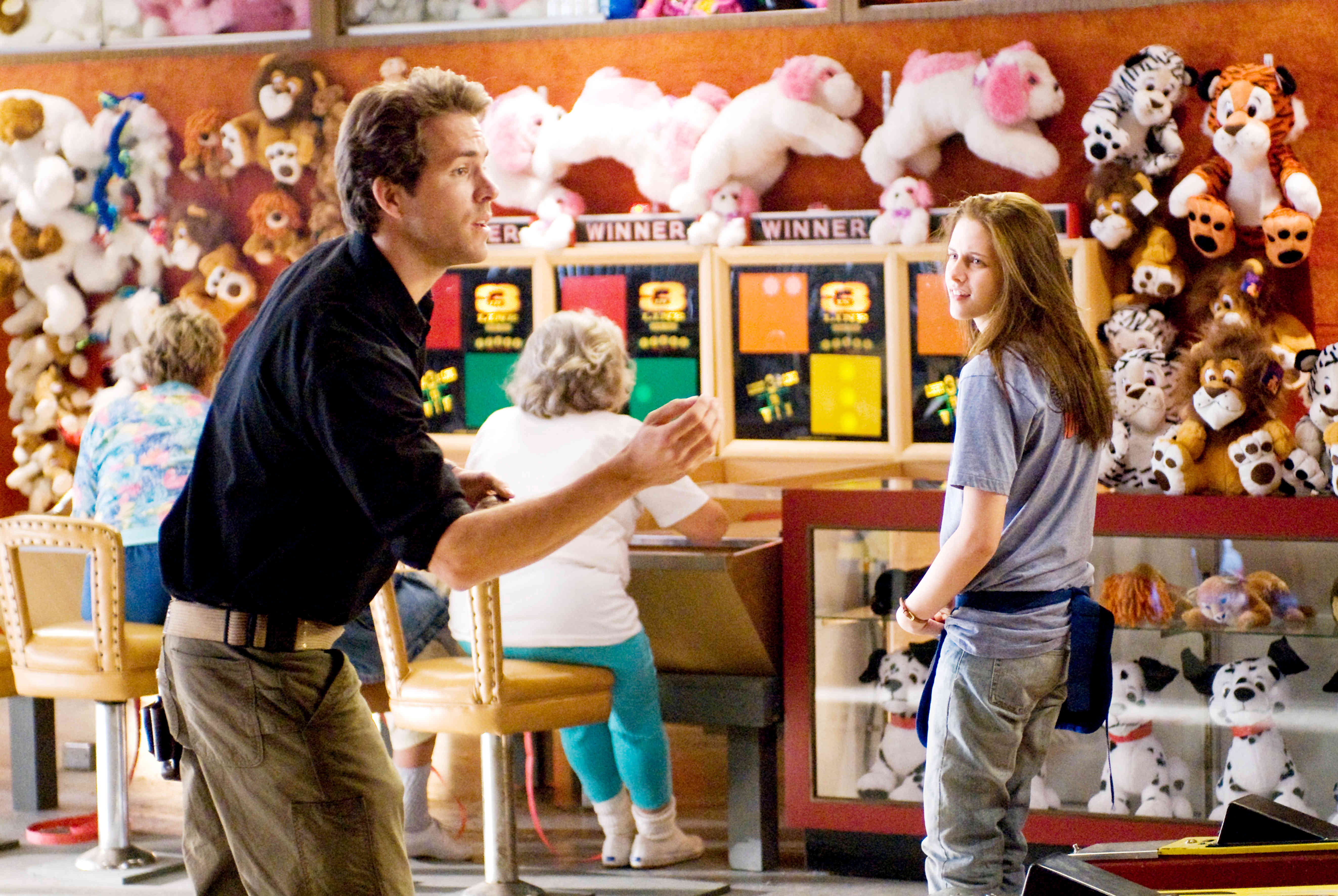
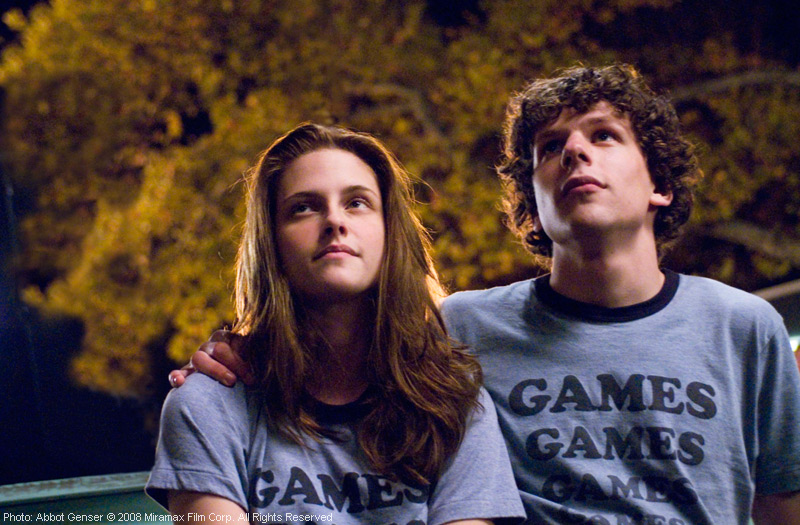
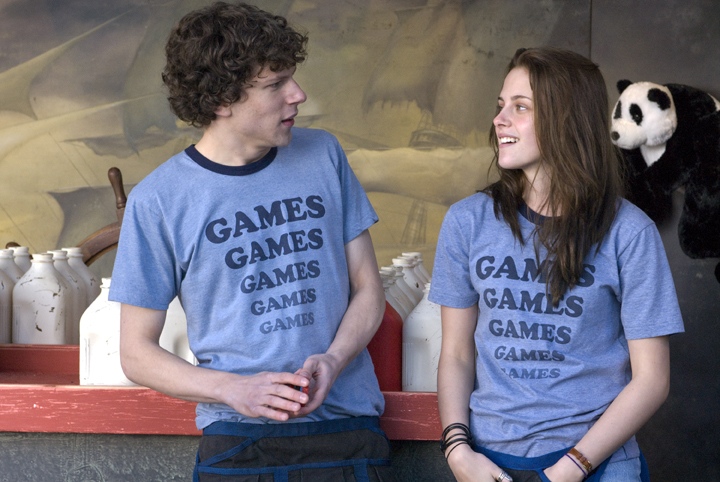
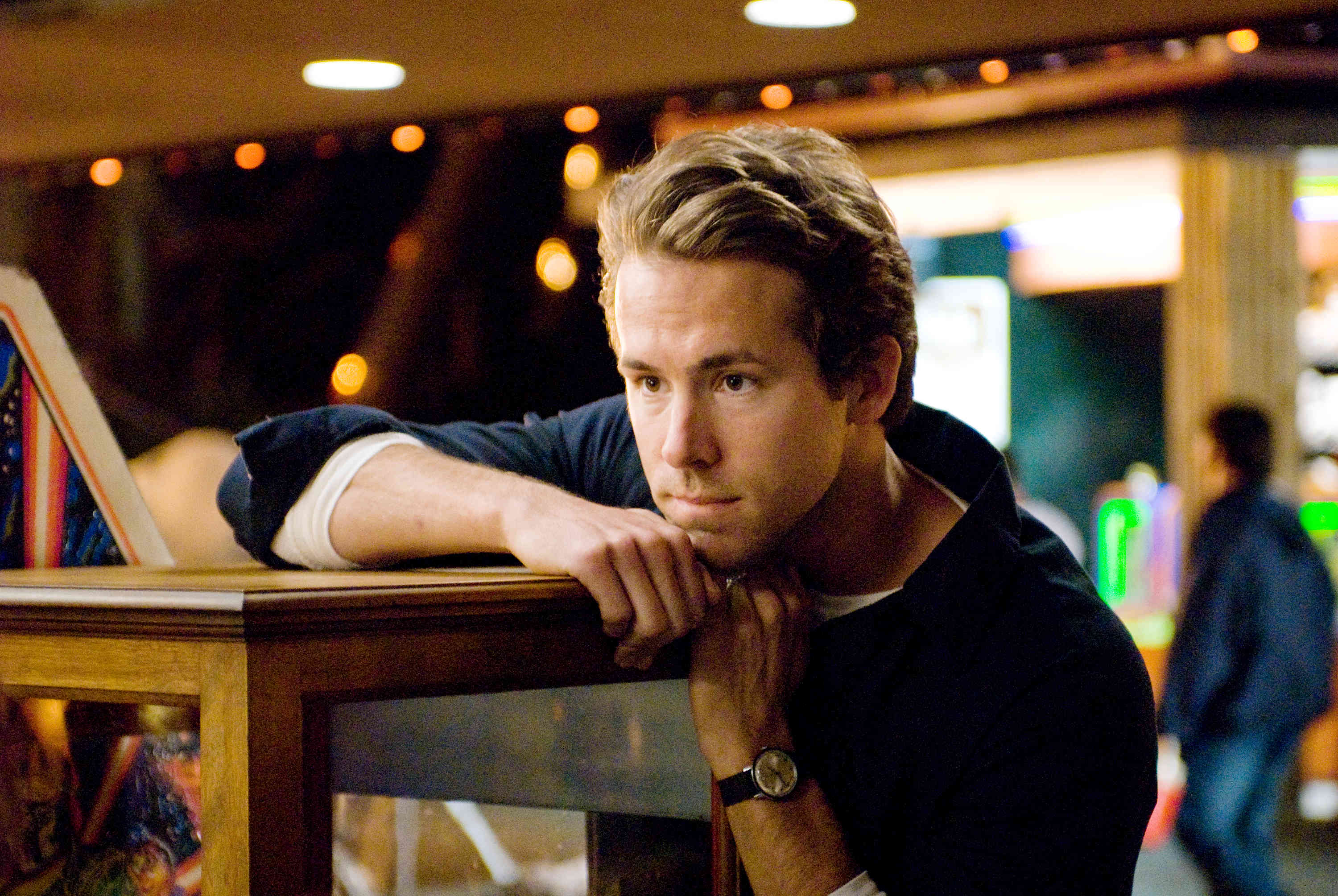
Folks like Frigo (Matt Bush), James' arrested development neighbor,* Connell (Ryan Reynolds), the mechanic who hasn't quite matured yet, the afore-mentioned Joel—smart as a whip and dull as a doorknobLisa P (Margarita Levieva), the self-absorbed knock-out, and Em Lewin (Kristen Stewart), troubled slacker-chick. Brennan and Em start a spastically friendly courtship that spills over into one of those deadly earnest mis-matches that raging hormones have trouble steering clear of. But it's helped that Eisenberg and Stewart are two polar opposites acting: he is quick-silver fast, while maintaining a deadly funny dead-pan throughout; she's unfocused and just guarded enough to make her character interesting.
Because it's semi-autobiographical, it's very male-centric, so that the guys are quirky and nuanced while the women are fascinating unfathomables, pedestaled and superficially drawn. But Mottola gets the work-place vibe right, especially in that first post-curfew touch of responsibility mixed with slacker-freedom that makes one think the pain of growing up might be behind you. It has that sense of "new crowd" work-place tribalism that feels like community until something better comes along. And it's sweetly raunchy without getting too deep in the muck, though it's probably not for the kids. And anything with Wiig and Hader in it is worth watching.
* Did I mention that Mottola directed a few episodes of the late, lamented "Arrested Development?" That helps explain the somewhat dead-pan tone of the thing.